
Quick Answer
Septic system terms are the specialized vocabulary used to describe the components, processes, soil tests, and maintenance procedures that make up onsite wastewater treatment systems. This glossary covers more than 60 definitions - from the scum layer in your tank to the percolation test your installer ran before breaking ground.
💡 Key Takeaways
- Roughly 21 million U.S. households rely on septic systems - that's about 1 in 5 homes, according to the EPA.
- Many terms vary by region: what Northeasterners call a "leach field," engineers call a "soil treatment area."
- A working knowledge of septic vocabulary helps you read inspection reports, compare contractor quotes, and avoid costly misunderstandings.
- The EPA recommends pumping most systems every 3–5 years; ignoring that timeline risks a $10,000–$30,000 replacement.
- Terms marked (alt.) indicate regional or regulatory alternate names for the same concept.
What Are the Main Parts of a Septic System?
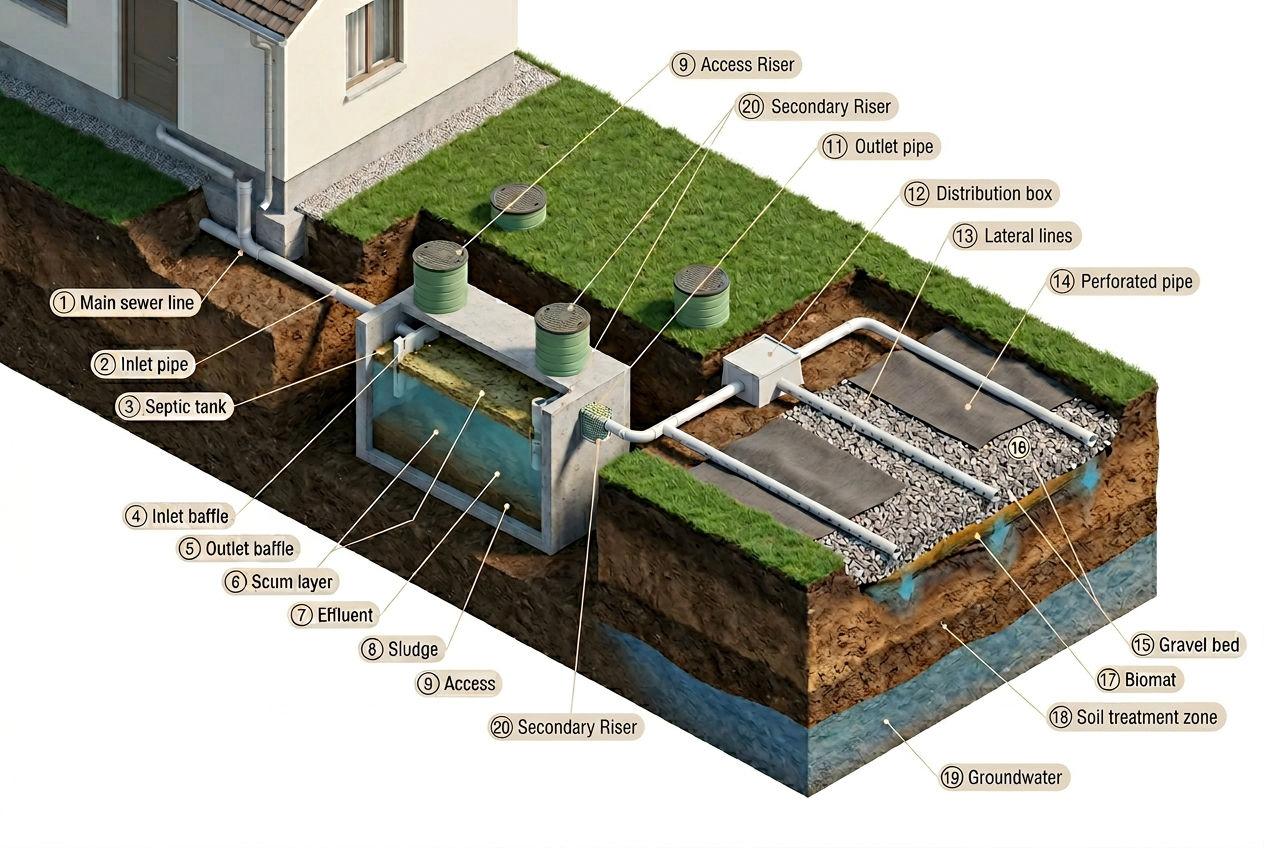
A conventional septic system has three core components: the septic tank (a buried concrete or plastic vault that separates solids from liquid), the distribution box (which splits effluent flow to multiple drain lines), and the drain field (a network of perforated pipes in gravel-filled trenches where liquid waste filters into soil). Understanding these three parts - and how big a system you need - unlocks every other term in this glossary.
For a full system overview, read What Is a Septic System?. To compare different designs, see our guide to types of septic systems.
What Are the Most Important Septic System Terms to Know?
Most homeowners never need to memorize all 60+ definitions here - but a handful come up constantly:
- Effluent - partially treated liquid leaving the tank
- Scum layer - floating fats and oils at top of tank
- Sludge - settled solids at bottom of tank
- Baffle - flow control walls inside the tank
- Perc test - soil absorption rate measurement (full guide, cost breakdown)
- Drain field - network of pipes dispersing treated water into soil
✅ Pro Tip: Knowing what your inspector or contractor means when they use those six words saves you from nodding along and agreeing to work you don't understand.
If you're choosing a septic service company, fluency in these terms gives you a real edge in evaluating quotes.
The sections below define all of them, plus dozens more, in plain language. If you want to see how these terms appear in a real inspection report, our septic inspection guide walks through a sample form line by line. Buying a home? Our septic inspection checklist for home buyers pairs perfectly with this glossary.
Septic System Terms, Definitions, and Meanings: The Complete A–Z Guide
Septic terminology is not standardized nationwide - regulations are set at the state and county level, so the same component may carry different names depending on where you live. You'll find that in Massachusetts, engineers refer to a "soil absorption system" in the same breath that a Texas contractor calls it a "drip irrigation field." Each entry below cross-references common alternate names so you're covered regardless of where you're reading an inspection report or permit application.
Before You Dive In
📊 Quick Fact: Two things you can do today before reading further - pull out your most recent inspection report (or request one from your county health department if you've never seen it) and highlight every term you don't recognize. Then use this glossary to decode them one by one.
By the time you finish, you'll be able to have a real conversation with your pumper or installer - not just nod along.
A
Absorption Field (alt.) - See Drain Field. Common in regulatory and engineering documents. Some state health codes use it exclusively.
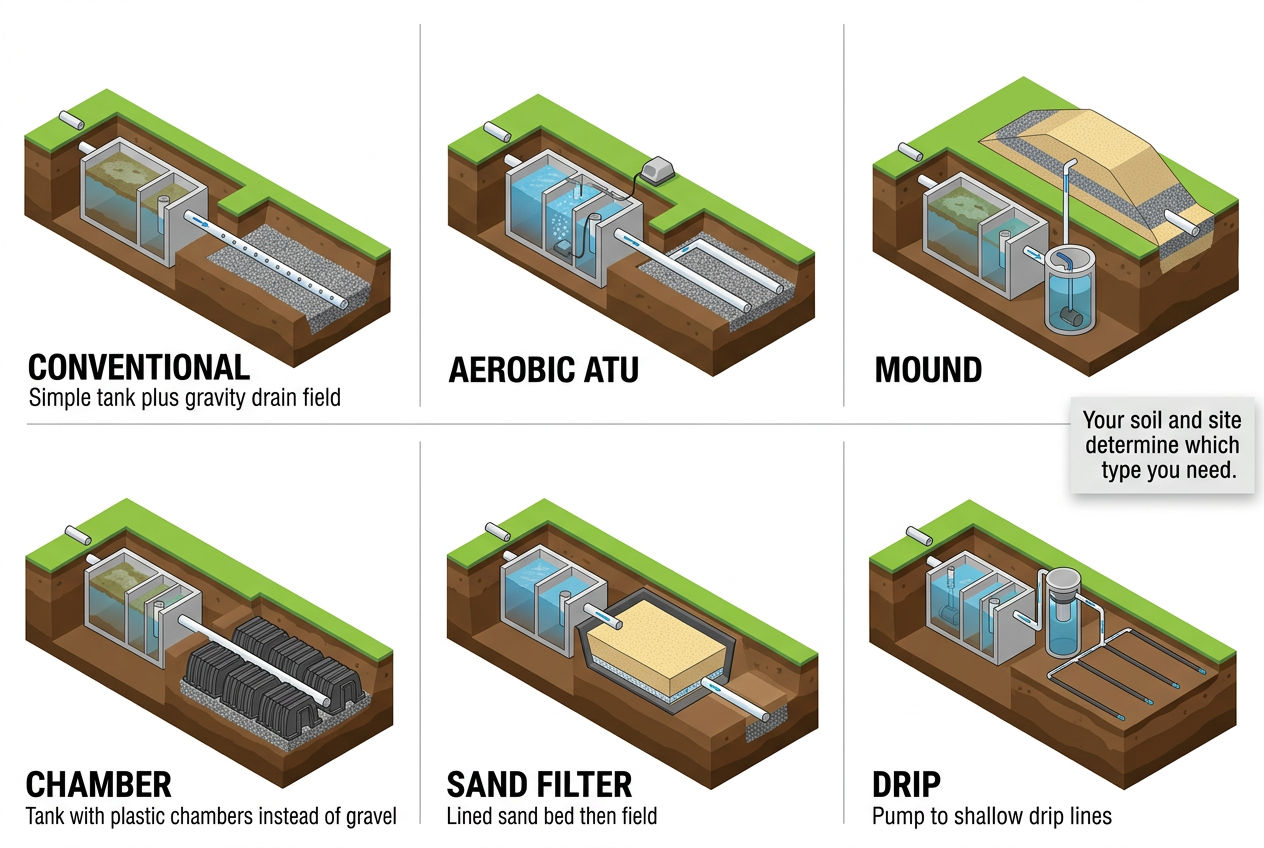
Aerobic Treatment Unit (ATU) - A system that injects air into the treatment tank to promote aerobic (oxygen-using) bacteria. Key advantages: ATUs treat wastewater more thoroughly than conventional anaerobic tanks, producing clearer effluent suitable for surface spray disposal. They're more common in Texas, the Ozarks region, and coastal areas with strict discharge rules. See our aerobic septic system cost breakdown.
⚠️ Warning: ATUs require a service contract (septic alarm guide) in most states - plan on $150–$400/year for mandatory inspections.
For a detailed comparison, read aerobic vs. anaerobic septic systems.
Anaerobic Digestion - The breakdown of organic waste by bacteria that thrive without oxygen. This is the primary process inside a conventional septic tank. Slower than aerobic digestion but requires no electricity or aeration equipment. See how septic systems work for more on this process. Some products claim to boost this process - read do septic additives work? and do septic tank treatments actually work? before spending money on additives.
At-Grade System - A system where the drain field is installed at ground surface rather than buried in a trench. Used in shallow-bedrock areas common in New England and Appalachia where digging deep trenches isn't possible. At-grade systems are one of several engineered septic system designs.
B
Backflow - Wastewater flowing back toward the house instead of forward into the tank or field. Usually caused by a blockage or hydrostatic pressure. If you see sewage backing up into your lowest drains, backflow is the likely culprit. Gurgling sounds are a common early sign.
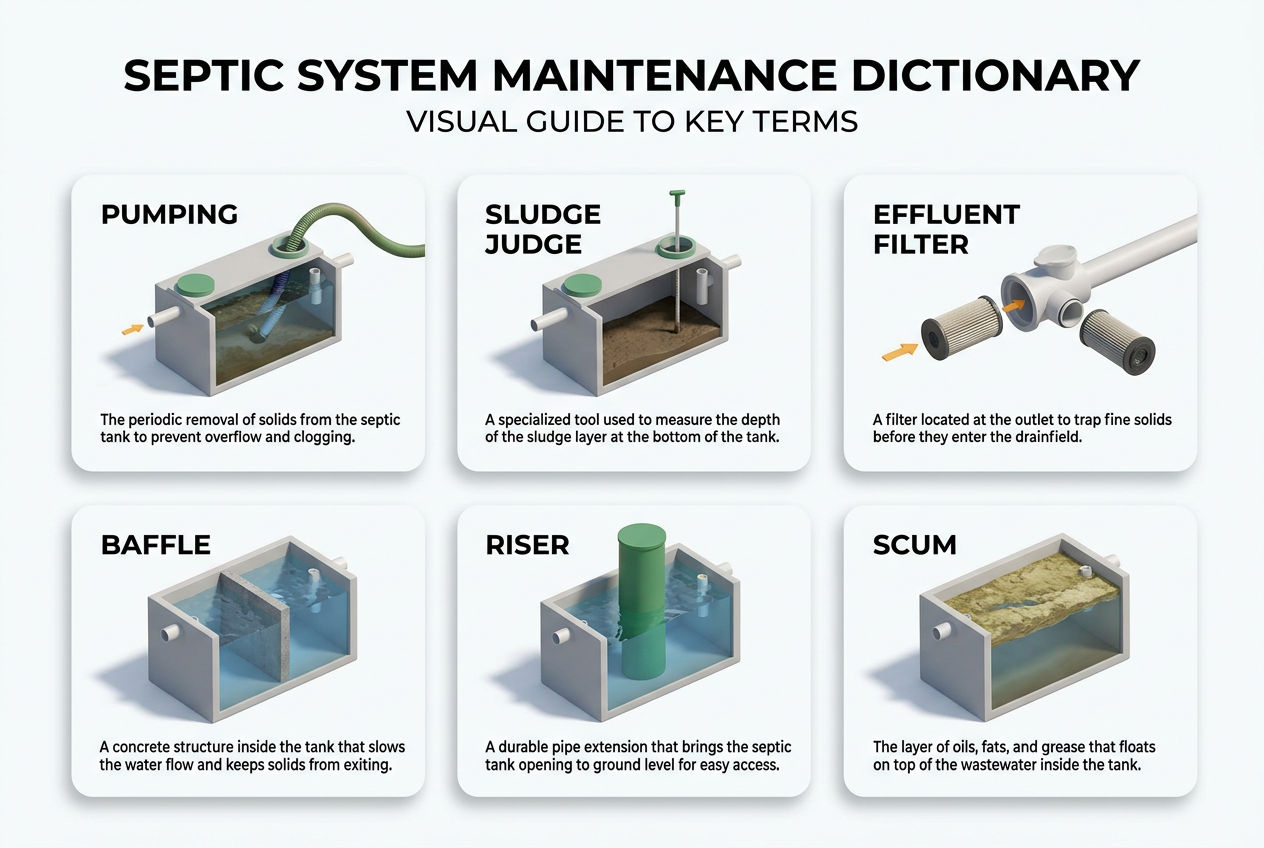
Baffle - A wall or partition inside the septic tank that controls the direction and speed of flow. See our baffle repair guide for signs yours needs attention.
| Baffle Type | Function | Failure Consequence |
|---|---|---|
| Inlet baffle | Slows incoming wastewater so it doesn't disturb settled solids | Turbulence stirs up sludge |
| Outlet baffle | Prevents scum and sludge from escaping into drain field | Solids clog field, accelerate failure |
💡 Key Takeaway: When a baffle fails - common in older concrete tanks - solids reach the drain field and accelerate system failure. Replacement costs run $150–$500; see our septic repair cost guide for more.
Biofilm - A thin layer of microorganisms that forms on drain field pipe walls and soil particles. Healthy biofilm is normal and aids treatment. Excessive biofilm - called "biomat" - clogs soil pores and signals a failing drain field.
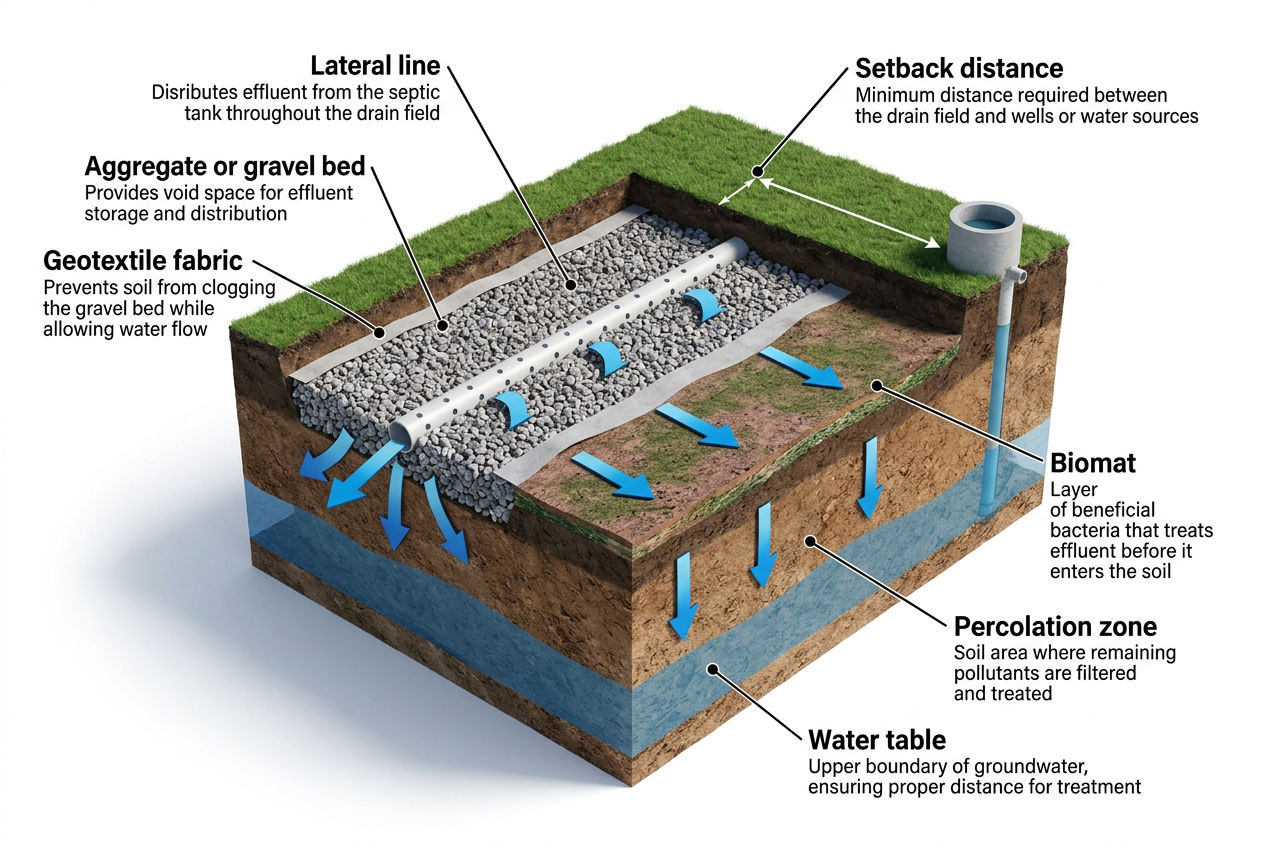
Biomat - See Biofilm. For a detailed look, read our septic biomat guide. A thick, gelatinous layer of biological matter that blocks the interface between drain field gravel and native soil. The most common cause of drain field failure. Once a true biomat forms, resting the field or replacement are often the only fixes.
Black Water - Wastewater from toilets. Contains pathogens and requires full treatment in the septic tank before dispersal. Know what you can and can't flush to protect your system - and choose the best toilet paper for septic systems to minimize solid buildup. Contrast with Gray Water.
C
Cesspool - An older system consisting of a covered pit or vault that receives raw sewage. Unlike a septic tank, it has no treatment stage - liquids seep directly through the pit walls into surrounding soil.
📊 Quick Fact: Cesspools are still in active use on Long Island, NY and parts of Hawaii but are being phased out due to groundwater contamination risk. Most states prohibit new cesspool construction.
Chamber System - A drain field that uses large plastic arch-shaped chambers instead of gravel-filled trenches. Infiltrator Water Technologies is the dominant manufacturer. Benefits include:
- Less excavation required
- Easier to install in tight sites
- Can handle higher hydraulic loads
See drain field installation for more on modern field construction methods.
Cleanout - A capped pipe fitting that provides access to the sewer line between your house and the septic tank. Plumbers use it to snake blockages without digging. If you can't find your cleanout, it's typically 3–10 feet from the house foundation. Our guide to finding your drain field covers locating other buried components too.
Conventional System - The most common septic design: a tank + gravel-and-pipe drain field. Works well in areas with permeable soil, adequate lot size, and a water table at least 24 inches below the trench bottom. For installation costs, see our cost guide. Learn what the septic system installation process looks like step by step, and whether you can install a septic system yourself.
Curtain Drain (alt.: interceptor drain) - A trench filled with gravel and perforated pipe installed upslope of a septic system to intercept and redirect groundwater. Used in rocky, sloped terrain - particularly in New England and Appalachia - to prevent surface water from saturating the drain field.
D
Distribution Box (D-Box) - A small concrete or plastic box that receives effluent from the septic tank outlet pipe and divides it equally among drain field lateral lines.
⚠️ Warning: A D-box that's tilted, cracked, or buried in saturated soil will send all flow to one lateral, overloading it. Inspect the D-box at every pump-out.
Learn more in our distribution box guide.
Dosing Chamber (alt.: pump chamber, dosing tank) - A separate tank that holds treated effluent and pumps it to the drain field in timed doses rather than continuously. Used in pressure-dosed systems and mound systems. Keeps the drain field from flooding between uses.
Drain Field (alt.: leach field, absorption field, soil treatment area) - The network of perforated pipes and surrounding gravel or chambers buried in soil where effluent from the septic tank is dispersed and further treated.
Standard specifications:
- Trench depth: 18–36 inches
- Pipe diameter: typically 4 inches
- Lifespan: depends on soil type, loading, and maintenance
How long drain fields last varies widely by region and use. If your drain field is soggy, smelly, or backing up, see our guide on how to fix a saturated drain field. For sizing guidance, read drain field size guide.
E
Effluent - The partially treated liquid that flows out of the septic tank into the drain field. Wastewater enters the tank as a cloudy, raw mixture. After 24–48 hours of settling and anaerobic digestion, the clarified middle layer - that's your effluent - exits through the outlet baffle.
💡 Key Takeaway: Effluent still contains bacteria, nitrates, and some solids, which is why the drain field's soil treatment stage is critical.
Effluent Filter - A cartridge-style filter (full effluent filter guide) (common brands: Polylok PL-122, Zabel A1800) installed in the outlet baffle that screens solids before they reach the drain field. Clean it every 3–5 years during pump-outs.
✅ Pro Tip: A clogged effluent filter can back up your drains - but that's actually what it's designed to do. It's protecting your drain field, which costs far more to replace.
Effluent filters are a key part of keeping your septic system healthy.
Effluent Screen - See Effluent Filter.
F
Float Switch - An electrical switch inside a pump chamber that activates the effluent pump when liquid reaches a set level.
⚠️ Warning: A failed float switch can cause the dosing chamber to overflow or run dry. They're inexpensive ($25–$80) but require a licensed electrician or septic service tech to replace properly.
Frost Line - The maximum depth to which soil freezes in a given region.
| Region | Frost Line Depth |
|---|---|
| Minnesota | 42–60 inches |
| Tennessee | 12–18 inches |
| Northern states (avg) | 36–48 inches |
| Southern states (avg) | 6–12 inches |
Septic pipes above the frost line are vulnerable to freezing - read our guide on septic tank pumping in winter for cold-weather precautions. A thaw-out service call runs $1,500–$2,500.
G
Gray Water - Wastewater from sinks, showers, and laundry - everything except toilets. Gray water contains fewer pathogens than black water but still requires treatment. Know which products are septic-safe before sending them down the drain. Some jurisdictions allow separate gray water systems; most require it to enter the main septic system.
Grease Trap - A device installed before the septic tank (often under a kitchen sink) that captures fats, oils, and grease before they enter the system. Learn about grease trap services for maintenance schedules.
✅ Pro Tip: Residential grease traps are less common but useful in households that cook frequently with heavy oils - especially if you use a garbage disposal with a septic system. Clean grease traps every 1–3 months depending on usage.
H
High-Water Alarm - An audible or visual alert that activates when liquid in a pump chamber or ATU rises above a safe level.
⚠️ Warning: If your alarm activates, reduce water use immediately and call your service provider - don't reset it and ignore it. This may require emergency septic services.
The alarm exists because an overflowing pump chamber can push untreated effluent to the surface, causing septic system smells.
Hydraulic Loading - The volume of water entering a septic system per day, measured in gallons per day (GPD). Most county health codes size systems based on bedroom count: typically 150 GPD per bedroom.
💡 Key Takeaway: Exceeding design hydraulic loading - through a large family, water softener backwash, or frequent laundry days - accelerates drain field failure. Knowing your system's hydraulic loading limit is one of the most practical pieces of information a homeowner can have.
Ask your installer or find it on your original permit.
I
Infiltration - The movement of effluent from drain field trenches into surrounding native soil. Healthy infiltration depends on soil texture, structure, and biological activity.
Infiltration rates by soil type:
- Sandy soils: Fast infiltration
- Loam soils: Moderate infiltration
- Clay soils: Slow infiltration or failure
Infiltration rate is what a percolation test measures.
Inspection Port (alt.: inspection pipe, observation port) - A vertical pipe, typically 4–6 inches in diameter, extending from the drain field trenches to the surface. Allows inspectors to check liquid levels and soil saturation without excavating. Learn more about the full septic inspection process and inspection costs.
L
Lateral Line - A single perforated pipe within the drain field, running horizontally from the distribution box. Most drain fields have 2–6 laterals. Each lateral should receive equal flow; unequal distribution overloads some laterals while others stay dry.
⚠️ Warning: If one lateral fails, it's a warning sign - see signs your drain field is failing and our guide on how to repair a septic system.
Leach Field (alt.) - See Drain Field. Predominantly used in the Northeast and Midwest. For the full terminology breakdown, read drain field vs. leach field.
Loading Rate - The volume of effluent applied per square foot of drain field per day. Expressed as gallons per day per square foot (GPD/ft²).
| Soil Type | Allowable Loading Rate |
|---|---|
| Coarse sand | ~1.2 GPD/ft² |
| Medium sand/loam | ~0.6 GPD/ft² |
| Dense clay | ~0.2 GPD/ft² |
Engineers calculate this during system design using perc test or soil morphology data.
M
Maintenance Agreement - A service contract between a homeowner and a licensed septic contractor, typically required by the state for ATUs, drip irrigation systems, and other advanced treatment systems.
What it covers:
- Scheduled inspections
- Filter cleaning
- Emergency response
Typical costs:
- ATUs: $150–$400/year
- Basic pump systems: $100–$250/year
Not sure who pumps septic tanks in your area? Our guide covers how to find and vet the right company.
Mound System - An engineered drain field built above native ground level using imported sand fill. Used when the water table is too high or the soil is too dense for conventional trenches. The effluent pump pushes dosed effluent up into the mound.
Common locations: Wisconsin, Minnesota, and coastal areas with seasonal high water tables.
Installation costs: $10,000–$20,000 depending on size. See our septic system cost guide for a full breakdown of installation pricing by system type.
N
Nitrate - A nitrogen compound produced when bacteria break down organic waste. Septic effluent carries nitrates into groundwater, where high concentrations (above 10 mg/L) are a health concern - especially for infants.
📊 Quick Fact: Conventional septic systems don't remove nitrates. Advanced systems with denitrification stages (common in nitrogen-sensitive coastal zones like Cape Cod and the Chesapeake Bay watershed) do.
O
Onsite Wastewater Treatment System (OWTS) (alt.: on-lot system, decentralized system) - The regulatory term for any system that treats and disperses household wastewater on the property where it's generated.
Encompasses:
- Conventional septic systems
- ATUs
- Mound systems
- Alternative designs
OWTS is the term you'll see in state health code documents and EPA guidance. If you're comparing bids from contractors and one uses OWTS while another says "septic system," they mean the same thing. If you're buying rural property, understanding these systems is essential. Check whether homeowners insurance covers septic repairs before closing.
P
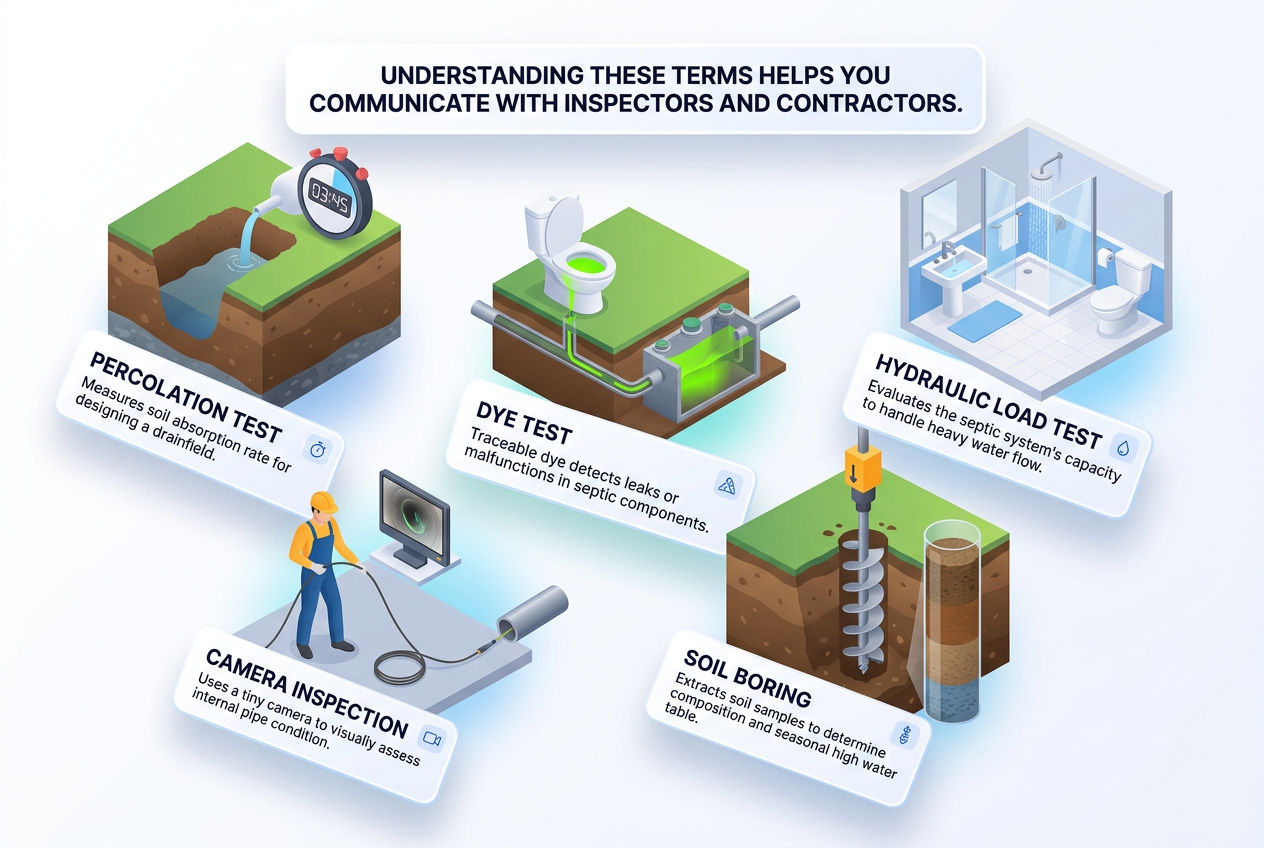
Percolation Test (alt.: perc test) - A field test that measures how quickly water absorbs into soil. A hole is dug to trench depth, saturated with water, and timed as the water level drops. Results are expressed in minutes per inch (MPI).
Acceptable perc rates:
- 1–60 MPI: typically acceptable for conventional systems
- Faster or slower: requires special design or alternative systems
✅ Pro Tip: Your county health department keeps perc test results on file - call and ask for your property's records before paying for a new test.
Perforated Pipe - Drain field pipe with small holes or slots along its length that allow effluent to seep into surrounding gravel and soil.
Standard specifications:
- Diameter: 4 inches
- Material: PVC or ABS plastic
- Maintenance: Inspect for root intrusion every 5–7 years in areas with mature trees
Pressure Distribution System - A drain field where effluent is pumped under pressure through small-diameter pipes with orifice holes, ensuring even distribution across all laterals simultaneously. Reduces the overloading of individual laterals that gravity systems are prone to. Required by Wisconsin, Oregon, and California in many soil conditions.
Primary Treatment - The first stage of wastewater treatment, occurring inside the septic tank. Physical separation of solids (sludge and scum) from liquid (effluent). No biological treatment at this stage - just settling and flotation.
⚠️ Warning: The clarified effluent that exits is still far from clean. Chemical drain cleaners like Drano can disrupt this process - read can you use Drano with a septic system? before pouring anything down your drains.
Pump Chamber - See Dosing Chamber.
R
Reserve Area - A section of the lot designated - and legally protected - for a future replacement drain field. Most counties require homeowners to maintain a reserve area equivalent to 100% of the primary field.
⚠️ Warning: Building a deck, driveway, or shed on your reserve area voids it and may make your property unsellable until you establish a new one.
Check your original permit to confirm its location. Learn what can and can't go over a drain field.
Riser - A vertical pipe extension that brings a septic tank access lid to or near ground surface. Without risers, pumpers have to dig down to access the tank at every service call - at $50–$200 per hour for excavation labor, that adds up.
✅ Pro Tip: If your pumper has to dig each time, ask them about adding risers at the end of the service call. Most cost $200–$500 installed and pay for themselves in 2–3 pump-outs.
See our complete septic tank risers guide for installation details.
S
Secondary Treatment - Treatment that occurs in the drain field (or in an ATU) after primary treatment in the tank. Biological and physical processes in the soil remove pathogens and further reduce organic matter. The combination of primary + secondary treatment is what makes conventional septic systems functional without a connection to a municipal plant.
Septic Tank - A watertight buried container - typically concrete, fiberglass, or polyethylene - that receives all household wastewater and separates it into three layers: scum (top), effluent (middle), and sludge (bottom).
Standard sizes: 1,000–1,500 gallons for residential use.
💡 Key Takeaway: The tank doesn't treat wastewater so much as it prepares it for treatment in the drain field.
For pumping schedules, see:
- Septic tank pumping cost guide
- What to expect when getting your septic tank pumped
- How long a pump-out takes
Can you avoid pumping altogether? Our guide on cleaning a septic tank without pumping explains what works and what doesn't.
Setback - The minimum required distance between a septic system component and a property feature: well, stream, property line, foundation, or wetland.
Common residential setback requirements:
- 50 feet from a well
- 10 feet from a property line
- 20 feet from a foundation
⚠️ Warning: Violating setbacks can trigger costly system relocation and permit problems at resale.
If you're buying property with a well, see our well and septic system cost guide for full pricing.
Sludge - The heavy, settled layer of solid waste at the bottom of a septic tank. Composed of inorganic materials and bacterial byproducts that don't float or dissolve. Sludge accumulates at roughly 1–3 inches per year.
✅ Pro Tip: When it reaches within 12 inches of the outlet baffle, it's time to pump - use a sludge judge (an 8–10 foot acrylic tube with a check valve) to measure depth without opening the tank.
Watch for the 8 signs your septic tank needs pumping so you don't wait too long.
Sludge Judge - A clear acrylic tube, typically 8–10 feet long, with a check valve at the bottom. Lowered through the inspection port into the tank to sample sludge depth. If the sludge layer reads 12 inches or less from the outlet baffle bottom, schedule a pump-out.
✅ Pro Tip: Your pumper should show you the reading - if they don't, ask.
Scum Layer - The floating layer of fats, oils, and lightweight solids at the top of a septic tank. Grease, soap residue, and toilet paper fragments accumulate here. When the scum layer grows to within 6 inches of the outlet baffle, it risks passing into the drain field. Scum thickness is measured during inspection using a baffle probe.
Soil Morphology - The physical characteristics of native soil - color, texture, structure, and mottling - evaluated by a soil scientist or engineer as an alternative to a perc test.
What to look for:
- Mottled gray and rust colors indicate seasonal high water table
- Texture affects drainage rate
- Structure reveals water movement patterns
💡 Key Takeaway: Many states now prefer soil morphology evaluations over perc tests because they provide richer data. If your county allows it, a soil morphology evaluation may save you time and money on the permitting process.
Soil Treatment Area (STA) (alt.) - See Drain Field. The regulatory term preferred by many state environmental agencies, particularly in the Southeast and Mountain West. Emphasizes the soil's active role in treating effluent rather than simply receiving it.
T
Title 5 - Massachusetts's state septic system regulation (310 CMR 15.000), widely regarded as one of the strictest in the country. Title 5 requires a septic inspection before any property transfer.
⚠️ Warning: A system that fails Title 5 must be repaired or replaced before closing - often at the seller's expense.
The term has become shorthand in New England real estate for "septic inspection." Other states have equivalent regulations under different names: New Jersey's NJAC 7:9A, Wisconsin's SPS 383.
Time Dosing - A drain field delivery method where effluent is pumped in timed intervals (e.g., every 4 hours) rather than on demand. A timer controls the pump cycle regardless of tank liquid level.
Benefits:
- Ensures consistent, measured doses throughout the day
- Prevents feast-or-famine hydraulic loading
- Extends drain field lifespan
Common in pressure distribution systems.
Transfer Tank - An intermediate holding tank between the primary septic tank and the drain field, used when the field is uphill or far from the tank. The transfer tank collects effluent and a pump sends it to the distribution point.
📊 Quick Fact: Not the same as a dosing chamber, which meters doses on a schedule - a transfer tank simply moves effluent from point A to point B.
Trench - The excavated channel in a drain field that holds gravel, perforated pipe, and (in some designs) geotextile fabric.
Standard trench dimensions:
- Width: 18–36 inches
- Depth: 18–36 inches
- Length: 25–100 feet (depending on soil conditions and system design)
- Spacing: 6–10 feet center to center between parallel laterals
U
Ultraviolet (UV) Disinfection - A treatment stage, usually added after an ATU, that exposes effluent to UV light to kill remaining pathogens before discharge. Required in some coastal and environmentally sensitive zones where surface discharge is permitted.
Maintenance requirements:
- UV bulb: annual replacement ($50–$150)
- Quartz sleeve: quarterly cleaning
V
Vadose Zone - The unsaturated layer of soil between the ground surface and the water table. Septic drain fields are designed to operate entirely within the vadose zone, where air in soil pores enables aerobic bacteria to further treat effluent before it reaches groundwater.
💡 Key Takeaway: A seasonal high water table that rises into the drain field eliminates this treatment buffer - one of the primary reasons mound systems exist.
Vault Privy - A watertight underground chamber that collects sewage without any soil dispersal component - essentially a holding tank for a privy or outhouse. Still permitted in some rural western counties and national forest inholdings where conventional systems aren't feasible. Requires regular pump-outs, typically every 3–6 months depending on use.
W
Water Table - The underground level at which soil and rock are permanently saturated with water. Septic system design requires a minimum vertical separation - typically 24–48 inches - between the drain field trench bottom and the seasonal high water table.
📊 Quick Fact: If the water table is too high, effluent can't percolate through enough unsaturated soil for adequate treatment. Mound systems, at-grade systems, and drip irrigation systems are all engineered responses to high water table conditions.
Weeping Tile (alt.) - An older term for perforated drain pipe, still used in parts of Canada and the upper Midwest. Originally referred to short sections of clay pipe laid end-to-end with gaps between them for drainage. Modern "weeping tile" is perforated PVC - functionally identical to what the rest of the industry calls perforated pipe.
Comparing costs? Find septic professionals near you on SepticTankHub.
Related reading: how often pump septic tank.
How to Use This Glossary
Bookmark this page and reference it whenever you encounter unfamiliar terms in an inspection report, contractor estimate, or county permit application. If a contractor uses a term that's not here, ask them to define it - legitimate professionals expect the question and will respect you for asking.
For a complete overview of how these components work together, start with What Is a Septic System?. If you're comparing quotes or planning maintenance, our septic pumping cost guide and drain field guide put these terms into practical, dollar-figure context.
Free download
Free: the Septic Fridge Card — what to flush, what never to.
The Do / Don’t card the whole family can see, plus the Survival Kit: emergency flowchart, warning-sign decoder and pump-schedule card. One printable PDF.
Sources & Methodology
-
U.S. Environmental Protection Agency — A Homeowner's Guide to Septic Systems and the EPA's onsite wastewater treatment glossary. Primary source for standardized septic system terminology.
-
National Onsite Wastewater Recycling Association (NOWRA) — Industry-standard definitions for onsite wastewater treatment components, processes, and system types.
-
National Environmental Services Center (NESC) — Technical glossary and educational publications on septic system terminology for homeowners and professionals.
-
National Association of Wastewater Technicians (NAWT) — Professional certification program definitions and standardized terminology for septic system inspection and maintenance.
-
University of Minnesota Extension — Educational resources on septic system components, processes, and terminology used in homeowner guidance publications.
Need help with your septic system? Browse local septic companies in Georgia or North Carolina.
Was this article helpful?
Frequently Asked Questions
Recommended Resources
📖 Related Articles
- What Is a Septic System? How It Works (Visual Guide)
- What Is a Drain Field? (And How Does It Work?)
- Septic Tank Baffle Repair & Replacement: Costs, Signs of Failure, and DIY vs Pro
- Septic Tank Biomat: What It Is and When It's a Problem
- Septic Effluent Filters: Do You Need One?
- Aerobic Septic System (ATU) Cost: $10K–$20K Install (2026)
- Perc Test (Percolation Test): What It Is & How It Works
- How Much Does a Perc Test Cost? (2026 Pricing)
- Concrete vs Plastic Septic Tanks: Which Is Better?
- High Water Table and Septic Systems: What You Need to Know
- How Septic Tank Bacteria Work (And Why They Matter)
- Septic Tank Alarm Going Off? What It Means and What to Do
- Septic Tank Gurgling Sounds: Causes and Fixes
- Do Septic Tank Additives Actually Work? (The Science)
💰 Cost Guides
🔧 Services
Find Septic Professionals Near You
Compare licensed, verified septic companies by area — top county markets and cities below, or browse all 50 states.
County markets
Popular cities
