
Quick Answer
Learn about cleaning your septic tank without pumping for maintenance between scheduled service.
Septic tank maintenance is the routine process of pumping, inspecting, and protecting your septic system to prevent failures that cost $15,000–$30,000 to fix. Most households need a pump-out every 3–5 years, a professional inspection every 1–3 years, and consistent habits around water use and what goes down the drain. For a side-by-side look at our infographic on the true cost of septic ownership, which compares the full 30-year cost of maintenance vs. neglect.
Related: septic system glossary — worth reading if this applies to your situation.
Related: septic tank care for beginners
Related: septic tank maintenance products
Key Takeaways
📊 Quick Facts:
- The EPA recommends pumping your septic tank every 3–5 years for most households - more often with heavy use or a garbage disposal
- About 21 million U.S. homes (roughly 1 in 5) rely on septic systems - yet most owners never see the inside of their tank until something goes wrong
- A well-maintained system lasts 25–40 years; a neglected one can fail in 10–15 years
💰 Cost Reality:
- A standard pump-out costs $300–$600 nationally
- Skipping it risks a $15,000–$30,000 system replacement
- What you flush matters as much as how often you pump - grease, wipes, and harsh chemicals accelerate drain field failure
If you've never thought about your septic tank, you're not unusual - most homeowners only think about it the day the toilets back up or the yard starts smelling like a porta-potty in July. By then, the damage is already done.
Picture this: you're three months from closing on a home sale. The buyer's inspector runs a dye test, pulls the riser lid, and calls you over. The sludge layer is 18 inches deep. The drain field is showing signs of hydraulic overload. The sale stalls. You're now negotiating a $12,000 credit or losing the buyer entirely. That scenario plays out thousands of times a year across the country - and nearly all of it is preventable.
This guide gives you everything you need to keep your system running for decades. If you'd like to learn how septic systems work before diving into maintenance, that primer is a good starting point.
How Often Should a Septic Tank Be Pumped?
Most households need their septic tank pumped every 3–5 years. The EPA's SepticSmart program lists this as the baseline recommendation, but your actual schedule depends on tank size, household size, and daily water use. A 2-person household with a 1,500-gallon tank might go 7–8 years between pump-outs. A family of 6 with a 750-gallon tank may need service every 18 months.
💡 Key Takeaway: The industry standard threshold for pumping is when the combined sludge layer (bottom) and scum layer (top) together consume one-third of the tank's capacity. A licensed pumper uses a sludge judge - a clear acrylic tube - to measure both layers during a service visit.
Pumping Frequency by Household Size and Tank Size
Use the table below as a starting point. Add a garbage disposal and subtract roughly one year from each interval - disposals push significantly more solids into the tank. If you'd like a deeper breakdown, our guide on how often to pump a septic tank covers edge cases in detail.
| Tank Size | 1–2 People | 3–4 People | 5–6 People | 7+ People |
|---|---|---|---|---|
| 750 gallons | 4–5 years | 2–3 years | 1–2 years | annually |
| 1,000 gallons | 5–7 years | 3–4 years | 2–3 years | 1–2 years |
| 1,250 gallons | 7–8 years | 4–5 years | 3–4 years | 2–3 years |
| 1,500 gallons | 8–10 years | 5–7 years | 4–5 years | 3–4 years |
Source: EPA SepticSmart Program; data cross-referenced with NAWT service interval guidelines.
A typical family of four generates roughly 400 gallons of wastewater per day. At that rate, sludge accumulates approximately 1 inch per month in a 1,000-gallon tank. Do the math and it becomes clear why that 3–4 year window isn't arbitrary - it's a measured threshold.
What Does Septic Tank Maintenance Actually Cost?
Septic tank maintenance costs $200–$400 per year on average when you amortize routine pump-outs and inspections across a 5-year period. That sounds like a lot until you compare it to what neglect costs.
Realistic Cost Breakdown
| Service | National Cost Range | Regional Notes |
|---|---|---|
| Pump-out (1,000-gallon tank) | $300–$600 | Central Florida: $275–$375 Rural Minnesota: $350–$500 (longer drive times) |
| Professional inspection | $100–$300 | Annual for systems with pump chambers or aerators |
| Effluent filter cleaning | $50–$150 | Often included in pump-out (Polylok PL-122, Zabel A1800) |
| Drain field repair | $2,000–$10,000+ | Depends on damage extent |
| Full system replacement | $15,000–$30,000+ | Varies by system type and lot conditions |
💰 The Math Is Simple: Three pump-outs over 10 years at $500 each = $1,500. One drain field replacement = $5,000–$15,000 minimum. Maintenance wins every time.
See our septic pumping cost guide for current regional pricing and what's included in a full service.
What Are the Signs That Your Septic Tank Is Full or Failing?
A failing septic system almost always gives you warning before it collapses completely. The problem is that most homeowners don't recognize the early signals - or they dismiss them as plumbing quirks. Catch these signs early and you're looking at a pump-out. Miss them long enough and you're replacing a drain field.
Warning Signs to Watch For
- Slow drains throughout the house - not just one fixture (a single slow drain is a clog; multiple slow drains point to a full or failing tank)
- Gurgling sounds in toilets or drains after flushing or running water
- Sewage odors inside the home or near the tank/drain field area (a healthy system is nearly odorless)
- Wet, spongy ground or unusually lush, green grass over the drain field - effluent surfacing is a late-stage warning
- Sewage backup in the lowest fixtures of the home (floor drains, basement toilets) - this is an emergency
- Nitrate or coliform bacteria showing up in a well water test (contamination risk if well is within 100 feet)
⚠️ Warning: Late-1990s EPA literature estimated that 10–20% of septic systems in the U.S. are malfunctioning at any given time, often releasing partially treated or untreated sewage into groundwater. A failed system doesn't just cost money - it's a public health issue.
Our septic system failure guide goes deeper on diagnosis and next steps.
Can You Maintain a Septic System Yourself, or Do You Need a Professional?
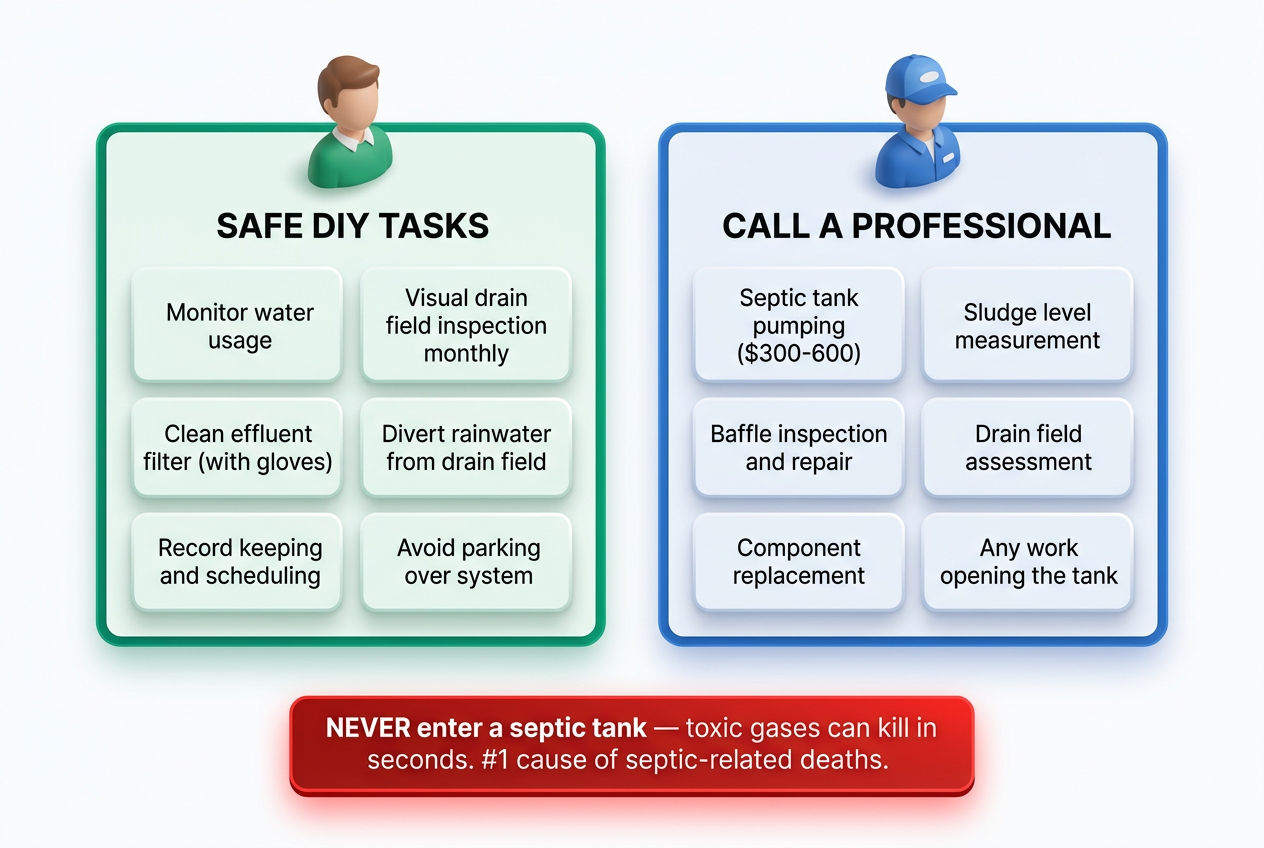
Some maintenance tasks are firmly in the DIY category. Others require a licensed contractor with equipment you don't own and, in many states, a regulatory mandate to use.
What You Can Do Yourself
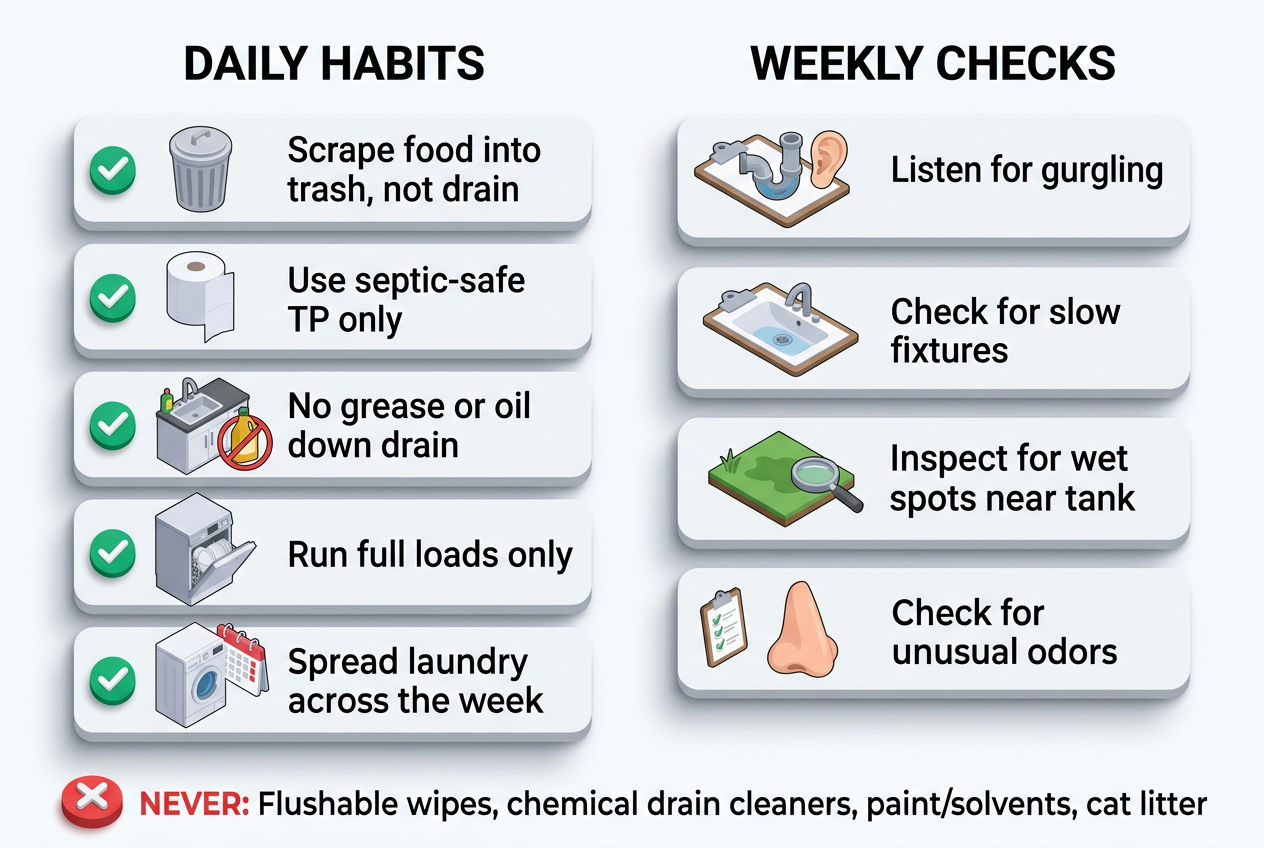
- Conserve water daily - spread laundry loads throughout the week instead of doing seven loads on Saturday; fix leaky faucets (a running toilet adds 200 extra gallons per day)
- Monitor drain field condition - walk the field periodically and look for wet spots, odors, and unusually green grass patches
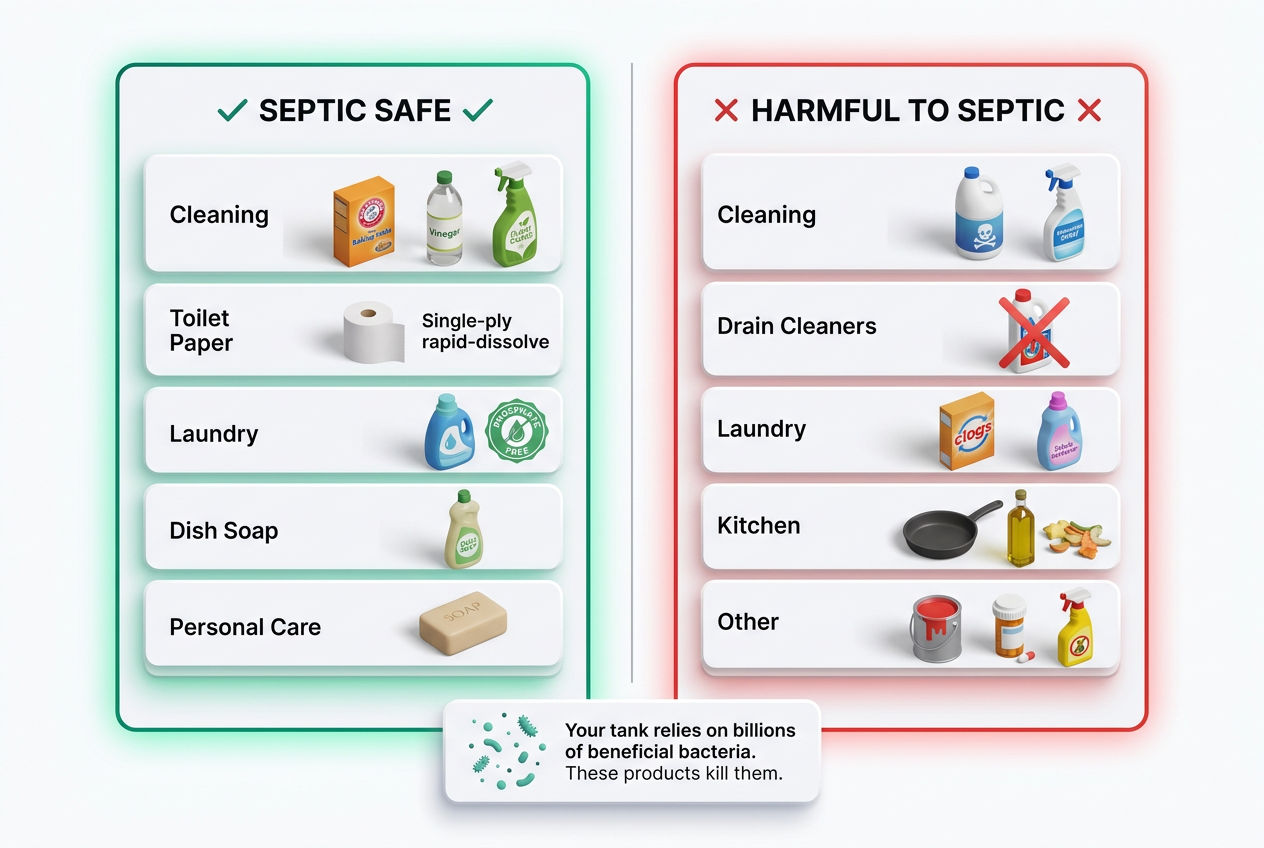
- Use septic-safe products - swap out antibacterial soaps, bleach-heavy cleaners, and chemical drain openers (our septic-safe products guide covers what's approved)
- Protect the system physically - don't park vehicles on the drain field; don't plant trees or shrubs near leach laterals (root intrusion is a leading cause of pipe damage)
- Keep records - note every pump-out date, inspection, and repair (this documentation is gold when you sell the home)
What Requires a Professional
✅ Pro Tip: You cannot legally pump a septic tank yourself in most states, and the waste must be transported to an approved disposal facility. Minnesota's MPCA, for example, requires licensed pumpers to file disposal manifests with the county after every service.
Professional-only tasks:
- Pumping - legal requirements and proper disposal
- Inspections - involves opening the tank, checking baffles, measuring sludge/scum layers, inspecting effluent filter, evaluating drain field
- Repairs - replacing distribution boxes, riser lids, baffle walls, or drain field laterals requires permits in most jurisdictions
- Aerobic system maintenance - systems with aerator compressors (like the Hiblow HP-80) require licensed service contracts for quarterly inspections in most states
Find a licensed septic professional in your area before problems escalate.
What Should You Never Put in a Septic Tank?
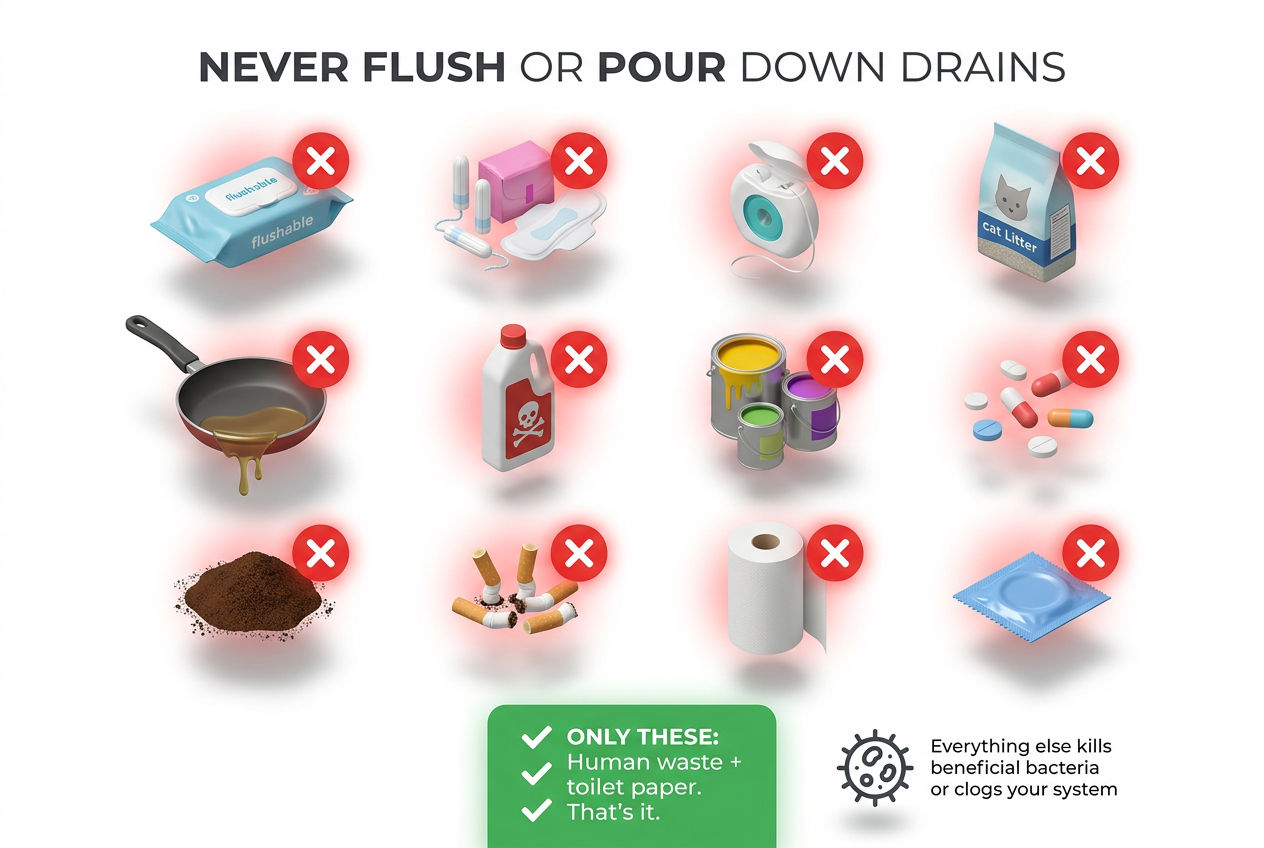
Your septic tank is a living biological reactor. The anaerobic bacteria inside it are doing the work of breaking down solids and treating effluent. Flush the wrong thing and you're killing the workforce.
Never Flush or Pour Down the Drain
Personal care & household items:
- "Flushable" wipes - they don't break down; they mat together and clog pump impellers
- Paper towels, feminine products, condoms, cotton swabs - none break down at the same rate as toilet paper
- Cat litter - even "flushable" varieties contain clay that does not break down
Kitchen waste:
- Grease, oil, and fats - hardens in the tank, builds up in the scum layer, can migrate into the drain field and permanently clog soil
- Coffee grounds - accumulate as inert solids
Cleaning & chemicals:
- Chemical drain cleaners (Drano, Liquid-Plumr) - contain lye or sulfuric acid that kills bacterial population (here's why Drano is incompatible)
- Bleach in large quantities - small amounts from laundry are fine; pouring a gallon to "sanitize" is not
- Paint, solvents, pesticides - hazardous waste that kills bacteria and contaminates groundwater
Medical & pharmaceutical:
- Prescription medications - pass through the system largely intact and contaminate groundwater
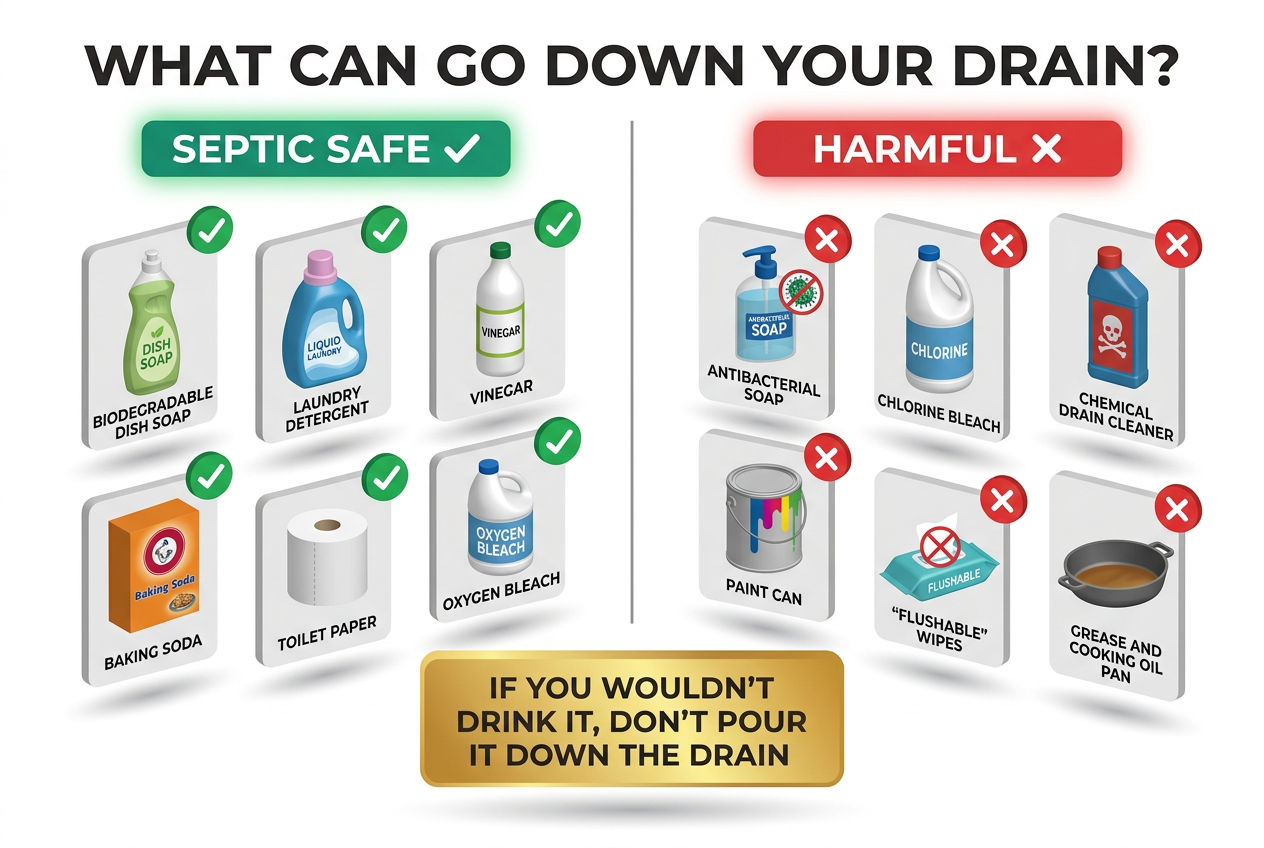
For a full breakdown of what's safe and what's not, see our guide on what you can flush with a septic system. We also have dedicated guides on best toilet paper for septic systems and whether to use a garbage disposal with a septic system.
Drain Field Maintenance: The Part Most Homeowners Ignore
Your drain field - also called a leach field - is where the final treatment of wastewater happens. Effluent from the septic tank flows through perforated distribution pipes into the surrounding soil, which filters and treats it before it rejoins groundwater. When the drain field fails, the whole system fails.
Most drain field damage is preventable. Understanding how your drain field works is the first step.
Drain Field Protection Guidelines
Do these things:
- Keep the area planted with shallow-rooted grass - grass roots help evapotranspiration and don't damage pipes
- Divert roof drains, sump pumps, and surface runoff away from the field - saturated soil can't treat effluent
- Know where your field is - get a copy of your system's as-built drawing from the county health department
Never do these:
- Park vehicles or heavy equipment on the field - even one pass from a riding mower over wet soil can compact the ground enough to reduce percolation
- Plant trees or shrubs within 30 feet of leach laterals - willow, poplar, and silver maple are especially aggressive
- Build structures - decks, sheds, patios - over any part of the system
- Install irrigation systems in or near the drain field area
⚠️ Regional Warning: In areas with clay-heavy soils - common across Ohio, Indiana, and much of the Midwest - drain fields are particularly vulnerable to compaction and hydraulic overload during wet seasons. A mound system or chamber system (using Infiltrator Water Technologies chambers) may be required in these conditions.
If your drain field is already showing signs of failure, get a quote before assuming the worst - our drain field replacement cost guide explains what drives pricing.
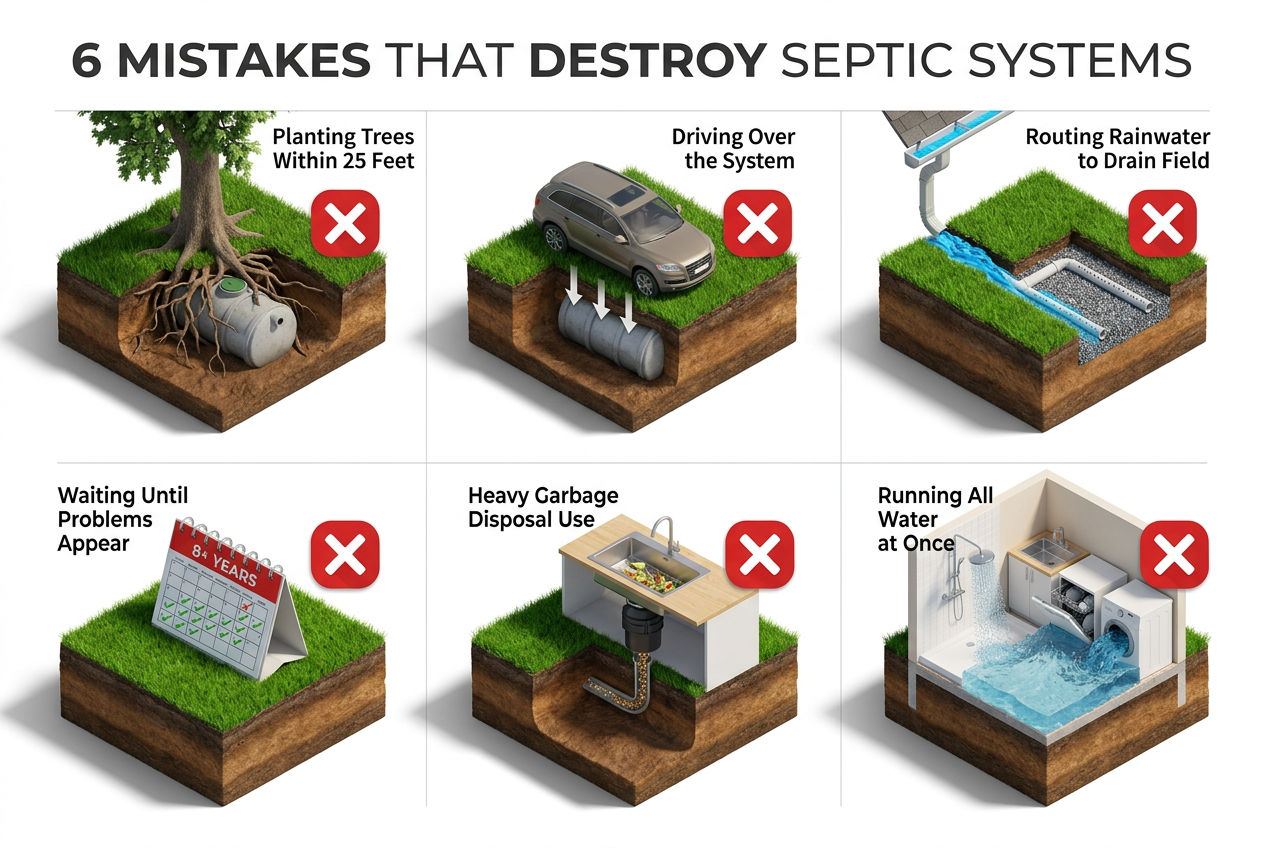
Do Septic Tank Additives Really Work?
Bacterial additives like Rid-X add live microbes to your septic tank, and the marketing makes them sound like a maintenance solution in a box. The reality is more nuanced - and the research is pretty clear.
📊 The Research Says: A peer-reviewed study from the University of Arkansas found that commercial bacterial additives did not significantly reduce sludge accumulation compared to untreated control tanks. The EPA's position is consistent: additives do not eliminate the need for pumping and should not replace routine maintenance.
When Additives Might Help
That said, bacterial additives aren't entirely useless. They may help reestablish biological populations faster after:
- A large dose of antibiotics
- System shock-loaded with bleach
- Period of very low use (vacation property sitting empty for months)
What Additives Cannot Do
- ❌ Reverse drain field clogging once biomat has formed
- ❌ Replace physical pump-outs (dead bacteria, inorganic solids, and non-biological waste still accumulate)
- ❌ Fix a failing system
- ❌ Compensate for putting the wrong things down the drain
If you're considering additives as part of a broader maintenance approach, our best septic tank treatment guide reviews the options honestly - including which ones have independent evidence behind them.
Seasonal Septic Maintenance: A Year-Round Calendar
Your septic system's needs shift with the seasons. Here's how to stay ahead of problems throughout the year.

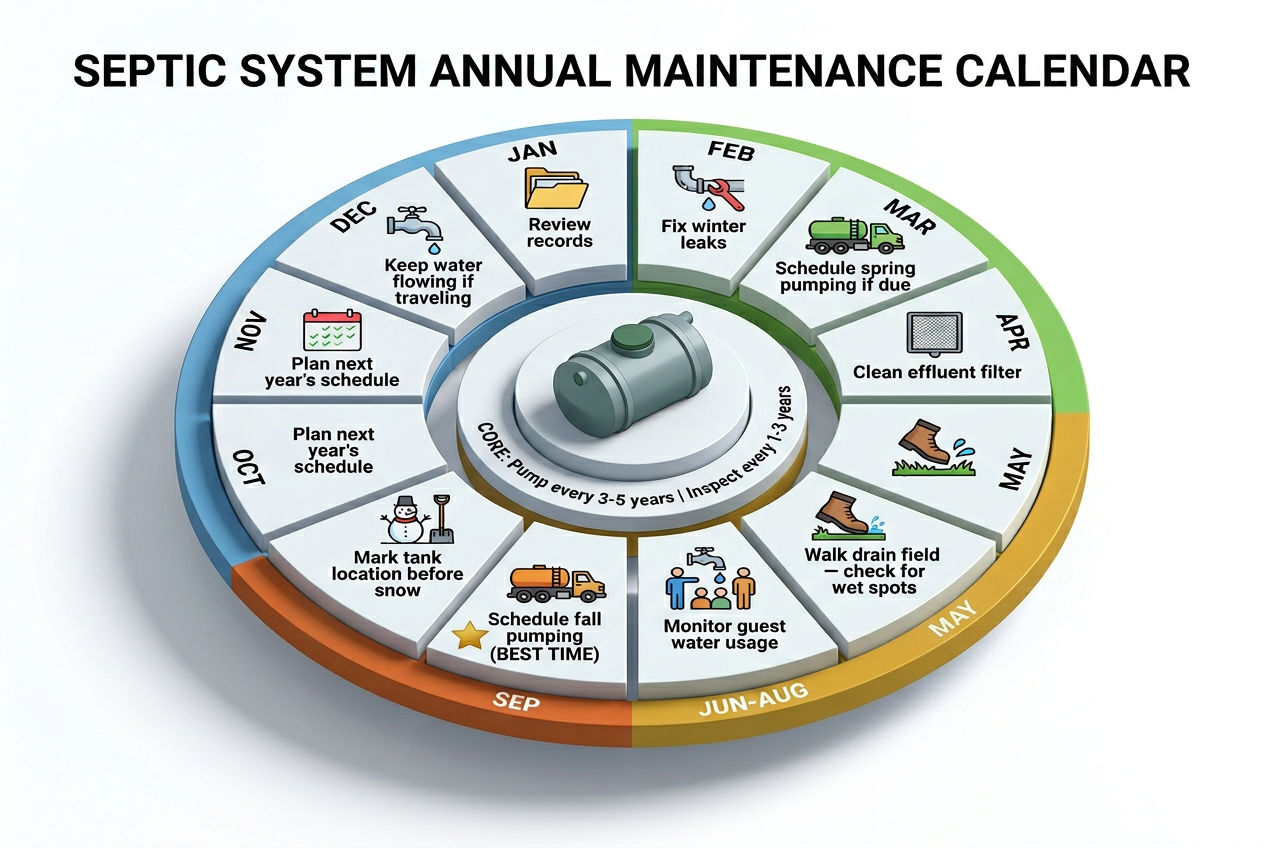
Spring: Prime Pump-Out Season
Spring is prime pump-out season. Ground thaws, access is restored, and service companies have more scheduling flexibility than in summer.
Key tasks:
- Schedule pump-out if overdue (before summer demand spikes)
- Inspect drain field for saturated soil or frost heave damage after wet winter
- Check riser lids and risers for cracking or displacement
Summer: Guest Season Load Management
Guest season means more water through your system. A family of four becoming a family of eight for two weeks is a real hydraulic load - 400 gallons per day becomes 800.
Key tasks:
- Stagger laundry loads
- Spread dishwasher usage throughout the day
- Remind guests that wipes don't go in the toilet
- Don't park on drain field during outdoor gatherings
- Avoid heavy water use during and after major storms (saturated soil slows percolation)
Fall: Last Chance Before Freeze
Fall is your last chance to pump before the ground freezes in northern states. If you're in Minnesota, Wisconsin, or upstate New York and you're due for a pump-out, don't wait until Thanksgiving guests arrive.
Key tasks:
- Schedule pump-out if needed before winter
- Check that tank covers are secure and insulated if in frost-prone area
- Final drain field inspection before snow cover
Winter: Freeze Prevention & Snow Management
In states where the frost line reaches 42–60 inches (most of the Upper Midwest and New England), the pipes connecting your house to the tank are the most vulnerable point.
Key tasks:
- Northern climates: Insulate first 10 feet of sewer line with rigid foam board (prevents $1,500–$2,500 emergency thaw-out)
- Keep snow cover over drain field intact (natural insulation)
- Avoid driving over snow-covered fields
- Southwest: Maintain consistent, moderate water flow rather than letting system sit idle (arid winters reduce bacterial activity)
How Long Does a Septic System Last with Proper Maintenance?
A well-maintained septic system lasts 25–40 years. Concrete tanks and cast-iron components can last longer with proper care. Neglected systems often fail within 10–15 years - sometimes sooner if the drain field is abused.
💡 Key Insight: The limiting factor is almost always the drain field, not the tank itself. Once biomat (a layer of organic slime and bacteria) permanently clogs the soil pores in a leach field, no amount of pumping or additives restores permeability.
Impact on Property Value
A failed septic system can reduce a property's value by 10–25% and can halt a home sale entirely in states with mandatory inspection requirements:
- Massachusetts Title 5 is one of the strictest - requires full inspection before any property transfer
- Other states with transfer-of-ownership inspection requirements have similar impacts
✅ Pro Tip: If you're planning to sell in the next 5 years, getting a septic inspection now gives you time to address any issues on your timeline, not the buyer's.
The bottom line: maintenance is not optional. It's a 25-year investment strategy.

Regional Considerations: Regulations Vary Significantly
Septic regulations are not federal - they're state and county-level, and the variation is enormous. What's legal in one county may require a permit in the next.
State-by-State Snapshot
Florida:
- Requires all contractors to hold Registered Septic Tank Contractor (RSTC) license through Department of Health
- High water tables in South Florida mean more frequent inspection needed
- Tanks with minimal clearance above water table year-round are under more stress
- Find a licensed Florida professional familiar with local water table conditions
Massachusetts:
- Operates under Title 5 - one of the country's most rigorous septic regulations
- Mandatory inspection on property transfer
- Required documentation and strict design standards make DIY approaches impractical
Texas:
- Delegates septic regulation to county-level Designated Representatives
- Significant variation across the state
- Requirements in Travis County may differ from Bexar County
Pacific Northwest (Washington, Oregon):
- Heavy annual rainfall saturates soils for months
- Mound systems common (standard drain fields can't achieve adequate separation from seasonal high water table)
- Environmental regulations near waterways and salmon habitat are especially strict
Southwest (Arizona, New Mexico):
- Arid conditions and high temperatures reduce bacterial activity and accelerate evaporation
- Expansive soils can shift concrete tanks enough to crack inlet and outlet connections
✅ Pro Tip: Regardless of where you live, find a licensed septic contractor who knows your local code before scheduling any service. A professional who operates regularly in your county will know the permit requirements, soil conditions, and local inspectors.
Your Septic Tank Maintenance Checklist
Use this checklist to stay on schedule. Adapt the intervals based on your household size and tank capacity.
Every Month
- Avoid flushing non-biodegradable items
- Spread laundry loads through the week
- Check for slow drains or gurgling sounds
Every 6 Months
- Inspect the drain field visually (wet spots, odors, lush grass)
- Check riser lids are secure and sealed
- Test well water if your well is within 100 feet of the system
Annually
- Professional inspection for systems with pump chambers or ATUs
- Effluent filter cleaning (Polylok PL-122, Zabel A1800, or similar)
- Review water use patterns and fix any leaks
Every 3–5 Years
- Professional pump-out (adjust per the frequency table above)
- Full system inspection including baffle condition, distribution box, and drain field evaluation
- Update maintenance records
As Needed
- After any household product changes, review septic-safe compatibility - see our guide on septic-safe products
- After heavy rainfall seasons, inspect field drainage
- Before selling a home, get a certified inspection
Learn more about our septic pumping services.
Sources & Methodology
This guide was developed using data from the following primary sources:
- U.S. Environmental Protection Agency - SepticSmart Program: Core pumping frequency guidelines, system failure statistics, and groundwater contamination data.
- National Association of Wastewater Technicians (NAWT): Service interval standards and inspection protocols referenced in the pumping frequency table.
- University of Arkansas Cooperative Extension Service: Peer-reviewed research on the efficacy of bacterial additives in residential septic systems.
- Minnesota Pollution Control Agency (MPCA): State-specific regulatory requirements for licensed pumpers, including disposal manifest requirements.
- Florida Department of Health: Contractor licensing requirements for Registered Septic Tank Contractors (RSTCs).
Cost data reflects national averages reported by licensed septic service companies across multiple regions. Regional cost variations are based on aggregated service data and publicly available contractor pricing.
Free download
Not ready for the Handbook? Start with the free Fridge Card.
The Do / Don’t card the whole family can see, plus the Survival Kit: emergency flowchart, warning-sign decoder and pump-schedule card. One printable PDF.
Was this article helpful?
Frequently Asked Questions
Recommended Resources
📖 Related Articles
- What Is a Septic System? How It Works (Visual Guide)
- How Often Should You Pump Your Septic Tank?
- How to Keep Your Septic System Healthy
- Septic-Safe Products: What to Use (and What to Avoid)
- Can You Use Drano with a Septic System?
- What Can You Flush with a Septic System? (Tampons, Wipes & More)
- What Is a Drain Field? (And How Does It Work?)
- Do Septic Tank Treatments Actually Work?
💰 Cost Guides
📍 Find Local Pros
Find Septic Professionals Near You
Compare licensed, verified septic companies by area — top county markets and cities below, or browse all 50 states.
County markets
Popular cities
