
Quick Answer
A drain field looks like an ordinary patch of lawn - and that's intentional. Above ground, you'll typically see a flat or gently mounded area of grass, sometimes greener than the rest of your yard, with no structures, trees, or obvious markers. Below the surface, it's a carefully engineered system of perforated pipes, gravel trenches, and living soil biology that treats your household wastewater every single day.
💡 Key Takeaways
- A drain field (also called a leach field or absorption field) is the final treatment stage of a conventional septic system
- Above ground, it looks like a flat grassy area - often with greener, lusher grass than surrounding lawn
- Below ground: 4-inch perforated PVC pipes sit in gravel-filled trenches, typically 18–36 inches deep
- A properly sized drain field for a 3-bedroom home covers 450–900 square feet
- The average drain field lasts 15–25 years with proper septic tank maintenance; some exceed 30 years
Roughly 1 in 5 U.S. homes - over 21 million households - rely on a septic system rather than municipal sewer, according to the EPA. If your home is one of them, that patch of grass in your backyard is doing serious work. Understanding what it is, what it looks like, and how to protect it can save you from a $5,000–$20,000 replacement bill.
This article covers every angle: what a drain field looks like above and below ground, how it actually works, how to find yours, how to read the warning signs of failure, and what it costs to replace one when things go wrong.
What Is a Drain Field, and What Does It Do?
A drain field - also called a leach field, absorption field, or soil absorption system - is the component of your septic system that disperses and treats liquid wastewater after it leaves your septic tank. It's the final stage in an on-site wastewater treatment process that handles everything your household flushes, drains, or washes down the sink.
The Simple Version
Your septic tank separates solids from liquids. The liquid portion (called effluent) flows out of the tank and into the drain field, where it slowly seeps through the soil. The soil does the actual treatment - filtering pathogens, breaking down nutrients, and returning clean water to the groundwater supply.
⚠️ Warning: Without the drain field, your septic tank would back up within days. It's the part of the system most homeowners never think about - until it fails.
For a complete overview of how all the components connect, see our guide on how a septic system works.
What Does a Drain Field Look Like Above Ground?
Above ground, a drain field looks almost exactly like the rest of your lawn. That's by design. But once you know what to look for, you can usually spot it.
Visual Characteristics of a Healthy Drain Field:
-
Flat or gently raised terrain - Most drain fields are slightly elevated (maybe 6–12 inches higher than surrounding ground) because of the gravel bed and backfill below. Some look completely level.
-
A rectangular or grid-like footprint - The trenches run in parallel lines, usually 6–10 feet apart (center to center). From above, the grass pattern often hints at this linear layout - especially after a rain or during dry spells, when you might notice alternating strips of greener and drier grass.
-
Greener, lusher grass - This is the most reliable visual clue. The effluent moving through the soil acts like slow-release fertilizer. If you've got a suspiciously green strip of lawn that stays lush even during a drought, you've probably found your drain field.
-
No trees, shrubs, or structures - Setback regulations and common sense keep trees well away from drain fields. Roots destroy perforated pipes. If there's a rectangular area of your yard with no landscaping, that's a strong signal.
-
Inspection port caps or risers - Some drain fields have 4-inch or 6-inch cleanout caps poking slightly above ground at the ends of the laterals. These look like small white or green plastic caps flush with the lawn. Older systems may have concrete inspection risers.
-
No permanent structures - You won't find a shed, deck, driveway, or garden bed over a properly installed drain field. If a previous owner added a patio and you're on septic, it may be worth checking what's underneath.
What a Failing Drain Field Looks Like:
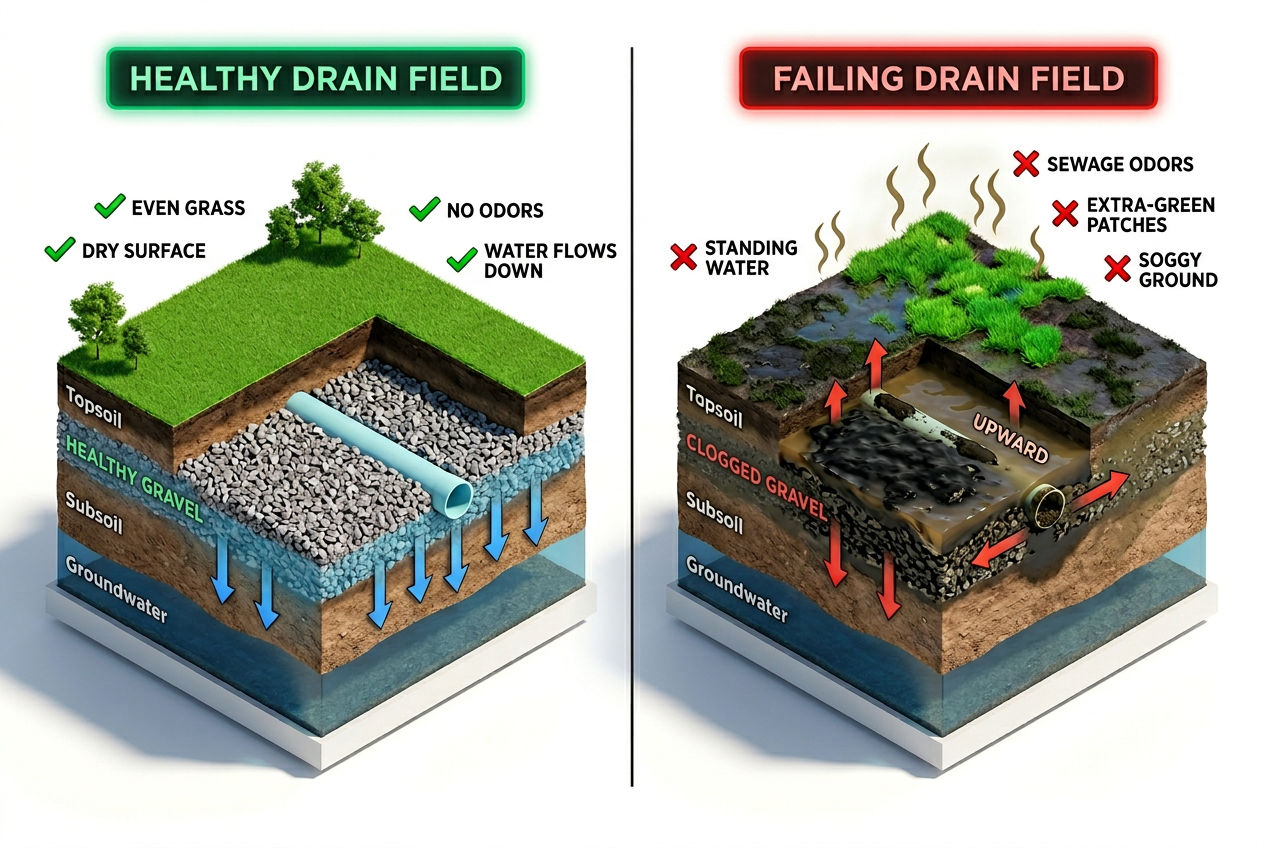
A drain field in trouble tells a different story above ground. Warning signs include:
- Spongy, wet soil over the field area
- Patches of standing water after a rain that shouldn't be there
- Visible sheen of wastewater on the surface (advanced failure)
- Soggy ground with an unmistakable sewage odor
- Grass so green it looks almost artificial
⚠️ Warning: These are all red flags requiring immediate professional evaluation. More on this in the failure signs section below.

DIY Septic Blueprint
Thinking about building it yourself?
The complete, plain-English plan to size, permit and install your own septic system — designed for homeowners, not contractors. Skip the $15,000–$25,000 quotes and do it right the first time.
Get the DIY Blueprint — $67 →Instant download · 8 modules + 3 bonus guides · 60-day money-back guaranteeWhat Does a Drain Field Look Like Below Ground?
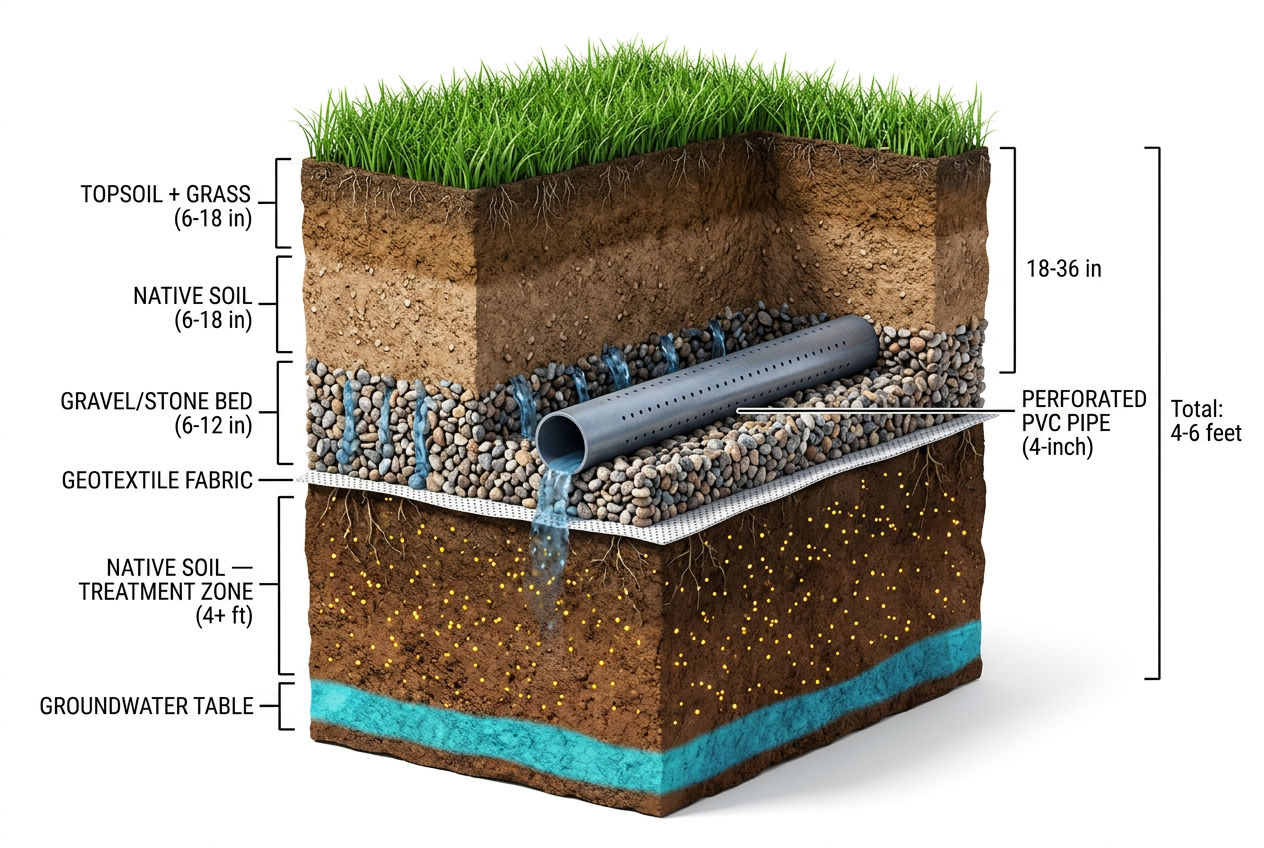
This is where it gets interesting. Dig down through that unremarkable patch of grass and here's what you'd find, layer by layer:
Layer-by-Layer Breakdown:
1. Topsoil and grass (0–6 inches)
A few inches of loamy topsoil and your lawn. Deliberately kept shallow over the field so plants don't interfere with the system below.
2. Native soil (6–18 inches)
This layer varies by location. Sandy soil drains faster; clay soil drains slowly. The percolation rate of this native soil determines how your entire drain field is sized.
3. Gravel bed and perforated pipes (18–36 inches deep)
Here's the core of the system. Parallel trenches - typically 1–3 feet wide and 2–4 feet deep - are filled with 6–12 inches of washed, ¾-inch crushed gravel. Sitting in that gravel bed: 4-inch perforated PVC pipe (Schedule 20 or Schedule 40), installed with perforations facing down. The holes face down so effluent drips into the gravel, not pools in the pipe.
4. Geotextile fabric
A layer of non-woven geotextile fabric (sometimes called filter fabric) covers the top of the gravel bed before backfill. This prevents soil from migrating down into the gravel and clogging the void spaces that the effluent needs to flow through.
5. Backfill
Native soil is replaced on top of the geotextile, bringing the trench back up to grade.
The Biomat Layer:
Over time, a biological mat - called a biomat - forms at the gravel-soil interface at the bottom of the trench. This dark, gelatinous layer is actually part of how the system works. Anaerobic bacteria in the biomat perform a final round of treatment on the effluent before it enters the native soil.
✅ Pro Tip: A healthy biomat is thin and manageable. An overgrown biomat - often caused by a tank that hasn't been pumped regularly - clogs the trench and causes system failure.
How Does a Drain Field Work? (The Full Process)
Walk through the process from toilet flush to treated groundwater:
Step 1 - Wastewater Enters the Septic Tank
Every drain in your house - toilets, sinks, showers, washing machine - flows to a single underground pipe that empties into your septic tank. A typical 3-bedroom home has a 1,000–1,250 gallon concrete, fiberglass, or polyethylene tank.
Step 2 - Separation Happens in the Tank
Inside the tank, three layers form:
- Heavy solids sink to the bottom (sludge layer)
- Grease and lighter material float to the top (scum layer)
- Clarified liquid in the middle (effluent) continues to the drain field
Baffles inside the tank prevent the sludge and scum from leaving with the effluent.
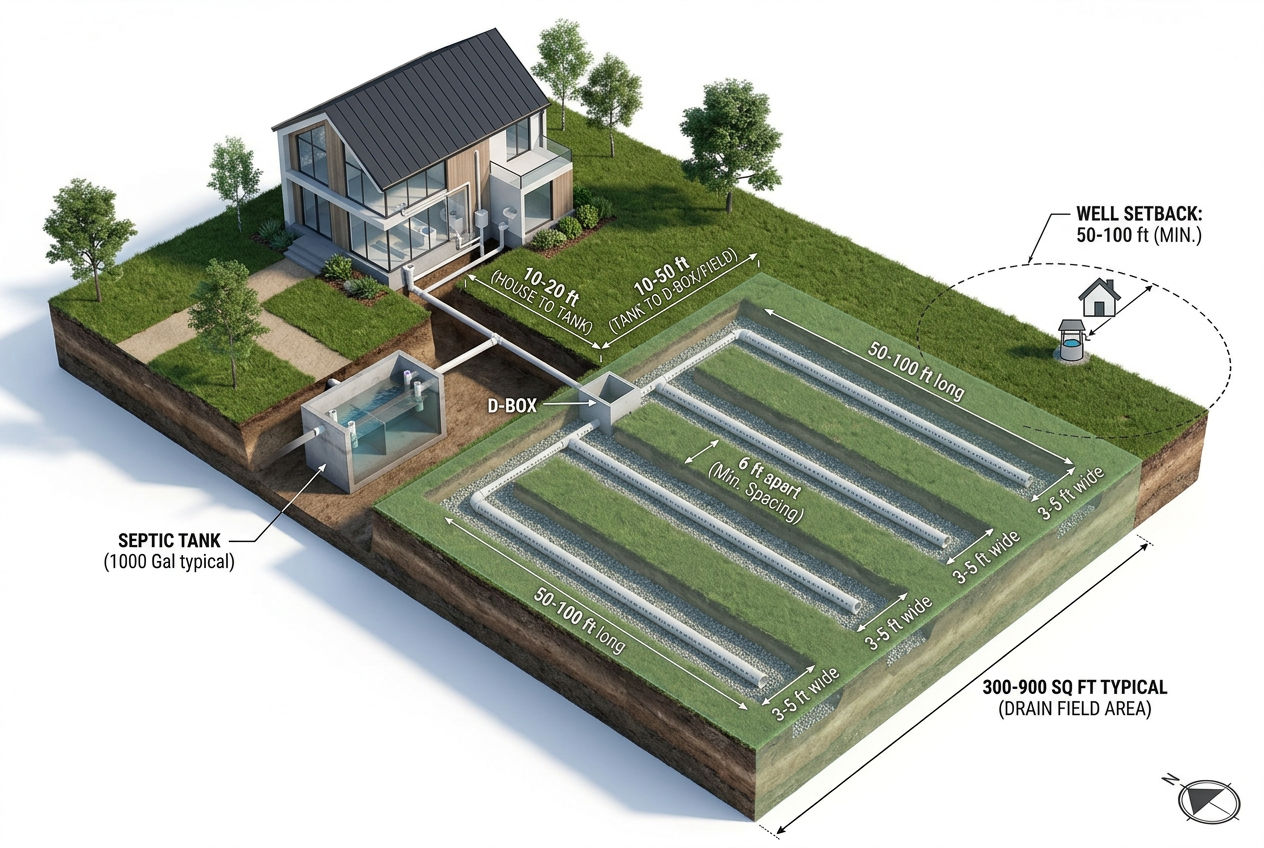
Step 3 - Effluent Flows to the Distribution Box
The effluent exits the septic tank through an outlet baffle (or Polylok PL-122 effluent filter, in newer systems) and travels to a distribution box - commonly called a D-box. This small concrete or plastic box sits between the tank and the drain field trenches. Its job: split the effluent flow evenly among all the lateral pipes.
Step 4 - Effluent Enters the Perforated Pipes
From the D-box, effluent flows by gravity into 4-inch perforated PVC lateral pipes - one pipe per trench. The perforations (small holes or slots) let the effluent drip down into the gravel bed below.
Step 5 - Soil Absorption and Treatment
Effluent percolates from the gravel bed down through native soil. As it moves through the soil, aerobic and anaerobic bacteria break down pathogens and organic material. Nutrients like nitrogen and phosphorus are absorbed. By the time the treated water reaches the water table - potentially 3–10 feet below the drain field - it's been significantly cleaned.
📊 Quick Fact: The average household produces 150–300 gallons of wastewater per day. A correctly sized drain field absorbs all of it. A 4-person household running showers, laundry, dishwasher, and toilets is putting about 240–300 gallons through the system daily. Every single day.

How Is a Drain Field Sized? (Dimensions and Specifications)
Drain field size isn't arbitrary. It's calculated based on how quickly your soil absorbs water - determined by a percolation test (perc test) - and local regulatory requirements.
Standard Dimensions for Reference:
| Specification | Typical Range | Notes |
|---|---|---|
| Total drain field area | 450–900 sq ft | 3-bedroom home; varies by soil |
| Trench width | 1–3 feet | Wider in slower-draining soils |
| Trench depth | 2–4 feet | Varies by frost depth and soil type |
| Trench length | 25–100+ feet | Depends on lot size and layout |
| Trench spacing | 6–10 feet (center to center) | Local code varies |
| Pipe diameter | 4 inches (perforated PVC) | Schedule 20 or 40 |
| Gravel bed depth | 6–12 inches | Washed ¾-inch crushed stone |
| Depth to top of gravel | 18–36 inches | Varies; frost depth a factor in northern climates |
Source: EPA Onsite Wastewater Treatment Systems Manual; local figures vary by jurisdiction
Perc Test Requirements:
A perc test typically costs $250–$1,000 and must be performed by a licensed soil evaluator or engineer before a permit is issued.
- Fast-draining sandy soils can handle a smaller field
- Slow-draining clay soils require a much larger one - or an alternative system entirely
Learn more in our drain field size guide. For details on how deep drain fields are installed and the full drain field installation process, we have dedicated guides.
How Do I Find My Drain Field?
Most homeowners have no idea exactly where their drain field sits. Here's how to locate it without digging up half your yard.
1. Start with Your Property Records
Contact your county health department and request the as-built drawing (also called a site plan or permit drawing) for your septic system. Most jurisdictions require these drawings on file when the system was permitted. This is the fastest, most accurate method - and it's often free or costs a small copying fee.
2. Check the Septic Tank Outlet
Once you find your septic tank (look for a concrete lid or riser cap, often near the house), the drain field is downstream from the outlet end of the tank. The outlet side typically faces away from the house. Follow that direction 10–25 feet and you're likely over the drain field.
3. Look for Visual Clues
- Slightly raised ground
- Greener grass in a rectangular pattern
- No trees or structures in a rectangular area
Walk the yard on a dry day in late summer - drain field grass often stays greener during drought stress.
4. Use a Probe Rod
A metal soil probe (a thin rod about 3–4 feet long) can be pushed into the ground to feel for the gravel bed. The shift from compacted soil to loose gravel is noticeable. This is a legitimate field technique used by inspectors and pumpers.
5. Ask Your Pumper
The last company that pumped your tank almost certainly knows where the D-box and lateral lines run. It's a 60-second conversation worth having.
✅ Pro Tip: Our dedicated article on how to find your drain field walks through each method in detail.
What Are the Signs of a Failing Drain Field?
Drain field failure doesn't usually happen overnight. It's a gradual process, and catching it early can sometimes save the field rather than requiring full replacement. Here's what to watch for:
Early Warning Signs:
Soggy or spongy ground over the field area
If you're squishing through wet grass in a dry week, effluent is surfacing. This means the soil has lost its absorption capacity - it's saturated, biologically clogged, or both.
Standing water or a shiny surface film
Raw or partially treated effluent pooling on the surface is a public health concern. If you see water sitting over your drain field with no recent heavy rain to explain it, stop using water in the house and call a professional the same day.
Sewage odors outdoors - or indoors
A healthy drain field has essentially no odor. A faint musty smell occasionally is normal. A clear sewage odor - outdoors near the field or indoors near floor drains - means effluent is backing up or surfacing somewhere it shouldn't be.
Indoor Symptoms:
Slow drains and gurgling sounds inside
When the drain field can't accept more effluent, the backup comes into the house. Watch for:
- Toilets that flush slowly
- Drains that gurgle
- Washing machines that cause other fixtures to back up
These are all downstream symptoms of an overwhelmed drain field.
Landscape Indicators:
Unusually lush, fast-growing grass
A suddenly vivid green strip of lawn - especially during dry weather - can signal effluent surfacing just below the soil and fertilizing the grass from below. It looks great. It isn't.
Nitrates in a nearby well
If you have a private well, and a water test shows elevated nitrate levels, a failing drain field can be the source. This is a health issue, not just a plumbing one.
💡 Key Takeaway: For a complete breakdown of each symptom and what it means for your system, read our guide on signs your drain field is failing.
If the field is waterlogged but not yet destroyed, there may be options - read our guide on how to fix a saturated drain field before assuming you need a full replacement. If you're already there and need help, find a drain field services professional near you through our directory.
What Is the Difference Between a Drain Field and a Leach Field?
Same thing. The terms "drain field," "leach field," and "absorption field" all refer to the same component - the underground network of perforated pipes and gravel trenches that disperses and treats effluent from your septic tank.
Regional Terminology:
- "Drain field" is the more common term in the Southeast and Midwest
- "Leach field" is widely used in the Northeast and West
- "Absorption field" shows up in regulatory documents and engineering permits
If a contractor, inspector, or county health official uses any of these terms, they're talking about the same structure.
📊 Quick Fact: Some engineers use "leach field" specifically for systems with engineered leaching chambers (like Infiltrator Water Technologies' Quick4 chambers) rather than traditional gravel-and-pipe construction. But in everyday use, the terms are interchangeable.
See our full breakdown in drain field vs. leach field.
Conventional Drain Fields vs. Alternative Systems
A conventional gravel-and-pipe drain field works well when you have the right soil and enough space. Many properties don't check both boxes. That's where alternative systems come in.
System Comparison:
| System Type | Best For | Typical Cost | Key Features |
|---|---|---|---|
| Conventional drain field | Well-draining sandy/loamy soil, adequate lot size, water table 2–4 feet below trenches | $3,000–$10,000 | Standard gravel-and-pipe; lowest cost option |
| Mound system | High water table or slow-draining soil | $10,000–$30,000+ | Raised bed of imported sand/soil; visible above grade |
| Chamber systems | Areas where gravel is expensive; smaller lots | $5,000–$15,000 | Plastic arch chambers; no gravel required; smaller footprint |
| Drip irrigation systems | Sloped lots; environmentally sensitive areas | $10,000–$25,000 | Pressurized drip emitters; requires ATU pre-treatment |
| Aerobic treatment units (ATUs) | Challenging soils; strict discharge standards | $8,000–$20,000 | Pre-treats effluent before drain field; extends field life |
Regional Patterns:
- Florida, coastal Georgia, Carolinas: Mound systems common due to high water tables
- Wisconsin, Minnesota: Frequent mound systems for seasonal high water tables
- Texas, Oklahoma: ATU systems required by state regulation in many areas
- Arizona, New Mexico: Systems must work around caliche hardpan layers
How Long Does a Drain Field Last?
A well-maintained drain field typically lasts 15–25 years. Some last 30–40 years. Others fail in under 10 years. The difference usually comes down to two things: how well the septic tank was maintained, and whether anyone drove on the field.
The Septic Tank Connection Is Critical:
The EPA recommends pumping your septic tank every 3–5 years for most households. A 1,000-gallon tank serving four people should be pumped every 3–4 years.
⚠️ Warning: Skip pumping, and sludge overflows into the drain field, clogging the gravel bed and the biomat layer. Once the gravel is biologically clogged, the field can rarely be restored. This is the single most preventable cause of premature drain field failure.
Other Lifespan Factors:
- Soil type - Sandy soils age more gracefully; clay soils can develop drainage problems even with perfect maintenance
- Regional climate - In Minnesota and Michigan, freeze-thaw cycles stress pipes and connections over decades in ways that don't affect systems in Florida or Arizona
- Vehicle traffic - Driving on the field compacts soil and crushes pipes, causing irreversible damage
- Water usage patterns - Consistent overloading shortens lifespan dramatically
For a deeper look at lifespan factors and what you can do to extend yours, read how long drain fields last.
How Much Does It Cost to Replace a Drain Field?
This is usually the question homeowners arrive at after learning their field is failing. The numbers vary widely, but here are realistic ranges:
Replacement Cost Breakdown:
| System Type | Cost Range | Includes |
|---|---|---|
| Conventional drain field | $5,000–$15,000 | Permits, excavation, pipe/gravel materials, inspection fees |
| Mound system | $15,000–$30,000+ | Imported fill material, engineering, larger excavation |
| Alternative/engineered systems | $10,000–$40,000+ | Complex terrain, high water tables, proximity to water bodies |
Regional Cost Examples:
- Rural Tennessee: Conventional replacement runs $6,000–$9,000 all-in
- Coastal Massachusetts: Same job can exceed $20,000–$25,000 due to rocky soil, higher labor rates, strict Title 5 regulations
⚠️ Warning: The permit and inspection process alone adds $500–$2,000 in most states. Some counties require a new perc test before issuing a replacement permit - add another $250–$1,000 to that.
The Best Investment: Prevention
Protecting your existing drain field is dramatically cheaper than replacing it. Regular pumping through a licensed pumper (see our septic pumping guide) and keeping vehicles off the field are the two highest-leverage things you can do.
See the full cost breakdown in our drain field replacement cost guide.
Can You Walk or Drive on a Drain Field?
Walking on a drain field is fine. Grass needs to be mowed, and foot traffic doesn't cause structural damage to a properly installed system.
Driving on a drain field is a different story. Never park or drive vehicles over a drain field. A vehicle - even a passenger car - exerts enough weight to compact the soil, crush the gravel bed, and crack or collapse the 4-inch PVC laterals. Heavy equipment like riding mowers can cause problems on shallow systems. A full-size pickup or SUV can do thousands of dollars of damage in a single pass.
Why Vehicle Traffic Is Catastrophic:
Compacted soil loses its percolation capacity. Once the pore spaces in the gravel and soil are crushed shut, effluent has nowhere to go. There's no repair for compaction - you're looking at partial or full replacement.
Keep These OFF Your Drain Field (Permanently):
- Vehicles of any kind - Cars, trucks, ATVs, tractors
- Heavy equipment - Skid steers, excavators, delivery trucks
- Structures - Sheds, decks, pools, hot tubs
- Deep-rooted trees and shrubs - Maintain a 10–25 foot clearance minimum
- Garden beds with irrigation - Adding water to the field overloads it
Get the full picture in our guide: can you drive over a drain field?
Regional and Seasonal Factors That Affect Drain Fields
Drain fields don't behave the same everywhere. Where you live changes how yours was designed, what it costs, and what problems you're likely to face.
Spring Saturation (Northeast, Midwest, Pacific Northwest):
In these regions, snowmelt and spring rains can temporarily saturate the soil around a drain field. A system that was working fine in November might show signs of stress in April - slow drainage, wet spots over the field - that resolve naturally as the soil dries.
✅ Pro Tip: Don't assume spring saturation means system failure. Wait a few weeks, reduce water use in the house, and reassess.
Frozen Drain Fields (Northern States):
In Minnesota, Wisconsin, Michigan, and New England, the frost line reaches 42–60 inches in severe winters. Drain fields installed at proper depth (18–36 inches) in well-drained soils rarely freeze. But snow-free winters with high foot traffic can remove the insulating snow cover and allow shallow laterals to freeze solid.
- If your field freezes: Thawing services run $1,500–$3,000+
- Prevention: Aerate or add insulation over the field in autumn
High Water Tables (Southeast):
Florida, coastal Georgia, and the Carolinas frequently have water tables within 24 inches of the surface. Conventional drain fields can't function when the water table sits below the trench bottom - there's no room for effluent to percolate. Florida's Department of Health has strict site evaluation requirements for this reason, and mound systems or elevated drain fields are common throughout the state.
Clay Soils (Midwest):
Heavy clay soils in Ohio, Indiana, and Michigan have very low percolation rates. Systems designed for clay need larger fields - sometimes double the square footage of a sandy-soil equivalent - or must use alternative technologies. County health departments in these areas often require engineered designs stamped by a licensed professional engineer.
Arid Conditions (Southwest):
In Arizona, New Mexico, and parts of Texas, caliche (a hardpan calcium carbonate layer) can block percolation entirely at certain depths. Soil evaluators must probe below the caliche layer to find suitable absorption zones.
📊 Quick Fact: On the positive side, low rainfall means less soil saturation stress, and systems in desert climates often outperform their design lifespan.
How to Protect Your Drain Field
A drain field that's working well is invisible to you. Keep it that way with these habits:
Essential Maintenance:
1. Pump your septic tank every 3–5 years
This is non-negotiable. Sludge overflow into the drain field is the leading cause of premature failure - and it's entirely preventable. Our septic pumping guide explains what to expect from a service call.
2. Spread water use throughout the day
Doing six loads of laundry on Saturday afternoon dumps 150+ gallons into the system in a few hours. Spread laundry across the week. The drain field needs recovery time between large inputs.
Never Flush or Drain These:
- Grease, oils, or fats - Solidify in pipes and tank
- Wet wipes, even "flushable" ones - They don't break down
- Medications - Pass through the system and enter groundwater
- Harsh chemical cleaners - Kill beneficial bacteria in the tank and biomat
- Paint, solvents, or antifreeze - Toxic to the soil biology
Smart Upgrades:
Install an effluent filter
A Polylok PL-122 or Zabel A1800 filter fits into your tank's outlet baffle and catches solids before they reach the drain field. These run $30–$90 for the filter itself and need cleaning at every pump-out. Best cheap insurance on the market for drain field protection.
Keep records
Know when your tank was last pumped, who did it, and what the as-built drawing shows. If you ever sell the house, have the system inspected first. Our septic inspection cost guide covers what to expect.
Related reading: septic system installation process.
Related: homemade leach field designs
Related: does every septic system need a drain field
Sources & Methodology
This article draws on the following primary sources:
-
U.S. Environmental Protection Agency - Septic Systems Overview: Used for national statistics on septic system prevalence, recommended pumping intervals, and design guidelines from the EPA's Onsite Wastewater Treatment Systems Manual.
-
EPA Onsite Wastewater Treatment Systems Manual (EPA/625/R-00/008): Technical reference for drain field dimensions, soil absorption specifications, and system design criteria.
-
National Onsite Wastewater Recycling Association (NOWRA): Industry standards and terminology for conventional and alternative drain field systems.
-
State Health Departments: Florida Department of Health, Minnesota Pollution Control Agency (MPCA), and Massachusetts Title 5 regulations referenced for regional regulatory context.
-
University Extension Programs: Penn State Extension and University of Minnesota Extension publications on septic system maintenance and drain field lifespan were consulted for maintenance data points.
Cost ranges reflect national averages and regional contractor data compiled from permit records, contractor interviews, and industry publications as of 2025–2026. Individual costs vary by location, soil conditions, system type, and local labor markets.
Need help with your drain field? Find a septic professional near you through the SepticTankHub directory - search by state and city to connect with vetted contractors in your area.
Need help with your septic system? Browse local septic companies in Georgia or North Carolina.
Free download
Not ready for the Blueprint? Start free.
Grab the free DIY Septic Planning Kit — the permit-first checklist, perc-test cheat sheet, and sizing tables that keep your build from getting red-tagged.
Was this article helpful?
Frequently Asked Questions
Recommended Resources
📖 Related Articles
- What Is a Septic System? How It Works (Visual Guide)
- Leach Field Size by Bedrooms: Drain Field Sizing Chart (2026)
- How to Find Your Septic Drain Field
- Signs Your Drain Field Is Failing (And What to Do)
- Drain Field vs Leach Field: Is There a Difference?
- How Long Do Drain Fields Last? Lifespan Guide
- How Often Should You Pump Your Septic Tank?
- Can You Drive or Build Over a Drain Field?
💰 Cost Guides
Find Septic Professionals Near You
Compare licensed, verified septic companies by area — top county markets and cities below, or browse all 50 states.
County markets
Popular cities
