
Quick Answer
Your septic drain field location matters more than most homeowners realize - until the day a contractor shows up to pour a concrete patio and accidentally punches through a leach line. Or until you're selling your home and the buyer's inspector flags an unknown structure sitting directly over the absorption field.
Knowing exactly where your drain field sits protects your system, your wallet, and your yard.
💡 Key Takeaways
- Start with county permit records - an as-built diagram is the fastest, most reliable method
- Drain fields typically sit 10–100 feet from the tank, covering 450–1,200+ sq ft
- Visual clues like greener grass, snow melt patterns, or ground depressions can pinpoint the field
- Never dig, plant trees, or build structures over your drain field without knowing its exact location — see our tree safety distances guide
- Professional locating services cost $100–$400 and are worth every dollar when records don't exist
What Is a Septic Drain Field?
A septic drain field - also called a leach field or absorption field - is the final stage of your home's wastewater treatment. Liquid effluent flows out of your septic tank, passes through a distribution box (D-box), and spreads into a network of perforated 4-inch PVC pipes buried in gravel-filled trenches. The soil does the real work, filtering and absorbing the liquid before it reaches groundwater.
A typical residential drain field for a 3-bedroom home covers 450–1,200 square feet, with 3–9 parallel leach lines running 25–100 feet each. The trenches are usually 1–3 feet wide and 18–36 inches deep. That's a substantial footprint - and it's all invisible from above.
For a deeper look at how the full system fits together, see our guide on what a drain field is and how it works.
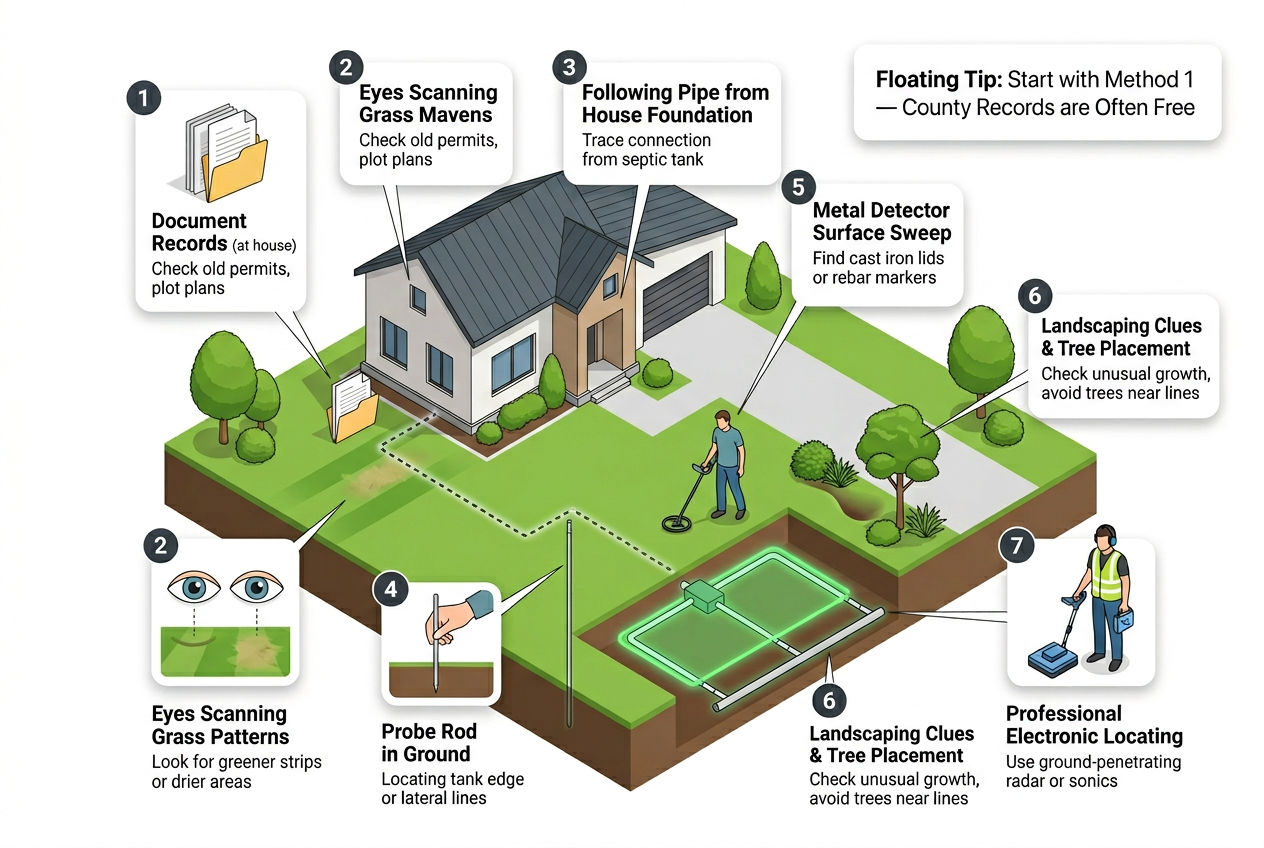
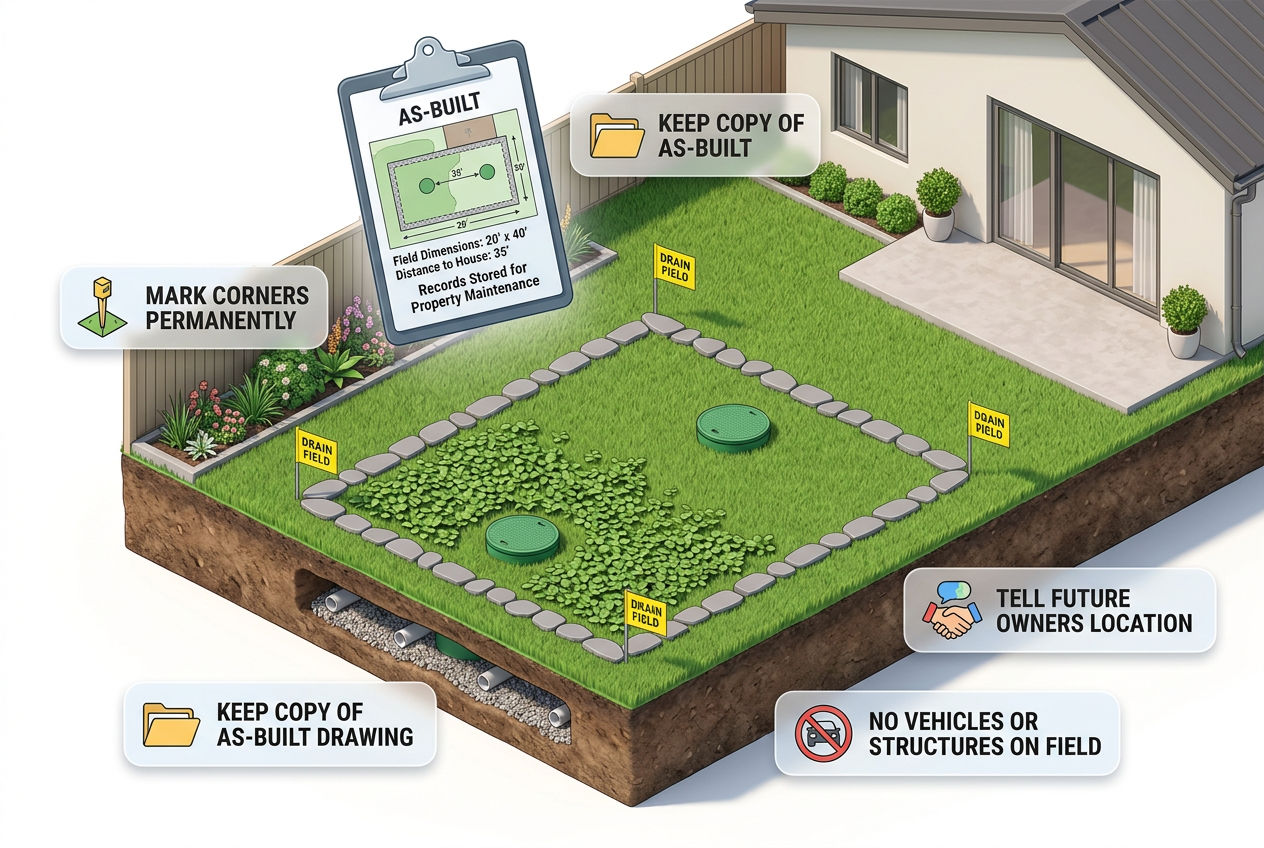
Method 1: Check Your Septic Permit and As-Built Records
This is your first stop. It's free, it's fast, and it's often the only method you'll need.
When a septic system is installed, the contractor files a permit and typically submits an as-built diagram - a sketch showing the tank location, the D-box, and the drain field layout with rough measurements from fixed landmarks like your house or property corners.
Where to Find These Records:
- Your county or local health department - Call the environmental health services division. Most counties that issued permits after the late 1970s or early 1980s have records on file. Some have online portals where you can search by address.
- Your closing documents - If you bought the home, your title company may have included a septic permit or inspection report in the closing package.
- Your state's health department - Some states maintain centralized databases. Florida's Department of Health, for example, maintains permit records through county health departments with an online lookup for many counties.
- Previous owners - Worth a call if you have contact information. Many homeowners keep the original system paperwork.
⚠️ Warning: Systems installed before the mid-1970s often have no records at all. Older New England stone-and-pipe systems, pre-code Midwest installations, and rural properties across the Southeast frequently predate permit requirements. If your home was built before 1970, don't be surprised if the county comes up empty.
Method 2: Follow the Pipe From Your Septic Tank
If you can find your septic tank, you can trace the system to the drain field.
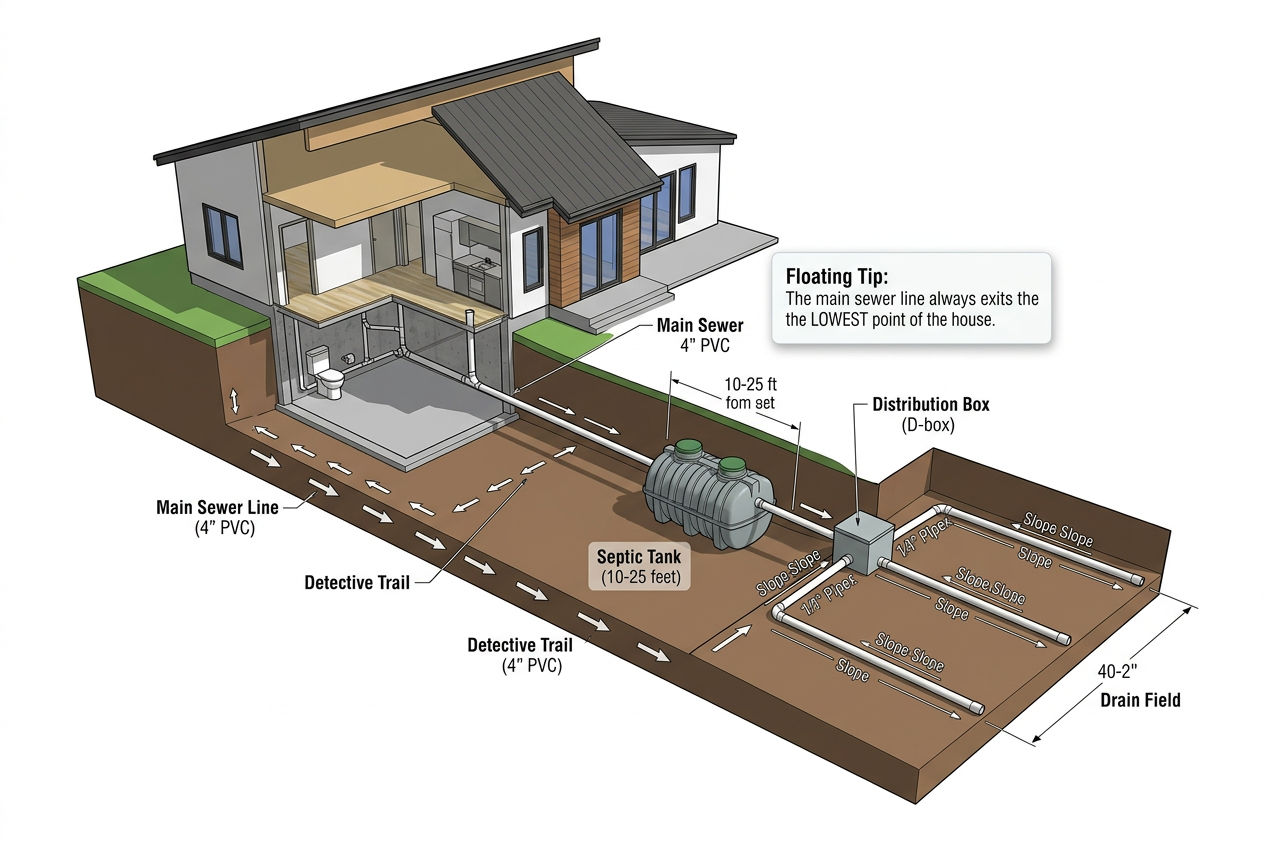
Your septic tank has two pipes: an inlet from the house and an outlet toward the drain field. The outlet side runs to the distribution box, which then splits into the individual leach lines.
How to Trace It:
- Locate your septic tank first. The tank is usually 10–25 feet from the house, buried 1–3 feet deep. Look for a riser lid (a green or black plastic cap) in the yard, or check your permit records. Our septic tank location guide covers this step in detail.
- Identify the outlet side. The outlet pipe leaves the tank on the side facing away from the house. It's typically 4-inch diameter PVC or cast iron, running toward the D-box.
- Find the distribution box. The D-box sits 5–20 feet from the tank. It's a small concrete or plastic box that splits effluent evenly into the leach lines. Sometimes it has its own access lid at or near grade.
- Follow the leach lines outward. From the D-box, the lines fan out in parallel. They typically run downslope, staying level within each trench.
✅ Pro Tip: Use a thin metal probe rod (a 3/8-inch steel rod works well) to gently follow the pipe path without damaging the lines. Push it into the soil at an angle every foot or two along your estimated line - when you hit the pipe, you'll feel the resistance difference immediately.
Free download
Free: the Septic Fridge Card — what to flush, what never to.
The Do / Don’t card the whole family can see, plus the Survival Kit: emergency flowchart, warning-sign decoder and pump-schedule card. One printable PDF.
Method 3: Look for Visual Clues in Your Yard
Your yard is already telling you where the drain field is. You just have to know what to look for.
Above-Ground Appearance
A healthy drain field often shows subtle surface signs:
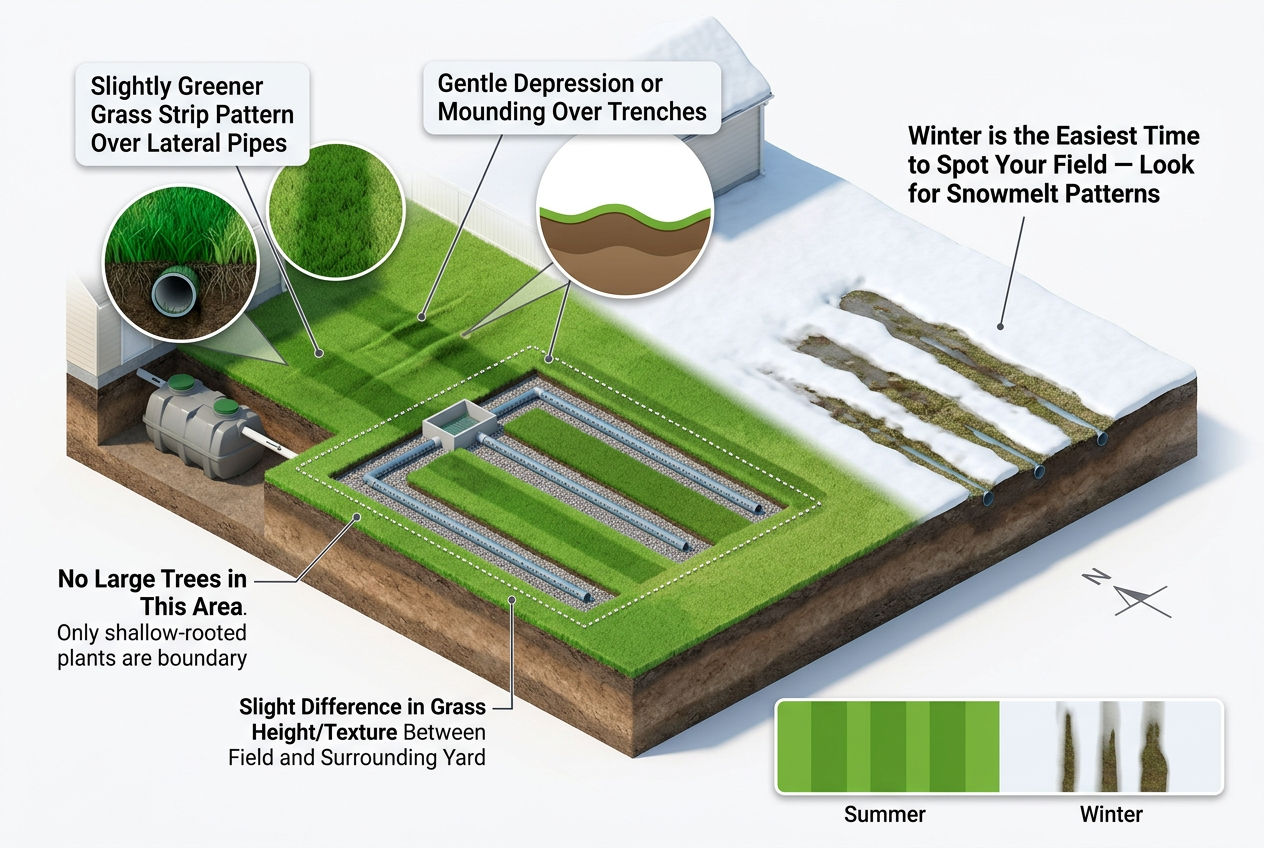
- Greener, lusher grass - Effluent adds moisture and nutrients. During dry summer months, a suspiciously green strip of grass over an otherwise dry lawn is a classic drain field marker.
- Slightly raised or mounded ground - Especially in systems with gravel-filled trenches. The soil above leach lines sometimes settles differently than surrounding ground.
- No trees, structures, or pavement - Drain fields have setback requirements that keep them clear of obstacles. An unusually open area of yard is worth investigating.
- Inspection ports or cleanout caps - Small PVC pipes capped at grade level near the field's edges.
Seasonal Visual Clues
Seasons change what you can see:
| Season | What to Look For | Why It Works |
|---|---|---|
| Winter | Areas where snow melts faster or frost is absent | Bacterial activity in an active drain field generates mild heat |
| Spring | Snow melt patterns (clearest marker of the year) | Temperature differences become most visible during thaw |
| Summer drought | Rectangular strips of green grass while everything else is brown | Effluent provides moisture when surrounding soil is dry |
| Fall | Wet spots or surface ponding after rain | May indicate a saturated or failing field (separate issue) |
📊 Quick Fact: Spring snow melt patterns are the single best time to visually identify a drain field if you don't have records.
⚠️ Regional Note: In Florida and the Gulf Coast Southeast, many systems use mound configurations where the drain field is visibly elevated above grade - easier to spot, but also easier to damage with lawn equipment. In the clay-heavy Midwest (Ohio, Indiana, Michigan), fields are often larger than average due to poor percolation rates, so the footprint you're searching for may be bigger than you'd expect.
What Does a Drain Field Look Like Underground?
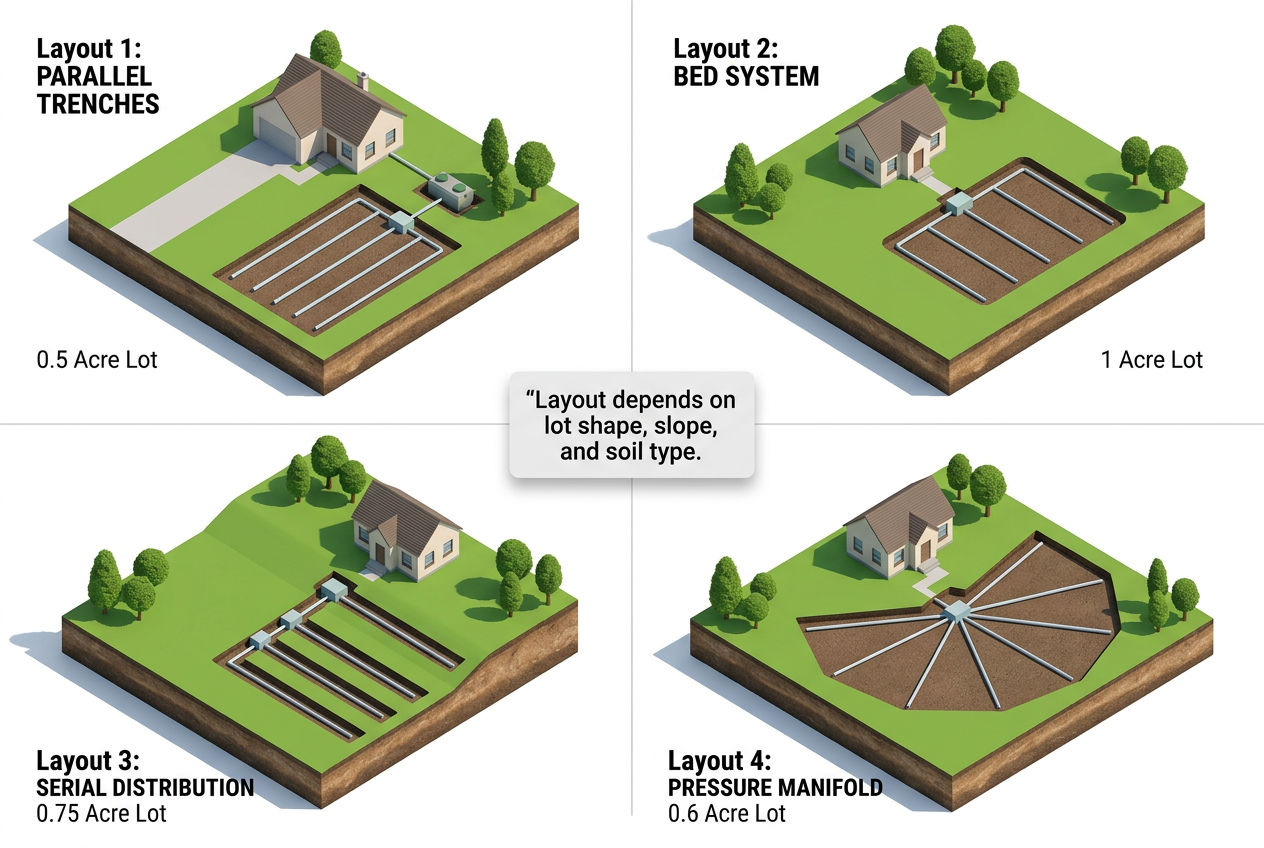
To understand what you're locating, picture this: a series of parallel trenches, each 1–3 feet wide and 18–36 inches deep. Inside each trench, a layer of washed gravel surrounds 4-inch perforated PVC pipe. The pipe has small holes along the bottom that let effluent seep into the gravel and then into the surrounding soil.
Newer systems using chamber technology (like Infiltrator Water Technologies' Quick4 chambers) skip the gravel entirely, but the trench dimensions are similar. Our drain field depth guide explains the variation in installation depths by system type.
Method 4: Probe the Ground Carefully
Probing is low-tech and surprisingly effective when combined with the visual clues from Method 3.
You need a thin metal rod - a 3/8-inch diameter steel probe rod, or even a long screwdriver. Push it straight down into the soil in a grid pattern across your suspected field area.
What You're Feeling For:
- Gravel layer resistance - The drainage aggregate around leach lines feels loose and rocky compared to compacted native soil
- Hollow sound when tapped - A light tap on the probe over a gravel-filled trench sounds different from solid earth
- Pipe contact - A hard stop at 18–36 inches that doesn't feel like a rock (pipes give a slightly hollow knock; rocks don't)
Work in a grid, probing every 2–3 feet, and mark your finds with small flags. You'll start to see the trench lines emerge.
⚠️ Warning: Probe gently. You're trying to locate pipes, not damage them. Pushing too hard with a sharp rod can crack older PVC or puncture corrugated drainage pipe. Never use a solid steel stake or fence post to probe - the risk isn't worth it.
Method 5: Use a Sewer Camera or Electronic Locator
These tools cost more than probing but work without guesswork.
Sewer Camera Inspection
A plumber or septic contractor threads a flexible camera through your home's cleanout, into the septic tank outlet, and then into the distribution box and leach lines. The camera head contains a locator transmitter. A technician above ground uses a compatible handheld receiver to track the camera's position in real time - marking the exact path of the leach lines on your lawn.
Cost: $250–$800 depending on your area and system complexity. See our septic inspection cost guide for regional pricing breakdowns.
Electronic Pipe Locators
Contractors can also attach a signal transmitter to the pipe and use a surface receiver to trace its path. These work well for systems with metal components. For all-PVC systems, the camera-and-transmitter method is more reliable.
💡 Key Takeaway: Can a metal detector find a drain field? Sometimes. If your distribution box is concrete with rebar, or if your system has metal pipe fittings or clamps, a metal detector will pick up the signal. But for modern all-PVC systems with plastic D-boxes, a standard metal detector won't find anything useful. Don't buy one specifically for this purpose.
Method 6: Hire a Professional Septic Locating Service
When records don't exist and DIY methods haven't nailed it down, this is the right call.
Septic locating professionals use a combination of electronic pipe locating equipment, ground-penetrating radar (GPR), and system knowledge to find and map your drain field accurately. They'll provide you with a hand-drawn or digital sketch you can keep for future reference.
Cost: $100–$400 for a basic locating service. If they also run a camera inspection to assess field condition, expect $250–$800 total. That's a reasonable investment before you spend $5,000 on landscaping that might need to be torn out later.
When This Is Clearly Worth It:
- You're planning any construction, fencing, or hardscaping
- You're buying or selling a home
- You suspect a drain field problem and need to know exactly where to look
- Permit records don't exist or the as-built drawing is too vague to be useful
Find a licensed septic professional in your area through the SepticTankHub.com directory - search by state and service type to get quotes from contractors who specialize in system locating and inspection.
Drain Field Location Reference: Key Measurements
| Feature | Typical Range | Notes |
|---|---|---|
| Distance from tank to D-box | 5–20 ft | D-box is the field's starting point |
| Distance from tank to field | 10–100 ft | Varies by lot size and system design |
| Drain field depth | 18–36 inches | Shallower for mound/pressure-dosed |
| Field size (residential) | 450–1,200+ sq ft | Depends on bedroom count and soil perc rate |
| Leach line length | 25–100 ft each | 3–9 parallel lines typical |
Data sourced from EPA Septic Systems guidance (epa.gov/septic) and NOWRA (nowra.org) installation standards. Setback distances and field sizing requirements vary by jurisdiction - always verify with your county health department.
What to Do After You Locate Your Drain Field
Finding the field is step one. Protecting it is the ongoing job.
Mark It Permanently
After locating the field, install small permanent markers at the corners - landscape flags, stakes, or even small decorative rocks. Photograph the area with landmarks in frame. Better yet, sketch a rough diagram and store it with your home records. The contractor who found your field may provide one - ask for it.
Protect It From Damage
The EPA's septic systems guidance is clear: keep vehicles, heavy equipment, and structures off the drain field. A single pass from a loaded concrete truck can collapse a leach trench. Our can you drive over a drain field article explains exactly how much weight is too much.
Schedule Regular Pumping
A well-maintained septic tank protects the drain field from solids carryover - the leading cause of premature field failure. The EPA recommends pumping every 3–5 years for most households. A 1,000-gallon tank serving a family of four should be pumped every 3–4 years; add a garbage disposal and that interval drops to 2–3 years.
See our septic pumping schedule guide for a detailed breakdown. You can also book a pump-out through our septic pumping service listings.
Know How Long You Have
A properly maintained conventional drain field lasts 20–30 years. Learn what factors affect lifespan in our guide on how long drain fields last.
For pricing details, see our drain field replacement cost guide.
Learn more about our drain field services services.
Related reading: septic system installation process.
Sources & Methodology
This article draws on the following primary sources:
- U.S. Environmental Protection Agency - Septic Systems: Used for recommended pumping intervals, setback guidance, and general system design standards.
- National Onsite Wastewater Recycling Association (NOWRA): Referenced for drain field sizing norms and installation standards across system types.
- National Association of Wastewater Technicians (NAWT): Referenced for inspection and locating service cost ranges and professional standards.
- State health department records (Florida DOH, Minnesota MPCA): Referenced for regional regulatory context and permit record availability.
- Infiltrator Water Technologies: Referenced for chamber system specifications and installation standards.
Cost ranges reflect national averages as of 2025 and will vary by region, contractor, and system complexity.
Need help with your septic system? Browse local septic companies in Wisconsin or Oregon.
Was this article helpful?
Frequently Asked Questions
Recommended Resources
📖 Related Articles
- What Is a Drain Field? (And How Does It Work?)
- What Is a Septic System? How It Works (Visual Guide)
- Signs Your Drain Field Is Failing (And What to Do)
- How Deep Should a Drain Field Be?
- Can You Drive or Build Over a Drain Field?
- How Often Should You Pump Your Septic Tank?
- How Long Do Drain Fields Last? Lifespan Guide
- Trees Near Septic Systems: Safe Distances & Worst Species (2026)
🔧 Services
Find Septic Professionals Near You
Compare licensed, verified septic companies by area — top county markets and cities below, or browse all 50 states.
County markets
Popular cities
