
Quick Answer
Driving or building over a septic drain field is not safe for most vehicles or structures. The soil compaction caused by vehicle weight reduces the field's ability to filter and absorb wastewater, and heavy loads can crush the perforated pipes buried just below the surface. Repairs run $1,500–$5,000 for localized damage and $5,000–$20,000 or more for full replacement.
💡 Key Takeaways
- Even a standard passenger car (3,000–4,000 lbs) can damage a drain field, especially on saturated or clay-heavy soil
- Driving, parking, and building over a leach field compacts soil and can crush perforated pipes as shallow as 6 inches below grade
- No permanent structure-shed, patio, deck, or driveway-should ever be built over a drain field
- Most U.S. jurisdictions require health department approval before any structure is placed near a septic system, and that approval is almost universally denied for the field area itself
- Full drain field replacement costs $5,000–$20,000 nationally; preventing damage costs nothing
What Happens If You Drive Over a Septic Drain Field?
Driving over a septic drain field compacts the soil, crushes distribution pipes, and can collapse the gravel bed surrounding the leach laterals-all of which destroy the system's ability to treat wastewater. This isn't a theoretical risk. Drain field pipes are typically buried just 6–36 inches below the surface, depending on your region and soil type. That's not a lot of protection.
The Underground Damage Process
Here's what actually happens underground when you drive over the field:
Soil compaction. Your drain field works because effluent from your septic tank slowly percolates down through loose, aerated soil. That percolation and evaporation process depends on tiny air pockets in the soil. A vehicle compresses those pockets. On saturated or clay-heavy soils-common in the Pacific Northwest, the Southeast, and much of the rural Midwest-soil can compact significantly under as little as 10 PSI of pressure, reducing percolation rates by 70–90%. Once compacted, soil rarely returns to its original structure without mechanical remediation.
Crushed drain field pipes. Standard 4-inch Schedule 40 PVC distribution pipe can fail under concentrated loads as low as 2,000–3,000 lbs in unprepared soil. Corrugated HDPE pipe-the type commonly used in modern chamber systems-is even more flexible and vulnerable to deformation. A 4,000-lb passenger car concentrates its weight through four tire contact patches, each roughly the size of a postcard. On soft or wet soil, that's more than enough to crack or collapse a lateral.
Gravel displacement. Conventional leach fields use a gravel envelope around the distribution pipes to distribute effluent and keep the pipe zone stable. Vehicle traffic shifts and crushes that gravel, eliminating the drainage layer entirely.
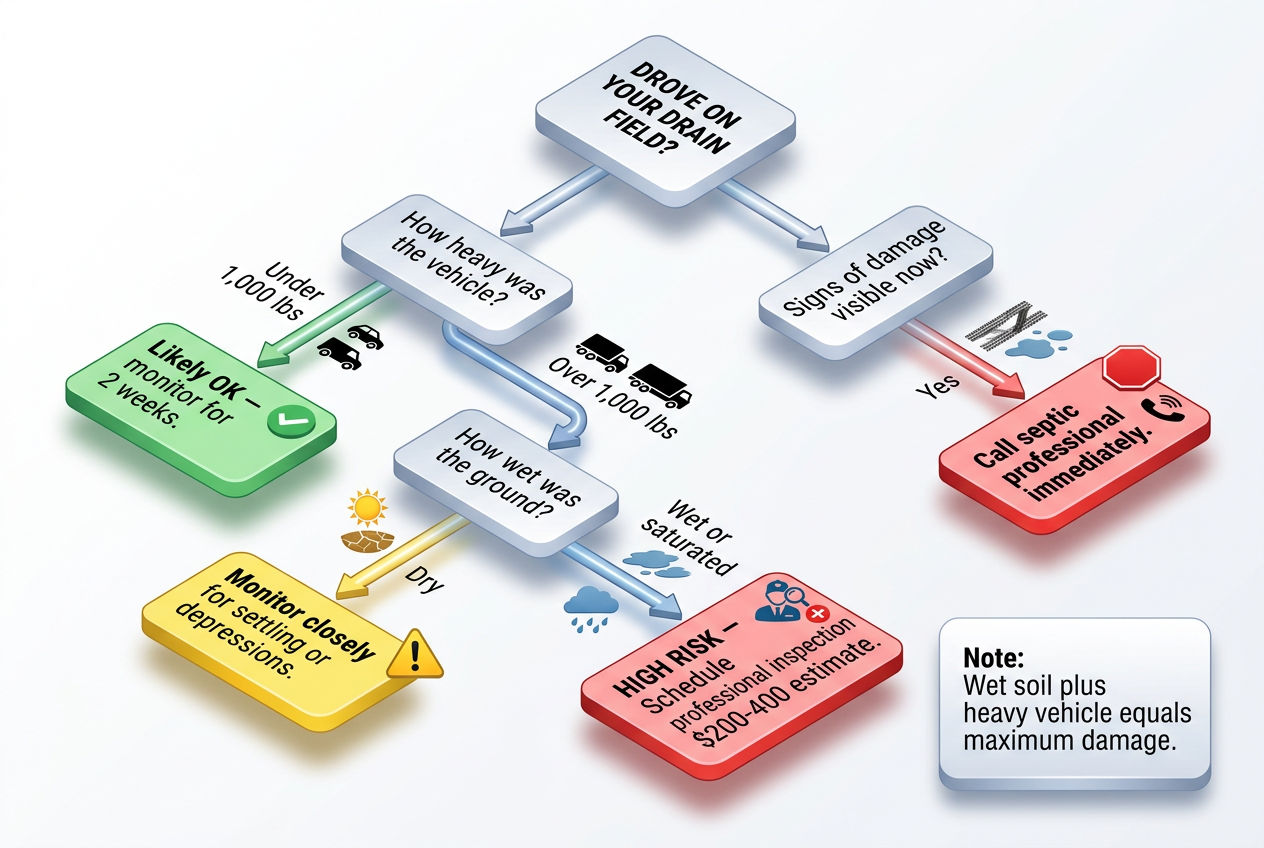
⚠️ Warning: The damage is often invisible until the system fails. You won't see a crack in a pipe six inches underground. What you will see-sometimes months later-are the signs of drain field failure: soggy spots in the yard, sewage odors, slow drains throughout the house, or raw effluent surfacing above ground.

DIY Septic Blueprint
Thinking about building it yourself?
The complete, plain-English plan to size, permit and install your own septic system — designed for homeowners, not contractors. Skip the $15,000–$25,000 quotes and do it right the first time.
Get the DIY Blueprint — $67 →Instant download · 8 modules + 3 bonus guides · 60-day money-back guarantee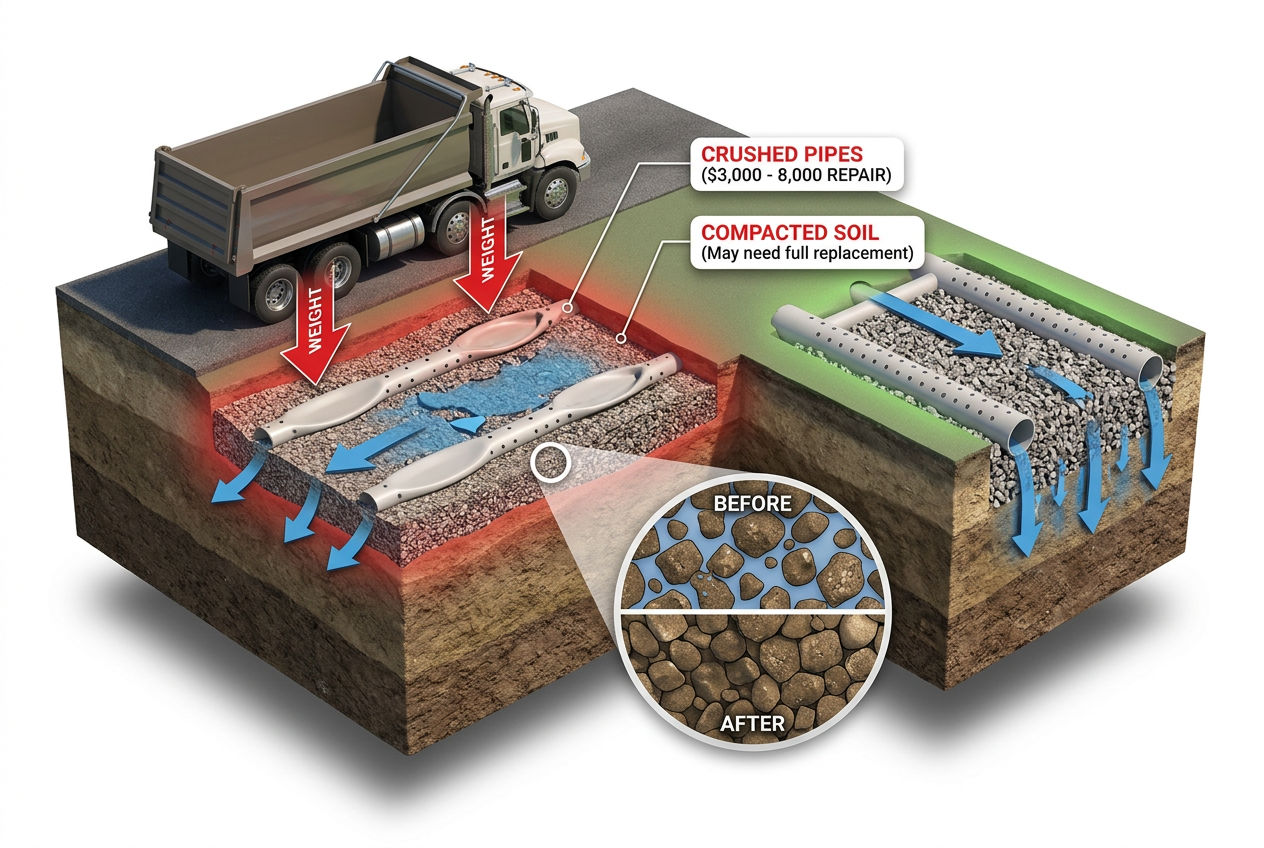
Can You Park an RV or Heavy Vehicle on a Leach Field?
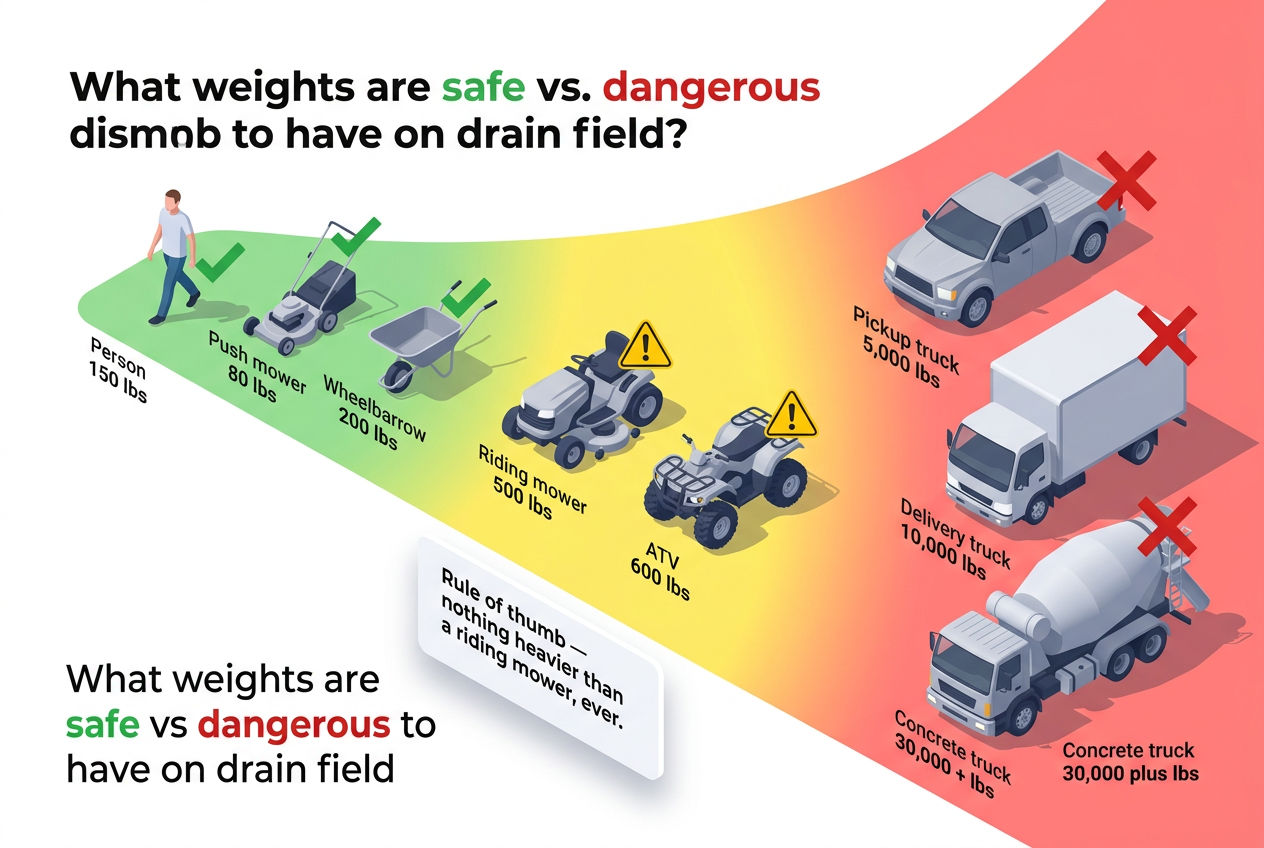
No. An RV or motorhome weighs 10,000–30,000 lbs. A loaded concrete truck can top 60,000 lbs. Even a full-size pickup truck runs 5,000–7,000 lbs-heavy enough to cause soil compaction in a single pass over wet soil. Parking any of these vehicles on your drain field, even briefly, is a serious risk.
Real-World Scenario
Picture this: it's late summer, you've just returned from a camping trip, and you pull your 24-foot Class C motorhome onto what looks like flat grass in your backyard. You park it there for two weeks. The weather turns wet. By the time you move the RV, you've parked roughly 14,000 lbs of vehicle on soil that was already saturated from rain. The compaction can be severe enough to permanently reduce percolation in that zone of the field-even though the grass looks fine.
📊 Quick Fact: This scenario plays out constantly. It's one of the most common causes of premature drain field failure that septic professionals cite.
If you need to park an RV long-term, locate your drain field boundaries first. Our guide on how to find your drain field walks through the process using your as-built permit records, visual clues, and professional locating services. Keep all vehicles-including lawn tractors-off the field area.
How Much Weight Can a Septic Drain Field Support?
There's no universal weight limit for a drain field because the answer depends on soil type, pipe depth, pipe material, and soil moisture. That said, even light loads cause harm under the wrong conditions.
Weight Capacity by Vehicle Type
| Vehicle / Load | Approx. Weight | Risk Level |
|---|---|---|
| Riding lawn mower | 400–800 lbs | Low (avoid when wet) |
| Passenger car | 3,000–4,000 lbs | Moderate to High |
| Full-size pickup truck | 5,000–7,000 lbs | High |
| RV / motorhome | 10,000–30,000 lbs | Very High |
| Loaded dump truck | 30,000–50,000 lbs | Catastrophic |
| Concrete/cement truck | 60,000+ lbs | Catastrophic |
Source: Manufacturer pipe specifications, EPA septic system guidance (epa.gov/septic), and NOWRA (nowra.org) field management resources.
✅ Pro Tip: The "safe" answer most septic professionals give: foot traffic and basic lawn maintenance equipment are fine on a healthy, dry drain field. Anything heavier than a residential walk-behind mower should stay off the field, especially when the soil is wet or frozen and thawing.
The Frozen Ground Myth
One more thing worth knowing: frozen ground is not safe ground. Some homeowners assume that solid, frozen soil adds structural support. It doesn't work that way. Frozen conditions actually make pipes more brittle-corrugated HDPE becomes stiffer and more prone to cracking under impact loads. When the frost thaws, the soil shifts, adding lateral stress to already-stressed pipe joints.
Can You Build a Deck, Patio, or Shed Over a Drain Field?
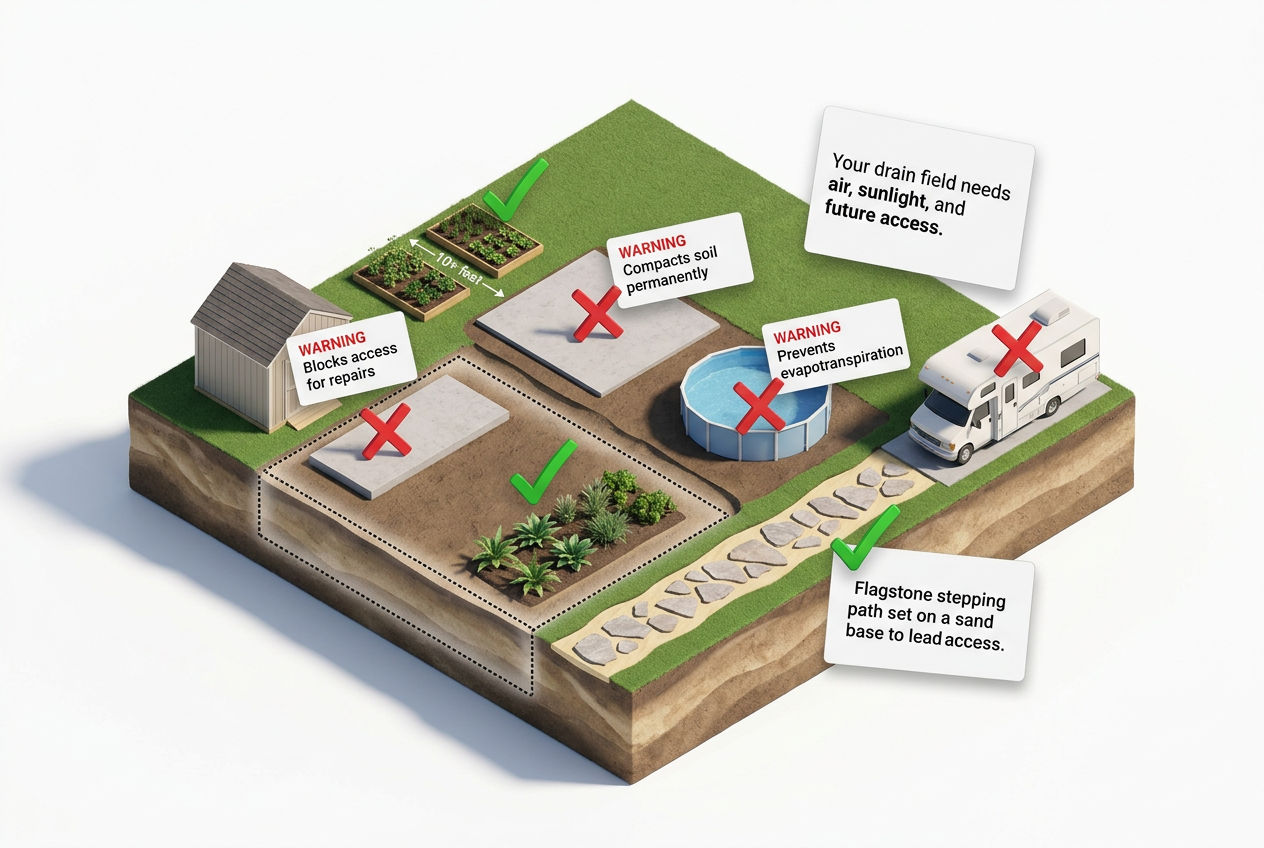
No permanent structure should be built over a drain field-and in most U.S. jurisdictions, doing so without permits is illegal. This covers decks, patios, sheds, detached garages, and any other structure with a foundation or anchored footings.
Why Structures Are Harmful
- Point load concentration: Foundations and footings concentrate enormous point loads on the soil
- Evaporation blockage: Impervious surfaces (concrete, asphalt) prevent the evaporation component of the drain field's treatment process
- Direct pipe damage: Structural footings can directly penetrate distribution pipes during installation
- Access elimination: Any structure blocks access for future inspection, pump-out hose routing, or repair equipment
The Permit Reality
Most state and county health departments require a permit before any structure is placed within the setback zone of a septic system. Typical setback requirements:
- Structures: at least 10–20 feet from the drain field boundary
- Septic tank: 5–10 feet from any structure
The International Residential Code (IRC) provides baseline standards, but the real authority is your local health department-and they almost universally deny permit applications to build over a drain field.
State-by-State Examples
- Florida: Department of Health requires site evaluation and permits through the county health department before any modification to the area over or adjacent to an onsite sewage treatment and disposal system
- Texas: TCEQ (Texas Commission on Environmental Quality) delegates oversight to county-level authorized agents
- California: County environmental health departments handle permitting; setback requirements vary by county but typically exceed state minimums
⚠️ Warning: Building without permits creates a different kind of problem: your title. When you sell your home, the buyer's inspector or their real estate attorney will flag an unpermitted structure over the drain field. That becomes your problem to fix-at the worst possible time.
If you want to know more about how your drain field was installed and what's actually buried under your yard, that context makes these restrictions make a lot more sense.
Can You Put Concrete or Asphalt Over a Drain Field?
Paving over a septic drain field is one of the most damaging things you can do to it. Concrete and asphalt are impervious surfaces-they block both oxygen and evaporation, two things a drain field needs to function. Beyond that, the weight of a poured concrete slab, combined with the vibration of compaction equipment during installation, can crush pipes and displace gravel throughout the entire leach field.
Common Mistake: Driveway Extensions
This is a common issue when homeowners extend driveways. The existing gravel driveway looks close to the field boundary, a contractor offers a great price on extending the concrete pad, and nobody checks the as-built permit to verify where the drain field actually starts. A week later, you have a beautiful new driveway poured directly over your lateral lines.
📊 Quick Fact: The EPA's septic systems guidance (available at epa.gov/septic) specifically identifies covering the drain field with impervious surfaces as a primary cause of system failure. The USDA Rural Development program, which finances septic installations in rural areas, also prohibits impervious coverage over funded systems.
If you're dealing with soggy areas or standing water near your field and wondering whether repair is possible, see our guide on how to fix a saturated drain field. Paving over it is never the solution.
How Do I Know Where My Drain Field Is Located?
Before you park anything, build anything, or grade your yard, you need to know exactly where your drain field is. Guessing wrong is expensive.
Three Reliable Location Methods
-
As-built permit records. Your county health department keeps the original installation permit and site plan for your septic system. Call them or check their online portal. This is the most accurate source. Our detailed walkthrough on finding your drain field covers exactly how to pull these records.
-
Probe the yard. A septic probe (a thin metal rod) lets you trace the tank, distribution box, and lateral lines by feel. This is how professionals locate systems without digging. You can rent probes at equipment rental shops or hire a locating service for $100–$300.
-
Have the system inspected. A licensed inspector can locate and map the entire system in a single visit. If you're about to start any outdoor project, this is a worthwhile investment. You can find a licensed septic inspector in your area through our directory.
How Much Does It Cost to Repair or Replace a Damaged Drain Field?
Drain field damage is not cheap. That's the honest reality, and it's worth knowing before you let a contractor park equipment anywhere near the field.
Repair & Replacement Cost Breakdown
| Repair Type | Cost Range | Details |
|---|---|---|
| Localized pipe repair | $1,500–$5,000 | One or two crushed laterals; varies by depth, pipe access, and distribution box needs |
| Partial field replacement | $3,000–$8,000 | Replacing a section of leach bed |
| Full drain field replacement | $5,000–$20,000 | Conventional system; mound or alternative systems can exceed $30,000 |
| Soil remediation | $1,000–$4,000 | Aerating and restoring compacted soil without pipe replacement (no recovery guarantee) |
For a detailed cost breakdown, see our drain field replacement cost guide.
💡 Key Takeaway: A healthy drain field lasts 15–30 years under normal conditions. Compaction and coverage damage shorten that lifespan dramatically-sometimes to a few years. The math is simple: avoiding vehicles and structures costs nothing. Replacing a failed field costs you a significant amount of money, disruption, and potentially a permit battle with your county health department.
If you want a professional to assess your field before any project starts, find a licensed septic company near you through our directory. This is not the place to skip a consultation.
How to Protect Your Drain Field Long-Term
You already know the rules: no driving, no parking, no building, no paving. Here's what a well-maintained drain field actually looks like day-to-day:
Best Practices for Drain Field Protection
Plant the right vegetation. Grass is ideal over a drain field. Its shallow roots don't penetrate pipes, and it absorbs surface moisture without disrupting the soil structure. Avoid trees and large shrubs-root intrusion is a leading cause of pipe failure in older systems. Keep any tree with an aggressive root system at least 30 feet from the field boundary.
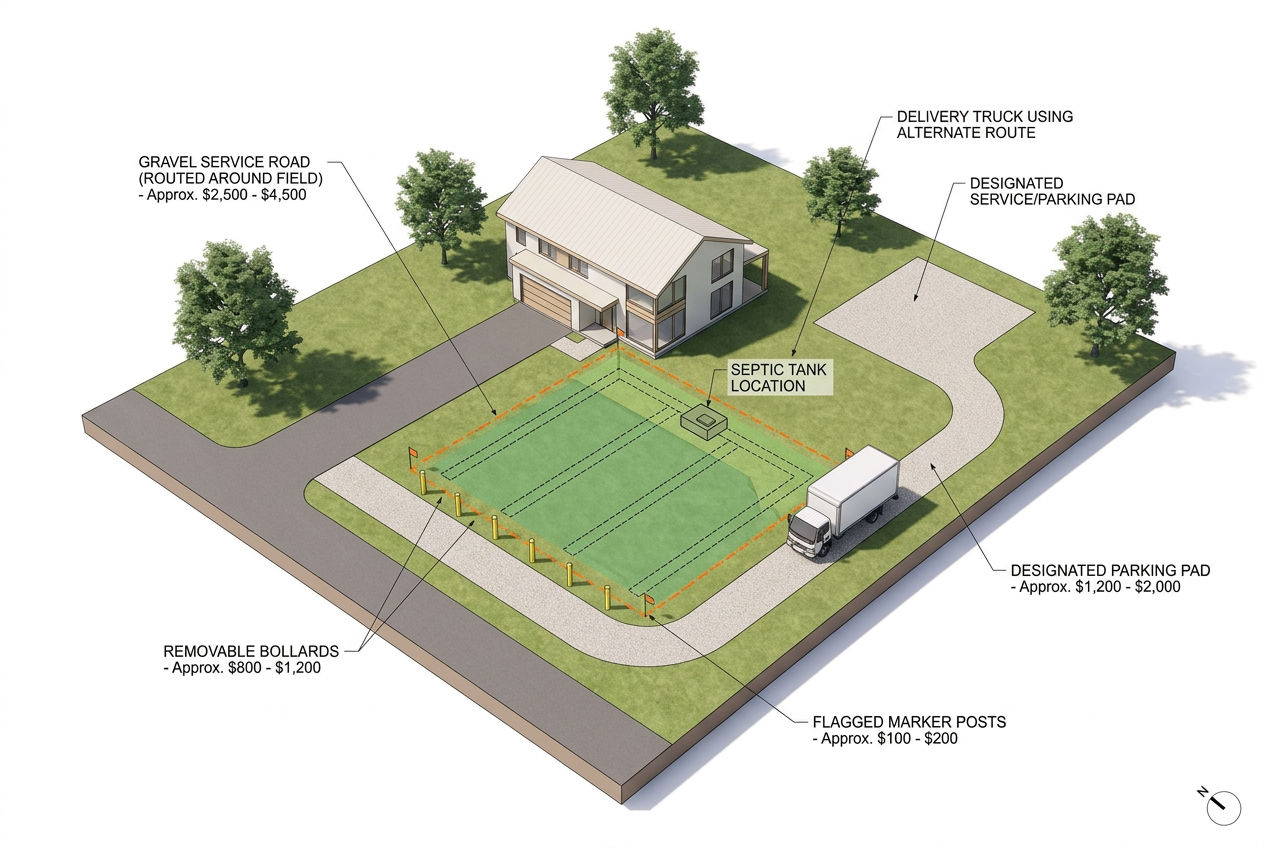
Mark the boundaries. Small landscape flags or a simple fence line prevent accidental driving. If you have guests, contractors, or delivery trucks using your yard regularly, visible markers prevent the "I didn't know" conversation after the damage is done.
Don't overload the system. A drain field sized for a 4-person household will fail faster if you consistently run more water through it than it was designed to handle. Our drain field size guide explains how sizing works and what happens when capacity is exceeded.
Pump your tank on schedule. An overfull tank sends solids into the drain field, clogging the soil biomat-the biological treatment layer just below the gravel bed. The EPA recommends pumping every 3–5 years for most households. See our complete septic maintenance guide for a full service schedule.
Schedule inspections. A septic inspection every 3–5 years catches early signs of compaction or pipe stress before they become replacement-scale problems.
✅ Pro Tip: Understanding how your drain field fits into your overall septic system makes all of these precautions feel less arbitrary. These aren't random rules-they're protecting a system that, if treated right, will serve your home for decades.
Need drain field help? Find a qualified contractor near you on SepticTankHub.
Learn more about our drain field services services.
Related reading: septic system installation process.
Sources & Methodology
- U.S. Environmental Protection Agency - Septic Systems: Primary source for drain field function, impervious surface guidance, and maintenance recommendations.
- National Onsite Wastewater Recycling Association (NOWRA): Industry standards for drain field design, loading rates, and field management practices.
- International Residential Code (IRC): Baseline setback and construction standards referenced for structure placement near septic systems.
- Texas Commission on Environmental Quality (TCEQ): State-specific regulatory framework for onsite sewage facilities; county-level authorized agent delegation model.
- Florida Department of Health - Onsite Sewage Program: Site evaluation and permitting requirements for modifications to onsite sewage treatment systems.
Cost data sourced from contractor survey data and regional permit records. Vehicle weight figures sourced from manufacturer published curb weights. Pipe specifications sourced from Schedule 40 PVC and HDPE corrugated pipe manufacturer load ratings.
[Author bio placeholder]
Need help with your septic system? Browse local septic companies in Tennessee or Virginia.
Free download
Not ready for the Blueprint? Start free.
Grab the free DIY Septic Planning Kit — the permit-first checklist, perc-test cheat sheet, and sizing tables that keep your build from getting red-tagged.
Was this article helpful?
Frequently Asked Questions
Recommended Resources
📖 Related Articles
- Signs Your Drain Field Is Failing (And What to Do)
- How to Find Your Septic Drain Field
- How to Install a Septic Drain Field
- How to Fix a Saturated Drain Field
- Leach Field Size by Bedrooms: Drain Field Sizing Chart (2026)
- The Complete Septic Tank Maintenance Guide
- What Is a Septic System? How It Works (Visual Guide)
💰 Cost Guides
🔧 Services
Find Septic Professionals Near You
Compare licensed, verified septic companies by area — top county markets and cities below, or browse all 50 states.
County markets
Popular cities
