
Quick Answer
Starting a septic tank business requires a state contractor license, a vacuum pump truck, liability insurance, and a wastewater hauling permit. Total startup costs range from $75,000 to $350,000 depending on whether you buy new or used equipment. A solo operator running 3–5 jobs per day can generate $150,000–$300,000 in annual revenue within the first two years.
Key Takeaways
- The U.S. septic services market tops $5 billion annually — roughly 21 million homes depend on septic systems (EPA data)
- Startup costs run $75,000–$350,000+; a used pump truck is the biggest variable
- Solo operators net $75,000–$150,000/year after expenses; small fleets can clear $500,000–$1M+ in gross revenue
- Every state has its own licensing requirements — there is no national septic contractor license
- The business has built-in recurring demand: systems need pumping every 3–5 years, guaranteed
Why the Septic Industry Is Worth a Hard Look Right Now
About 1 in 5 American homes — roughly 21 million properties — runs on a septic system, according to the EPA. Most of those tanks were installed 20 to 40+ years ago. They need pumping, inspection, repair, and eventually replacement. That demand isn't going anywhere.

New rural and suburban-fringe development continues adding systems to the ground every year, layering fresh customers on top of an already large installed base. Emergency calls — backed-up tanks, failing drain fields — arrive in every economic climate. People can't stop flushing.
To put a number on the recession-resistance argument: during the 2008–2009 financial crisis, IBISWorld data shows the septic pumping segment contracted less than 3% at its worst year, compared to double-digit declines in residential construction. Maintenance services on existing systems held up because homeowners couldn't defer a failing tank the way they could defer a kitchen renovation.
If you're also curious about what owning a septic business actually looks like financially, we cover the profit picture in detail. Or if you're considering skipping the startup phase entirely, our guide to buying an existing septic business walks through that path too. For a broader overview of the industry, start with our septic business owner's hub which covers everything from licensing through scaling.
Step 1: Learn the Business Before You Touch a Truck
Spend time understanding how septic systems work before you spend a dollar on equipment. A septic system isn't just a buried tank — it's a complete wastewater treatment ecosystem involving inlet and outlet baffles, effluent filters (like the Polylok PL-122), distribution boxes, and a drain field made up of leach laterals running through gravel or chamber systems like Infiltrator Water Technologies units.
Why does this matter for a business owner? Because your customers will ask questions you need to answer confidently. Because you'll need to identify upsells — a pump-out that reveals a cracked baffle wall becomes a repair call. Because inspectors and regulators will test your knowledge during licensing.
If you're coming from a plumbing or excavation background, you have a head start. If you're starting from scratch, consider working for a septic company for 6–12 months before launching. Many state licensing exams require documented field experience anyway.
Step 2: Research Your State's Licensing Requirements
Most aspiring owners stall here — and the confusion is legitimate. There is no federal septic contractor license. Every state (and sometimes individual counties) sets its own rules.
Here's what varies by state:
- Florida requires a Registered Septic Tank Contractor (RSTC) license issued through the Florida Department of Health. The exam covers system design, installation, and maintenance.
- Texas delegates septic regulation to county-level Designated Representatives (DRs) under the Texas Commission on Environmental Quality (TCEQ). Licensing happens at the county level.
- North Carolina requires a Certified Soil Scientist or Licensed Soil Scientist evaluation for installation, plus a separate contractor license through the state.
- Massachusetts has its own Title 5 system, which requires licensed inspectors and certified installers under the Massachusetts Department of Environmental Protection.
Licensing costs run $500–$5,000 in application fees, exam fees, and renewal costs. Processing time ranges from 2 to 12 weeks. Plan for this before you plan your launch date.
You'll also need a wastewater hauling permit in most states — this governs where you can legally dispose of the waste you pump. Check with your state's Department of Environmental Quality (DEQ) or equivalent agency.
The National Association of Wastewater Technicians (NAWT) at nawt.org also offers nationally recognized certification programs that can strengthen your credentials even when your state doesn't require them.
Step 3: Write a Septic Tank Business Plan
A solid business plan does two things: it forces you to make real decisions, and it makes lenders take you seriously. You'll need one if you're financing a truck.
Your septic tank business plan should cover:
Service area: How many homes are on septic systems within a 30-mile radius? Use county property records and the EPA's septic systems data to estimate market size.
Service menu: Start with residential septic pumping. Add septic system maintenance contracts, septic tank inspections (strong demand from real estate transactions), and eventually drain field repair. Each service tier improves your revenue per customer.
Pricing strategy: Standard residential pump-outs for a 1,000-gallon tank run $300–$600 nationally, according to our septic pumping cost guide. Rural markets with long drive times — think central Minnesota or rural Montana — sit at the higher end, $400–$600+. Suburban Florida or the Carolinas often comes in at $300–$450. Premium emergency services command $600–$1,200+ depending on timing and complexity.
Revenue projections: Running 3–5 pump-outs per day at $350–$450 average puts a solo operator at $1,050–$2,250 per day. Five days a week, 48 weeks a year: $252,000–$540,000 in gross revenue. Subtract labor (if you hire), fuel, disposal fees, insurance, and loan payments, and you're looking at net margins of 20–35% for an established operation.
Growth path: Two trucks doubles capacity. Three trucks with a dispatcher is a small regional operation. Some owners scale to $1M+ in gross revenue within five years by adding grease trap cleaning, commercial septic services, and portable restroom rental.
Step 4: Choose and Finance Your Equipment
Your vacuum/pump truck is your most important asset — and your biggest expense. Here's how the numbers break down.
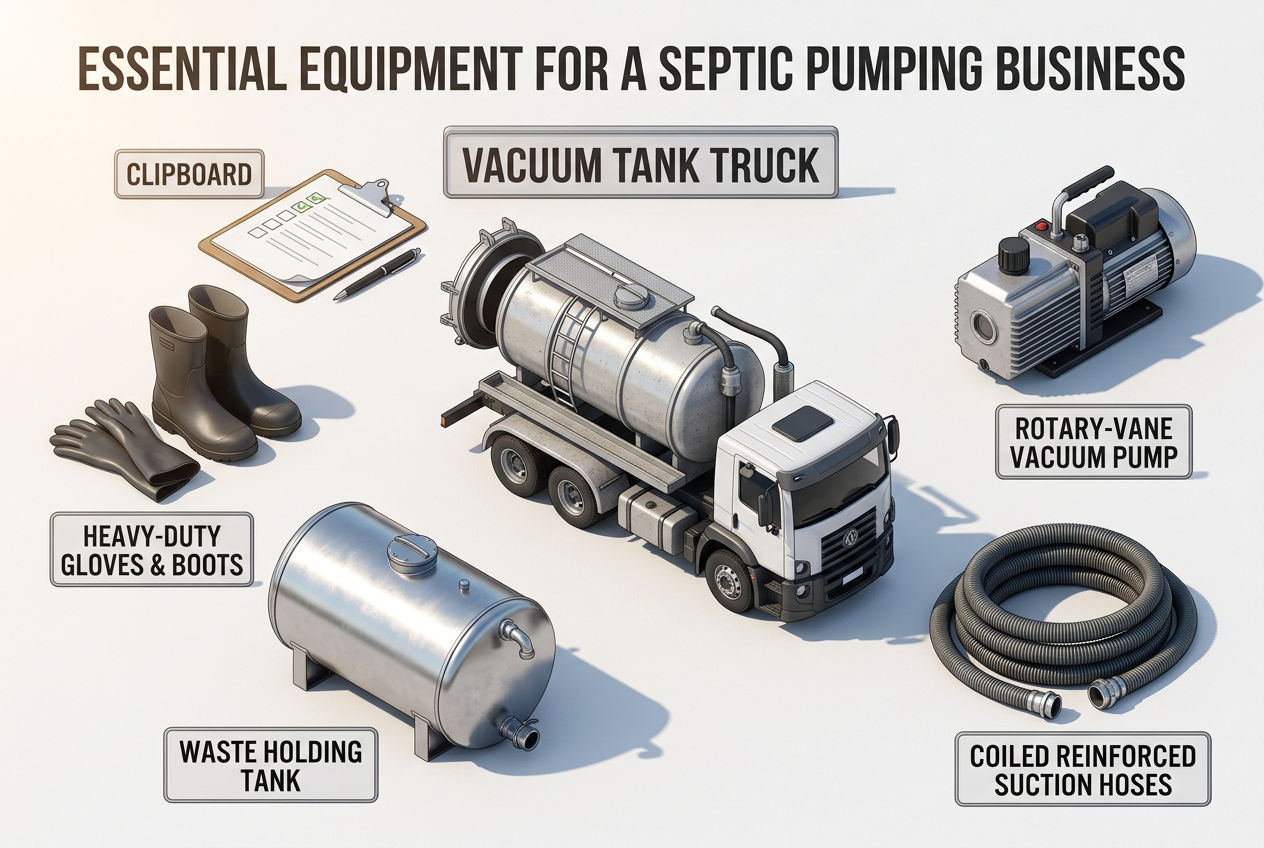
Vacuum Truck Costs
| Equipment Type | Cost Range | Tank Capacity | Best For |
|---|---|---|---|
| Used vacuum truck (10–15 yr old) | $25,000–$50,000 | 2,000–2,500 gal | Budget start, rural market |
| Used vacuum truck (5–10 yr old) | $50,000–$80,000 | 2,500–3,500 gal | Best value for solo operator |
| New vacuum truck (mid-spec) | $120,000–$180,000 | 3,000–4,000 gal | Financing-dependent launch |
| New vacuum truck (heavy-spec) | $200,000–$300,000+ | 4,000–5,000 gal | Multi-service, high volume |
| Trailer-mounted pump unit | $15,000–$40,000 | 500–1,500 gal | Supplement, not primary |
Source: Industry dealer estimates; National Onsite Wastewater Recycling Association (NOWRA) member surveys
For a first business, a used vacuum truck in the 2,500–3,500 gallon range hits the sweet spot. It's large enough to handle most residential jobs (a typical 1,000–1,500 gallon tank) without multiple trips to the dump station, but affordable enough to preserve cash flow in year one.
Financing options:
- SBA 7(a) loans for small business equipment purchases
- Equipment financing through truck dealerships (some offer 10–15% down on used trucks)
- USDA Rural Development business loans if you're operating in a rural area — check rd.usda.gov
- Equipment leasing (higher long-term cost, but lower entry barrier)
CDL Requirement
Most septic pump trucks exceed 26,001 lbs GVWR, which triggers the Class B Commercial Driver's License (CDL) requirement. Budget 4–8 weeks and $1,500–$3,000 for CDL training and testing if you don't already hold one.
If you're hiring drivers, CDL holders command a premium wage — typically $22–$35/hour depending on region.
Step 5: Set Up Your Business Structure and Insurance
Register your business before you start operating. Most septic business owners choose an LLC for liability protection — a single-member LLC in most states costs $50–$500 to register and takes 1–2 weeks.
Insurance You Cannot Skip
General liability insurance: $2,000–$6,000/year. This covers property damage and bodily injury claims. If your hose blows and ruins a homeowner's landscaping, this pays.
Commercial auto insurance (vacuum truck): $3,000–$8,000/year. Standard personal auto policies exclude commercial vehicles. Get a dedicated commercial policy from day one.
Surety bond: $500–$3,000/year where required by state licensing. This protects customers if you fail to complete contracted work.
Workers' compensation: Required in most states the moment you hire your first employee. Rates vary by state and payroll — budget 5–10% of gross payroll for septic work classifications.
Pollution liability: Strongly recommended. If waste spills during transport or at a disposal site, standard general liability often excludes pollution events. Specialized pollution liability policies run $1,500–$4,000/year and are worth every cent.
Step 6: Handle Waste Disposal Logistics
New owners are often caught off guard by this: you can pump the tank — but you need an approved place to take the waste before you run your first job.
You need a licensed disposal facility: a municipal wastewater treatment plant, a land application site, or a composting facility that accepts septage. Some municipalities charge $0.03–$0.10 per gallon for septage disposal. Others charge flat rates per load.
A practical approach before launch: Call three municipal wastewater treatment plants within a 45-minute radius of your service area as a prospective hauler — not as a homeowner. Ask directly whether they accept septage, what their gate fee structure is, and whether they require a hauler registration. In most markets you'll find at least one accepting facility. In tighter urban markets, this conversation sometimes reveals that the nearest plant has a waiting list for new haulers — which is exactly the kind of constraint that can delay your launch if you discover it on day one rather than month three of planning.
Important limitation to acknowledge here: Disposal access is the single variable in this business that's hardest to plan around from a distance. Operators in states with stricter effluent regulations — California and Washington are notable examples — sometimes report that approved disposal sites are 60–90 minutes away, which materially cuts into the number of jobs per day a single truck can run. If you're planning to launch in a coastal or environmentally regulated state, confirm your nearest disposal facility and its current availability before you finalize your equipment purchase.
According to the Water Environment Federation (WEF), approximately 34 states have formal septage management programs that govern hauler registration and disposal site approval. Check your state's program requirements through your DEQ before signing any disposal contracts.
Step 7: Price Your Services to Cover Costs and Make Money
Pricing in the septic industry follows a fairly consistent structure, but getting it right in your specific market requires working through the numbers — not just matching a competitor's rate.
A worked pricing example: Say your daily fixed and variable costs as a solo operator break down like this:
- Truck payment (financed used truck): $800/day annualized
- Insurance (all policies combined): $45/day annualized
- Fuel (100 miles at $0.25/mile loaded): $25/day
- Disposal fees (8 loads × average 300 gallons × $0.07/gal): $168/day
- Phone, software, supplies: $20/day
- Total daily cost floor: approximately $1,058/day
Divide that by 4 jobs (a conservative daily target): you need $264 per job just to break even. At $375/job — a below-market rate in most regions — you're generating $111 of gross profit per job before your own labor. Run 5 jobs instead of 4, and that same $375/job generates $817/day in gross profit.
This is why operators who optimize route density — clustering jobs geographically so they're spending less time driving between stops — often outperform operators who simply charge more. Reducing drive time by 20 minutes per job on a 5-job day recovers 100 minutes of productive capacity.
For a detailed breakdown of what customers pay and what that means for your margin, see our septic pumping cost guide.
Step 8: How Much Does It Cost to Start a Septic Tank Business?
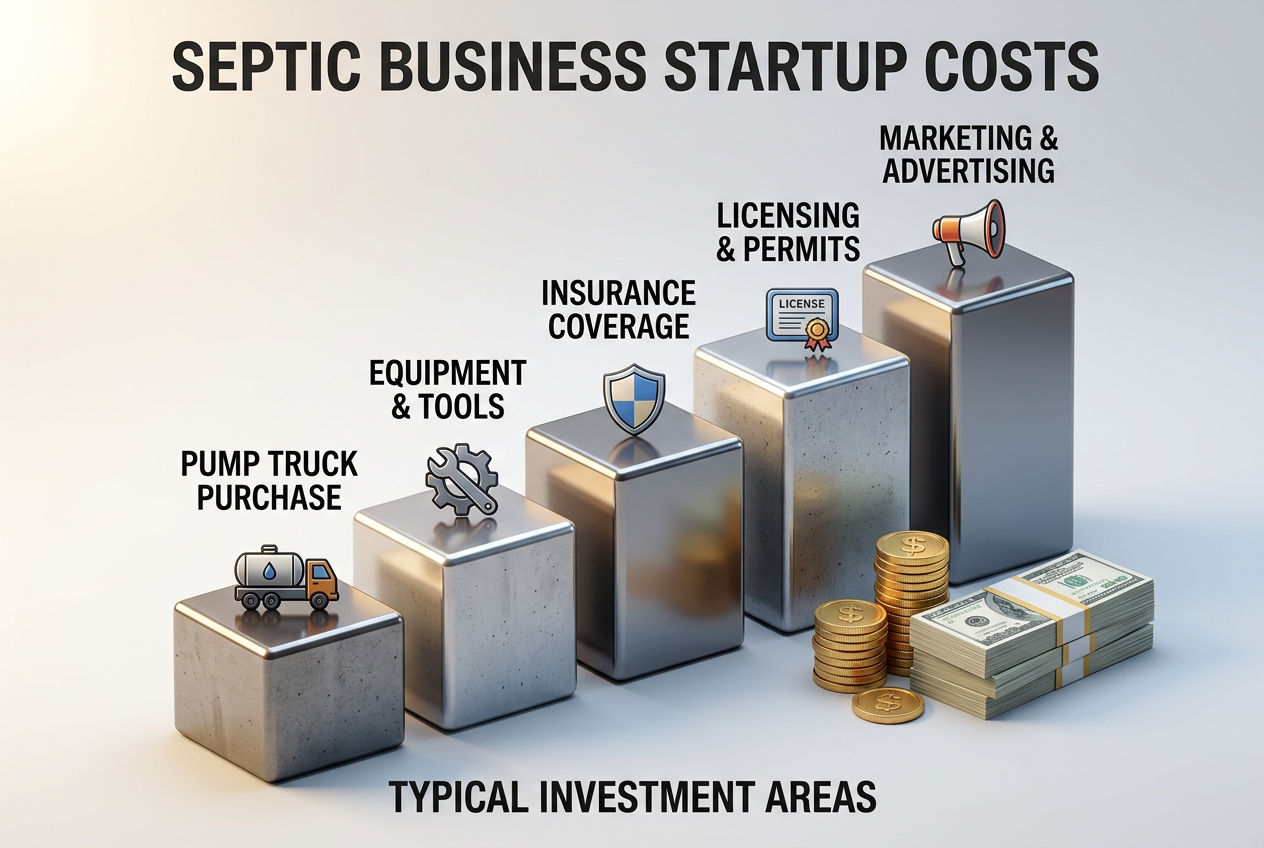
Startup costs for a septic tank business range from $75,000 to $350,000+. Here's where the money goes:
| Expense | Low End | High End |
|---|---|---|
| Vacuum truck (used) | $25,000 | $80,000 |
| Vacuum truck (new) | $120,000 | $300,000 |
| CDL training | $1,500 | $3,000 |
| Licensing and permits | $500 | $5,000 |
| LLC registration | $50 | $500 |
| Insurance (first year) | $7,000 | $21,000 |
| Tools and equipment | $2,000 | $8,000 |
| Website and marketing | $1,500 | $5,000 |
| Working capital (3 months) | $10,000 | $25,000 |
| Total | ~$48,000–$75,000 | ~$350,000+ |
The low end assumes a very used truck purchased for cash and minimal working capital. The high end reflects a new heavy-spec truck financed with full first-year insurance and marketing spend. Most first-time owners land between $80,000–$150,000 in total startup investment.
Step 9: How Much Money Can a Septic Tank Business Make?
A solo septic tank operator running 4–5 jobs per day in a mid-sized market can expect $150,000–$300,000 in gross revenue in year one, with net margins of 20–35% once operations stabilize — meaning $30,000–$105,000 in owner income. That range is wide because geography, job mix, and disposal costs vary significantly.
What established operators report: According to NOWRA member survey data, single-truck owner-operators with 3+ years of experience report median gross revenue of $185,000–$240,000 annually, with owner compensation (salary plus profit distribution) of $75,000–$130,000. Multi-truck operations with 3–5 vehicles report gross revenue of $600,000–$1.2M, with owner income heavily dependent on whether the owner is still operating a truck or managing exclusively.
Honest caveat: Those numbers reflect operators who made it past year two. First-year income is typically lower — equipment downtime, slower customer acquisition, and the learning curve on efficient routing all compress margins early. Some operators we've reviewed took 18–24 months to reach full daily capacity. Planning your personal finances around a 12-month runway rather than a 6-month runway reduces the pressure that causes early-stage owners to underprice jobs just to fill the schedule.
Septic Business Blueprint
Thinking about starting your own septic business?
The complete, plain-English playbook to start (or buy), license and grow a profitable septic business — the models, the money math, trucks, disposal, insurance, pricing and how to land your first customers.
Get the Blueprint — $297 →Instant access · 12-chapter playbook + 6-piece toolkit · 60-day money-back guaranteeRegional income variation matters more than most guides acknowledge. Here's how markets differ:
- Northeast (Massachusetts, Connecticut, New York suburbs): High density of older septic systems, high per-job pricing ($450–$650), but also higher insurance costs, stricter disposal regulations, and more competition in metro-adjacent areas. Strong market for real estate inspection work.
- Southeast (Florida, Carolinas, Georgia): High volume of systems, competitive pricing ($300–$450), but year-round operating season and strong new construction activity adding fresh customers constantly. Florida's RSTC licensing is rigorous but creates a meaningful barrier against fly-by-night competitors.
- Midwest (Ohio, Indiana, Michigan rural markets): Lower per-job pricing ($300–$400), but low disposal costs, low competition density in rural counties, and strong loyalty dynamics — customers who find a reliable operator tend to stay for decades.
- Mountain West and Plains (Montana, Wyoming, rural Colorado): Highest per-job pricing ($500–$800+) due to drive times and low competition, but also the lowest job density. A single-truck operator might run 2–3 jobs per day rather than 5, and winter operating conditions require additional equipment investment.
Understanding how often septic tanks need pumping in your specific market — soil type, system age, household size distribution — helps you model realistic job frequency and recurring revenue potential.
Step 10: Build Your Customer Base From Day One
Your first 50 customers are the hardest to get and the most valuable you'll ever have — because each one becomes a recurring account and a referral source.
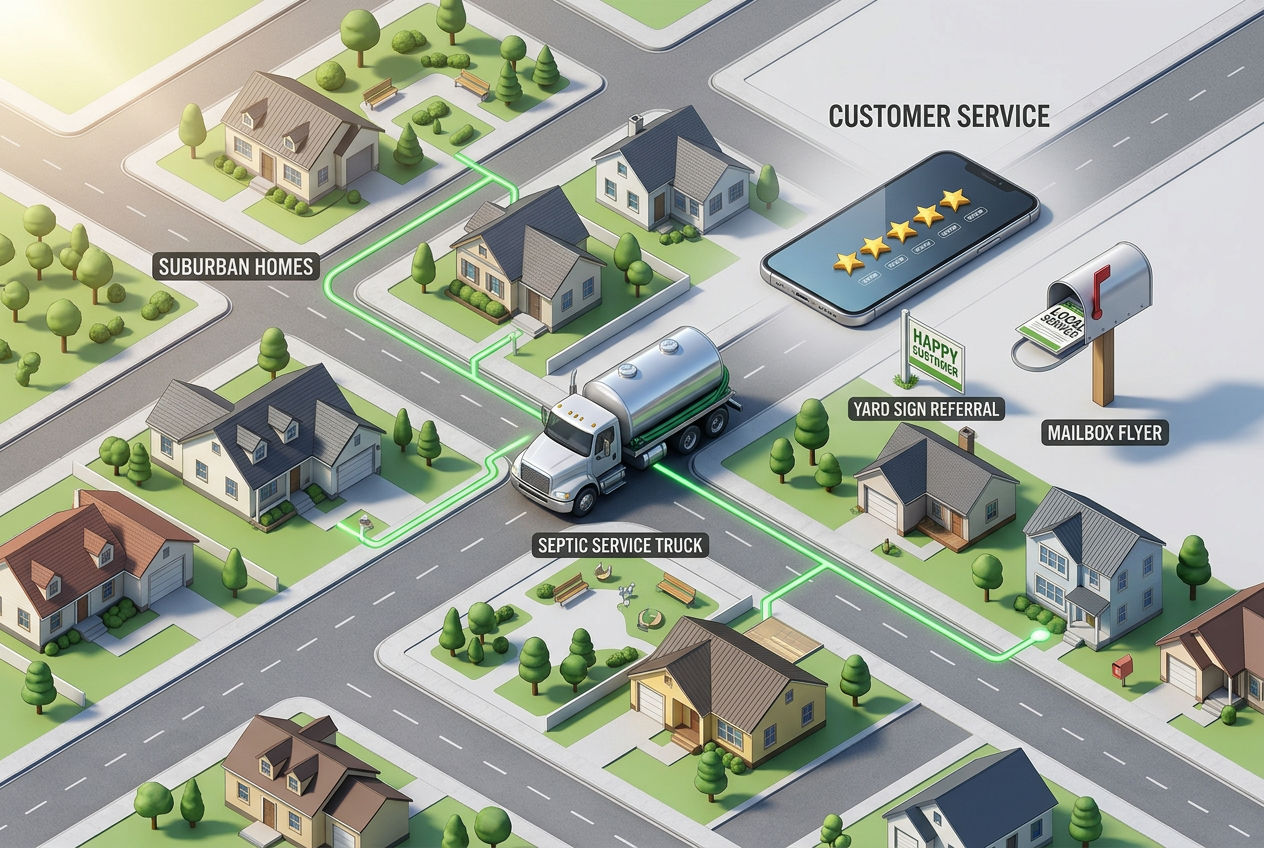
Real estate agents and home inspectors: A septic inspection is required or strongly recommended in most real estate transactions involving properties on septic. Building relationships with two or three active real estate agents in your market can generate a consistent stream of inspection calls — and inspection calls that reveal maintenance needs convert directly into pump-out revenue. One operator in central Virginia built his first year's revenue almost entirely through three real estate agency relationships before he'd spent a dollar on digital advertising.
Google Business Profile: Claim and optimize your profile before you run your first job. Septic pumping is a local service that people search for urgently — "septic pumping near me" — and a complete GBP with photos, service areas, and early reviews will outrank a bare listing. According to BrightLocal's 2024 Local Consumer Review Survey, 87% of consumers read online reviews for local service businesses, and the average consumer reads 10 reviews before trusting a business.
Direct mail in your service radius: A 500-piece mailer to homes on well and septic (identifiable through county records in most markets) costs $300–$500 and routinely generates 5–15 calls in rural and suburban markets. The response rate is low in percentage terms but the customer lifetime value — a customer who pumps every 3 years for 20 years — justifies the acquisition cost.
Plumber referral network: Plumbers encounter septic problems they can't fix. A standing referral arrangement — where you refer plumbing work back to them and they refer septic calls to you — costs nothing and generates warm leads from a trusted source.
SepticTankHub.com directory: Getting your business listed on industry directories that rank for service-area searches puts your name in front of people actively looking for help.
For related context on the service side of the business, see our guides on septic system installation, the septic inspection process, and drain field installation — understanding these services deeply helps you speak credibly with customers and identify upsell opportunities.
Step 11: Operations, Scheduling, and Growing Beyond One Truck
Your first year, you are the operator, dispatcher, bookkeeper, and salesperson. That's the reality of a solo service business launch — not a problem to be solved immediately, but a phase to be managed deliberately.
Route efficiency is your primary operational lever. Grouping jobs by geography — running Monday in the northwest quadrant of your service area, Tuesday in the southeast, and so on — cuts fuel costs and travel time while letting you build density in each zone. Operators who route efficiently often complete one additional job per day compared to operators who accept jobs in random geographic order. Over a year, that's 240+ additional jobs on the same truck with the same overhead.
Software from day one: Field service management platforms like Jobber, ServiceTitan, or Housecall Pro handle scheduling, invoicing, customer records, and route optimization. The cost ($50–$300/month depending on tier) pays for itself quickly when you're running a full schedule and can't afford to miss a call or lose a customer record.
Hiring your first employee: When you're consistently turning away work — when your schedule is full 4–5 days a week — it's time to consider a second truck and a second operator. This is the most capital-intensive growth step you'll take, and it requires that your first truck is generating enough margin to service debt on the second. The operational systems you build in year one — standardized job checklists, disposal route documentation, customer communication templates — are what make handing work to a second operator viable without quality falling off.
For operators planning to add installation and repair services alongside pumping, our guides on failed perc test options and drain field installation cover the technical and business dimensions of expanding into that work.
Sources & Methodology
- U.S. Environmental Protection Agency (EPA): Septic system prevalence data (21 million systems) sourced from EPA's "Septic Systems Overview" page at epa.gov/septic
- National Onsite Wastewater Recycling Association (NOWRA): Equipment cost ranges and operator revenue figures from NOWRA member survey publications; industry association for onsite wastewater professionals at nowra.org
- National Association of Wastewater Technicians (NAWT): Certification program details and training requirements at nawt.org
- Water Environment Federation (WEF): State septage management program data; wef.org
- BrightLocal Local Consumer Review Survey 2024: Consumer review behavior statistics for local service businesses at brightlocal.com
- USDA Rural Development: Business loan program details for rural operators at rd.usda.gov
- IBISWorld: Septic pumping industry recession performance data; subscription-based industry research platform
Pricing ranges, insurance costs, and equipment figures reflect operator-reported data compiled through industry association surveys and dealer estimates. Individual costs vary by state, market size, and operator experience. This guide is updated annually to reflect current market conditions.
Was this article helpful?
Frequently Asked Questions
Recommended Resources
📖 Related Articles
- Is a Septic Business Profitable? Real Owner Salary & Margins
- Buying a Septic Business: What to Look For and What to Pay
- What Is a Septic System? How It Works (Visual Guide)
- How Often Should You Pump Your Septic Tank?
- What Happens During a Septic Inspection?
- How to Install a Septic Drain Field
- Land Failed the Perc Test? Here Are Your Options
💰 Cost Guides
🔧 Services
Find Septic Professionals Near You
Compare licensed, verified septic companies by area — top county markets and cities below, or browse all 50 states.
County markets
Popular cities
