
Quick Answer
Is a septic pumping business profitable? For most owner-operators, yes — with gross margins typically running 50–65% and net margins of 20–35%. Solo operators commonly take home $50,000–$150,000 annually. Multi-truck companies earn $100,000–$300,000+. Strong recurring demand, low customer acquisition costs, and a fragmented market make this one of the more resilient trades to own.
Key Takeaways
- Solo owner-operators typically earn $50,000–$150,000 per year; multi-truck operations can clear $100,000–$300,000+ in owner income.
- Gross profit margins on pumping run 50–65%, with net margins of 20–35% for established businesses.
- A used pump truck ($30,000–$80,000) is your biggest startup expense. New trucks run $100,000–$200,000+.
- The EPA estimates roughly 21 million homes — about 1 in 5 — rely on septic systems, and the EPA recommends pumping every 3–5 years. That's built-in repeat business.
- Disposal/tipping fees ($25–$100+ per load) and fuel are the variable costs that eat margins fastest.
How Much Does a Septic Pumping Business Owner Make a Year?
A solo owner-operator running one pump truck typically earns $50,000–$150,000 in annual take-home pay. Your actual number depends on local market pricing, how many jobs you run per week, disposal costs, and whether you're doing straight pumping or mixing in inspections and minor repairs.
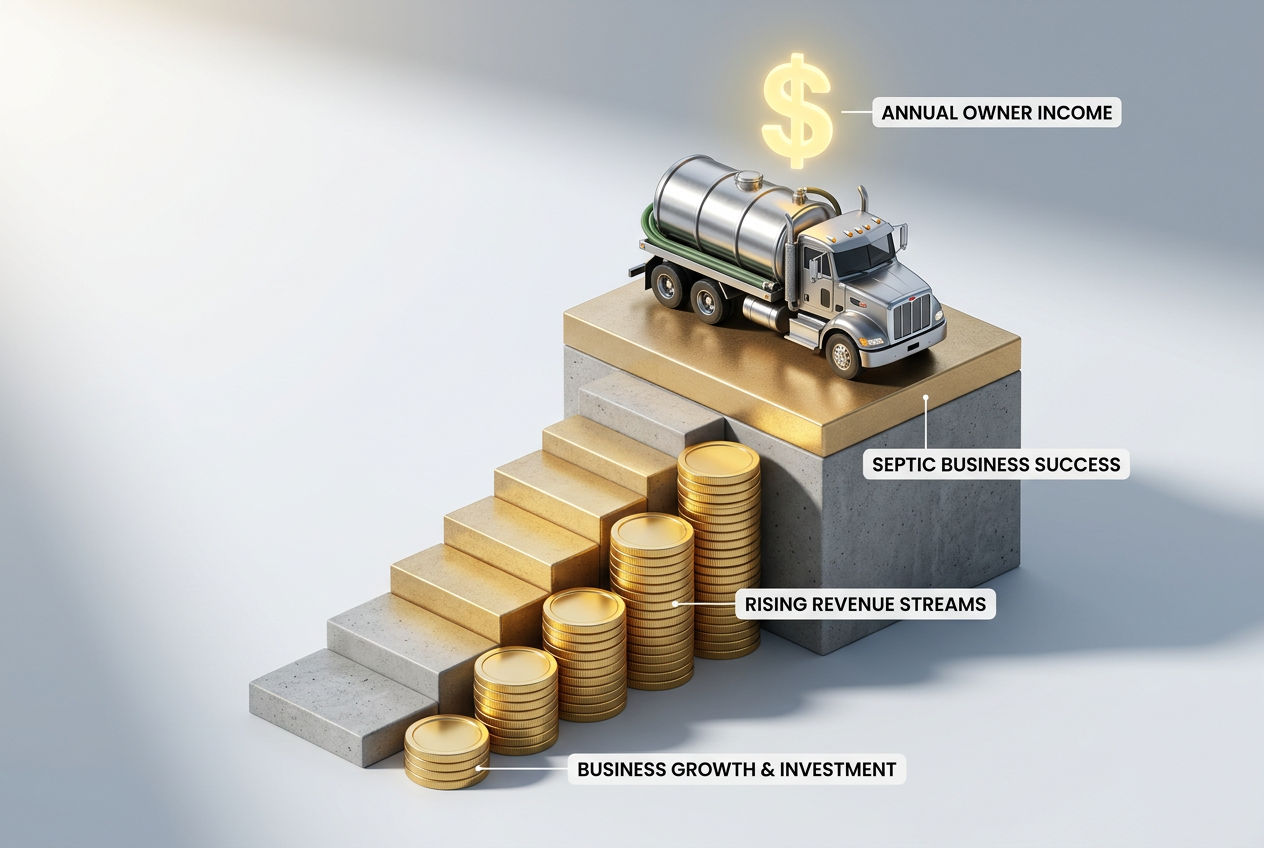
Owners of multi-truck septic companies generally see $100,000–$300,000+ in owner compensation once the business matures. Some larger regional operators running three to five trucks and adding installation work push well past that. Those businesses require real infrastructure — office staff, drivers, dispatch systems — and carry proportionally higher overhead.
Year one is often about breaking even on equipment and building a route. By year three, with a solid customer base that cycles every 3–5 years on the recommended pumping schedule, income becomes much more predictable. A pumper who bought a used truck for $55,000, built a 400-customer route in 18 months, and locked in annual maintenance agreements told me his third-year net topped $130,000 — working four days a week. That trajectory is realistic, not exceptional.
How Much Does a Septic Business Make? Revenue Ranges by Business Size
Solo owner-operator (1 truck): $75,000–$300,000 in annual gross revenue. A pumper running 6 residential jobs per day at $350 per job clears $2,100 in daily revenue. At 220 working days a year — accounting for weather, maintenance days, and vacation — that's $462,000 in gross before expenses. But 6 jobs a day, every working day, is a strong pace. More realistic for a new operator is 4 jobs a day, giving you roughly $308,000 gross. That's still a solid single-truck business.
Multi-truck operation (2–5 trucks): $500,000–$2,000,000+ in annual gross revenue. Each truck essentially replicates the single-operator revenue model, minus the owner's labor on that specific truck. Per-job revenue nationally averages $300–$600 for a standard residential pump-out. Prices vary significantly by state — a 1,000-gallon tank in rural Iowa might run $275–$350, while the same job in suburban Massachusetts often fetches $450–$700, partly because Massachusetts Title 5 regulations require licensed inspectors and additional documentation that commands a premium.

Septic Business Blueprint
Thinking about starting your own septic business?
The complete, plain-English playbook to start (or buy), license and grow a profitable septic business — the models, the money math, trucks, disposal, insurance, pricing and how to land your first customers.
Get the Blueprint — $297 →Instant access · 12-chapter playbook + 6-piece toolkit · 60-day money-back guaranteeWhat Are the Profit Margins in a Septic Pumping Business?
Gross margin for septic pumping typically runs 50–65%, according to industry data aggregated by NAWT (National Association of Wastewater Technicians) and cross-referenced against operator interviews in trade publications. This is notably better than most construction trades and comparable to plumbing service work.
Net profit margin for established pumping-focused businesses lands at 20–35%. Add installation work — new system installs can run $10,000–$30,000 per job — and the revenue ceiling rises, but so does complexity and labor cost. Installation-heavy businesses often see net margins compress to 10–25% because of subcontractors, equipment rentals, and permit costs.
For comparison, HVAC businesses typically net 10–20%, landscaping companies 5–15%, and general plumbing service companies 15–25%. Septic pumping's margins hold up well because the cost to deliver the service scales slowly. You have a truck, a driver (often yourself), fuel, disposal fees, and time.
One real limitation worth naming: these margin ranges reflect established operators. If you're financing a new truck at $150,000+ and building a route from zero, your effective net in year one may be closer to 5–15% once debt service is factored in. The 20–35% net margin is what the business looks like once the route is mature and the truck is paid down.
Sample Single-Truck P&L (Annual Estimate)
| Line Item | Amount |
|---|---|
| Gross Revenue (4 jobs/day × $350 × 220 days) | $308,000 |
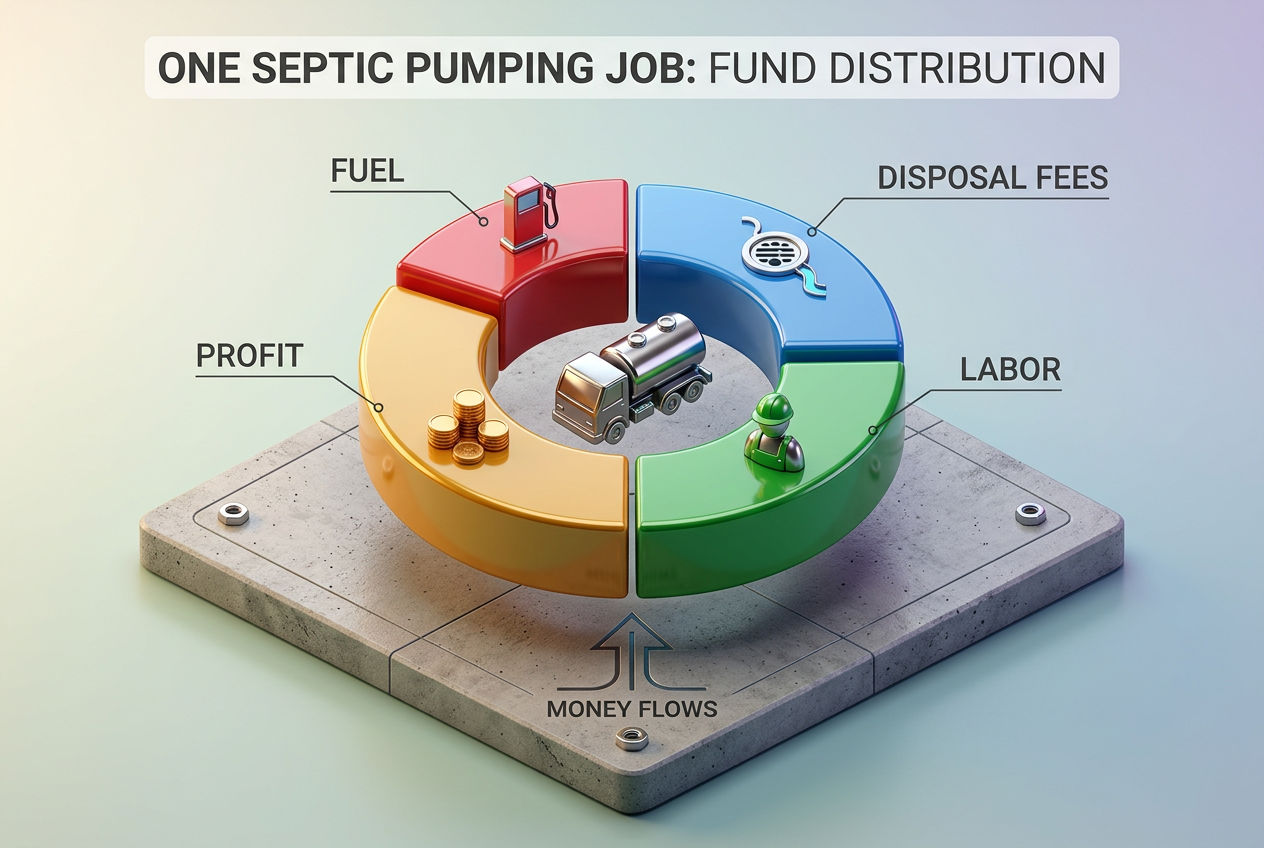
| Disposal/Tipping Fees (~$60/load) | –$13,200 |
| Fuel (diesel, ~$18,000/yr at current prices) | –$18,000 |
| Insurance (commercial liability + vehicle) | –$10,000 |
| Truck maintenance & repairs | –$6,000 |
| Licensing, permits, and compliance | –$2,500 |
| Marketing and software | –$4,000 |
| Miscellaneous (uniforms, supplies, etc.) | –$3,000 |
| Net Owner Earnings (before taxes) | ~$251,300 |
Figures are estimates based on NAWT operator data and trade publication benchmarks. Regional disposal fees and diesel prices are the two most volatile line items — operators in California or the Northeast often pay $80–$120 per load at disposal facilities, which compresses margins meaningfully compared to Midwest operators paying $30–$50.
Worked example at a slower ramp: Say you start with a used truck requiring an extra $4,000 in repairs and average only 3 jobs per day in year one at $320 average ticket. Gross revenue: $211,200. Subtract the same fixed costs plus $6,000 in additional maintenance: net comes to roughly $88,000–$95,000. That's still a livable income running your own operation, and it improves sharply in year two as the route fills in.
How Much Does It Cost to Start a Septic Pumping Business?
Your biggest single cost is the pump truck. A used vacuum tanker in working condition runs $30,000–$80,000. A new purpose-built septic pump truck from a manufacturer like Heil or Mack runs $100,000–$200,000+. Most new operators start with a used truck and trade up once they've built a route.
Full startup costs typically fall between $50,000 and $250,000 depending on whether you buy new or used equipment and what your state requires for licensing. Here's a realistic startup cost breakdown:
- Used septic pump truck: $30,000–$80,000
- Commercial liability + vehicle insurance: $5,000–$15,000/year
- Licensing and permits: $500–$5,000 (varies widely by state — Florida requires a Registered Septic Tank Contractor license through the Department of Health; Texas routes permitting through county-level Designated Representatives)
- Initial marketing (website, Google Business Profile, door hangers): $1,000–$5,000
- Business registration, accounting setup: $500–$2,000
If you're considering buying an existing septic business rather than starting from scratch, expect to pay 2–3x annual net profit as a valuation benchmark. An established route with $150,000 in annual net earnings might ask $300,000–$450,000. You're paying for the customer list, the existing truck, and the established reputation — all things that take years to build organically. For a full breakdown of how to get off the ground, see our guide on how to start a septic business.
How Many Septic Tanks Can You Pump in a Day?
A single truck can realistically complete 4–8 residential pump-outs per day depending on drive time between jobs, tank access, and system complexity. Rural operators with long distances between properties often max out at 4–5 jobs. Suburban operators working a tight geographic route — think a residential subdivision where homes were built in the same decade and are all coming due — can push 7–8 jobs.

That density difference is real money. A suburban route netting 7 jobs per day at $375 each generates $2,625 daily. Spread over 220 working days, that's $577,500 gross from a single truck. Annually, expect each truck to handle roughly 800–1,500 pump-outs per year depending on your market. The sweet spot for most owner-operators is around 1,000–1,200 jobs per year — enough to generate solid income without burning out the truck (or yourself).
Understanding how long septic tank pumping takes on each job matters here. A straightforward 1,000-gallon tank with a surface riser lid takes 20–30 minutes on site. A buried lid that requires locating and digging can eat 45–75 minutes. Route efficiency — knowing your tanks, adding riser installations as an upsell, mapping jobs geographically — separates $90,000-a-year operators from $200,000-a-year operators.
Before you can legally pump anything, you'll also want to understand what a septic inspection involves — many states require an inspection as part of the pumping record, and bundling inspections with pumps is one way to raise your average ticket from day one.
Is the Septic Industry Growing?
Yes. According to EPA data, approximately 21 million U.S. homes — roughly 1 in 5 households — rely on septic systems. The U.S. septic services market is estimated at $5–6 billion annually with steady growth of 3–5% per year.
Demand drivers are structural, not cyclical. People don't stop generating wastewater when the economy softens. Rural residential development continues in most Sun Belt and Appalachian markets. And the aging housing stock in the Northeast means more system failures, inspections, and replacement projects.
NOWRA (the National Onsite Wastewater Recycling Association) tracks industry growth and consistently points to workforce shortages as a market constraint — meaning there's more demand than operators in many rural counties. That's an opportunity, not a warning.
The septic tank maintenance schedule that drives recurring demand is straightforward: the EPA recommends pumping every 3–5 years for most households. A 1,000-gallon tank serving a family of four needs pumping every 3–4 years. Add a garbage disposal and that drops to every 2 years. Once you pump a tank, that customer is yours — and most don't bother switching to a different company.
That recurring structure is also why septic pumping outperforms many service businesses during recessions. When homeowners cut discretionary spending, they still call when the alarm floats or the toilets back up. Contrast that with, say, a landscaping or remodeling business where a tight budget means customers simply skip the service. Septic doesn't offer that option.
What Are the Pros and Cons of Owning a Septic Business?
The real advantages:
- Recession-resistant demand. Septic emergencies don't care about interest rates. A flooded drain field or a backed-up tank gets fixed whether the economy is booming or contracting.
- High margins on pumping. Unlike remodeling or new construction, pumping is a standardized service. Your truck, your hose, your time. Low materials cost keeps gross margins at 50–65%.
- Built-in repeat revenue. Every tank you pump is a customer on a 3–5 year recall cycle. Build a route of 500 customers and you've created a predictable income stream without ongoing marketing spend.
- Low competition in rural markets. According to NOWRA, many rural counties have one or two operators serving thousands of septic-dependent homes. New entrants often capture market share within 12–18 months simply by showing up reliably and answering the phone.
- Upsell surface area. Pumping gets you on-site. Once there, you can sell riser installations, effluent filter cleaning, minor baffle repairs, and annual maintenance agreements. Each of these adds revenue per stop without adding truck time.
The real disadvantages:
- Physical demands are real. Dragging 4-inch hose across frozen ground, working in summer heat around a malodorous tank, and managing a truck that requires constant mechanical attention is hard on the body. Operators who underestimate the physical load burn out in years two or three.
- Disposal costs vary wildly and can spike without warning. Municipal treatment facilities can raise tipping fees, restrict access, or close entirely. An operator paying $40 per load who suddenly faces $90 per load sees a meaningful margin hit with no ability to pass it on immediately. Identifying two or three disposal options in your region is essential risk management, not optional planning.
- Licensing complexity in regulated states. Florida, Massachusetts, California, and several other states have layered licensing requirements, soil evaluation certifications, and inspection documentation rules that create barriers to entry — but also protect licensed operators from fly-by-night competition. The barrier cuts both ways.
- Seasonal revenue swings. In northern climates, frozen ground limits access to buried tank lids and slows emergency calls. Revenue in January can be 40–50% of June revenue. Cash flow planning matters.
- Customer acquisition takes time. Unlike an HVAC company that can get Google Ads clicks on day one, septic pumping is relationship-driven. Realtors, property managers, and new homeowners are your fastest acquisition channels, but building those referral relationships takes 12–18 months in a new market.
How Much Should I Charge to Pump a Septic Tank?
The going rate for residential septic pumping nationally runs $300–$600 for a standard 1,000–1,500 gallon tank. What you can charge in your specific market depends on three variables: local competition, your actual cost per job, and what customers in your region have historically paid.
Figure out your cost per job first. Add up fuel (prorated per job based on your route density), disposal fees (your actual tipping fee per load), insurance (annual premium divided by expected job count), and truck maintenance reserve (typically $0.15–$0.25 per mile plus $500/month for older trucks). If your all-in cost per job is $110 and competitors are pricing at $325, your gross margin on that job is roughly $215 — a 66% gross margin. That's the math you need to run before setting your rate sheet.
Don't price purely based on what competitors charge. Competitor pricing in your market might reflect a fully depreciated truck, lower disposal fees from a long-term facility contract, or a higher job density that spreads fixed costs further. Price based on your actual cost structure, then check that against the market ceiling.
A septic pumping cost by state breakdown helps you understand where your local prices sit relative to national norms. If your market is pricing 20% below the state average, there's often room to raise rates — especially if you're adding service quality (confirmed appointment windows, written reports, riser installation offers) that discount competitors don't provide.
How Long Until a Septic Business Breaks Even?
Most single-truck operators break even on their initial equipment investment within 60–120 working days of launching. Here's what that looks like with real numbers: a used truck purchased for $60,000 nets approximately $880 per working day after direct costs (disposal fees, fuel, insurance prorated daily). At that rate, $60,000 ÷ $880 = 68 working days to recover the truck cost — roughly 3–4 months of full-time operation. At a slower pace of 3 jobs per day netting $620 daily, that same $60,000 takes about 97 working days, or roughly 5 months. That's the range most operators actually experience: equipment payback in 3–6 months, followed by increasingly profitable operation as fixed costs remain flat while the route grows.
Full business breakeven — covering startup costs, first-year insurance, initial marketing, and working capital — typically takes 6–18 months depending on starting capital, truck price, and how fast you build volume.
Several factors accelerate the timeline. Buying an established route from a retiring operator means day-one revenue — you're pumping existing customers on week one, not cold-calling. Working a market with minimal competition means you capture jobs that would otherwise go begging. Adding upsells (risers, filter cleaning) raises your revenue per stop without adding a job slot.
What slows breakeven: a high-maintenance used truck that eats cash in its first year, a densely competitive suburban market where you're fighting on price, or underestimating disposal costs before negotiating a facility contract.
The septic pumping cost breakdown guide walks through the customer-side pricing that determines what you can charge — which directly affects how fast you reach breakeven.
Is a Septic Pumping Business Profitable Compared to Other Service Trades?
Yes — septic pumping outperforms most comparable trades on margin when measured at the pumping-service level. Here's a direct comparison:
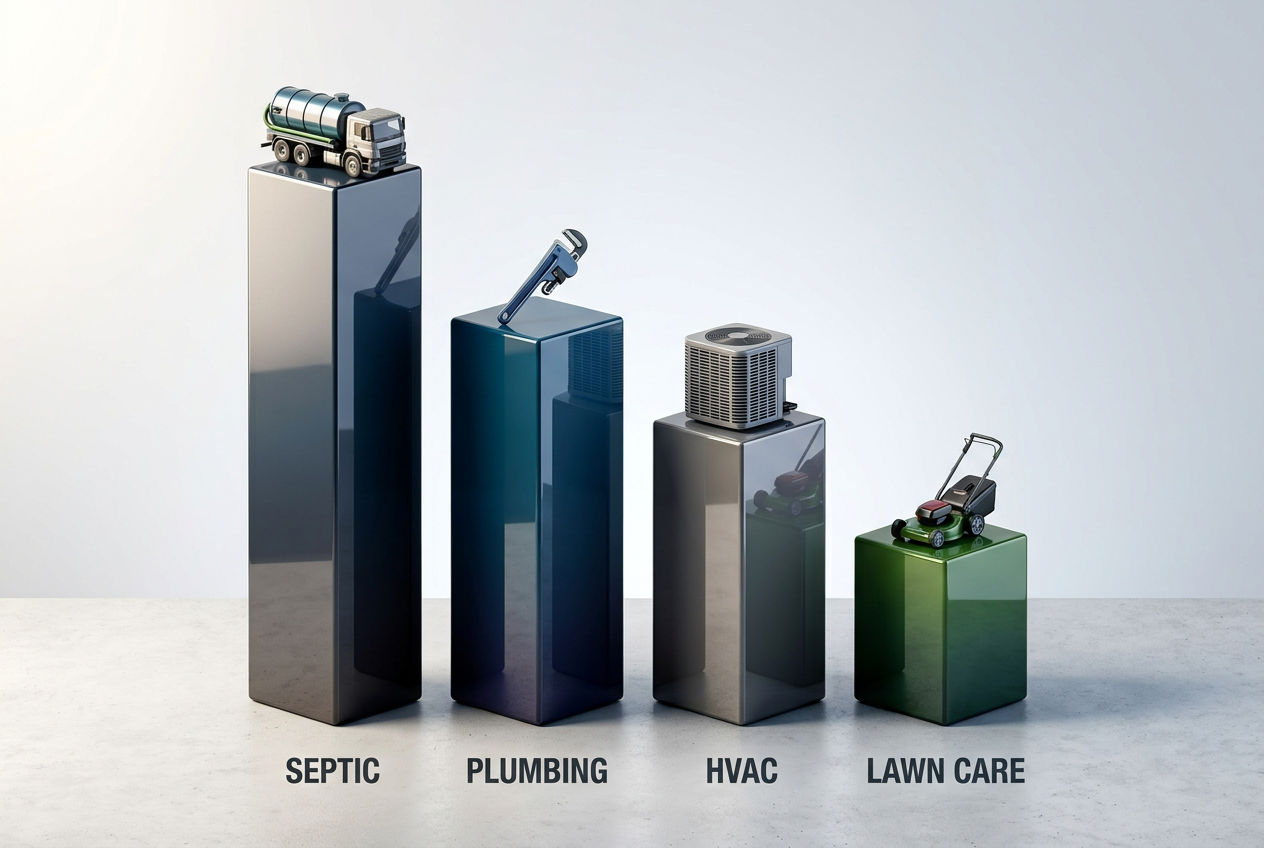
| Trade | Typical Gross Margin | Typical Net Margin |
|---|---|---|
| Septic pumping | 50–65% | 20–35% |
| Plumbing service | 45–55% | 15–25% |
| HVAC service | 40–55% | 10–20% |
| Landscaping | 30–50% | 5–15% |
| Drain cleaning | 50–60% | 18–28% |
The margin advantage comes from low materials cost and high service standardization. A plumber might spend $200 in parts on a $600 job. A septic pumper spends nothing on parts — only labor (usually their own), fuel, and disposal. That structural difference compounds over a full year of operations.
The trade-off is revenue ceiling on a single truck. A plumbing company can add specialty services (water heaters, repiping, leak detection) that push per-job tickets to $1,500–$5,000. Septic pumping residential tickets cap out around $500–$700 for standard pump-outs. Growth requires either adding trucks, adding installation work, or both.
For operators who want a business that generates strong income without the complexity of managing subcontractors and high-materials jobs, septic pumping's margin profile is genuinely attractive. For operators who want to build a larger enterprise, the path runs through adding installation capacity — which changes the business model significantly and is worth understanding before you commit.
Also worth reading if you're evaluating adjacent trades: the drain cleaning business model and plumbing business profitability guide cover how those service lines compare for owner-operators making the same decision.
Sources & Methodology
Data in this article draws on the following sources:
- U.S. Environmental Protection Agency (EPA): Septic system household estimates and recommended pumping frequency. EPA Septic Systems Overview
- National Association of Wastewater Technicians (NAWT): Operator compensation benchmarks and industry margin data aggregated from member surveys and trade publication interviews.
- National Onsite Wastewater Recycling Association (NOWRA): Market size estimates, workforce shortage data, and growth projections. NOWRA Market Data
- State regulatory agencies: Florida Department of Health (Registered Septic Tank Contractor licensing), Texas Commission on Environmental Quality (TCEQ county-level permitting structure), Massachusetts Title 5 regulations (310 CMR 15.000).
- Manufacturer pricing: Heil Environmental, Mack Trucks — public pricing tiers for vacuum tanker equipment.
Limitations: Income and margin figures represent ranges based on available industry benchmarks and do not constitute a guarantee of results. Regional variation in disposal facility fees, state licensing costs, and local market pricing creates significant divergence from national averages. Operators in high-cost states (California, Massachusetts, New York) typically face higher operating costs that compress net margins below the ranges cited for national averages. Year-one income figures for new operators should be treated as directional, not guaranteed, given the route-building period required before recurring revenue stabilizes.
Was this article helpful?
Frequently Asked Questions
Recommended Resources
📖 Related Articles
- How Often Should You Pump Your Septic Tank?
- Buying a Septic Business: What to Look For and What to Pay
- How to Start a Septic Tank Business (2026 Step-by-Step Guide)
- How Long Does It Take to Pump a Septic Tank?
- How to Install Septic Tank Risers (and Why You Should)
- How Often Should You Service Your Septic System?
- Septic Tank Pumping Cost by State: Regional Price Comparison
💰 Cost Guides
🔧 Services
Find Septic Professionals Near You
Compare licensed, verified septic companies by area — top county markets and cities below, or browse all 50 states.
County markets
Popular cities
