
Quick Answer
The short answer: How often to service your septic system depends on your tank size, how many people live in your home, and what type of system you have. For most households, that means pumping every 3–5 years and a professional inspection every 3 years. Skip those appointments and you're looking at potential drain field failure - a repair bill that can hit $15,000–$30,000.
💡 Key Takeaways
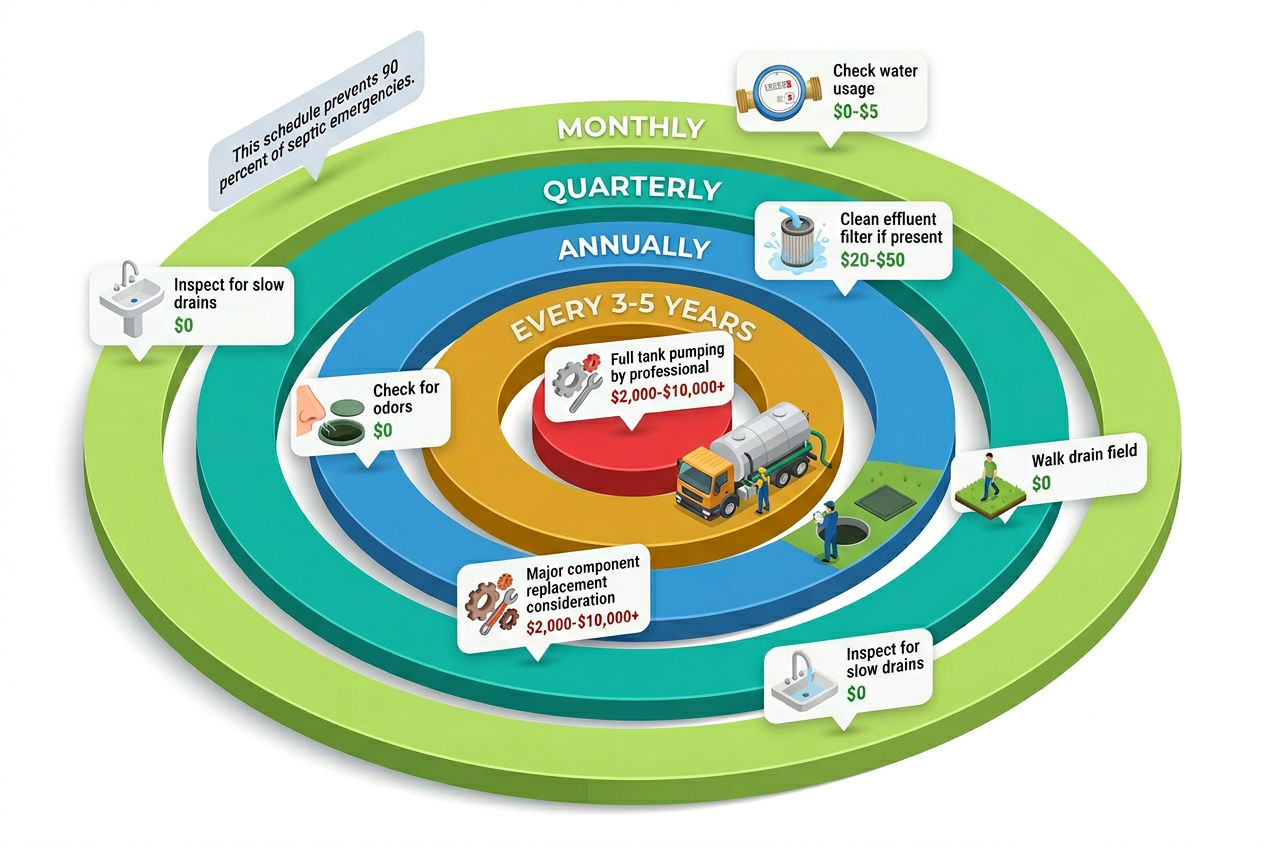
- The EPA recommends inspecting conventional septic systems every 3 years and pumping every 3–5 years.
- Tank size and household size are the two biggest variables - a 1,000-gallon tank serving 4 people needs pumping roughly every 3 years.
- Advanced systems (aerobic treatment units, mound systems) need annual inspections and may require service contracts.
- Skipping pumps doesn't save money - a full system replacement costs $15,000–$30,000+.
- Fall is the best time to schedule service before ground freezes and provider backlogs hit.
The reality: About 21 million U.S. households - roughly 1 in 5 homes - rely on a septic system instead of municipal sewer. Despite that, late-1990s EPA literature estimated 10–20% of those systems were malfunctioning at any given time, most often because of skipped maintenance. Understanding how a septic system works is the first step. Building a consistent service schedule is the second.
What Does "Servicing" a Septic System Actually Include?
Septic service isn't just one thing. Most homeowners use the terms "pumping" and "inspection" interchangeably, but they're two different appointments with two different purposes.
Pumping vs. Inspection: What's the Difference?
Pumping removes accumulated solids - the sludge layer at the bottom and the scum layer at the top - from your tank. Over time, those layers grow. When they crowd out the liquid zone in the middle, partially digested solids push through to your drain field and clog the leach laterals. That's how a functioning system becomes a $20,000 problem.
Inspection evaluates the structural integrity and performance of the full system. A licensed inspector checks:
- Inlet and outlet baffles for deterioration
- Effluent filters (common models include the Polylok PL-122 and Zabel A1800)
- Distribution box condition and level
- Drain field absorption area for signs of hydraulic overload
- Tank walls for cracks and root intrusion
Learn more about what to expect during a septic inspection.
Advanced Systems Require More Attention
Advanced systems - aerobic treatment units (ATUs), mound systems, and pressure distribution systems - add mechanical components that need annual eyes-on attention:
- Aerator compressors (like the Hiblow HP-80)
- Pump chambers and float switches
- Spray heads and pressure distribution lines
- Electrical controls and alarms
⚠️ Warning: Many states require mandatory service contracts for advanced systems as a condition of the operating permit. Check your permit requirements before closing on a property with an ATU or mound system.
The EPA's septic systems guidelines are clear: inspect every 3 years for conventional systems, pump every 3–5 years on average, and service advanced systems annually.
How Often Should a Septic Tank Be Pumped Based on Household Size?
Pumping frequency isn't one-size-fits-all. A retired couple with a 1,500-gallon tank has almost nothing in common with a family of six sharing a 750-gallon system. The table below - drawn from EPA guidance and University extension service data - gives you a starting point.
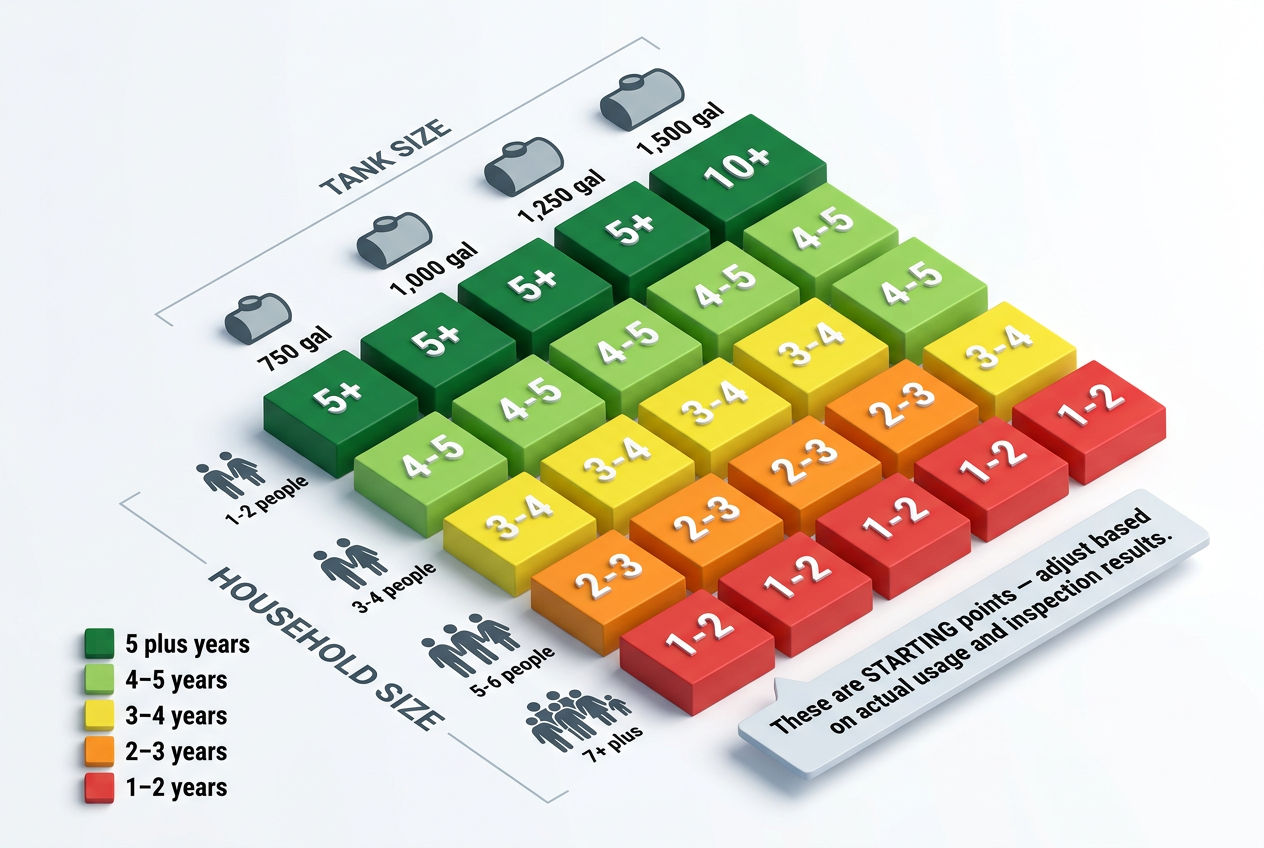
Septic Tank Pumping Frequency by Tank Size and Household Size
| Tank Size | 1–2 People | 3–4 People | 5–6 People | 7+ People |
|---|---|---|---|---|
| 750 gallons | Every 4 yrs | Every 2 yrs | Every 1 yr | Under 1 yr |
| 1,000 gallons | Every 5 yrs | Every 3 yrs | Every 2 yrs | Every 1 yr |
| 1,250 gallons | Every 5 yrs | Every 3.5 yrs | Every 2.5 yrs | Every 1.5 yrs |
| 1,500 gallons | Every 6 yrs | Every 4 yrs | Every 3 yrs | Every 2 yrs |
Source: EPA "A Homeowner's Guide to Septic Systems"; University extension service pumping interval data.
📊 Quick Fact: A family of four in suburban Atlanta has a 1,000-gallon concrete tank - the most common residential size in the Southeast. By the table, they're pumping every 3 years. Now add a garbage disposal. University of Illinois Extension data shows that garbage disposal use increases the solids load entering a tank by up to 50%. That same family now realistically needs service every 2 years to avoid baffle damage and early drain field stress.
Don't know your tank size? Check your original property disclosure documents, your county health department's permit records, or ask a technician to measure sludge depth with a sludge judge during your next pump-out.
What Factors Change How Often You Need Septic Maintenance?
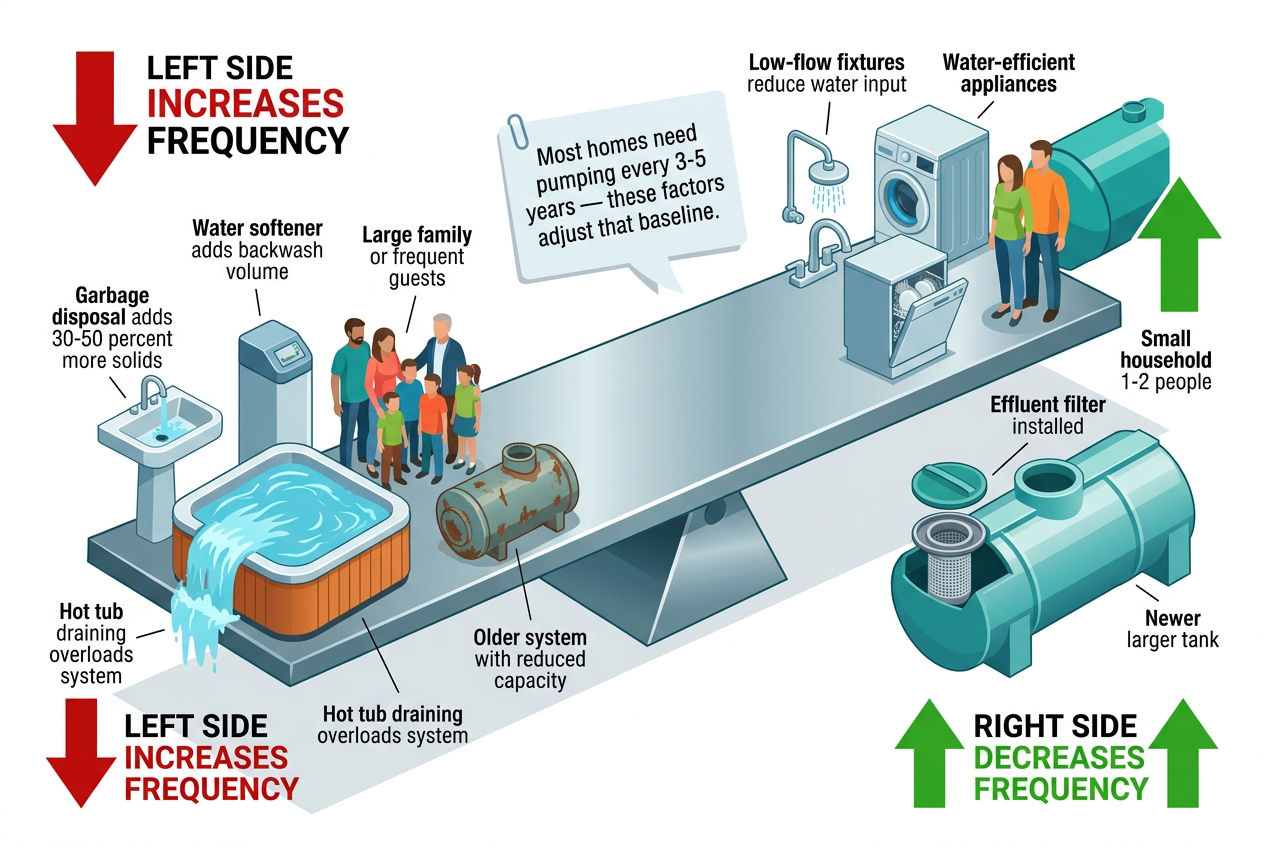
The table above assumes average water use. Several variables can compress or extend those intervals significantly.
Major Variables That Affect Pumping Frequency
Household water usage. High-efficiency fixtures reduce hydraulic load on your tank:
- Low-flow toilets rated at 1.28 GPF (gallons per flush)
- WaterSense-certified faucets and showerheads
Conversely, a household running daily loads of laundry dumps concentrated greywater into the tank in short bursts, limiting the settling time your tank bacteria need to break down solids.
Garbage disposal use. Running food waste through a disposal can cut your pumping interval nearly in half. If you have a disposal and a 1,000-gallon tank with four people in the house, budget for every 2 years - not 3.
System type. Different systems behave differently:
- Conventional gravity-fed systems with concrete tanks
- Infiltrator Water Technologies chamber systems
- Aerobic treatment units (ATUs) requiring annual inspections, motor checks, and effluent quality testing
✅ Pro Tip: Many state health departments require a service contract as a condition of the operating permit for advanced systems. Check with your local septic service provider about what your specific permit requires.
System age. A system installed in the 1970s with clay pipe laterals and an unprotected concrete outlet baffle needs more frequent monitoring than a newer system with PVC distribution lines and a Polylok effluent filter. Older baffles deteriorate and allow floating scum to flow directly toward the drain field.
Soil conditions. Clay-heavy soils - common across Ohio, Indiana, and much of the Midwest - absorb effluent more slowly than sandy soils. That limits how much hydraulic load your drain field can handle before it becomes saturated. Homes in these areas often benefit from slightly more conservative pumping schedules.
Seasonal water use spikes. Hosting holidays, summer guests, or a teenager who showers three times a day all temporarily increase the load. A single Thanksgiving weekend won't break a healthy system, but repeated high-use events on a tank that's already at 80% sludge capacity can push solids into places they shouldn't go.
What Happens If You Don't Service Your Septic System?
Picture this scenario: You're selling your home and the buyer's inspector finds your drain field is failing. The deal pauses. You're on the hook for a full drain field replacement - $10,000–$20,000 for the excavation and new leach laterals alone, or $15,000–$30,000+ if the tank needs replacement too. The buyer renegotiates or walks. All of it was preventable.
The Cascade of Failure in a Neglected Tank
Skipping routine septic service doesn't just risk a big repair bill. Here's what actually happens inside a neglected tank:
- Sludge accumulates past the 30% threshold recommended by the National Association of Wastewater Technicians (NAWT). Solids begin migrating toward the outlet baffle.
- The effluent filter (if present) clogs, triggering backups into the house. If there's no filter, raw solids flow directly into the distribution box.
- The drain field receives biomat clogging - a dense, anaerobic layer that seals the soil interface and prevents effluent absorption.
- Sewage backs up into the lowest drains in the house, or surfaces as a wet, foul-smelling patch of grass over the leach field.
💡 Key Takeaway: If your drain field has failed, the cost of drain field replacement is significantly higher than a decade of routine pump-outs. Regular pumping at roughly $300–$500 every 3–5 years costs $600–$1,000 over a 10-year period. A failed drain field costs $15,000+. The math isn't complicated.
For a full breakdown of septic repair scenarios and costs, see our septic repair cost guide.

How Much Does It Cost to Service a Septic System?
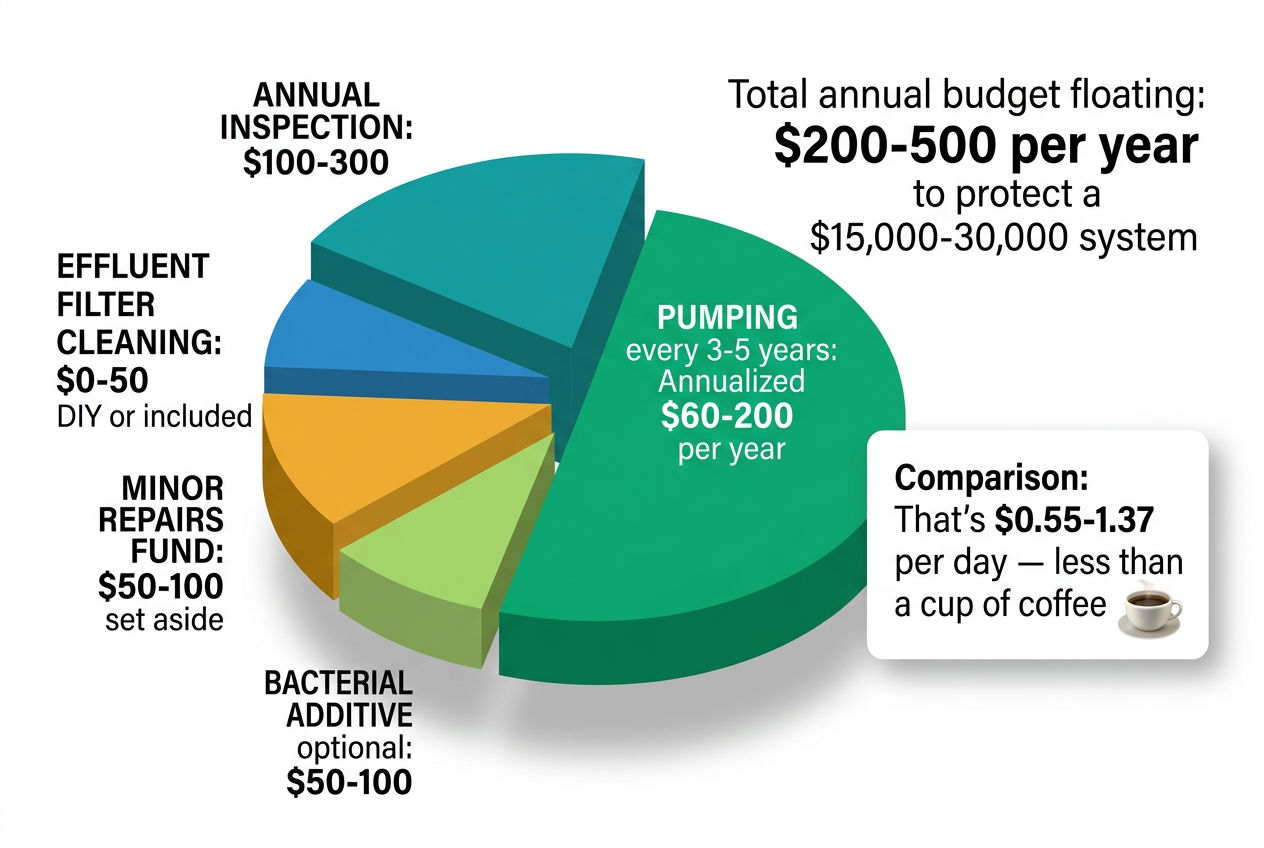
Standard septic pumping runs $250–$600 nationally, with most homeowners paying $300–$500 for a 1,000-gallon residential tank in 2024–2025. Geographic location matters significantly.
Regional Cost Variations
| Region | Typical Cost Range | Key Factors |
|---|---|---|
| Central Florida | $275–$375 | Competitive market, year-round access |
| Rural Minnesota | $350–$500 | Longer drive times, equipment winterization, compressed seasonal window |
| Northeast (NJ, CT) | $450–$600 | High labor costs, regulatory compliance |
| Coastal California | $450–$600 | Urban market, high cost of living |
Inspection costs run separately: $100–$300 for a standard visual inspection, and $250–$600 for a full inspection that includes uncovering the tank lids, checking the effluent filter, and testing distribution. See our septic inspection cost guide for a detailed breakdown.
Septic pumping costs are detailed in our septic pumping cost guide if you want to compare local pricing before booking.
Do Septic Tank Additives Reduce How Often You Need to Pump?
Bacterial additives like Rid-X introduce additional microorganisms into your tank to supplement the naturally occurring septic tank bacteria. The product marketing often implies you can extend pumping intervals. The science doesn't fully support that claim.
What the Research Actually Shows
Peer-reviewed research from the University of Arkansas and other extension programs found no consistent evidence that commercial bacterial additives meaningfully reduce sludge accumulation or allow homeowners to safely extend pumping intervals. Your tank already contains billions of bacteria doing exactly that job. A healthy, properly loaded system doesn't need help from a bottle.
⚠️ Warning: Chemical additives - anything that includes solvents, degreasers, or bleach - are a different matter. Several states have outright banned specific formulations because they strip beneficial bacteria and push dissolved chemicals into the groundwater. Check your state environmental agency's guidance before using any additive product.
The One Legitimate Use Case
After a system has been pumped and sat dormant - a seasonal vacation home, for example - a bacterial starter can help re-establish active digestion faster than waiting for natural recolonization. That's a reasonable, narrow application.
What additives cannot do:
- Reverse a failing drain field
- Dissolve grease layers caused by cooking oil disposal
- Compensate for mechanical problems like a deteriorating outlet baffle
How Do You Know If Your Septic System Needs Service Right Now?
Sometimes you don't need a calendar reminder. Your system tells you. Watch for these warning signs:
Immediate Red Flags That Require Professional Attention
- Slow drains throughout the house (not just one fixture - that's usually a clog; all fixtures suggest a full tank)
- Gurgling sounds from toilets or drains when water runs elsewhere in the house
- Sewage odors inside the home or near the tank and drain field area outside
- Unusually lush, fast-growing grass directly over the drain field - effluent is fertilizing the soil from below
- Standing water or a soggy, spongy area over the leach field that doesn't dry out between rain events
- Sewage backing up into the lowest drains - floor drains, basement showers - during heavy use
⚠️ Warning: Any one of these signs warrants an immediate call to a licensed septic professional, not a wait-and-see approach. The longer a failing system runs, the more saturated the drain field soil becomes. Some biomat damage is irreversible.
For a broader list of failure indicators, see our guide to signs your septic system needs attention.
When Is the Best Time of Year to Schedule Septic Service?
Fall is the best window for proactive maintenance in most of the U.S. Here's why: scheduling a pump-out in September or October means you're heading into winter with an empty tank and no risk of solids migrating toward the drain field during the higher-use holiday season. Providers are still accessible, ground is workable, and you're not competing with spring emergency calls.
Seasonal Considerations by Region
Spring - specifically March through May - is when most homeowners notice problems. Snow melt and heavy spring rainfall can temporarily saturate drain fields, triggering backups and surfacing that appeared fine all winter. This is peak call volume for most septic companies, which means longer wait times.
Winter service is difficult or impossible in northern states:
- In Minnesota, Wisconsin, and Maine, frozen ground from December through March makes accessing tank lids problematic
- Pumper trucks can struggle with frozen lines
- Emergency winter service calls are real - and expensive
- Prevention is straightforward: Don't wait until January to schedule the pump-out you knew was due
Southern states - Florida, Georgia, Texas, the Gulf Coast - offer year-round service availability. Florida's high water table and sandy soils mean some systems need more frequent service than the national average, and the Florida Department of Health has specific rules governing inspection requirements at the point of sale.
✅ Pro Tip: If you're buying rural property and need to assess an existing system before closing, our rural property septic checklist walks through what to look for - and what to ask the seller.
Can You Service Your Own Septic System, or Do You Need a Professional?
Homeowners can handle a handful of maintenance tasks themselves:
- Keeping the area around tank lids clear of vehicles and deep-rooted plants
- Spreading laundry loads across the week instead of running back-to-back loads
- Not flushing anything except human waste and toilet paper
These habits genuinely extend service intervals.
Why Professional Service Is Required
Pumping requires a licensed pumper with a vacuum truck rated for the job. You can't do it with a shop vac. Beyond equipment, licensed pumpers in most states are required to transport and dispose of septage at an approved facility - not discharge it on-site.
State licensing requirements:
- Minnesota: The Pollution Control Agency (MPCA) requires licensed pumpers to file disposal manifests with the county after every service
- Massachusetts: Septic system inspectors must hold a Title 5 certification issued by the state
- New Jersey: Similar requirements exist under Title 5 equivalent regulations
- Florida: Contractors must hold a Registered Septic Tank Contractor (RSTC) license through the Department of Health
Inspections for advanced systems require:
- Calibrated testing equipment
- Knowledge of mechanical components
- State-issued inspector credentials in many jurisdictions
💡 Key Takeaway: DIY maintenance is encouraged. DIY pumping and inspection is not legal in most states and not physically feasible anyway.
Ready to find a licensed septic professional in your area? Search the SepticTankHub directory to connect with providers near you.
Related reading: homeowners insurance septic.
Sources & Methodology
-
U.S. Environmental Protection Agency - "A Homeowner's Guide to Septic Systems" (): Primary source for recommended inspection and pumping intervals, system malfunction prevalence data, and household septic usage statistics.
-
National Association of Wastewater Technicians (NAWT) (): Industry guidance on sludge depth thresholds and professional inspection standards.
-
University Extension Programs (University of Arkansas, University of Illinois Extension): Peer-reviewed research on bacterial additive efficacy and garbage disposal impact on solid loading rates.
-
National Onsite Wastewater Recycling Association (NOWRA) (): Technical standards for advanced and alternative septic system maintenance requirements.
-
State Health Departments (Florida Department of Health, Massachusetts Title 5 regulations, Minnesota MPCA): State-specific licensing, inspection, and pumping manifest requirements referenced in regional sections.
Cost figures reflect 2024–2025 national survey data and regional contractor pricing compiled by SepticTankHub.com editorial research.
Reviewed by the SepticTankHub.com Editorial Team. This article reflects EPA guidelines and current industry standards. Consult a licensed septic professional for advice specific to your system.
Need help with your septic system? Browse local septic companies in California or Ohio.
Free download
Not ready for the Handbook? Start with the free Fridge Card.
The Do / Don’t card the whole family can see, plus the Survival Kit: emergency flowchart, warning-sign decoder and pump-schedule card. One printable PDF.
Was this article helpful?
Frequently Asked Questions
Recommended Resources
📖 Related Articles
💰 Cost Guides
🔧 Services
Find Septic Professionals Near You
Compare licensed, verified septic companies by area — top county markets and cities below, or browse all 50 states.
County markets
Popular cities
