
Quick Answer
Homeowners insurance covers septic system damage only in limited circumstances. Most standard policies exclude septic failures caused by neglect, gradual deterioration, or lack of maintenance - which accounts for the vast majority of real-world failures. Sudden, accidental damage from a covered peril may qualify. Understanding exactly where that line falls could save you thousands.
Published: June 10, 2025 · Updated: 2026-04-16
💡 Key Takeaways
- Standard homeowners policies almost never cover septic tank failure caused by neglect or wear - which is most failures.
- Sudden, accidental damage (like a tree root rupturing a tank) may be covered under your dwelling or other structures coverage.
- A water backup and sump overflow endorsement adds $5,000–$25,000 in coverage for roughly $40–$100/year extra premium.
- Home warranties offer septic coverage, but caps of $500–$2,000 rarely cover full repair costs of $3,000–$25,000+.
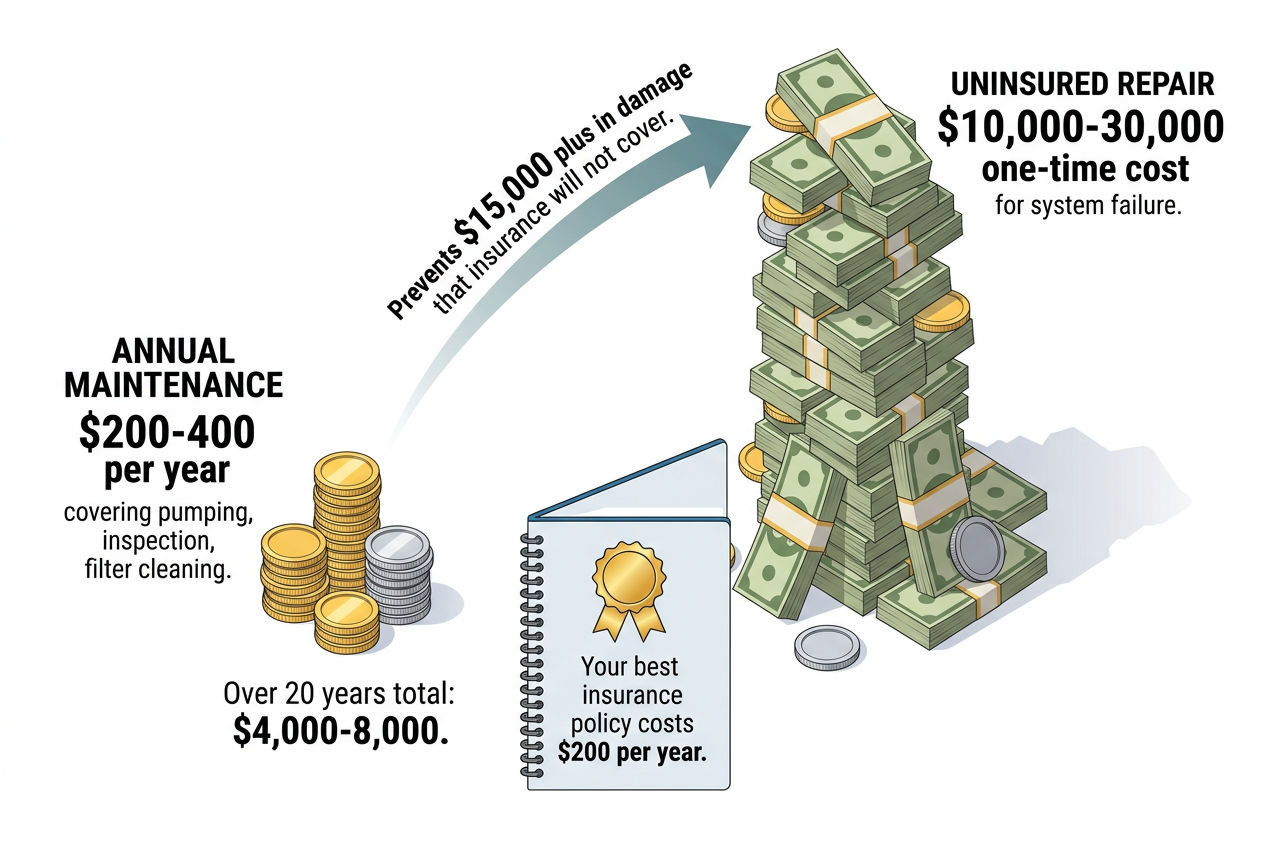
- Regular pumping every 3–5 years is your best financial defense - and your insurer's first line of defense against paying a claim.
Does Homeowners Insurance Cover Septic Tank Replacement?
Standard homeowners insurance does not cover septic tank replacement when the cause is neglect, age, or gradual deterioration. The Insurance Information Institute confirms that most policies explicitly exclude "continuous or repeated seepage or leakage" and "wear and tear." Since the EPA estimates that a majority of septic failures stem from inadequate maintenance, most claims are denied before an adjuster even visits your property.
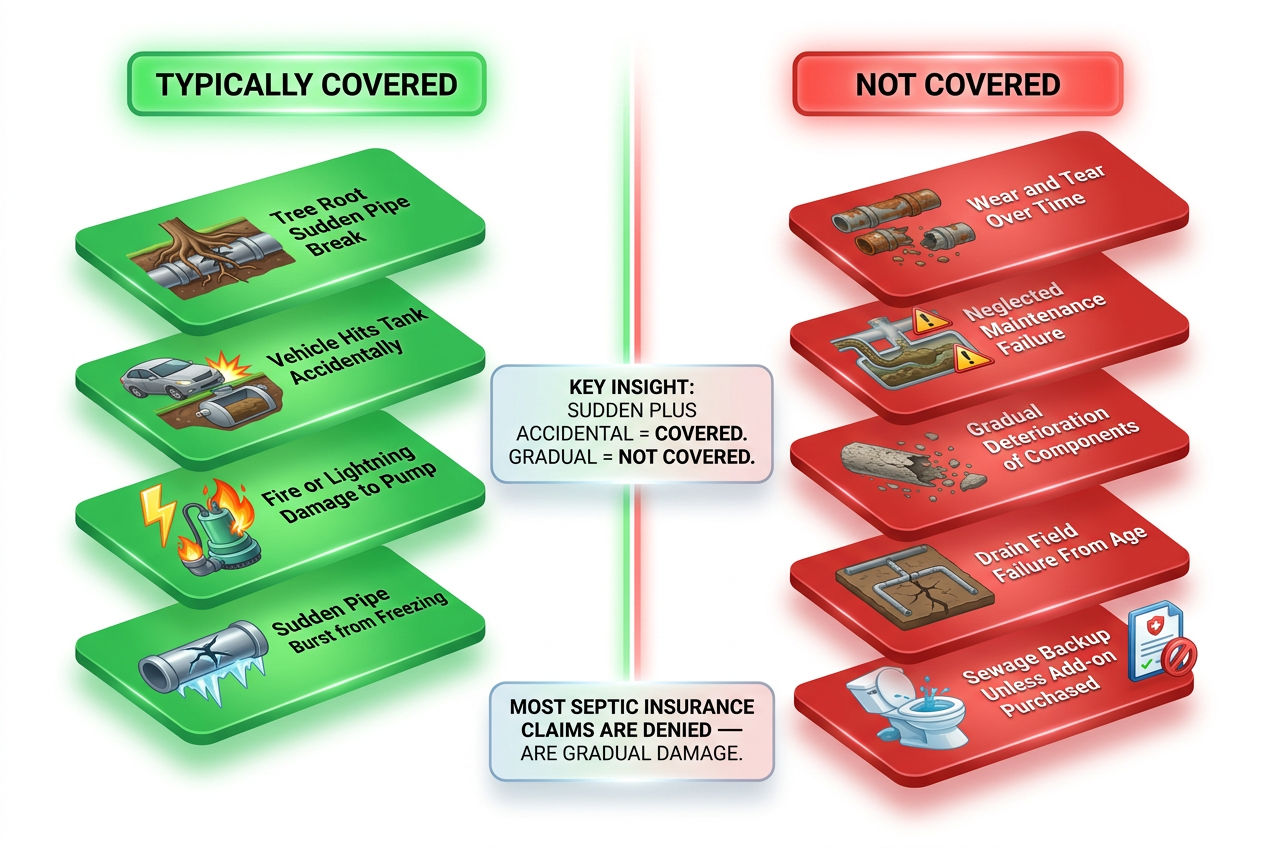
That said, the answer isn't a flat "no" in every scenario. Insurance works on perils, not components. If a covered peril - say, a vehicle collision that crushes your tank lid, or a fire that damages your pump chamber - directly causes the damage, your policy may respond under your dwelling or other structures coverage. The key phrase insurers look for is "sudden and accidental."
Understanding Sudden vs. Gradual Damage
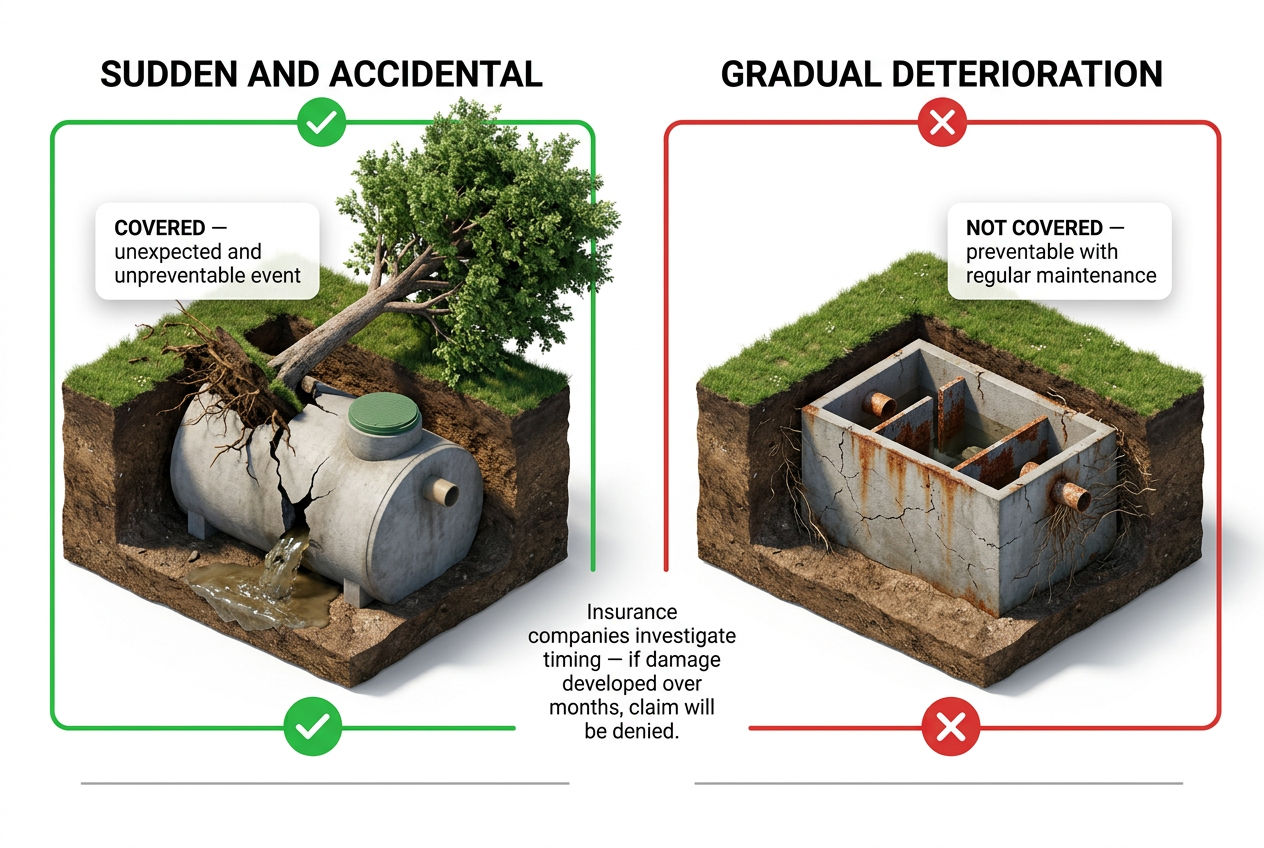
Picture this: a contractor operating heavy equipment near your yard cracks your 1,500-gallon concrete tank during a project. That's sudden and accidental. Your insurer might cover it.
Now picture this: your 25-year-old drain field slowly fails because the baffle walls inside your tank have deteriorated and solids have been flowing into the leach laterals for years. That's gradual deterioration. No standard policy will touch it.
⚠️ Warning: The "sudden and accidental" requirement is why most real-world septic failures aren't covered. Biomat buildup, root intrusion, and soil compaction all happen gradually - exactly what insurers exclude.
Free download
Free: the Septic Fridge Card — what to flush, what never to.
The Do / Don’t card the whole family can see, plus the Survival Kit: emergency flowchart, warning-sign decoder and pump-schedule card. One printable PDF.
What Does Homeowners Insurance Actually Cover?
A standard HO-3 policy covers your home's structure and attached components against named perils. Septic tanks are typically classified as "other structures" - the same bucket as detached garages and fences - with a default coverage limit of 10% of your dwelling coverage amount.
Scenarios That May Trigger Coverage
- ✅ A tree falls and physically crushes your septic tank
- ✅ A vehicle runs off the road and damages your distribution box
- ✅ Vandalism causes direct physical damage to your pump chamber or float switches
- ✅ Fire damages above-ground septic components (common with aerobic treatment units and their aerator compressors, such as a Hiblow HP-80)
Scenarios Almost Certainly NOT Covered
- ❌ Drain field failure from root intrusion over multiple years
- ❌ Tank cracks due to soil shifting or ground settling
- ❌ Pump failure from normal wear on a 15-year-old system
- ❌ Sewage backup caused by a full or clogged tank you haven't pumped
📊 Quick Fact: If your system fails because you skipped the $300–$600 pump-out every 3–5 years, expect a denial letter. Insurers call it the neglect exclusion, and it's standard in virtually every homeowners policy.
Does Homeowners Insurance Cover Sewage Backup in the House?
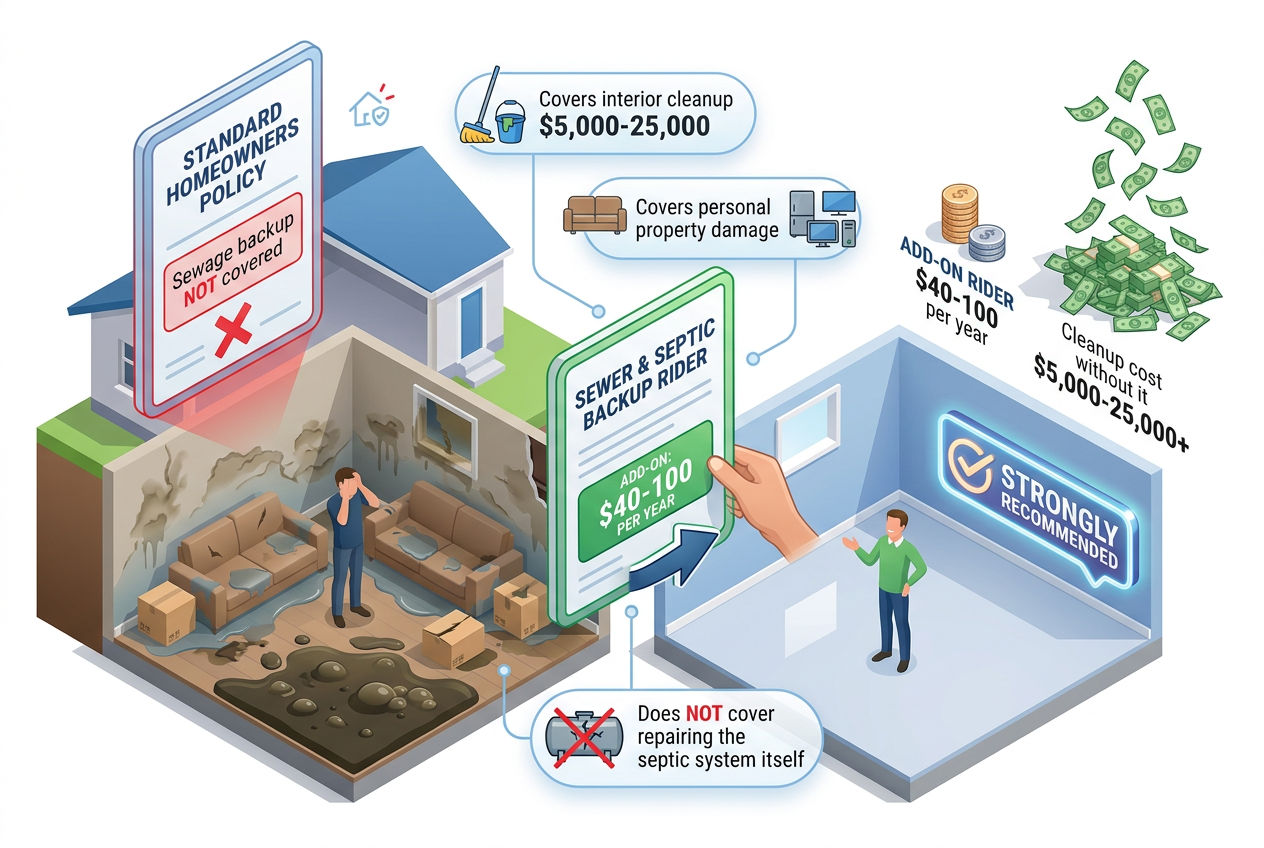
This is a separate question from system failure, and the answer is different. A standard HO-3 policy typically does not cover sewage or wastewater that backs up through your drains into your home - but you can buy coverage that does.
The endorsement is usually called "water backup and sump overflow coverage" (not to be confused with flood insurance). This add-on, available from carriers like State Farm, Allstate, and USAA, typically costs $40–$100 per year and provides $5,000–$25,000 in coverage for cleanup, structural damage, and personal property ruined by a backup event.
That $12,500 average water damage claim cited by the Insurance Information Institute? It assumes you have this endorsement. Without it, you're paying out of pocket for every gallon of sewage that backs up through your shower drain.
The Critical Limitation
One important limitation: the endorsement covers the damage inside your home from a backup event. It typically does not pay to repair the septic system itself that caused the backup. You'd be covered for the ruined flooring and drywall. You'd still write a personal check for the septic repair.
✅ Pro Tip: If you don't have this endorsement, call your insurance agent today. It's one of the best-value add-ons available for homeowners on a septic system.
What Is a Septic System Endorsement or Rider?
A handful of specialty insurers and home warranty providers offer a true "septic system endorsement" - coverage specifically written for the mechanical and structural components of your septic system. This is rare in standard homeowners policies but worth asking about.
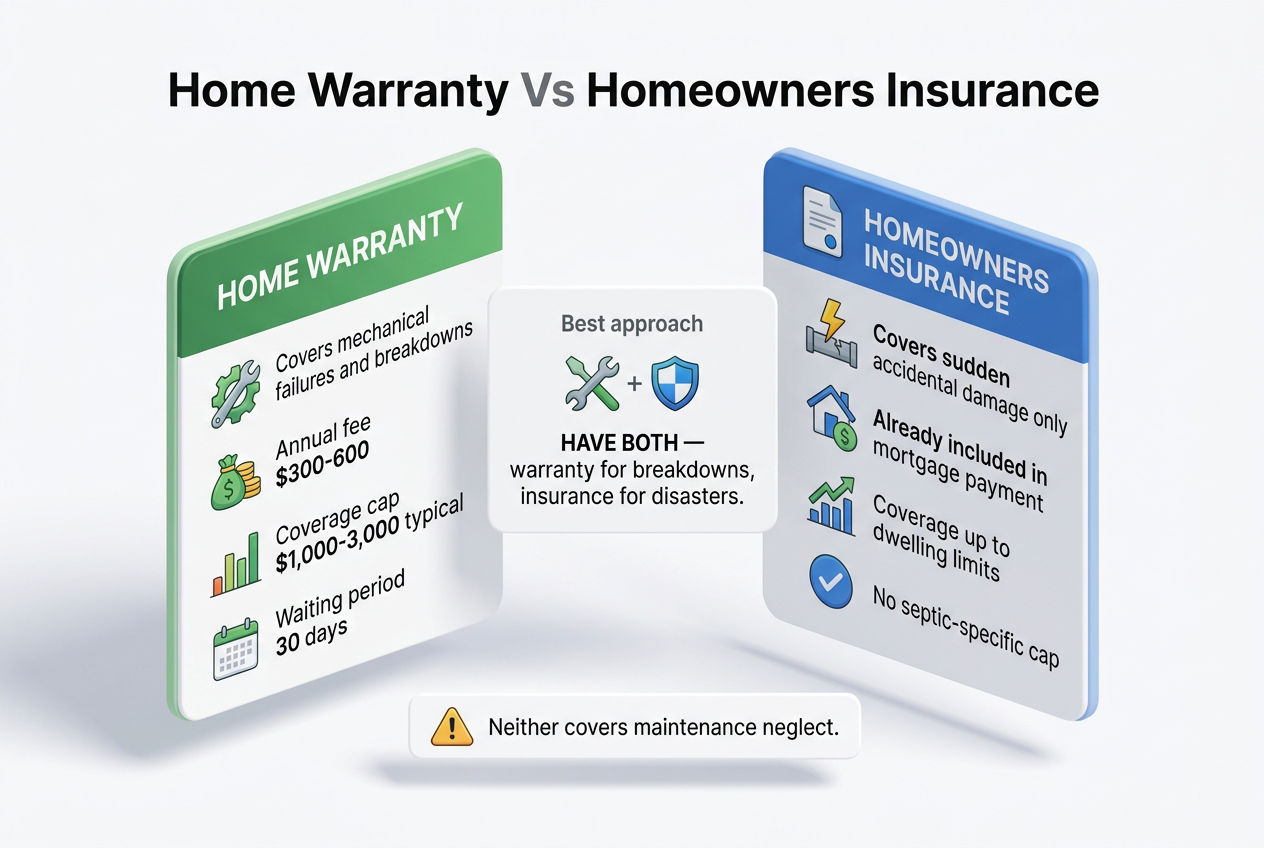
More commonly, you'll encounter this coverage in a home service contract (home warranty) rather than from your homeowners insurer. These are separate products entirely - a home warranty is a service contract, not an insurance policy - but they're frequently confused because both can help pay for unexpected repairs.
What a True Septic Rider Might Cover
- Sudden pump failure
- Collapse of a concrete tank due to structural defect
- Specific mechanical component failures
The coverage limits, exclusions, and definitions vary significantly by carrier. Before assuming you have it, pull out your policy declarations page and look specifically for language about "septic," "sewer," or "underground service lines." If you don't see it, you probably don't have it.
Is Septic System Failure Covered by Home Warranty?
Home warranties cover septic systems more consistently than standard homeowners insurance, but the coverage caps are often shockingly low. Most home warranty contracts cap septic system coverage at $500–$2,000.
Now compare that to actual repair costs:
| Repair Type | Cost Range |
|---|---|
| Septic tank replacement alone | $1,500–$5,000 |
| Drain field replacement | $2,000–$15,000 |
| Full system replacement (conventional) | $3,000–$10,000 |
| Engineered or alternative system | $15,000–$25,000+ |
⚠️ Warning: A $1,500 warranty cap on a $12,000 mound system replacement is better than nothing - but not by much.
Read the fine print carefully. Many warranties also exclude pre-existing conditions, which is a problem if your system was already showing signs of stress when you bought the contract.
Annual home warranty costs run $300–$600, with a $75–$125 service call fee each time you use it. For a system that's under 10 years old and well-maintained, a warranty can make sense. For a 30-year-old system in clay soil, you may be throwing money at a coverage cap that won't cover half your repair bill.
Insurance vs. Home Warranty vs. Septic-Specific Coverage
| Coverage Type | Annual Cost | Typical Septic Limit | Best For | Key Limitation |
|---|---|---|---|---|
| Standard HO-3 Policy | Varies (base premium) | $0 (neglect excluded) | Sudden accidental damage | Excludes wear, neglect, gradual damage |
| Water Backup Endorsement | $40–$100/yr add-on | $5,000–$25,000 | Sewage backup into home | Covers interior damage, not system repair |
| Home Warranty | $300–$600/yr | $500–$2,000 cap | Mechanical component failures | Low cap, pre-existing exclusions |
| Septic Endorsement / Rider | Varies by carrier | Varies ($2,000–$10,000+) | Comprehensive system coverage | Rare; maintenance requirements still apply |
| No Coverage (Self-Insured) | $0 | N/A | New systems, strong emergency fund | Full out-of-pocket exposure |
Sources: Insurance Information Institute; home warranty terms from industry contract analysis; EPA septic cost data.
How Much Does It Cost to Repair or Replace a Septic System?
This is why the insurance question matters so much. According to EPA guidance on onsite wastewater systems, roughly 21 million U.S. homes - about 1 in 5 - rely on a septic system. Many of those systems are 20–30 years old and approaching the end of their service life.
Real-World Cost Breakdown
| Service/Repair | Cost Range |
|---|---|
| Routine pumping (1,000-gallon tank, 4-person household) | $300–$600 every 3–5 years |
| Emergency repair, after-hours call | $1,000–$3,000+ |
| Septic tank replacement only | $1,500–$5,000 |
| Drain field repair or replacement | $2,000–$15,000 depending on soil type and system design |
| Full conventional system replacement | $3,000–$10,000 |
| Alternative system (mound, aerobic, drip irrigation) | $15,000–$25,000+ |
A Worked Example
A 4-person household in rural Ohio with a 1,250-gallon concrete tank and 120 linear feet of perforated pipe in a conventional leach field. If that drain field fails due to biomat clogging from years of solids carryover, replacing the field alone runs $6,000–$9,000 in that region. Add a deteriorated distribution box and failing effluent filter (like a Polylok PL-122), and you're at $8,000–$11,000 total.
- Standard insurance: $0
- Water backup endorsement: covers the backed-up sewage in the basement, not the field
- Home warranty: maybe $1,500 toward the bill
💡 Key Takeaway: That gap is real. Understanding it before you get the quote is what this article is for.
For a deeper breakdown, see our septic repair cost guide and full installation cost guide.
Does Insurance Cover Drain Field Replacement?
Almost never. The drain field - sometimes called a leach field - is the most expensive component of most septic systems, and it's almost always excluded from standard homeowners insurance coverage.
Why Drain Fields Are Excluded
Because drain field failure is almost always gradual:
- Biomat builds up in the soil over years
- Tree roots infiltrate leach laterals slowly
- Soil compaction from vehicle traffic happens incrementally
None of these are sudden and accidental events.
The only realistic scenario where insurance might cover drain field damage is direct physical damage from a covered peril - for example, excavation equipment accidentally destroying your leach field during a permitted construction project. Even then, you'd need the contractor's liability insurance to respond, not your homeowners policy.
✅ Pro Tip: If you're concerned about your drain field's condition, a septic inspection by a licensed professional is money well spent. In Massachusetts, Title 5 regulations require a full septic inspection at point of sale - a model other states are slowly adopting.
Knowing your drain field's condition before it fails is far cheaper than replacing it in an emergency. Learn more about what causes drain field problems and the warning signs to watch for.
How to File a Septic Insurance Claim (Step-by-Step)
If you believe your septic damage was caused by a sudden, covered event, here's how to approach the claim:
Step 1: Document Everything Immediately
Photograph the damage from multiple angles before anyone touches anything. Note the date, time, and what you observed. If the damage is related to a storm or other event, save any news reports or weather service records that corroborate the timing.
Step 2: Review Your Policy Before Calling
Pull your declarations page and policy booklet. Look for language about "other structures," "sudden and accidental," "water backup," and "exclusions." Know what you have before you're on the phone with an adjuster.
Step 3: Call Your Insurance Company to Report the Damage
File a formal claim, even if you're not sure it's covered. A denial in writing is better than a verbal "that's not covered." Get a claim number.
Step 4: Hire a Licensed Septic Professional to Assess the Damage
You'll need a written diagnosis - not just a quote - that identifies the cause of failure. An adjuster will use this to determine if the cause qualifies under your policy. Find a licensed septic contractor near you who can provide formal written documentation.
Step 5: Get the Adjuster's Reasoning in Writing
If your claim is denied, ask for the specific policy language used to deny it. This is your starting point for any appeal.
Step 6: Appeal if Warranted
If you believe the damage was sudden and accidental and the denial was incorrect, you can appeal. Your state's Department of Insurance handles unresolved complaints.
How to Protect Yourself Financially From Septic Failure
The honest truth: insurance and home warranties are inadequate backstops for most septic failures. Your real financial protection is maintenance.
Your Five-Point Financial Defense Strategy
1. Pump your tank on schedule. The EPA recommends pumping every 3–5 years for most households. A 1,000-gallon tank serving a 4-person household hits that mark around year 3–4. Add a garbage disposal and push it to every 2 years. Skipping pumping is the single most common reason claims are denied - and the single most common cause of drain field failure. See our detailed guide on how often to pump your septic tank.
2. Add the water backup endorsement. It costs $40–$100 per year. It covers sewage cleanup inside your home. There is almost no scenario where this isn't worth having.
3. Build a dedicated emergency fund. If your system is over 15 years old, set aside $100–$200/month toward a septic replacement fund. A 20-year-old system can fail without warning. Having $5,000–$10,000 available changes a crisis into an inconvenience.
4. Get a professional inspection. If you've never had one, or if you're buying a home with a septic system, a professional septic inspection runs $300–$600 and gives you a clear picture of what you're working with. The cost of a septic inspection is a fraction of a surprise repair bill.
5. Ask your insurer about endorsements. Call your agent and specifically ask: "Do I have any coverage for my septic system components?" and "What does my water backup endorsement actually cover?" Get the answers in writing.
Follow the septic tank maintenance guide to build a schedule that keeps your system - and your coverage eligibility - intact.
📍 Regional Note: Septic regulations, coverage requirements, and average repair costs vary significantly by state and county. Florida homeowners in high water table areas face different drain field risks than homeowners in Minnesota dealing with freeze-thaw soil cycles. In flood zones, note that standard homeowners insurance - and any septic endorsements - do not cover flood damage. That requires a separate policy through the National Flood Insurance Program (NFIP). Always verify coverage details with your local insurance agent and check your state health department's septic regulations.
Comparing costs? Find septic professionals near you on SepticTankHub.
For pricing details, see our septic pumping cost guide.
Related reading: septic inspection process.
Sources & Methodology
This article draws on the following primary sources:
- U.S. Environmental Protection Agency - Septic Systems Overview: EPA data on the 21 million U.S. homes using onsite wastewater systems, maintenance recommendations, and failure cause analysis.
- Insurance Information Institute: Data on standard HO-3 policy structure, water damage claim averages, and coverage definitions for water backup endorsements.
- National Onsite Wastewater Recycling Association (NOWRA): Industry guidance on system lifespan, component failure patterns, and professional standards.
- Massachusetts Title 5 Regulations: Referenced as an example of state-level septic inspection requirements at point of sale.
- National Association of Wastewater Technicians (NAWT): Technical standards for septic inspection and pumping frequency guidance.
Cost estimates reflect national averages compiled from contractor pricing data and regional cost-of-service variations. Individual costs vary by system type, soil conditions, local labor rates, and permit requirements.
This article is for informational purposes only and does not constitute insurance advice. Contact your insurance provider directly for policy-specific coverage details. Septic system regulations, coverage requirements, and repair costs vary by state and locality.
Ready to get a professional assessment of your septic system? Don't wait until a failure forces your hand. Find a licensed septic professional near you through the SepticTankHub directory - and know exactly what you're working with before your insurer does.
Need help understanding your septic coverage? Browse licensed septic professionals in Massachusetts, Florida, Minnesota, Tennessee, or Virginia — or find a pro in any state on our homepage.
Was this article helpful?
Frequently Asked Questions
Recommended Resources
📖 Related Articles
💰 Cost Guides
🔧 Services
Find Septic Professionals Near You
Compare licensed, verified septic companies by area — top county markets and cities below, or browse all 50 states.
County markets
Popular cities
