
Quick Answer
Septic tank pumping frequency depends on your tank size and household size. According to the EPA, most households should pump every 3 to 5 years. A 1,000-gallon tank serving four people needs service roughly every 2.6 years. A larger 1,500-gallon tank with two occupants can safely go 9 years between pump-outs.
Key Takeaways
- The EPA baseline recommendation is every 3 to 5 years for average households
- Tank size and household size are the two biggest variables - use the frequency table below to find your number
- Garbage disposals cut your pumping interval roughly in half by adding up to 50% more solids
- A standard pump-out costs $300–$600 nationally; ignoring your tank risks a $15,000–$30,000+ drain field replacement
- Some states legally require pumping on a set schedule - check your local health department rules
More than 21 million U.S. households run on a septic system, according to the EPA. If yours is one of them, you already know that "out of sight, out of mind" is a terrible maintenance philosophy. Septic tanks don't announce problems until those problems are expensive - or smelly, or both.
The good news: staying ahead of it is straightforward once you know the numbers. This guide gives you the exact pumping schedule for your specific tank size and household, explains what changes that schedule, and tells you the warning signs that you're already overdue. For a visual breakdown of maintenance vs. neglect costs over 30 years, see our infographic on the true cost of septic ownership.
Before you schedule anything, find a licensed septic pumping company in your area on SepticTankHub.com. Not sure who pumps septic tanks in your area or what credentials to look for? We've got a full breakdown.
How Does a Septic Tank Actually Work?
A concrete or polyethylene tank buried in your yard receives all the wastewater leaving your home - toilets, sinks, showers, laundry, everything. Inside the tank, three distinct layers form:
- Scum layer - Grease and lightweight solids float to the top
- Effluent - Relatively clear liquid in the middle exits through the outlet baffle
- Sludge - Heavy solids settle to the bottom
The effluent flows into your drain field (also called a leach field), where soil microbes treat it before it reaches groundwater.
📊 Quick Fact: The scum and sludge layers don't go anywhere on their own. They accumulate continuously until removed through pumping.
When those layers grow large enough, two bad things happen: solids can escape through the outlet baffle into the drain field, and the tank loses hydraulic capacity. Both outcomes damage your drain field - the most expensive component of your entire system.
Pumping removes those accumulated layers before they cause damage. That's the whole job.
For a deeper look at how the full system functions, read our guide to what a septic system is and how it works.
What Is the Standard Septic Tank Pumping Frequency?
The EPA's "Homeowner's Guide to Septic Systems" recommends pumping every 3 to 5 years for a typical household. That's the correct baseline answer, and it will satisfy most people searching this topic.
Related: Pumping removes the waste; a full septic tank cleaning also rinses the tank walls and services the effluent filter — worth it if you're 7+ years overdue.
But "typical household" covers a lot of ground. A retired couple in a house with a 2,000-gallon concrete tank lives in a very different system reality than a family of five with a 750-gallon tank and a garbage disposal running twice a day.
✅ Pro Tip: The 1/3 rule is the technical trigger - your tank needs pumping when the combined sludge and scum layers occupy one-third of the tank's total liquid capacity, or when the sludge layer is within 12 inches of the outlet baffle.
A pumping technician uses a tool called a sludge judge - a calibrated clear tube - to measure this directly. You don't have to guess.
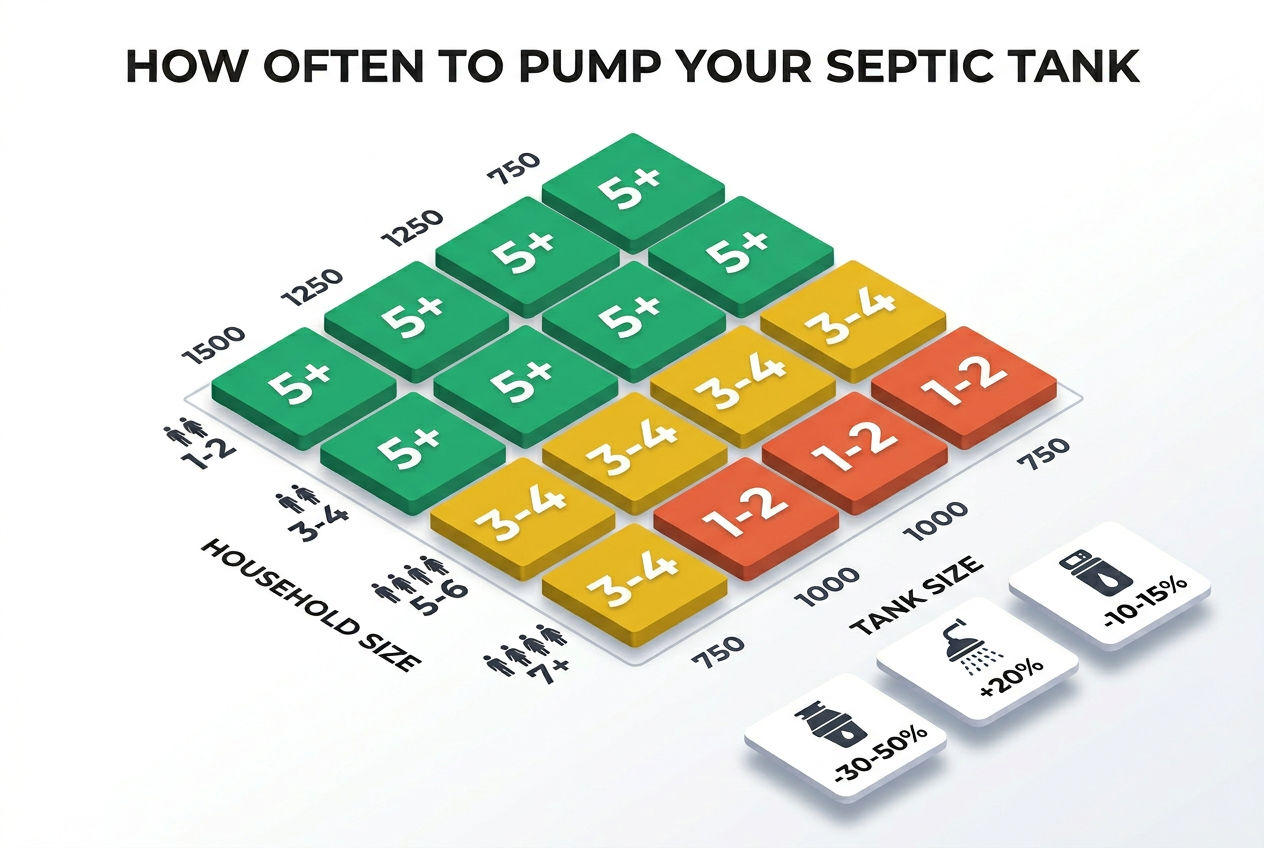
Septic Tank Pumping Frequency Table: Find Your Schedule
Use this table to find the recommended pumping interval for your specific tank size and household size. These figures come from EPA data and assume no garbage disposal is in use. If you have a garbage disposal, cut every interval roughly in half.
Recommended Pumping Intervals by Tank Size and Household Size
| Tank Size | 1 Person | 2 People | 3 People | 4 People | 5 People | 6 People |
|---|---|---|---|---|---|---|
| 750 gal | 9.1 yrs | 4.2 yrs | 2.6 yrs | 1.8 yrs | 1.3 yrs | 1.0 yrs |
| 1,000 gal | 12.4 yrs | 5.9 yrs | 3.7 yrs | 2.6 yrs | 2.0 yrs | 1.5 yrs |
| 1,250 gal | 15.6 yrs | 7.5 yrs | 4.8 yrs | 3.4 yrs | 2.6 yrs | 2.0 yrs |
| 1,500 gal | 18.9 yrs | 9.1 yrs | 5.9 yrs | 4.2 yrs | 3.3 yrs | 2.6 yrs |
| 2,000 gal | 25.4 yrs | 12.4 yrs | 8.0 yrs | 5.9 yrs | 4.5 yrs | 3.7 yrs |
Source: EPA "A Homeowner's Guide to Septic Systems." Intervals assume no garbage disposal and average water usage of 80–100 gallons per person per day. With a garbage disposal, reduce intervals by approximately 50%.
Worked example: A family of four in a 1,000-gallon tank should pump every 2.6 years without a garbage disposal. Add a garbage disposal, and that drops to roughly every 13 months - essentially once a year. That's not a scare tactic; that's just how much solid material a disposal adds to your system.
💡 Key Takeaway: If you're not sure what size tank you have, check your property's "as-built" septic diagram, which should be on file with your county health department. Many county offices have digitized these records and can email them within a business day.
What Factors Change How Often You Should Pump Your Septic Tank?
The table above gives you the math, but several real-world variables push that number up or down.
Primary Variables That Affect Pumping Frequency
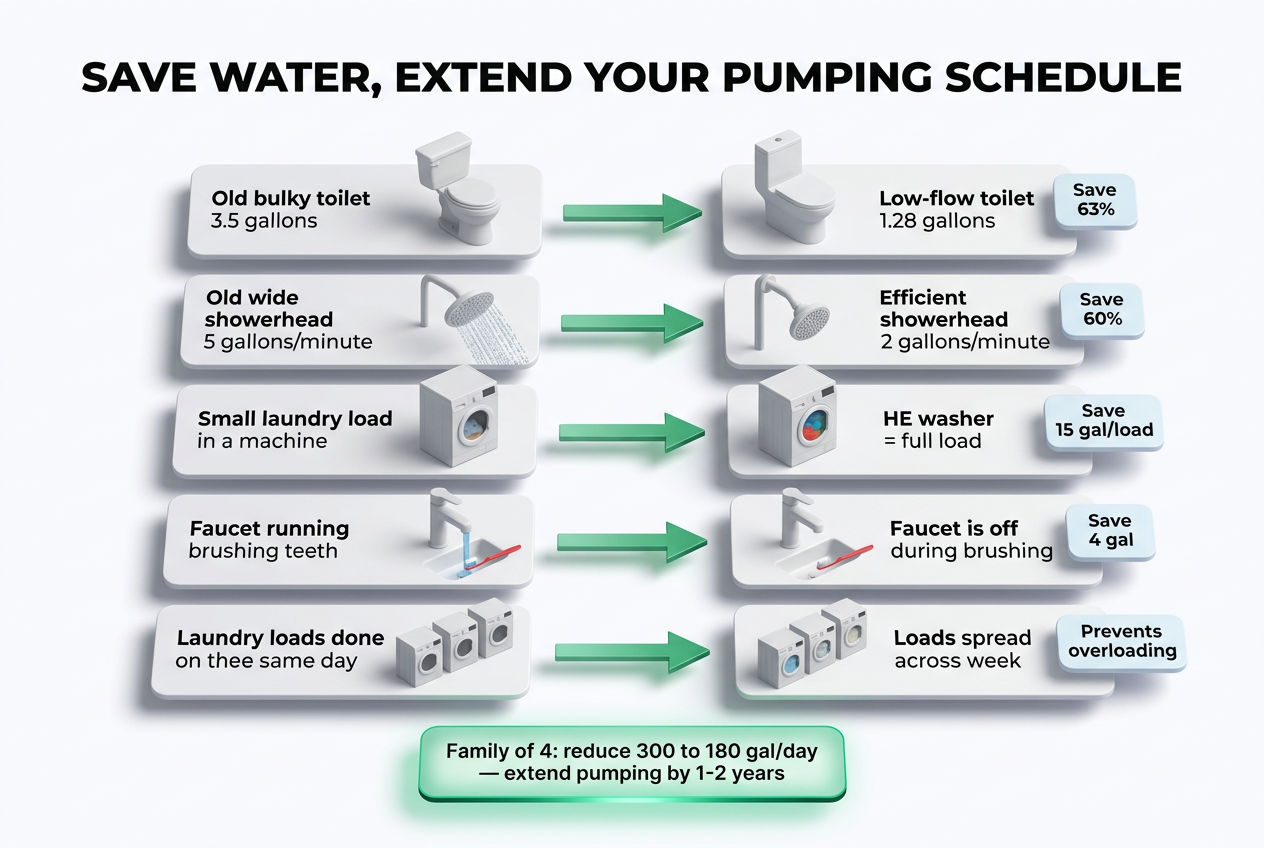
Household water usage. The EPA baseline assumes 80–100 gallons per person per day. A household that runs multiple loads of laundry daily, takes long showers, and runs the dishwasher twice could easily hit 150 gallons per person. Higher flow accelerates fill rates. Conversely, a two-person household that travels frequently and uses water conservation fixtures might extend their interval beyond the table's estimate.
Garbage disposal use. This one deserves its own emphasis. A garbage disposal can increase suspended solids entering your tank by up to 50%, according to EPA data. A 1,500-gallon tank serving four people would normally go 4.2 years between pump-outs. Add a disposal and you're looking at roughly every 2 years. Many septic service professionals recommend skipping the garbage disposal entirely if your tank is on the smaller side.
System age and condition. An older tank - especially a pre-1980 concrete tank - may have deteriorated baffles or cracked walls that change how solids accumulate. A fiberglass or polyethylene tank from the last 15 years behaves more predictably. If you've moved into an older home, get a baseline septic inspection before trusting any prior pumping schedule.
System-Specific Factors
Tank type. Conventional gravity-fed tanks follow the table above. Aerobic treatment units (ATUs) - systems that inject air to boost bacterial activity - typically require more frequent maintenance visits (every 1–2 years in most states) even if liquid pumping happens less often. Mound systems and chamber systems have their own specific maintenance protocols.
Effluent filter maintenance. Many modern tanks include an effluent filter (common brands include Polylok PL-122 and Zabel A1800) installed on the outlet baffle. These catch solids before they reach the drain field - a great thing. But the filter itself needs cleaning every 1–3 years. A clogged effluent filter can cause the tank to back up into the house even if the sludge layer isn't yet critical.
Guest loads and short-term surges. Picture this: it's Thanksgiving week. Your in-laws are staying, the kids are home from college, and your household temporarily doubles from three people to eight. Four days of doubled water usage won't destroy your system, but recurring seasonal surges do accumulate. Homeowners who regularly host large gatherings may want to pump on the shorter end of their interval range.
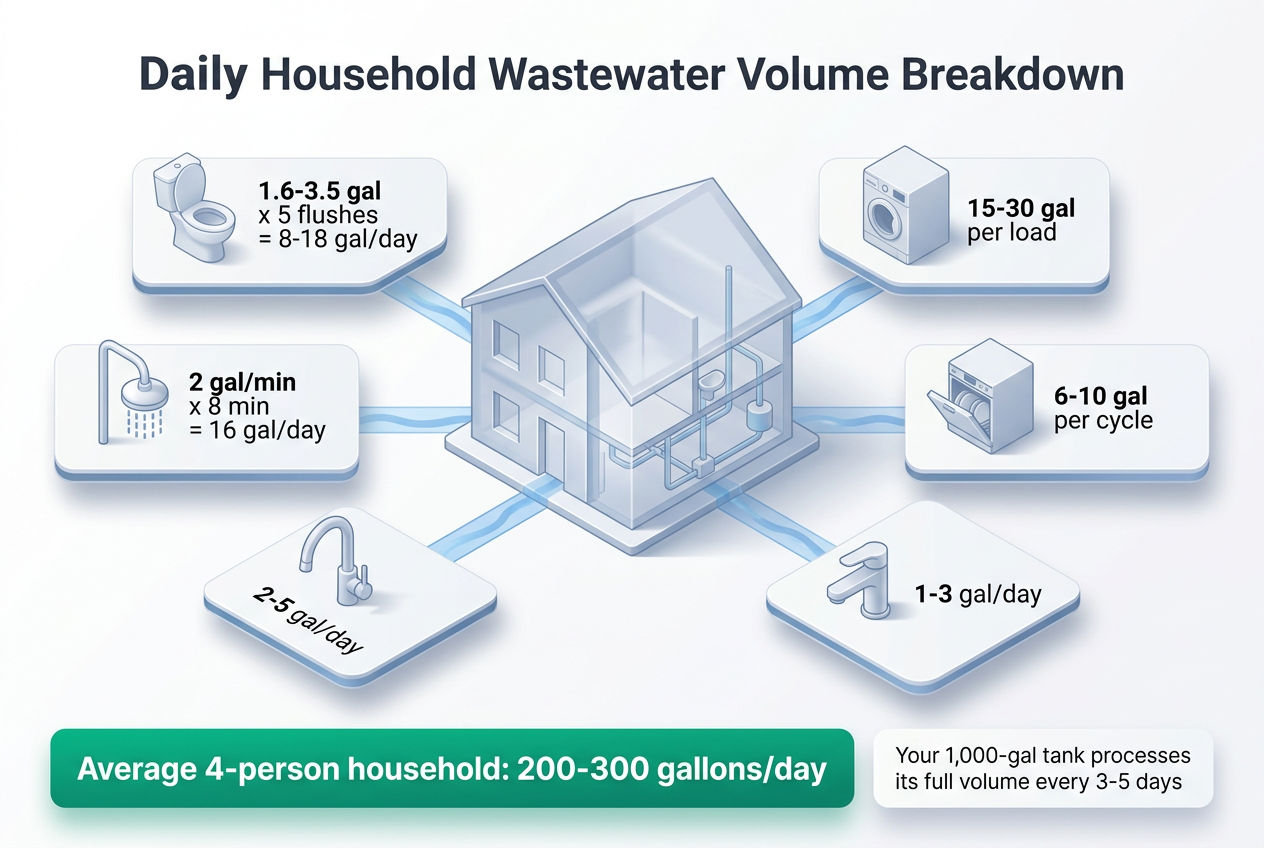
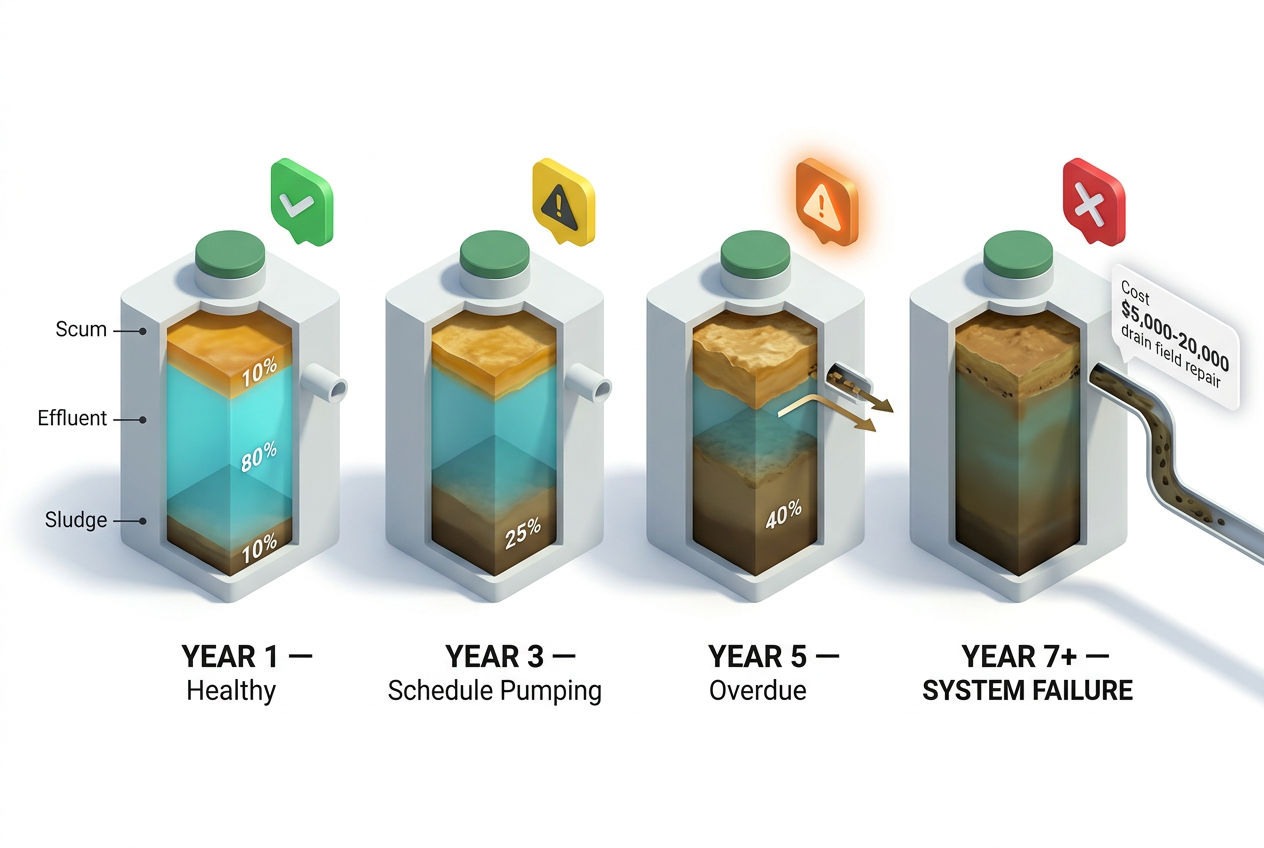
How Do I Know When My Septic Tank Needs to Be Pumped?
Your tank won't send a calendar reminder. But it does send signals. Here are the ones that matter, ranked from "act soon" to "act now":
Warning Signs Your Tank Is Full
-
Slow drains throughout the house - When one drain runs slow, it's usually a clog in that line. When every drain in the house runs slow simultaneously, the tank is likely approaching capacity and effluent has nowhere to go.
-
Gurgling sounds in plumbing - Air being pushed back through your drain lines often signals a full or sluggish tank. You'll hear it most in toilets and floor drains.
-
Sewage odors indoors or near the tank - A healthy system is essentially odorless. If you're smelling sulfur or sewage inside your home, near the tank lid, or around the drain field, something is wrong. Don't wait.
-
Wet or spongy ground over the drain field - If the grass above your leach field is unusually green, wet, or spongy - especially during dry weather - effluent is surfacing. That's a septic emergency.
-
Sewage backup into the home - This is the worst-case scenario. Toilets backing up, or sewage appearing in the lowest-level drains, means the tank is completely overwhelmed. At this point you're past "needs pumping" and may have a drain field problem too.
⚠️ Warning: Sewage backup is a health hazard and a septic emergency. Call a professional immediately if you experience this symptom.
See our full breakdown of signs your septic tank needs pumping for photos and diagnostic steps.

What Happens If You Don't Pump Your Septic Tank?
Skipping pumping doesn't just mean your tank gets a little fuller. The consequences escalate in a predictable and expensive pattern.
The Three Stages of Septic System Failure
Stage 1: Reduced efficiency. As sludge and scum layers grow, the effective liquid volume in your tank shrinks. The tank pushes solids toward the outlet baffle more aggressively.
Stage 2: Drain field contamination. Solid particles escape past the outlet baffle (or through a clogged effluent filter) and enter the drain field's distribution box. From there, solids clog the leach laterals - the perforated pipes buried in gravel trenches that disperse effluent into the soil. Biomat forms: a dense black layer of organic material that seals the soil pores and stops drainage cold.
Stage 3: System failure. Once a drain field is biomat-clogged, you can't pump your way out. The drain field itself needs rehabilitation or full replacement. That costs $3,000–$7,000 for repair and $15,000–$30,000+ for a full drain field replacement, depending on your region, soil type, and local permitting requirements.
💡 Key Takeaway: Compare drain field replacement costs to a routine pump-out at $300–$600. The math isn't subtle.
For more on what drain field failure looks like and how it's treated, see our drain field guide.
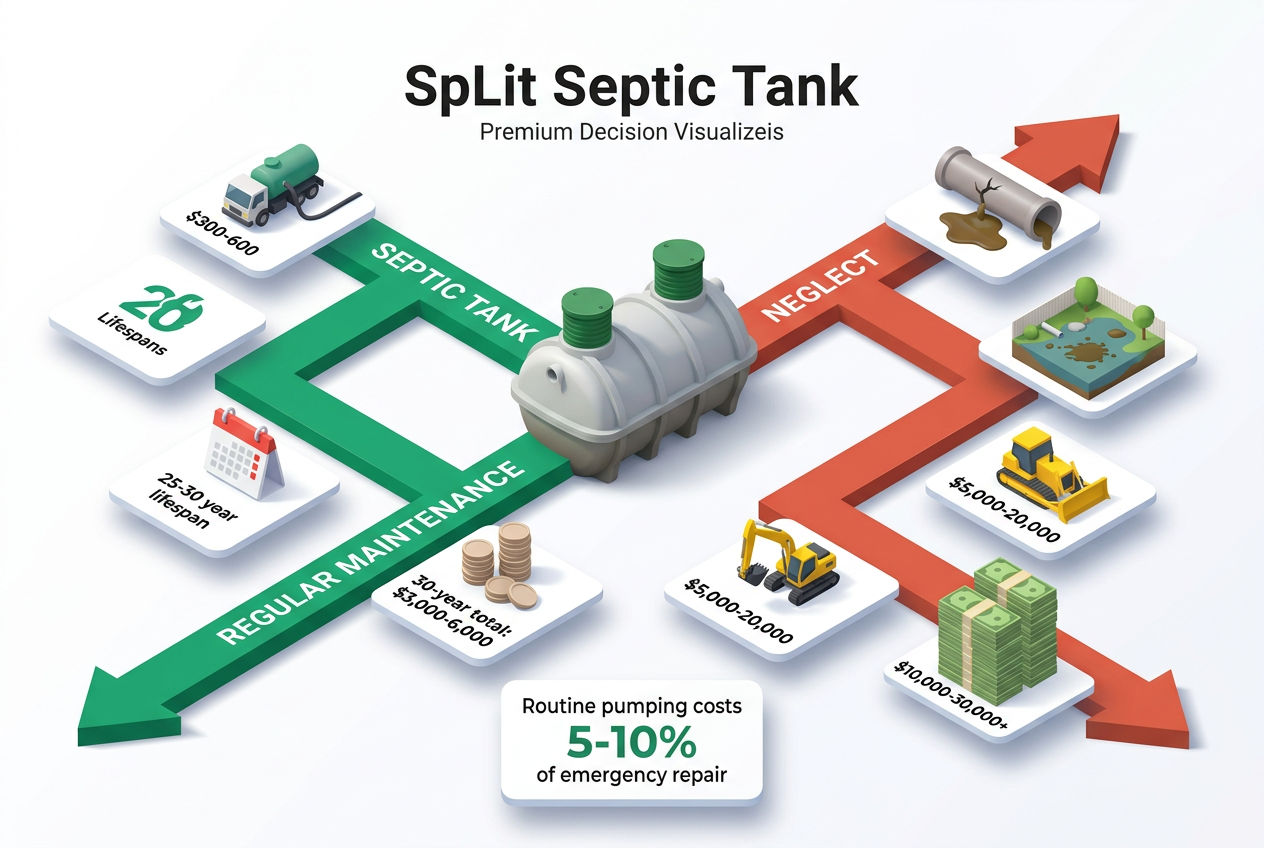
How Much Does Septic Tank Pumping Cost?
A standard residential pump-out for a 1,000-gallon tank runs $300–$600 nationally in 2026. Most companies price within a $275–$400 range for standard residential service. Larger tanks, difficult-access lids, or unusually heavy sludge accumulation push the price higher - sometimes to $800–$1,000 for a 2,000-gallon tank in a remote location.
Regional Cost Variations
Geography matters more than most people expect:
- Central Florida: $275–$375 for a 1,000-gallon tank
- Rural Minnesota: $350–$500 for the same job, reflecting longer drive times, shorter seasonal windows, and higher equipment operating costs in cold climates
Some companies bundle inspection with pumping for $400–$700 total - often a smart investment if you're overdue or just moved into the home.
⚠️ Warning: What you should never do is let cost be the reason you skip a service cycle. A single neglected pump-out that leads to drain field failure will cost you 25 to 75 times more than the pumping itself.
See our full septic tank pumping cost guide for regional breakdowns and what's included in a standard service.
Does a Garbage Disposal Affect How Often I Need to Pump?
Yes - significantly. A garbage disposal introduces food solids directly into your septic tank. The EPA estimates disposals can increase the suspended solid load entering your tank by up to 50%. In practical terms, that means cutting your pumping interval roughly in half.
Real-World Impact Examples
| Household | Tank Size | Without Disposal | With Disposal |
|---|---|---|---|
| 4 people | 1,500 gal | Every 4.2 years | Every 2 years |
| 4 people | 1,000 gal | Every 2.6 years | Every 13 months |
If you already have a disposal and love it, the fix is simple: pump more frequently and monitor your sludge levels annually. If you're building or remodeling, consider skipping the disposal entirely - most septic contractors recommend against them, especially on systems with tanks under 1,250 gallons.
Do Septic Tank Additives Reduce the Need for Pumping?
No. Bacterial additives like Rid-X add live microorganisms to the tank, but a healthy septic tank already contains billions of anaerobic bacteria doing exactly that job. University of Arkansas extension research found that commercially available septic additives did not reduce solids accumulation or extend pumping intervals in controlled studies. The National Onsite Wastewater Recycling Association (NOWRA) and the EPA both state that no additive eliminates the need for routine pumping.
⚠️ Warning: Some additives are actively harmful. Enzyme-based products and chemical additives can disrupt the biological balance in your tank and may push partially digested solids into the drain field faster.
If your tank is already failing, no additive will unclog biomat from a drain field. That's not what additives do. Regular pumping, careful water use, and protecting the drain field from physical damage are the only proven maintenance strategies. For more on what actually works (and what doesn't), see our deep dive on cleaning a septic tank without pumping. Learn more about year-round care in our septic tank maintenance guide.
Can You Pump a Septic Tank Too Often?
This question comes up more than you'd think - usually from homeowners who've been told they're pumping "unnecessarily." The short answer: pumping too frequently wastes money but does not harm your tank or your drain field.
Why Over-Pumping Is Harmless
- No mechanical damage - There's no wear-and-tear caused by pumping
- Bacteria recover quickly - You lose some beneficial bacteria with each pump-out, but the population rebuilds within days under normal household use
- Economic consideration - If you pump a 1,500-gallon tank serving two people every year, you're paying $300–$600 annually when the table says you could safely wait 9 years
✅ Pro Tip: If you're selling your home, getting a baseline reading on a new-to-you system, or following a county-mandated schedule, annual pumping is perfectly acceptable.
Bottom line: too often is better than not often enough.
Seasonal and Regional Factors That Affect Your Pumping Schedule
Timing your pump-out well can save you money and scheduling headaches.
Best Times to Schedule Service
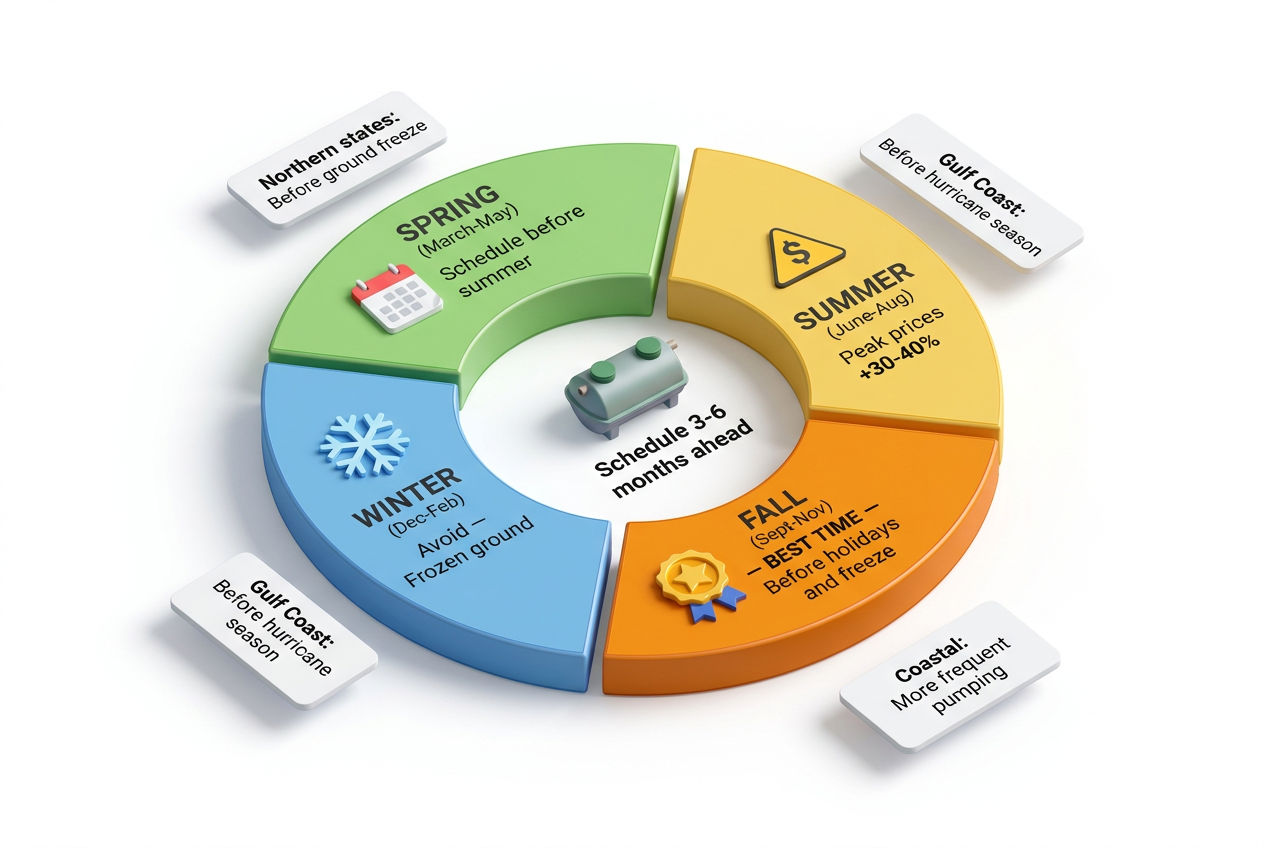
Spring is peak season in northern states. As the ground thaws and becomes accessible, companies in states like Minnesota, Wisconsin, and Michigan get slammed with service calls. The Minnesota Pollution Control Agency (MPCA) requires licensed pumpers to file disposal manifests with the county after every service - records you can request if you're buying a home and want to verify the service history. Book spring appointments at least 4–6 weeks out.
Late summer through early fall is the second peak window. Homeowners in cold climates schedule pump-outs before Thanksgiving and Christmas gatherings, knowing a full house will stress the system. Smart move.
Winter pumping is possible but more expensive in frost-belt states. If your tank access lid is buried under frozen ground, a company may need to locate and excavate it - adding $100–$300 in labor. Some regions see surcharges for winter service. We cover this in detail in our winter septic pumping guide.
Regional Regulatory Notes
-
Florida requires all septic contractors to hold a Registered Septic Tank Contractor (RSTC) license through the Florida Department of Health. Some counties - including Hillsborough and Miami-Dade - have enhanced inspection requirements tied to their advanced waste management ordinances.
-
Washington and Oregon have jurisdictions requiring annual operating permits for advanced treatment systems. Heavy rainfall in the Pacific Northwest regularly saturates drain fields - what looks like a "full tank" in January may actually be a temporarily waterlogged leach field.
-
Texas delegates septic regulation to county-level Authorized Agents rather than a single state body. Rules vary significantly by county; check with your local county health department before scheduling service.
-
Northeast states (New York, Pennsylvania, Massachusetts) have a high concentration of pre-1980 systems that may be undersized by modern standards. A 500- or 750-gallon tank installed for a two-bedroom cottage is now serving a family of four. These systems need more frequent pumping and a professional assessment of whether the tank needs upgrading.
How Long Does Septic Tank Pumping Take?
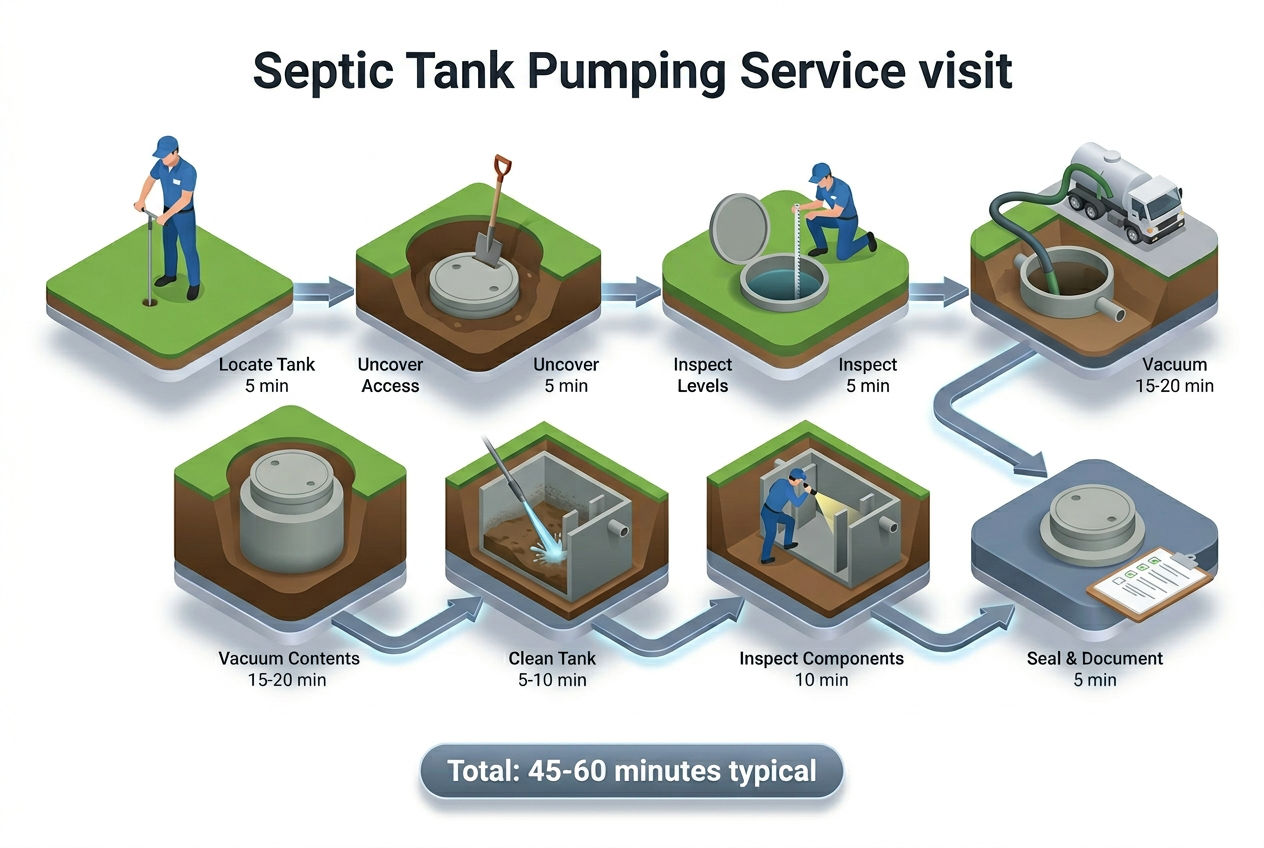
A standard residential pump-out takes 30 to 60 minutes from the time the truck arrives. The technician locates and uncovers your access lids (most residential systems have 1–3 lids depending on the tank design), inserts a 4-inch vacuum hose, and removes the liquid and solid waste - typically 1,000 to 1,500 gallons per service visit for a standard residential tank.
What Happens During Service
During the pump-out, a good technician will:
- Visually inspect the inlet and outlet baffles
- Check the effluent filter if one is present
- Note the condition of the tank walls
- Alert you to any concerns - cracked baffles, root intrusion, or unusual scum composition that might indicate household product misuse
For a detailed step-by-step walkthrough of what the pumper actually does on-site, see our guide on how septic tanks are pumped.
Get the full walkthrough in our article on what to expect during a septic tank pump-out and our breakdown of how long septic pumping takes.
How to Set Up a Septic Tank Maintenance Schedule You'll Actually Keep
The biggest mistake homeowners make isn't neglecting their system once - it's having no system for tracking service history.
Here's a practical approach:
5-Step Maintenance System
-
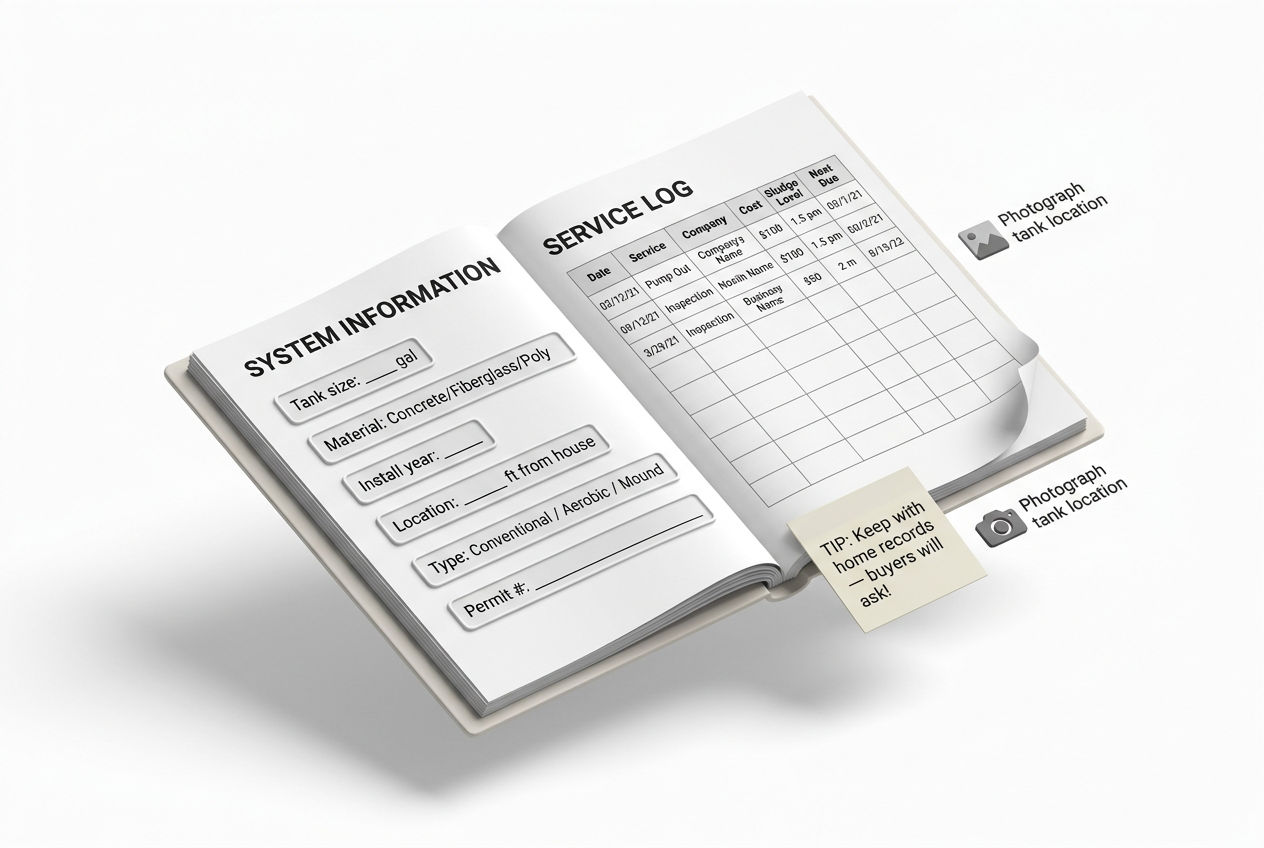
Find your tank size and location. Pull the as-built diagram from your county health department. If the previous owner had it pumped, ask for the service records - the pumping company should have them, and your county may have the disposal manifests on file.
-
Use the frequency table. Find your tank size and household size. That's your maximum interval. Set a reminder in your phone for 6 months before that date.
-
Account for variables. Add a garbage disposal? Cut the interval in half. Planning a major renovation that adds a bedroom or a bathroom? Call for a pump-out before the project starts.
-
Schedule an inspection with your pump-out. A septic inspection every other pump cycle - roughly every 6–10 years for most households - catches structural problems before they become catastrophic. See our septic inspection cost guide for what to expect.
-
Keep written records. A simple notepad in a kitchen drawer with the service date, company name, and any technician notes is more valuable than you think - especially if you ever sell the home.
✅ Pro Tip: For a complete year-round maintenance checklist, our septic system maintenance guide covers everything from effluent filter cleaning to drain field protection.
Sources & Methodology
The pumping frequency recommendations and data in this article draw from the following primary sources:
-
U.S. Environmental Protection Agency - A Homeowner's Guide to Septic Systems (EPA 832-B-02-005). Source of the core pumping frequency table, the 1/3-rule sludge measurement standard, and household water usage baselines.
-
Minnesota Pollution Control Agency (MPCA): State-level guidance on septic pumping manifests, licensed pumper requirements, and seasonal service considerations. Referenced for regional regulatory specificity.
-
Florida Department of Health: Licensing requirements for Registered Septic Tank Contractors (RSTC) and county-level enhanced ordinance information.
-
National Onsite Wastewater Recycling Association (NOWRA): Industry position on septic additives and routine maintenance standards.
-
University of Arkansas Cooperative Extension Service: Peer-reviewed research on the efficacy of commercial bacterial additives in septic systems; findings referenced in the additives section above.
Cost data reflects 2025–2026 national averages compiled from contractor pricing surveys and regional service company rate cards across SepticTankHub.com's directory network.
For tips on vetting contractors, see our guide on how to choose a septic service company.
Ready to schedule? Find a licensed septic pumper near you on SepticTankHub.
Learn more about our septic pumping services.
Related: septic terminology guide — worth reading if this applies to your situation.
Related reading: septic system smell.
Ready to Schedule Your Pump-Out?
You now have your number. Look up your tank size on the table, match it to your household size, and check whether you're due - or overdue.
Find licensed septic pumping companies near you on SepticTankHub.com. Search by zip code, read verified reviews, and get quotes from local professionals who know your region's soil conditions, permit requirements, and seasonal access windows. Don't wait for your drains to tell you it's time.
Free download
Not ready for the Handbook? Start with the free Fridge Card.
The Do / Don’t card the whole family can see, plus the Survival Kit: emergency flowchart, warning-sign decoder and pump-schedule card. One printable PDF.
Was this article helpful?
Frequently Asked Questions
Recommended Resources
📖 Related Articles
- What Is a Septic System? How It Works (Visual Guide)
- 8 Signs Your Septic Tank Needs to Be Pumped
- What Is a Drain Field? (And How Does It Work?)
- The Complete Septic Tank Maintenance Guide
- Should You Pump Your Septic Tank Before Winter?
- What to Expect When Getting Your Septic Tank Pumped
- How Long Does It Take to Pump a Septic Tank?
💰 Cost Guides
Find Septic Professionals Near You
Compare licensed, verified septic companies by area — top county markets and cities below, or browse all 50 states.
County markets
Popular cities
