
Quick Answer
Septic tanks are pumped by inserting a large vacuum hose through the tank's access lid and using a commercial pump truck - capable of generating 15–27 inches of mercury suction - to extract all sludge, liquid, and floating scum from the tank in a single visit lasting 30 to 60 minutes.
💡 Key Takeaways
- A commercial vacuum truck does the work - this is not a DIY job, and attempting it yourself is illegal in most states
- The entire process takes 30–60 minutes for a standard 1,000–1,500 gallon residential tank
- Technicians remove sludge, scum, and liquid - then inspect baffles, check for cracks, and assess your drain field
- Most households need pumping every 3–5 years; a 4-person household with a 1,000-gallon tank should book service every 3 years
- Skipping pumping can destroy your drain field - a repair that costs $10,000–$30,000+
If you've never watched a pump truck back up to your yard, you might wonder what actually happens during those 45 minutes your technician is out there. Is it complicated? Is it messy? Are they doing everything they should be? This guide walks you through the entire septic tank pumping process - equipment, steps, timing, and everything that happens to the waste afterward.
What Is Septic Tank Pumping, and Why Is It Necessary?
Septic tank pumping is the periodic removal of accumulated solids and liquids from your underground septic tank by a licensed vacuum truck operator. Your tank separates household wastewater into three layers: a floating scum layer of grease and light solids on top, a middle layer of clarified liquid called effluent, and a settled sludge layer of heavy solids at the bottom.
Anaerobic bacteria inside the tank break down a portion of those solids - but not all of it. According to the EPA, sludge accumulates at roughly 70–80 gallons per person per year in a properly functioning system. A 4-person household generates approximately 280–320 gallons of sludge annually.
⚠️ Warning: Left unchecked, those solids eventually spill over into your drain field, clogging the leach laterals and causing a failure that costs far more to fix than a routine pump-out.
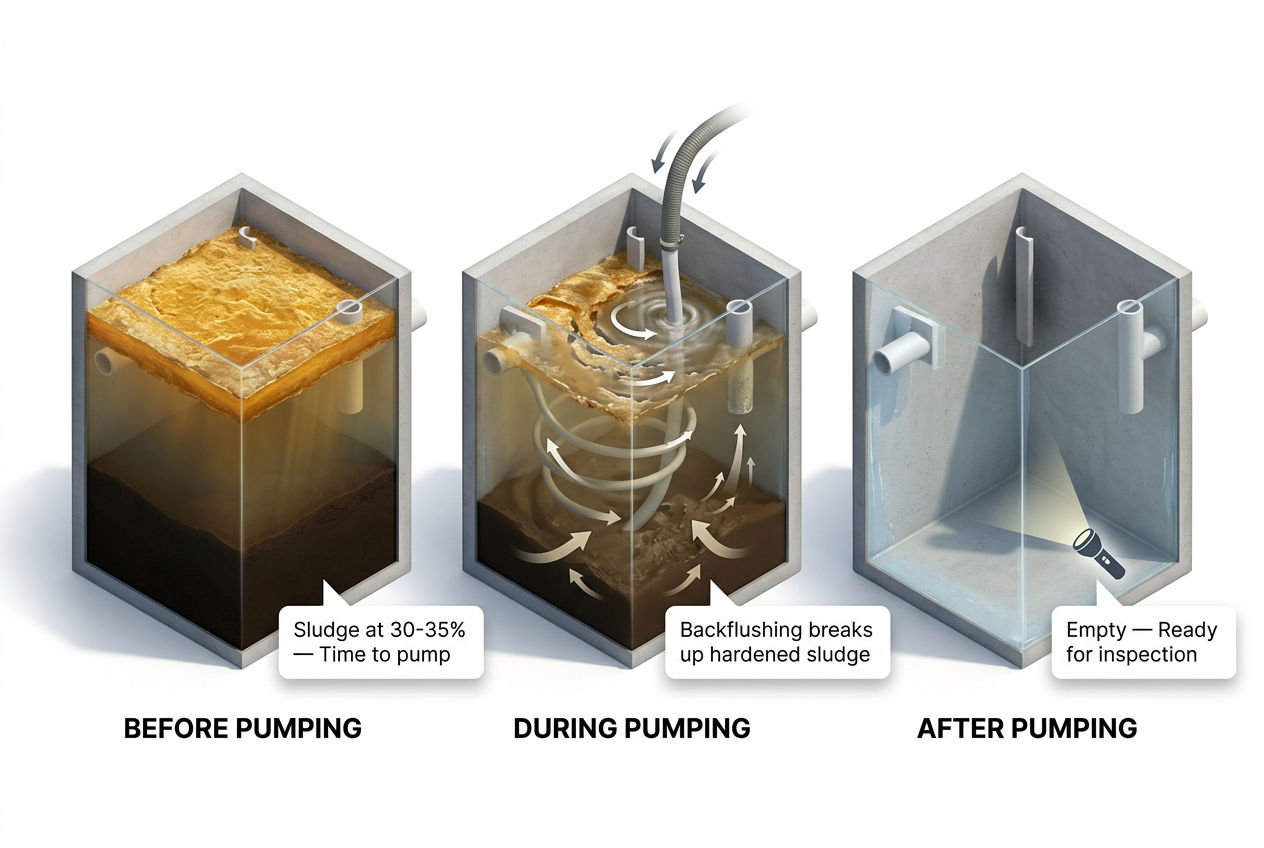
The EPA recommends pumping when sludge and scum together occupy one-third of the tank's total capacity. For most households, that means service every 3–5 years.
If you're seeing slow drains, gurgling pipes, or soggy spots in your yard, don't wait for your next scheduled service - those are signs your septic tank needs pumping now.
What Equipment Is Used in Septic Tank Pumping?
The centerpiece of every pump-out is the vacuum truck - also called a septic pump truck or septage hauler. These aren't small vehicles. A standard residential service truck carries a 2,000–5,500 gallon stainless steel or aluminum tank mounted on a heavy-duty chassis. Inside that tank, a positive-displacement vacuum pump generates the suction needed to move thick, heavy sludge through long hose runs.
Essential Truck Components
Here's what the technician brings to your job:
- Vacuum pump: Generates 15–27 inches of mercury (Hg) of vacuum pressure - enough to pull dense sludge from 100+ feet away
- Hoses: Heavy-duty 4-inch diameter suction hose, typically 100–150 feet in length. Most trucks carry up to 200 feet for properties with distant tank locations
- Hand tools: Shovels, pry bars, and riser lid tools for accessing the tank
- Sludge judge: A clear acrylic tube used to sample and measure sludge depth before and after pumping
- Inspection mirror and flashlight: For visually assessing baffles, tank walls, and effluent levels
- Pressure washer (sometimes): Used to rinse tank walls and dislodge compacted sludge in neglected tanks
✅ Pro Tip: Some companies also carry a high-pressure jetting wand if your effluent filter (such as a Polylok PL-122 or Zabel A1800) needs cleaning during the service visit.

How Does Septic Tank Pumping Work? Step-by-Step
This is the core of what happens during a service call. Here's the process from the moment the truck arrives:
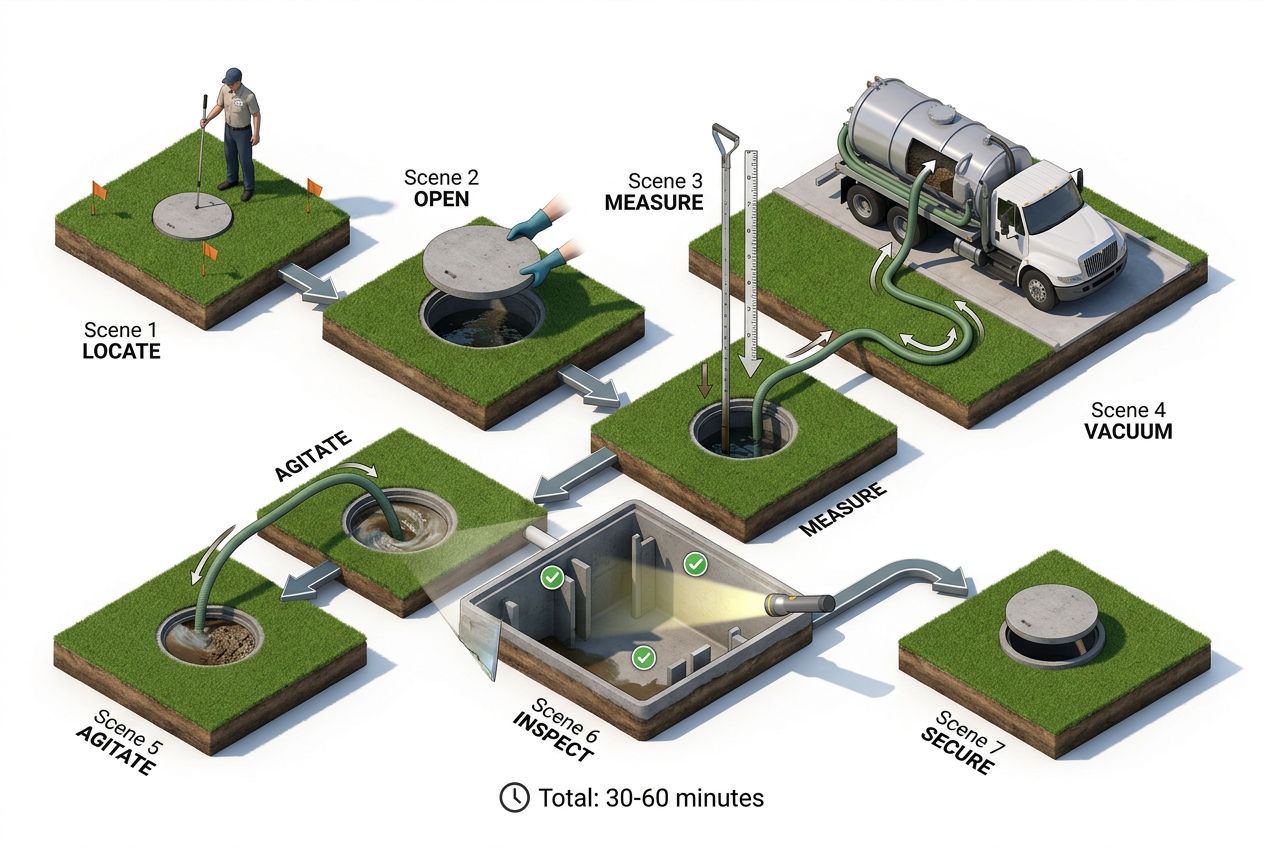
Step 1: Locate and Expose the Access Port
The technician confirms your septic tank's location - ideally you've already marked it, but experienced pumpers can often find it using probing rods, system records, or a soil probe. Most residential tanks are buried 12–36 inches below grade. They'll shovel down to the concrete or plastic riser lid and remove it.
📊 Quick Fact: Many tanks have two lids (one over the inlet baffle, one over the outlet), and accessing both produces a more thorough pump-out.
Step 2: Measure Sludge and Scum Levels
Before anything is removed, a professional will use a sludge judge - a 6-foot clear polycarbonate tube - to sample the sludge depth. This gives them a baseline, confirms pumping is needed, and helps identify whether the system is functioning normally. Some technicians skip this step; if yours doesn't measure before pumping, it's worth asking.
Step 3: Insert the Suction Hose
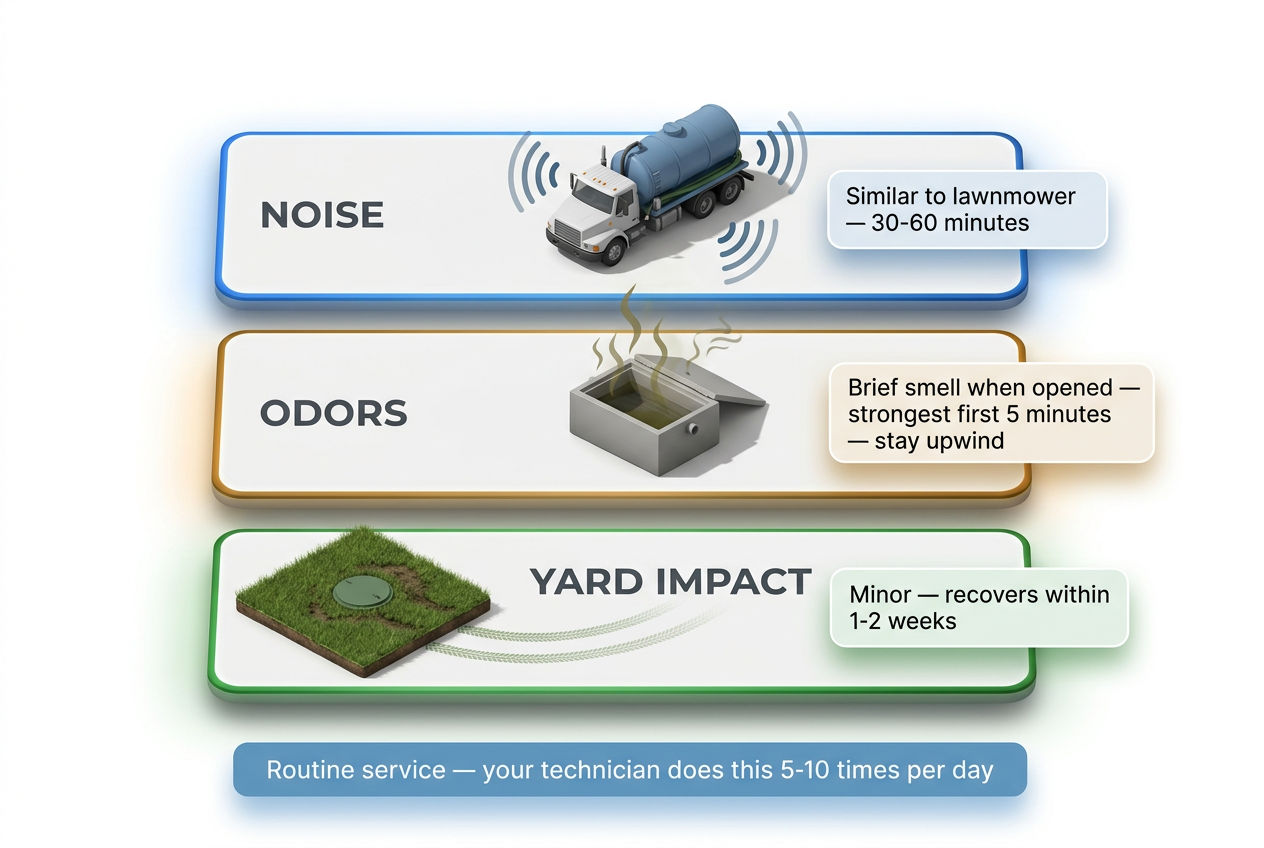
The 4-inch vacuum hose goes into the tank through the access opening. The truck's vacuum pump starts pulling immediately. You'll hear a loud engine roar - that's normal. The operator manipulates the hose to break up the floating scum layer and work around the tank's interior.
Step 4: Remove All Contents
A full pump-out removes everything: sludge, scum, and liquid effluent. Some old-timers will tell you to leave a bit of sludge to "seed" bacterial activity. The EPA's guidance disagrees - a complete pump-out is best practice. Beneficial anaerobic bacteria will re-establish naturally within 2–4 weeks. The truck's onboard tank receives all septage, which is monitored to avoid overfilling.
Step 5: Backflush and Rinse (If Needed)
On tanks that haven't been pumped in 10+ years, sludge can become compacted and thick. The technician may pump a small amount of water back into the tank using a backflush valve, stir the contents, and vacuum again. This breaks up stubborn sludge at the bottom and along the walls.
Step 6: Inspect the Tank Interior
With the tank empty, a qualified technician will inspect:
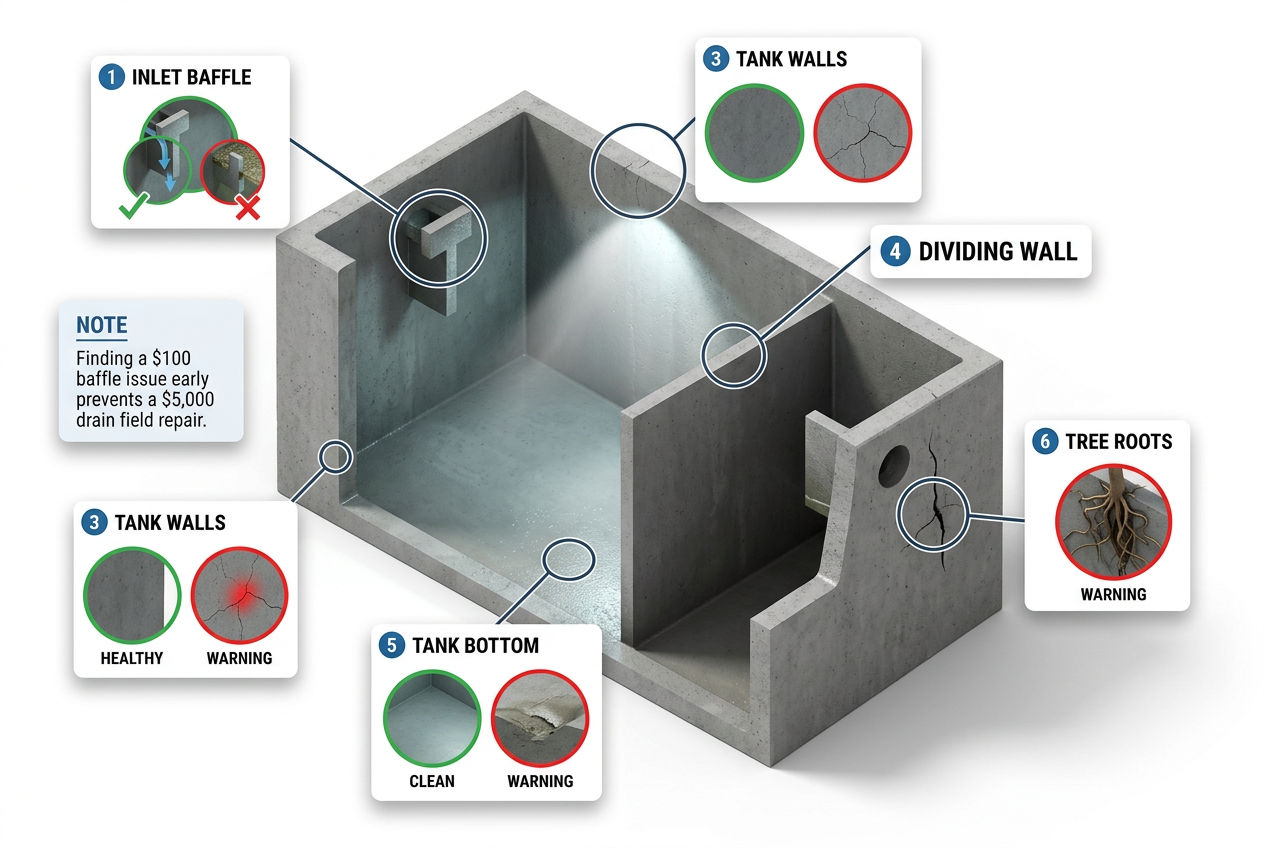
- Inlet and outlet baffles - checking for cracks, deterioration, or missing baffles entirely (a common problem in pre-1990 concrete tanks)
- Tank walls and floor - looking for cracks, root intrusion, or signs of structural compromise
- Effluent filter - cleaning the filter cartridge if one is installed
- Scum and sludge accumulation rate - cross-referenced against your pumping history to flag abnormal accumulation
💡 Key Takeaway: This inspection step is where pumping earns its value beyond just waste removal. A thorough septic tank inspection during pumping can catch a $300 baffle replacement before it becomes a $25,000 drain field failure.
Step 7: Replace the Lids and Clean Up
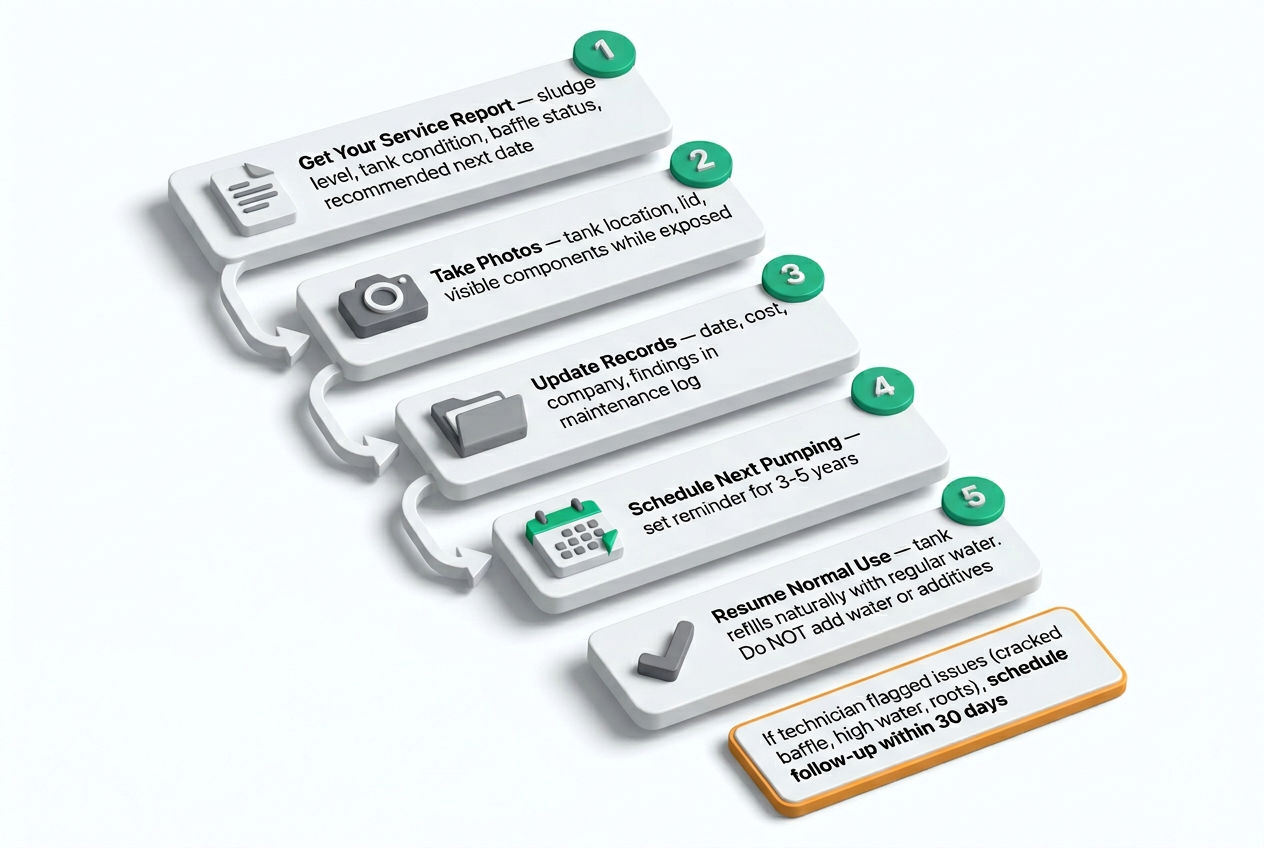
The technician replaces all access lids, fills in any excavated soil, and documents the service. Request a written report - it should include tank condition, sludge depth before service, any issues noted, and recommended follow-up. Minnesota's MPCA requires licensed pumpers to file a disposal manifest with the county after every service; many other states are moving toward similar requirements.
Where Does the Waste Go After a Septic Tank Is Pumped?
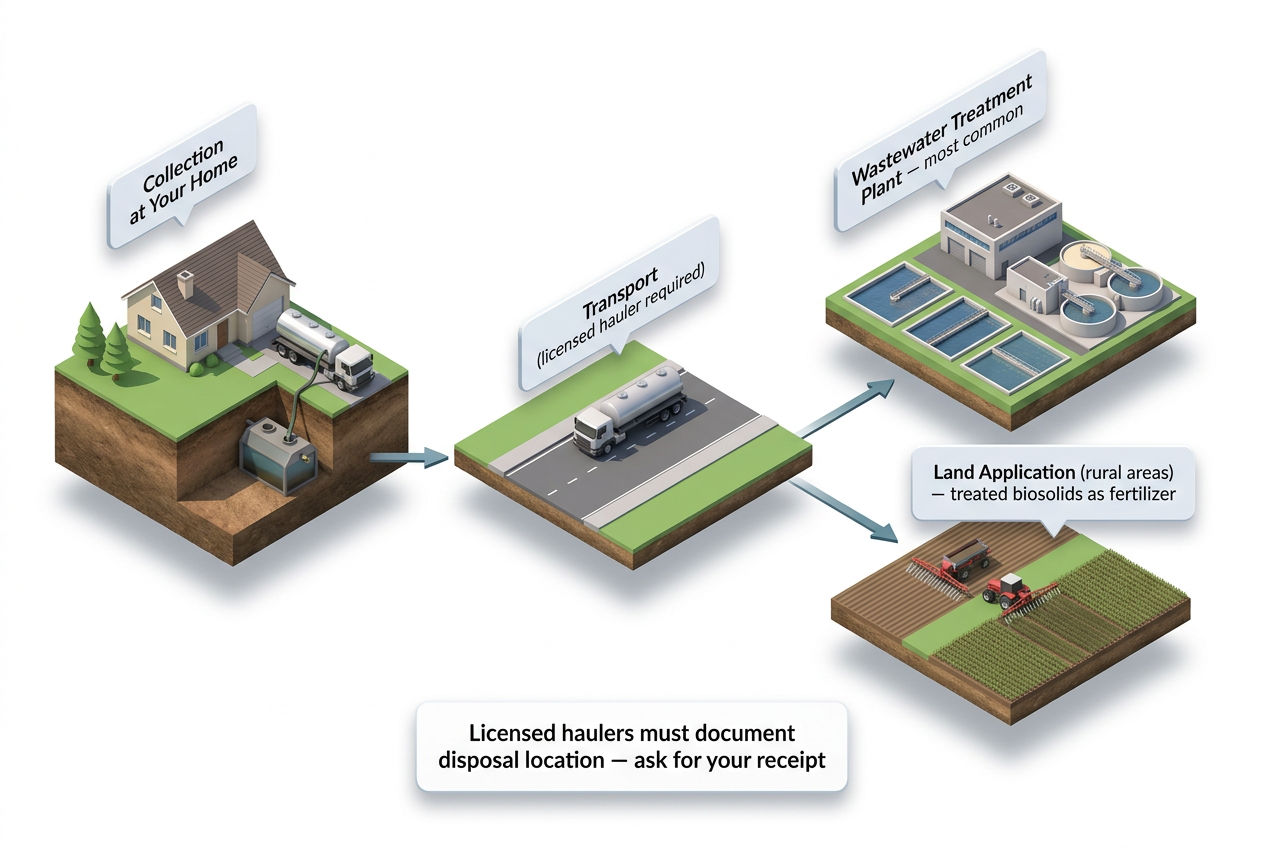
Once the truck leaves your property, the septage - everything that came out of your tank - must be disposed of legally. Licensed haulers transport it to one of three approved destinations:
- Municipal wastewater treatment plants - The most common route; the plant processes septage through its existing treatment systems
- Approved land application sites - Septage can be spread on agricultural land as a soil amendment under strict permits and setback requirements
- Dedicated septage processing facilities - Standalone plants designed specifically to handle high-solids septage
⚠️ Warning: Dumping septage anywhere else is a federal violation under the Clean Water Act. When you hire a licensed company, you're not just paying for the pump-out - you're paying for legal, documented disposal.
Always ask for a disposal receipt if you're in a state that requires manifest documentation.
How Long Does Septic Tank Pumping Take?
A standard pump-out for a 1,000–1,500 gallon residential tank takes 30–60 minutes from hose insertion to lid replacement, assuming normal access and a tank that's been serviced within the last 5 years.
Factors That Extend Service Time
Expect longer service times if:
- The tank hasn't been pumped in 10+ years - compacted sludge requires backflushing and multiple pump cycles; add 30–45 minutes
- Access is difficult - a lid buried 3 feet deep, under landscaping, or far from the driveway requires more setup time
- Your tank is larger than 1,500 gallons - a 2,000-gallon tank serving a large family can take 90+ minutes
- The technician discovers problems - inspecting a damaged baffle or clogged effluent filter adds time
For a deeper breakdown of timing factors, see how long septic tank pumping takes.
How Often Should You Pump Your Septic Tank?
Pumping frequency depends on tank size and household size. The EPA publishes the following guidance in A Homeowner's Guide to Septic Systems:
| Household Size | 1,000-gal Tank | 1,500-gal Tank |
|---|---|---|
| 1 person | Every 12 years | Every 19 years |
| 2 people | Every 6 years | Every 9 years |
| 3 people | Every 4 years | Every 6 years |
| 4 people | Every 3 years | Every 5 years |
| 5 people | Every 2 years | Every 3.5 years |
Source: EPA "A Homeowner's Guide to Septic Systems" (epa.gov/septic)
📊 Quick Fact: These are baseline figures. Your actual interval shortens if you use a garbage disposal, which the EPA estimates can cut your pumping interval nearly in half.
What Shortens Your Pumping Interval
Your actual pumping schedule may be more frequent if you:
- Use a garbage disposal (adds significant solids load)
- Have frequent houseguests or run a home-based business
- Use high water-volume appliances frequently
- Have older teenagers or young adults in the home
For a full breakdown of variables - including how soil type and system age affect frequency - read our guide on how often to pump your septic tank.
How Much Does Septic Tank Pumping Cost?
A standard residential pump-out costs $400–$600 nationally, based on 2024–2025 data from Angi and NAWT member surveys. The full range runs $275 on the low end (small tank, easy access, lower cost-of-living area) to $900+ for large tanks, difficult access, or remote locations.
Regional Cost Examples
To make that concrete:
- Central Florida: Pumping a 1,000-gallon tank typically runs $275–$375 with easy driveway access
- Rural Minnesota: The same service can run $425–$600 or more where technicians drive 45+ minutes each way and may face frozen ground
⚠️ Warning: Emergency or after-hours pumping typically costs 1.5x–2x the standard rate. If you call at 10 PM on Thanksgiving because your toilets are backing up, expect to pay $700–$1,200+ depending on your market.
For a complete breakdown of what drives pricing in your region, see our septic tank pumping cost guide.
What Happens If You Don't Pump Your Septic Tank?
Skipping pumping isn't just an inconvenience - it's a system death sentence.
When sludge builds past the outlet baffle, solids flow into the distribution box and down into your drain field's leach laterals. Biomat - a thick biological layer - forms in the soil pores. Once that happens, water can't drain. Your yard gets soggy, sewage backs up into your home, and the drain field fails.
💡 Key Takeaway: Replacing a failed drain field costs $10,000–$30,000 depending on size and soil conditions. In some properties with poor percolation or limited space, it costs even more - or isn't feasible at all, requiring a complete septic system redesign.
The Real-World Scenario
Picture this: you're selling your home and the buyer's inspector flags a saturated drain field during the inspection. The buyer walks. You're now looking at a failed sale, a $20,000 repair, and a disclosure obligation on every future listing. All of it preventable with a $400 pump-out every 3–4 years.
Can You Pump a Septic Tank Yourself?
No - and this is one of the clearest cases where DIY is off the table. Here's why:
A residential pump-out generates 1,000–1,500 gallons of Class B septage - a regulated waste material under federal and state law. Handling it requires:
- A commercial vacuum truck (minimum $80,000–$200,000)
- A waste hauler's license
- An approved disposal facility permitted to accept septage
⚠️ Warning: In most states, transporting septage without a license is a criminal violation, not just a civil fine.
Renting a portable pump won't work either - residential pumps can't generate the vacuum pressure (15–27 inches Hg) needed to pull thick sludge through a 4-inch hose over any meaningful distance. You'd be left with a partially emptied tank and a mess.
For a full breakdown of who is licensed to perform this work and what credentials to verify, see who pumps septic tanks.
How to Prepare for Your Septic Tank Pumping Appointment
A little preparation saves time and sometimes money:
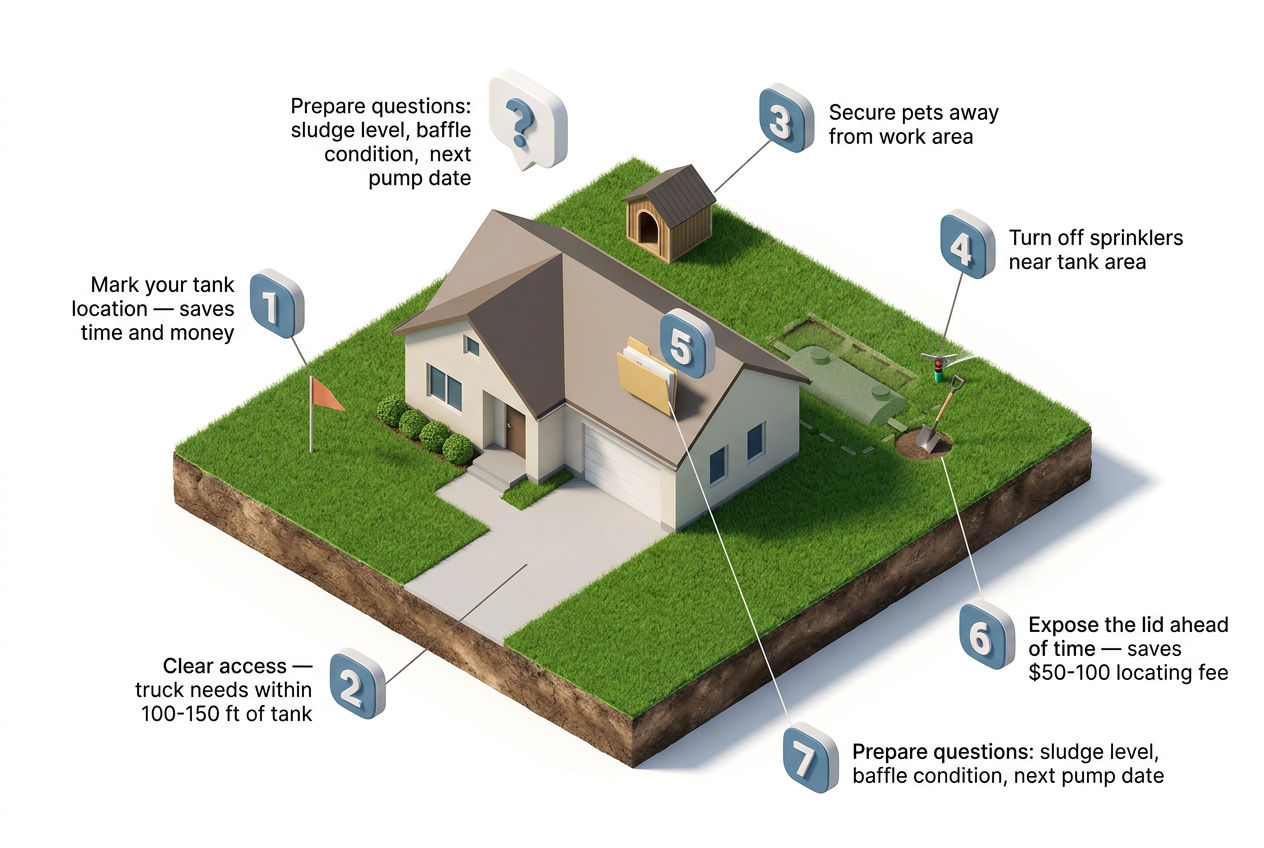
- Know your tank location. Mark it with a flag or stake before the technician arrives. If you don't know where it is, check your property's as-built drawing (often on file with your county health department) or tell the company upfront - they may charge extra for locating
- Clear the access area. Move lawn furniture, potted plants, or vehicles parked over the tank area
- Note any problems. Tell the technician about slow drains, gurgling sounds, or wet spots before they start - this context helps them know what to look for
- Have your service history handy. If you know when the tank was last pumped, share that. It helps the technician calibrate expectations
- Ask for a written report. Any reputable company will provide one. If they won't, that's a red flag
Free download
Free: the Septic Fridge Card — what to flush, what never to.
The Do / Don’t card the whole family can see, plus the Survival Kit: emergency flowchart, warning-sign decoder and pump-schedule card. One printable PDF.
For a full pre-appointment checklist, read what to expect from septic tank pumping.
Seasonal Considerations: Does Time of Year Matter?
Timing your pump-out matters more than most homeowners realize.
Best Seasons for Pumping
Spring and fall are ideal in most of the country - ground is accessible, temperatures are moderate, and scheduling is easier before peak summer demand hits.
Winter Challenges
Winter pumping in northern states is a different story. In Minnesota, Wisconsin, and Maine, frost lines reach 42–60 inches. Tanks buried shallower than that can be difficult or impossible to access without thawing equipment. Some companies in these regions charge a winter surcharge of $50–$200 or decline service until spring.
✅ Pro Tip: If you're in a cold-climate state, book your pump-out in September or October - not December.
Pre-Holiday Planning
Pre-holiday pumping is smart if you're expecting a house full of guests for Thanksgiving or Christmas. Adding 6–8 people to a system sized for 4 significantly stresses your tank over 3–5 days. A pump-out 2–4 weeks before the holiday gives your system maximum capacity going in.
For cold-climate specifics, our guide on septic tank pumping in winter covers what to expect in frozen-ground conditions.
Sources & Methodology
The data, cost figures, and process descriptions in this article are drawn from the following primary sources:
- U.S. Environmental Protection Agency - A Homeowner's Guide to Septic Systems: Pumping frequency guidelines, sludge accumulation rates, and general system guidance
- National Association of Wastewater Technicians (NAWT): Industry standards for inspection procedures performed during pump-outs
- National Onsite Wastewater Recycling Association (NOWRA): Trade equipment specifications and technician certification standards
- Angi / HomeAdvisor 2024 Cost Data: National and regional cost ranges for residential septic pumping.
- Minnesota Pollution Control Agency (MPCA): State-level regulatory requirements for septage disposal manifests, referenced as an example of stricter state oversight.
Cost figures reflect 2024–2025 market conditions and should be verified with local providers before making service decisions.
Ready to schedule? Find a licensed septic pumper near you on SepticTankHub.
Learn more about our septic pumping services. Wondering about a deeper service? Our septic tank cleaning guide explains when a full tank cleaning is worth the extra cost over a standard pump-out.
Related reading: septic tank maintenance guide.
Find a Licensed Septic Pumping Company Near You
Understanding the process is one thing - finding a qualified technician who actually follows it is another.
SepticTankHub.com connects homeowners with licensed, reviewed septic pumping professionals across the country. Search by zip code to find companies serving your area, compare credentials, and book with confidence.
Find a septic pumping company near you →
Need help with your septic system? Browse local septic companies in Georgia or North Carolina.
Was this article helpful?
Frequently Asked Questions
Recommended Resources
📖 Related Articles
- What Is a Drain Field? (And How Does It Work?)
- 8 Signs Your Septic Tank Needs to Be Pumped
- How Long Does It Take to Pump a Septic Tank?
- How Often Should You Pump Your Septic Tank?
- What Is a Septic System? How It Works (Visual Guide)
- Who Pumps Septic Tanks? (How to Find the Right Company)
- What to Expect When Getting Your Septic Tank Pumped
- Should You Pump Your Septic Tank Before Winter?
💰 Cost Guides
Find Septic Professionals Near You
Compare licensed, verified septic companies by area — top county markets and cities below, or browse all 50 states.
County markets
Popular cities
