
Quick Answer
Septic tank cleaning is the process of removing accumulated sludge and scum from your septic tank — typically costing $300–$600 nationally for a standard service on a 1,000-gallon tank. The EPA recommends cleaning every 3–5 years for most households, though your actual schedule depends on tank size, household size, and usage habits.
Key Takeaways
- Standard septic tank cleaning costs $300–$600 for a 1,000-gallon tank; full cleaning with hydro jetting runs $500–$1,200
- The EPA recommends cleaning every 3–5 years — a 4-person household with a 1,000-gallon tank typically needs service every 2–3 years
- "Cleaning" and "pumping" are often used interchangeably, but a full cleaning goes further than a basic pump-out
- Skipping service can lead to drain field failure costing $2,000–$15,000+
- Adding a garbage disposal increases how often you need service by roughly 50%
About 21 million U.S. households rely on septic systems, according to EPA data — that's roughly one in five homes. Most of those homeowners will go years without thinking about their tank. Then the drain starts gurgling, or they catch a whiff of something sulfurous near the yard, and suddenly they're scrambling for answers.
This guide covers everything you need: what septic cleaning actually involves, what it costs in 2026, how often your specific system needs it, and what happens if you skip it too long. We'll also clear up the confusion between cleaning and pumping — because those two terms are not always the same thing.
What Does Septic Tank Cleaning Include?
Septic tank cleaning, at minimum, involves pumping out the liquid, sludge, and scum from your tank using a vacuum truck. A full cleaning goes several steps further.
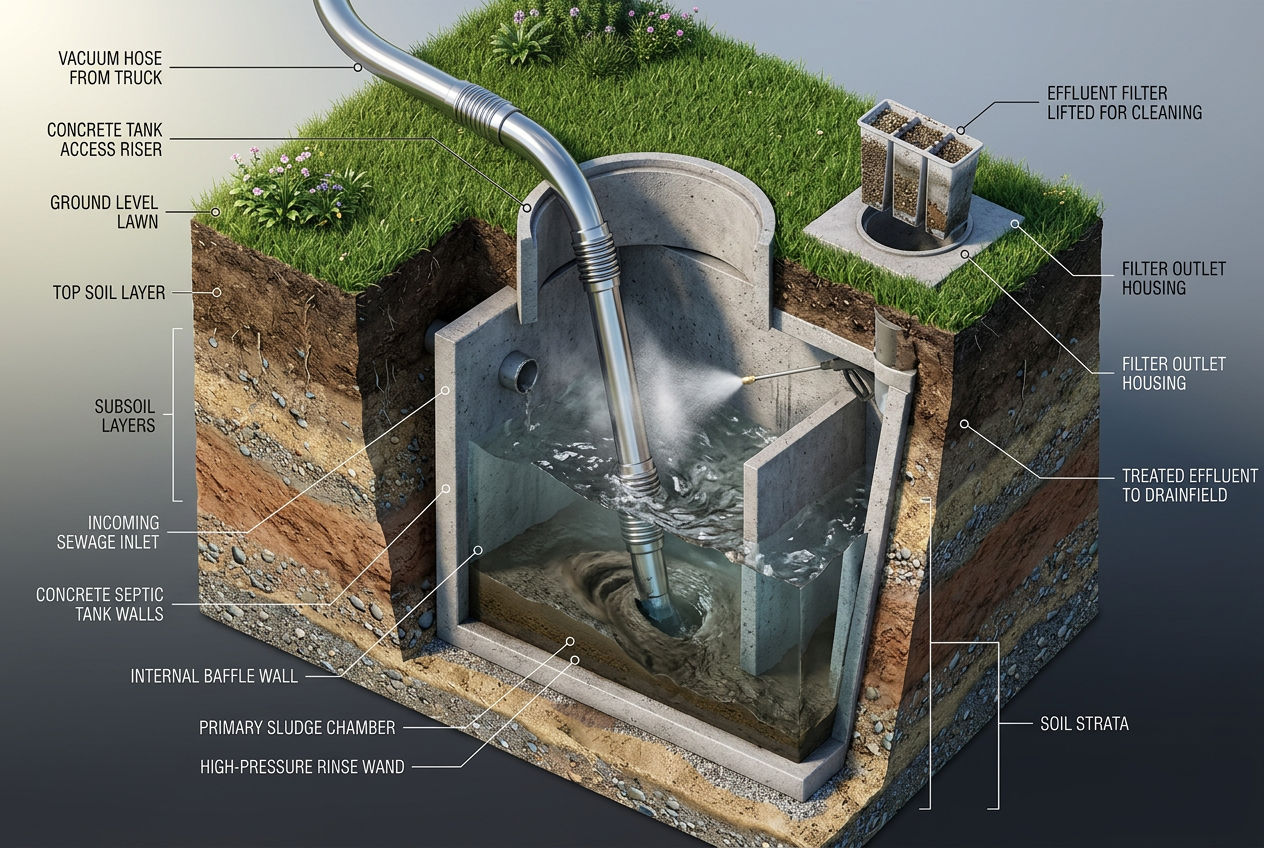
Here's what a thorough service call typically covers:
1. Locating and accessing the tank The technician locates your tank lids or risers and opens them. If your tank is buried without risers — common in older homes — the tech may need to probe and dig to find the access ports. Expect to pay an extra $50–$150 for excavation if this applies to you. Installing septic tank risers after the service is worth every penny to avoid that charge next time.
2. Inspecting the sludge and scum layers Before pumping, a technician uses a sludge judge — a clear plastic tube inserted into the tank — to measure how deep the sludge layer has accumulated at the bottom and how thick the floating scum layer is on top. When sludge reaches roughly one-third of the tank's total volume, it's time to pump. If a technician skips this step, that's a red flag.
3. Pumping out the tank contents A vacuum pump truck — typically with a 2,000–5,000 gallon tank capacity — removes everything: the liquid effluent, the sludge at the bottom, and the floating scum. For a standard 1,000-gallon residential tank, this typically takes 30–60 minutes. Larger tanks or severely neglected systems can take 1–3 hours.
4. Inspecting baffles, filters, and the tank interior Good technicians check the inlet baffle and outlet baffle for cracks or deterioration. The inlet baffle directs incoming waste downward; the outlet baffle keeps solids from migrating toward your drain field. If either baffle is damaged, solids escape into the leach field and cause expensive clogs. Many modern tanks also have an effluent filter — such as a Polylok PL-122 or Zabel A1800 — installed at the outlet. A full cleaning includes removing, cleaning, and reinstalling this filter.
5. Rinsing the tank walls (full cleaning vs. basic pumping) In a basic pump-out, the tech vacuums out the liquid contents and calls it done. In a full cleaning, they'll also spray down the interior walls with water to dislodge stubborn sludge deposits, then vacuum that out too. Some companies use high-pressure water jetting — the same hydro jetting approach used for clogged pipes — to thoroughly scour the tank interior. That's the difference between a rinse and a deep clean.
6. Visual inspection of the drain field A conscientious technician will note whether the drain field shows signs of stress — wet spots, odors near the leach laterals, or backed-up effluent in the tank. This doesn't replace a formal septic inspection, but it gives you useful real-time information.
Want a detailed walkthrough of what happens during service? Our guide on how septic tanks are pumped walks through the entire process step by step.
Is Septic Tank Cleaning the Same as Pumping?
No — septic tank cleaning and pumping are related but not identical, though contractors often use the terms interchangeably.
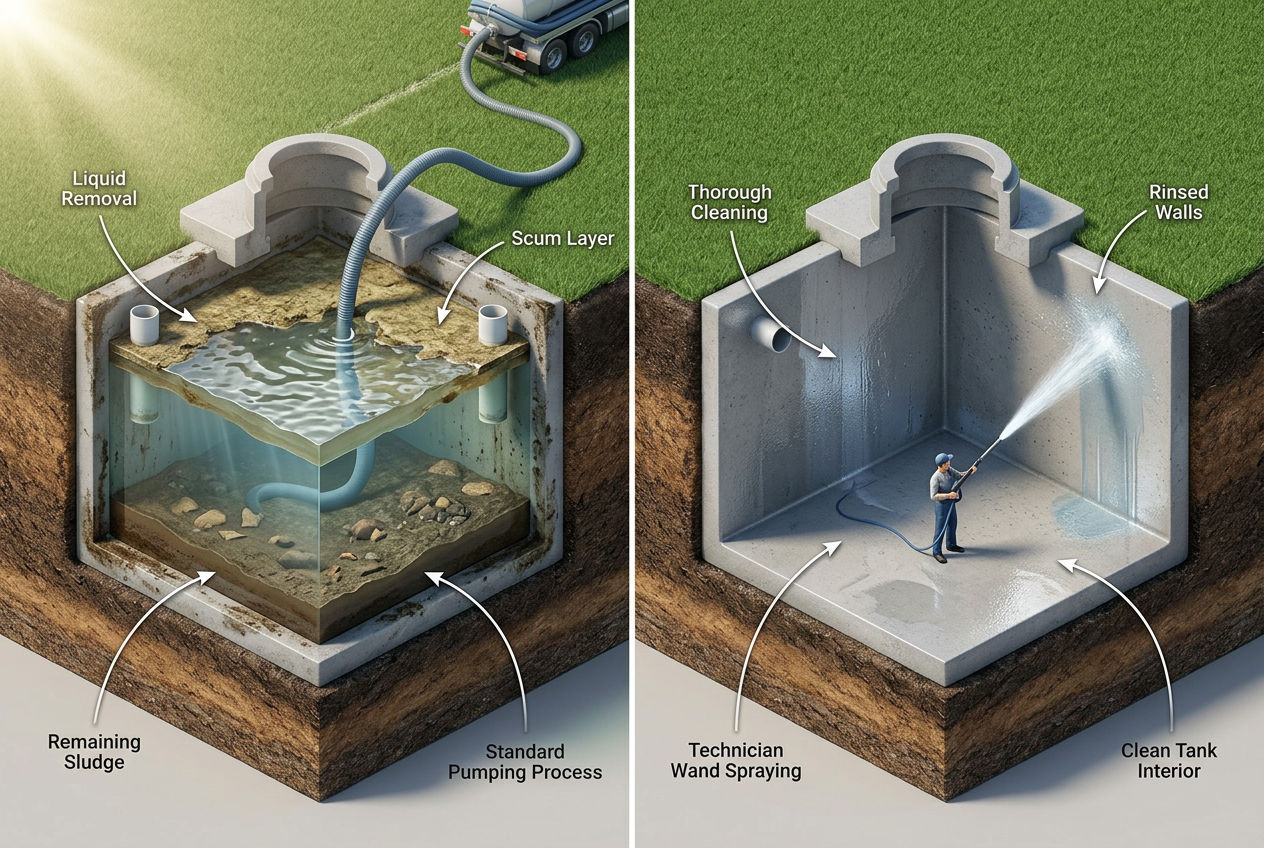
Septic pumping is the extraction of liquid and semi-liquid waste from the tank. It removes the effluent (liquid layer) and a portion of the sludge. It's fast, it's the industry baseline, and it's what most "routine service" calls include.
Septic tank cleaning is more thorough. It includes pumping, plus washing down the interior walls, fully evacuating compacted sludge from the bottom, cleaning or replacing the effluent filter, and inspecting baffles and components. Some providers also jet the inlet and outlet pipes.
Think of it like this: pumping is emptying your vacuum's dustbin. Cleaning is emptying the bin and washing the filters.
For most homeowners on a regular maintenance schedule, a quality pump-out every 3–5 years keeps the system healthy. If you've gone 7+ years between services, or you've noticed slow drains and odors, a full cleaning is the smarter call. It costs more upfront — typically $500–$1,200 — but it's far cheaper than a drain field repair.
For a deeper breakdown of routine maintenance tasks, see our septic tank maintenance guide.
How Much Does Septic Tank Cleaning Cost in 2026?
A standard septic tank cleaning costs $300–$600 nationally in 2026, with most residential jobs for a 1,000-gallon tank falling in the $300–$500 range. Full cleaning with hydro jetting runs $500–$1,200.
The biggest variables are tank size, your location, how long since the last service, and whether excavation is needed to access the lids.
Cost by Tank Size
| Tank Size | Basic Pump-Out | Full Cleaning |
|---|---|---|
| 750 gallons | $250–$350 | $400–$600 |
| 1,000 gallons | $300–$500 | $450–$750 |
| 1,500 gallons | $400–$600 | $550–$900 |
| 2,000+ gallons | $500–$850 | $700–$1,200 |
| Jetting add-on | +$150–$300 | Included above |
Sources: NAWT member pricing surveys, HomeAdvisor/Angi 2025 cost data, SepticTankHub.com provider network data.
Regional Cost Differences
Location matters as much as tank size. A 1,000-gallon tank in Central Florida runs $275–$375 for a standard pump-out. That same tank in rural Minnesota costs $350–$500 — higher prices driven by longer drive times, seasonal access issues, and stricter state disposal requirements. Minnesota's Pollution Control Agency (MPCA) requires licensed pumpers to file waste disposal manifests with the county after every service, which adds to overhead.
In Massachusetts, Title 5 inspection requirements mean many service calls include a mandatory inspection component, pushing total costs to $400–$700+ for the combined service. If you're in New England, plan for the higher end of the range.
Rural properties anywhere add $50–$100 in travel surcharges. Urban and suburban areas with multiple competing providers tend toward lower prices — competition works in your favor.
Emergency and weekend premiums: Need service on a Sunday or the day before a real estate closing? Expect a 25–50% surcharge on top of normal rates. A $400 standard job becomes $500–$600 on short notice. This is one of the strongest arguments for keeping a regular maintenance schedule.
For a complete state-by-state pricing breakdown, see our septic pumping cost guide.
What Drives Your Final Bill Higher
- No risers installed: Add $50–$150 for excavation to access buried lids
- Severely neglected tank: Compacted sludge requires more vacuum time and potentially jetting; add $100–$300
- Effluent filter replacement: Cleaning the filter is usually included; replacing a worn Polylok or Zabel unit runs $50–$150 in parts
- Baffle repair: Plastic tee baffles cost $20–$50 in materials; labor runs $75–$150 extra
- Inspection add-on: A full Level 2 septic inspection alongside your cleaning adds $150–$350
Free download
Free: the Septic Fridge Card — what to flush, what never to.
The Do / Don’t card the whole family can see, plus the Survival Kit: emergency flowchart, warning-sign decoder and pump-schedule card. One printable PDF.
Use the calculator above to estimate your septic cleaning cost based on tank size, location, and service type. Enter your details to get a personalized range before you call a provider.
How Often Should a Septic Tank Be Cleaned?
The EPA recommends cleaning your septic tank every 3–5 years for most households. That's a reasonable starting point, but your actual schedule should be based on household size, tank size, and usage patterns. A 2-person household with a 1,500-gallon tank can stretch to 6+ years. A family of five with a garbage disposal in a 1,000-gallon tank might need service every 12–18 months.

Frequency by Household and Tank Size
| Household Size | Tank Size | Recommended Frequency |
|---|---|---|
| 1–2 people | 1,000 gallons | Every 5–6 years |
| 3–4 people | 1,000 gallons | Every 2–3 years |
| 5+ people | 1,000 gallons | Every 1–2 years |
| 3–4 people | 1,500 gallons | Every 3–5 years |
| 5+ people | 1,500 gallons | Every 2–3 years |
| 1–2 people | 1,500 gallons | Every 6–8 years |
Factors That Shorten Your Cleaning Interval
Garbage disposals: University of Minnesota Extension research notes that garbage disposals increase solids entering your tank by 50% or more. If you use one daily, shorten your service interval by one to two years. Learn more about managing a garbage disposal on a septic system.
High water usage: Long showers, leaky toilets, and large laundry loads all push more water through the tank faster. Hydraulic overload — too much liquid entering the tank — pushes solids toward the drain field before they've had time to settle.
Commercial cleaning products: Antibacterial soaps, bleach-based cleaners, and certain drain treatments kill the beneficial bacteria that break down solids in your tank. Without active bacterial digestion, sludge accumulates faster.
Number of guests: A vacation home that sits empty most of the year but gets heavy use during holidays doesn't follow normal scheduling rules. Track actual usage rather than calendar years.
Older tank design: Tanks built before the 1970s often have smaller capacity relative to modern household water usage, and they may lack baffles entirely.
What Are the Signs Your Septic Tank Needs Cleaning?
The most common signs that your septic tank needs cleaning include slow drains throughout the house, gurgling sounds in the plumbing, sewage odors inside or outside, and wet or unusually green patches of grass over the drain field.

Don't wait for symptoms before scheduling service — by the time you notice these signs, your system may already be stressed. But if you're past due and see any of the following, call a pumper immediately:
- Slow drains in multiple fixtures simultaneously — not just one clogged drain, but sluggishness throughout the house. This points to a full tank rather than a localized clog. See our guide on slow drains and septic systems for diagnosis steps.
- Gurgling sounds coming from toilets or drains after flushing or running water. Septic tank gurgling typically indicates the tank is full or the outlet baffle is partially blocked.
- Sewage odors inside the house or near the tank and drain field area. Sulfurous smells near the yard are a hallmark of a tank that's at capacity. Our septic system smell guide covers what each type of odor indicates.
- Wet spots or unusually lush grass over the drain field, especially without recent rain. Effluent surfacing above ground is a health hazard and a system failure signal. Read about wet spots in the yard related to septic if you're seeing this.
- Sewage backup in the lowest drain in the house — typically a basement floor drain or ground-level toilet.
For a full checklist, see our guide on signs your septic tank needs pumping.
What Happens If You Don't Clean Your Septic Tank?
Skipping septic tank cleaning leads to a predictable and expensive progression: sludge overflow, drain field clogging, system failure, and ultimately a full drain field replacement costing $5,000–$25,000 or more.
Here's the failure sequence in plain terms:
Stage 1: Sludge accumulation. Without regular pumping, the sludge layer at the bottom of the tank rises steadily. Once it reaches roughly one-third of total tank volume, solids begin migrating toward the outlet baffle.
Stage 2: Solids enter the drain field. Solids that escape the tank travel into the distribution box and then into the leach field laterals. Unlike liquid effluent, solids cannot be filtered by the surrounding soil — they clog the biomat layer that allows effluent to percolate.
Stage 3: Drain field failure. Once the biomat is clogged with solids, effluent has nowhere to go. It backs up into the tank, then into the house. Or it surfaces above ground, creating a sewage hazard in your yard.
Stage 4: System replacement. A failed drain field cannot usually be repaired — it must be replaced. See our drain field replacement cost guide for what that runs in your region, but budget $5,000–$25,000 depending on soil conditions and drain field size. In some cases, an aerobic treatment upgrade is required when conventional gravity systems can no longer be installed.
A real scenario that plays out every week: A homeowner lists their house for sale. The buyer's inspector calls for a septic inspection. The pumper pulls the lids and finds sludge at 90% capacity, both baffles damaged, and early signs of drain field stress. The closing gets delayed. The seller pays $9,500 for emergency pumping, baffle replacement, and a drain field rejuvenation treatment — none of which were budgeted. The house eventually sells, but for $7,000 less than asking after the inspection report spooked the buyers.
Regular cleaning — $400 every three years — would have cost this homeowner roughly $2,000 over 15 years instead of $16,500 in crisis costs plus negotiated price reduction.
For emergency situations, contact our septic repair service for urgent assistance.
Does Septic Tank Cleaning Include the Drain Field?
Standard septic tank cleaning does not include drain field treatment or repair. A standard service call covers the tank only — pumping the contents, inspecting internal components, and cleaning the effluent filter. The drain field is a separate system.
What a technician will do during a cleaning is observe the drain field for obvious surface symptoms — wet spots, odors, unusually lush grass — and report them to you. That's a courtesy visual check, not a professional drain field evaluation.
If you need a formal drain field assessment, that requires a separate inspection with probing, percolation testing, or camera inspection of the distribution box and laterals. Many homeowners bundle this with their regular cleaning if the system is older or hasn't been inspected recently.
Drain field rejuvenation services are a separate category entirely. Products like Terralift aeration, Bio-Septic Boost bacterial treatments, or hydro-jetting of clogged laterals are sometimes marketed alongside cleaning services. These services range from $300–$1,500. They're not a guaranteed fix for a severely failed drain field, but they can extend the life of a borderline system. Learn more about what a drain field is and how it works before deciding whether this service makes sense for your situation. If yours is already failing, see our drain field repair services page for professional evaluation options.
Can You Clean a Septic Tank Yourself?
Practically speaking, no. And in most states, legally, no.
Here's why DIY septic cleaning isn't viable:
Equipment: Pumping a septic tank requires a commercial vacuum truck — typically a 2,000–4,000 gallon tank truck with industrial-grade suction equipment. This equipment costs $80,000–$250,000 new. It's not rentable at Home Depot.
Waste disposal: Septage — the contents of a septic tank — is classified as a regulated waste stream in every U.S. state. It must be transported to an approved treatment facility. You cannot legally haul it yourself or dispose of it on your property.
Licensing: Most states require septic pumpers to hold a license issued by the state department of environmental quality or equivalent agency. Unlicensed pumping is a violation in most jurisdictions, regardless of whether you're doing it on your own property.
What you can do yourself:
- Add bacterial supplements (septic-safe products like Rid-X or equivalent) to support tank biology between services
- Monitor your drain field for early warning signs
- Keep accurate records of service dates and tank dimensions
- Avoid flushing non-biodegradable materials
For a full breakdown of what's possible between professional visits, see our guide on how to maintain your septic system between pumpings.
How Do You Find a Qualified Septic Cleaning Company?
Finding a qualified septic cleaning company requires checking state licensing, verifying insurance, and confirming the provider follows proper waste disposal procedures — not just choosing the lowest quote.

Here's what to look for:
State licensing: Every legitimate septic pumper holds a state-issued license. In most states, you can verify a pumper's license status online through the Department of Environmental Quality, Department of Health, or equivalent agency. Don't hire anyone who can't provide a license number.
NAWT certification: The National Association of Wastewater Technicians (nawt.org) certifies septic professionals who've completed training beyond minimum licensing requirements. NAWT-certified technicians are a good sign — though not every excellent pumper holds this credential.
Waste manifests: Reputable pumpers provide a waste manifest or service receipt showing where your septage was disposed. This is legally required in many states (Minnesota, Massachusetts, and Washington State among them) and is good practice everywhere. If a provider can't tell you where the waste goes, walk away.
Red flags to avoid:
- Technicians who skip the sludge judge measurement and just pump without assessment
- Providers who finish a 1,000-gallon tank job in under 15 minutes (that's not enough time for a thorough pump-out)
- Companies that can't provide a written estimate before arriving
- Unusually low quotes that undercut the local market by 40%+ — this often means corners are being cut on disposal
For a complete checklist, read our guide on how to choose a septic service company.
When Is the Best Time of Year to Schedule Septic Tank Cleaning?
The best time to schedule septic tank cleaning is spring or early fall — after the ground thaws and before heavy rainfall season in most regions, giving technicians easy access and your system time to stabilize before peak use periods.
That said, the best time is whenever your tank is due — don't delay service because it's not the "right season."
Spring (March–May): Generally the best window in northern climates. The ground has thawed, access is easy, and you can address any issues the winter may have stressed. Spring is also when many septic companies run their highest volume of calls, so book early.
Fall (September–October): An excellent second choice, especially in regions with wet winters. Servicing before winter reduces the risk of a cold-weather emergency when frozen ground can complicate access and pumping.
Summer: Fine for scheduling, but peak season means longer lead times. Book 2–3 weeks out in busy markets.
Winter: Possible in most regions, but frozen ground can prevent access to buried lids, and some suction hoses become less effective in extreme cold. Emergency winter pumping is available but may carry a premium. See our detailed guide on septic tank pumping in winter if you're facing an urgent cold-weather situation.
When timing is dictated for you: Real estate transactions, permit applications, and system failures don't respect the calendar. If you're selling a house with a septic system, schedule your cleaning and inspection well before listing — don't let it become a closing-table crisis.
Sources & Methodology
-
U.S. Environmental Protection Agency — Septic Systems Overview (epa.gov/septic): Primary source for system prevalence data (21 million households), recommended pumping frequency (3–5 years), and general maintenance guidance.
-
National Association of Wastewater Technicians (NAWT) (nawt.org): Member pricing surveys used for regional cost benchmarking; NAWT certification standards referenced for contractor evaluation criteria.
-
University of Minnesota Extension — Septic System Owner's Guide: Source for garbage disposal impact data on solids accumulation rates; used for frequency adjustment factors.
-
HomeAdvisor / Angi 2025 Cost Data: Consumer-reported pricing used to validate and cross-check tank-size and regional cost ranges.
-
State Agency Guidance: Minnesota Pollution Control Agency (MPCA) waste manifest requirements; Massachusetts Department of Environmental Protection Title 5 inspection rules; Washington State Department of Ecology pumper licensing requirements — all referenced for regional regulatory cost factors.
Was this article helpful?
Frequently Asked Questions
Recommended Resources
📖 Related Articles
- How to Install Septic Tank Risers (and Why You Should)
- How Are Septic Tanks Pumped? The Complete Process
- The Complete Septic Tank Maintenance Guide
- Can You Use a Garbage Disposal with a Septic System?
- Slow Drains With Septic: Is It the Plumbing or the Tank?
- Septic Tank Gurgling Sounds: Causes and Fixes
- Why Does My Septic System Smell? Causes & Fixes
- Wet Spot in Yard Over Septic: What It Means & How to Fix It
- 8 Signs Your Septic Tank Needs to Be Pumped
- Mound Septic System: $10K–$25K Cost & How It Works (2026)
- What Is a Drain Field? (And How Does It Work?)
- Can You Clean a Septic Tank Without Pumping It?
- How to Choose a Septic Service Company: 8 Questions to Ask
- Should You Pump Your Septic Tank Before Winter?
- Selling a House With a Septic System: What Sellers Must Disclose
💰 Cost Guides
Find Septic Professionals Near You
Compare licensed, verified septic companies by area — top county markets and cities below, or browse all 50 states.
County markets
Popular cities
