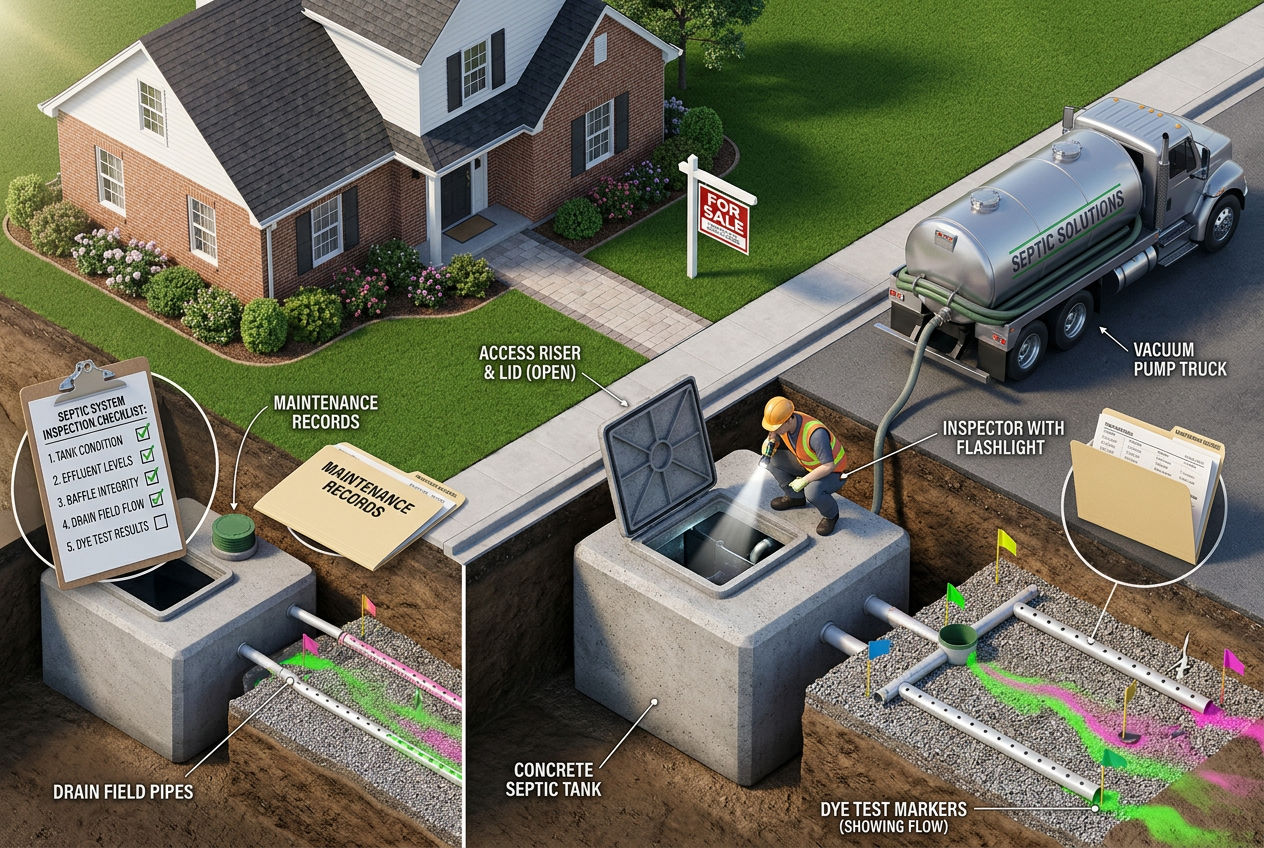
Quick Answer
Selling a house with a septic system requires disclosing the system's age, condition, maintenance history, and any known defects on your property disclosure statement. Most states mandate written disclosure; several — including Massachusetts, Indiana, and Minnesota — require a passing inspection before transfer. Failure to disclose known problems creates significant legal liability.
💡 Key Takeaways
- Nearly every state requires written septic disclosure on the property disclosure statement
- Massachusetts, Indiana, Minnesota, and parts of New Jersey mandate a pre-sale inspection
- Pump your tank and gather maintenance records before listing — it signals good stewardship and speeds closing
- A failed inspection doesn't kill the deal, but sellers must negotiate repairs, a price reduction, or an escrow holdback
- Concealing a known septic defect exposes you to lawsuit for 2–6 years after closing, depending on your state
About 21 million U.S. households — roughly one in five homes — run on a private septic system, according to the EPA. If yours is one of them, the sale process has an extra layer that sewer-connected neighbors don't deal with. Buyers get nervous about systems they can't see. Lenders have their own requirements. And state law may demand an inspection before you can hand over the keys.
This guide walks you through every piece of it — what you must disclose, where inspections are mandatory, how to prepare your system, and what happens when something goes wrong at the worst possible time.
Do You Have to Disclose a Septic System When Selling a House?
Yes — in virtually every state. Approximately 48 states plus the District of Columbia have mandatory property disclosure requirements, and septic systems are almost universally covered. You'll disclose the system on a property disclosure statement, a standardized form your real estate agent provides or your state's real estate commission publishes.
What You Must Disclose
At minimum, most states require you to disclose:
- Whether the property uses a private septic system or public sewer
- The system's approximate age and type (conventional gravity, aerobic treatment unit, mound, chamber, etc.)
- Known septic system maintenance records and pumping history
- Any known defects — drain field problems, failing components, odors, backups
- Whether the system has ever failed an inspection
- Location of the tank and drain field if known
⚠️ Warning: "Known defects disclosure" is the legal concept that matters most here. You don't have to be a septic engineer. But if you've smelled sewage in your yard, seen slow drains, or received a failed inspection report, that knowledge triggers your disclosure obligation. Hiding it is fraud — and in most states, the statute of limitations for non-disclosure claims runs 2–6 years after closing.
That's a long window of liability to carry after you've moved on.
If you're unsure whether your system qualifies as a full septic system versus a cesspool or a holding tank, learn the basics of how different systems work before completing your disclosure form — the distinction matters legally in several states, particularly New Jersey, where cesspools must be replaced at the time of sale in certain areas.
Is a Septic Inspection Required to Sell a House?
Whether a pre-sale inspection is legally required depends entirely on your state and sometimes your county. There are three categories:
Inspection Requirement Categories
| Category | Description | Examples |
|---|---|---|
| Mandatory by state law | Inspections at point of sale regardless of buyer or lender requests | Massachusetts, Indiana, Minnesota, parts of Maryland |
| Required by lender | FHA and VA loans impose their own septic functionality rules | Government-backed financing triggers inspection requirements |
| Requested as contingency | Buyers include inspection clause in offer | Most non-mandatory states: Florida, Texas, Georgia, Midwest |
FHA requirements: The septic system must be functional, with a minimum separation distance from any well (typically 50 feet, though local codes often require 100 feet).
VA requirements: Evidence of maintenance and compliance with local health codes.
✅ Pro Tip: In states without mandatory inspection laws, buyers routinely include a real estate contingency for septic inspection in their offer. Declining that contingency raises red flags and often costs you the deal anyway.
Here's a real-world scenario: You're in central Florida, no state mandate applies, and your 1,200-gallon fiberglass tank hasn't been pumped in seven years. The buyer's offer includes a 10-day septic inspection contingency. An inspector runs a hydraulic load test. The drain field shows signs of biomat clogging. Now you're negotiating instead of closing. We'll cover that outcome below — but first, let's look at the states where you don't even get to that contingency conversation because the inspection is simply required.
State-by-State Septic Inspection Requirements at Point of Sale
| State / Region | Requirement | Notes |
|---|---|---|
| Massachusetts | Mandatory — Title 5 inspection | Must pass or seller escrows funds for repair |
| Indiana | Mandatory statewide | Inspection required within 1 year of transfer |
| Minnesota | Mandatory in most counties | SSTS compliance inspection at point of sale |
| New Jersey | Mandatory in many municipalities | Cesspools must be replaced in some areas |
| Maryland | Required in some counties | Bay watershed counties have strictest rules |
| Pennsylvania | Varies by municipality | Some townships require it; others don't |
| North Carolina | Improvement permit records must be disclosed | County health departments are primary authority |
| Florida | No statewide mandate | High water table makes buyer inspections common |
| Texas | No statewide mandate | OSSF permitting records relevant to disclosure |
| Washington / Oregon | County health departments regulate | Many counties require operational permits to transfer |
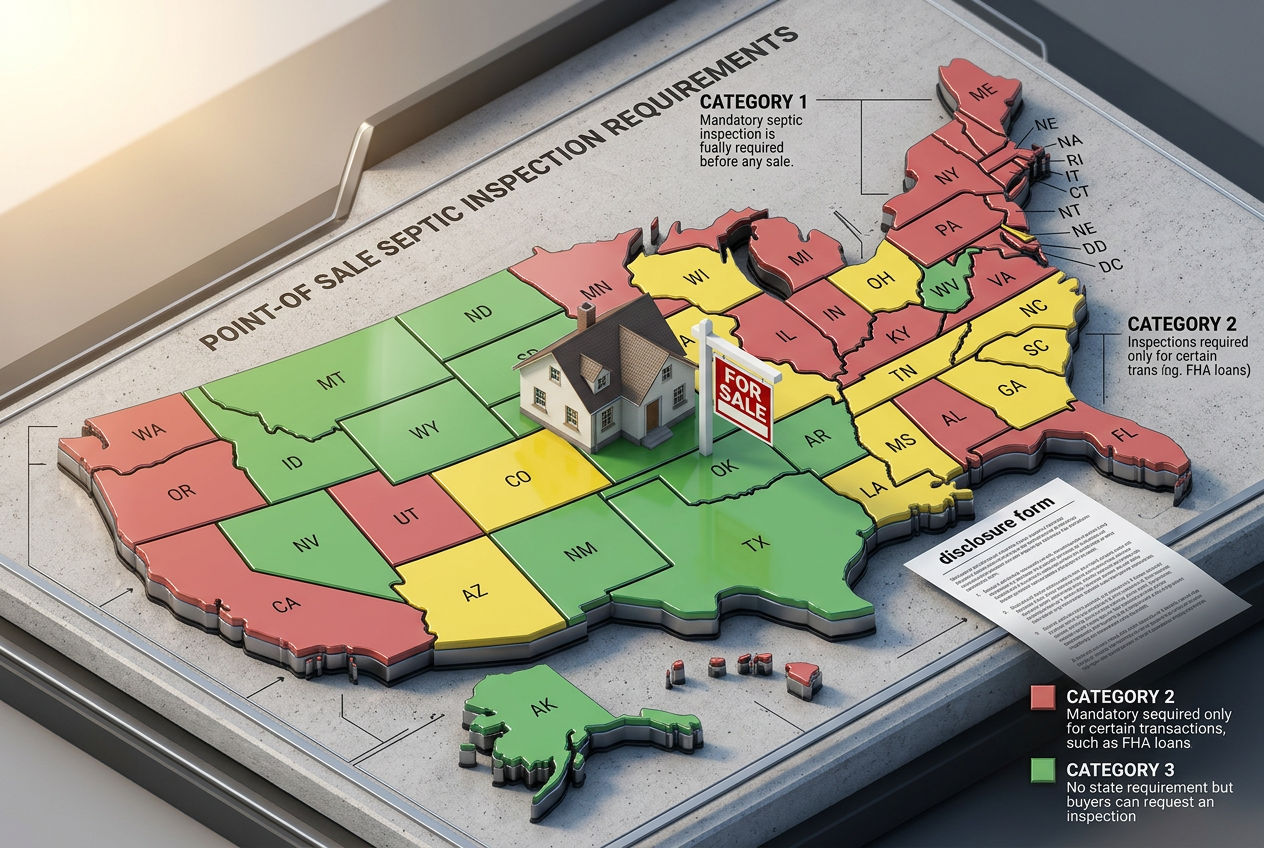
Source: State health department regulations and real estate commission disclosure requirements. Rules change — verify current requirements with your state's health department or a local real estate attorney.
Massachusetts Title 5: The Gold Standard
Massachusetts Title 5 is the most stringent model in the country and worth knowing even if you don't live there. Every property transfer triggers a Title 5 inspection by a licensed inspector. If the system fails, the seller must either repair it before closing or deposit funds into escrow — typically 1.5 times the estimated repair cost. A conditional pass (usually granted for systems near a tipping point) allows the sale to close with specific remediation timelines.
To find a licensed inspector in your state, use our septic inspection directory or browse by your state.
Free download
Free: the Septic Fridge Card — what to flush, what never to.
The Do / Don’t card the whole family can see, plus the Survival Kit: emergency flowchart, warning-sign decoder and pump-schedule card. One printable PDF.
Should You Pump Your Septic Tank Before Selling?
Yes — pump it. Even if it's not legally required, pumping before listing is one of the smartest moves you can make as a seller.
Why Pre-Sale Pumping Matters
📊 Quick Fact: A 1,000-gallon concrete tank serving a household of four should be pumped every 3–5 years under EPA guidelines. Add a garbage disposal and that drops to every 2–3 years.
If you can't produce a pumping receipt, buyers and their inspectors assume the worst. And honestly, they're not wrong to.
Pumping serves two purposes before a sale:
-
Allows proper inspection — An empty tank reveals the inlet and outlet baffles, concrete walls for cracks, and the scum and sludge layers. A full tank hides problems.
-
Provides documentation — A recent pump-out receipt signals good stewardship and moves the needle on buyer confidence.
Cost Reality
| Tank Size | National Cost Range |
|---|---|
| 1,000–1,500 gallons | $300–$600 |
| 1,500–2,500 gallons | $450–$900 |
✅ Pro Tip: Book it 3–4 weeks before listing — good pumping companies get busy, especially in spring. See our septic pumping cost guide for regional pricing breakdowns.
While the pumper is on site, ask them to note the condition of the inlet baffle and outlet baffle (or effluent filter, if your tank has a Polylok PL-122 or similar). These are the components inspectors look at hardest, and a $150 baffle replacement now beats a renegotiation over "deferred maintenance" later.
For more on how often to pump your septic tank based on household size and usage, we've got a full breakdown.
Who Pays for the Septic Inspection When Selling?
General rule: In states where inspection is mandatory, the seller typically pays — it's a cost of sale, like termite clearance in California. In states where inspection is buyer-requested, the buyer usually pays as part of their due diligence, similar to a general home inspection.
Reality varies by local market customs and negotiation.
Typical Inspection Costs by State
| State / Scenario | Inspection Type | Cost Range | Who Pays |
|---|---|---|---|
| Massachusetts | Title 5 (mandatory) | $700–$1,200 | Seller |
| Indiana | Standard (mandatory) | $200–$400 | Seller |
| Minnesota | SSTS compliance | $150–$350 | Seller |
| Non-mandatory states | Visual inspection | $250–$500 | Usually buyer |
| Non-mandatory states | Full hydraulic load test | $1,000–$1,500 | Usually buyer |
✅ Pro Tip: Some sellers get ahead of this by ordering their own pre-listing inspection — you control the timeline, you're not surprised by the findings, and you can make repairs before the buyer's inspector finds problems.
See the septic inspection cost guide for a full breakdown by system type and state.
What Happens if a Septic System Fails Inspection During a Home Sale?
A failed inspection isn't automatically a dead deal — but it changes the negotiation significantly.

Real-World Scenario
Picture this: You've accepted an offer. Buyer orders their inspection. The inspector runs a hydraulic load test and reports the drain field is showing hydraulic failure — effluent isn't absorbing, and there's evidence of surfacing sewage near the leach laterals. The signs of drain field failure are hard to dispute when they're in a written report.
Your Four Options After a Failed Inspection
1. Repair before closing
You get bids, fix the problem, provide documentation.
- Minor repairs (baffle replacement, riser installation, distribution box repair): $500–$2,500
- Full drain field replacement: $8,000–$20,000 for conventional systems
- See detailed figures in our drain field replacement cost guide
2. Price reduction
You and the buyer negotiate a credit equal to the estimated repair cost, sometimes with a multiplier. The buyer buys it as-is and handles the repair after closing.
3. Escrow holdback
Funds sufficient to cover repairs are held in escrow at closing and released when work is completed. Common in Massachusetts under Title 5.
4. Deal falls through
If the system needs full replacement ($15,000–$50,000+) and neither party can agree on who absorbs the cost, buyers walk. A failed inspection that reveals a catastrophically failing septic system is one of the few situations where a deal genuinely falls apart rather than just getting renegotiated.
⚠️ Warning: The delay factor matters too. A failed inspection followed by repairs can push closing back 30–90 days. For a seller who's already bought elsewhere, that's real carrying cost.
Can You Sell a House With a Failing Septic System?
You can — but you must disclose it fully, and the math has to work for both parties.
As-Is Sale Requirements
An as-is sale with a septic system that's known to be failing means:
- Disclosing that fact on the property disclosure statement
- Pricing accordingly
- Finding a buyer willing to accept the condition
Most likely buyers: Cash buyers and investors are your most likely audience for this scenario.
⚠️ Warning: Buyers using FHA or VA financing cannot purchase a home where the septic system is non-functional — the lender won't approve the loan.
The Legal Reality of Concealment
Concealing a known failing system is fraud. Courts have consistently sided with buyers in non-disclosure cases, and the damages typically include:
- The full cost of system replacement
- Consequential damages (not just the repair bill)
- Legal fees and court costs
If you're not sure whether your system is struggling or just aging, read through our article on signs your septic tank needs pumping and septic system testing methods to get a baseline before calling an inspector.
Seller's Pre-Sale Septic Checklist
Use this before you list:
<Image src="https://ik.imagekit.io/34qr7twyt/blog-infographics/selling-house-septic-inspection-prep.png"
Related: septic tank abandonment process — worth reading if this applies to your situation. alt="3D scene showing home for sale with underground septic system being inspected and pump truck on site" width={1200} height={800} loading="lazy" className="rounded-lg shadow-md my-6 w-full" />
Documentation to Gather
- Septic system permit and installation records (contact your county health department if you don't have them — see septic permit requirements)
- All pumping receipts for the past 5–10 years
- Any prior inspection reports, including Title 5 or county inspection documents
- As-built drawing showing tank and drain field location
- Perc test results if available (see our perc test guide for what these mean)
- Service records for any aerobic treatment unit components (aerator compressors, float switches, UV disinfection systems)
Pre-Listing Actions
- Pump the tank — budget $300–$600 for a standard 1,000–1,500 gallon tank
- Have a licensed inspector evaluate the inlet and outlet baffles
- Locate and mark the tank lid and inspection ports
- Check for odors at the drain field surface — walk the area after a rain
- Repair any visible issues: broken risers, missing lids, exposed pipe
- Check your state's specific disclosure form for septic-related questions
At Listing
- Complete the property disclosure statement accurately and completely
- Include all septic documentation in the listing file
- Inform your real estate agent of any historical issues, even ones that were repaired
FHA and VA Loan Septic Requirements
If your buyer is financing with an FHA or VA loan, the septic system must meet minimum property requirements — not just pass a state-mandated inspection.
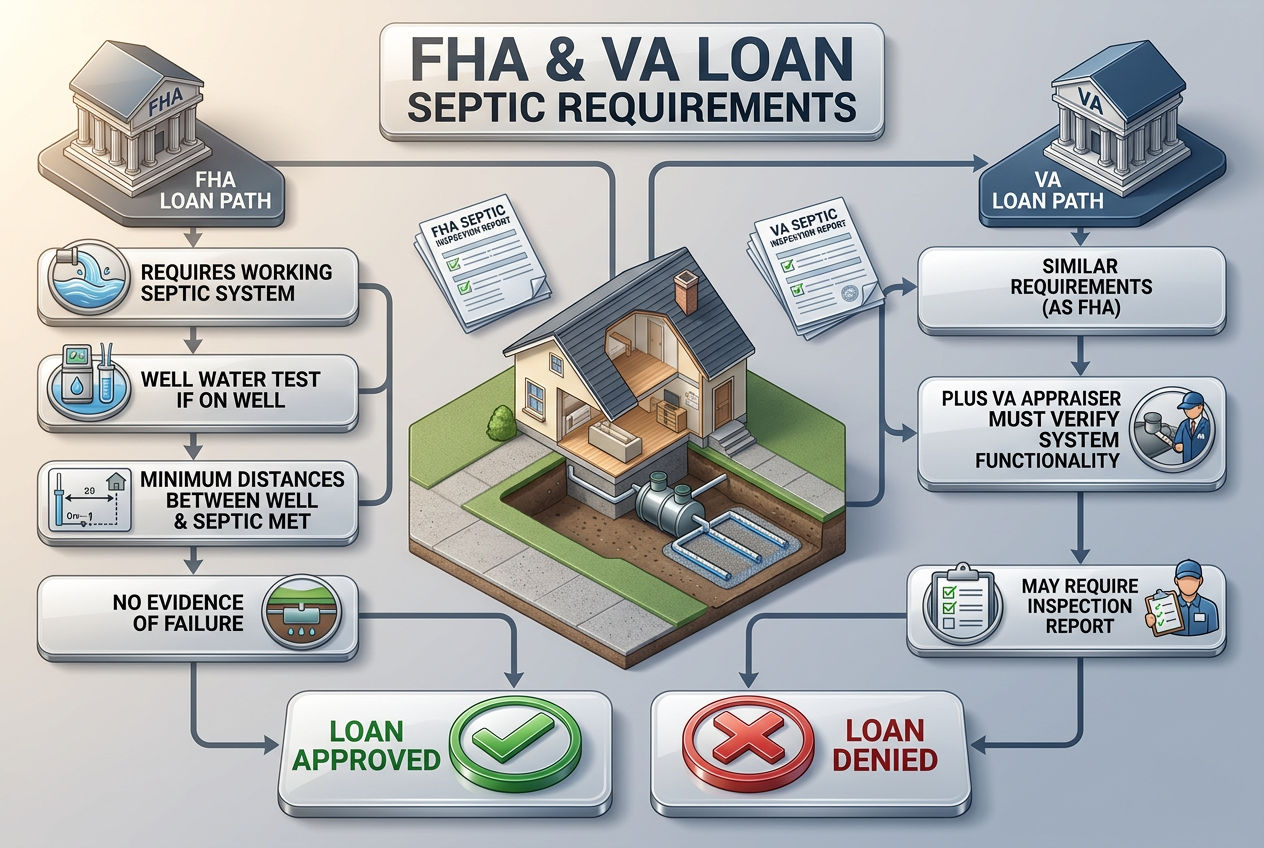
FHA Requirements
System must meet these standards:
- In proper working order at the time of appraisal
- Well (if applicable) must maintain minimum separation distance from septic tank and drain field (typically 50 feet minimum, but local codes often require 100 feet)
- No evidence of system failure
- FHA appraiser will flag any obvious problems and may require an inspection as a condition of loan approval
VA Requirements
VA Minimum Property Requirements (MPRs) state:
- System must be adequate in size for the property
- Properly functioning
- Meet local health codes
- VA appraisers are specifically trained to note septic issues that require further review
💡 Key Takeaway: If you're expecting offers from FHA or VA buyers — common in rural markets where septic systems are the norm — your system needs to be genuinely functional, not just "disclosed as-is." A non-functional system will kill those deals at the appraisal stage, not just the inspection.
Sources & Methodology
-
National Association of Realtors (NAR) — Real estate transaction data, seller disclosure requirements, and guidance on septic system considerations during property sales.
-
U.S. Environmental Protection Agency — Federal guidance on septic system maintenance standards and homeowner responsibilities that affect property transfer requirements.
-
Federal Housing Administration (FHA) — Loan requirements for properties with septic systems, including pre-sale inspection and functionality standards.
-
National Association of Wastewater Technicians (NAWT) — Professional inspection standards and certification programs that establish pre-sale inspection best practices.
-
Massachusetts Department of Environmental Protection — Title 5 septic system regulations, referenced as the leading example of mandatory point-of-sale inspection requirements.
Cost data reflects 2025–2026 national averages compiled from real estate transaction records and contractor pricing surveys across SepticTankHub.com's directory network.
Need help with your septic system? Find trusted septic professionals near you to get free quotes. Browse local septic companies in Colorado or Minnesota.
Was this article helpful?
Frequently Asked Questions
Recommended Resources
📖 Related Articles
- What Is a Septic System? How It Works (Visual Guide)
- How Often Should You Pump Your Septic Tank?
- Signs Your Drain Field Is Failing (And What to Do)
- 8 Signs Your Septic Tank Needs to Be Pumped
- How to Test Your Septic System
- Septic System Permit Cost & State Requirements (2026 Guide)
- Perc Test (Percolation Test): What It Is & How It Works
💰 Cost Guides
🔧 Services
Find Septic Professionals Near You
Compare licensed, verified septic companies by area — top county markets and cities below, or browse all 50 states.
County markets
Popular cities