
Quick Answer
A septic system permit is required in all 50 states before installing, replacing, or significantly modifying a septic system. The issuing agency, application process, costs, and timelines vary widely — most permits come from county health departments, but some states manage permitting at the state level. Expect to spend $800–$3,500 on total permitting-related costs before installation begins.
💡 Key Takeaways
- Every state requires a septic permit — no exceptions for "rural" or "small" systems
- Most permits are issued by county health or environmental health departments, not state agencies
- Total permitting costs (permit fee + perc test + design) typically run $800–$3,500
- Processing takes 2–8 weeks in most jurisdictions; peak season (spring) runs longer
- Installing without a permit can mean $500–$10,000+ in fines and problems selling your home
Do You Need a Permit to Install a Septic System?
Yes — every state in the U.S. requires a septic system permit before installation. There are no true exemptions, even for small systems on large rural parcels. The permit exists to protect groundwater, neighboring wells, and public health. The EPA estimates roughly 21–25 million U.S. households rely on onsite wastewater treatment systems (OWTS), and unpermitted systems are a documented source of groundwater contamination in every region of the country.
What varies is who you ask for the permit, what they require before approving it, and how much it costs. A homeowner in Forsyth County, North Carolina deals with a different process than someone in King County, Washington — even though both need the same fundamental permission to put a system in the ground.
If you're not sure what kind of system you'll need before you apply, our guide to types of septic systems walks through conventional, aerobic, mound, and chamber options.
Who Issues Septic Permits?
In most states, septic permits are issued at the county level — typically by the county health department or environmental health department. The state sets the regulatory framework, and counties handle the day-to-day permit review and inspections.
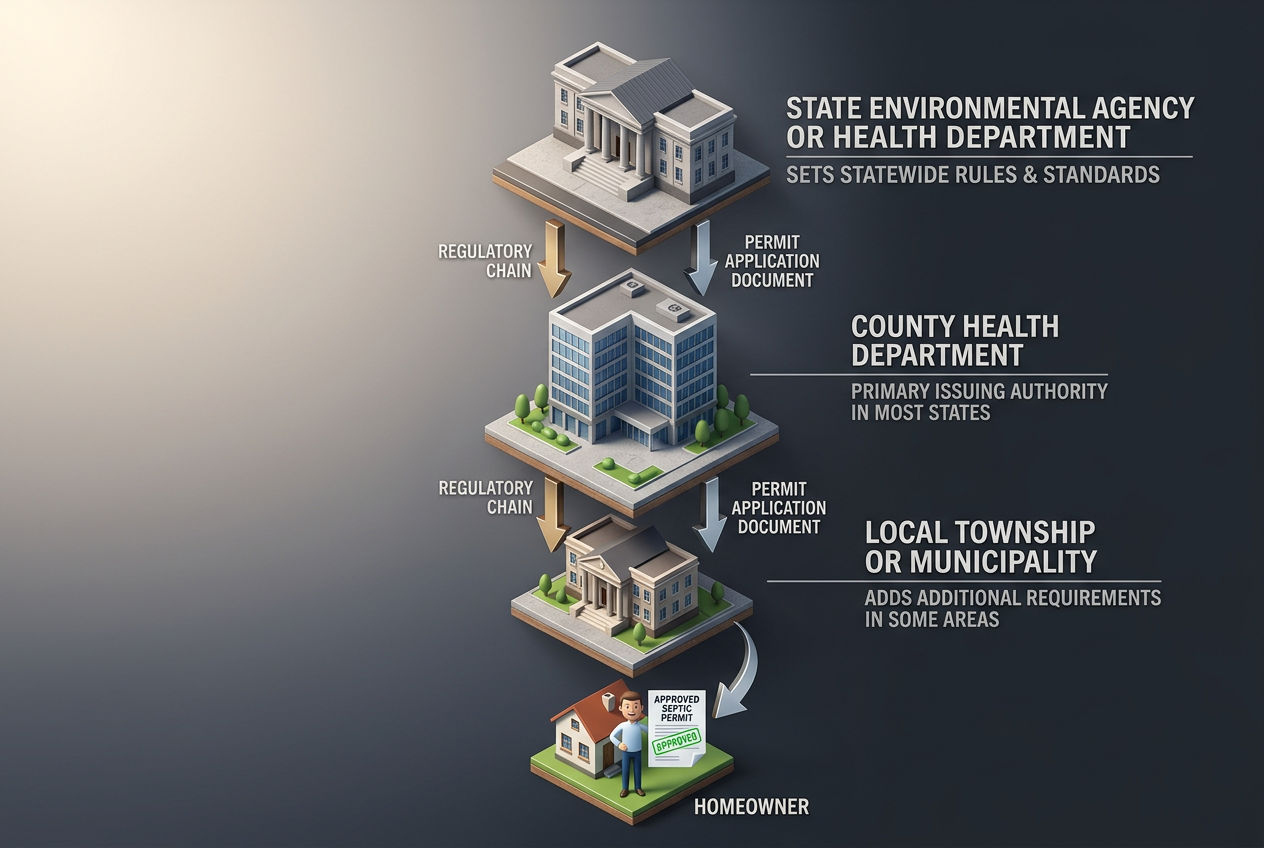
States With Centralized Permitting Oversight
A handful of states take a more centralized approach:
- Massachusetts — The state Department of Environmental Protection sets Title 5 standards, but local Boards of Health issue permits
- New Jersey — The NJ Department of Environmental Protection has significant direct oversight; local health departments process applications under tight state rules
- Washington — County health departments issue permits but must comply with Washington State Department of Health rules, including annual operating permits for advanced treatment systems
- California — Regional Water Quality Control Boards play a major role alongside county environmental health departments, making this one of the more complex multi-agency processes in the country
📊 Quick Fact: Texas is a notable outlier in the other direction. The Texas Commission on Environmental Quality (TCEQ) sets rules, but on-the-ground permitting runs through county-level Authorized Agents — and in some rural counties, the process is minimal. That's increasingly rare, but it still exists in a handful of jurisdictions.
How Do You Get a Septic Permit? (Step-by-Step)
The process looks similar across most states, though timelines differ. Here's what to expect from application to approval.

Step 1 — Site Evaluation and Perc Test
Before you can apply, you need data on your soil. Nearly every state requires a percolation test (perc test) or formal soil evaluation to determine whether your land can absorb effluent at a safe rate.
A licensed soil scientist or evaluator digs test holes — typically 12–18 inches in diameter, 24–48 inches deep — and measures how fast water drains. Results are reported in minutes per inch (MPI). Most conventional drainfields require an MPI between 1 and 60. Faster or slower than that range, and you're looking at an alternative system design.
💰 Cost Alert: Perc tests cost $250–$1,500 depending on your region and site complexity. Rocky soil in a Colorado mountain county or high clay content in Georgia can drive that number up. In peak spring season, scheduling a soil evaluator can take 2–6 weeks.
Our perc test guide covers the full process, including what to do if your land fails.
Step 2 — System Design and Engineering
Once you have soil data, you (or your contractor) submit a system design. Simple conventional systems on favorable soil may need only a basic site plan. But many states — particularly in the Northeast — require a licensed engineer or designer to stamp the plans.
Expect to pay $500–$2,000+ for an engineered design, depending on system complexity. An advanced aerobic treatment unit (ATU) or mound system will cost more to engineer than a standard 1,000-gallon septic tank with a conventional drainfield. Learn more about engineered septic systems if your soil or site conditions push you toward a non-conventional design.
Step 3 — Permit Application Submission
You submit the septic permit application form along with your site evaluation results, system design, and application fee to the issuing authority — usually the county health department. Some counties accept electronic submissions; many still require paper.
The application will ask for:
- Property legal description and parcel number
- Proposed system type and capacity (e.g., 1,500-gallon concrete tank, 600 sq ft drainfield)
- Setback documentation confirming distances from wells, property lines, and structures
- Contractor license number (required in most states)
✅ Pro Tip: Septic system setback requirements vary significantly by state and can affect where you're allowed to site a system — get these confirmed early.
Step 4 — Review, Approval, and Inspections
The health department reviews your application for septic code compliance. If it's approved, you receive your septic system installation permit and can schedule work. Most permits require one or more on-site inspections before you cover anything with soil:
- Pre-cover inspection — Inspector verifies tank placement, inlet/outlet baffle walls, and drainfield layout before backfill
- Final inspection — Confirms the system was installed per approved plans
⚠️ Warning: Most permits are valid for 1–2 years from the date of approval. If you don't break ground in time, you'll need a renewal — sometimes with a new perc test if soil data has expired.

DIY Septic Blueprint
Thinking about building it yourself?
The complete, plain-English plan to size, permit and install your own septic system — designed for homeowners, not contractors. Skip the $15,000–$25,000 quotes and do it right the first time.
Get the DIY Blueprint — $67 →Instant download · 8 modules + 3 bonus guides · 60-day money-back guaranteeHow Much Does a Septic System Permit Cost?
The permit fee alone typically runs $50–$500 depending on state and county. But the permit fee is only one piece of the total permitting cost.
Here's a realistic breakdown for a straightforward 4-bedroom home installation:
| Cost Component | Typical Range |
|---|---|
| Perc test / soil evaluation | $250 – $1,500 |
| System design / engineering | $500 – $2,000 |
| Permit application fee | $50 – $500 |
| Inspection fees | $50 – $200 |
| Total before installation | $850 – $4,200 |
Sources: EPA Onsite Wastewater Treatment Systems, state health department fee schedules, NOWRA industry data
📊 Real Example: A homeowner in Wake County, North Carolina installing a new 1,000-gallon concrete tank with a conventional drainfield paid $325 for the perc test, $750 for design drawings, and $275 for the county permit — $1,350 total before a single shovel hit the ground.
That $1,350 is a small fraction of the full septic installation cost, which typically runs $4,000–$15,000+ depending on system type and region.
Septic Permit Requirements by State — 50-State Overview
Rather than list 50 identical paragraphs, here's the information organized by region with callouts for states with notably strict or unique requirements. The table below summarizes key variables.
State-by-State Permit Reference Table
| State | Primary Issuing Authority | Avg. Permit Fee | Homeowner Install? | Strict/Notable |
|---|---|---|---|---|
| Alabama | County Health Dept | $150–$300 | No | No |
| Alaska | AK Dept. of Environmental Conservation | $100–$250 | Limited | Decentralized |
| Arizona | County Environmental Health | $150–$400 | No | County-varies |
| Arkansas | AR Dept. of Health | $75–$200 | Limited | State-managed |
| California | Regional Water Quality Board + County | $200–$600 | No | Complex/strict |
| Colorado | County Environmental Health | $150–$400 | No | Mountain setbacks |
| Connecticut | Local Health Dept | $200–$500 | No | Strict |
| Delaware | DNREC + County | $150–$300 | No | State oversight |
| Florida | County Health Dept (DOH) | $250–$500 | No | Coastal rules |
| Georgia | County Environmental Health | $150–$350 | No | Clay soil rules |
| Hawaii | HI Dept. of Health | $200–$500 | No | Volcanic soil rules |
| Idaho | Central District Health | $100–$300 | Limited | Varies by district |
| Illinois | County Health Dept | $100–$300 | Limited | — |
| Indiana | County Health Dept | $100–$250 | Limited | — |
| Iowa | County Board of Health | $75–$200 | Limited | — |
| Kansas | Local Environmental Office | $75–$200 | Limited | — |
| Kentucky | County Health Dept | $100–$250 | No | — |
| Louisiana | LA Dept. of Health | $100–$300 | No | — |
| Maine | Local Plumbing Inspector | $150–$350 | No | Strict |
| Maryland | MDE + County Health | $200–$500 | No | Strictest in U.S. |
| Massachusetts | Local Board of Health (Title 5) | $250–$500 | No | Strictest in U.S. |
| Michigan | County Environmental Health | $150–$350 | No | — |
| Minnesota | County Environmental Services | $150–$400 | No | MPCA oversight |
| Mississippi | MS Dept. of Health | $75–$200 | Limited | — |
| Missouri | County Health Dept | $75–$250 | Limited | Rural gaps exist |
| Montana | County Health Dept | $100–$300 | Limited | — |
| Nebraska | County Health Dept | $75–$200 | Limited | — |
| Nevada | County Health District | $150–$350 | No | — |
| New Hampshire | Local Health Officer | $200–$400 | No | Strict |
| New Jersey | Local Health Dept (DEP rules) | $250–$500 | No | Strictest in U.S. |
| New Mexico | NM Environment Dept | $100–$300 | No | — |
| New York | County DOH | $200–$500 | No | Strict |
| North Carolina | County Environmental Health | $200–$350 | No | High-density rules |
| North Dakota | Local Health Board | $75–$200 | Limited | — |
| Ohio | County Board of Health | $150–$350 | No | — |
| Oklahoma | DEQ + County | $100–$300 | Limited | — |
| Oregon | County Environmental Health | $150–$400 | No | — |
| Pennsylvania | County Conservation District | $150–$400 | No | — |
| Rhode Island | RIDEM | $200–$400 | No | Strict |
| South Carolina | County Environmental Health | $150–$300 | No | — |
| South Dakota | County Health | $75–$200 | Limited | — |
| Tennessee | County Health Dept | $150–$300 | No | Growth pressure |
| Texas | County Authorized Agent (TCEQ) | $100–$400 | Limited | Decentralized |
| Utah | County Health Dept | $150–$350 | No | — |
| Vermont | ANR + Local | $200–$500 | No | Strict |
| Virginia | VDH via Local Health | $150–$400 | No | — |
| Washington | County Health Dept | $150–$500 | No | Annual permits (ATU) |
| West Virginia | County Health Dept | $100–$250 | Limited | — |
| Wisconsin | County Zoning/Sanitation | $150–$350 | No | — |
| Wyoming | County Environmental Quality | $75–$250 | Limited | — |
Note: Fees shown are for the permit application only and exclude perc tests, design plans, and inspection fees. Verify current fees with your county health department before budgeting. Data compiled from state health department fee schedules and NOWRA, 2025–2026.
States With the Strictest Septic Permit Requirements
Maryland requires permits through the Maryland Department of the Environment (MDE) and mandates nitrogen-reducing technology in many areas, particularly the Chesapeake Bay watershed. A standard new system installation in Maryland can require $2,000–$5,000 in permitting costs alone before installation.
Massachusetts Title 5 is its own regulatory universe. Every septic system must be designed by a licensed Site Evaluator, built by a licensed installer, and meet strict setback and capacity requirements. When you sell a home in Massachusetts, Title 5 inspection is mandatory — buyers and sellers both feel the weight of this regulation. See our guide on selling a house with a septic system for how this plays out in real estate transactions.
New Jersey requires licensed professionals at every step — soil evaluation, design, installation, and inspection. The DEP exercises unusually direct oversight for a state that formally delegates to local health departments.
💡 Key Takeaway: Washington is notable for its operating permit requirement on advanced treatment units (ATUs). If your system includes an aerator or other active treatment technology, you may owe an annual operating permit renewal fee of $50–$200 per year, plus mandatory service contract documentation filed with the county.
Do You Need a Permit to Replace or Repair a Septic Tank?
Almost always yes for a full septic tank replacement. Swapping out a 1,000-gallon concrete tank for a 1,500-gallon polyethylene tank — even in the same hole — requires a permit in virtually every state. The issuing authority wants to verify the replacement system meets current code, especially if the original system was installed decades ago under older standards.
What Triggers a Permit?
Minor repairs are the gray area. The following typically don't require permits:
- Replacing a cracked inlet baffle
- Swapping an effluent filter
- Rodding a clogged distribution box
But the moment work crosses into structural tank replacement, drainfield modification, or adding a pump chamber, you need to call your county health department first.
⚠️ Warning: Drainfield repairs and replacements almost always require a drainfield permit issued separately from (or in addition to) the tank permit. Replacing leach laterals, expanding a failing absorption area, or installing a new mound system triggers the full permitting process — including a new perc test in many states.
Understand what might be wrong with your system before you start the permit process. Signs of a failing drain field often look different from tank problems, and the permit pathway differs accordingly.
Can You Install Your Own Septic System?
Some states allow homeowner-installed systems on owner-occupied residential property, but the list is shrinking. States where limited DIY installation is technically permitted include parts of Texas, Missouri, Arkansas, Mississippi, and a few other rural-dominant states — typically with conditions attached (owner must occupy the property, system must be inspected, contractor still required for electrical work on pump systems).
Where Licensed Installers Are Mandatory
In the majority of states — including all of New England, Florida, the Mid-Atlantic, and the Pacific West — a licensed septic installer must perform the work.
- Florida requires contractors to hold a Registered Septic Tank Contractor (RSTC) license through the Florida Department of Health
- Minnesota requires licensed installers to meet MPCA standards and file documentation with the county after every project
✅ Pro Tip: Even in states where homeowner installation is technically allowed, most county health departments are skeptical and will scrutinize your application more closely. The liability risk alone — groundwater contamination, neighbor complaints, resale issues — makes DIY a bad bet for most homeowners.
If you're curious what licensed work actually involves, the septic system installation process explains what happens from site prep to final inspection.
What Happens If You Install a Septic System Without a Permit?
Nothing good. The consequences of an unpermitted septic installation include:
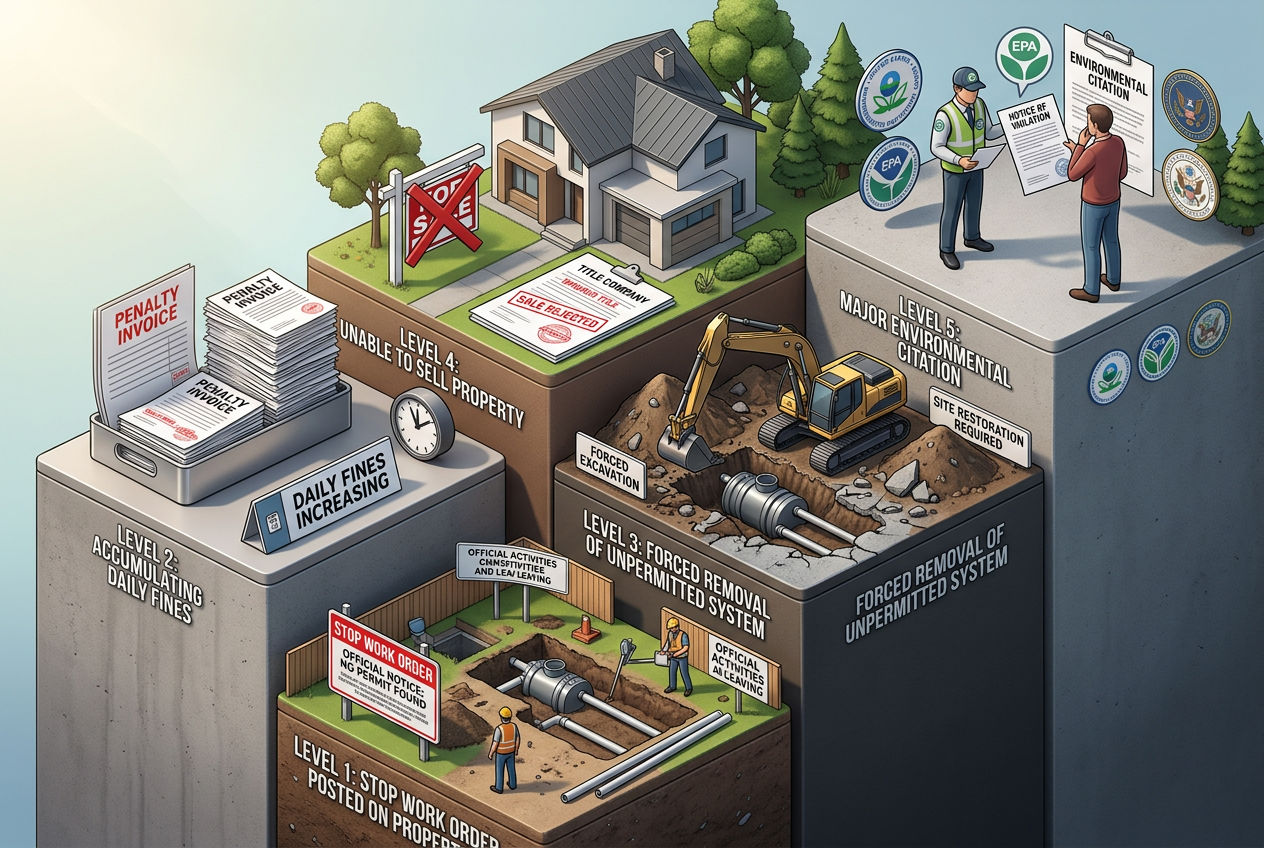
Legal and Financial Consequences
Fines. Most states impose civil fines ranging from $500 to $10,000+ per violation. Some jurisdictions charge per-day penalties until the violation is corrected. A homeowner in a regulated watershed state like Maryland or Washington could face compounding daily fines that reach five figures quickly.
Forced removal. The county can order you to excavate and remove the unpermitted system at your own expense, then go through the full permitting process before installing a compliant replacement. You pay twice.
Property sale complications. Title searches and home inspections often uncover unpermitted septic work. Buyers can back out, demand price reductions, or require you to retroactively permit the system (if even possible) before closing. In some states, the seller is legally required to disclose known code violations.
Related: illegal septic system consequences — worth reading if this applies to your situation.
⚠️ Warning: Installing without a permit isn't just illegal — it's a direct threat to groundwater quality and neighboring wells. The permit process exists because improperly sited or designed systems contaminate drinking water sources. The short-term savings aren't worth the long-term liability.
Sources & Methodology
-
U.S. Environmental Protection Agency — Federal guidance on septic system permitting authority, which is delegated to state and county health departments in most jurisdictions.
-
National Onsite Wastewater Recycling Association (NOWRA) — Industry guidance on permitting processes, design standards, and regulatory requirements across jurisdictions.
-
Tennessee Department of Environment and Conservation — State-specific permitting requirements referenced as a representative example of county-administered septic permit programs.
-
Virginia Department of Health — State regulations for septic system permits, including soil evaluation requirements, system design approval, and final inspection protocols.
-
National Environmental Services Center (NESC) — Comprehensive database of state-by-state septic system permitting requirements and regulatory frameworks.
Cost data reflects 2025–2026 permit fee ranges compiled from county health department fee schedules across SepticTankHub.com's coverage area.
Need help with septic system permits? Browse licensed septic installers in Maryland, Massachusetts, New Jersey, Vermont, or Maine — or find a pro in any state on our homepage. Learn more about septic inspection services.
Free download
Not ready for the Blueprint? Start free.
Grab the free DIY Septic Planning Kit — the permit-first checklist, perc-test cheat sheet, and sizing tables that keep your build from getting red-tagged.
Was this article helpful?
Frequently Asked Questions
Recommended Resources
📖 Related Articles
- Types of Septic Systems: Complete Comparison Guide
- Perc Test (Percolation Test): What It Is & How It Works
- Engineered Septic System Cost: $12K–$30K+ (2026)
- Septic System Setback Requirements: How Far From the House?
- Selling a House With a Septic System: What Sellers Must Disclose
- Signs Your Drain Field Is Failing (And What to Do)
- What to Expect During Septic System Installation
📍 Find Local Pros
- Septic Services in Maryland
- Septic Services in Massachusetts
- Septic Services in New Jersey
- Septic Services in Vermont
- Septic Services in Maine
- Septic Services in Connecticut
- Septic Services in Rhode Island
- Septic Services in New Hampshire
- Septic Services in Kentucky
- Septic Services in Mississippi
- Septic Services in Arkansas
Find Septic Professionals Near You
Compare licensed, verified septic companies by area — top county markets and cities below, or browse all 50 states.
County markets
Popular cities
