
Quick Answer
The 1000 gallon septic tank is the workhorse of the residential septic world. It's the default size specified by most county health departments for smaller homes, the tank most septic installers keep in regular stock, and the first number that comes up when a contractor walks through your house counting bedrooms.
But "1,000-gallon tank" is not one thing. It's a size category with two very different product types inside it — concrete and plastic (poly) — that differ dramatically in weight, lifespan, regional suitability, and installation logistics. Getting this choice wrong can cost you thousands of dollars in repair bills or a failed inspection down the road. That holds true whether a contractor handles the work or you're planning a DIY septic system installation on land where your county permits owner-builds.
This guide covers everything you need to make a confident decision: exact dimensions, honest cost breakdowns, a straight comparison of concrete vs. plastic, and clear answers on whether a 1,000-gallon tank is actually big enough for your household.
Key Takeaways
- A 1000-gallon septic tank typically suits homes with 1–3 bedrooms and households of 2–4 people.
- Concrete tanks weigh 8,000–10,000 lbs empty and last 40–100+ years; plastic tanks weigh 150–250 lbs and last 20–40 years.
- Full installation costs range from $3,000–$7,000, with regional differences of 40–60%.
- Most states now require two-compartment tanks — confirm local code before purchasing.
- Pumping frequency for a 1,000-gallon tank serving a 4-person household is every 3–4 years.
What Is a 1000-Gallon Septic Tank?
A 1,000-gallon septic tank is an underground wastewater holding vessel designed to separate solids from liquid effluent before that liquid flows out to a drain field (also called a leach field). Solids — sludge — settle to the bottom. Grease and lighter waste float as a scum layer on top. The clarified liquid in the middle zone exits through an outlet baffle into the drain field for final treatment in the soil.
Most modern 1,000-gallon tanks are built as two-compartment tanks, with a baffle wall dividing them roughly 2/3 to 1/3. This two-stage settling process dramatically reduces the solids load reaching your drain field — which is important because a failed drain field costs $5,000–$20,000 to replace. For a full picture of how the system works together, see our guide to what a septic system is.
What Are the Dimensions of a 1000-Gallon Septic Tank?
Dimensions vary by manufacturer and material, but the ranges below cover the vast majority of tanks you'll encounter in the field.
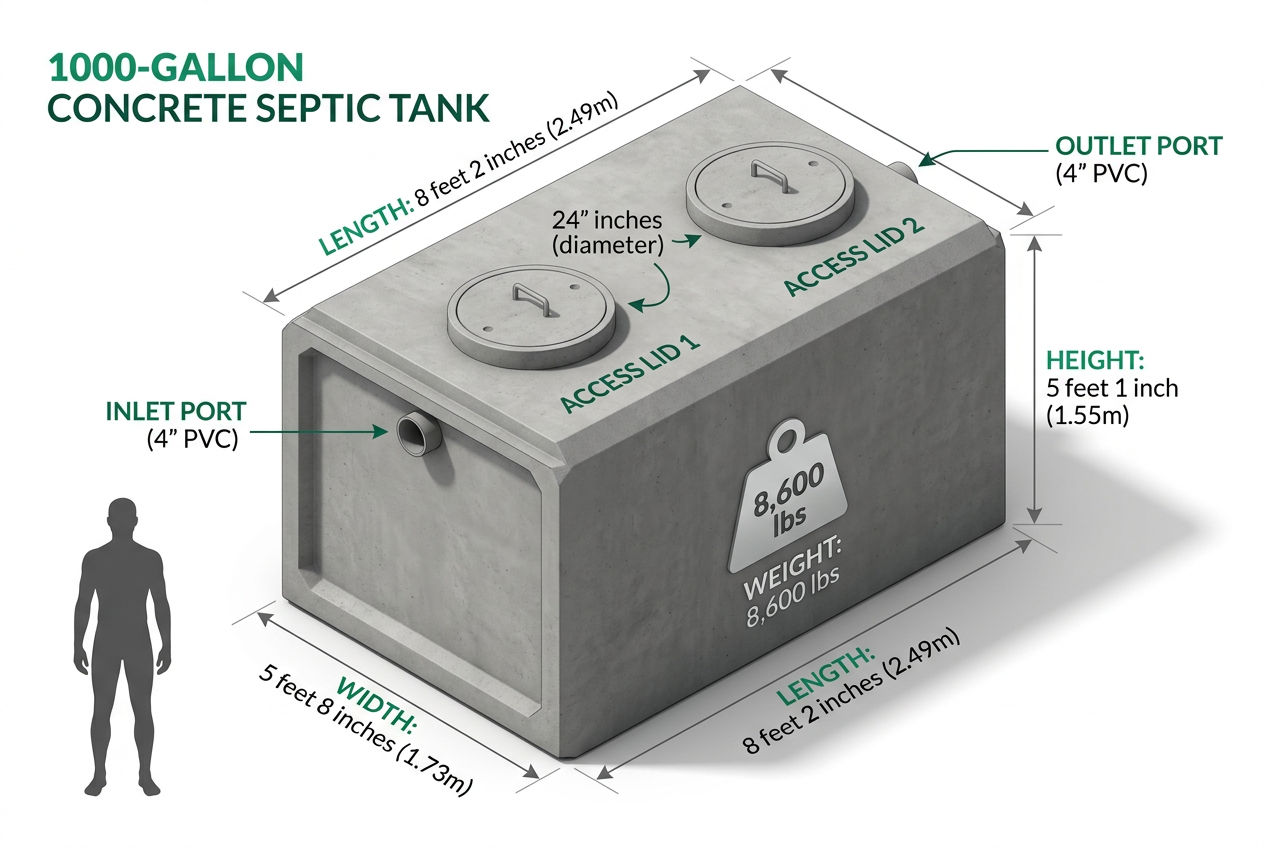
| Specification | Concrete Tank | Plastic/Poly Tank |
|---|---|---|
| Length | 96–120 in (8–10 ft) | 102–127 in (8.5–10.6 ft) |
| Width | 60–62 in (5 ft) | 55–60 in (4.6–5 ft) |
| Height/Depth | 48–58 in (4–4.8 ft) | 48–60 in (4–5 ft) |
| Wall Thickness | 3–4 inches | 0.25–0.5 inches |
| Weight (empty) | 8,000–10,000 lbs | 150–250 lbs |
| Weight (full) | ~18,300 lbs | ~8,500 lbs |
Data sourced from manufacturer specifications (Infiltrator Water Technologies, Norwesco, Copeland precast) and installer field data compiled by NAWT-certified contractors.
A few things those numbers don't tell you: concrete tanks vary more by precast plant than plastic tanks do. A precast plant in rural Georgia may produce a tank that's 96 inches long, while a plant in Ohio builds their standard 1,000-gallon unit at 108 inches. Always request the actual spec sheet from your supplier before finalizing excavation dimensions.
For a low-profile septic tank installation — properties with shallow soil above bedrock or high water tables — some manufacturers offer low-profile variants that trade length for reduced height, keeping the burial depth under 30 inches while maintaining the full 1,000-gallon capacity. Infiltrator Water Technologies makes one of the more popular polyethylene models in this category.
The inlet-to-outlet drop is typically 2–3 inches — meaning the outlet baffle sits 2–3 inches lower than the inlet. That gravity-driven flow is what keeps effluent moving toward the drain field without a pump in most conventional systems.
For a deeper look at 1000-gallon concrete septic tank dimensions specifically, and how they compare across manufacturers, our septic tank size chart breaks this down by tank capacity.
1000-Gallon Concrete Septic Tank: Pros, Cons & Specs
Concrete has dominated the residential septic market for decades — and for good reason. A properly installed precast concrete septic tank is essentially permanent infrastructure. Well-maintained units routinely last 50–75 years. Some installers in the Midwest have pulled tanks still functioning after 80+ years of service.
Why concrete works:
- Structural integrity under heavy soil loads and vehicle traffic (with appropriate cover depth)
- No buoyancy risk — a concrete tank won't "float" in high water table conditions the way a plastic tank can
- Widely available through regional precast plants, keeping delivery costs manageable
- Code-approved in every state
Where concrete struggles:
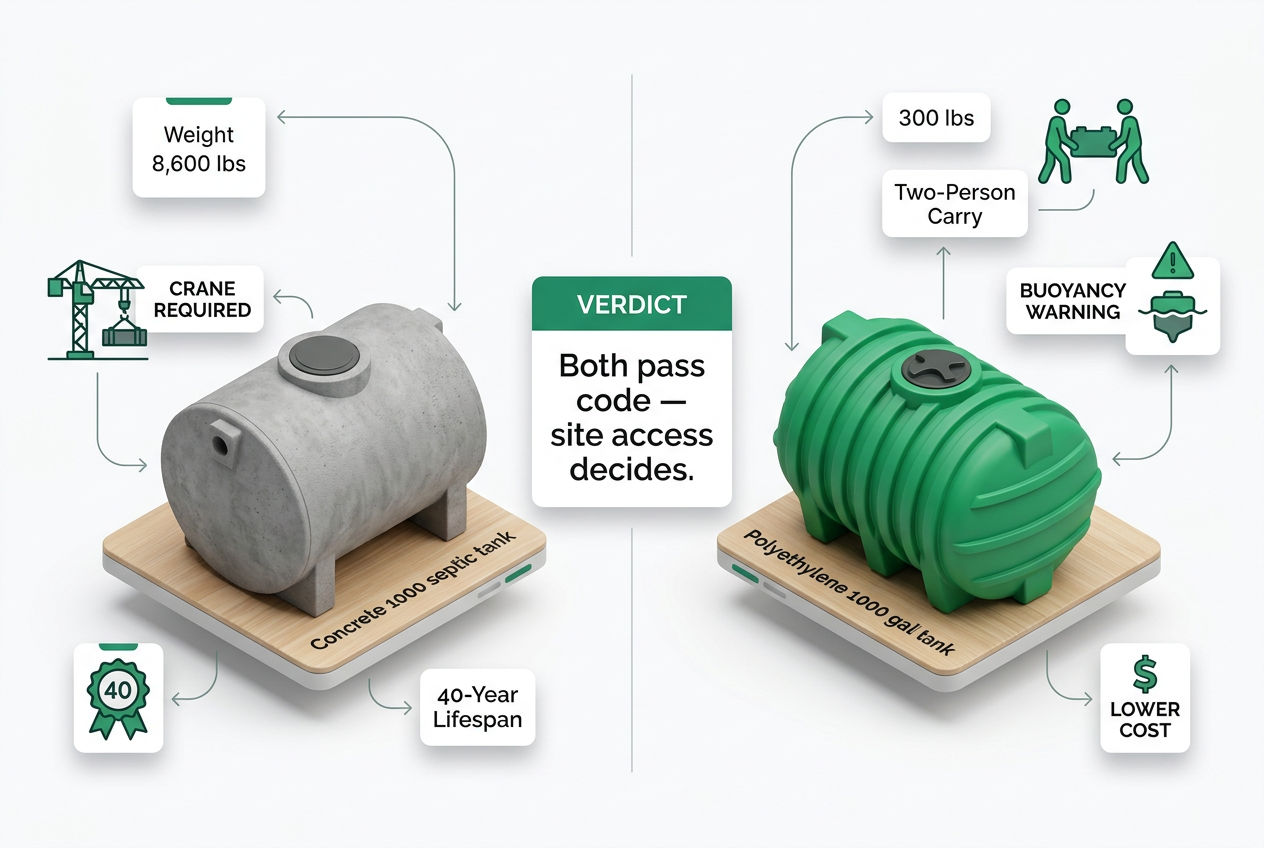
- At 8,000–10,000 lbs empty, delivery requires a crane or boom truck. That's an added cost — typically $200–$600 — and it means the installer needs clear access to your yard. Fenced lots, narrow driveways, or mature trees can complicate delivery significantly.
- Concrete is porous. Over decades, the alkalinity can degrade as hydrogen sulfide gas (produced by anaerobic bacterial activity inside the tank) attacks the concrete ceiling above the liquid line. This is called "crown corrosion." It's rare in properly maintained tanks but more common in tanks that are chronically overfull. Tanks built with sulfate-resistant cement or polymer-coated interiors are more resistant.
- Cracking is possible — particularly at the inlet and outlet seams — if the tank wasn't properly cured or if soil shifts significantly.
Concrete is the right choice for most homeowners in the Southeast, Midwest, and Northeast. In Florida especially, where the water table can sit just 18 inches below grade in some coastal areas, a heavy concrete tank is often the only code-compliant option.
DIY Septic Blueprint
Thinking about building it yourself?
The complete, plain-English plan to size, permit and install your own septic system — designed for homeowners, not contractors. Skip the $15,000–$25,000 quotes and do it right the first time.
Get the DIY Blueprint — $67 →Instant download · 8 modules + 3 bonus guides · 60-day money-back guarantee1000-Gallon Plastic (Poly) Septic Tank: Pros, Cons & Specs
A 1000 gallon plastic septic tank — more precisely, a polyethylene septic tank — is rotationally molded from high-density polyethylene (HDPE). It's a single piece of material with no seams to crack, no rebar to corrode, and no weight that requires a crane.
Why plastic makes sense in the right situation:
- At 150–250 lbs, two people can carry it. That matters enormously on rural mountain properties where a concrete delivery truck simply can't reach the site.
- HDPE doesn't corrode, so crown corrosion isn't a concern.
- Installation is faster — no crane rental, less equipment on-site.
- The 1000 gallon poly septic tank is the preferred choice in Colorado, Montana, Idaho, and Wyoming for exactly this reason.
Where plastic falls short:
- Buoyancy is a real, code-level concern. An empty polyethylene tank in saturated soil can literally pop out of the ground. Florida's Department of Health prohibits plastic tanks in many high-water-table areas for this reason. Some jurisdictions require concrete ballast or anchor straps — which adds cost and partially negates the weight advantage.
- Lifespan is shorter: 20–40 years vs. 40–100+ for concrete. That matters if you're building a family home you intend to pass down.
- Thinner walls (0.25–0.5 inches) mean plastic tanks are more susceptible to deformation under soil pressure if improperly backfilled. Always confirm the manufacturer's backfill specifications — many require pea gravel rather than native soil.
For a comprehensive side-by-side breakdown, our concrete vs. plastic septic tank comparison goes deeper on both materials, including fiberglass as a third option. A fiberglass septic tank sits between the two — lighter than concrete, more durable than polyethylene, with a lifespan of 25–50 years — but it's significantly less common and harder to source in most markets.
How Much Does a 1000-Gallon Septic Tank Cost?
A 1,000-gallon septic tank itself costs $800–$1,500 for concrete and $800–$1,200 for plastic. But the tank price is almost never the biggest line item on your invoice.
Full 1000-gallon septic tank installation cost breakdown:
- Tank (concrete or poly): $800–$1,500
- Excavation and backfill: $1,500–$3,500
- Labor (installation): Included in excavation or $500–$1,500 additional
- Permits: $200–$1,000+ depending on jurisdiction
- Drain field connection/distribution box: $500–$2,000
- Septic tank risers (for access): $100–$400
- Total installed: $3,000–$7,000
Regional variation is significant. A 1,000-gallon concrete tank installation in rural Mississippi might run $3,200 total. The same job in Westchester County, New York could reach $8,000–$10,000+ due to stricter engineering requirements, higher labor rates, and permit fees that can exceed $1,500 on their own.
Rocky soil — common in Texas Hill Country and the Southwest — can push excavation costs to $4,000–$6,000 by themselves when blasting is required.
For a full regional cost breakdown, see our septic installation cost guide.
One scenario worth thinking through: Say you're installing a system on a rural 5-acre lot in western Montana. The site is 600 feet from the road, uphill, on a slope with no crane access. A concrete tank delivery isn't feasible. A 1,000-gallon poly tank can be hand-carried into position, saving $1,200–$2,000 in equipment costs. The tank costs $200 less up front, lasts 20–30 fewer years, but gets the job done at a site where concrete simply isn't practical.
Permits are non-negotiable. Most jurisdictions require a septic system permit before any excavation begins. Don't skip this step — unpermitted systems can halt a home sale dead in its tracks and trigger costly forced upgrades. Learn more about the full septic system installation process to know what to expect from start to finish.
How Many Bedrooms Can a 1000-Gallon Septic Tank Support?
A 1,000-gallon septic tank is sized for homes with 1–3 bedrooms in most states. Some jurisdictions allow it for 4-bedroom homes under specific conditions, but that's the exception rather than the rule.
Here's why this matters: septic codes are built around estimated daily wastewater generation. The EPA estimates the average person generates 60–70 gallons of wastewater per day. Most state codes use 110–150 gallons per bedroom per day as the design flow — a higher number that accounts for guests, laundry, and peak usage periods.
| Bedrooms | Est. Daily Flow | 1,000-Gal Tank Adequate? |
|---|---|---|
| 1 | 110–150 gal/day | Yes, comfortably |
| 2 | 220–300 gal/day | Yes |
| 3 | 330–450 gal/day | Yes (most codes) |
| 4 | 440–600 gal/day | Marginal — check local code |
| 5+ | 550+ gal/day | No — upgrade to 1,500 gal |
If you're building a 4-bedroom home and the county approves a 1,000-gallon tank, pay close attention to actual household size. Four people generating 280 gallons per day fills a 1,000-gallon tank to design capacity in about 3.5 days. It works — but your pumping frequency will be higher, and there's less buffer for heavy-use events like holiday gatherings.
For a 3-bedroom home with 3–4 occupants, a 1,000-gallon tank is entirely appropriate. A family of 4 using the system normally, without a garbage disposal, will need pumping every 3–4 years.
Add a garbage disposal, and drop that to every 2 years. The solids load from food waste accumulates faster than most homeowners realize. Our guide on garbage disposals and septic systems explains exactly why.
Not sure what size you actually need? Use our septic tank size chart or read our how big a septic system do I need guide before committing to a tank size. If a smaller tank is a better fit for your situation, see our 500-gallon septic tank guide for comparison.
Installation Considerations for a 1000-Gallon Septic Tank
Installation is where the theory meets reality — and where most of the cost surprises happen.
Burial depth: The top of the tank typically sits 6–36 inches below grade, depending on local frost line requirements and access preferences. In Minnesota, where the frost line reaches 42–60 inches in northern counties, the Minnesota Pollution Control Agency (MPCA) recommends burying connecting pipes below frost depth or insulating them. The first 10 feet of pipe from the house foundation is the most vulnerable — rigid foam board insulation over that section prevents the $1,500–$2,500 emergency thaw call in February.
Septic tank risers: Most installers now set risers — extending the access lid to grade level — during installation. A Tuf-Tite or similar riser system costs $100–$400 and makes every future pumping and inspection dramatically easier. If your tank was installed without risers, adding them is one of the best $300 investments you can make in your system's serviceability.
Two-compartment requirement: Most states now mandate two-compartment tanks for new installations. If you're purchasing a tank, confirm it meets your state's compartment requirements before ordering. Single-compartment tanks still exist on the market and are appropriate in some replacement scenarios, but they won't pass inspection for new construction in most jurisdictions.
Soil type and perc test: Before the county approves your permit, you'll likely need a percolation (perc) test to determine if your soil can accept effluent from the drain field. Sandy soils drain fast — sometimes too fast. Heavy clay drains slowly. Either extreme can affect whether a standard drain field is approved or whether you need an alternative system like a mound or sand filter. A failed perc test isn't necessarily a dead end, but it does change your system design options.
How Often Do You Pump a 1000-Gallon Septic Tank?
The EPA recommends pumping most residential septic tanks every 3–5 years. For a 1,000-gallon tank specifically, here's how pumping frequency scales with household size:
- 1–2 person household: Every 5–7 years
- 3–4 person household: Every 3–4 years
- 5+ person household: Every 2–3 years
- 4-person household with garbage disposal: Every 2 years
These aren't arbitrary numbers — they're based on sludge and scum accumulation rates. When the combined sludge layer at the bottom and scum layer at the top leave less than 12 inches of clear liquid space between them (measured with a sludge judge), it's time to pump. A NAWT-certified pumper can measure this during service and give you a data-based pumping interval rather than a guess.
Pumping a 1,000-gallon tank costs $275–$500 nationally, with significant regional variation. Expect $275–$375 in Central Florida, $350–$500 in rural Minnesota, and $400–$600+ in the Northeast. See our septic pumping cost guide for current regional pricing.
Skip pumping too long and you pay a different price: solids carry over into the drain field, clog the soil pores, and begin building a biomat — a dense layer of anaerobic bacteria that eventually makes the drain field impermeable. Drain field restoration or replacement is the most expensive septic repair there is. For more on how often to pump your tank, including a printable schedule, we've covered that in detail.
How Long Does a 1000-Gallon Septic Tank Last?
- Concrete septic tank: 40–100+ years with proper maintenance
- Plastic/polyethylene septic tank: 20–40 years
- Fiberglass septic tank: 25–50 years
Lifespan depends heavily on what goes into the tank. Harsh chemicals — bleach, paint thinner, antibacterial soaps in high volumes — kill the beneficial bacteria doing the treatment work and can accelerate corrosion. Knowing what kills septic bacteria and avoiding those products extends tank life measurably.
A concrete tank that's been properly maintained, pumped on schedule, and protected from chemical abuse can genuinely outlast the house above it. Plastic tanks in the right application — remote location, properly backfilled, appropriate climate — can hit 30–40 years without issues.
How to Choose the Right 1000-Gallon Septic Tank
A few decision points that matter more than most contractors will mention upfront:
Choose concrete if: Your site has crane access, you're in a high-water-table area (Southeast coastal, Pacific Northwest lowlands), or you want the longest possible service life with the least risk of structural failure.
Choose plastic if: Your site has difficult access for heavy equipment, you're in a remote mountain or rural area, or your jurisdiction doesn't restrict polyethylene tanks based on soil conditions.
Ask your installer: What's the standard tank used in this county for this application? Experienced local installers know which tanks pass inspection reliably and which suppliers deliver consistent quality. A Norwesco or Snyder poly tank from a reputable supplier is a different product than a discount tank from an unfamiliar manufacturer.
Always confirm your final tank choice against your county health department's approved product list. Many counties maintain one — and some explicitly prohibit certain materials or manufacturers. Read through the septic system permit requirements for your state before finalizing any purchasing decisions. A quick call to licensed septic contractors near you can also flag county-specific restrictions before you order.
Ready to get quotes? Find a licensed septic installer near you through our directory and get competitive bids from pre-screened professionals in your area.
Sources & Methodology
- U.S. Environmental Protection Agency — Septic Systems Overview (epa.gov/septic): Used for daily wastewater generation estimates (60–70 gallons/person/day) and general pumping frequency guidelines.
- National Association of Wastewater Technicians (NAWT) (nawt.org): Referenced for pumping interval methodology and sludge accumulation measurement standards.
- Infiltrator Water Technologies & Norwesco: Manufacturer specification sheets for polyethylene tank dimensions and weight data.
- Minnesota Pollution Control Agency (MPCA): Referenced for frost line depth guidance and cold-climate pipe insulation recommendations.
- Florida Department of Health — Environmental Health: Referenced for high-water-table tank material restrictions and contractor licensing requirements (RSTC license).
Free download
Not ready for the Blueprint? Start free.
Grab the free DIY Septic Planning Kit — the permit-first checklist, perc-test cheat sheet, and sizing tables that keep your build from getting red-tagged.
Was this article helpful?
Frequently Asked Questions
Recommended Resources
📖 Related Articles
- What Is a Septic System? How It Works (Visual Guide)
- Septic Tank Sizes & Dimensions Chart (by Bedrooms)
- Concrete vs Plastic Septic Tanks: Which Is Better?
- Septic System Permit Cost & State Requirements (2026 Guide)
- What to Expect During Septic System Installation
- Can You Use a Garbage Disposal with a Septic System?
- What Size Septic System Do I Need?
- 500-Gallon Septic Tank: Dimensions, Uses & When It's Too Small
- How to Install Septic Tank Risers (and Why You Should)
- Perc Test (Percolation Test): What It Is & How It Works
- Land Failed the Perc Test? Here Are Your Options
- How Often Should You Pump Your Septic Tank?
- What Kills Septic Tank Bacteria? (14 Things to Avoid)
💰 Cost Guides
🔧 Services
Find Septic Professionals Near You
Compare licensed, verified septic companies by area — top county markets and cities below, or browse all 50 states.
County markets
Popular cities
