
Quick Answer
A failed perc test means the soil on your land doesn't absorb water at a rate acceptable for a conventional septic drain field — but that doesn't mean you're out of options. Most landowners have at least two or three viable paths forward, ranging from a strategic retest to a fully engineered alternative system approved by your county health department.
Key Takeaways
- A failed percolation test disqualifies your land for a conventional drain field, not necessarily for building altogether
- Retesting during drier conditions is often the simplest and cheapest first move
- Engineered alternatives — mound systems, aerobic treatment units, sand filters, and drip irrigation systems — are approved in most U.S. counties
- Alternative systems cost significantly more than conventional: $10,000–$25,000+ versus $3,000–$10,000
- Regulations vary dramatically by county — what's allowed two miles away may not be permitted on your parcel
What Does a Failed Perc Test Actually Mean?
A percolation test measures your soil's absorption rate — specifically, how many minutes it takes for water to drop one inch in a test hole. That number is expressed in minutes per inch, or MPI.
Most jurisdictions accept soil that percolates between 1 and 60 MPI. Soil that absorbs water faster than 1 MPI is too porous — effluent passes through before it's treated. Soil slower than 60 MPI is too dense — usually heavy clay or a high water table is the culprit — and sewage-laden water simply has nowhere to go.
Your county health department typically requires two to three test holes per proposed drain field area, each dug 18–36 inches below grade. If the majority of holes fall outside that 1–60 MPI window, the site fails.
This does NOT mean your land is worthless. It means a conventional drain field won't work there. That's a meaningful distinction — and it applies whether you're hiring a contractor or planning a DIY septic system build.
What Causes a Perc Test to Fail?
The two most common culprits are clay soil and a high water table. Clay particles are tiny and tightly packed, leaving almost no pore space for water movement. In clay-heavy counties across the Southeast — think North Carolina, Georgia, and Alabama — perc test failure rates can hit 30–40% or higher. The soil just won't budge.
A high water table is a different problem. Seasonal saturation from rainfall or proximity to a body of water pushes groundwater up close to the surface. When your test hole fills with water before you even pour test water in, the site fails — and the reason is elevation, not soil type.
Rocky or shallow soil (common in the Mountain West and parts of New England) creates a third failure scenario. Bedrock sitting 18 inches below grade doesn't absorb anything.
For a deeper look at how the test works before the failure notice arrives, read our perc test guide.
Can You Still Build on Land That Failed a Perc Test?
Yes — in most cases. A failed perc test closes the door on one type of system, not on building itself. The path forward depends on your state and county regulations, your specific failure reason, and your budget.
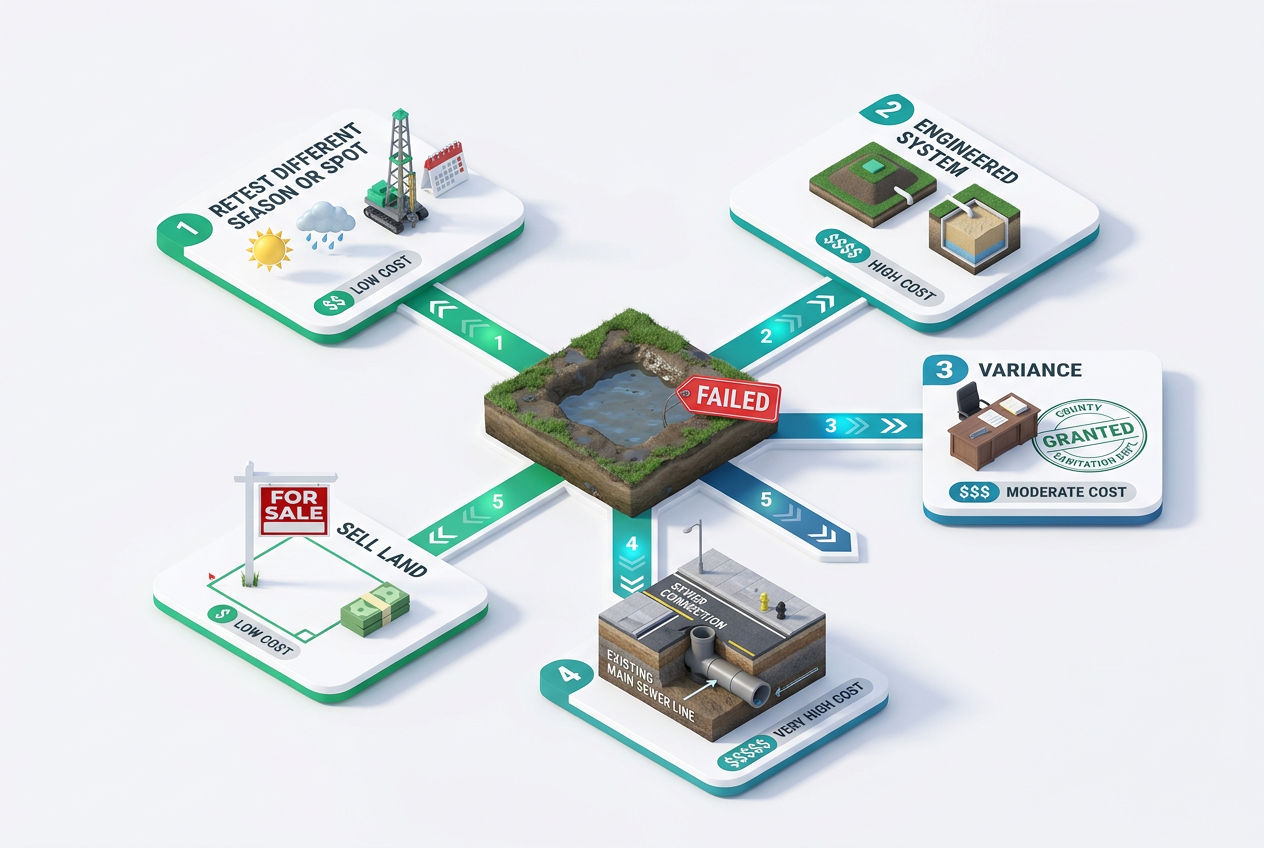
Some counties require you to demonstrate that an approved alternative system can handle the projected wastewater load before they'll issue a building permit. Others offer conditional permits pending a successful engineered system design. A handful of rural counties still offer variances for low-use structures.
The worst-case scenario is a parcel where no approved alternative system can be designed — typically extreme high-water-table lots in areas like coastal Florida or certain wetland-adjacent properties in the Northeast. But that outcome is genuinely rare and requires a professional site evaluation to confirm, not just a failed test result.
If you're purchasing land and a perc test just came back failed, don't walk away before talking to a licensed septic system design engineer. Get a second opinion on whether an alternative system is feasible.
Option 1: Request a Retest
Before you spend $15,000 on an engineered system, ask your county health department whether a retest is allowed — and under what conditions.
Soil moisture content significantly affects percolation rates. The same parcel can pass in late August and fail in March. If your test was conducted in spring when soil is saturated from snowmelt or heavy rain, a dry-season retest could yield a completely different result.
Most jurisdictions allow at least one retest, though some require a waiting period of six to twelve months. A few states specifically mandate wet-season testing to establish worst-case conditions — in those places, a dry-season retest won't help because the fail result is intentionally conservative.
A single perc test costs $250–$1,000 depending on your county and the number of holes required. That's cheap compared to any alternative system. If there's any reasonable chance the soil conditions skewed your result, the retest is worth every dollar.
Ask your county health department two questions: "Is a retest allowed?" and "What season produces the most favorable conditions for testing on this soil type?" The answers will tell you whether this path is worth pursuing.

DIY Septic Blueprint
Thinking about building it yourself?
The complete, plain-English plan to size, permit and install your own septic system — designed for homeowners, not contractors. Skip the $15,000–$25,000 quotes and do it right the first time.
Get the DIY Blueprint — $67 →Instant download · 8 modules + 3 bonus guides · 60-day money-back guaranteeOption 2: Install an Engineered Alternative Septic System
This is where most landowners end up. When a conventional septic drain field isn't an option, an engineered system takes over the job — just with more sophisticated technology and a bigger price tag.
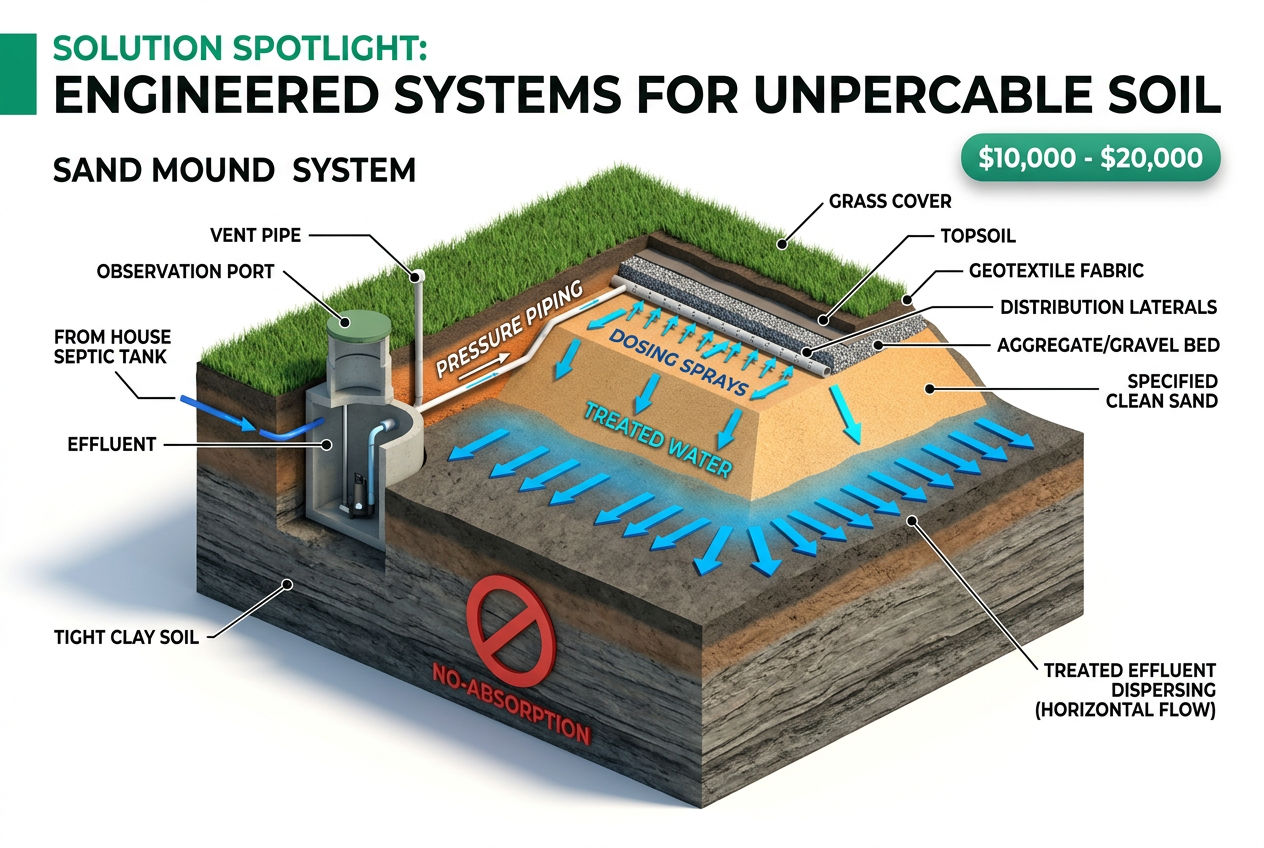
Here's a breakdown of the most common options. Every system listed below has been approved in jurisdictions across the U.S., though your specific county determines what's on the menu. Experienced septic installation services can usually tell you within one site visit which of these designs your county actually permits.
Mound Septic Systems
A mound system raises the drain field above natural grade by importing a large volume of sand fill. Effluent from the septic tank is pressure-dosed upward into the mound, where it travels through the sand layer and receives treatment before reaching native soil.
Mound systems are the most widely approved alternative system in the country. They work well in clay soil, high water table situations, and shallow-bedrock sites. The downside is the visual footprint — a properly sized mound for a 3-bedroom home typically measures 30–60 feet wide and 2–4 feet tall. Your backyard will look different.
Cost: $10,000–$25,000+, depending on mound size, fill material costs, and local labor rates.
Learn more in our mound septic systems guide.
Aerobic Treatment Units (ATUs)
An aerobic treatment unit injects oxygen into the treatment process, producing a cleaner effluent that can be dispersed over a smaller area — or in some states, even surface-sprayed. ATUs use electric aerator compressors (Hiblow HP-80 and similar units are commonly specified) to keep the treatment chamber aerated continuously.
Texas is the clearest example of a state where ATUs dominate. The TCEQ's OSSF (On-Site Sewage Facilities) program has driven widespread ATU adoption, and you'll find them on rural lots throughout the state that would otherwise be unbuildable. Florida's FDOH similarly approves ATUs as an alternative for high-water-table lots where mounds aren't feasible.
ATUs require an annual maintenance contract with a licensed service provider in most states — budget $150–$300 per year on top of installation costs.
Cost: $10,000–$20,000 installed.
See the full breakdown at our aerobic septic system cost guide.
Sand Filter Septic Systems
A sand filter system passes septic tank effluent through a constructed bed of coarse sand before it reaches the soil. The sand acts as a biological treatment layer, and the cleaner output is then dispersed through a reduced-size drain field or drip system.
Sand filters work well in the Pacific Northwest, where heavy clay and seasonal rainfall combine to fail conventional systems regularly. Oregon and Washington have both approved sand filter systems at the county level for decades.
Cost: $7,000–$18,000, with the range driven by whether you need a recirculating or single-pass design.
Drip Irrigation Septic Systems
Drip systems deliver highly treated effluent through a network of subsurface drip tubing installed just 6–12 inches below grade. Because the effluent is treated to a high standard before dispersal, drip systems can work on sites with marginal soil or shallow depth to groundwater.
Orenco Systems is one of the most recognized manufacturers of drip dispersal components. Their AdvanTex treatment pods paired with drip dispersal fields appear on engineered system plans across the country.
These systems work best on relatively flat terrain. Steep slopes complicate pressure zone design and increase pump requirements.
Cost: $8,000–$18,000 installed.
What Does an Engineered Septic System Cost to Design?
Before any of the above gets installed, you need a licensed professional engineer (PE) or state-certified designer to stamp the plans. Expect to pay $1,000–$5,000 for design services alone, plus the county health department permit fee (typically $200–$800). For context on how these figures compare to a conventional build, see our full guide to septic installation costs.
The engineered system approval process — design, submittal, review, and permit issuance — typically takes 4–12 weeks. Plan accordingly if you're on a construction timeline.
Our septic system installation process guide walks through exactly what that timeline looks like.
A Worked Example: What Perc Test Failure Actually Costs
Here's a concrete scenario that illustrates how these numbers stack up. Take a 2-acre lot in a clay-heavy county in central North Carolina — a region where the North Carolina DHHS Division of Environmental Health reports that alternative systems account for a significant share of all new septic permits issued in Piedmont counties.
The lot tested at 85 MPI in two of three test holes. That's a failed percolation test result: soil is too dense for a conventional drain field. The owner's options and approximate costs:
- Retest in dry season: $400 (two holes, one re-evaluation visit)
- Mound system if retest fails: $18,500 installed, including $2,200 PE design fee and $450 county permit
- ATU alternative: $14,800 installed, plus $200/year maintenance contract
If the dry-season retest passes, total out-of-pocket is $400. If it fails and the owner proceeds with a mound system, total investment before construction is roughly $19,400. According to the National Onsite Wastewater Recycling Association (NOWRA), engineered alternative systems now represent more than 30% of new residential septic installations nationwide — meaning this scenario is far from unusual.
The honest limitation here: these numbers assume the county approves a mound system on this specific parcel. In counties with strict setback requirements from property lines or seasonal stream buffers, the footprint of a mound may not physically fit — in which case an ATU or drip system becomes the only viable path, regardless of cost preference.
Option 3: Apply for a Variance
Some counties allow a variance — a formal exception to standard perc test requirements — for specific circumstances. Low-use structures (seasonal cabins, storage buildings with minimal plumbing) are the most common candidates.
Variance criteria vary widely. In some counties, a variance requires demonstrating that your lot predates current septic code and that strict enforcement would create undue hardship. In others, a variance is essentially a negotiation with the health department over system sizing and placement.
This option has real limits. Variances are rarely granted for primary residences intended for year-round use. They're more commonly applied to seasonal or low-flow structures where the wastewater volume is genuinely minimal. And they require documentation — don't show up at the health department expecting an informal conversation to resolve this.
Check your county's website for variance application forms and requirements. Bring your perc test results, a site plan, and documentation of the structure's intended use. Ask specifically whether a low-use variance applies to your situation and request the written criteria in writing.
Option 4: Connect to Municipal Sewer
If your parcel is within reasonable distance of a municipal sewer line, connection may be the most cost-effective path — and in some jurisdictions, it's required before alternative septic systems are even considered.
Municipal connection costs vary dramatically based on distance and terrain. A lot sitting 200 feet from an existing sewer main might pay $5,000–$15,000 for connection fees, tap fees, and lateral installation. A lot sitting a quarter-mile away from the nearest line faces a different math problem entirely — extension costs can run $50–$150 per linear foot, making rural connection economically unfeasible.
Call your municipal utility and ask two things: whether a sewer main exists within 500 feet of your parcel, and what the current connection fee schedule looks like. If you're inside a city's utility service area, this conversation is worth having before you invest in an engineered septic design.
Option 5: Sell the Land (With Full Disclosure)
Nobody wants this to be the answer. But selling a parcel with a documented perc test failure is a legitimate option — and it's more viable than most landowners assume when they first see the failed result.
The key is disclosure and pricing. A failed percolation test must be disclosed in most states when selling land. Buyers who know what they're buying — investors, developers with access to engineered system contractors, or buyers who intend to apply for variances — will negotiate on price, not walk away entirely.
The value reduction depends on what an engineered system would cost on your specific parcel. If a mound system is feasible for $18,000, a reasonable buyer will discount their offer by roughly that amount plus a margin for uncertainty. If the lot is in a desirable area, that's still a sale.
One strategy worth considering: commission an engineered system design before listing. Paying $2,000–$3,000 for a PE-stamped design plan that shows an approved system is feasible narrows the uncertainty for buyers and can recover its cost many times over in the final sale price. A buyer who sees an approved design pays for land that can be built on. A buyer who sees only a failed test is pricing in everything that could go wrong.
For more on navigating property transactions with septic complications, see our guide on selling a house with septic system issues.
Alternative System Cost Comparison
| System Type | Installed Cost Range | Best For | Annual Maintenance |
|---|---|---|---|
| Mound System | $10,000–$25,000+ | Clay soil, high water table, shallow bedrock | Low ($0–$100) |
| Aerobic Treatment Unit | $10,000–$20,000 | High water table, small lots, TX/FL regulations | $150–$300 |
| Sand Filter | $7,000–$18,000 | Pacific Northwest, heavy clay, seasonal saturation | Low–Moderate |
| Drip Irrigation | $8,000–$18,000 | Marginal soil, shallow groundwater, flat terrain | Moderate |
| Municipal Connection | $5,000–$50,000+ | Urban/suburban fringe parcels near existing mains | Utility bill only |
Cost data sourced from NOWRA member contractor surveys and EPA Onsite Wastewater Treatment Systems Technology Fact Sheets. Regional variation is significant — get local bids before using these figures for budgeting.
What to Do Right Now: Your Next Steps
Here's the sequence that makes sense for most landowners facing a failed percolation test result:
- Confirm the failure reason — ask your county health department what specifically caused the fail (MPI too slow, too fast, water table intrusion). The reason determines your options.
- Ask about a retest — get the specific conditions required and the cost. If there's a legitimate seasonal argument, budget $250–$1,000 and put it in the queue.
- Hire a site evaluator — a licensed soil scientist or PE can assess whether any alternative system is feasible on your specific parcel. Budget $300–$800 for this evaluation. This is the step that tells you whether you're looking at Option 2 or Option 5.
- Check municipal sewer availability — one phone call to your utility can rule this in or out in 10 minutes.
- Get variance criteria in writing — if you have a low-use structure or a pre-code parcel, the variance path is worth exploring formally.
- Price your options — get bids on the feasible engineered systems before making any decision about building, selling, or holding.
Whatever county you're in, the health department is the first call. They issue the permits, they define what's approved, and they can tell you whether your specific failure reason has a practical solution in your jurisdiction. Once you know which systems are on the table, find a septic professional near you to get real bids on your parcel.
Sources & Methodology
-
EPA Onsite Wastewater Treatment Systems Technology Fact Sheets — https://www.epa.gov/septic/types-septic-systems — Used for system type descriptions, treatment process details, and general regulatory framework guidance.
-
Texas Commission on Environmental Quality (TCEQ) — On-Site Sewage Facilities Rules — https://www.tceq.texas.gov/compliance/field_ops/ossf — Used for ATU approval process and Texas OSSF program details.
-
National Onsite Wastewater Recycling Association (NOWRA) — https://www.nowra.org — Cost data sourced from NOWRA member contractor surveys. Used for alternative system cost ranges and market share estimates.
-
North Carolina DHHS — Division of Environmental Health, Wastewater Branch — https://ehs.ncdhhs.gov/wastewater — Used for Southeast regional failure rate context and NC-specific permitting requirements.
-
Orenco Systems, Inc. — https://www.orenco.com — Technical specifications for AdvanTex treatment pods and drip dispersal system components.
Free download
Not ready for the Blueprint? Start free.
Grab the free DIY Septic Planning Kit — the permit-first checklist, perc-test cheat sheet, and sizing tables that keep your build from getting red-tagged.
Was this article helpful?
Frequently Asked Questions
Recommended Resources
📖 Related Articles
- What Is a Drain Field? (And How Does It Work?)
- Perc Test (Percolation Test): What It Is & How It Works
- Mound Septic System: $10K–$25K Cost & How It Works (2026)
- Aerobic Septic System (ATU) Cost: $10K–$20K Install (2026)
- What to Expect During Septic System Installation
- Selling a House With a Septic System: What Sellers Must Disclose
Find Septic Professionals Near You
Compare licensed, verified septic companies by area — top county markets and cities below, or browse all 50 states.
County markets
Popular cities
