
Quick Answer
Septic system design is the process of determining the right tank size, drain field layout, and system type for your specific property — based on soil conditions, household size, lot dimensions, and local code requirements. A properly engineered design protects groundwater, prevents system failure, and is required before any permit will be issued.
Key Takeaways
- Septic design starts with a percolation test — soil that drains too slowly or too fast can rule out a conventional system entirely.
- Tank size is calculated from bedroom count and daily wastewater flow; a 3-bedroom home typically requires a 1,000–1,250-gallon tank.
- Setback rules govern where every component can be placed — your drain field must usually sit 50–100+ feet from any drinking water well.
- Permit-ready design drawings must be approved before a single shovel hits the ground.
- Design fees run $500–$2,500; alternative or engineered systems cost significantly more to design and install.
What Is Septic System Design?
Septic system design is the technical process of sizing, siting, and documenting a complete wastewater treatment system for a specific parcel of land. It covers every component — the septic tank, effluent distribution, and drain field (also called a leach field or absorption field) — and produces drawings detailed enough to satisfy your county health department.
Think of it as the blueprint phase. Before any excavator shows up, a licensed designer evaluates your soil, calculates your household's daily wastewater flow, and maps out exactly where each component goes. The same holds true if you're planning a DIY septic system — the design work comes before any labor, hired or otherwise. Skip this step and you're looking at permit violations, fines, or a system that fails within a few years. Late-1990s EPA literature estimated 10–20% of septic systems were malfunctioning at any given time — poor design and siting are leading causes.
What Are the Key Components of a Septic System Layout?
A standard septic system layout includes four main elements working in sequence:
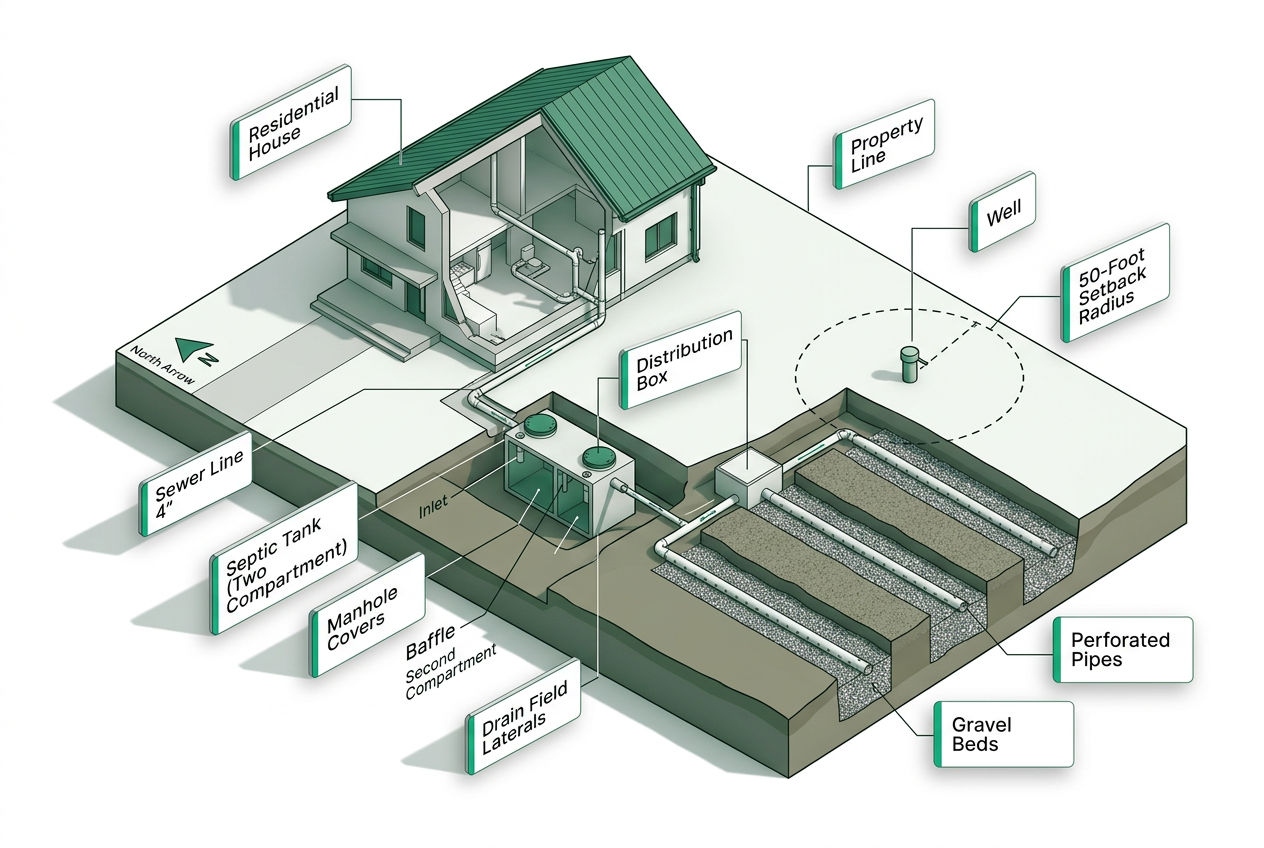
- Septic tank — A buried concrete, fiberglass, or plastic tank that separates solids from liquid wastewater. A 1,000-gallon or 1,250-gallon precast concrete tank is the most common residential choice.
- Distribution box (D-box) — A small concrete or plastic chamber that splits effluent evenly between drain field trenches. Proper D-box placement is critical; an unlevel box sends all flow to one trench and kills the field prematurely.
- Drain field / leach field — A network of perforated pipes (or Infiltrator chamber systems) buried in gravel-filled trenches that allow treated effluent to absorb into the soil.
- Connecting pipes — Schedule 40 PVC or SDR-35 pipe runs between components, sloped at roughly ¼-inch per foot to maintain gravity flow.
Some systems also include a pump chamber with a float switch and effluent pump — required when gravity flow isn't possible, or when pressure distribution is needed for uniform loading across the field. For a deeper look at how these pieces fit together, see our septic system diagram guide.
What Does the Septic Design Process Look Like Step by Step?
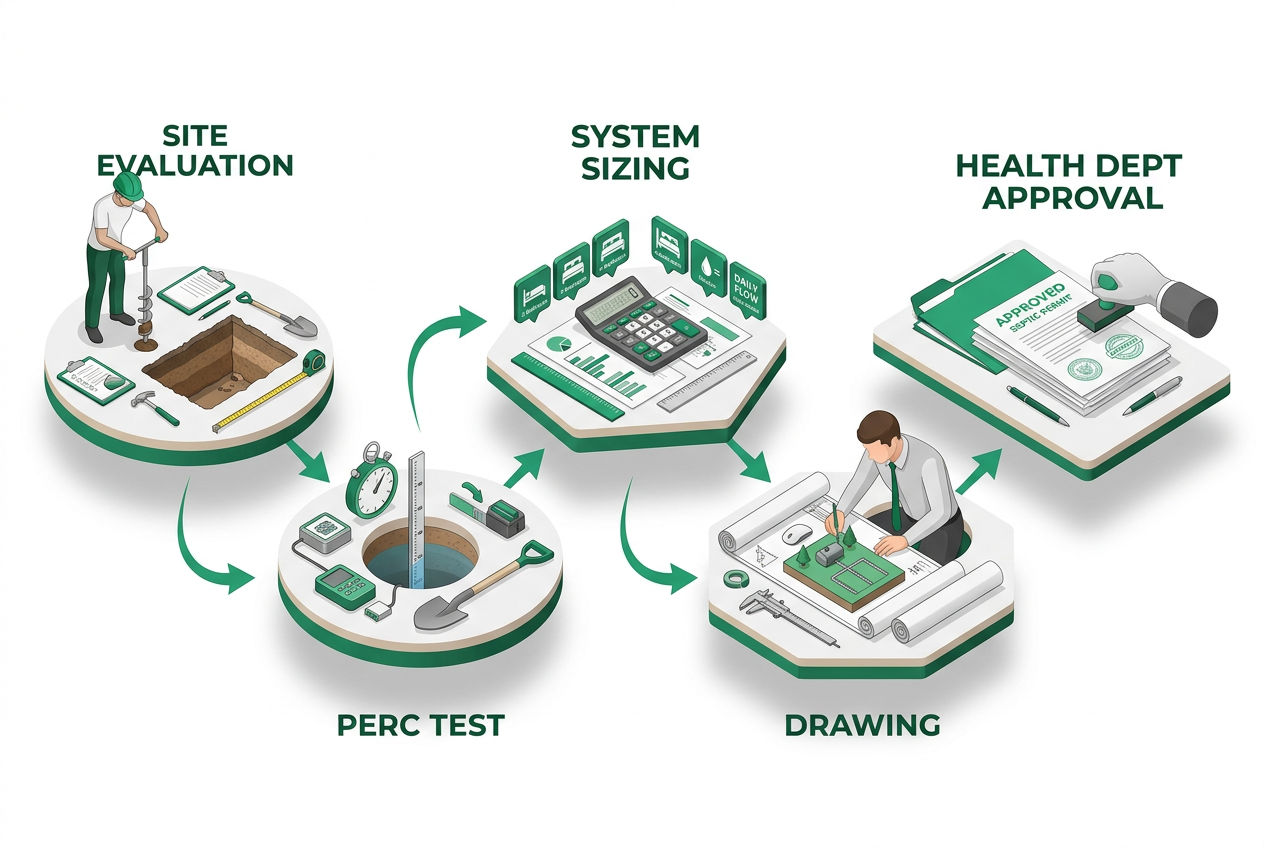
Step 1: Site Evaluation and Soil Testing
Everything starts with the soil. A licensed soil scientist or designer digs test holes — typically 5–8 feet deep — to examine soil horizons, check for seasonal high water tables, and identify restrictive layers like hardpan or bedrock. Then comes the percolation test: water is poured into a pre-soaked test hole and the drainage rate (in minutes per inch) is measured.
That perc rate determines whether a conventional system is even feasible:
| Perc Rate (min/inch) | Soil Type | Design Implication |
|---|---|---|
| 1–5 | Sandy / Gravel | May need flow-retarding design |
| 5–20 | Loamy / Good | Standard conventional system |
| 20–60 | Silty / Clay mix | Larger field or alternative system |
| 60+ | Heavy clay / Failing | Conventional system not permitted |
Source: EPA Onsite Wastewater Treatment Systems Manual; state code variations apply.
In Midwest states like Ohio and Indiana, clay-heavy soils push perc failure rates above 30–40% in some townships. In those cases, alternative septic systems — mound systems, sand filters, or aerobic treatment units — become the path forward.
Step 2: Calculating Septic Tank Size
Tank sizing is driven by bedroom count, which serves as a proxy for daily wastewater flow (measured in gallons per day, or GPD). Most state codes use the following baseline:
- 1–2 bedrooms: 750–1,000-gallon tank / 150–300 GPD
- 3 bedrooms: 1,000–1,250-gallon tank / 300–450 GPD
- 4 bedrooms: 1,250–1,500-gallon tank / 450–600 GPD
- 5–6 bedrooms: 1,500–2,000+ gallon tank / 600–750+ GPD
Here's a real-world example: A 3-bedroom house in rural Tennessee with four occupants generates roughly 360 GPD. The designer specifies a 1,250-gallon precast concrete tank — not just to handle the daily load, but to maintain the 30–50% liquid retention time that allows proper settling. Add a garbage disposal and that GPD estimate jumps by 40–50%, which can push the designer to a larger tank or a more frequent pumping schedule.
For more detail on tank sizing, see our septic tank size chart.
Step 3: Drain Field Sizing and Layout
Leach field size is calculated from two variables: daily flow (GPD) and the soil's loading rate (derived from the perc test). A soil with a perc rate of 10 min/inch might allow 0.8 gallons per square foot per day — so a 360 GPD system needs at least 450 square feet of trench bottom.
As a rough rule, plan on 150–300 square feet of drain field per bedroom, though sandy soils can support smaller fields and slow-draining soils require significantly more. Trenches are typically 18–36 inches wide and 24–36 inches deep, with perforated pipe surrounded by ¾-inch washed gravel (or Infiltrator Quick4 chambers as a gravelless alternative).
The layout itself matters too. Gravity-fed systems work when the field sits downhill from the tank — simple and reliable. If topography or lot size forces the field uphill, a pump chamber with a pressure distribution manifold is added. This design pushes effluent through smaller-diameter pipes with orifice holes, loading the entire field surface evenly rather than saturating one end.
Our drain field size guide covers trench calculations in detail, and the residential drain field layout article walks through common configuration patterns.
Step 4: Applying Setback Requirements
Every component must be placed within setback boundaries set by your state or county health department. These are hard limits — no variance, no exceptions in most jurisdictions. Typical minimums include:
- Septic tank to house foundation: 5–10 feet
- Drain field to house foundation: 10–20 feet
- Drain field to drinking water well: 50–100+ feet (100 feet is common; Massachusetts Title 5 requires 100 feet minimum)
- System to property line: 5–15 feet
- System to surface water or wetlands: 50–100+ feet
These numbers shape the design drawing before a single calculation is made. A half-acre suburban lot with a well, a pond, and a neighbor's fence 20 feet away can make septic field placement a puzzle. That's when a designer earns their fee.
See our full article on septic system setback requirements for state-by-state breakdowns.

DIY Septic Blueprint
Thinking about building it yourself?
The complete, plain-English plan to size, permit and install your own septic system — designed for homeowners, not contractors. Skip the $15,000–$25,000 quotes and do it right the first time.
Get the DIY Blueprint — $67 →Instant download · 8 modules + 3 bonus guides · 60-day money-back guaranteeWhat Does a Septic System Design Drawing Include?
A permit-ready septic design drawing — sometimes called a site plan or as-built drawing — is a scaled overhead view of your property that shows every relevant feature and measurement. Expect to see:
- Property boundaries and lot dimensions
- Existing structures (house, garage, driveway, fences)
- Wells, water lines, and surface water features
- Septic tank location with access risers marked
- D-box location and distribution line routing
- Drain field trenches with dimensions, spacing, and invert elevations
- Setback distances from every regulated feature
- Soil profile logs and perc test hole locations
- Designer's stamp and license number
Some counties also require a soil profile detail drawing showing the layers encountered during site evaluation, plus a system cross-section illustrating trench depth, pipe placement, and gravel depth.
These drawings go to your county health department with a permit application. Approval timelines vary — rural counties might turn permits around in 2–3 weeks, while suburban counties with heavy development backlogs can take 6–12 weeks. Plan ahead, especially if you're targeting a spring installation when contractors are booked solid.
What Are Standard vs. Alternative Septic System Designs?
A conventional septic system — gravity-fed tank and gravel trench drain field — is the baseline design. It's the least expensive to build ($5,000–$15,000 installed) and the simplest to maintain. If your soil passes the perc test and your lot has adequate space, this is almost always the right call.
Alternative or engineered systems come into play when the site fails conventional requirements:
- Mound systems — The drain field is raised above natural grade using engineered fill, used when seasonal high water tables or slow soils make in-ground absorption impossible. Common in Wisconsin, Minnesota, and Florida coastal areas.
- Aerobic treatment units (ATUs) — Add oxygen to the treatment process, producing cleaner effluent that can be pressure-dosed into smaller fields. Required in many Texas counties.
- Sand filter systems — Effluent passes through a sand bed before reaching the drain field, providing additional treatment in sensitive areas.
- Drip irrigation systems — Orenco Systems' AdvanTex is a popular example; treated effluent drips into shallow soil zones, useful for tight lots or challenging terrain.
Alternative systems cost $15,000–$40,000+ installed and typically require annual service contracts. The design process is also more complex, often requiring a licensed professional engineer (PE) rather than just a certified designer.
Explore more options in our types of septic systems guide.
How Much Does Septic System Design Cost?
Septic design fees typically run $500–$2,500 for a conventional residential system, though engineered or alternative system designs can push well beyond that. Here's how the full pre-installation budget breaks down:
- Perc test: $250–$1,000 (varies by state and number of test holes required)
- Design and drawing fees: $500–$2,500
- Permit fees: $200–$1,000+
- Total design phase (before installation): $1,000–$4,500 typical
A conventional system in rural North Carolina might come in at $1,200 total for design and permits. That same process in Massachusetts — where Title 5 requires a licensed site evaluator, a detailed soil log, and a town-specific permit process — can run $3,500 before the first pipe goes in.
Installation adds $5,000–$15,000 for a conventional system. The complete septic installation cost guide breaks this down by system type and region.
Can You Design Your Own Septic System?
In most states, no — at least not the official version that gets a permit. State health codes almost universally require septic designs to be prepared and stamped by a licensed professional: a certified soil scientist, licensed designer, or professional engineer depending on the state.
That said, a few rural counties still allow homeowners to pull their own permits with a basic site sketch and perc test results. DIY septic installation is explored in more detail in that guide — but understand that "DIY" usually means doing the physical work under an approved design, not skipping the design phase entirely.
The risk of designing your own system without credentials isn't just legal — it's practical. An undersized drain field that saturates within five years costs far more to replace than the $1,500 you saved skipping a licensed designer. Septic system permit requirements vary by state, and some counties conduct random inspections during installation. If you'd rather not gamble, get quotes from licensed septic installers near you who handle design and permitting as part of the job.
Does Septic Design Vary by Region?
Dramatically. Septic design is hyper-local, and what works in Arizona won't fly in Oregon.
- Southeast (Florida, Georgia, South Carolina): High water tables and sandy soils mean mound systems and advanced treatment units are common. Flood zone overlays add another layer of regulation.
- Northeast (Massachusetts, New York, Pennsylvania): Frost lines reach 48–60 inches in some areas, requiring deeper tank burial and insulated pipe connections. Massachusetts Title 5 is one of the strictest state codes in the country.
- Midwest (Ohio, Indiana, Minnesota): Clay-heavy soils drive perc failure rates high. Mound systems dominate in many counties. Minnesota's MPCA enforces some of the most detailed designer certification requirements in the nation.
- Mountain West (Colorado, Montana, Idaho): Steep slopes, shallow bedrock, and rocky soils push designers toward pressure-dosed systems. Engineered solutions are the norm, not the exception.
- Southwest (Arizona, New Mexico, Texas): Water scarcity shapes design. Evapotranspiration systems work in arid climates where ground absorption alone isn't the goal. Texas delegates regulation to county-level offices, creating wide variation even within the state.
A designer who knows your county's specific requirements — not just state minimums — is worth every dollar. Use SepticTankHub.com's directory to find licensed septic designers near you.
Sources & Methodology
- U.S. Environmental Protection Agency — Onsite Wastewater Treatment Systems Manual (epa.gov/septic): Primary source for design flow calculations, setback guidelines, and system failure statistics.
- NOWRA (National Onsite Wastewater Recycling Association) (nowra.org): Industry standards for designer certification and alternative system design.
- Massachusetts Title 5 Regulations (310 CMR 15.000): State-specific source for Northeast setback and designer licensing requirements referenced in regional section.
- University of Minnesota Extension — Septic System Design and Management: Referenced for Midwest soil conditions and perc failure rate context.
- State health department guidelines for Florida, Texas, and Ohio: Referenced for regional design requirement variations.
Cost ranges reflect national contractor pricing data compiled from SepticTankHub.com directory listings and publicly available state permit databases. Individual quotes will vary.
Free download
Not ready for the Blueprint? Start free.
Grab the free DIY Septic Planning Kit — the permit-first checklist, perc-test cheat sheet, and sizing tables that keep your build from getting red-tagged.
Was this article helpful?
Frequently Asked Questions
Recommended Resources
📖 Related Articles
- Perc Test (Percolation Test): What It Is & How It Works
- Alternative Septic Systems: Options When a Standard System Won't Work
- How Often Should You Pump Your Septic Tank?
- Septic Tank Sizes & Dimensions Chart (by Bedrooms)
- Leach Field Size by Bedrooms: Drain Field Sizing Chart (2026)
- Septic System Setback Requirements: How Far From the House?
- Types of Septic Systems: Complete Comparison Guide
- Can You Install a Septic System Yourself?
- Septic System Permit Cost & State Requirements (2026 Guide)
- Land Failed the Perc Test? Here Are Your Options
🔧 Services
Find Septic Professionals Near You
Compare licensed, verified septic companies by area — top county markets and cities below, or browse all 50 states.
County markets
Popular cities
