
Quick Answer
Alternative septic systems are engineered wastewater solutions designed for properties where a conventional gravity-fed septic tank and drain field can't be installed. Poor soil percolation, high seasonal water tables, shallow bedrock, and small lot sizes all disqualify land from a standard system — but rarely mean you're out of options entirely. They're also worth understanding before you attempt to install a septic system yourself, because challenging sites are exactly where owner-built plans tend to fall apart.
According to the EPA, roughly 21 million U.S. homes — about one in five — rely on septic systems rather than municipal sewer. As development pushes onto more challenging land, alternative systems are no longer a niche product. In many states, they're standard practice.
Key Takeaways
- A failed percolation test doesn't mean you can't build — it means you need an engineered solution.
- At least eight viable alternative system types exist, each suited to different soil, water table, and lot-size conditions.
- Alternative systems generally cost $7,000–$20,000+, compared to $3,000–$7,000 for a conventional system.
- Most alternatives require more frequent maintenance than a conventional system — typically 2–4 inspections per year vs. a pump-out every 3–5 years.
- Permitting rules vary enormously by state and county — what's approved in Florida may not be allowed in Oregon.
What Makes a Site Fail for a Conventional System?
A conventional septic system moves wastewater from your home into a tank, then out through perforated pipes into a drain field, where soil bacteria treat the effluent before it reaches groundwater. That process only works when the soil can absorb liquid at the right rate.
Your county health department will require a percolation test — often called a "perc test" — before approving any septic permit. Soil that absorbs water faster than 1 minute per inch risks pushing untreated effluent straight to groundwater. Soil slower than 60 minutes per inch won't drain fast enough to prevent surfacing sewage. Conventional drain fields also require at least 2–4 feet of suitable soil above the seasonal high-water table (the exact number varies by state).
Fail either of those tests and you're looking at an engineered septic system.
Common site conditions that trigger the need for alternatives:
- High water tables — common in Florida, coastal Carolinas, Louisiana, Minnesota, and Wisconsin
- Rocky or shallow soil — typical in New England and Appalachia
- Caliche or clay hardpan — widespread in Arizona, New Mexico, and parts of Texas
- Small lots — under ¼ acre often can't fit a conventional drain field with required setbacks
- Steep slopes — drain fields need relatively flat, stable ground
- Environmental setback rules — properties near Chesapeake Bay tributaries or sensitive lake systems face nitrogen-reduction mandates that go beyond what a conventional system can meet
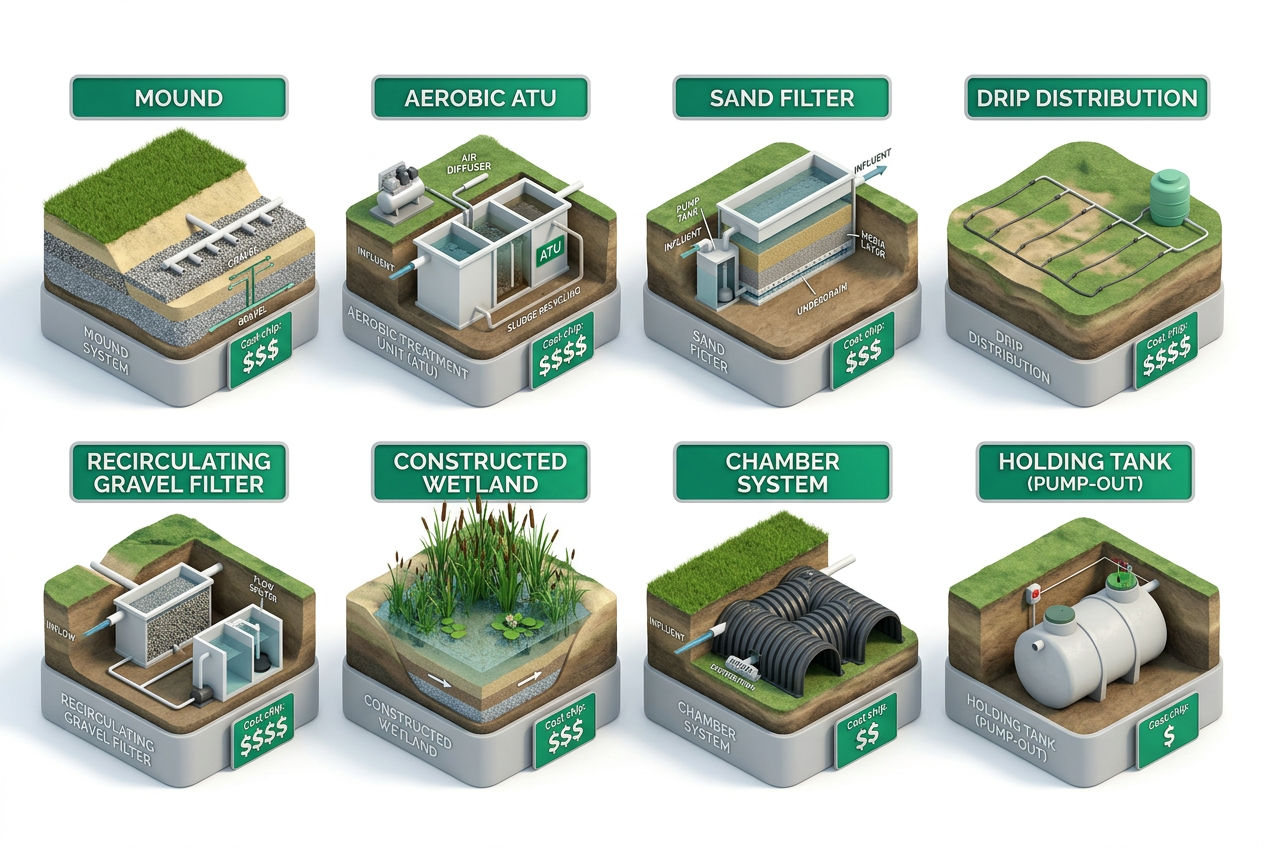
8 Alternative Septic Systems, Compared
Mound Septic Systems
A mound system is the most commonly permitted alternative across the U.S. and the first system most contractors propose when a conventional system fails the perc test.
Instead of burying a drain field in native soil, installers construct a raised mound — typically 2–4 feet high — of engineered sand fill above the existing ground surface. A pump chamber pushes septic tank effluent up into the mound through a pressure distribution manifold and small-diameter laterals, where the sand provides treatment before liquid seeps down into the native soil.
Mound systems work well for high-water-table sites and slowly-percolating soil. They don't work on steep slopes (typically limited to less than 12% grade) or very small lots — a mound can cover 3,000–5,000 square feet of yard.
Installed cost: $10,000–$20,000 Lifespan: 20–25 years with proper maintenance Maintenance: Pump inspection annually; full system service every 1–3 years Best for: High water tables, slowly-percolating soil, moderate lot sizes
For a deeper look, see our guide to mound septic systems.
Aerobic Treatment Units (ATUs)
An aerobic treatment unit (ATU) injects air into the treatment process, creating conditions that allow aerobic bacteria to break down waste far more aggressively than the anaerobic process in a standard septic tank. The result is effluent with 85–98% BOD (biochemical oxygen demand) reduction — often clean enough to be spray-irrigated on the surface or dispersed through a much smaller drain field.
ATUs use an aerator compressor (the Hiblow HP-80 is a common residential unit) to force air through a diffuser in the treatment chamber. Treated effluent passes through a clarifier, then a disinfection stage — typically a chlorine tablet or UV unit — before discharge.
Texas requires ATUs to meet NSF/ANSI Standard 40, meaning units must be third-party certified for performance. Florida mandates them in many high-density areas as "performance-based treatment systems." In the Chesapeake Bay watershed, Maryland and Virginia require enhanced ATUs meeting NSF/ANSI Standard 245 for nitrogen removal.
Installed cost: $10,000–$20,000+ Lifespan: 15–20 years with maintenance Maintenance: 2–4 inspections per year by a licensed service provider; chlorine tablets replenished every 2–3 months Best for: Poor-percolation soils, lots with limited space, environmentally sensitive areas, properties where effluent quality standards are high
Learn more about how these systems compare in our aerobic vs. anaerobic septic overview.
Sand Filter Septic Systems
A sand filter system sits between the septic tank and the final dispersal field, adding a treatment stage that a conventional system skips entirely. Pretreated effluent from the tank is pumped — either intermittently or recirculated — through a bed of coarse sand (typically 24–36 inches deep), where bacteria colonize the sand grains and remove pathogens and BOD before the effluent moves on to a smaller, shallower drain field.
Two configurations exist: single-pass sand filters treat effluent once before dispersal; recirculating sand filters cycle effluent through the bed multiple times, achieving significantly higher treatment quality. The filter bed itself is typically lined with a geomembrane and can be open (unlined top) or enclosed in a concrete vault.
Sand filters are popular in the Pacific Northwest and New England, where heavy rainfall, clay-heavy soils, and environmental sensitivity around salmon streams and drinking-water aquifers demand high effluent quality.
Installed cost: $7,000–$18,000 Lifespan: 15–20+ years (sand media may need replacement after 15–20 years) Maintenance: Annual inspection; pump float switches and distribution nozzles need periodic cleaning Best for: Environmentally sensitive sites, slow-percolating soils, lots where the drain field must be downsized
Our full breakdown covers sand filter septic systems in detail.
Drip Irrigation Septic Systems
A drip irrigation (or drip dispersal) system replaces the conventional perforated-pipe drain field with a network of small-diameter, pressure-compensating drip tubing buried 6–12 inches below the surface — far shallower than conventional laterals. An ATU or other advanced treatment unit first treats the effluent to a high standard; the drip system then disperses it at low doses throughout the yard, lawn, or landscape area.
Because the tubing is shallow and doses are small and frequent (typically timed by a programmable dosing controller), drip irrigation works well on sloped lots, irregularly shaped parcels, and sites with shallow soil depth. The tubing network can snake around trees, structures, and setback boundaries that a conventional drain field couldn't navigate.
Orenco Systems is a major manufacturer of residential drip dispersal components, including their AdvanTex treatment units, which are widely used in Oregon and Washington.
Installed cost: $8,000–$18,000 (typically requires an ATU upstream) Lifespan: 15–25 years with proper filtration upstream Maintenance: Filter flushing every 3–6 months; dosing controller inspections annually Best for: Sloped lots, small or irregular parcels, rocky sites with shallow soil, high-quality-effluent requirements
Constructed Wetland Systems
A constructed wetland uses a shallow, gravel-filled basin planted with aquatic plants — typically bulrush, cattails, or native sedges — to treat septic effluent through a combination of microbial activity, plant uptake, and filtration. Effluent flows from the septic tank into the wetland cell, moves slowly through the root zone, and exits at a significantly reduced pathogen and nutrient load.
These systems are genuinely eco-integrated. The plant roots create an oxygen-rich zone that hosts treatment bacteria, and the visible vegetation means the system can blend into the landscape in ways a mound or ATU cannot. They're most practical in mild climates — constructed wetlands lose significant treatment efficiency when the plants go dormant below freezing temperatures, making them a poor fit for Minnesota winters but well-suited to coastal Oregon, the Southeast, or mid-Atlantic regions.
Installed cost: $8,000–$15,000 Lifespan: 20+ years with plant management Maintenance: Plant harvesting 1–2 times per year; inlet/outlet inspection annually Best for: Mild climates, eco-conscious property owners, sites with room for a larger footprint, low to moderate-strength wastewater
Evapotranspiration (ET) Systems
Evapotranspiration systems don't discharge treated effluent into soil or groundwater at all. Instead, a shallow, lined bed — filled with sand and often planted with shallow-rooted vegetation — allows effluent to evaporate from the surface and transpire through plant leaves. Nothing escapes downward into native soil.
That makes ET systems the only true zero-discharge option for land where groundwater protection is paramount or where the native soil literally won't accept liquid. They only work in arid climates with high evaporation rates and low rainfall. If evaporation can't keep pace with incoming wastewater volume, the bed overflows — which is exactly why ET systems are common in Arizona, New Mexico, and west Texas, and almost unheard of in Washington State.
Installed cost: $10,000–$15,000 Lifespan: 20+ years Maintenance: Vegetation management; bed inspection after heavy rainfall events Best for: Arid Southwest climates, sites with no viable soil for dispersal, high groundwater protection requirements
Pressure Distribution Systems
A pressure distribution system isn't a fundamentally different treatment technology — it's an upgraded delivery method that dramatically improves how effluent reaches the drain field. Instead of flowing by gravity to the first few feet of leach laterals (where most conventional drain fields fail first), a pump chamber doses effluent evenly through small-diameter orifices to all laterals simultaneously.
The result is more even soil loading, better treatment, and a significantly longer drain field lifespan. It can also allow a smaller drain field footprint. Most states allow pressure distribution as an upgrade to conventional systems on marginal soils — it's often the lowest-cost path to approval when the perc test results are borderline.
Installed cost: $3,000–$8,000 over a conventional system Lifespan: 25–30 years (matches or exceeds conventional) Maintenance: Annual pump and float switch inspection Best for: Borderline-percolation soils, uniform loading requirements, sites where gravity-only systems have failed
Holding Tanks
A holding tank is exactly what it sounds like: a sealed underground tank — typically 1,000–2,500 gallons — that stores all household wastewater until it's pumped out by a vacuum truck. No treatment. No dispersal. Just storage.
This is rarely a long-term solution for a full-time residence. A 1,500-gallon holding tank serving a family of four will fill in roughly two weeks. At $200–$400 per pump-out, you're spending $400–$800 per month or more to manage human waste. Annual operating costs can exceed $5,000–$8,000, dwarfing any installation savings.
Holding tanks are the right answer for seasonal cabins with very low use, emergency bridge systems while a permanent system is permitted, or situations where no other option exists. In Minnesota, the MPCA reports that holding tanks are more common than in most states, particularly for seasonal lake cabins where year-round dispersal isn't practical.
Installed cost: $3,000–$5,000 Operating cost: $200–$400 per pump-out, every 1–4 weeks for full-time use Best for: Seasonal or very-low-use properties, temporary installations, last-resort situations only
How Much Does an Alternative Septic System Cost?
The table below summarizes installed cost ranges and key characteristics for each system type. All costs reflect 2025 national averages; actual prices vary significantly by region, site conditions, and local labor rates.
| System Type | Installed Cost | Maintenance Level | Best Soil/Site Condition |
|---|---|---|---|
| Mound System | $10,000–$20,000 | Moderate | High water table, slow perc |
| Aerobic Treatment Unit | $10,000–$20,000+ | High (2–4x/year) | Poor perc, small lots |
| Sand Filter System | $7,000–$18,000 | Moderate | Sensitive sites, slow perc |
| Drip Irrigation | $8,000–$18,000 | Moderate–High | Slopes, small lots, rocky |
| Constructed Wetland | $8,000–$15,000 | Low–Moderate | Mild climates, eco sites |
| ET System | $10,000–$15,000 | Low | Arid climates only |
| Pressure Distribution | $3,000–$8,000 add-on | Low | Borderline perc soils |
| Holding Tank | $3,000–$5,000 install | Very High (pumping) | Last resort / seasonal |
Source: National Onsite Wastewater Recycling Association (NOWRA) cost data; EPA Decentralized Wastewater Management Program; contractor quotes compiled by SepticTankHub.com.
For a full breakdown of installation costs, see our septic installation cost guide.
Free download
Planning your own septic system?
Grab the free DIY Septic Planning Kit — the permit-first checklist, perc-test cheat sheet, and sizing tables that keep your build from getting red-tagged.
Can You Have a Septic Tank Without a Leach Field?
Yes — several alternative septic systems operate without a conventional leach field. Aerobic treatment units can discharge to drip irrigation lines or spray heads instead of a drain field. Evapotranspiration systems use a lined sand bed with no soil dispersal at all. Holding tanks store waste for pump-out with no dispersal component. Constructed wetlands treat and discharge through plant and microbial uptake rather than soil percolation. The right choice depends on your site's specific constraints and local regulations.
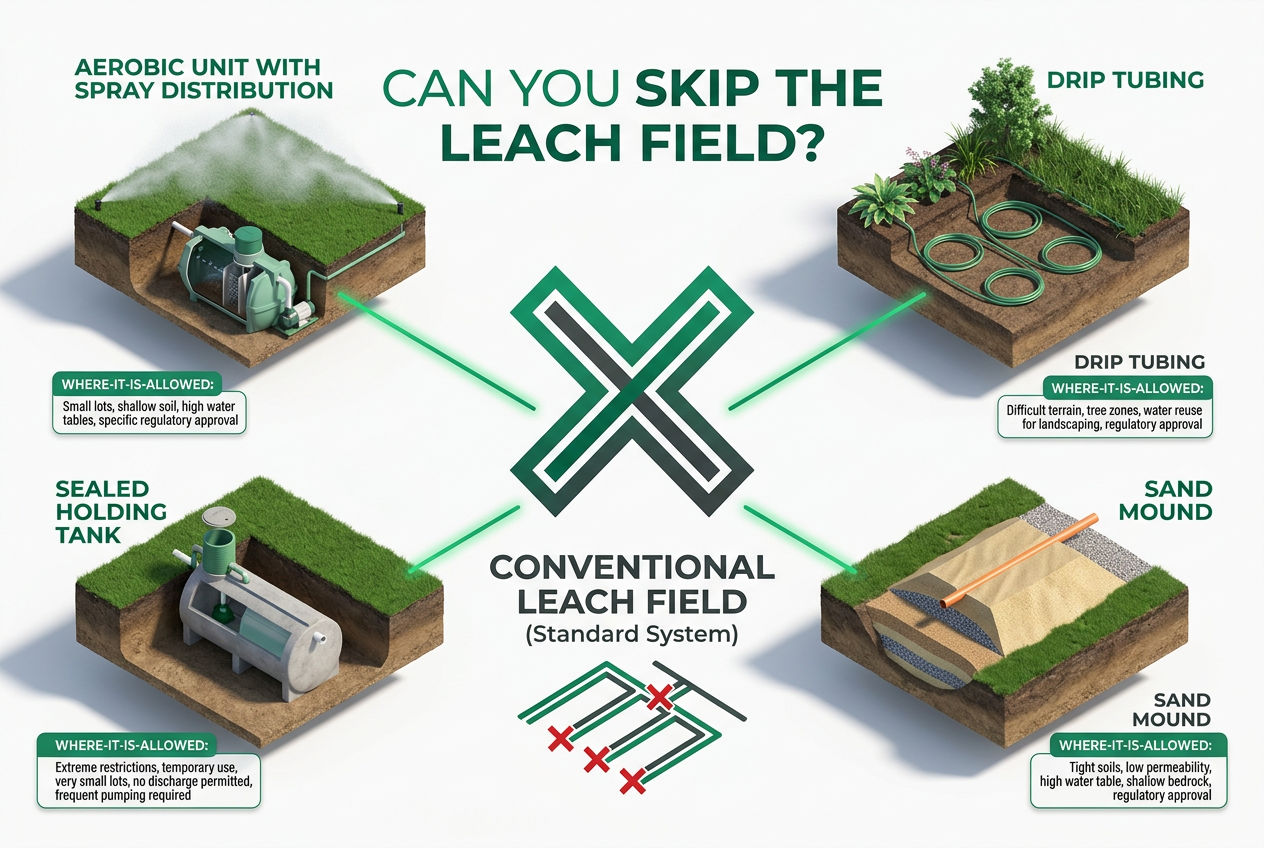
The leach field — also called a drain field — is the component most commonly limited by soil conditions, lot size, and setback rules. For a deep look at how drain fields work and why they fail, see our drain field overview.
What Is the Best Septic System for a High Water Table?
For high water table sites, a mound system is typically the first recommendation and the most widely permitted option across the country. By building a raised sand fill above the existing grade, a mound system creates the vertical separation between the drain laterals and the seasonal high-water table that regulators require — typically 2–4 feet, depending on state code.
In areas like coastal Florida or southern Louisiana, where water tables can be less than 12 inches below grade, ATUs with drip dispersal are often the more practical choice because they don't require the same vertical separation as a conventional-style drain field. Florida's Department of Health maintains specific approved system lists for high-water-table counties.
For more on this specific constraint, see our guide to high water table septic options.
Do Alternative Septic Systems Require More Maintenance?
Honestly? Most of them do. A conventional septic tank serving a 4-person household needs pumping every 3–5 years, per EPA guidance. A well-managed conventional system might go 25–30 years with minimal intervention beyond that.
Alternative systems introduce mechanical components — pumps, aerator compressors, float switches, dosing controllers, UV disinfection units, drip filter assemblies — that need regular attention. ATUs require certified inspections 2–4 times per year in most states that permit them. The aerator compressor on a unit like a Hiblow HP-80 runs continuously and needs replacement every 3–5 years at roughly $200–$400. Chlorine tablet feeders need refilling every 2–3 months.
That maintenance isn't optional — most ATU permits are tied to mandatory service contracts, and skipping them can void your permit and trigger fines.
For a realistic look at ongoing ownership costs, see our septic system maintenance guide and septic pumping cost guide.
What Happens If Your Land Doesn't Pass a Perc Test?
A failed perc test closes the door on a conventional system — but it doesn't close it on development entirely. Here's what typically happens next:
-
Request a detailed soil evaluation. A licensed soil scientist or site evaluator can identify whether any area of the parcel has acceptable conditions, or whether an engineered system can compensate for the soil's limitations.
-
Engage an engineer early. Many alternative systems require a site-specific design stamped by a licensed professional engineer (PE). Getting that engineer involved before you've committed to a lot purchase can save significant money.
-
Understand your permit path. Some alternatives require variances or conditional-use permits beyond the standard onsite system permit. In states like Maryland (for Chesapeake Bay properties) or Washington (for salmon-bearing watershed setbacks), the approval process can take months.
-
Get multiple contractor bids. Alternative system costs vary more than conventional systems because site conditions drive design. Three bids are a minimum.
-
Check USDA Rural Development options. The USDA Rural Development program offers loans and grants for wastewater system improvements for qualifying rural properties — including alternative system installations. See usda.rd.usda.gov for current programs.
For a full overview of the permit process, see our septic system permit requirements guide.
Regional Quick Reference: Which Systems Are Common Where?
Your geography matters enormously. A system that's routine in Texas may not even be listed in Oregon's approved technology catalog.
- Florida & Gulf Coast: High water tables and strict Department of Health permitting push most new installations toward ATUs or mound systems. Florida has specific county-by-county approved system lists — check with your local county health department before assuming any system is available in your area. Florida septic regulations
- New England & Northeast: Rocky, shallow soil and small lots make mound systems and sand filters the standard alternatives. Massachusetts Title 5 regulations and New York State DEC rules create specific design requirements.
- Pacific Northwest: Environmental sensitivity around salmon streams and drinking water aquifers means Oregon and Washington favor high-treatment alternatives — recirculating sand filters, ATUs, and Orenco AdvanTex-style drip systems are common. Oregon septic regulations
- Southwest: Caliche hardpan and low rainfall make evapotranspiration systems viable in Arizona and New Mexico. Arizona septic regulations
- Chesapeake Bay Watershed: Maryland and Virginia require nitrogen-reducing systems (NSF/ANSI Standard 245) in many Bay-adjacent areas. Maryland septic regulations
- Upper Midwest: Minnesota's MPCA oversees one of the most detailed alternative system programs in the country, with specific designs for shoreland setback areas and lake districts. Minnesota septic regulations
Find the Right System for Your Property
No article can tell you which system is right for your specific parcel. That determination requires a licensed site evaluator, a perc test done in the right season (spring wet conditions give the most accurate results in most states), and a design engineer familiar with your county's approval process.
What this article can tell you: alternatives exist for almost every challenging site. The question isn't whether a solution is out there — it's which one your soil, your lot, and your local regulator will accept. Talking to septic contractors near you early in the process will also reveal which systems local installers actually build.
Find a qualified alternative septic system installer near you or get quotes from licensed local contractors to get site-specific answers.
Sources & Methodology
-
U.S. Environmental Protection Agency — Septic Systems Overview (epa.gov/septic): Source for the 21 million household statistic and conventional system pumping frequency guidance.
-
National Onsite Wastewater Recycling Association (NOWRA) (nowra.org): Alternative system cost ranges and technology performance data.
-
NSF International — NSF/ANSI Standard 40 and Standard 245: Performance certification standards referenced for ATU permitting in Texas, Florida, Maryland, and Virginia.
-
USDA Rural Development — Water & Waste Disposal Programs (rd.usda.gov): Loan and grant program information for rural wastewater systems.
-
State health department and environmental agency publications (Florida DOH, Minnesota MPCA, Oregon DEQ, Maryland MDE, Washington DOE): State-specific permitting requirements, approved technology lists, and regional regulatory context.
Content reviewed for technical accuracy. For site-specific guidance, consult a licensed septic system designer or engineer in your jurisdiction.
Was this article helpful?
Frequently Asked Questions
Recommended Resources
📖 Related Articles
- Perc Test (Percolation Test): What It Is & How It Works
- Engineered Septic System Cost: $12K–$30K+ (2026)
- Mound Septic System: $10K–$25K Cost & How It Works (2026)
- Aerobic vs Anaerobic Septic Systems: How They Compare
- Sand Filter Septic Systems: How They Work & What They Cost
- What Is a Drain Field? (And How Does It Work?)
- High Water Table and Septic Systems: What You Need to Know
- The Complete Septic Tank Maintenance Guide
- Septic System Permit Cost & State Requirements (2026 Guide)
💰 Cost Guides
🔧 Services
Find Septic Professionals Near You
Compare licensed, verified septic companies by area — top county markets and cities below, or browse all 50 states.
County markets
Popular cities
