
Quick Answer
A sand filter septic system is an advanced secondary treatment system that passes pre-treated effluent through a sand filter bed before it reaches the soil. It removes 85–98% of biochemical oxygen demand (BOD) and up to 99% of fecal coliform bacteria — making it one of the most effective on-site wastewater treatment options available when conventional drainfields simply won't work.
Key Takeaways
- Sand filter systems cost $7,000–$25,000+ installed, depending on system type and region
- Two main types: intermittent sand filter (ISF) and recirculating sand filter (RSF) — each suits different site conditions
- The EPA recognizes sand filters as Best Available Technology (BAT) for on-site wastewater treatment
- Primary use cases: high water tables, failed perc tests, clay soils, and environmentally sensitive lots near waterways
- Annual maintenance runs $500–$1,500; sand media lasts 15–25 years with proper management
How Does a Sand Filter Septic System Work?
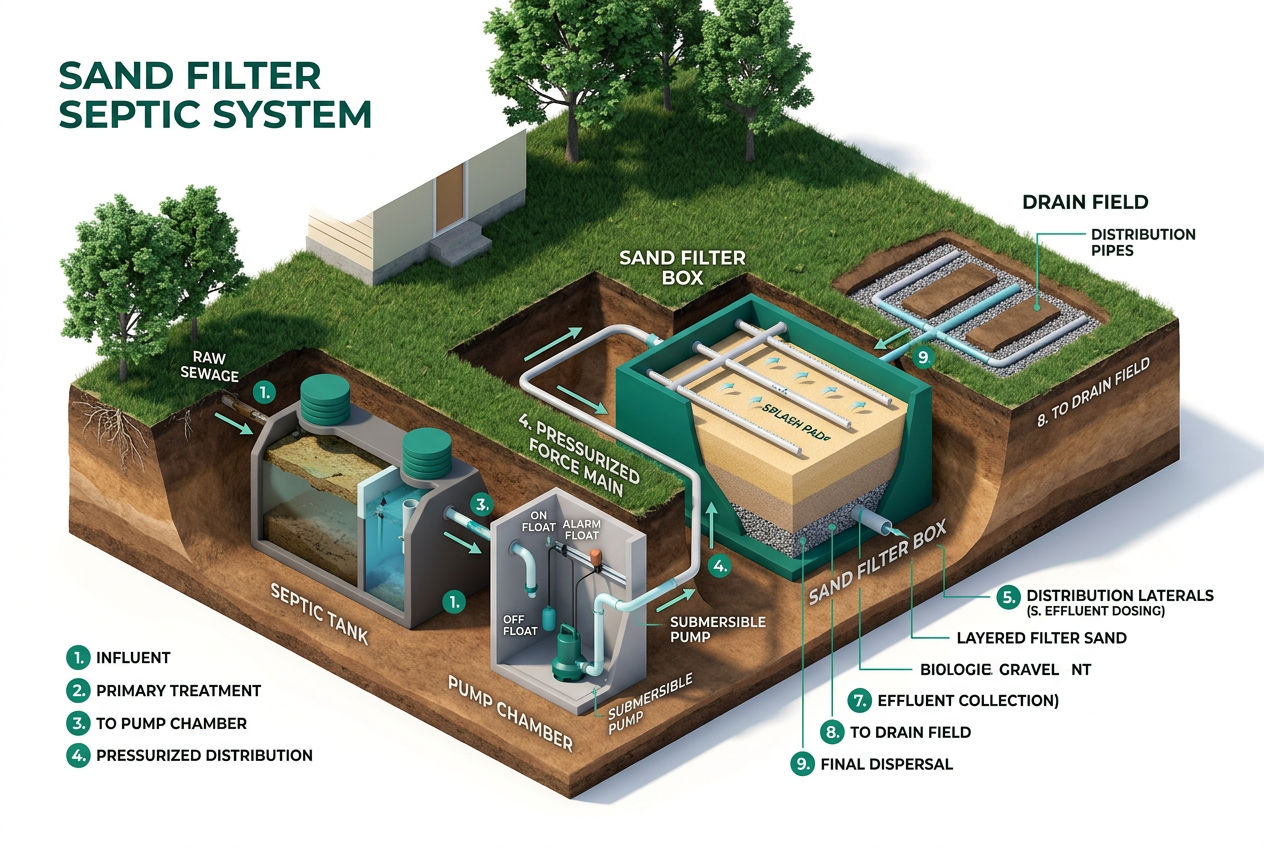
A sand filter septic system treats wastewater in stages. First, raw sewage flows into a standard septic tank — typically a 1,000- to 1,500-gallon concrete or fiberglass unit — where solids settle and anaerobic bacteria begin breaking down organic matter. This is the same first step as any conventional septic system.
What happens next is different.
The partially treated liquid (effluent) flows into a dosing chamber, also called a pump chamber. A submersible pump — often a Orenco Systems or Goulds pump rated for effluent service — doses the sand filter bed at timed intervals. This intermittent dosing prevents the sand surface from staying constantly wet, which would clog it quickly and shut down treatment.
The effluent then drips or sprays through a pressure distribution system — a network of small-diameter pipes with orifice holes — evenly across the top of the sand filter bed. From there, it percolates downward through 24–36 inches of precisely graded sand media. The sand specification matters: most state codes require ASTM C-33 sand with an effective grain size of 0.25–0.50 mm. Use the wrong sand and the system fails fast. That level of spec-sheet precision is one reason sand filters sit well beyond the scope of building your own septic system — every layer has to be exactly right.
As effluent moves through the sand, three things happen simultaneously:
- Physical filtration — suspended solids get physically strained out
- Biological treatment — a biofilm of bacteria colonizes the sand grains and consumes organic matter
- Chemical adsorption — some nitrogen and phosphorus compounds bind to sand particles
The treated effluent exits the bottom of the sand filter bed at 5–15 mg/L BOD — compared to 150–250 mg/L leaving a standard septic tank alone. That's a dramatic quality improvement. From there, the effluent moves to a final drain field or other approved dispersal area.
What's the Difference Between an Intermittent and Recirculating Sand Filter?
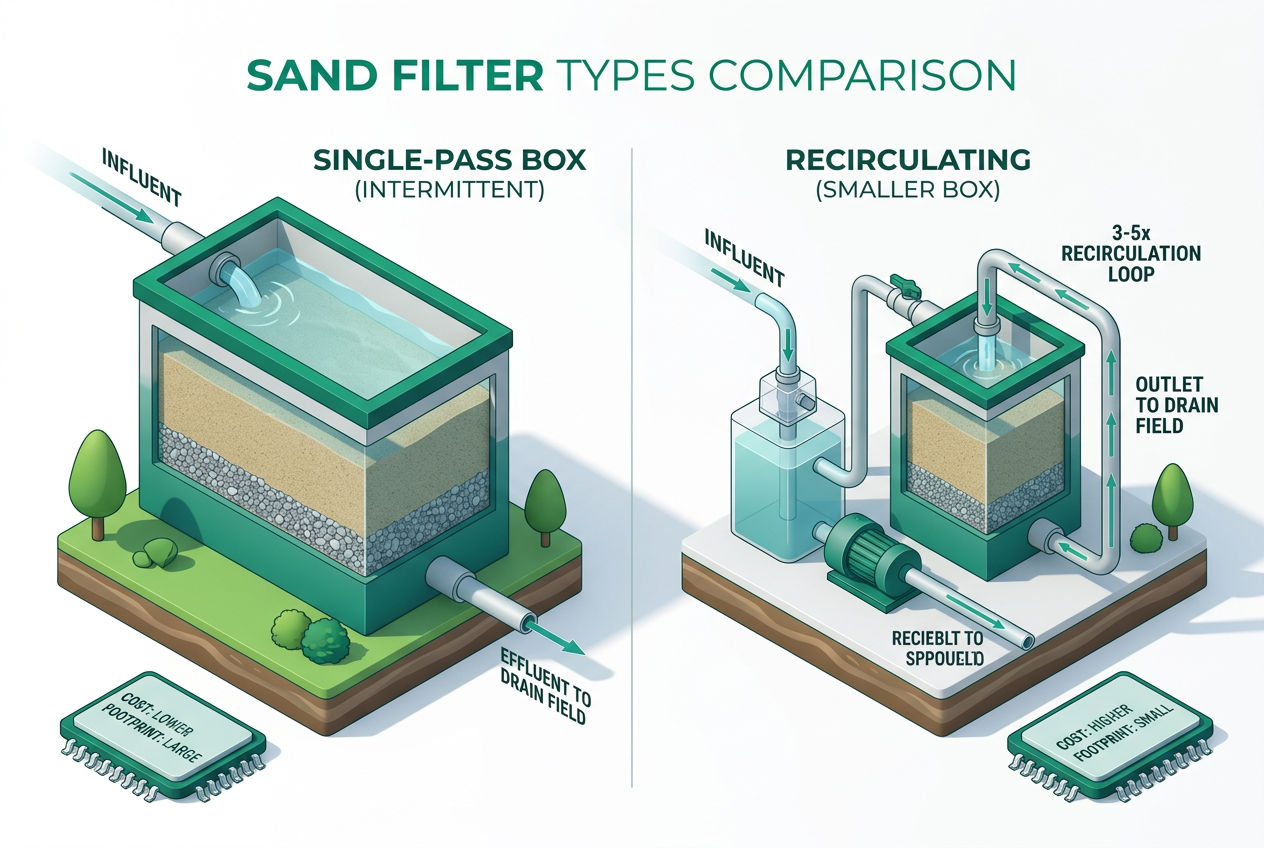
These are the two main subtypes, and they're not interchangeable. Picking the right one depends on your site conditions, local regulations, and how clean the final effluent needs to be.
Intermittent Sand Filter (ISF)
The ISF doses effluent through the sand once, then sends it directly to a dispersal field. Simple. Reliable. Lower upfront cost. Application rate typically runs 1.0–1.5 gallons per square foot per day across a 100–300 sq ft sand bed for a standard residential system.
Intermittent systems achieve 85–95% BOD reduction and roughly 25–50% nitrogen removal. For most residential sites, that's sufficient.
Recirculating Sand Filter (RSF)
A recirculating sand filter runs effluent through the sand bed multiple times before final dispersal — typically at a 3:1 to 5:1 recirculation ratio. Meaning for every gallon discharged, three to five gallons cycle back through the sand bed again.
The result? Better treatment. RSFs achieve 90–98% BOD reduction and 50–70%+ nitrogen removal. That matters if your lot drains toward a sensitive body of water — a Chesapeake Bay tributary in Maryland, a coastal estuary in Oregon, or a watershed with nutrient loading restrictions.
RSFs are more complex and cost more upfront. But if your county health department requires nitrogen reduction as a condition of your septic permit, an intermittent system won't qualify.
Think of it this way: an ISF is a Brita pitcher. An RSF is a whole-house reverse osmosis system. Both filter water — one just does it more thoroughly.
When Do You Actually Need a Sand Filter Septic System?
Three scenarios drive most sand filter installations:
1. Failed perc test. A perc test measures how fast water absorbs into your soil. Clay-heavy soils in Arkansas, Tennessee, and much of the Pacific Northwest absorb water too slowly for a conventional drainfield. A sand filter provides the advanced treatment that lets you use a smaller, more forgiving dispersal area — or sometimes a mound system — downstream.
2. High water table. If your seasonal high water table sits within 24 inches of the surface, a standard drainfield can't maintain adequate separation distance from groundwater. Sand filters elevate treatment quality so that the treated effluent poses less contamination risk even with reduced separation. This is a common situation in coastal Maine, the New Jersey Pine Barrens, and low-lying areas throughout the Southeast. See our full guide on septic systems for high water table sites for more context.
3. Environmental sensitivity. Waterfront lots, watershed protection zones, and properties near shellfish harvesting areas often face stricter effluent quality requirements than inland sites. Sand filters — especially recirculating systems — meet those standards where conventional systems can't.

DIY Septic Blueprint
Thinking about building it yourself?
The complete, plain-English plan to size, permit and install your own septic system — designed for homeowners, not contractors. Skip the $15,000–$25,000 quotes and do it right the first time.
Get the DIY Blueprint — $67 →Instant download · 8 modules + 3 bonus guides · 60-day money-back guaranteeHow Much Does a Sand Filter Septic System Cost?
Sand filter septic system cost depends on system type, site conditions, and your region. Here's what you're realistically looking at:
- Intermittent sand filter (ISF): $7,000–$18,000 installed
- Recirculating sand filter (RSF): $10,000–$25,000+ installed
To put that in context, here's how sand filters compare to other septic system types:
| System Type | Installed Cost | Annual Maintenance | Best For |
|---|---|---|---|
| Conventional gravity | $3,000–$7,000 | $100–$300 | Good soil, adequate depth |
| Mound system | $10,000–$20,000 | $400–$800 | Poor perc, shallow bedrock |
| Sand filter (ISF) | $7,000–$18,000 | $500–$1,200 | Failed perc, high water table |
| Sand filter (RSF) | $10,000–$25,000+ | $700–$1,500 | Sensitive areas, N-reduction |
| Aerobic treatment unit | $10,000–$20,000 | $500–$1,000 | Drainfield alternatives |
Source: NOWRA market data, state health department cost surveys, and contractor interviews. Costs reflect 2024–2025 residential installations.
Regional cost variation is real. An intermittent sand filter in rural Arkansas might run $8,000–$12,000. The same system in Oregon's Willamette Valley — where DEQ design standards are stricter and labor costs are higher — could easily hit $18,000–$22,000. Coastal New England installations often fall in the $15,000–$25,000 range due to frost-depth requirements and engineered designs. Wherever you are, budget for professional septic installation — permitting agencies almost never approve owner-installed sand filters.
Ongoing costs to budget for:
- Annual maintenance contract: $500–$1,500/year (includes pump inspections, float switch testing, and report filing with county health departments)
- Electricity for dosing pump: $40–$100/year
- Septic tank pumping (still required every 3–5 years): $300–$600 per pump-out — see current septic pumping costs in your area
- Sand media replacement: $1,000–$3,000 every 5–10 years depending on loading rates and management
The full septic installation cost guide covers how site prep, soil testing, and permit fees stack onto those base numbers.
Are Sand Filter Septic Systems Better Than Conventional Systems?
Depends on what "better" means for your situation.
Sand filters win on treatment quality. A sand filter produces 5–15 mg/L BOD effluent. A standard septic tank discharges 150–250 mg/L into the drainfield. That's not a slight improvement — it's a tenfold difference. Fecal coliform reduction reaches up to 99%. The EPA classifies sand filters as Best Available Technology (BAT) for on-site wastewater treatment, a designation that carries weight with permitting agencies.
Conventional systems win on simplicity and cost. No pump. No electricity. No maintenance contracts. No float switches to replace. A properly installed conventional gravity system on suitable soil will quietly treat wastewater for 25–40 years with nothing more than periodic tank pumping.
The honest answer: if your soil and site conditions support a conventional system, that's usually the right call. Sand filters exist for the situations where a conventional system can't work — not to replace one that can.
Pros of sand filter systems:
- Treats effluent to near-drinking-water clarity for suspended solids
- Enables development on sites that would otherwise be unbuildable
- Reduces nitrogen and phosphorus loading to groundwater
- Qualifies for permits in environmentally restricted areas
Cons of sand filter systems:
- Higher upfront cost than conventional systems
- Requires electricity 24/7 — power outages interrupt treatment
- Pump and float switch failures can go unnoticed without monitoring
- Some states require quarterly inspections and annual reporting to county health departments
- Not a DIY project. Engineered septic system design is required in most jurisdictions
What Does Sand Filter Septic System Maintenance Look Like?
Sand filter systems are classified as alternative septic systems, and most states require an ongoing maintenance contract with a licensed installer. This isn't optional — it's written into the operating permit.
Here's what typical maintenance covers:
Quarterly or semi-annual inspections — A technician checks pump operation, timer settings, distribution orifices for clogging, and the condition of the sand surface. They'll look for ponding on the sand bed (a sign of overloading or clogged orifices) and test the float switches in the dosing chamber.
Annual reporting — Many state and county health departments require written inspection reports. Oregon DEQ, Maryland MDE, and Arkansas health regulations all have specific reporting requirements for sand filter systems. Check your state regulations at your state health department's website or review our septic permit requirements guide.
Septic tank pumping — The primary septic tank still needs pumping every 3–5 years, same as any conventional system. Skip this and solids carry over into the sand filter bed, shortening media life dramatically.
Sand media replacement — The sand bed itself lasts 15–25 years under normal loading. But if the system has been overloaded, received non-compliant materials (grease, wipes, heavy solids), or improperly maintained, media can clog in 5–8 years. Replacement costs $1,000–$3,000 depending on bed size and access.
Cold weather considerations. In northern climates — think Vermont, Maine, Minnesota, the northern Rockies — biofilm activity slows significantly below 50°F. Sand filter beds in these regions are often buried below frost depth (42–60 inches in Minnesota, for example) or insulated with rigid foam board. Some installations include low-wattage heat tape around the distribution piping. A system that runs fine in August can underperform in January without proper winterization.
How Long Does a Sand Filter Septic System Last?
With proper maintenance, the sand media lasts 15–25 years. Pump components — including the submersible effluent pump and float switches — typically need replacement every 7–15 years. Control panels may need attention at the 10–15 year mark.
The concrete or fiberglass tank portion outlasts everything else. A quality concrete tank installed correctly can last 40+ years.
The shortest-lived component is usually the distribution orifices or laterals — small holes in the pressure distribution pipes that can clog with biofilm or mineral scale. Cleaning or replacing laterals is a straightforward service call, but it needs to happen before the clogging causes uneven distribution across the sand bed.
Bottom line: budget for pump replacement once per system lifetime, media replacement potentially once as well, and ongoing annual maintenance. Total 20-year ownership cost for a sand filter system typically runs $15,000–$35,000 including installation, maintenance, and component replacements. That's more than a conventional system — but on a lot where nothing else will work, it's the only math that matters. When you're ready for site-specific numbers, find local septic companies that design and maintain sand filter systems and compare quotes.
Do Sand Filter Septic Systems Smell?
A properly designed and maintained sand filter system should produce minimal odor. The sand bed itself is aerobic — meaning it operates with oxygen present — which drastically reduces the sulfur compounds responsible for that classic septic smell.
That said, odor issues do occur, and they usually trace back to specific causes:
- Inadequate venting — The dosing chamber and sand filter enclosure need properly sized vent pipes. Without them, gases accumulate and escape at ground level.
- Overloading — Running a sand filter system well beyond its designed daily flow rate creates anaerobic conditions on the sand surface. Smell is the early warning sign.
- Biomat buildup — A thick septic biomat developing on the sand surface can restrict airflow and produce odors. This usually signals a maintenance issue, not a design flaw.
- Pump failure — If the dosing pump fails and wastewater sits stagnant in the chamber, you'll notice. Alarm systems with audible alerts and auto-dialers catch this early.
If you're experiencing odors from an existing sand filter system, read through our septic system smell troubleshooting guide before calling a contractor.
Sources & Methodology
-
U.S. Environmental Protection Agency (EPA) — Onsite Wastewater Treatment Systems Manual, EPA/625/R-00/008. Used for BOD/TSS reduction data, BAT classification, and system design parameters. epa.gov/septic
-
National Onsite Wastewater Recycling Association (NOWRA) — Used for regional cost benchmarks, maintenance frequency standards, and system classification. nowra.org
-
Oregon Department of Environmental Quality (DEQ) — Oregon Administrative Rules for alternative treatment technology design standards and inspection requirements. Referenced for Pacific Northwest regulatory context.
-
Maryland Department of the Environment (MDE) — Chesapeake Bay nitrogen-reduction program requirements and sand filter approval data. Referenced for Mid-Atlantic regional context.
-
University of Minnesota Extension — "Onsite Sewage Treatment: Intermittent Sand Filters" technical publication. Used for cold-climate performance data and frost-depth specifications.
Find licensed sand filter septic installers in your area — get free local quotes.
Free download
Not ready for the Blueprint? Start free.
Grab the free DIY Septic Planning Kit — the permit-first checklist, perc-test cheat sheet, and sizing tables that keep your build from getting red-tagged.
Was this article helpful?
Frequently Asked Questions
Recommended Resources
📖 Related Articles
- What Is a Septic System? How It Works (Visual Guide)
- What Is a Drain Field? (And How Does It Work?)
- Perc Test (Percolation Test): What It Is & How It Works
- High Water Table and Septic Systems: What You Need to Know
- Types of Septic Systems: Complete Comparison Guide
- Mound Septic System: $10K–$25K Cost & How It Works (2026)
- Engineered Septic System Cost: $12K–$30K+ (2026)
- Alternative Septic Systems: Options When a Standard System Won't Work
- Septic System Permit Cost & State Requirements (2026 Guide)
- Septic Tank Biomat: What It Is and When It's a Problem
- Why Does My Septic System Smell? Causes & Fixes
Find Septic Professionals Near You
Compare licensed, verified septic companies by area — top county markets and cities below, or browse all 50 states.
County markets
Popular cities
