
Quick Answer
The fundamental split in septic technology comes down to oxygen. An aerobic septic system uses injected oxygen and aerobic bacteria to treat wastewater to near-drinking-water quality before dispersal. A conventional anaerobic system relies on oxygen-free bacterial digestion inside a sealed tank. The two systems handle the same job through fundamentally different biology - and that difference ripples through cost, maintenance, soil requirements, and lifespan.
📊 Key Takeaways
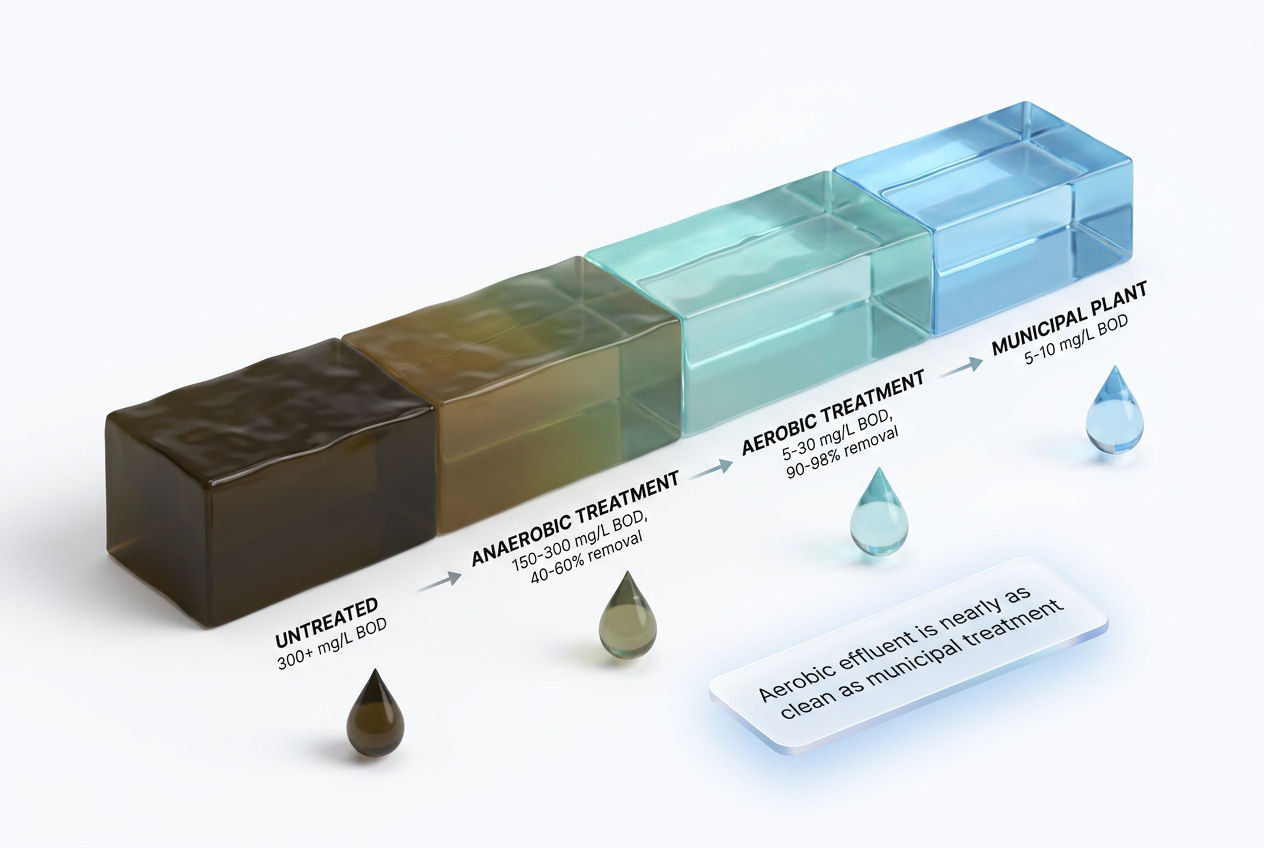
- Aerobic systems (ATUs) produce effluent with BOD levels under 20–30 mg/L - far cleaner than the 150–200 mg/L leaving a conventional tank.
- Installation costs run $10,000–$20,000 for aerobic vs. $3,000–$8,000 for conventional systems.
- Aerobic systems require quarterly inspections and maintenance contracts; conventional systems need pumping every 3–5 years.
- Aerobic systems can reduce required drain field area by 40–60%, making them viable on small or challenging lots.
- Mechanical components in aerobic systems - aerator compressors, pumps - add ongoing repair and electricity costs of $50–$120/year just for power.
What Is the Difference Between an Aerobic and Anaerobic Septic System?
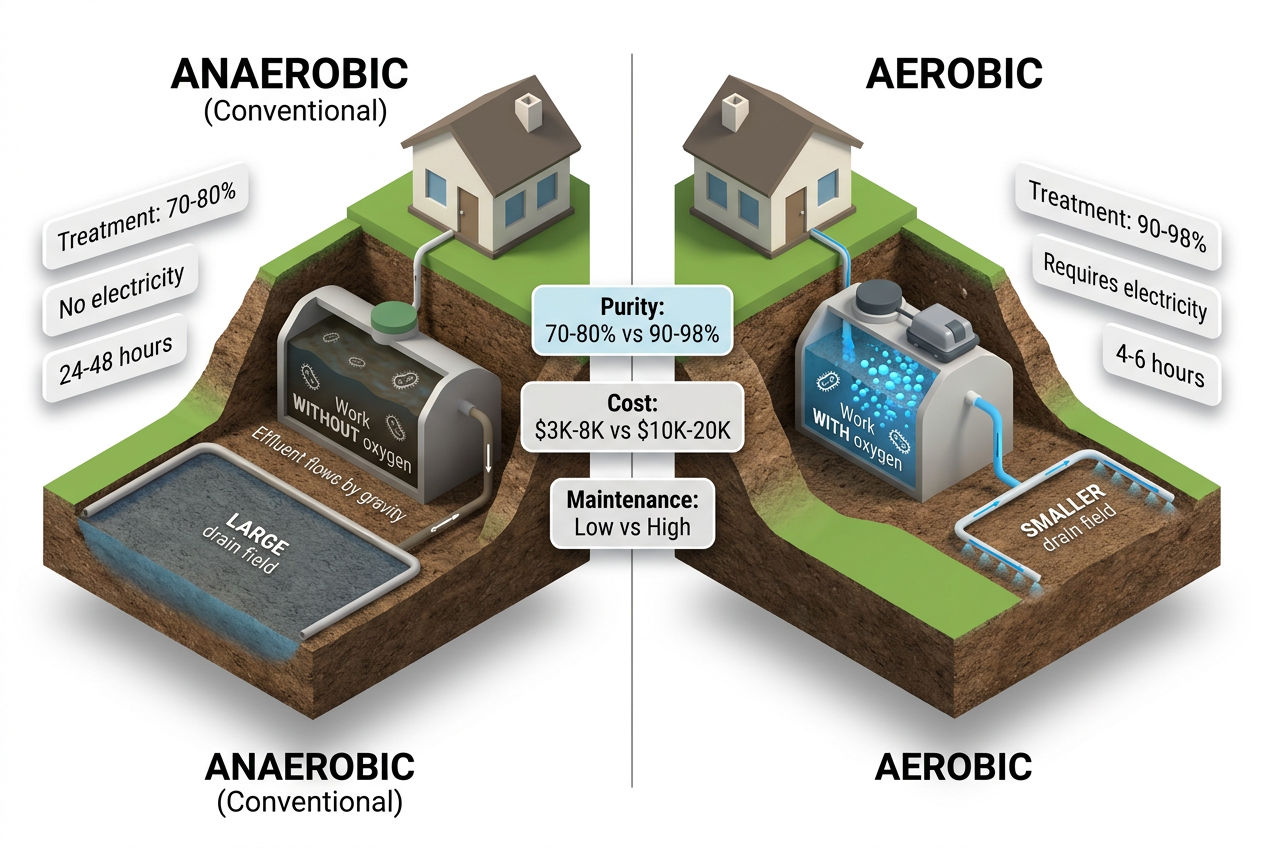
The core difference is oxygen. Anaerobic bacteria - the workhorses inside a conventional septic tank - die in the presence of oxygen. They digest solid waste slowly inside a sealed 1,000–1,500-gallon concrete or fiberglass tank, separating solids from liquid effluent. That effluent flows to a septic system drain field where soil does the final filtering.
Aerobic systems flip the biology. An aerator compressor - often a Hiblow HP-80 or similar linear diaphragm pump - continuously pushes air into a treatment chamber. Aerobic bacteria thrive in that oxygen-rich environment and break down waste far more aggressively. The result is cleaner effluent leaving the tank before it ever touches your soil.
💡 Illustrative Example: Two neighbors on identical half-acre lots. One has a 1,200-gallon conventional tank installed in the 1980s. The other has a 1,500-gallon aerobic treatment unit (ATU) installed last year. After a wet spring, the conventional system backs up - the drain field is waterlogged because the effluent still carries too much biological oxygen demand (BOD) for saturated soil to handle. The ATU keeps functioning, dispersing through spray irrigation heads across the yard, because the treated effluent is clean enough to meet surface-dispersal standards.
That pattern is what drives aerobic system adoption across the Gulf Coast, Texas, and the Ozarks - regions where soil and water table conditions make conventional systems unreliable or outright prohibited.
For a deeper look at how the conventional side of this equation works, see our guide on what is a septic system.
Key Differences at a Glance
| Feature | Aerobic (ATU) | Anaerobic (Conventional) |
|---|---|---|
| Treatment process | Oxygen + aerobic bacteria | Anaerobic bacteria, no oxygen |
| Effluent BOD | <20–30 mg/L | ~150–200 mg/L |
| Installation cost | $10,000–$20,000+ | $3,000–$8,000 |
| Drain field size | 40–60% smaller possible | Full-size required |
| Maintenance frequency | Every 3–4 months | Pump every 3–5 years |
| Annual maintenance cost | $200–$600 (contract) | $75–$150/year averaged |
| Power required | Yes (~$50–$120/year) | No |
| Lifespan | 15–25 years (components) | 20–30+ years |
| Best for | Poor soil, small lots, high water table | Suitable soil, adequate lot size |
Sources: EPA Septic Systems (epa.gov/septic), TCEQ (Texas Commission on Environmental Quality), national contractor cost surveys.
Free download
Free: the Septic Fridge Card — what to flush, what never to.
The Do / Don’t card the whole family can see, plus the Survival Kit: emergency flowchart, warning-sign decoder and pump-schedule card. One printable PDF.
How Does an Aerobic Septic System Work?
A conventional aerobic treatment unit moves wastewater through three to four chambers in sequence:
Trash Tank (Pre-Treatment)
Solids and grease settle out first - functionally similar to a conventional septic tank. A 500–750-gallon pre-treatment chamber removes the bulk material before it enters the aeration zone.
Aeration Chamber
This is where the biology happens. An aerator compressor continuously pushes fine air bubbles through the wastewater. Aerobic bacteria colonize the water, digesting dissolved organics rapidly. BOD drops from 150–200 mg/L to under 30 mg/L in this stage alone.
Clarification Chamber
Remaining solids settle out. Clean liquid effluent rises to the top.
Disinfection
Most ATUs add a chlorine disinfection step - tablet chlorinators are common - before dispersal. Some systems use UV disinfection instead. This step is what allows surface spray irrigation, which would be prohibited with conventional effluent.
Dispersal
Treated effluent goes to either a reduced-size drain field or spray irrigation heads. Spray irrigation septic dispersal lets you use lawn or landscaped areas for final treatment - something you'd never do with conventional effluent.
📊 Quick Fact: The EPA classifies aerobic treatment units as secondary treatment systems, the same classification applied to municipal wastewater plants. That's a meaningful designation - it's why ATU effluent can often be dispersed in places where conventional effluent cannot.
How Does a Conventional (Anaerobic) Septic System Work?
A conventional system is simpler by design - and that simplicity is a genuine advantage in the right conditions.
Wastewater flows from your house into a 1,000–1,500-gallon buried tank. Inside, three layers form:
- Floating scum on top
- Liquid effluent in the middle
- Settled sludge on the bottom
Anaerobic bacteria slowly break down the sludge. The liquid effluent exits through an outlet baffle - ideally protected by an effluent filter like a Polylok PL-122 - and flows into distribution lines feeding your leach field.
In the drain field, soil microbes and physical filtration handle final treatment. Soil type matters enormously here. Sandy loam works well. Clay-heavy or high-water-table soils fail quickly.
✅ Pro Tip: No electricity. No mechanical parts. No quarterly inspections. When conditions are right, a conventional system runs for 25–30 years with nothing more than a pump-out every 3–5 years at $300–$600 per service.
If you want the full breakdown on conventional system mechanics, our types of septic systems guide covers the variations in detail.
How Much Does an Aerobic Septic System Cost Compared to a Conventional System?
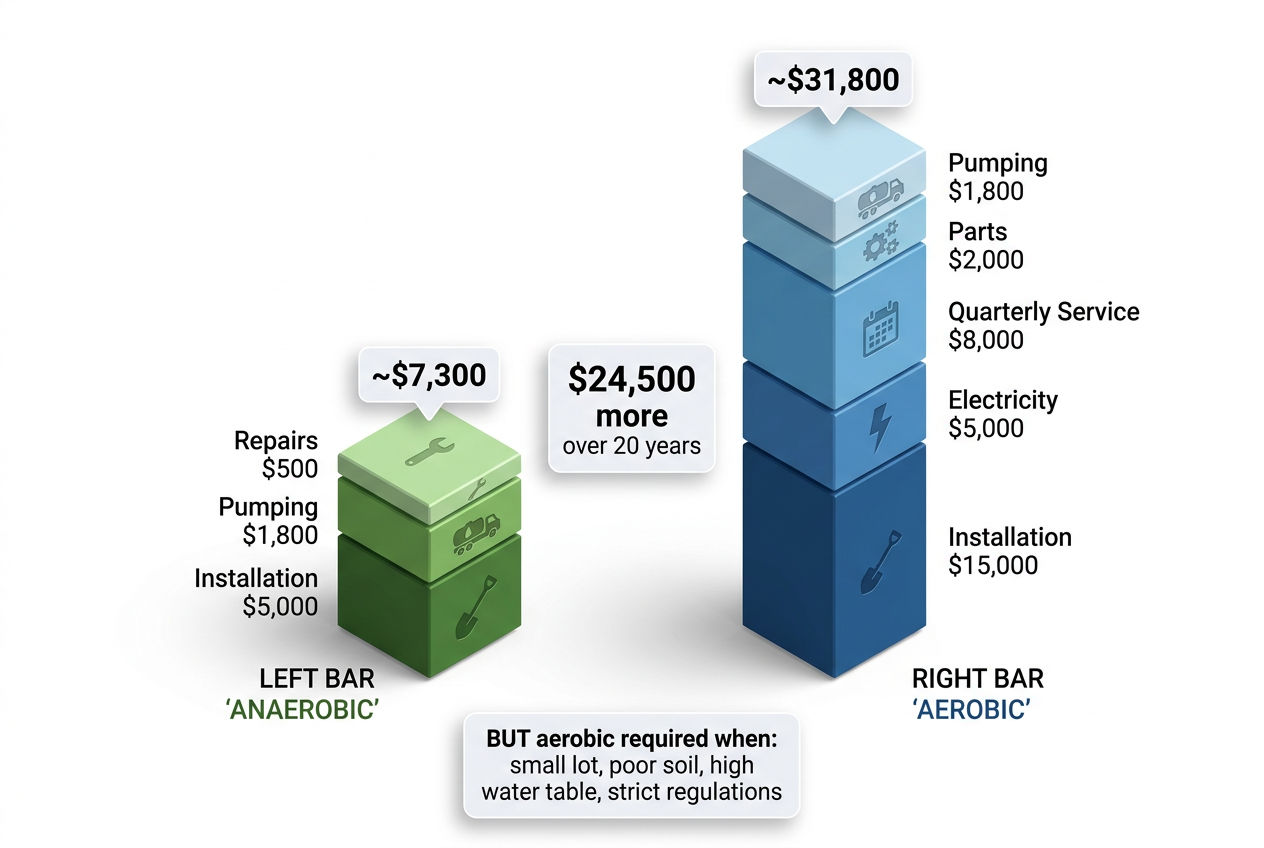
Installation costs for an aerobic system typically run $10,000–$20,000 nationally, compared to $3,000–$8,000 for a conventional system. The gap comes from added components: the multi-chamber tank, aerator compressor, pump chamber, spray heads or reduced drain field, and chlorination equipment.
💡 Real-World Scenario: A four-bedroom home in suburban Houston needs a new septic system. The lot is 0.4 acres with clay-heavy soil. A conventional system would require a 1,500-gallon tank plus a large engineered drain field - if the soil even percolates well enough to permit one. Total installed: around $9,000–$12,000, assuming the county approves it. An aerobic treatment unit on the same lot: $13,000–$17,000 installed, with a mandatory TCEQ-compliant maintenance contract running $400–$500 per year. But it gets permitted. The conventional system might not.
Ongoing Cost Breakdown
Aerobic system annual costs:
- Maintenance contracts: $200–$600/year (state-mandated quarterly inspections in Texas, Louisiana, and Florida)
- Aerator compressor electricity: $50–$120/year
- Aerator pump or compressor replacement: $500–$1,200 (every 5–10 years)
- Chlorine tablets: $50–$100/year
Conventional system annual costs:
- Averaged pump-out cost: $75–$150/year (when you amortize a $300–$600 pump-out every 3–5 years)
⚠️ Warning: Over a 20-year period, an aerobic system can cost $4,000–$8,000 more in cumulative maintenance than a conventional system - before factoring in any mechanical failures.
For detailed cost breakdowns on installation, see our septic installation cost guide.
Aerobic Septic System Pros and Cons
Aerobic System Advantages
- Superior effluent quality - TSS reduction of 85–95%, BOD under 30 mg/L
- Works on small lots where full-size drain fields won't fit
- Functions in high water table conditions and poor-percolation soils
- Smaller drain field footprint (40–60% reduction in required area)
- Can use spray irrigation dispersal for flexible placement
- Often the only permitted option in environmentally sensitive areas
Aerobic System Disadvantages
- Installation costs 2–4x higher than conventional systems
- Requires electricity - power outages stop treatment (see FAQ below)
- Mandatory maintenance contracts in many states
- More moving parts = more failure points (aerator compressors, float switches, pump chambers)
- Chlorine handling and tablet replacement adds ongoing tasks
- Cold climates can freeze spray heads and reduce bacterial efficiency in winter
Anaerobic (Conventional) System Advantages
- Lower installation and lifetime costs
- No electricity dependency
- Fewer mechanical components to fail
- Longer lifespan with minimal intervention - 20–30+ years
- Simple, proven technology dating back decades
Anaerobic System Disadvantages
- Requires adequate soil percolation - fails in clay, high water table, or rocky terrain
- Needs full-size drain fields, which require adequate lot size
- Cannot be used for surface dispersal
- Drain field replacement can run $5,000–$25,000 if it fails - see our drain field replacement cost guide
Do Aerobic Septic Systems Require More Maintenance?
Yes - significantly more. This isn't a knock on the technology; it's just the nature of mechanical systems. More components mean more scheduled service.
Most states that permit aerobic systems require a certified maintenance provider to inspect the unit every 3–4 months. In Texas, the TCEQ requires a licensed maintenance provider under a signed service contract - homeowners cannot self-maintain their ATU and stay compliant. Florida's Department of Health has similar licensing requirements for ATU maintenance contractors.
Each Quarterly Visit Typically Includes:
- Checking and adjusting the aerator compressor
- Testing effluent quality
- Inspecting float switches and pump chambers
- Replenishing chlorine tablets
- Logging results for regulatory records
A conventional system's maintenance is far simpler: pump the tank every 3–5 years, inspect the outlet baffle and effluent filter annually, and watch for wet spots over the drain field. Our septic tank maintenance guide walks through what both system types need year to year.
How Long Does an Aerobic Septic System Last?
Aerobic systems last 15–25 years with consistent maintenance. The caveat is that "the system" includes components with very different lifespans:
- The tank itself (fiberglass or concrete) may outlast the house
- The aerator compressor (often a Hiblow HP-80 or similar unit) typically needs replacement every 5–10 years at $500–$1,200 per swap
- Spray heads need periodic cleaning and occasional replacement
- Float switches and control panels can fail unexpectedly
📊 Quick Fact: Conventional systems, with no mechanical components, regularly hit 25–30 years before requiring major intervention. The drain field is usually the first component to fail - biomat clogging from years of imperfect effluent is the most common cause.
Can You Convert a Conventional Septic System to an Aerobic System?
Sometimes - but it's rarely a simple swap. In many cases, an ATU can be added inline: your existing tank becomes the pre-treatment (trash) chamber, a new aeration tank is installed downstream, and new dispersal infrastructure is added. This retrofit approach runs $6,000–$12,000 depending on what's reusable.
The Complications:
- Your local health department may require a new permit and site evaluation
- Your existing drain field may need to be relocated or replaced to accommodate ATU-quality effluent dispersal requirements
- The existing tank may not meet current standards for ATU pre-treatment
⚠️ Warning: Check with your county health department before assuming conversion is a cost-saving path - it sometimes costs nearly as much as a full new installation.
Homeowners in Texas can check TCEQ's authorized maintenance provider lists; Florida homeowners should contact their county's Environmental Health office for a pre-conversion site assessment.
Are Aerobic Septic Systems Better for the Environment?
In terms of effluent quality, yes. ATUs produce effluent that is 90–98% cleaner than raw sewage in terms of biological oxygen demand and total suspended solids. That matters enormously near waterways, wetlands, and areas with shallow groundwater. The EPA specifically recommends ATUs for sensitive environmental areas where conventional effluent could contaminate drinking water sources or degrade aquatic ecosystems.
The Environmental Trade-Off
The trade-off is electricity consumption and chlorine use:
- Running an aerator compressor 24/7 draws 50–120 watts continuously - modest, but not zero
- Chlorine tablets, while effective disinfectants, introduce residual chlorine to the soil
- Some newer ATU models use UV disinfection to eliminate the chlorine concern entirely
✅ Pro Tip: For sites near protected wetlands, coastal zones, or public water supply watersheds, an ATU isn't just better - it's often the only legal option.
Which System Is Right for You?
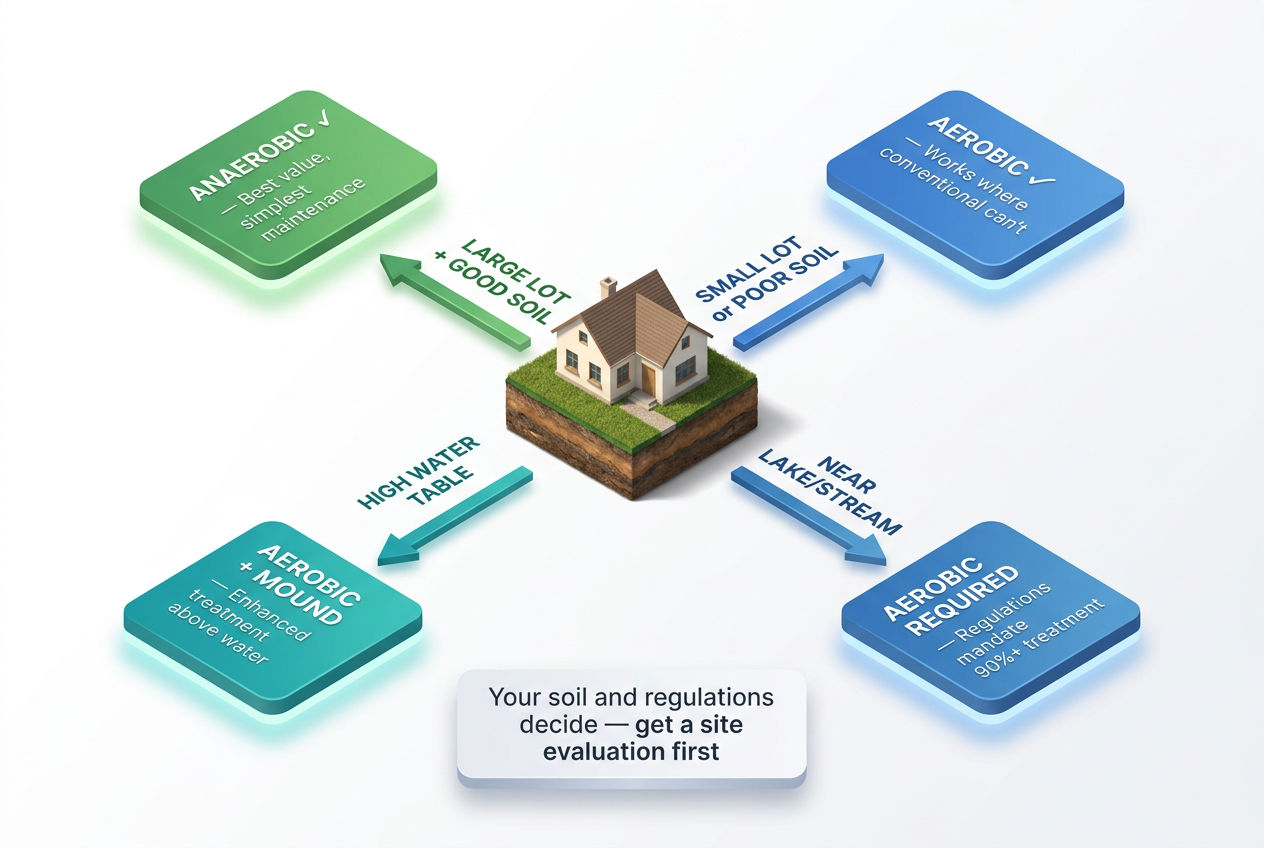
Choose an Aerobic System If:
- Your lot is under half an acre and can't accommodate a full drain field
- Soil percolation tests (perc tests) fail or return marginal results
- Your water table sits within 24 inches of the surface seasonally
- You're in a county or state that requires ATUs near waterways or wetlands
- You're building in Texas, Louisiana, coastal Florida, or the Ozarks - regions where aerobic systems are standard practice
Stick with a Conventional Anaerobic System If:
- Your soil perc test passes and your lot has room for a proper drain field
- You want lower installation and lifetime costs
- You're in the Northeast or Upper Midwest where cold winters limit aerobic system performance
- Power reliability is a concern (rural properties with frequent outages)
- You want minimal mechanical complexity over a 25–30-year lifespan
💡 Key Takeaway: Not sure which applies to your property? The answer starts with a soil evaluation and a site assessment from a licensed installer. Find septic service professionals in your area who can pull permit records and run a perc test before you commit to either system.
Regional Considerations
Texas
Texas is the largest aerobic system market in the country. The TCEQ regulates ATU installation and maintenance under Title 30 of the Texas Administrative Code, requiring licensed Authorized Agents for ongoing maintenance. Many Texas counties - particularly in the Hill Country, East Texas, and suburban Houston - mandate aerobic systems due to shallow, clay-heavy, or caliche soils. Texas homeowners should budget for mandatory quarterly service contracts as a fixed operating cost. Find septic companies in Texas familiar with TCEQ compliance.
Gulf Coast and Southeast States
Louisiana, Mississippi, Alabama, and coastal Florida deal with high water tables and flood-prone soils that make conventional drain fields impractical. ATUs with spray irrigation are the norm across much of this region.
Northeast and Upper Midwest
Homeowners rarely need aerobic systems in these regions. Cold winters suppress aerobic bacterial activity, and spray irrigation heads can freeze and crack in climates where frost penetrates 36–60 inches deep. Conventional systems dominate in New England, Wisconsin, and Minnesota - and for good reason.
Ozarks Region
Missouri, Arkansas, and Oklahoma present thin, rocky soils with poor percolation. ATUs are increasingly common here, particularly in the Table Rock Lake and Bull Shoals watersheds where Missouri and Arkansas environmental agencies restrict conventional effluent dispersal near water bodies.
What Happens to an Aerobic Septic System When the Power Goes Out?
This is one of the most practical questions aerobic system owners face - and the answer matters. When power fails, the aerator compressor stops. Aerobic bacteria begin dying within hours in an oxygen-depleted environment. The system essentially reverts to anaerobic digestion temporarily.
Short Outages (Under 24 Hours)
Most systems recover without significant issues once power returns. The bacterial population rebounds relatively quickly.
Extended Outages (Several Days)
Effluent quality degrades substantially. If the system continues dispersing through spray heads during an outage, that substandard effluent hits your yard and potentially your neighbor's property line.
⚠️ Warning: Some ATU control panels include alarms that trigger on power loss; others have float switches that halt dispersal pumping when the aerator is offline.
✅ Pro Tip: If you're in a region with frequent power outages or hurricane-season risks, ask your installer about a control panel with a dispersal lockout feature, and consider a generator hookup for the aerator circuit. The aerator compressor draws minimal power - a small 2,000-watt generator is sufficient.
Have questions? Find a septic professional near you on SepticTankHub.
Related reading: septic system installation process.
Sources & Methodology
This article draws on the following primary sources:
-
U.S. Environmental Protection Agency - Septic Systems: Effluent quality standards, ATU classification as secondary treatment systems, and general guidance on alternative septic technologies.
-
Texas Commission on Environmental Quality (TCEQ): Title 30 Texas Administrative Code regulations governing aerobic treatment unit installation, maintenance licensing, and Authorized Agent requirements.
-
Florida Department of Health: Onsite sewage program regulations for septic contractors and ATU maintenance provider licensing requirements.
-
National Onsite Wastewater Recycling Association (NOWRA): Industry cost benchmarks and performance data for aerobic treatment units.
-
National Association of Wastewater Technicians (NAWT): Maintenance standards and training protocols for onsite wastewater system technicians.
Cost figures represent national averages compiled from contractor surveys and regional market data. Actual costs vary significantly by location, soil conditions, local permit requirements, and system size. Always obtain multiple quotes from licensed local installers.
Content reviewed for technical accuracy by a licensed onsite wastewater systems professional.
Need help with your septic system? Browse local septic companies in California or Ohio.
Was this article helpful?
Frequently Asked Questions
Recommended Resources
📖 Related Articles
💰 Cost Guides
🔧 Services
Find Septic Professionals Near You
Compare licensed, verified septic companies by area — top county markets and cities below, or browse all 50 states.
County markets
Popular cities
