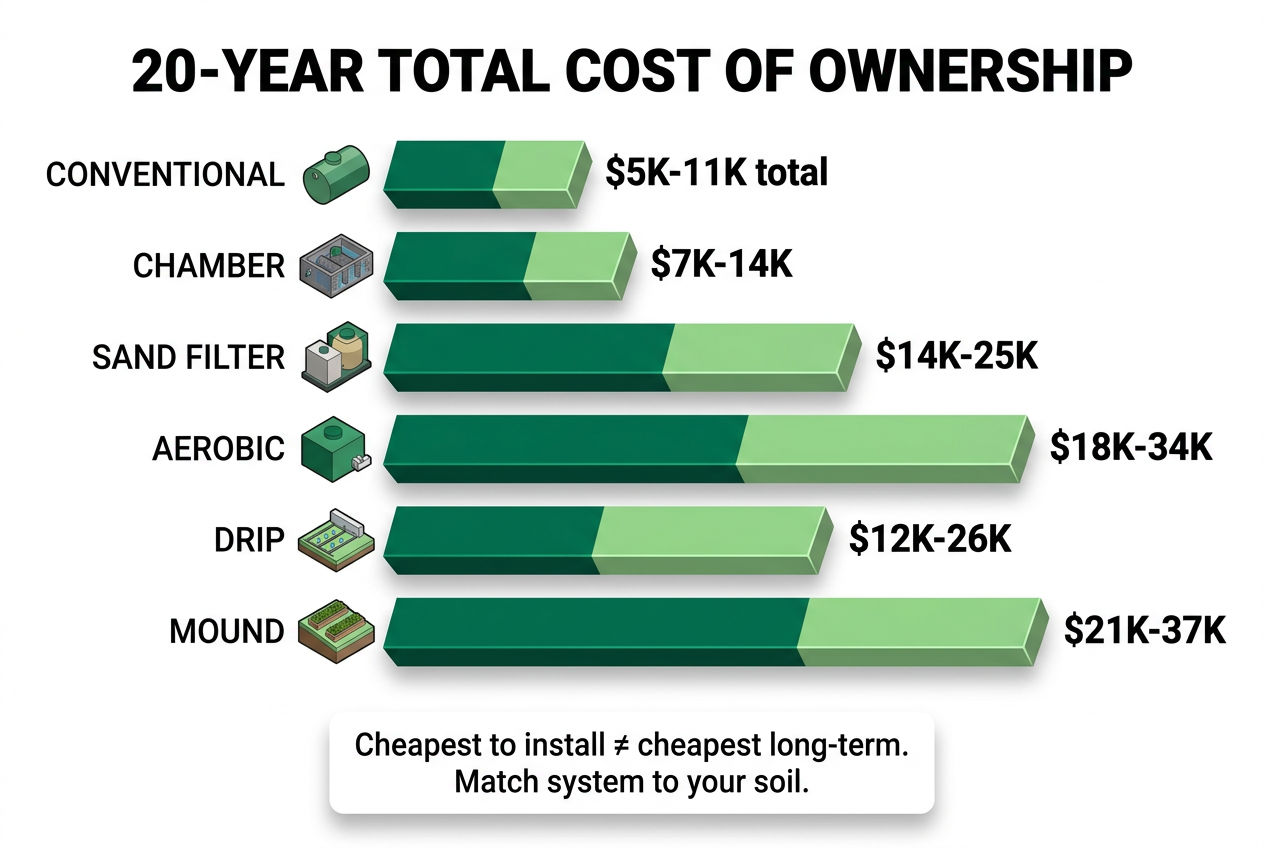
Quick Answer
There are six main types of septic systems: conventional gravity, aerobic treatment unit (ATU), mound, chamber, drip distribution, and sand filter. The right system depends on your soil type, lot size, water table depth, and local regulations. Conventional systems cost $3,000–$7,000; advanced systems range from $8,000–$20,000.
Key Takeaways
- Conventional gravity systems handle 70–80% of U.S. residential septic needs and cost $3,000–$7,000 to install.
- Alternative systems - mound, ATU, drip, and sand filter - exist specifically for problem soils, high water tables, and small lots.
- Aerobic treatment units treat wastewater more thoroughly but require inspections every 4–6 months.
- Your soil's percolation rate (how fast water drains through it) is the single biggest factor in which system your property can support.
- Identifying your existing system type starts with your county health department's permit records - most are public documents.
About 26 million homes across the United States run on private septic systems, according to the EPA. That's roughly 1 in 5 households. Yet most homeowners couldn't tell you which of the different types of septic systems they actually own. That's fine - until you need a repair quote, you're buying a property, or your drain field starts pushing back.
This guide covers every major system type, what it costs, what it demands from you in maintenance, and where it works best. If you're just starting out, the complete guide to what a septic system is will give you a solid foundation before you read further.
What Are the Different Types of Septic Systems?
The six main types of septic systems are conventional gravity, aerobic treatment unit (ATU), mound, chamber, drip distribution, and sand filter. Each one handles wastewater differently based on how it moves effluent through the soil, how much treatment happens before that effluent reaches the ground, and what happens when soil conditions won't cooperate with a standard design.
Here's a side-by-side look before we get into the details.
| System Type | Typical Install Cost | Maintenance Frequency | Best For |
|---|---|---|---|
| Conventional Gravity | $3,000–$7,000 | Pump every 3–5 yrs | Good soil, adequate lot |
| Chamber System | $5,000–$12,000 | Pump every 3–5 yrs | Variable soils, remodels |
| Mound System | $10,000–$20,000 | Pump every 3–5 yrs | High water table, clay |
| Sand Filter | $6,000–$15,000 | Service every 1–2 yrs | Poor soil, near water bodies |
| Drip Distribution | $8,000–$15,000 | Inspect every 6 mo | Small lots, sloped terrain |
| Aerobic Treatment Unit | $10,000–$20,000 | Inspect every 4–6 mo | Failing fields, strict regs |
Cost data sourced from national contractor surveys and EPA SepticSmart program guidance. Costs vary significantly by region, soil conditions, and local permitting requirements.
Free download
Free: the Septic Fridge Card — what to flush, what never to.
The Do / Don’t card the whole family can see, plus the Survival Kit: emergency flowchart, warning-sign decoder and pump-schedule card. One printable PDF.
Conventional Gravity Septic Systems: The Baseline
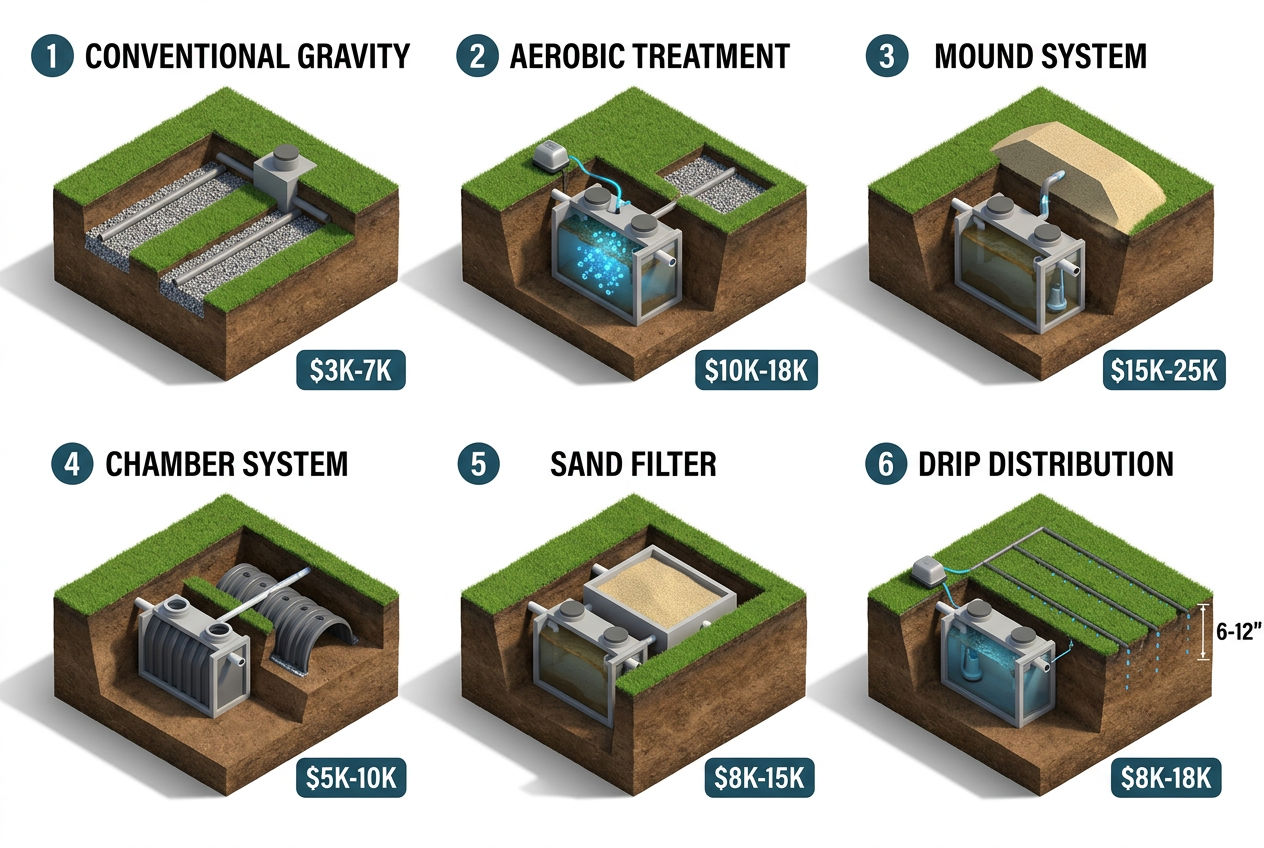
A conventional gravity system is the most common type of septic system in the U.S., handling an estimated 70–80% of all residential installations. It uses gravity - no pumps, no electricity - to move wastewater from the house, through a septic tank, and out to a drain field.
How It Works
Wastewater enters a 1,000- to 1,500-gallon concrete or fiberglass tank - see our fiberglass vs concrete comparison for help choosing. Inside the tank:
- Heavy solids sink to form a sludge layer
- Grease and lighter material float to the top as a scum layer
- The clarified liquid in the middle - called effluent - flows out through a 4-inch outlet pipe
The outlet pipe is protected by an effluent filter like a Polylok PL-122 or Zabel A1800. Effluent then moves into a distribution box, then into perforated pipes running through gravel-filled trenches in the drain field.
The drain field is where the real treatment happens. As effluent seeps into the soil, naturally occurring bacteria finish breaking it down before it reaches groundwater.
What Your Property Needs
- Soil percolation: 1–60 minutes per inch (mpi) on a standard perc test
- Water table clearance: At least 24 inches below the trench bottom
- Lot size: Enough space for 300–900 square feet of absorption field
Maintenance Costs
A 1,000-gallon tank serving a 3–4 person household needs pumping every 3–4 years. Budget $300–$500 per pump-out depending on your region. For a 30-year ownership cost comparison across the maintenance vs. neglect scenarios, our infographic shows exactly where your money goes.
⚠️ Warning: If you add a garbage disposal, that 3–4 year interval shrinks to 2 years - food waste adds significant solids load.
Honest Limitation
Conventional systems don't work everywhere:
- Clay soil with perc rates above 60 mpi won't absorb effluent fast enough
- High water tables in coastal areas create contamination risks
- Limited lot space prevents adequate drain field sizing
That's where alternative systems earn their place.
Chamber Septic Systems: The Flexible Alternative
Chamber systems replace the gravel-filled trenches of a conventional system with a series of open-bottomed plastic arch chambers - most commonly made by Infiltrator Water Technologies, whose Quick4 series is the dominant product in this category. Effluent flows into the chambers and seeps directly into the surrounding soil through the open bottom and perforated sidewalls.
Cost & Lifespan
- Installation: $5,000–$12,000
- Expected life: 30–40 years with proper care
- Pumping schedule: Every 3–5 years (mirrors conventional systems)
Key Advantages
- Material savings: Works in areas where gravel is scarce or expensive
- Design flexibility: Can be sized more easily for unusual lot shapes
- Easier retrofits: Lightweight plastic components are easier to move around tight properties
✅ Pro Tip: Soil requirements are nearly identical to conventional systems. If a perc test would pass your lot for a gravel-and-pipe system, it would likely pass for chambers.
Mound Septic Systems: When the Water Table Is Too High
A mound system is an alternative septic design built above ground specifically for properties with high water tables, shallow bedrock, or slowly permeable soils. Instead of burying the drain field in native soil, a mound system creates an engineered soil bed - typically 2–4 feet of imported sand - raised above grade. A pump chamber pushes effluent up into the mound in timed doses.
Regional Applications
If you're in Florida, Louisiana, or anywhere along the Gulf Coast, you've probably seen these. The state of Florida has pushed mound and at-grade systems heavily in coastal counties because the water table in some areas sits just 18–24 inches below the surface.
Minnesota uses what installers call a "Wisconsin mound" design, adapted for cold climates where the frost line reaches 42–60 inches deep.
Costs & Requirements
- Installation: $10,000–$20,000
- Pump chamber: Required with reliable float switch
- Effluent pump: Often a Goulds WE Series or comparable submersible
- Annual inspection: Pump and float switch check
⚠️ Warning: The mound itself needs to stay clear of vehicle traffic and deep-rooted plants - both damage the engineered fill.
For a deeper look at how these systems work and what they demand, the mound septic systems guide covers it thoroughly.
Aerobic Treatment Units: High Performance, Higher Maintenance
An aerobic treatment unit (ATU) is a septic system that injects oxygen into the treatment process, dramatically accelerating the breakdown of wastewater. Standard septic tanks are anaerobic - bacteria work without oxygen, which is slower and less complete. ATUs use an aerator compressor (commonly a Hiblow HP-80 or Thomas 5070) to push air into the treatment chamber, feeding aerobic bacteria that can reduce biological oxygen demand (BOD) by 85–95% versus 40–50% for conventional anaerobic tanks.
Why Enhanced Treatment Matters
Highly treated effluent is safer to discharge into:
- Marginal soils
- Areas near water bodies
- Small lots with limited drain field space
In Texas, where many counties require ATUs in areas near the Edwards Aquifer and other sensitive water sources, aerobic systems have become standard. The Texas Commission on Environmental Quality (TCEQ) mandates annual maintenance contracts for all ATUs in the state.
Cost Reality
Installation: $10,000–$20,000
That's real money, but in areas where a conventional system simply isn't permitted, it's the only option.
Maintenance Requirements
This is where ATUs bite back. You'll need:
- Licensed inspector check every 4–6 months
- Aerator compressor replacement every 3–5 years ($200–$600 for the unit)
- Monthly disinfection checks (usually chlorine tablets in a contact chamber)
📊 Quick Fact: The aerator compressor runs continuously, 24/7, adding $10–$20 to your monthly electric bill.
Honest Limitation
An ATU cannot rescue a drain field that's already biologically clogged. If the soil around your leach field has developed a biomat - that greasy, impermeable layer that forms when effluent has been overloading the soil for years - switching to an ATU won't fix it. You'll need drain field replacement, which runs $3,000–$15,000 depending on size.
To understand the full difference between aerobic and anaerobic approaches, the aerobic vs. anaerobic septic guide goes deeper on treatment chemistry.
Sand Filter Septic Systems: Precision Treatment for Problem Sites
Sand filter systems pass effluent through a contained bed of washed sand before it reaches the drain field. Think of it as adding a second treatment stage between the septic tank and the soil. A pump distributes effluent evenly across the top of the sand bed. Bacteria in the sand treat the effluent as it percolates down. The filtered, cleaner effluent then moves to a traditional drain field or a pressure distribution system.
Two Main Designs
| Design Type | Configuration | Treatment Level | Best Use |
|---|---|---|---|
| Open Filter | Uncovered sand bed | Secondary treatment | Warm climates |
| Recirculating Sand Filter (RSF) | Effluent passes through multiple times | Near-tertiary treatment | Near sensitive waterways, nitrogen reduction |
RSFs achieve treatment levels approaching tertiary treatment - useful near sensitive waterways or in states like California and Oregon with strict nitrogen reduction requirements.
Installation & Maintenance
- Cost: $6,000–$15,000
- Sand bed cleaning: Every 3–7 years
- Distribution pump: Annual inspection required
💡 Key Takeaway: Washington State's Department of Health lists sand filter systems as an approved alternative technology specifically for lots within 200 feet of Puget Sound shorelines.
Drip Distribution Systems: The Small-Lot Solution
Drip distribution systems deliver pre-treated effluent through a network of small-diameter tubing buried just 6–12 inches below the surface - much shallower than conventional trenches. A pump pushes timed doses of effluent through the drip tubing, which features emitter holes spaced every 1–3 feet.
Why Shallow Placement Works
The shallow placement is deliberate. The top layer of soil has the highest biological activity, so distributing effluent there maximizes treatment. It also lets drip systems work on:
- Steep slopes where conventional trenches won't hold
- Small lots where a 300–900 square foot trench network won't fit
- Irregularly shaped properties
Pretreatment Requirement
Because effluent at 6–12 inches depth needs to be cleaner going in, drip systems are almost always paired with a pretreatment unit:
- Conventional tank with an advanced effluent filter, OR
- An ATU
That requirement drives the installed cost to $8,000–$15,000.
Maintenance Reality
Drip emitters clog if not properly maintained. Most manufacturers (Orenco Systems is the market leader in residential drip distribution) recommend:
- Filter flush every 6 months
- Emitter inspection every 6 months
- Winterization in cold climates (system needs to drain or be insulated before sustained below-freezing temperatures)
How Do I Know What Type of Septic System I Have?
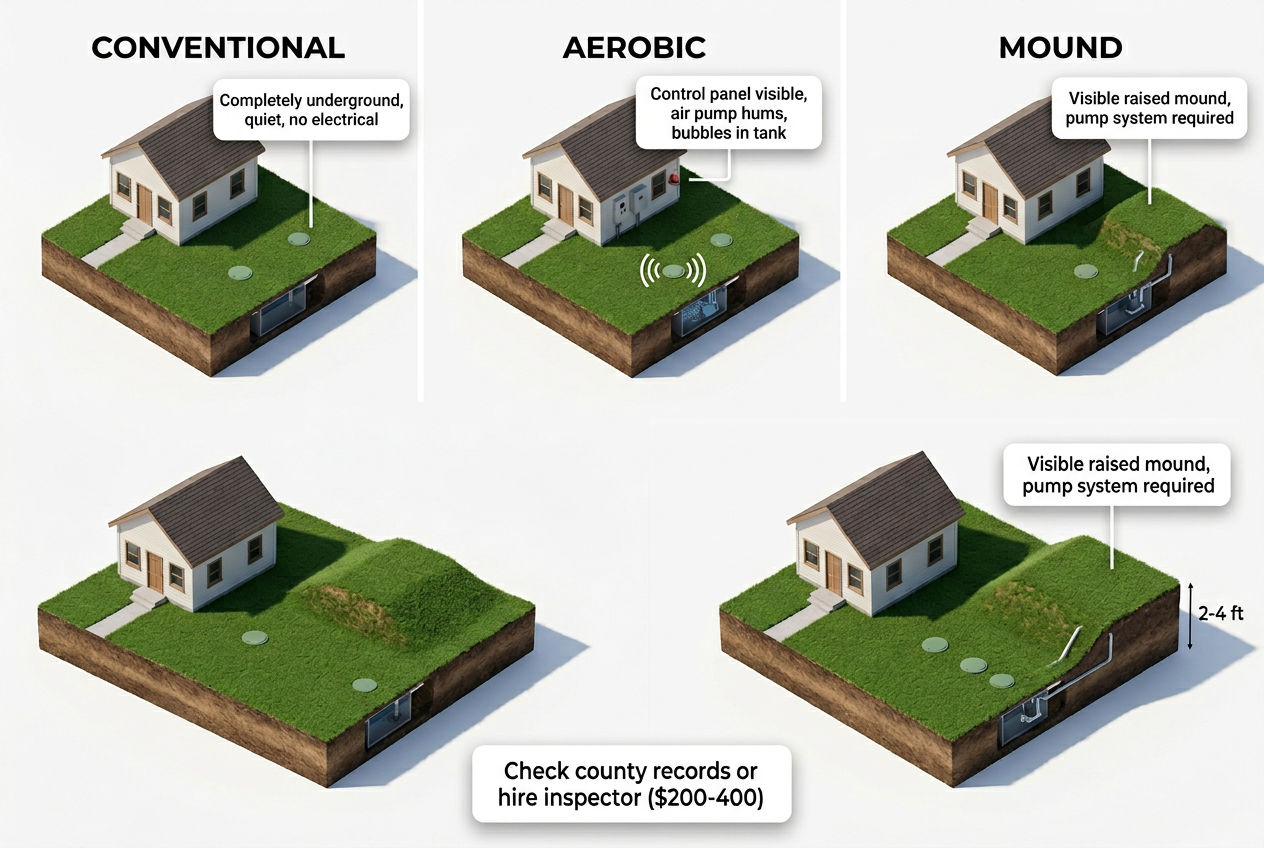
Start with your county health department's permit records. Every septic system installed after roughly 1980 required a permit, and those records are almost always public documents. Call or visit your county's environmental health office with your property address. In most states, they'll tell you:
- System type
- Tank size
- Drain field dimensions
- Installation date
Physical Clues When Records Are Missing
If permit records are missing - common with older rural properties - here's how to read the physical clues:
| What You See | What It Means |
|---|---|
| One tank lid, no additional components visible | Likely conventional gravity or chamber system |
| Multiple lids or a separate pump chamber | Indicates pressure distribution, mound, or ATU system |
| Raised earthen mound in the yard | Obviously a mound system |
| Small white PVC pipe or electrical conduit near the tank | Suggests a pump or aerator - points to ATU or pressure distribution |
| Air compressor or blower unit (often in a small housing near the tank) | That's an ATU. The Hiblow HP-80 and Jet Inc. units are recognizable once you know what you're looking for |
✅ Pro Tip: Your home inspection report may also name the system type. Pre-purchase inspections by NAWT-certified inspectors (National Association of Wastewater Technicians) typically include system type identification as part of the report.
You can use SepticTankHub's inspection service finder to locate a certified inspector near you.
Which Type of Septic System Is Right for Your Property?
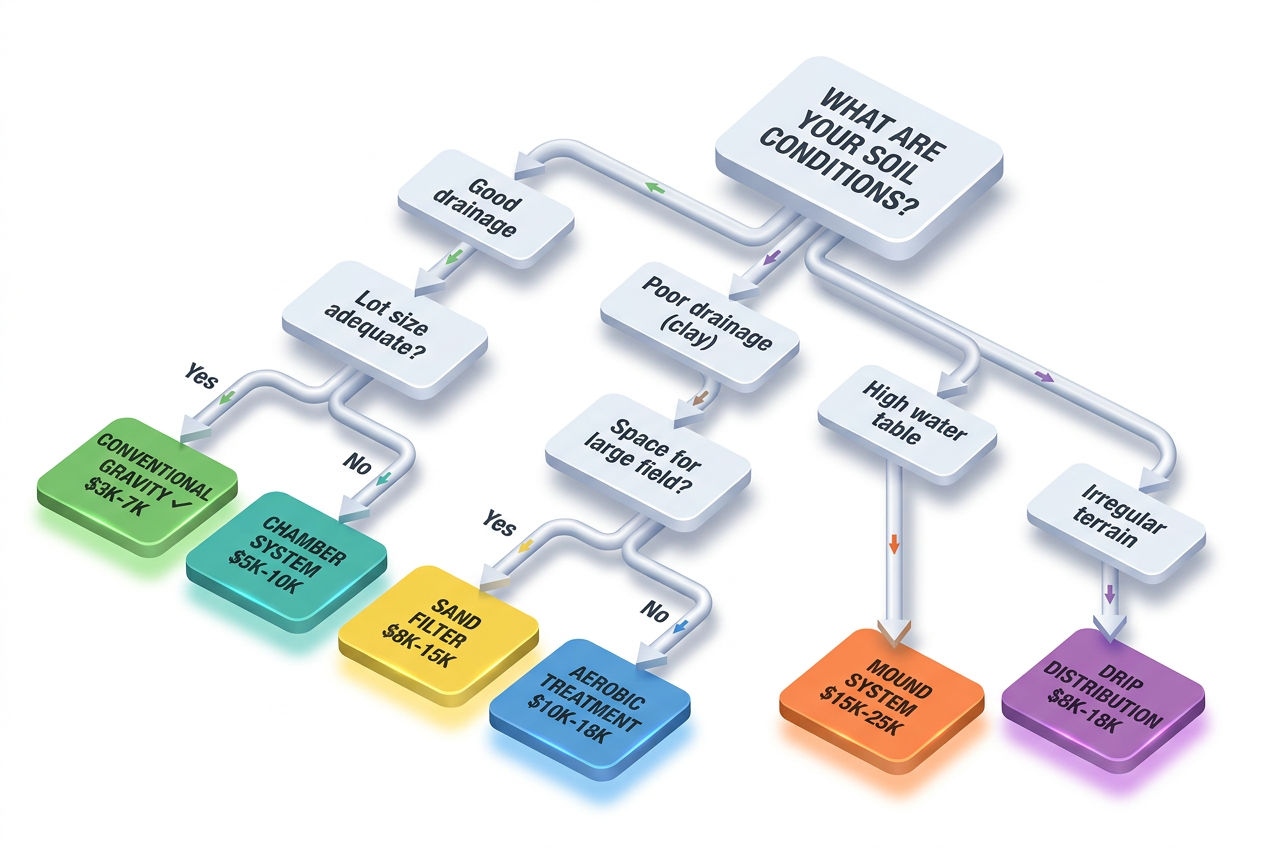
The honest answer: your soil and site conditions make most of this decision for you. A licensed designer will run a percolation test and soil profile evaluation, then match a system to what your land can actually handle.
That said, here's a practical decision framework:
Conventional Gravity System
Use when:
- Your perc test shows 1–60 mpi
- Your water table sits more than 24 inches below planned trench depth
- You have enough lot space
💡 Key Takeaway: It's the least expensive and lowest-maintenance option available.
Chamber System
Choose when:
- Your lot has irregular geometry
- Gravel is expensive in your area
- You're doing a repair/expansion where lightweight installation matters
Mound System
Go with when:
- Your water table is within 24 inches of the surface
- Your soil perc rate exceeds 60 mpi
- You're in a coastal area where the health department requires elevated drain fields
Aerobic Treatment Unit (ATU)
Install when:
- Local regulations require enhanced treatment (Texas, parts of California)
- You're near a water body
- Your lot is small enough that higher-quality effluent is the only way to protect the groundwater
Sand Filter or Drip System
Consider when:
- You need a second treatment stage before the drain field
- You're on a sloped or oddly shaped lot
- Environmental regulations require tertiary-level treatment
📊 Quick Fact: For properties where none of these standard options fit - extreme slopes, extreme soil conditions, very small lots - engineered septic systems offer custom-designed solutions, though costs climb accordingly.
Septic System Costs: What to Expect
Installation cost is often the deciding factor for homeowners who technically qualify for more than one system type. Here's how costs shake out in practice.
Regional Cost Examples
Midwest conventional system: A 1,500-gallon concrete tank with a conventional gravity drain field on a standard quarter-acre lot typically runs $4,000–$6,500 all-in, including permits.
Coastal conventional system: The same project in coastal New Jersey or suburban California can hit $8,000–$12,000 because of permitting complexity and labor costs.
Texas ATU: An aerobic treatment unit in Central Texas - where TCEQ regulations require them in many suburban counties - runs $12,000–$18,000 installed, plus an annual maintenance contract of $200–$400 with the service company.
Minnesota mound: A mound system in Minnesota with imported sand and a Wisconsin-style design runs $12,000–$20,000. The sand import alone often costs $2,000–$4,000 depending on haul distance.
💡 Key Takeaway: The full breakdown of what drives septic installation costs shows the permit fees, soil report costs, and contractor labor rates that don't show up in the headline numbers.
Ongoing Maintenance Costs
Conventional and chamber systems:
- Pumping every 3–5 years at $300–$500 per service
- Septic pumping costs vary by tank size and region
ATUs:
- Quarterly or semi-annual inspection costs on top of regular pumping
- Annual maintenance contracts typically $200–$400
<Image src="https://ik.imagekit.io/34qr7twyt/blog-infographics/septic-system-20-year-total-cost-comparison.png" alt="3D bar chart comparing 20-year total cost of ownership across six septic system types including installation and maintenance"
Related: tiny home septic options — worth reading if this applies to your situation. width={1200} height={800} loading="lazy" className="rounded-lg shadow-md my-6 w-full" />
How Long Do Different Types of Septic Systems Last?
The tank and the drain field age independently - and the drain field usually gives out first. For a detailed tank material comparison, our guide breaks down durability, cost, and installation differences.
Tank Lifespan by Material
| Material | Expected Life | Notes |
|---|---|---|
| Concrete | 40+ years | Can crack in acidic soils or freeze-thaw climates |
| Fiberglass | 30–40 years | Resistant to corrosion |
| Polyethylene (plastic) | 30–40 years | Lightweight, corrosion-proof |
| Steel | 15–20 years | Red flag on any inspection report |
Drain Field Lifespan
Conventional systems: 15–25 years on average with good maintenance
Aerobic systems and sand filters: Often extend drain field life because they deliver cleaner effluent to the field
✅ Pro Tip: The septic maintenance guide covers specific practices - water conservation, what not to flush, additive realities - that can push a drain field toward 25 years instead of 15.
Learn more about our septic installation services.
Related reading: septic system installation process.
Related: systems without a conventional drain field
Sources & Methodology
- U.S. Environmental Protection Agency - Septic Systems Overview: Primary source for national usage statistics, treatment efficiency benchmarks, and SepticSmart program guidance on pumping intervals.
- Texas Commission on Environmental Quality (TCEQ): State regulations on ATU requirements and licensed maintenance provider mandates.
- Washington State Department of Health - On-Site Sewage Systems Program: Sand filter approval specifications and shoreline proximity requirements.
- National Association of Wastewater Technicians (NAWT): Inspector certification standards and inspection protocol guidelines.
- Infiltrator Water Technologies and Orenco Systems: Product specification documentation for chamber systems and drip distribution emitter spacing.
Cost ranges reflect aggregated contractor pricing data from national septic service providers surveyed 2024–2025. Regional variation is significant; always obtain at least three local quotes.
Find a licensed septic professional in your area through SepticTankHub's directory - all listed contractors are verified and reviewed by homeowners.
Was this article helpful?
Frequently Asked Questions
Recommended Resources
📖 Related Articles
- What Is a Septic System? How It Works (Visual Guide)
- What Is a Drain Field? (And How Does It Work?)
- Mound Septic System: $10K–$25K Cost & How It Works (2026)
- Aerobic vs Anaerobic Septic Systems: How They Compare
- Engineered Septic System Cost: $12K–$30K+ (2026)
- The Complete Septic Tank Maintenance Guide
- Concrete vs Plastic Septic Tanks: Which Is Better?
- Fiberglass vs Concrete vs Poly Septic Tanks Compared
💰 Cost Guides
🔧 Services
Find Septic Professionals Near You
Compare licensed, verified septic companies by area — top county markets and cities below, or browse all 50 states.
County markets
Popular cities