
Quick Answer
A fiberglass septic tank weighs roughly 300 pounds. A concrete tank holding the same 1,000 gallons weighs up to 10,000 pounds. That single fact drives dozens of downstream decisions — from how much you'll spend on installation to whether your tank floats out of the ground during a wet spring.
Choosing the wrong material doesn't just cost money. It can mean a failed inspection, a flooded yard, or a premature replacement you weren't budgeting for. This guide breaks down all three materials side-by-side so you can make the right call for your specific property.
💡 Key Takeaways
- Concrete tanks dominate the U.S. market (~70–80% of installs) due to durability and wide availability, but hydrogen sulfide corrosion can compromise integrity in as few as 15–20 years without protective coatings.
- Fiberglass tanks weigh 200–400 lbs versus 8,000–10,000 lbs for concrete — reducing installation labor costs by 20–40%.
- Polyethylene tanks are the most affordable upfront ($800–$1,500 for 1,000 gallons) but have the shortest expected lifespan at 20–30 years.
- In high water table areas — where the water table sits within 24 inches of the tank bottom — fiberglass and poly tanks require anchoring systems to prevent flotation.
- Always verify material approval with your local health department before purchasing. Some counties in New York and parts of New England do not permit polyethylene tanks.
Key Differences at a Glance
Before getting into the details, here's how all three materials stack up across the metrics that matter most to homeowners.
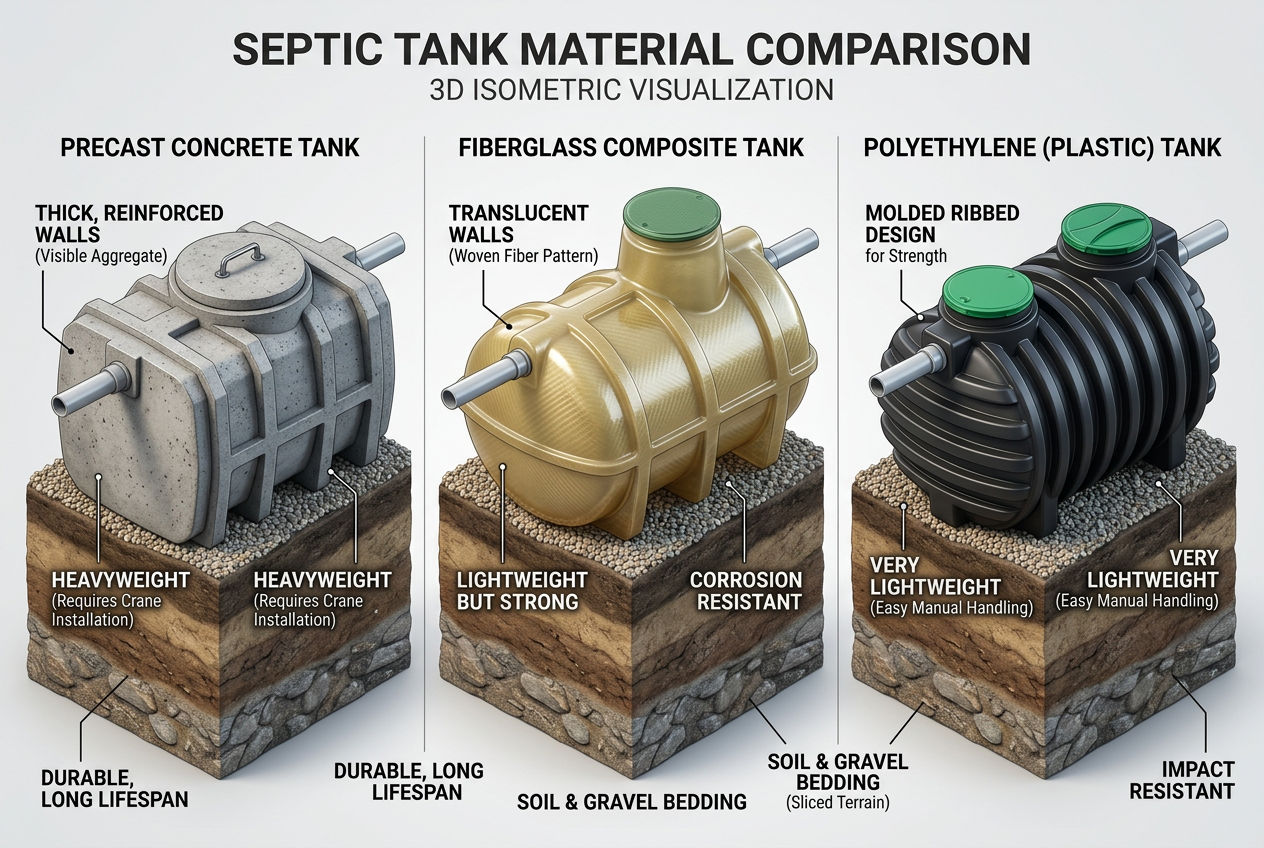
| Metric | Fiberglass | Concrete | Polyethylene |
|---|---|---|---|
| Tank cost (1,000 gal) | $1,200–$2,500 | $700–$2,000 | $800–$1,500 |
| Tank cost (1,500 gal) | $1,800–$3,500 | $1,100–$2,500 | $1,100–$1,800 |
| Weight (1,000 gal) | 200–400 lbs | 8,000–10,000 lbs | 150–300 lbs |
| Lifespan | 30–50+ years | 40–100+ years | 20–30 years |
| Corrosion resistance | Excellent | Poor–Moderate | Good |
| Buoyancy risk | High | Low | High |
| Max residential size | ~1,500 gal | 3,000+ gal | ~1,500 gal |
| Installation crew | 2 people | Crane + crew | 2 people |
| Soil load resistance | Moderate | Excellent | Low–Moderate |
Sources: EPA Septic Systems Program; National Onsite Wastewater Recycling Association (NOWRA); manufacturer specifications from Infiltrator Water Technologies.
Free download
Planning your own septic system?
Grab the free DIY Septic Planning Kit — the permit-first checklist, perc-test cheat sheet, and sizing tables that keep your build from getting red-tagged.
Is a Fiberglass Septic Tank Better Than Concrete?
Neither material is universally better. Fiberglass outperforms concrete in corrosion resistance, installation ease, and freeze-thaw environments — making it the stronger choice for coastal properties, rocky terrain, and remote lots without crane access.
Concrete wins on raw structural durability, load-bearing capacity, and resistance to flotation, which is why it remains the default choice in most of the country.
📊 Quick Fact: Your soil conditions, water table depth, lot access, and local building codes determine which material actually performs best for your installation. A tank that's perfect for a coastal Florida lot may be a liability on a saturated Pacific Northwest hillside without proper anchoring.
Fiberglass Septic Tanks: What You Need to Know
How They're Made
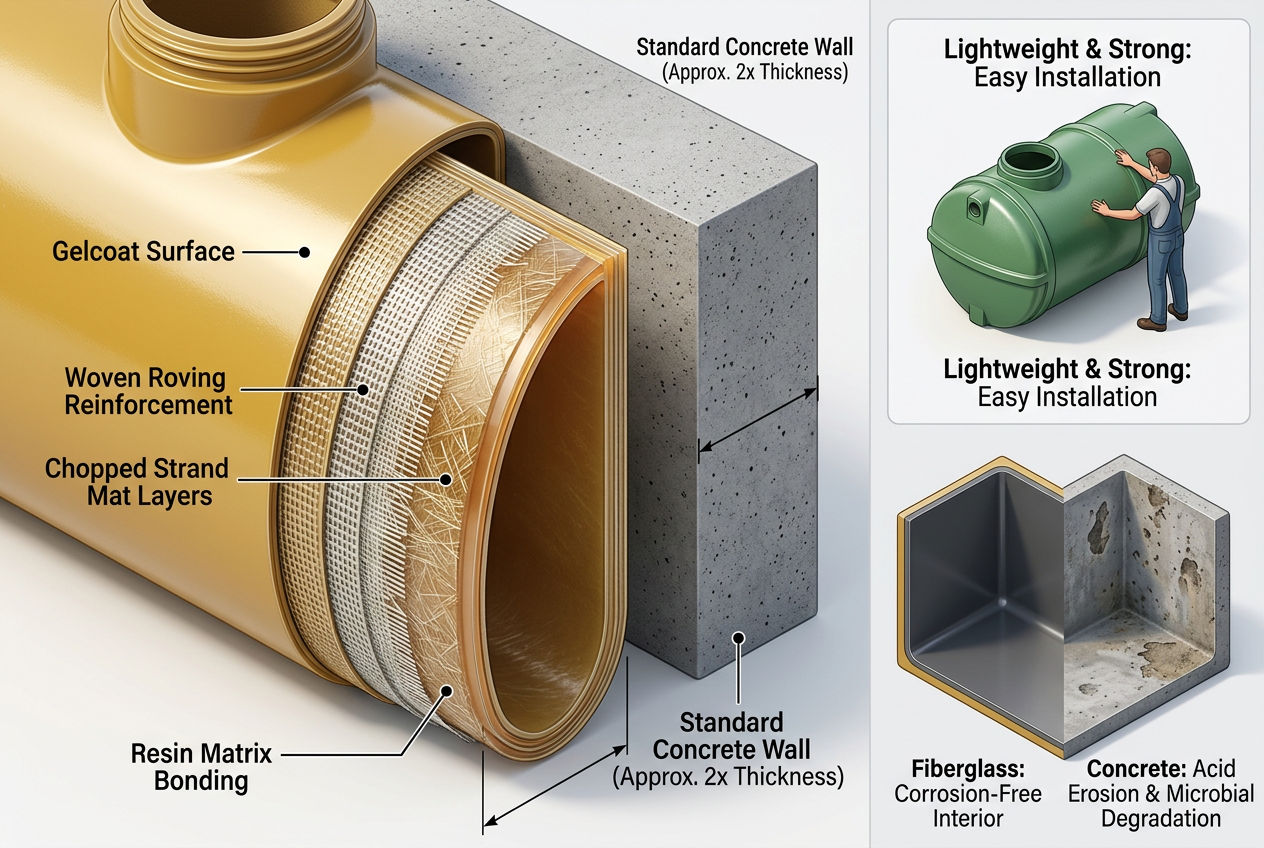
Fiberglass-reinforced plastic (FRP) tanks are manufactured by spraying or hand-laying fiberglass mat over a mold, then binding it with polyester or vinyl ester resin. The result is a one-piece, seamless vessel with no joints to leak.
Most residential fiberglass tanks range from 500 to 1,500 gallons. You won't find many fiberglass options above 1,500 gallons — manufacturing large molds becomes cost-prohibitive.
Fiberglass Septic Tank Pros and Cons
Advantages
Corrosion-proof construction: Hydrogen sulfide (H₂S) gas — a natural byproduct of anaerobic bacterial activity inside every septic tank — eats concrete from the inside out. Fiberglass is chemically inert. H₂S doesn't touch it. This is especially important in coastal areas, where brackish groundwater accelerates concrete degradation.
Lightweight installation: At 200–400 lbs, a 1,000-gallon fiberglass tank can be set by two workers with a small track excavator. No crane required. This saves 20–40% on installation labor compared to concrete, which often requires a crane rental costing $500–$1,500 on top of labor.
Watertight by design: One-piece seamless construction eliminates the joint between tank sections — the most common leak point on two-piece precast concrete tanks.
Freeze-thaw resistant: Fiberglass flexes slightly under freeze-thaw pressure without cracking. In New England and the Upper Midwest, this matters. Frost lines reach 48–72 inches in Minnesota, and freeze-thaw cycling is a documented cause of concrete septic tank cracking.
Disadvantages
⚠️ Warning: Flotation Risk Fiberglass tanks are so light that they can literally float out of the ground when the water table rises. If your water table sits within 24 inches of the tank bottom — common in coastal Florida, Louisiana, the Pacific Northwest, and after heavy rain events — an empty or recently pumped fiberglass tank can shift or rise. The fix is anchor straps or a concrete deadman anchor pad, which adds $300–$800 to installation cost. Do not skip this step.
Susceptible to surface pressure: Drive heavy equipment over a buried fiberglass tank and you risk cracking the shell. Concrete shrugs off soil compaction pressure that would damage fiberglass.
Limited sizing: If your household requires a 2,000-gallon or 3,000-gallon tank — common for larger homes, commercial properties, or some mound systems — fiberglass typically isn't available in those sizes.
Repair challenges: A cracked fiberglass tank can be patched with FRP repair kits, but finding a contractor experienced with the repair is harder than finding someone who can reline a concrete tank.
Fiberglass Septic Tank Lifespan
A well-installed fiberglass tank in stable soil lasts 30–50+ years. Because the material doesn't corrode from H₂S exposure, its lifespan is more predictable than concrete.
The main failure modes are:
- Physical damage (heavy equipment, improper backfill)
- UV degradation if the tank is left above-ground for extended periods before installation
Fiberglass Septic Tank Cost
Tank pricing:
- 1,000-gallon unit: $1,200–$2,500
- 1,500-gallon unit: $1,800–$3,500
Total installed cost including excavation, labor, inlet/outlet baffles, and inspection typically runs $3,500–$7,000 for a straightforward residential installation. For a complete picture of what drives total system cost, see our septic system installation cost guide.
Concrete Septic Tanks: The Workhorse of the Industry
How They're Made
Nearly every concrete tank you encounter is a precast concrete septic tank — meaning it's manufactured off-site in a controlled facility, then delivered and set by crane. Most residential units come in two precast halves bolted together, which creates a seam at mid-tank. Higher-quality manufacturers use integral gaskets at this seam; budget units sometimes don't. That seam is the first place to inspect for leaks on an older tank.
📊 Quick Fact: According to NOWRA, concrete accounts for roughly 70–80% of residential septic tanks installed nationally. There's a reason for that dominance — not just tradition, but genuine structural performance.
Concrete Septic Tank Pros and Cons
Advantages
Exceptional structural strength: A 1,500-gallon precast concrete tank can handle the soil pressure of a vehicle driving over it (with adequate burial depth). This makes concrete the right call for installations under driveways or in areas with regular heavy equipment traffic.
No flotation risk: At 8,000–10,000 lbs, a concrete tank isn't going anywhere. High water table? Saturated clay? Concrete stays put without anchoring systems.
Proven longevity — on paper: Properly installed concrete tanks can last 40–100+ years. The catch is that "properly installed" and "maintained" do a lot of heavy lifting in that sentence.
Available in large sizes: Commercial properties, large households, and alternative systems like mound systems or aerobic treatment units often require tanks above 1,500 gallons. Precast concrete manufacturers regularly produce 2,000-, 2,500-, and 3,000-gallon units.
Disadvantages
⚠️ Warning: Hydrogen Sulfide Corrosion This is concrete's Achilles' heel. H₂S gas produced by anaerobic bacteria reacts with moisture and oxygen to form sulfuric acid, which dissolves concrete. The EPA's SepticSmart program and university extension research from Penn State and Texas A&M document this degradation pathway. Without protective coatings (coal tar epoxy or polyurea lining), a concrete tank in a high-use system can develop serious corrosion within 15–20 years. Look for pitting, spalling concrete, or exposed rebar — all warning signs.
Heavy installation logistics: Getting a 10,000-lb tank down a steep driveway or through a narrow gate requires a crane, specialized delivery truck, and experienced crew. In remote or mountainous areas, this isn't always possible. Crane rental alone adds $500–$1,500 to the project.
Cracking over time: Freeze-thaw cycles and soil settlement cause concrete to crack. Two-piece tanks can separate at the mid-tank seam, allowing:
- Groundwater infiltration (which overloads your drain field)
- Effluent exfiltration (which contaminates soil and groundwater)
Weight-driven cost: The same weight that makes concrete stable also makes it expensive to transport long distances. Regional precast manufacturers dominate because shipping a 10,000-lb tank more than 100 miles isn't economical.
Concrete Septic Tank Lifespan
With good installation, proper maintenance, and no aggressive H₂S exposure, a precast concrete septic tank can last 50–100 years.
In practice, systems with heavy household use, infrequent pumping, or no protective interior coating often show significant degradation at 20–40 years. Signs your tank needs replacement include:
- Soft or crumbling concrete visible during pump-out
- Cracked lids
- Effluent seeping through the tank wall
Polyethylene Septic Tanks: The Budget Option
How They're Made
Polyethylene (poly) septic tanks — sometimes called plastic septic tanks — are rotationally molded from high-density polyethylene (HDPE) in a single seamless piece. Infiltrator Water Technologies is among the best-known manufacturers, and their tanks are widely distributed through plumbing supply houses across the country.
Like fiberglass, poly tanks top out around 1,000–1,500 gallons for residential use.
Polyethylene Septic Tank Pros and Cons
Advantages
Lowest upfront cost: A 1,000-gallon polyethylene septic tank typically costs $800–$1,500 — less than both fiberglass and concrete at the same capacity.
Seamless construction: Rotational molding produces a single-piece tank with no seams or joints. No joint failure, no infiltration at the mid-tank seam.
Lightweight handling: At 150–300 lbs for a 1,000-gallon unit, poly tanks are the easiest to handle and install. Two-person installation with basic equipment. This matters significantly on rural properties where road access limits equipment options.
Good chemical resistance: HDPE resists H₂S corrosion better than concrete, though fiberglass performs better over the long haul.
Disadvantages
Shortest lifespan: Polyethylene degrades faster than fiberglass or concrete. Expect 20–30 years under normal conditions. UV exposure before or during installation accelerates degradation. HDPE also becomes brittle in sustained sub-zero temperatures.
Lowest structural strength: Poly tanks have the least resistance to soil compaction pressure. They require careful, uniform backfill — often specified as pea gravel or clean sand rather than native soil — to prevent deformation. Never backfill with large rocks or use heavy compaction equipment directly over a poly tank.
Flotation risk equals fiberglass: Poly tanks share the same buoyancy problem as fiberglass. At 150–300 lbs, an empty tank in a saturated water table will float. Anchor strapping is not optional in high water table areas.
⚠️ Warning: Regulatory Restrictions Some jurisdictions don't allow poly tanks. Parts of New York State and several New England counties have historically excluded polyethylene tanks from approved materials lists. Always check with your county health department before ordering. See our septic system permit requirements guide for more on navigating local approvals.
Polyethylene Septic Tank Cost
Tank pricing:
- 1,000-gallon unit: $800–$1,500
- 1,500-gallon unit (where available): $1,100–$1,800
Installation labor is comparable to fiberglass — two people, basic equipment, no crane. Total installed cost typically lands at $3,000–$6,000 for a standard residential system, making poly the most budget-friendly option where it's approved.
Head-to-Head: Cost Per Year of Useful Life
This is the analysis most comparison articles skip. Raw price doesn't tell you much. Cost per year of useful life does.
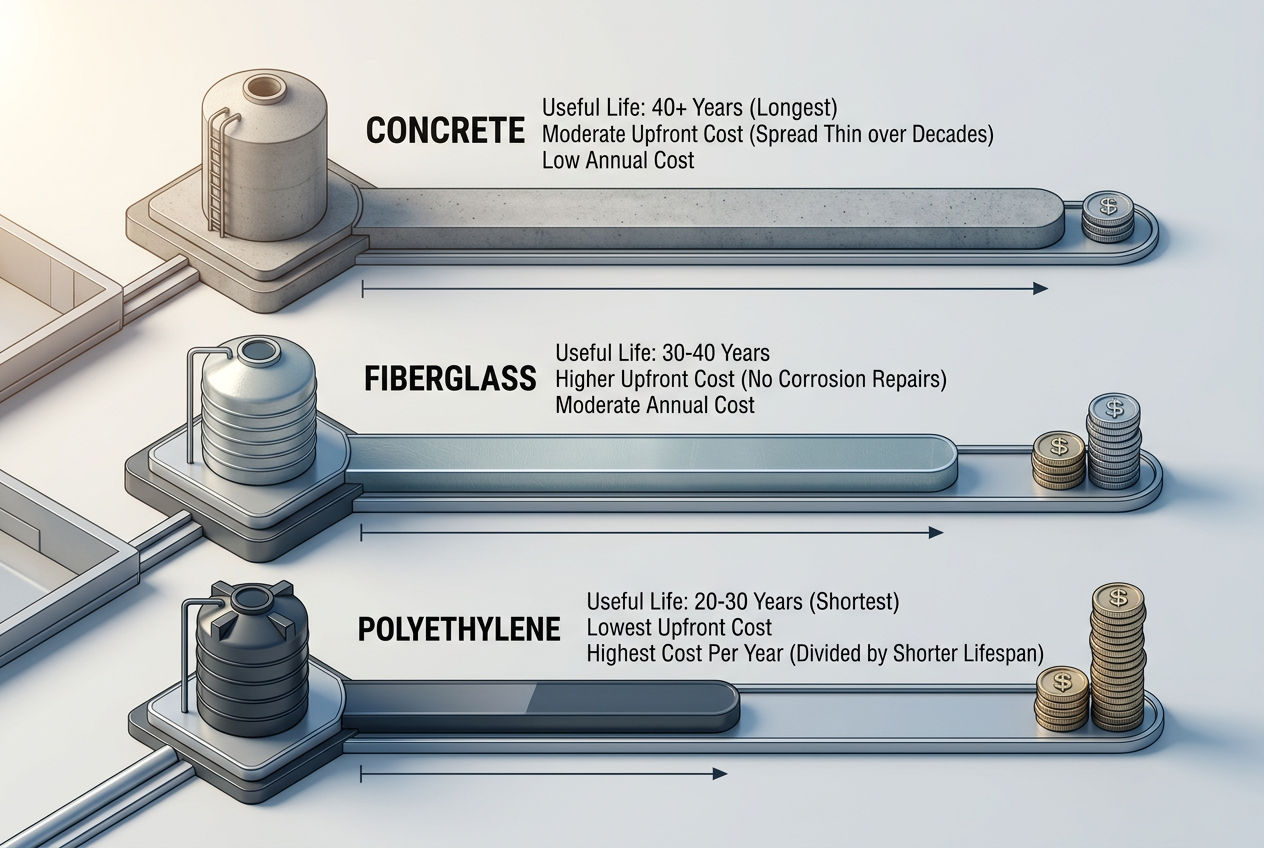
1,000-gallon tank, purchase price only:
| Material | Average Cost | ÷ Lifespan | = Annual Cost |
|---|---|---|---|
| Polyethylene | $1,150 | 25 years | $46/year |
| Fiberglass | $1,850 | 40 years | $46/year |
| Concrete | $1,350 | 70 years | $19/year |
✅ Pro Tip: On a pure cost-per-year basis, concrete wins — but only if it reaches that 70-year lifespan. A concrete tank that corrodes at year 20 without a protective lining turns into the most expensive option. Factor in the crane rental, higher labor cost, and potential lining treatment ($500–$2,000 for an epoxy interior coating), and the concrete advantage narrows considerably in corrosive environments.
Which Septic Tank Material Is Best for Your Situation?
By Water Table and Soil Conditions
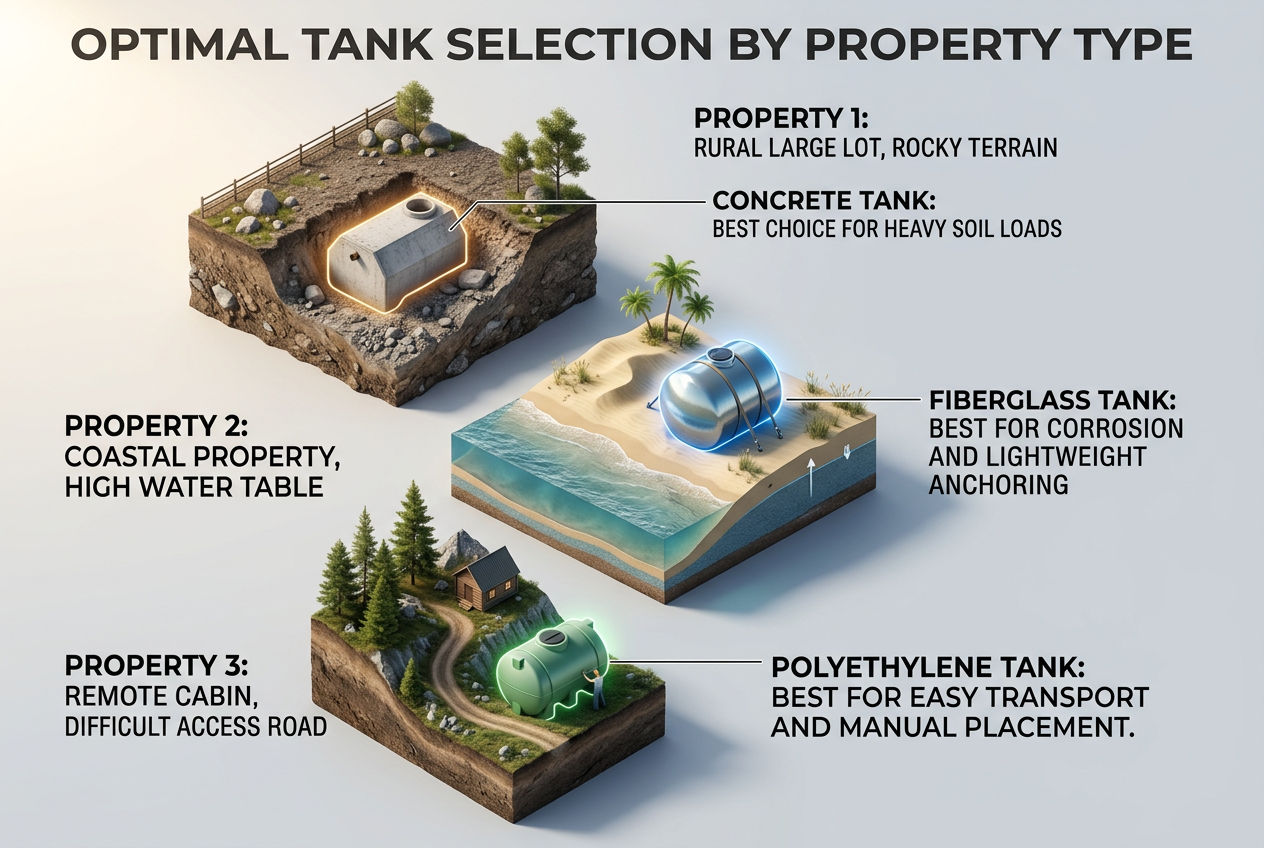
High water table (within 24 inches of tank bottom): Concrete is the safest choice because its weight prevents flotation. If you must use fiberglass or poly, you'll need a concrete anchor pad or strap system — add $300–$800 to your budget and make sure your installer is experienced with the anchoring method. For more on managing wet-site installations, read our guide on septic systems in high water table conditions.
Stable, well-drained soil: All three materials perform well. Cost and lot access become the primary differentiators.
Rocky or expansive clay soil: Fiberglass handles frost heave and soil movement better than concrete. In New England, where frost lines can reach 48–72 inches, fiberglass tanks see fewer cracking failures than precast concrete.
By Property Access
Remote lot, narrow roads, no crane access: Fiberglass or poly are your only practical options. A 300-lb fiberglass tank can be moved by hand if necessary. A 10,000-lb concrete tank cannot.
Standard suburban or rural lot with good road access: All three materials are viable. Your contractor's preference and regional material availability will narrow the field quickly.
By Budget
Tightest budget, code allows poly: Polyethylene gives you the lowest tank purchase price. Just factor in that you may be replacing it in 20–25 years rather than 40–50.
Balanced long-term value: Fiberglass offers strong corrosion resistance and manageable installation cost without the lifespan penalty of poly.
Maximum structural life, stable soil, crane access available: Precast concrete with a protective interior epoxy coating is the most durable option where H₂S corrosion can be mitigated.
Sources & Methodology
-
U.S. Environmental Protection Agency — Septic Systems Overview and material guidance for onsite wastewater treatment systems.
-
National Precast Concrete Association (NPCA) — Manufacturing standards, structural load ratings, and longevity data for precast concrete septic tanks.
-
University of Minnesota Extension — Research on septic tank material performance in cold climates, including frost heave resistance and groundwater buoyancy factors.
-
Infiltrator Water Technologies — Technical specifications for fiberglass and plastic tank products, including weight ratings, chemical resistance, and warranty terms.
-
National Onsite Wastewater Recycling Association (NOWRA) — Industry guidance on material selection for residential septic systems based on site conditions and regulatory requirements.
Cost data reflects 2025–2026 national averages compiled from contractor pricing surveys across SepticTankHub.com's directory network.
Need help with your septic system? Find trusted septic professionals near you to get free quotes. Learn more about septic repair services. Browse local septic companies in Arizona or Washington.
Was this article helpful?
Frequently Asked Questions
Recommended Resources
📖 Related Articles
📍 Find Local Pros
Find Septic Professionals Near You
Compare licensed, verified septic companies by area — top county markets and cities below, or browse all 50 states.
County markets
Popular cities
