
Quick Answer
A septic tank costs between $600 and $12,000 for the tank unit alone in 2026. Standard concrete tanks run $800-$2,000, plastic tanks cost $600-$1,800, fiberglass tanks run $1,200-$3,000, and aerobic treatment units range from $3,500 to $12,000. Your price depends on tank size, material, and whether it's a conventional or engineered system.
Key Takeaways
- Septic tank prices range from $600-$12,000 for the tank unit in 2026
- Concrete tanks ($800-$2,000) are the most common and longest-lasting option
- Plastic tanks ($600-$1,800) are the most affordable but less durable
- The tank is only 15-30% of total installation cost — labor and drain field add $5,000-$20,000
- Tank size is driven by bedroom count, not square footage or bathrooms
Shopping for a septic tank is unlike buying any other home component. You can't walk into a hardware store and pick one off the shelf — tank sizing is dictated by your county health department based on bedroom count and soil testing, and the material you choose affects everything from installation difficulty to how long the system lasts. With prices varying by a factor of 20 between the cheapest plastic tank and the most expensive aerobic unit, understanding what drives septic tank pricing is essential before you talk to a contractor.
This guide breaks down 2026 pricing for every major tank type, size, and material so you know exactly what to budget.
Find a licensed septic installer in your area on SepticTankHub.com
How Much Does a Septic Tank Cost by Material?
Septic tank prices vary dramatically by material. Each option comes with different upfront costs, lifespan, and installation requirements. Here's what you'll pay for the tank unit itself — not including installation labor, excavation, or drain field work.
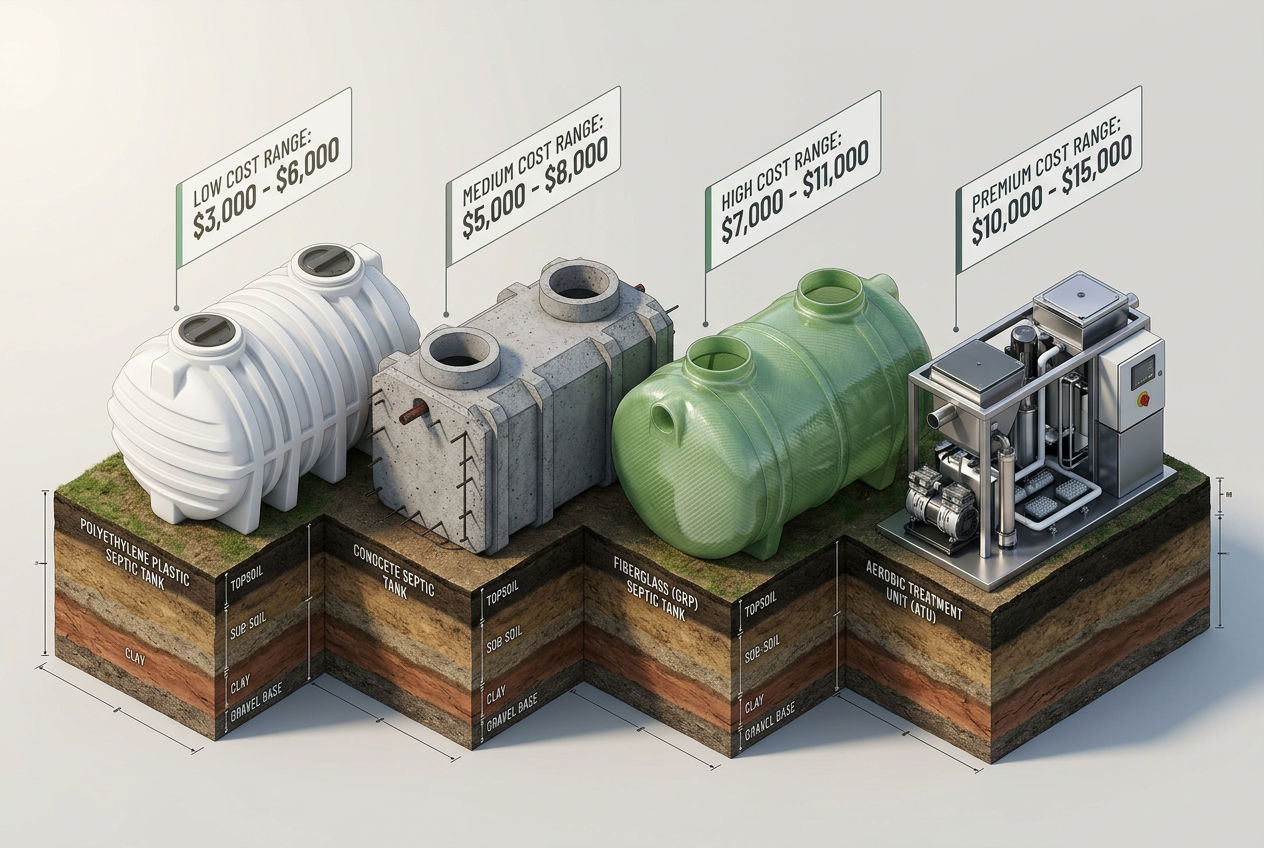
| Material | Price Range (Tank Only) | Lifespan | Weight (1,000 gal) | Best For |
|---|---|---|---|---|
| Polyethylene plastic | $600-$2,500 | 30-40 years | 150-300 lbs | Budget installs, tight access |
| Concrete | $800-$4,000 | 40-50 years | 8,000-12,000 lbs | Permanent homes, standard soil |
| Fiberglass | $1,200-$3,500 | 30-50 years | 200-400 lbs | High water tables, corrosive soil |
| Precast concrete | $1,000-$4,500 | 40-50 years | 8,000-12,000 lbs | Fast installation, commercial |
| Aerobic treatment unit | $3,500-$12,000 | 20-30 years | Varies | Failed perc tests, small lots |
| Steel | $500-$2,500 | 15-20 years | 1,000-2,000 lbs | Not recommended (corrosion) |
Source: SepticTankHub.com pricing data from 4,200+ septic companies, 2026
Concrete remains the industry standard for good reason. It's the heaviest and most expensive to deliver, but it resists buoyancy in high water tables, handles vehicle traffic overhead, and lasts the longest. Most county codes default to concrete for residential installations.
Plastic (polyethylene) tanks cost 25-40% less than concrete and are far easier to transport and install. A two-person crew can carry one into a backyard — no crane needed. The downsides: they can float or shift in saturated soil, and they're more vulnerable to crushing if heavy equipment drives over them. For a detailed comparison, see our concrete vs. plastic septic tank guide.
Fiberglass offers a middle ground — lighter than concrete, more rigid than plastic, and highly resistant to soil corrosion and tree root intrusion. Fiberglass tanks are popular in coastal areas and regions with acidic soil. Our fiberglass vs. concrete comparison covers the tradeoffs in depth.
Aerobic treatment units (ATUs) are a different category entirely. These are engineered systems with mechanical components — air pumps, aerators, and sometimes UV disinfection. They produce cleaner effluent than conventional tanks, which is why they're required in areas where soil percolation tests fail. The price reflects the mechanical complexity and ongoing maintenance requirements.
Key Insight: Steel septic tanks are still sold in some areas, but the septic industry has largely abandoned them. Steel corrodes in the acidic environment inside a septic tank, and most fail within 15-20 years. If you're replacing a steel tank, switch to concrete or fiberglass.
What Size Septic Tank Do You Need and What Does It Cost?
Tank size is determined by the number of bedrooms in your home — not the number of bathrooms, square footage, or how many people actually live there. County health departments use bedroom count because it represents the maximum potential occupancy of the home.
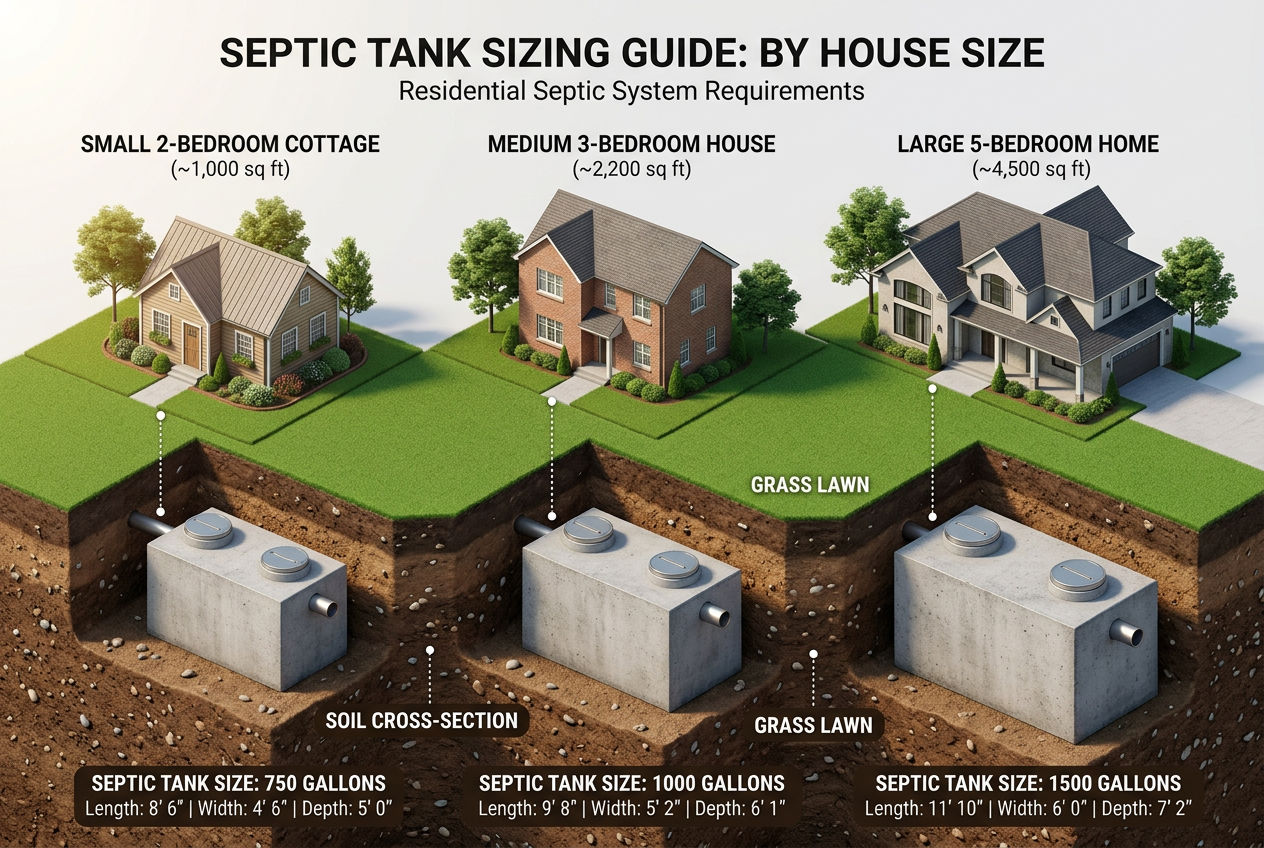
| Bedrooms | Minimum Tank Size | Concrete Price | Plastic Price | Fiberglass Price |
|---|---|---|---|---|
| 1-2 | 750 gallons | $800-$1,500 | $600-$1,000 | $1,200-$2,000 |
| 3 | 1,000 gallons | $1,000-$2,000 | $800-$1,200 | $1,500-$2,500 |
| 4 | 1,250 gallons | $1,200-$2,500 | $900-$1,500 | $1,800-$3,000 |
| 5 | 1,500 gallons | $1,500-$3,000 | $1,100-$1,800 | $2,000-$3,500 |
| 6+ | 2,000+ gallons | $2,000-$4,000 | $1,500-$2,500 | $2,500-$4,000 |
Source: EPA residential septic system sizing guidelines and manufacturer pricing, 2026
These are minimum sizes based on the International Private Sewage Disposal Code. Your county may require larger tanks — some jurisdictions add 250 gallons per bedroom beyond two, while others use a flat minimum of 1,000 gallons regardless of home size.
If you use a garbage disposal, many counties require upsizing by one tier (for example, a 3-bedroom home with a disposal gets a 1,250-gallon tank instead of 1,000). High-efficiency appliances like low-flow toilets can sometimes allow you to stay at the standard size even with extra occupants.
Not sure what size you need? Use our interactive calculator below or check our detailed guide on how to determine the right septic system size.
Free download
Free: the Septic Fridge Card — what to flush, what never to.
The Do / Don’t card the whole family can see, plus the Survival Kit: emergency flowchart, warning-sign decoder and pump-schedule card. One printable PDF.
How Does Tank Price Fit Into Total Septic System Cost?
The tank itself is only one piece of the total installation budget. Understanding the full cost breakdown prevents sticker shock when you see the final invoice.
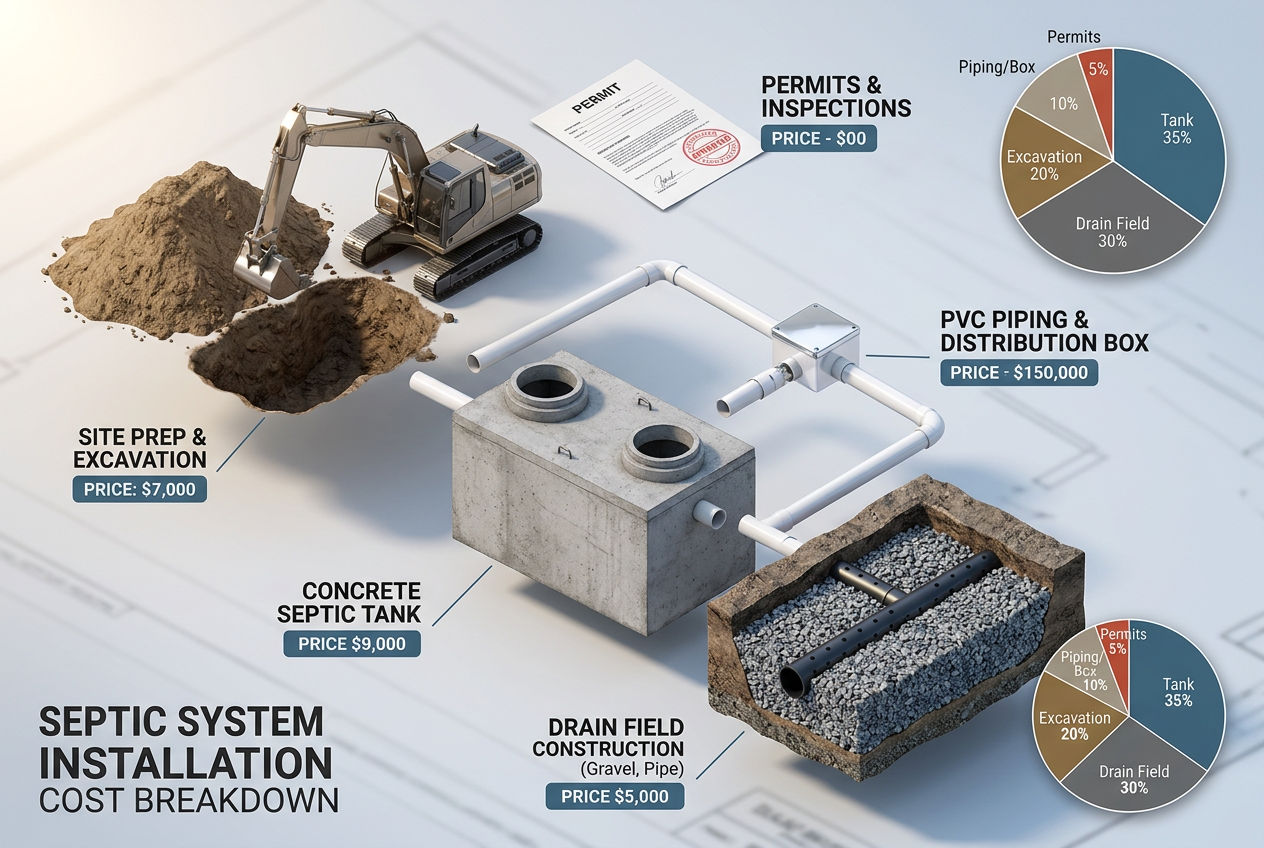
A complete septic system includes: the tank, distribution box, drain field (also called a leach field), piping, permits, excavation, backfill, and inspection. For most residential installations, the tank accounts for only 15-30% of the total project cost.
| Cost Component | Typical Range | % of Total |
|---|---|---|
| Septic tank (unit) | $600-$4,000 | 8-20% |
| Excavation and site prep | $1,500-$4,000 | 15-20% |
| Drain field construction | $2,000-$10,000 | 25-40% |
| Piping and distribution box | $500-$1,500 | 5-10% |
| Permits and inspections | $400-$2,000 | 3-10% |
| Installation labor | $1,500-$4,000 | 15-20% |
| Soil testing (perc test) | $250-$1,000 | 2-5% |
| Total conventional system | $7,000-$25,000 | 100% |
Source: SepticTankHub.com aggregated installer data across 50 states, 2026
Engineered systems — mound systems, sand filters, aerobic treatment units — can push the total to $30,000-$50,000. These are required when standard perc tests fail, meaning the soil can't absorb effluent at the rate a conventional drain field needs. See our guide on engineered septic systems for details.
The takeaway: don't choose a tank material solely based on tank price. A $600 plastic tank that requires a crane-free installation might save $1,000 on placement but cost the same or more when you factor in anchoring systems needed for high water table areas.
For a complete cost breakdown of new installations, see our septic installation cost guide.
Pro Tip: Get at least three quotes from licensed septic installers before committing. Ask each contractor to itemize the tank, drain field, excavation, and permit costs separately. This makes it easy to compare apples to apples and spot anyone padding a specific line item.
What Factors Affect Septic Tank Pricing?
Beyond size and material, several variables move the price needle:

Delivery distance. Concrete tanks weigh 4-6 tons and require a flatbed truck with a crane. If the nearest precast concrete manufacturer is more than 50 miles away, delivery fees add $200-$500. Plastic and fiberglass tanks ship on standard freight for far less.
Site accessibility. Tanks installed in backyards with limited equipment access cost more. If a crane can't reach the excavation site from the driveway, contractors may need smaller equipment with multiple lifts — adding $500-$1,500 to labor. Tight-access sites are where lightweight plastic or fiberglass tanks pay for themselves.
Soil conditions. Rocky soil or high water tables increase excavation costs and may require special tank anchoring. Concrete tanks resist buoyancy naturally due to their weight. Plastic tanks in wet conditions need concrete deadman anchors (adding $300-$600) or a concrete ballast slab beneath the tank.
Local regulations. County permit fees range from $200 to $2,000 depending on jurisdiction. Some counties require perc tests ($250-$1,000) and engineering plans ($500-$1,500) that add to the pre-construction budget. Check your state permit requirements before budgeting.
Single vs. dual compartment. Most modern codes require dual-compartment tanks, which cost 20-30% more than single-compartment models. The second compartment provides additional settling, producing cleaner effluent that extends drain field life. If you're replacing a single-compartment tank, expect your county to require upgrading to dual.
Common Mistake: Choosing the cheapest tank without considering soil conditions and water table depth. A $600 plastic tank installed in a high water table area without proper anchoring can float out of the ground during heavy rain — destroying your entire drain field connection and costing thousands to fix. Match the tank material to your site conditions, not just your budget.
Should You Buy a Septic Tank Online?
You'll find septic tanks listed on home improvement websites and even Amazon. Before clicking "Add to Cart," consider a few realities.
Shipping is the cost killer. Concrete tanks can't be shipped economically — they're purchased from local precast yards and delivered by the manufacturer's own trucks. Plastic and fiberglass tanks can be shipped nationwide, but freight for a 1,000-gallon tank runs $300-$800 depending on distance.
Your installer may not warranty someone else's tank. Many septic contractors prefer to source the tank themselves because they can verify quality, ensure correct specifications, and provide a single warranty covering both materials and labor. Bringing your own tank can void the installation warranty.
County inspection requirements. Your health department inspector needs to verify that the tank meets local code specifications — material thickness, inlet/outlet height, baffle configuration, and capacity. Some inspectors are skeptical of tanks without local manufacturer documentation.
When buying direct makes sense. If you're replacing a tank and already have an installer lined up who's willing to set a customer-supplied unit, buying direct from a manufacturer (not a reseller) can save 10-15%. This works best for plastic and fiberglass tanks with standardized specifications.
For most homeowners building a new construction septic system, the best approach is getting an all-inclusive quote from a licensed installer who handles procurement, delivery, installation, and permits as a package.
Quick Fact: The U.S. septic tank market is valued at approximately $4.5 billion and growing at 5.2% annually, driven by rural housing development and aging infrastructure replacements — according to industry market research.
How to Budget for a Septic Tank in 2026
Here's a practical budgeting framework for homeowners planning a septic tank purchase:
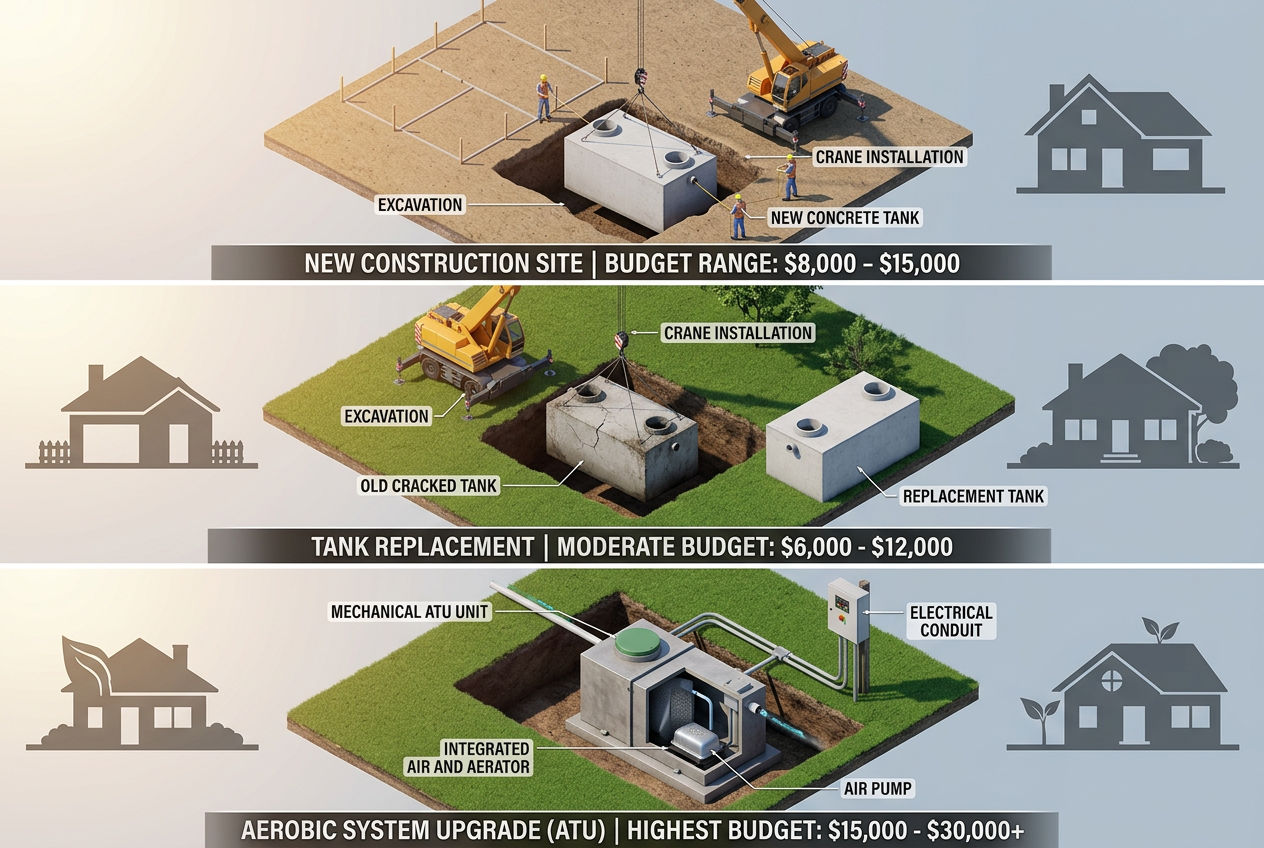
For new construction (building a new home): Budget $10,000-$20,000 for a complete conventional septic system. The tank itself will be $800-$3,000. Add 20% contingency for unexpected soil conditions. Get the perc test done early — it determines whether you need a conventional system or an expensive engineered alternative. Our new construction septic guide walks through the full timeline.
For tank replacement (existing system): Budget $3,000-$8,000 for a tank-only replacement if your drain field is healthy. The old tank needs to be pumped, abandoned, and removed before the new one goes in. Read our septic tank replacement cost guide for a detailed breakdown.
For upgrading to an aerobic system: Budget $15,000-$30,000. ATUs require electrical connections, ongoing maintenance contracts, and annual inspections in most states. Factor in $200-$500/year in maintenance costs beyond the initial purchase. Learn more about aerobic septic systems and their costs.
The septic system installation process typically takes 1-3 days for conventional systems. Plan for your property to be torn up during excavation and allow 1-2 weeks for grass to recover after backfilling.
Pro Tip: Ask your contractor about financing options. Many septic installers partner with home improvement lenders offering 12-24 month same-as-cash financing. Some states also offer low-interest loans for septic improvements through their environmental or health departments — check your state's clean water revolving fund.
Related: where to buy a septic tank
Sources & Methodology
EPA — Septic Systems Overview — Federal guidelines on septic system types, sizing requirements, and homeowner responsibilities
EPA — Types of Septic Systems — Descriptions of conventional, alternative, and engineered septic system configurations and their applications
International Code Council — International Private Sewage Disposal Code — National model code establishing minimum septic tank sizing by bedroom count
University of Minnesota Extension — Septic System Owner's Guide — Research-backed guidance on system selection, sizing, and lifespan expectations by material type
SepticTankHub.com Internal Data — Aggregated pricing from 4,200+ listed septic service companies and installers across all 50 states
Was this article helpful?
Frequently Asked Questions
Recommended Resources
📖 Related Articles
- Concrete vs Plastic Septic Tanks: Which Is Better?
- Fiberglass vs Concrete vs Poly Septic Tanks Compared
- Types of Septic Systems: Complete Comparison Guide
- What Size Septic System Do I Need?
- Septic Tank Replacement Cost 2026: $5,000–$15,000 (Full Breakdown)
- Aerobic Septic System (ATU) Cost: $10K–$20K Install (2026)
- Building a House With Septic: Complete New Construction Guide
- What to Expect During Septic System Installation
- What Is a Septic System? How It Works (Visual Guide)
- Engineered Septic System Cost: $12K–$30K+ (2026)
💰 Cost Guides
🔧 Services
Find Septic Professionals Near You
Compare licensed, verified septic companies by area — top county markets and cities below, or browse all 50 states.
County markets
Popular cities
