
Quick Answer
A new construction septic system (also called a new build septic or residential onsite wastewater system) requires soil testing, engineering design, local permits, licensed installation, and a final inspection before your county will approve occupancy. The full process takes 2–6 months and costs $10,000–$40,000+ depending on your soil, lot, and system type.
Key Takeaways
- Start the septic process before you finalize your house placement — soil results may force a redesign
- A failed perc test doesn't kill the project; alternative systems can work on most lots
- Budget $10,000–$25,000 for conventional systems; $15,000–$40,000+ for engineered alternatives
- Most permits take 2–8 weeks; schedule testing early to avoid construction delays
- Every state regulates septic, but your county health department is usually the authority to call first
Building in a rural area means you're responsible for your own wastewater treatment. There's no city hookup. No one else is managing it. It's on you — and if you handle the septic process wrong, you could end up with a house you can't legally occupy.
The good news? This isn't complicated when you know the sequence. Miss the sequence, and you'll be paying for redesigns, re-permits, and delays. Nail it, and your septic system goes in clean, passes inspection, and quietly does its job for 20–40 years.
Here's exactly how it works.
Do You Need a Perc Test Before Building a House?
Yes — a percolation test (perc test) is almost always required before you can get a septic permit, and you should complete it before finalizing where your house sits on the lot. The results directly affect system design and may limit where you can build.
What a Perc Test Actually Measures
A perc test measures how fast water absorbs into your soil — the absorption rate, expressed in minutes per inch (MPI). Inspectors dig 3–6 test holes, typically 24–72 inches deep, fill them with water, and time how long it takes for the water level to drop one inch.
📊 Quick Fact: Acceptable perc rates typically fall between 1–60 MPI. The sweet spot is 1–30 MPI. Slower than 60 MPI and most jurisdictions won't approve a conventional drain field — you'll need an engineered septic system instead.
A perc test costs $750–$2,500 depending on your region and the number of test holes required. In the Northeast, many counties require testing during high water table season (roughly November through April) to evaluate worst-case conditions. In states like Texas and Arizona, testing is often permitted year-round.
⚠️ Warning: Scheduling a perc test can take 1–6 weeks depending on your county's backlog. In spring and summer — peak construction season — that wait stretches toward the longer end. Start early.
What Happens During a Soil Evaluation for Septic?
A soil evaluation goes deeper than a perc test. A licensed soil scientist or septic designer examines soil texture, structure, color, and depth to bedrock or seasonal water tables. This full site evaluation for septic typically costs $500–$1,500 and happens alongside or just after the perc test.
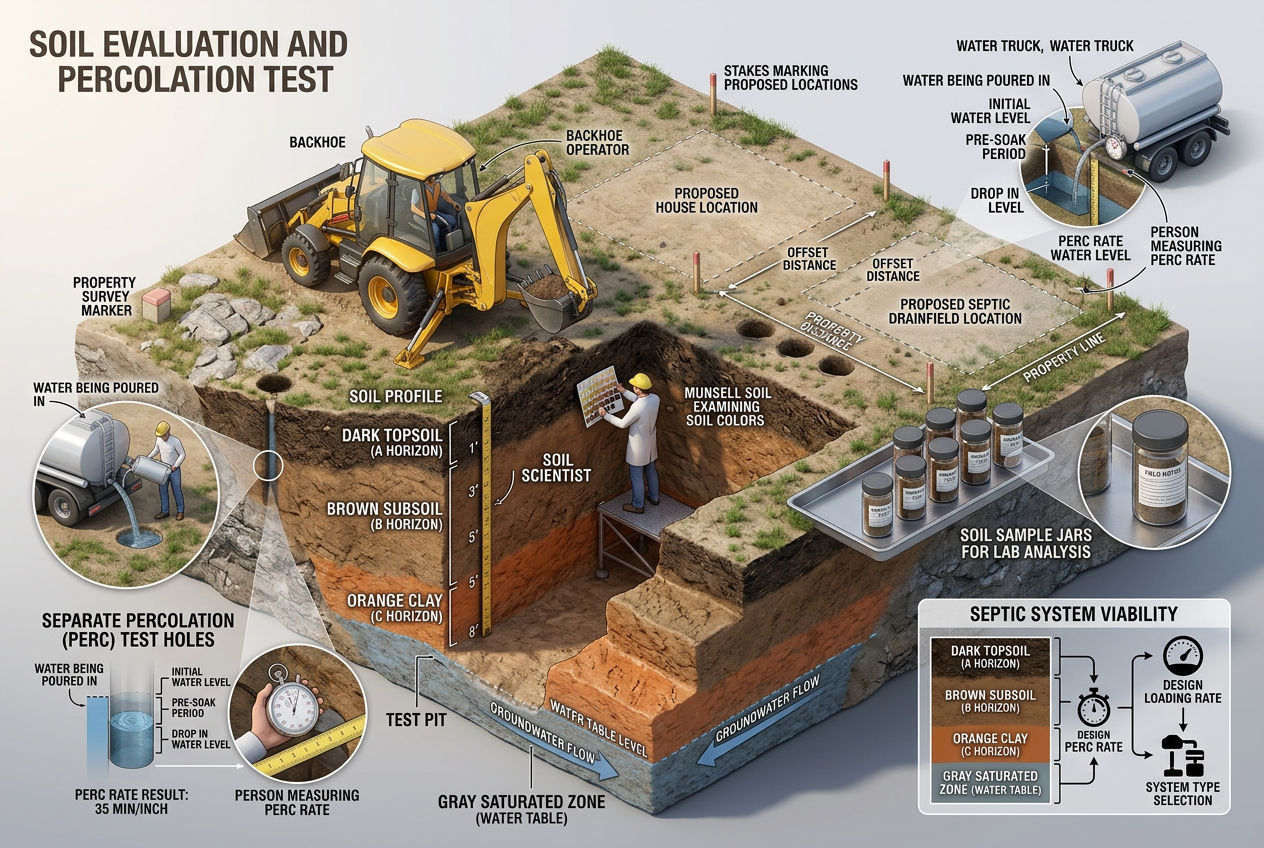
The evaluator is looking for:
- Soil permeability — whether water moves through at a workable rate
- Restrictive layers — hardpan, clay, caliche, or bedrock that blocks drainage
- Seasonal high water table — indicated by mottled (gray and rust-streaked) soil
- Usable area — how much square footage is available for a drain field after accounting for setbacks
💡 Key Takeaway: You need enough clean, undisturbed ground for both a primary drain field and a reserve drain field area — most jurisdictions require a 100% reserve area held back in case the primary field fails. Combined, this can easily require 5,000–10,000 square feet of viable soil.
How Do You Design a Septic System for a New House?
System design starts with your soil evaluation and perc test results, then factors in your home's size, the number of bedrooms, and local regulatory requirements. Most counties require a licensed septic system design engineer or certified designer to produce and stamp the plans.
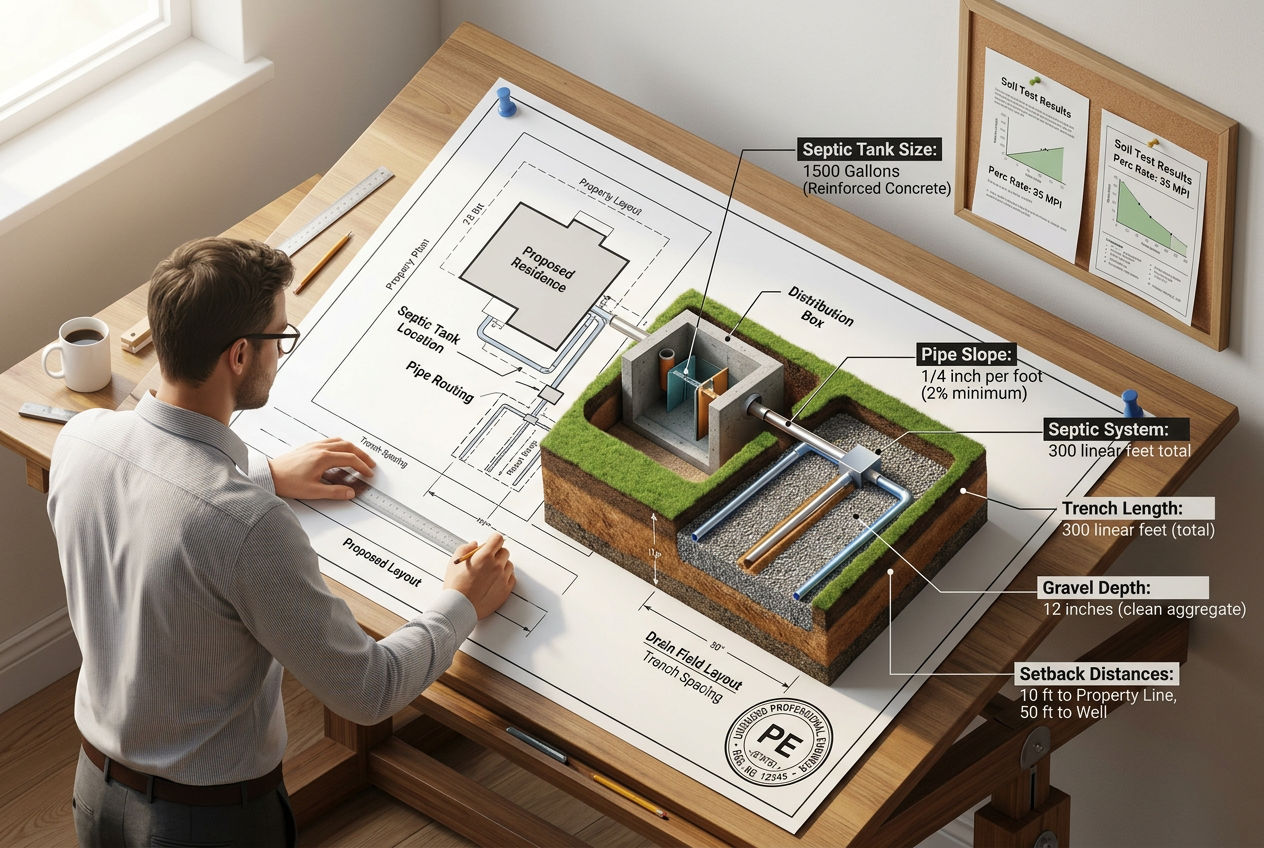
Design fees run $500–$2,000+ depending on system complexity.
Sizing Your Septic Tank
Tank sizing is driven by bedroom count, which acts as a proxy for daily wastewater flow. The standard design figure is approximately 150 gallons per bedroom per day. Common minimum tank sizes:
| Bedrooms | Minimum Tank Size |
|---|---|
| 2 bedrooms | 750-gallon tank |
| 3 bedrooms | 1,000-gallon tank |
| 4 bedrooms | 1,250-gallon tank |
| 5+ bedrooms | 1,500-gallon tank or larger |
✅ Pro Tip: Most designers recommend going one size up — a 1,500-gallon concrete tank on a 3-bedroom home gives you margin if your household grows or if you add a garbage disposal (which accelerates sludge accumulation significantly).
What Type of Septic System Do You Need?
That depends entirely on your soil. Here's the breakdown:
Conventional gravity system — Works when soil perc rates fall in the acceptable range and the topography allows effluent to flow downhill from the tank to the drain field by gravity. Lowest cost. Most common choice when the land cooperates.
Mound system — Used when the natural soil is too slow, too shallow, or the water table is too high. Effluent is pumped up into an engineered mound of imported sand above grade. Common in the Pacific Northwest and along Florida's coast. Learn more about mound septic systems.
Aerobic treatment unit (ATU) — Uses an aerator compressor (like a Hiblow HP-80) to inject oxygen into the tank, accelerating bacterial breakdown. Produces higher-quality effluent. Required in some jurisdictions near water bodies. Typical in Texas near the Edwards Aquifer recharge zone. Compare aerobic vs. anaerobic systems here.
Drip irrigation system — Effluent is treated and distributed through small-diameter tubing at shallow depths. Works on difficult lots with limited drain field space.
Chamber system — Uses Infiltrator Water Technologies chambers instead of perforated pipe and gravel. More efficient, often requires less drain field square footage. A common choice when drain field space is tight.
For a full comparison, see our guide to types of septic systems.

DIY Septic Blueprint
Thinking about building it yourself?
The complete, plain-English plan to size, permit and install your own septic system — designed for homeowners, not contractors. Skip the $15,000–$25,000 quotes and do it right the first time.
Get the DIY Blueprint — $67 →Instant download · 8 modules + 3 bonus guides · 60-day money-back guaranteeHow Long Does It Take to Get a Septic Permit for New Construction?
Permit approval for new construction septic typically takes 2–8 weeks after you submit completed design plans. Some rural counties with lighter workloads turn applications around in under two weeks. High-growth counties in Florida, Texas, and the Carolinas regularly run 6–8 weeks.
What the Septic Permit Process Looks Like
- Complete soil evaluation and perc test
- Hire a licensed designer to produce system plans
- Submit plans, site survey, and application to your county health department (in most states)
- Pay permit fees — typically $200–$1,000 depending on jurisdiction
- Wait for review and approval
- Receive permit with required inspection checkpoints
The permit will specify exactly what system must be installed, what materials are approved, and which stages require inspection before backfill.
📊 Quick Fact: Some states — Massachusetts (under Title 5), New Jersey, and Washington — require a licensed Professional Engineer (PE) to sign off on designs. Others allow certified designers to handle it without a PE seal. Check with your county health department before hiring anyone.
When Should the Septic System Be Installed During Construction?
The septic system is typically installed after the foundation is poured and rough plumbing is in place, but before final grading and landscaping. This sequencing matters for several reasons.
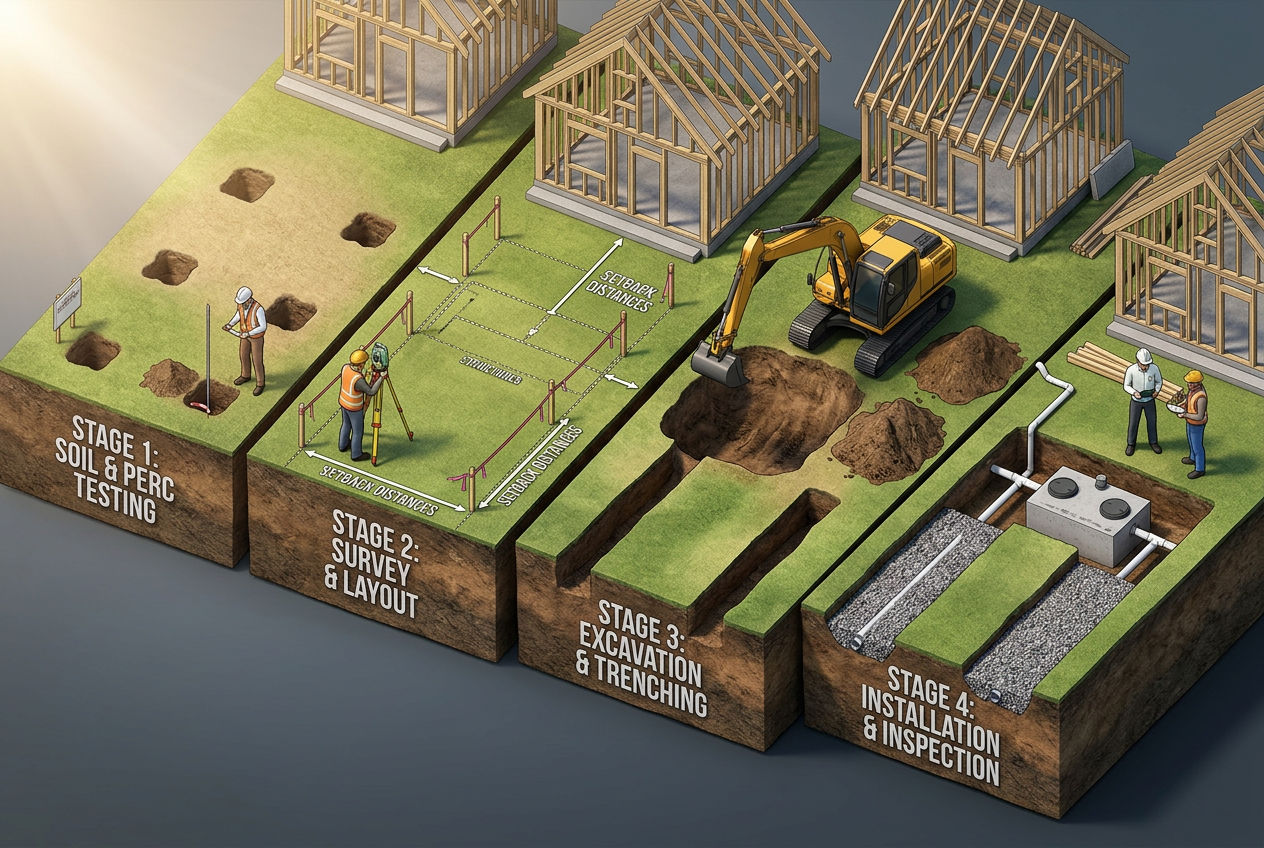
The rough plumbing sets the exit point of your building sewer — the pipe that runs from your house to the septic tank. The septic installer needs that elevation to set the tank correctly. Install the system too early, and you risk misalignment. Too late, and heavy equipment operating during finish grading can damage freshly installed drain field laterals.
A conventional system installation takes 2–5 days for most residential builds. Engineered systems with pump chambers, ATUs, or drip lines can take 5–10 days.
Construction Sequence for New Septic Systems
- Site evaluation and perc test
- System design and permits (can overlap with foundation work)
- Foundation and rough framing
- Rough plumbing (sets building sewer exit elevation)
- Septic system installation
- County inspection (before backfill)
- Backfill and site restoration
- Final grading and landscaping
- Certificate of occupancy
⚠️ Warning: Your county inspector will visit at least once — usually before the tank and drain field are covered with soil. Some jurisdictions require multiple inspection stages. Never backfill without passing inspection. If you do, you may be required to excavate everything.
Septic System Setback Requirements: How Far Does Everything Need to Be?
Setback requirements define minimum distances between septic components and other features on your lot. These distances directly affect where you can place your house, well, driveway, and outbuildings. Common minimums — though your county may require more:
| Component | From Septic Tank | From Drain Field |
|---|---|---|
| House foundation | 10 ft minimum | 20 ft minimum |
| Property line | 5 ft minimum | 10 ft minimum |
| Private well | 50 ft minimum | 50–100 ft minimum |
| Water body/stream | 50 ft minimum | 50–100 ft minimum |
| Swimming pool | 10 ft minimum | 25 ft minimum |
Source: EPA On-site Wastewater Treatment Systems Manual; requirements vary by state and county.
💡 Key Takeaway: The well-to-drain-field distance is where projects most often run into trouble. If you're planning both a private well and a septic system — common on rural properties — get your well driller and septic designer talking to each other before either one breaks ground. Check out our deeper look at well and septic system costs and planning.
States like Massachusetts require 150 feet between a private well and a drain field under Title 5 — three times the federal baseline. Florida requires 75 feet from a drain field to any potable water well. These variations aren't minor. They can make or break a lot's buildability.
Can You Build a House on Land That Won't Perk?
Yes — but it gets more expensive and more complicated. A failed conventional perc test doesn't mean the land is unbuildable. It means you need an engineered solution.
Options include:
- Mound systems
- Aerobic treatment units (ATUs)
- Drip irrigation systems
- Composting or evapotranspiration systems in arid climates
These alternative septic systems cost more upfront — typically $15,000–$40,000+ — but they're approved and installed every day across the country.
⚠️ Warning: The one scenario where building becomes genuinely difficult is when your lot is too small to accommodate a reserve drain field after accounting for setbacks. Many jurisdictions won't approve a permit if there's no viable location for a replacement field. If you're evaluating raw land before purchase, get a soil evaluation done first. Don't buy land on the assumption it will perk.
How Much Does a Septic System Cost for New Construction?
A new home septic system costs $10,000–$25,000 for a conventional gravity-fed installation. Engineered systems — mound, ATU, drip — run $15,000–$40,000+. These figures cover everything from tank to drain field, but don't include perc testing, soil evaluation, or permitting fees.
Realistic Cost Breakdown: 3-Bedroom Midwest Home
Here's what a conventional system costs for a 3-bedroom home in the Midwest:
| Item | Cost |
|---|---|
| Soil evaluation | $800 |
| Perc test | $1,200 |
| System design | $900 |
| Permit fees | $400 |
| 1,000-gallon concrete septic tank (installed) | $2,500 |
| Distribution box and leach laterals | $6,500 |
| Electrical (if pump required) | $1,500 |
| Inspection and closeout | $300 |
| Total | ~$14,100 |
📊 Quick Fact: The same project in coastal New England with rocky soil might require an engineered design, imported fill, and a mound system — easily pushing the total to $28,000–$35,000.
For a full breakdown by system type and region, see our septic installation cost guide.
What Happens at the Final Inspection?
Before your county issues a certificate of occupancy, a health department inspector will verify that the system was installed exactly as designed and permitted. They'll check:
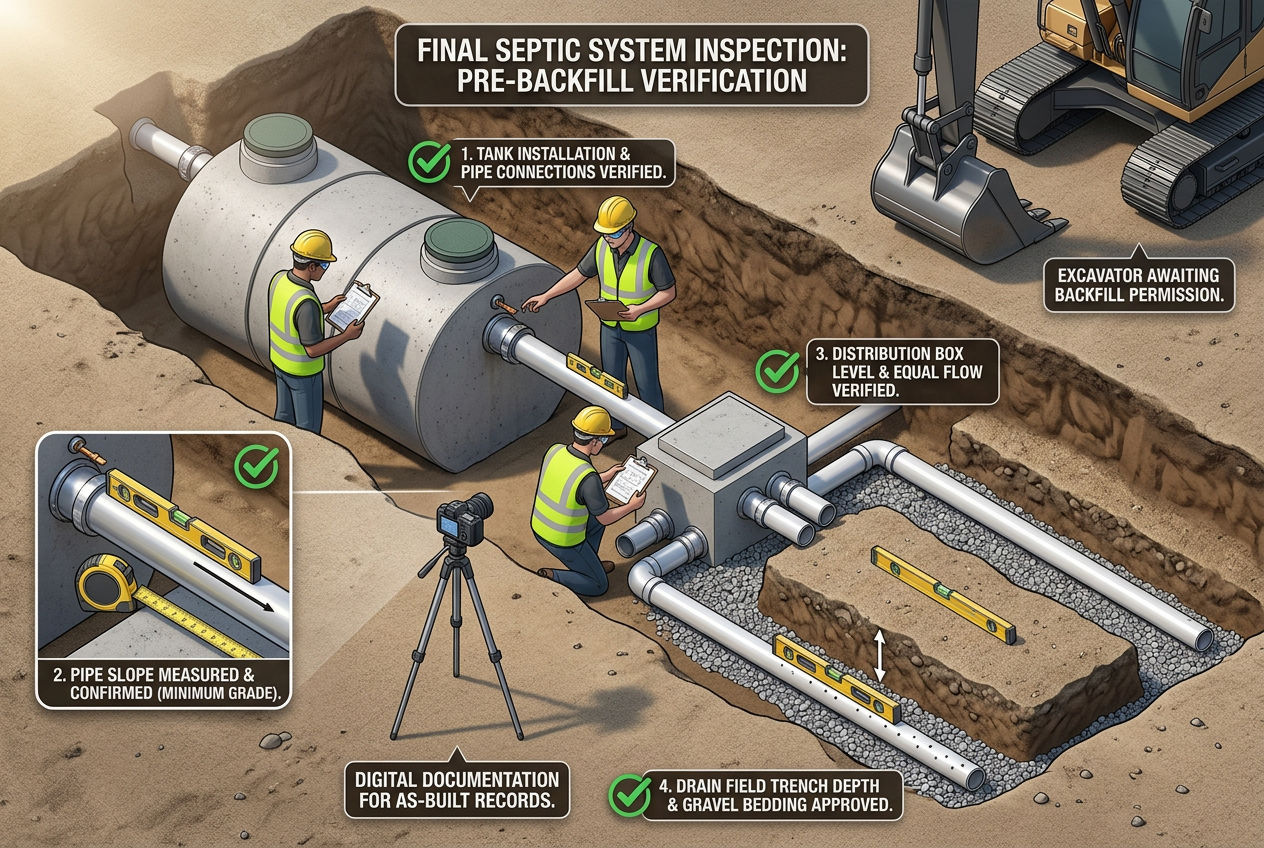
- Tank placement
- Inlet and outlet baffle walls
- Distribution box alignment
- Drain field dimensions
- Proper depth of the leach laterals
✅ Pro Tip: Some jurisdictions also require an effluent filter — like a Polylok PL-122 — installed at the outlet baffle of the tank. If your permit requires one and it's missing, the inspection fails.
Once you pass, the system gets backfilled, the site is restored, and you're cleared for occupancy. The system is now your responsibility. The EPA recommends pumping every 3–5 years for most households — start that clock the day you move in, not when the tank "seems full." For ongoing maintenance, our septic tank maintenance guide covers everything you need to know.
New Construction Septic System Cost & Type Comparison
| System Type | Typical Cost Range | Best For | Key Limitation |
|---|---|---|---|
| Conventional gravity | $10,000–$18,000 | Good soil, sloped lots | Needs acceptable perc rate |
| Chamber (Infiltrator) | $11,000–$20,000 | Limited drain field space | Still needs workable soil |
| Mound system | $15,000–$30,000 | High water table, slow soil | Requires large lot footprint |
| Aerobic ATU | $15,000–$35,000 | Near water bodies, poor soil | Annual maintenance contract |
| Drip irrigation | $18,000–$40,000+ | Steep slopes, tight lots | Most complex; pump required |
Cost ranges are national estimates for new residential construction. Regional costs vary significantly. Data sourced from NOWRA industry cost surveys and state health department publications.
Regional Notes: What State You're In Changes Everything
Northeast
Expect the strictest regulations and the highest costs. Massachusetts Title 5 requirements are among the most demanding in the country, with 150-foot well setbacks and mandatory inspections at point of sale. Many lots require engineered systems due to shallow bedrock and clay soils.
Southeast
High water tables along Florida's coast mean mound systems are common. The Florida Department of Health (FDOH) regulates installation through county health departments. Sandy soils in some areas perk too fast, which can actually require engineered solutions to slow effluent movement.
Midwest
County health departments are typically the authority, and permitting tends to be more straightforward. Clay soils are common — slower perc rates mean larger drain fields or mound systems in some areas. Costs are generally moderate at $8,000–$20,000.
Texas
The Texas Commission on Environmental Quality (TCEQ) oversees on-site sewage facilities (OSSFs). Each county must have a designated representative to authorize installations. Systems near the Edwards Aquifer recharge zone face additional restrictions and often require ATU systems.
Mountain West
Shallow bedrock and rocky terrain create real challenges in states like Colorado, Montana, and Idaho. Engineered systems are common, and some rural counties have minimal code enforcement — which can create long-term problems for buyers. Don't skip the engineering just because the county doesn't require it.
Sources & Methodology
- U.S. Environmental Protection Agency — Septic Systems (epa.gov/septic): Referenced for pumping recommendations, setback guidance, and general system function standards.
- National Onsite Wastewater Recycling Association (NOWRA) (nowra.org): Industry cost benchmarks and system type definitions.
- State health department publications: Massachusetts Title 5 (310 CMR 15.000), Florida FDOH septic standards, Texas TCEQ OSSF regulations — referenced for regional regulatory variations.
- USDA Rural Development (rd.usda.gov): Rural housing and on-site wastewater context.
- University Extension Programs: University of Minnesota Extension soil evaluation methodology referenced for perc test standards and soil absorption rate ranges.
Cost data reflects contractor surveys and published regional averages current as of early 2026. All regulatory requirements should be verified with your local county health department before beginning any project.
Find a licensed septic installer in your area through SepticTankHub.com — every professional in our directory is vetted for licensing and local code knowledge.
Need help with your septic system? Find trusted septic professionals near you to get free quotes. Browse local septic companies in California or Ohio.
Free download
Not ready for the Blueprint? Start free.
Grab the free DIY Septic Planning Kit — the permit-first checklist, perc-test cheat sheet, and sizing tables that keep your build from getting red-tagged.
Was this article helpful?
Frequently Asked Questions
Recommended Resources
📖 Related Articles
- Engineered Septic System Cost: $12K–$30K+ (2026)
- Mound Septic System: $10K–$25K Cost & How It Works (2026)
- Aerobic vs Anaerobic Septic Systems: How They Compare
- Septic System for Small Lots: Options When Space Is Tight
- Types of Septic Systems: Complete Comparison Guide
- How Much Does a Well and Septic System Cost?
- The Complete Septic Tank Maintenance Guide
🔧 Services
Find Septic Professionals Near You
Compare licensed, verified septic companies by area — top county markets and cities below, or browse all 50 states.
County markets
Popular cities
