
Quick Answer
A mobile home septic system works on the same basic principle as any other residential septic system — and the mobile home septic tank that anchors it follows the same engineering rules as a tank for a site-built house. Waste leaves the home, settles in the tank, liquid flows to a drain field, and soil does the final filtering. Same biology. Same physics.
But the details? That's where things get interesting — and where homeowners installing septic tanks for mobile homes get burned if they're not paying attention.
💡 Key Takeaway: Six areas separate a manufactured home septic installation from a conventional one: tank sizing, pipe specifications, placement and setback rules, regulatory requirements, installation costs, and ongoing maintenance frequency. Miss any one of them and you're looking at failed inspections, permit denials, or a drain field that quits on you in year four.
About 22 million Americans live in manufactured housing, according to U.S. Census Bureau data. A significant portion of those homes sit on private septic systems. If you're one of them — or you're about to be — here's what you need to know.
Key Takeaways
- Most states require a minimum 1,000-gallon septic tank for any mobile or manufactured home, regardless of bedroom count
- Older mobile homes often have 3-inch sewer outlet pipes; standard residential systems use 4-inch — you may need an adapter
- Conventional septic installation for a manufactured home runs $3,000–$7,000; alternative systems (mound, aerobic) can hit $10,000–$20,000+
- Mobile home septic tanks often need pumping every 2–3 years — more frequently than the 3–5 year standard for larger homes
- Regulations vary significantly by state; always pull a permit through your local health department before any work begins
Can You Put a Mobile Home on a Septic System?
Yes — a mobile home can absolutely be placed on a private septic system, and millions already are. The key conditions are a passing percolation test, a septic system permit from your local health department, and a system designed to match your home's specific bedroom count and lot characteristics.
The confusion usually comes from one of two places: people assume mobile homes have to connect to a municipal sewer, or they assume rural land automatically allows septic without any approvals. Neither is true.
What You Need Before Placement
Before placing a manufactured home on a septic system, you must complete:
-
Perc test (percolation test): A soil evaluation to determine how fast water absorbs into the ground. The acceptable range is typically 1–60 minutes per inch. Faster than 1 minute per inch means the soil won't filter properly; slower than 60 minutes per inch and a conventional drain field won't work — you'll need an alternative system like a mound or aerobic treatment unit.
-
Septic system permit: Issued by your county health department or state environmental agency. No legitimate contractor will install a system without one.
-
Proper system design: Tank size, drain field layout, and setback distances all need to meet your jurisdiction's standards for a manufactured home specifically — not just any residential structure.
📊 Quick Fact: The perc test alone costs $250–$1,000 depending on your state and how many test holes the engineer requires. Budget for it before you budget for anything else.
Is a Mobile Home Septic System Different From a Regular Septic System?
The core components are identical. You've got a septic tank (usually precast concrete or polyethylene), a distribution box or manifold, and a drain field — also called a leach field — made up of perforated pipes in gravel-filled trenches or chamber systems like Infiltrator Water Technologies leach chambers.
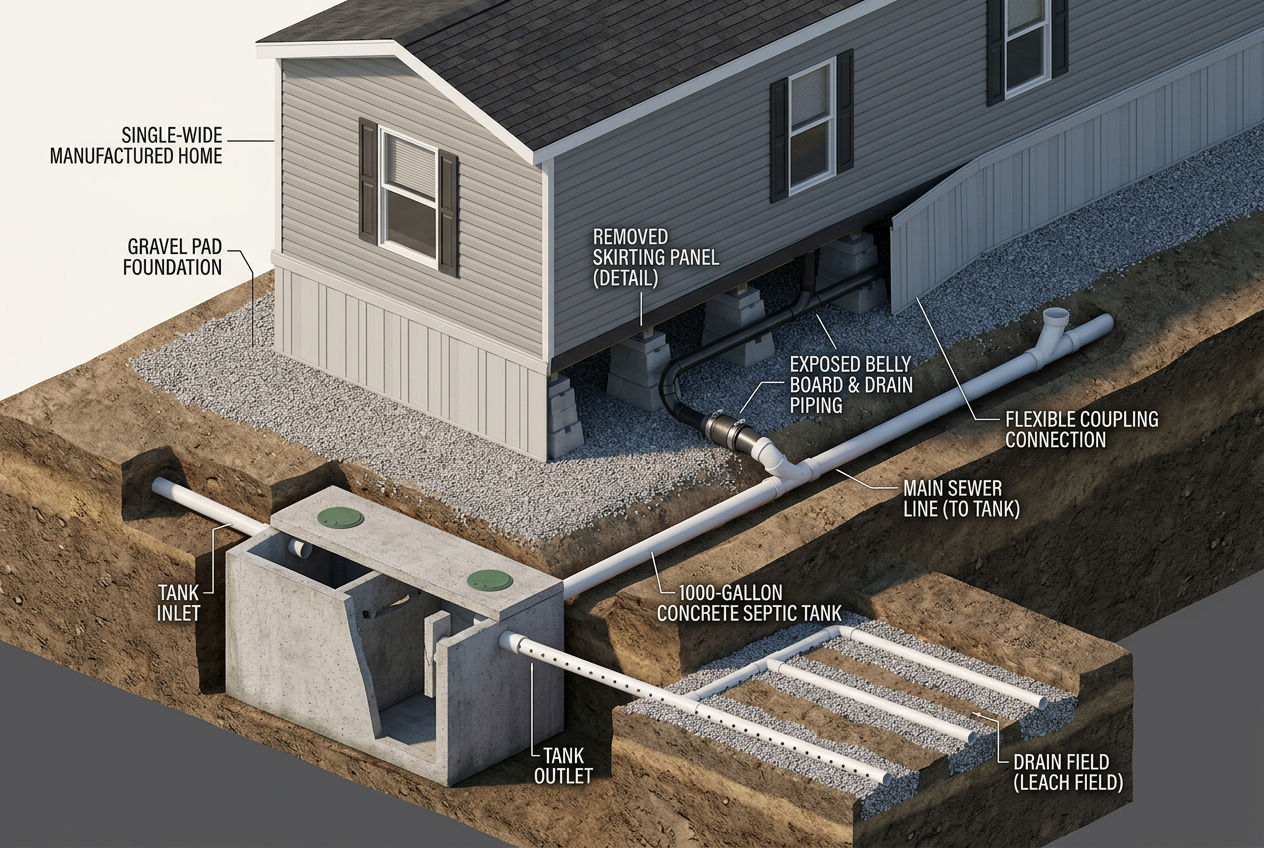
The differences are in the execution:
Pipe Diameter: The Detail That Trips People Up
This is the most common technical surprise. Standard site-built homes use 4-inch sewer outlet pipes. Many older mobile homes — particularly those manufactured before the 1990s — were built with 3-inch sewer outlets.
Hook a 3-inch outlet directly to a 4-inch system connection and you've got a leak waiting to happen, or a permit rejection on inspection day. The fix is a 3-to-4-inch reducer coupling, which runs $10–$30 at any plumbing supply. Simple — but only if you know to look for it.
✅ Pro Tip: Check your home's pipe diameter before your contractor designs the system. HUD Code 24 CFR 3280 governs manufactured housing construction standards, including plumbing specs. If you're unsure of your home's outlet size, a licensed plumber or septic installer can check it in under 30 minutes.
Foundation Type Affects Permitting
Here's something most people don't consider: whether your home sits on a permanent foundation or a temporary one (pier-and-beam, tie-down straps) affects how your county classifies it for septic permitting purposes.
- Some jurisdictions require a permanent foundation before they'll issue a septic permit at all
- Others treat manufactured homes on temporary foundations as recreational vehicles and restrict what type of system you can install
⚠️ Warning: Check with your local health department before you move the home onto the property. This conversation costs nothing. A failed permit application costs time and sometimes fees you don't get back.
Gravity-Fed vs. Pump Systems
Mobile homes often sit lower to the ground than site-built homes. That matters for drainage.
- Gravity-fed system: Waste flows downhill by gravity alone — simplest and cheapest design
- Pump chamber system: Required if your home sits in a low spot or the drain field needs to be uphill from the tank
📊 Quick Fact: A pump chamber with a float switch and effluent pump adds $1,500–$3,000 to your installation budget.
What Size Septic Tank Does a Mobile Home Need?
Tank sizing for a mobile home septic system follows the same bedroom-count formula as any residential system, but with a state-mandated floor that catches a lot of people off guard.
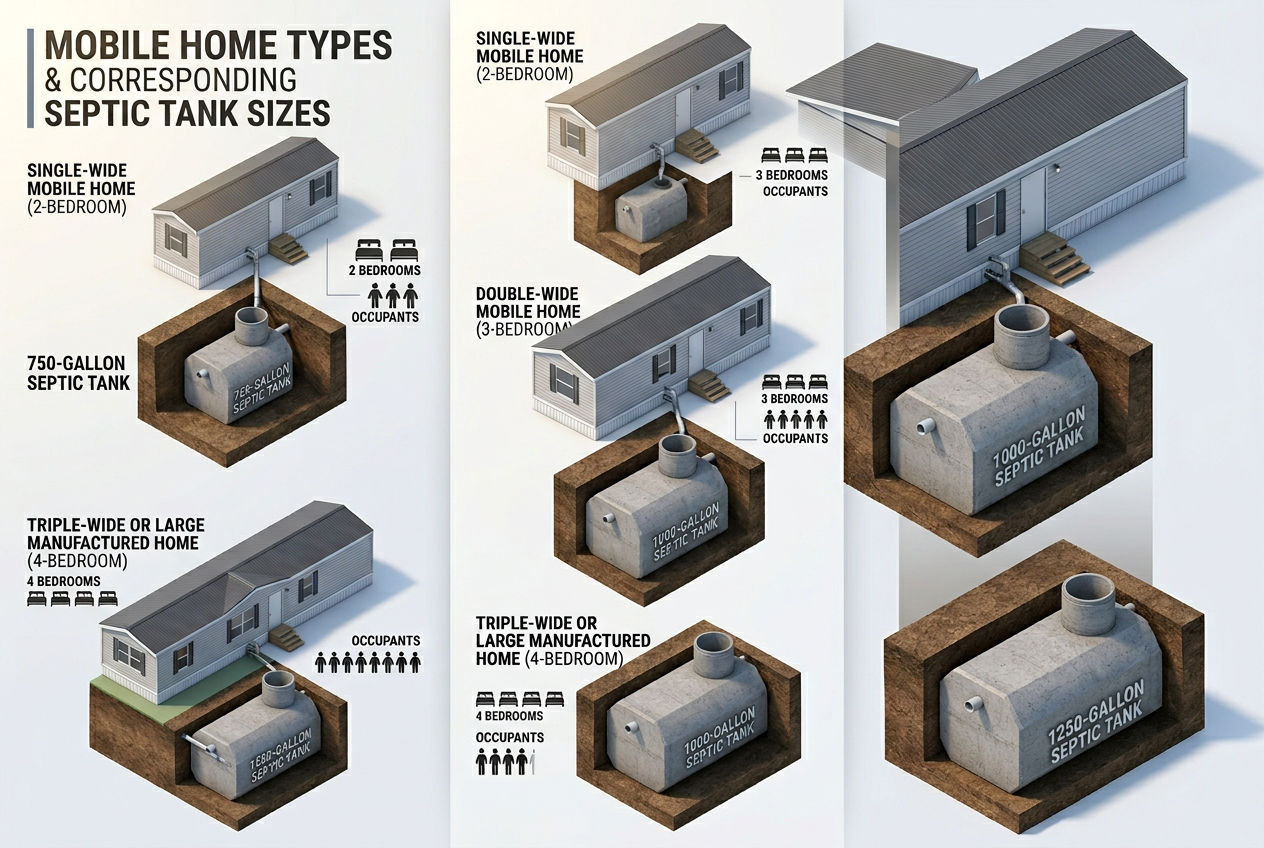
Standard engineering estimates put daily wastewater generation at roughly 150 gallons per bedroom. Here's how that translates to tank requirements:
| Home Configuration | Bedrooms | Min. Tank Size | Est. Daily Flow |
|---|---|---|---|
| Single-wide | 2 BR | 750–1,000 gal | 300 gal/day |
| Single-wide | 3 BR | 1,000 gal | 450 gal/day |
| Double-wide | 3 BR | 1,000–1,250 gal | 450 gal/day |
| Double-wide | 4 BR | 1,250 gal | 600 gal/day |
| Large manufactured home | 5 BR | 1,500 gal | 750 gal/day |
Source: State health department sizing guidelines; EPA On-Site Wastewater Treatment Systems Manual
💡 Key Takeaway: Most states set 1,000 gallons as the minimum tank size regardless of bedroom count. Even if the math on your 2-bedroom single-wide technically works with a 750-gallon tank, your county health department will likely require 1,000 gallons minimum.
A 1,000-gallon tank is $1,500–$3,500 installed before you add the drain field. For full system sizing guidance, the septic tank size guide covers bedroom-count calculations in more detail.

DIY Septic Blueprint
Thinking about building it yourself?
The complete, plain-English plan to size, permit and install your own septic system — designed for homeowners, not contractors. Skip the $15,000–$25,000 quotes and do it right the first time.
Get the DIY Blueprint — $67 →Instant download · 8 modules + 3 bonus guides · 60-day money-back guaranteeHow Much Does a Septic System for a Mobile Home Cost?
Installation for a conventional mobile home septic system runs $3,000–$7,000 nationally for the complete system — tank plus drain field. That range assumes reasonably cooperative soil and a straightforward lot.
Cost Breakdown by Component
- Perc test: $250–$1,000
- Permit fees: $200–$1,000+ (varies by county)
- Tank only (1,000-gallon): $1,500–$3,500 installed
- Drain field installation: $1,500–$4,000 depending on linear footage and soil conditions
- Pump chamber (if needed): Add $1,500–$3,000
Alternative Systems for Problem Soils
Soil that perc too slowly — common in clay-heavy Southeastern soils, rain-saturated Pacific Northwest ground, or high-water-table coastal areas — means a conventional drain field won't pass inspection. That's when alternative systems enter the picture:
| System Type | Cost Range | When Required |
|---|---|---|
| Mound system | $10,000–$20,000+ | Raised drain field built above grade |
| Aerobic treatment unit (ATU) | $10,000–$20,000+ | Uses compressor like Hiblow HP-80 to inject oxygen |
| Drip irrigation system | $12,000–$25,000 | Produces higher-quality effluent |
⚠️ Warning: Picture this: you buy a half-acre lot in coastal North Carolina, move your double-wide onto it, and order the perc test. The soil absorbs water in 90 minutes per inch — well outside the standard range. Your $5,000 installation budget just became a $15,000 mound system conversation. That scenario plays out across the Southeast, the Pacific Northwest, and low-lying Midwest areas every spring when construction season opens.
For a complete cost breakdown, see the septic system installation cost guide.
Above-Ground Septic Tanks for Mobile Homes: When You Can't Go Underground
An above-ground septic tank for a mobile home is required when soil percolation fails, the seasonal water table sits within 24 inches of the surface, or shallow bedrock prevents standard burial. Common across Florida wetlands, Louisiana parishes, parts of the Pacific Northwest, and coastal regions, above-ground systems for mobile homes typically cost $8,000–$25,000 installed depending on type — significantly more than a conventional buried system because the dispersal area has to be engineered above grade rather than relying on native soil.
Four Above-Ground Options for Mobile Homes
1. Mound systems — The most common above-ground solution. A bed of sand is built up over the native soil, the septic tank pumps effluent into laterals laid inside the mound, and treated wastewater percolates down through the sand into the underlying soil. Cost: $15,000–$25,000. Requires a pump chamber (the tank can be buried; the drain field is the part above ground). Mobile homes on small lots often have just enough room.
2. Aerobic Treatment Units (ATUs) with spray field — Spray heads disperse highly treated effluent above ground onto a designated lawn area. The tank itself is buried, but the dispersal field is surface-level. Cost: $12,000–$20,000 install + $75–$175/month maintenance. Florida and Texas mobile home installs frequently use this approach. See our aerobic septic system cost guide for full ATU pricing.
3. Sand filter systems — Effluent passes through an engineered sand filter above the native soil before percolating down. Common in coastal Washington and Oregon mobile home parks. Cost: $16,000–$28,000.
4. Holding tanks (no dispersal field at all) — A large above-ground or buried tank receives all wastewater and is pumped out on a regular schedule. Used as a last resort when no dispersal system is permitted — common for seasonal cabins and temporary mobile home placements. Cost: $3,000–$5,000 install, but $200–$400/month in pumping costs. Most jurisdictions only allow holding tanks for short-term or seasonal use.
When State Regulations Force Above-Ground
- Florida: Statewide requirement for above-ground or mound systems whenever the seasonal high water table is within 42 inches of the surface (FAC 64E-6)
- Louisiana: Most parishes in the southern half of the state require mound or aerobic systems for new mobile home installs due to high water table
- Pacific Northwest (Washington, Oregon): Sand filter and mound systems required in coastal zones and watershed-sensitive areas
- New England (Maine, NH, VT): Mound systems standard where bedrock is within 18 inches of surface
⚠️ Warning: Above-ground systems are visible. Mobile home HOAs and county zoning often regulate appearance — some require landscaping or screening. Confirm aesthetic requirements with your county before installation, especially in deed-restricted communities.
Above-Ground vs Conventional: Cost Difference for a 3-BR Mobile Home
| System Type | Installed Cost | Lifespan | Best Site Condition |
|---|---|---|---|
| Conventional buried | $3,000–$7,000 | 25–30 years | Standard soil, low water table |
| Mound (above ground) | $15,000–$25,000 | 20–25 years | High water table, shallow bedrock |
| Aerobic + spray field | $12,000–$20,000 | 20–30 years | Small lots, sensitive watersheds |
| Sand filter | $16,000–$28,000 | 20–25 years | Coastal, environmentally restricted |
| Holding tank only | $3,000–$5,000 | 20+ years | Seasonal/temporary use only |
What Are the Regulations for Mobile Home Septic Systems?
Mobile home septic regulations are genuinely complicated — not because the rules are arbitrary, but because they operate at multiple levels simultaneously.
Federal Level
HUD Code (24 CFR 3280) governs how manufactured homes are built, including plumbing and drainage standards. This affects what kind of outlet pipes and connections your home is factory-equipped with.
State Level
Most states regulate septic systems through their Department of Environmental Quality, Department of Health, or a similar agency. Some states — including Florida, Texas, and North Carolina — have specific provisions for manufactured housing septic installations that differ from site-built home requirements.
- Florida: Department of Health maintains particularly strict setback requirements — typically 75 feet from a surface water body and specific distances from potable wells
- Texas: The Texas Commission on Environmental Quality (TCEQ) oversees on-site sewage facilities (OSSFs). Some rural Texas counties have no building codes but still require septic permits through county-level Designated Representatives
Local Level
Your county health department is usually the final permitting authority. They approve the design, inspect the installation, and issue the certificate of completion.
Minimum Setback Distances
How far the tank must sit from your home, property lines, wells, and water features — set at the state or local level and vary considerably. Common minimums:
- Home to tank: 5–10 feet
- Tank to potable well: 50–100 feet (some states require 100+ feet)
- Drain field to well: 100 feet minimum in most jurisdictions
⚠️ Warning: Never assume your neighbor's setup is what code requires. Regulations vary enough state to state that what passed inspection in one county won't necessarily pass in the next.
How Often Should a Mobile Home Septic Tank Be Pumped?
More often than you might expect. The EPA recommends pumping most household septic tanks every 3–5 years. For mobile homes with 1,000-gallon tanks serving a 3–4 person household, that schedule compresses to every 2–3 years.
Why the Difference?
Smaller tanks accumulate sludge and scum layers faster relative to their capacity. A 1,500-gallon tank serving the same household has 50% more buffer before those layers threaten the outlet baffle. Your 1,000-gallon tank doesn't have that cushion.
📊 Quick Fact: Add a garbage disposal and knock another 6–12 months off your pumping interval. The solid food waste accelerates sludge buildup faster than any other single household habit.
Extending Your Pump-Out Interval
An effluent filter — specifically something like a Polylok PL-122 installed at the tank outlet — helps extend the interval between pump-outs by catching suspended solids before they reach the drain field. For a mobile home with a smaller tank, it's a worthwhile $30–$60 investment during installation.
⚠️ Warning: A standard pump-out for a 1,000-gallon mobile home tank runs $275–$450 in most markets. Skip it too long and you're looking at a drain field replacement in the $5,000–$25,000 range. The math on regular pumping is not complicated.
For more on how often to pump your septic tank, including a household-size calculator, we've broken that down separately.
Do Mobile Home Parks Have Individual or Shared Septic Systems?
Mobile home parks typically use shared community septic systems rather than individual tanks for each unit. The regulatory framework is entirely different from a single-home installation.
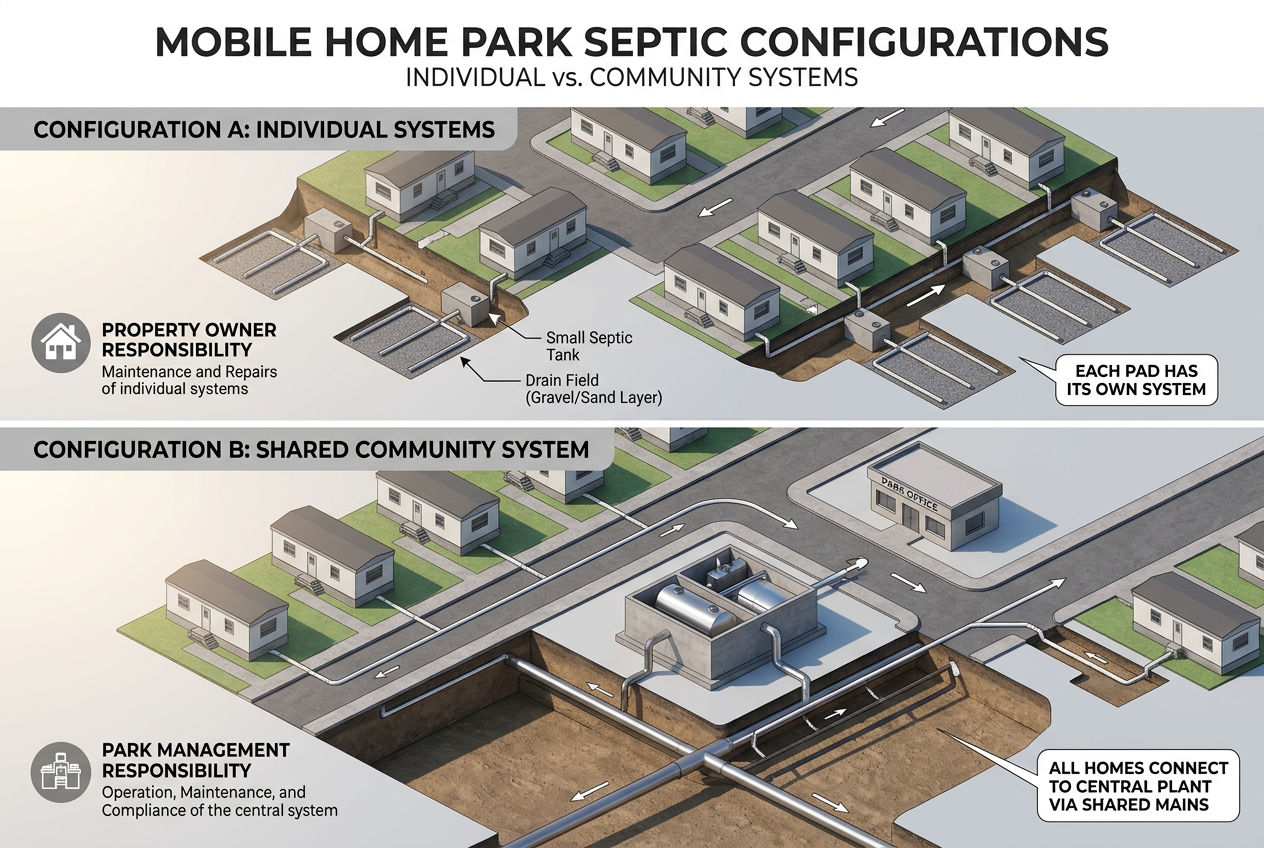
Shared Community Systems
Shared systems in mobile home parks fall under state environmental agency oversight — not just local health departments. Parks with 20 or more units often use package treatment plants: engineered systems that treat wastewater to a higher standard before dispersal. These are regulated as small wastewater treatment facilities in most states.
Individual Lots Within Parks
- Rental parks: Hookup to the community system is usually handled by the park operator
- Mobile home subdivisions: If you own your land, you may have your own individual system, and the rules above apply to you directly
📊 Quick Fact: The installation cost for a shared community system runs $5,000–$15,000+ per unit when you divide the total system cost across lot count. That cost is typically baked into park infrastructure, not charged directly to residents.
✅ Pro Tip: If you're buying into a mobile home park and the community septic system is aging, ask to see the last inspection report. Shared septic system rights can be complicated when systems need repair.
Double-Wide Septic Systems: What Changes?
A double-wide septic system isn't dramatically different from a single-wide setup — it's a bedroom-count and flow calculation question more than a structural one.
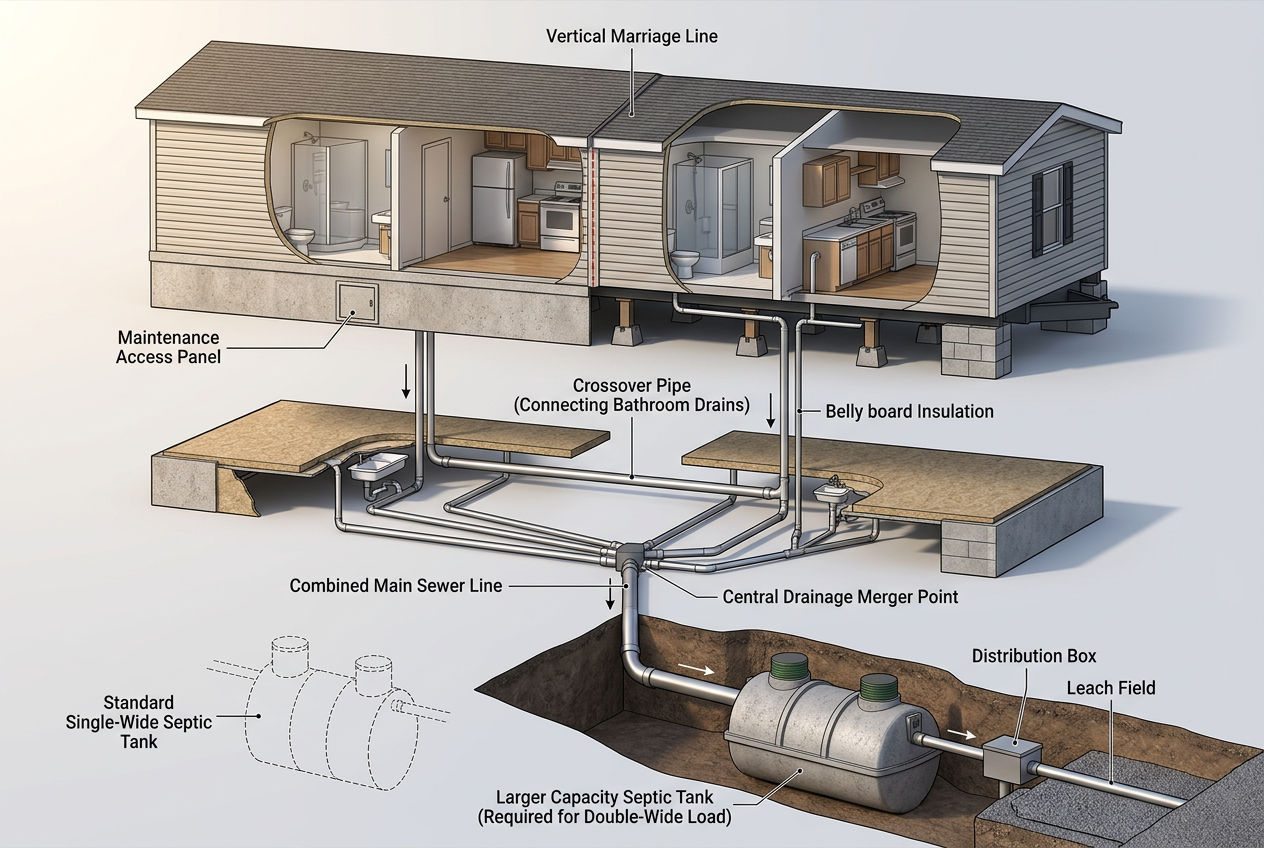
Tank Sizing for Double-Wides
- 3-bedroom double-wide generating ~450 gallons per day: 1,000-gallon tank minimum
- 4-bedroom double-wide generating ~600 gallons per day: 1,250-gallon tank recommended
Plumbing Configuration Considerations
What does change: Double-wides are wider (obviously), which affects where the sewer outlet exits and how the connection to the septic tank is routed. Some double-wides have two bathroom groups with separate drain lines that converge at a single outlet.
✅ Pro Tip: Verify the plumbing configuration before your installer designs the tank placement.
When Should You Call a Professional?
Every part of this process benefits from licensed professional involvement, but these moments are non-negotiable:
- Before you buy the land: Have a septic professional evaluate the lot's perc potential. A failed perc test on a rural lot can kill the entire purchase.
- Before you pull permits: Some counties require a licensed engineer to stamp the system design. DIY septic installation is illegal in most states.
Sources & Methodology
-
U.S. Environmental Protection Agency — Federal guidance on onsite wastewater treatment system requirements for manufactured and mobile home installations.
-
U.S. Department of Housing and Urban Development (HUD) — Manufactured home installation standards and site preparation requirements, including utility connections and septic system specifications.
-
University of Minnesota Extension — Research on septic system sizing, soil evaluation, and installation considerations specific to manufactured housing in cold climates.
-
National Onsite Wastewater Recycling Association (NOWRA) — Industry standards for septic system design and installation for various dwelling types, including manufactured homes.
-
USDA Rural Development — Financing programs and grants available for septic system installation on rural properties with manufactured homes.
Cost data reflects 2025–2026 national averages compiled from contractor pricing surveys across SepticTankHub.com's directory network.
Need help with your septic system? Find trusted septic professionals near you to get free quotes. Learn more about septic installation services. Browse local septic companies in Colorado or Minnesota.
Free download
Not ready for the Blueprint? Start free.
Grab the free DIY Septic Planning Kit — the permit-first checklist, perc-test cheat sheet, and sizing tables that keep your build from getting red-tagged.
Was this article helpful?
Frequently Asked Questions
Recommended Resources
📖 Related Articles
- Septic Tank Replacement Cost 2026: $5,000–$15,000 (Full Breakdown)
- How to Test Your Septic System
- Mound Septic System: $10K–$25K Cost & How It Works (2026)
- What Size Septic System Do I Need?
- Buying Rural Property? Septic System Checklist
- How Often Should You Pump Your Septic Tank?
- Shared Septic System Rights: Easements, Cost Splits & Disputes (2026)
Find Septic Professionals Near You
Compare licensed, verified septic companies by area — top county markets and cities below, or browse all 50 states.
County markets
Popular cities
