
Quick Answer
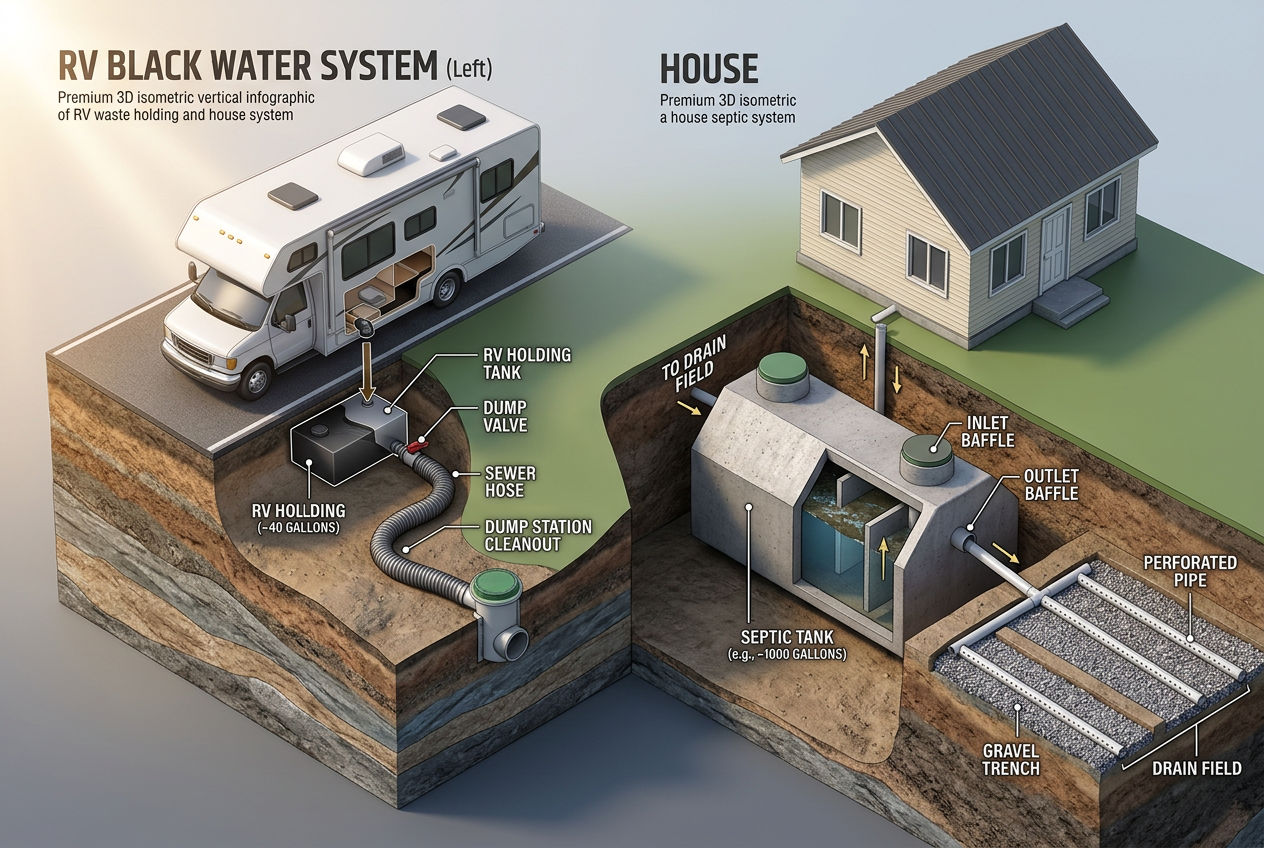
An RV septic system is a self-contained holding tank (15–50 gallons) that stores waste until you dump it at a station or approved site. A house septic system is a permanent, bacteria-driven treatment system anchored by a 1,000–1,500-gallon tank and a drain field that filters effluent into the soil. They both handle human waste — but they work in completely different ways.
💡 Key Takeaways:
- RV black water tanks hold 15–40 gallons; residential septic tanks hold 1,000–1,500 gallons — roughly 25–100 times more capacity.
- RV holding tanks store waste. Residential septic tanks treat waste through anaerobic bacterial digestion.
- Many formaldehyde-based RV toilet chemicals will kill the beneficial bacteria inside a house septic system. Switch to enzyme-based, septic-safe treatments before connecting.
- You can legally connect an RV to a home septic system in many areas — but permits are typically required, and local health department rules vary significantly.
- Adding a permanent RV connection increases daily wastewater load by roughly 10–25%, which may shorten your septic pumping interval from every 3–5 years to every 2–3 years.
What Is the Difference Between a Holding Tank and a Septic Tank?
A holding tank stores waste temporarily. A septic tank processes it biologically. That single distinction drives every practical difference between an RV septic system and a residential one — and missing it leads to expensive mistakes.
How an RV Holding Tank Works
Your RV has two separate holding tanks. The black water tank collects toilet waste. It typically holds 15–40 gallons, though Class A motorhomes sometimes reach 50 gallons. The gray water tank handles sink and shower water and usually runs larger — 30–65 gallons. Neither tank treats waste. They hold it until you connect a 3-inch RV sewer hose and drain everything into a dump station or approved disposal point, which you'll need to do every 3–5 days of active use.
How a Residential Septic Tank Works
A residential septic tank does something fundamentally different. Wastewater flows in from your house. Heavier solids sink to the bottom and form a sludge layer. Lighter fats and grease float to the top as scum. The liquid in the middle — called effluent — exits through the outlet baffle into a drain field (also called a leach field), where perforated pipes distribute it across gravel trenches and the soil filters it naturally. Anaerobic bacteria inside the tank constantly break down solids, which is why the system works for years between pump-outs. According to the EPA, roughly 21% of U.S. households — about 60 million people — rely on this type of onsite septic system.
📊 Quick Fact: With 21% of U.S. households on septic systems, roughly 60 million Americans depend on the same anaerobic bacterial process happening underground — a process that RV holding tanks bypass entirely.
To understand how the full residential process works from inlet to soil absorption, see our guide on how a septic system works.
RV Septic System vs House Septic System: Side-by-Side Comparison
| Feature | RV Septic System | House Septic System |
|---|---|---|
| Tank capacity | 15–50 gal (black water) | 1,000–1,500 gallons |
| System type | Holding tank (storage) | Treatment system (biological) |
| Drain field | None | Required; 300–1,000+ sq ft |
| Bacteria present | No (chemicals suppress) | Yes (essential to function) |
| Pump-out frequency | Every 3–5 days (active use) | Every 3–5 years (EPA guideline) |
| Chemical treatment | RV-specific (often toxic to septic) | Septic-safe products only |
| Gravity or pump fed | Either; portable hose dump | Gravity-fed or pump-assisted |
| Permit required | N/A (standalone) | Yes; county/state regulated |
Sources: EPA Septic Systems Overview (epa.gov/septic); manufacturer specifications for Class A, B, and C motorhomes; NOWRA onsite wastewater industry data.
Can You Hook Up an RV Directly to a Home Septic System?
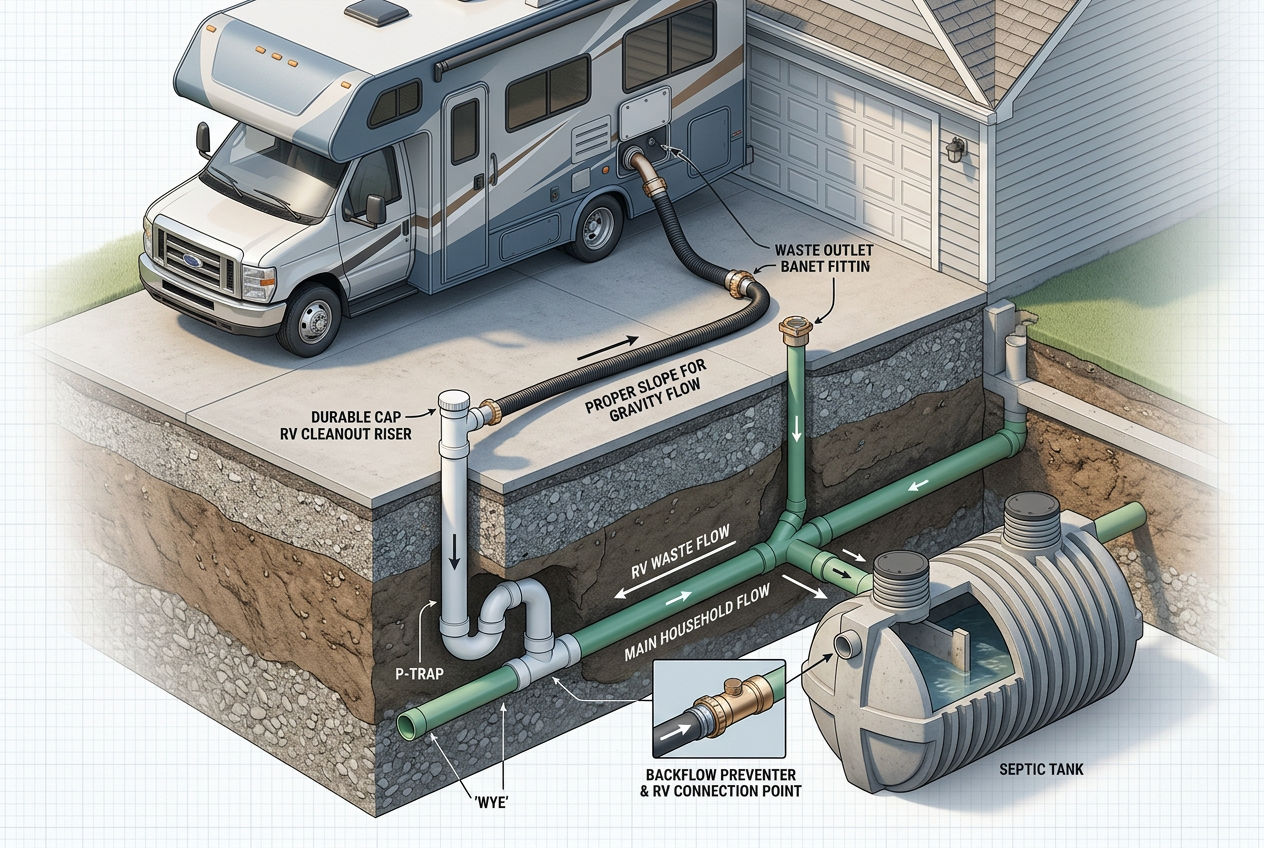
Yes — in many cases you can connect an RV to a residential septic system, but it requires a proper connection point, the right slope, and in most jurisdictions, a permit. Running an RV sewer hose across your yard and dropping it into a cleanout is neither safe nor legal.
Gravity-Fed vs Pump-Assisted
Gravity-fed connection: The RV must be parked uphill of, or at the same elevation as, the septic tank inlet. The connection requires a minimum slope of ¼ inch per foot so waste flows by gravity through the 3-inch sewer line into the tank's inlet side. This is the simplest and most common approach for permanent or semi-permanent RV parking on a property.
Pump-assisted connection: If the RV sits at a lower elevation than the tank, a macerator pump or a small lift station can push waste uphill to the system. This adds complexity and a point of failure, but it works reliably when installed by a licensed contractor.
Where to Connect
The connection point matters: Never tee directly into your drain field outlet line. RV waste must enter the septic tank at the inlet side so solids have the full residence time needed for bacterial processing. Bypassing the tank and dumping RV black water directly into or near the drain field risks clogging the leach laterals — a repair that can cost $3,000–$15,000 depending on your drain field replacement cost.
⚠️ Warning: Never tee into the drain field outlet line or any pipe downstream of the septic tank. RV black water entering the drain field directly will clog the leach laterals with raw solids — a failure that often requires full drain field replacement.
Before running any pipe, get your tank inspected. An aging 1,000-gallon concrete tank that was already near capacity for a 4-person household doesn't have much margin for an additional waste stream. A septic inspection before any RV connection project is the right starting point.

DIY Septic Blueprint
Thinking about building it yourself?
The complete, plain-English plan to size, permit and install your own septic system — designed for homeowners, not contractors. Skip the $15,000–$25,000 quotes and do it right the first time.
Get the DIY Blueprint — $67 →Instant download · 8 modules + 3 bonus guides · 60-day money-back guaranteeWill RV Tank Chemicals Damage a Septic System?
The wrong RV toilet chemicals will kill the anaerobic bacteria that make your residential septic system function — and the damage isn't immediate, which makes it easy to miss until your drain field is already compromised.
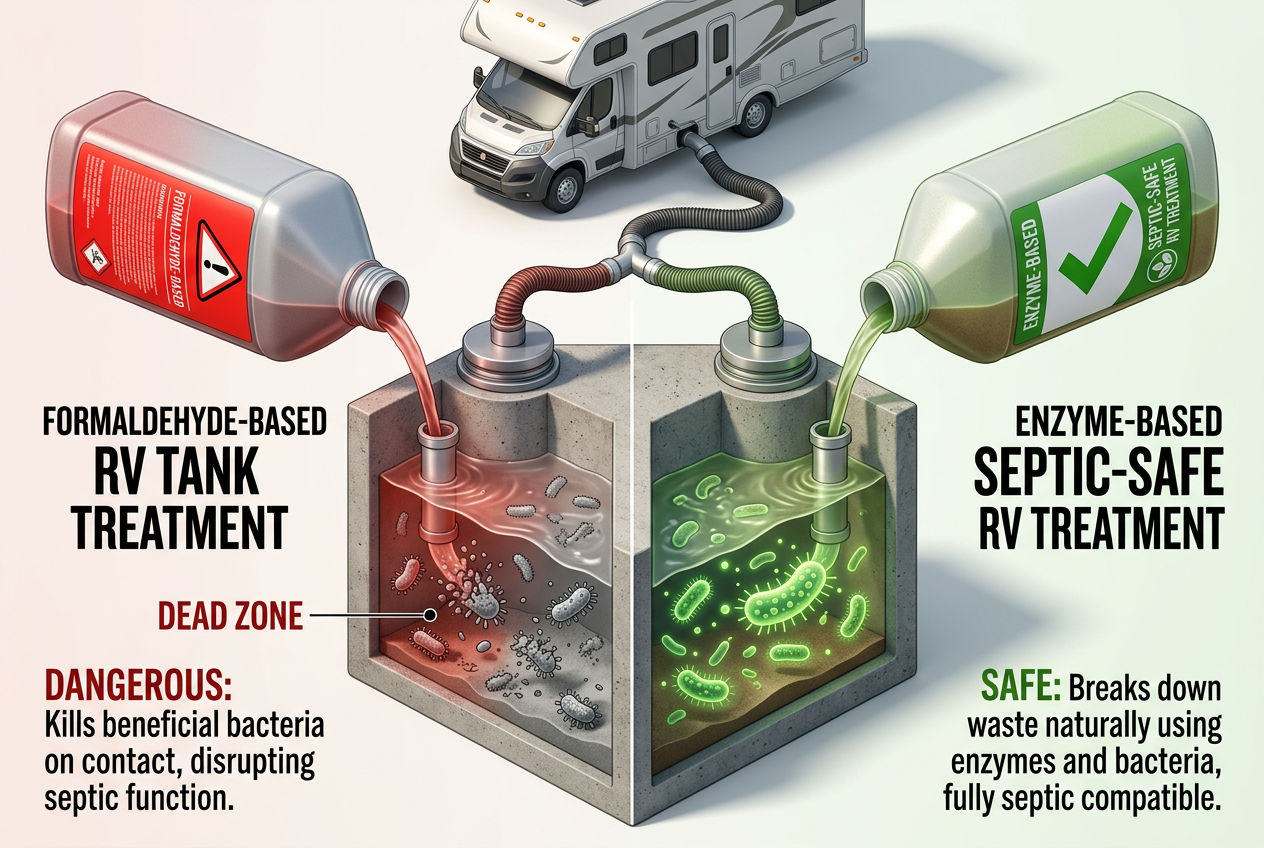
Older formaldehyde-based RV deodorizers are the primary culprit. Formaldehyde is a broad-spectrum biocide. It does exactly what it's supposed to do in an isolated holding tank — suppress odor-causing organisms. But introduce it into a residential septic tank and it starts killing the same bacteria your system depends on to break down solids. According to the National Onsite Wastewater Recycling Association (NOWRA), repeated introduction of biocidal chemicals is one of the leading causes of premature bacterial colony collapse in residential tanks. After repeated exposures, the bacterial colony inside your tank can take weeks to recover, during which partially digested solids pass into the drain field as raw sludge.
Septic-Safe RV Alternatives
Switch to enzyme-based, septic-safe RV toilet treatments. Products like Unique RV Digest-It, TankTechsRx, and Happy Campers Organic Holding Tank Treatment use natural enzymes and beneficial bacteria instead of biocides. They control odor without harming the downstream system. Check labels for the words "septic safe" and confirm there's no formaldehyde, bronopol, or quaternary ammonium compounds in the formula.
💡 Key Takeaway: Switching from formaldehyde-based to enzyme-based RV toilet treatments is the single most important step before connecting an RV to a residential septic system. It protects the bacterial colony your entire system depends on.
One honest limitation worth stating: even enzyme-based treatments vary in formulation quality, and "septic safe" on the label isn't a regulated certification in most states. When in doubt, contact the manufacturer directly and ask for their third-party test data on bacterial impact.
⚠️ Important: If you've already been using formaldehyde-based chemicals through an RV-to-septic connection, stop immediately and have your tank pumped. The bacterial colony inside your septic tank may need several weeks to recover before the system functions normally again.
For a broader look at which products are safe to use with a septic system, our septic-safe products guide covers RV treatments alongside household cleaners and laundry detergents.
Do You Need a Permit to Connect an RV to a Septic System?
In most U.S. counties, yes. Connecting an RV to a residential septic system is considered a modification to a permitted wastewater system, and that typically requires a permit from your local health department or building authority. Permit costs usually run $50–$500 depending on jurisdiction — a small line item compared to what it costs to fix an unpermitted system later.
Regulations vary significantly by state and county:
- Texas delegates septic oversight to county-level Authorized Agents. Some rural Texas counties have relaxed requirements for seasonal RV connections on agricultural property. Others require engineered plans for any new sewer tie-in.
- Florida requires all septic work to be performed by a Registered Septic Tank Contractor (RSTC) licensed through the Florida Department of Health. An unpermitted RV connection can trigger fines and mandatory removal.
- Oregon and Washington have stricter environmental oversight of onsite wastewater systems. The Oregon DEQ requires permits for any addition to an existing system that increases the daily flow.
- Rural Mountain West states (Colorado, Montana, Idaho) often have county-by-county variance. Properties on acreage in unincorporated areas may have more flexibility, but that varies even within a single county.
✅ Pro Tip: Call your county health department before buying materials or hiring a contractor. A 5-minute phone call can tell you exactly what permits, inspections, and contractor licenses your county requires — and save you from fines or mandatory removal later.
Check with your county health department before any physical work begins. And if you're buying rural property with plans to add an RV hookup, put "permission to connect RV to existing septic" on your due-diligence checklist. Our septic system checklist for rural property buyers covers exactly this scenario.
How Does an RV Connection Affect Septic Tank Pumping Frequency?
Adding an RV to your home septic system increases the daily wastewater volume entering your tank. How much depends on how often the RV is occupied.
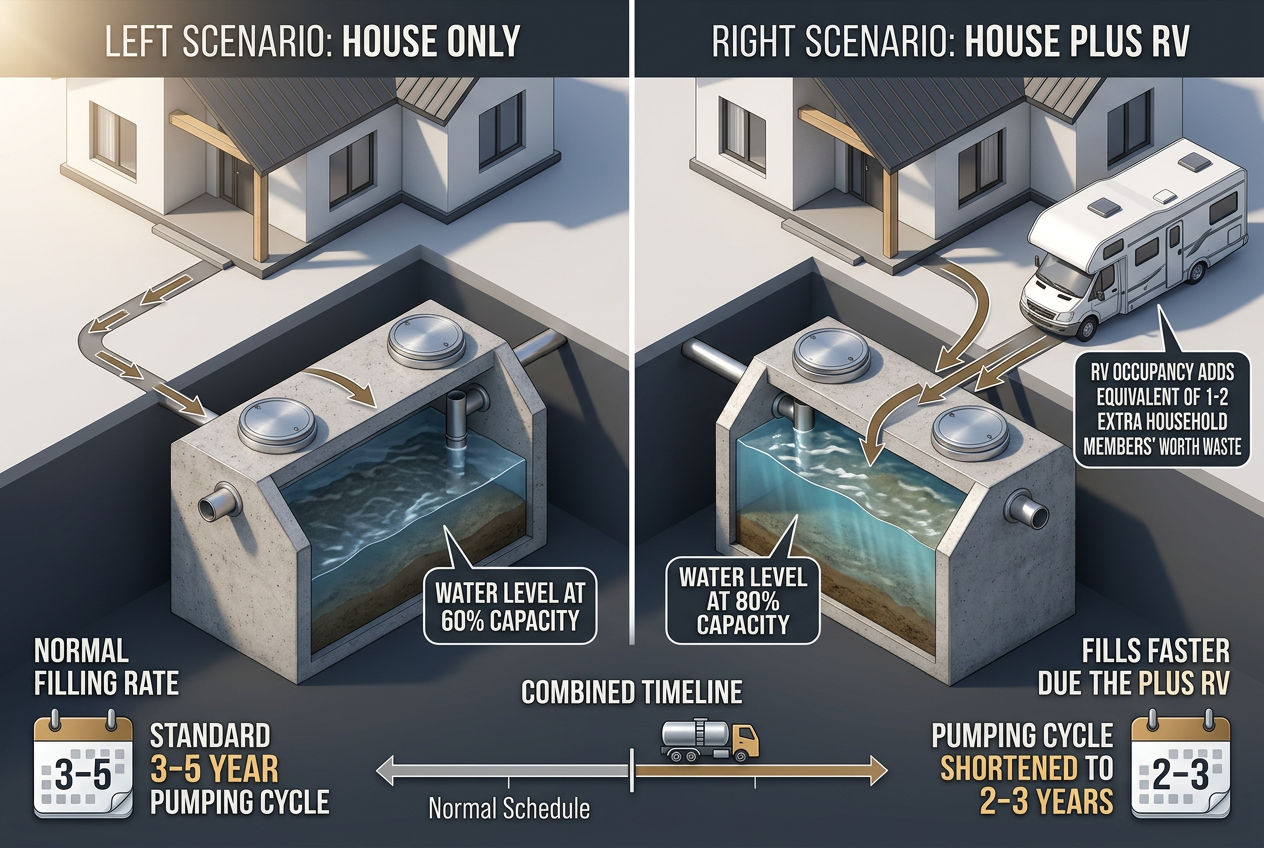
The average household produces 200–300 gallons of wastewater per day, according to EPA estimates. A couple living or camping in an RV adds roughly 20–50 gallons per day. That's a 10–25% increase in daily load — meaningful, but manageable if your septic system was properly sized for your home in the first place.
📊 Quick Fact: Adding just two RV occupants to a 1,500-gallon residential system increases daily wastewater load by 17% — enough to move your pumping schedule forward by 6–18 months over a decade.
Worked example: A 1,500-gallon tank serving a family of four handles roughly 240 gallons per day. At that rate, the liquid fraction turns over approximately every 6 days, and solids accumulate to pump-out threshold in about 3–5 years. Add two RV occupants generating 40 gallons per day, and daily load rises to 280 gallons — a 17% increase. Solids now reach pump-out threshold closer to every 2.5–3 years. That single change moves your pumping schedule forward by 6–18 months over a decade and adds roughly $300–$600 per additional pump-out, per the national average documented in our septic pumping cost guide.
If your tank was already undersized for your household, or if your system is more than 20 years old, that added load matters even more. Schedule a septic pumping and cleaning service before the RV season starts, and revisit how often to pump your septic tank with your new usage numbers in mind.
RV Septic System Hookup: Pre-Connection Checklist
Before connecting an RV gray water or black water tank to a residential septic system, confirm each of the following:
- Tank capacity confirmed — Your residential tank was sized for your household. Use our septic system sizing guide to verify it can handle the added load.
- Permit obtained — Contact your county health department. Don't skip this step.
- Slope verified — Minimum ¼ inch drop per foot from the RV sewer outlet to the septic tank inlet.
- Connection point correct — Tie in at the inlet side of the tank, never at the outlet or anywhere near the drain field.
- RV chemicals switched — Replace any formaldehyde-based treatments with enzyme-based, septic-safe alternatives before the first flush.
- Inspection scheduled — Have a licensed technician inspect the tank and drain field before first use and again after the first full season.
Missing any one of these steps — particularly the permit or the connection point — is how a straightforward RV parking situation turns into a $10,000 drain field problem.
⚠️ Warning: Skipping the permit or connecting to the wrong side of the tank are the two most common mistakes homeowners make with RV hookups. Either one can result in fines, mandatory disconnection, or drain field failure costing $3,000–$15,000 to repair.
💡 Tip: Keep a written log of your RV occupancy dates and estimated daily water usage. When it's time for your next septic pump-out, share this data with your technician so they can assess whether your current tank size and pumping schedule are still adequate.
Sources & Methodology
-
U.S. Environmental Protection Agency — Federal guidance on residential septic system standards and onsite wastewater treatment requirements.
-
Recreation Vehicle Industry Association (RVIA) — RV waste system specifications, holding tank capacity standards, and manufacturer guidelines for waste disposal.
-
National Park Service — Dump station regulations and RV wastewater disposal requirements at federal campgrounds and recreation areas.
-
University of Minnesota Extension — Research on residential septic system capacity, sizing requirements, and the impact of supplemental wastewater sources on system performance.
-
National Onsite Wastewater Recycling Association (NOWRA) — Professional standards for residential septic system design and the effects of connecting RV waste to household septic systems.
Cost data reflects 2025–2026 national averages compiled from contractor pricing surveys across SepticTankHub.com's directory network.
Need help with your septic system? Find trusted septic professionals near you to get free quotes. Browse local septic companies in South Carolina or Missouri.
Free download
Not ready for the Blueprint? Start free.
Grab the free DIY Septic Planning Kit — the permit-first checklist, perc-test cheat sheet, and sizing tables that keep your build from getting red-tagged.
Was this article helpful?
Frequently Asked Questions
Recommended Resources
📖 Related Articles
💰 Cost Guides
Find Septic Professionals Near You
Compare licensed, verified septic companies by area — top county markets and cities below, or browse all 50 states.
County markets
Popular cities
