
Quick Answer
A shared septic system is a single onsite wastewater system — tank, drain field, or both — legally serving two or more properties. Rights and responsibilities are governed by recorded easements, deeds, or maintenance agreements. Without a written agreement, cost disputes and repair conflicts are common. Always verify easement status through a title search before buying.
💡 Key Takeaways
- Two houses can legally share one septic system, but only with proper permits, adequate tank sizing, and a recorded easement.
- Without a written maintenance agreement, you have no guaranteed way to enforce cost-sharing when the system fails.
- Shared systems can save each household 25–40% on installation costs compared to two separate systems.
- A title search reveals whether a septic easement is formally recorded — many informal shared systems have nothing on file.
- If your neighbor refuses to pay for repairs, you have legal options — but they take time and money to pursue.
Can Two Houses Legally Share One Septic System?
Yes — two houses can legally share one septic system in most U.S. states, but local health departments must permit the arrangement, the system must be sized for the combined wastewater load, and a recorded easement or shared use agreement is typically required. Without those three things, a shared system may be operating illegally.
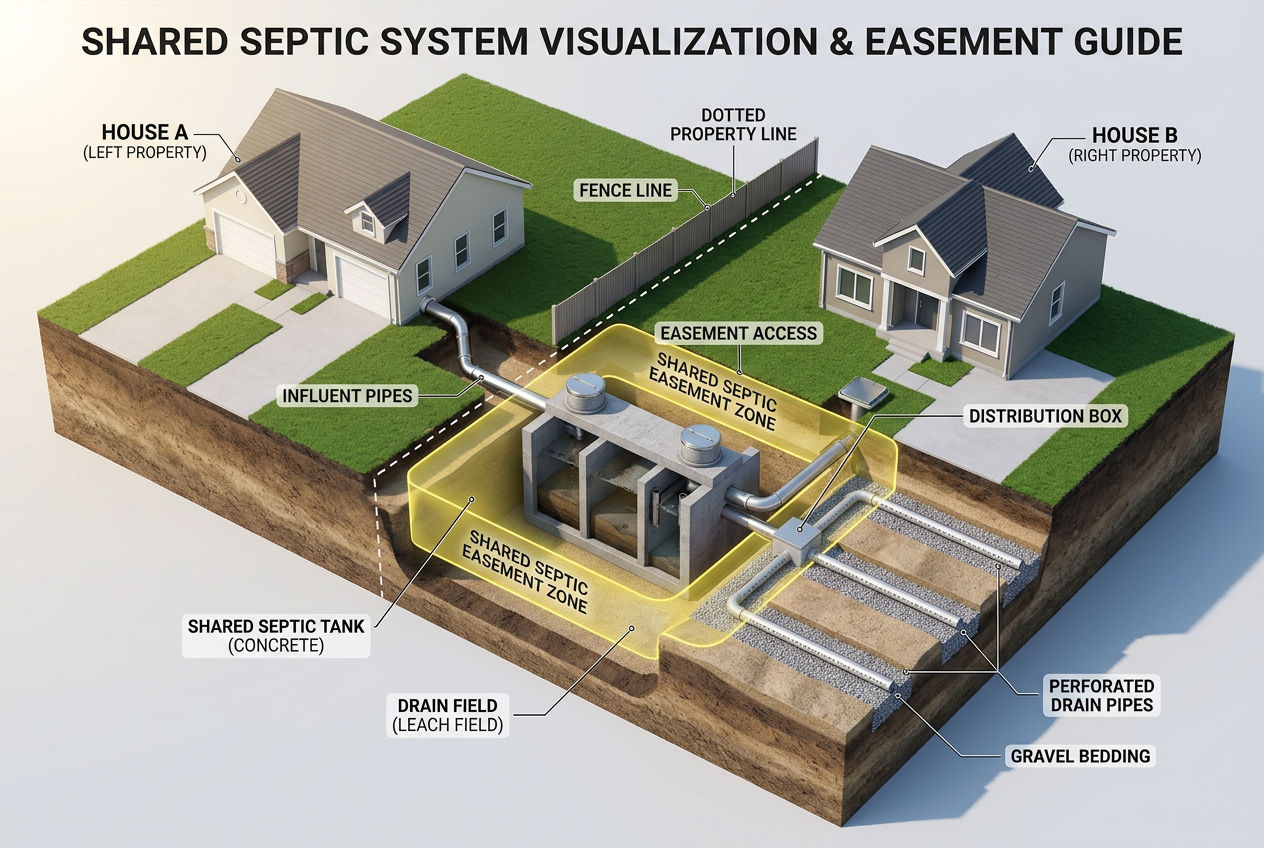
📊 Quick Fact: About 20% of U.S. homes rely on septic systems — roughly 60 million people, according to the EPA. In rural areas, shared systems are common, especially on older properties established before modern permitting laws existed.
Some were installed with proper legal documentation. Many were not.
Three Legal Requirements for Shared Systems
Whether two homes can share a system legally depends on:
-
System capacity. A 1,000-gallon tank is the minimum for a single home with 1–3 bedrooms. Two homes sharing a system typically need a 1,500–2,500+ gallon tank, depending on the combined bedroom count and daily wastewater flow. The EPA estimates average daily flow at 60–70 gallons per person. A household of four generates roughly 240–280 gallons per day. Add a second household and you're looking at 480–560 gallons daily — minimum.
-
Drain field sizing. The shared drain field (sometimes called a leach field) must be engineered to handle the combined hydraulic load. Undersized leach laterals are the number-one cause of failure in shared systems.
-
Legal documentation. State and county health departments regulate shared systems. North Carolina, Virginia, and Washington State have some of the most well-developed regulations governing community and shared onsite systems. Other states leave it to county health departments, which means the rules can vary dramatically even within the same state.
⚠️ Warning: Before you assume your shared system is legal, pull the permit history from your county health department. You may be surprised — or alarmed — by what you find.
What Is a Septic System Easement and How Do You Find One?
A septic system easement is a recorded legal right allowing one property to use part of a neighboring property for septic system access, piping, or drain field placement. Without a recorded easement, a property has no guaranteed legal right to use infrastructure that crosses another owner's land.
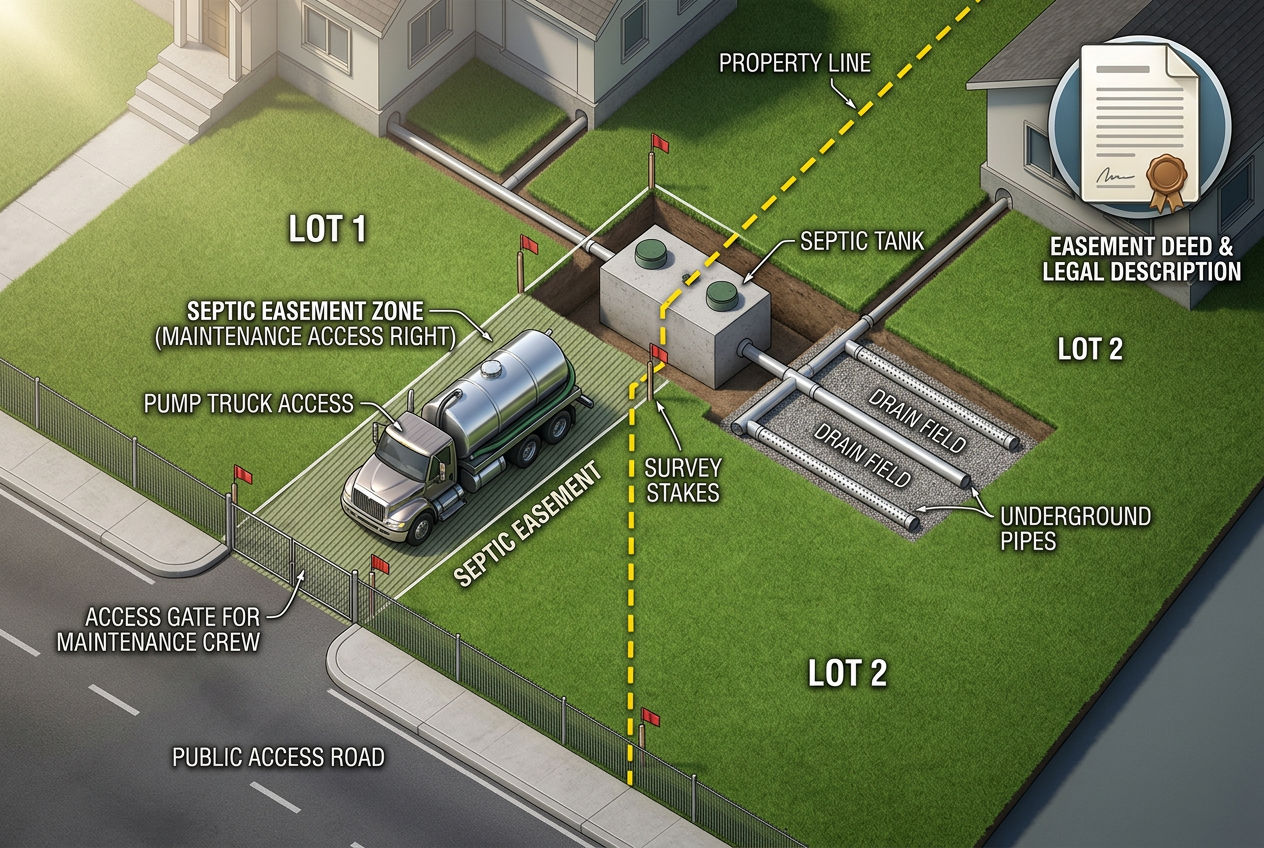
Here's the problem: a significant number of shared systems in rural markets were installed informally, with no recorded easement on file. Title companies and real estate attorneys frequently flag this in rural transactions. If you've bought a home and the drain field sits partially on your neighbor's land — or vice versa — with nothing recorded in the deed, you're in legally uncertain territory.
How to Find Out if There's an Easement on Your Property
- Order a title search. This is the most reliable method. A title search examines your property's chain of ownership and identifies all recorded easements, restrictions, and encumbrances. Cost: $75–$200 for a basic search.
- Check your property deed. Easements are often (but not always) referenced in the property deed itself.
- Contact your county recorder's office. Recorded easements are public documents. Many counties now offer online access.
- Review the property survey. A licensed surveyor's plat may show utility and access easements graphically.
✅ Pro Tip: If there's no recorded easement but a shared system has been operating for years, you may be dealing with what lawyers call a prescriptive easement — essentially an implied legal right that arises from long, continuous, uninterrupted use.
The statute of limitations to establish a prescriptive easement varies by state: as short as 5 years in some states, as long as 20 years in others. If you think this applies to your situation, talk to a real estate attorney. This is not a gray area you want to navigate without legal help.
Free download
Free: the Septic Fridge Card — what to flush, what never to.
The Do / Don’t card the whole family can see, plus the Survival Kit: emergency flowchart, warning-sign decoder and pump-schedule card. One printable PDF.
Who Is Responsible for Maintaining a Shared Septic System?
Responsibility for maintaining a shared septic system is determined first by any written maintenance agreement, second by the property deed or recorded easement, and third — if neither exists — by state law and local precedent. Without documentation, "responsibility" becomes whatever you and your neighbor can agree on, or whatever a judge decides.
This is why a shared septic system maintenance agreement isn't optional — it's the document that prevents a $3,000 pump-out from turning into a $30,000 lawsuit.
What a Solid Maintenance Agreement Should Cover
-
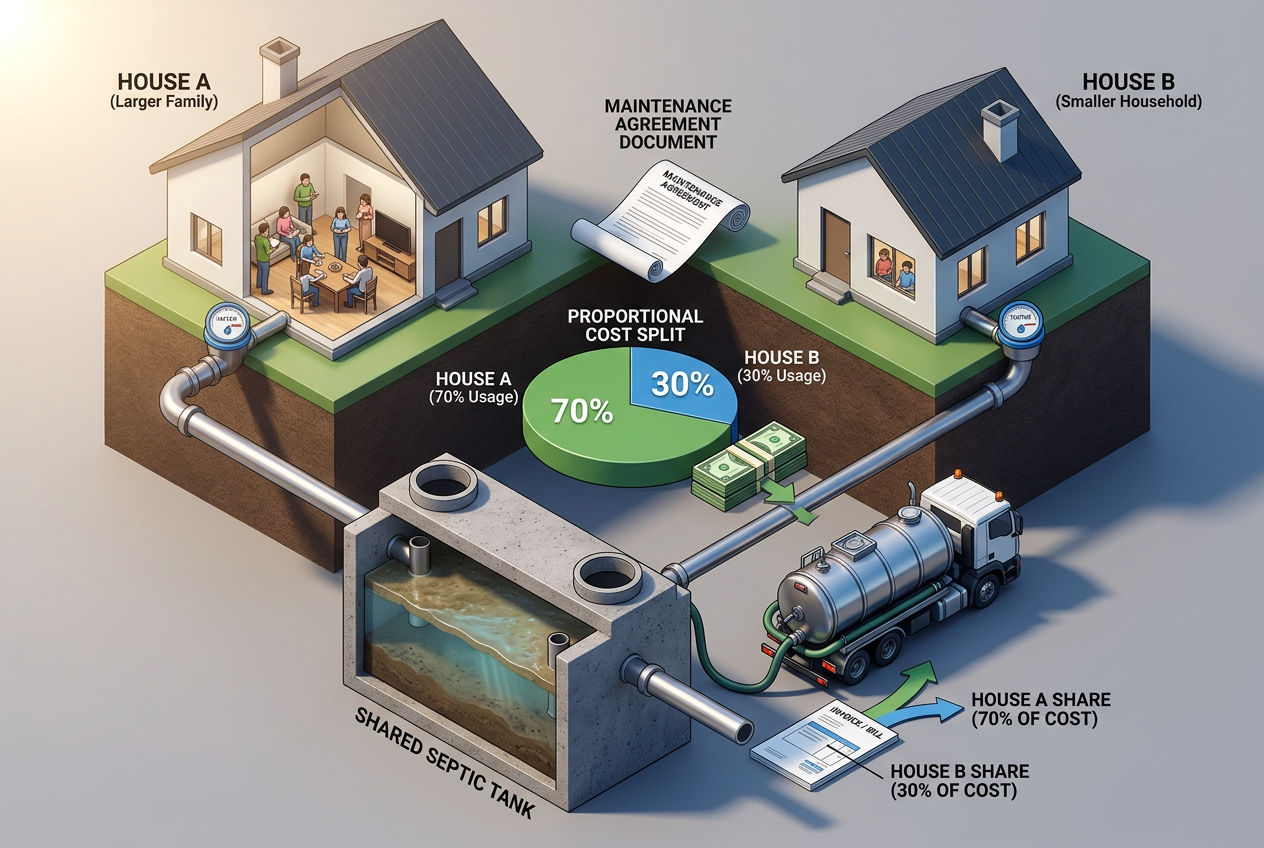
Cost-splitting formula. The most common approach is a 50/50 split for shared components. Some agreements base the split on bedroom count, daily water usage, or number of occupants. A two-bedroom home and a five-bedroom home probably shouldn't split costs equally — that's a conversation to have before a problem forces it.
-
Who schedules service. Designate one property owner to coordinate pumping and inspections. Shared responsibility without a point person means things get neglected.
-
Pumping schedule. For a 1,500-gallon tank serving two households totaling six people, pumping every 2–3 years is reasonable. Add garbage disposals to both homes and that schedule shortens. A licensed pumper can measure sludge depth with a sludge judge and give you a data-based recommendation.
-
Repair authorization. Define a dollar threshold — say, $500 — below which either party can authorize repairs. Above that threshold, both owners must agree in writing.
-
Dispute resolution process. Specify mediation before litigation. Professional mediators typically charge $100–$300/hour, which is substantially cheaper than real estate litigation at $200–$400/hour.
-
What happens on sale. The agreement should transfer with the property and bind future owners.
⚠️ Warning: Get the agreement recorded with your county. An unrecorded agreement is worth less than the paper it's printed on if one party sells and the new owner claims ignorance.
How Should Shared Septic System Costs Be Split?
Shared septic system costs should be divided based on proportional use, though equal splits are acceptable when both properties have similar household sizes. Common costs include routine pumping ($300–$600 per service), inspections ($300–$600), and repairs that can range from $1,500–$5,000 for minor fixes to $10,000–$25,000+ for full drain field replacement.
Real-World Cost Splitting Example
Picture this: two neighboring homes share a 2,000-gallon concrete tank and a combined drain field. Home A has three bedrooms and two occupants. Home B has four bedrooms and five occupants. The drain field fails — saturated laterals, sewage surfacing in the yard. Full replacement: $18,000.
| Split Method | Home A Pays | Home B Pays | Rationale |
|---|---|---|---|
| Bedroom count (3:4 ratio) | $7,714 | $10,286 | Based on property capacity |
| Flat 50/50 split | $9,000 | $9,000 | Equal responsibility |
| Occupancy (2:5 ratio) | $5,143 | $12,857 | Based on actual usage |
Which is "fair" depends on how your agreement is written. Without an agreement, you're arguing about fairness with a neighbor while sewage soaks into your yard.
💡 Key Takeaway: Installation of a conventional system for one home runs $3,500–$10,000. For advanced or alternative systems (mound, aerobic, drip irrigation), costs jump to $15,000–$30,000+. Sharing a system typically saves each household 25–40% on installation.
That's real money — but only worth it if the legal framework is solid from day one.
For detailed cost breakdowns, see our septic installation cost guide and septic repair cost guide.
Common Shared System Expenses
| Expense | Typical Cost Range | Common Split Method |
|---|---|---|
| Tank pumping | $300–$600 | 50/50 or by occupancy |
| Septic inspection | $300–$600 | 50/50 |
| Minor repair (baffle, filter) | $1,500–$5,000 | 50/50 or by use |
| Drain field replacement | $10,000–$25,000+ | By bedroom count |
| Full system replacement | $15,000–$30,000+ | Per written agreement |
Cost data sourced from national contractor averages; regional variation is significant. Get local quotes for accurate estimates.
What Happens When a Neighbor Won't Pay for Septic Repairs?
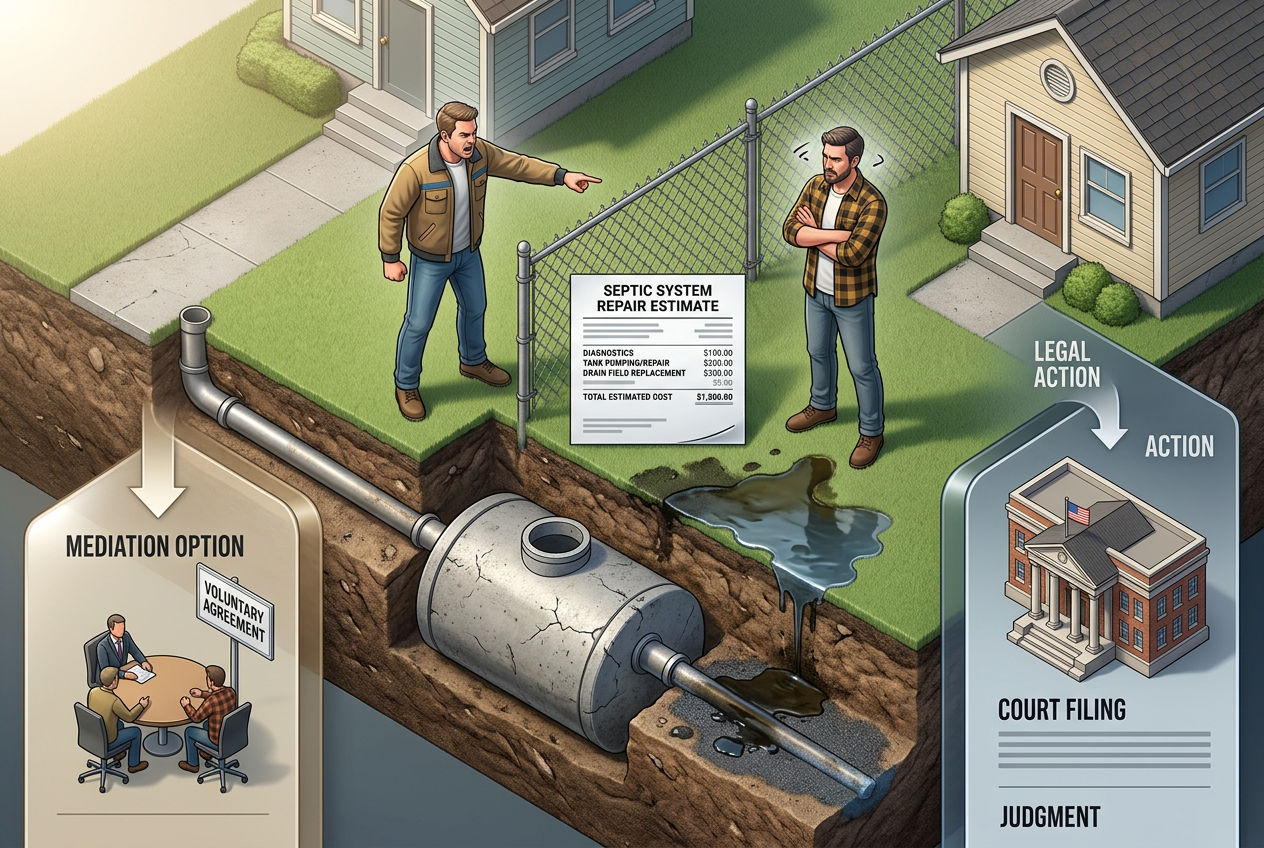
When a neighbor refuses to pay their share of shared septic system repairs, your options — in order of speed and cost — are direct negotiation, formal written demand, mediation, small claims court (for smaller amounts), and civil litigation.
⚠️ Warning: Do not let the system go unrepaired while you wait. A failing system is a health hazard and can violate state environmental regulations regardless of whose fault the dispute is.
The Five-Step Resolution Process
Step 1: Document everything. Get the system inspected by a licensed septic professional. Get a written repair estimate. Put the repair need in writing to your neighbor via certified mail. Date everything. This paper trail matters enormously if you end up in court.
Step 2: Review your agreement and easement. If you have a recorded maintenance agreement, it should specify what happens when one party refuses to pay. If the agreement includes an arbitration clause, you're required to use it before suing.
Step 3: Try mediation. Many counties offer low-cost or free neighbor dispute mediation services. A neutral third party often resolves what direct conversation cannot.
Step 4: Proceed with repairs anyway — carefully. If the system poses a health or environmental risk, you may need to repair it and then sue for reimbursement. Check with a real estate attorney before doing this — some states allow you to place a lien on the neighbor's property for their unpaid share of shared infrastructure costs. Others don't.
Step 5: Small claims or civil court. For amounts under $5,000–$10,000 (limits vary by state), small claims court is accessible without an attorney. Above that threshold, you're looking at civil litigation — which is expensive, time-consuming, and not guaranteed.
💡 Key Takeaway: If a neighbor can't afford their share of a $20,000 drain field replacement, winning in court doesn't guarantee you'll collect. A judgment is only as good as the debtor's ability to pay.
If you're dealing with a neighbor whose septic is physically on your property without your permission, that's a septic system encroachment — a separate (and more serious) legal issue requiring immediate consultation with a real estate attorney.
Should You Agree to Share Your Septic System With a Neighbor?
If a neighbor asks to connect to your existing septic system, think carefully before agreeing — even if the offer seems financially attractive. Your system was sized for your household's wastewater load. Adding a second household increases hydraulic stress on the tank, distribution box, and drain field. A 1,000-gallon tank and 600-square-foot drain field designed for a 3-bedroom home will not perform the same with two homes connected to it.
Requirements Before Agreeing to Share
Before agreeing, require all of the following:
-
A licensed septic inspector evaluates your current system's capacity. See our septic inspection cost guide for what to expect.
-
Your county health department permits the shared arrangement. Connecting without a permit can trigger fines and require disconnection at your expense.
-
The system is upgraded if necessary. Don't absorb the cost of an undersized system just because a neighbor wants to save money on a new installation.
-
A formal easement and maintenance agreement are recorded before connection. Not signed and filed in a drawer — recorded at the county.
-
Your homeowners insurance is reviewed. Some policies exclude damage related to shared infrastructure. Check our article on homeowners insurance and septic systems to understand your exposure.
⚠️ Warning: The cost savings are real — but so is the liability. If a shared system fails and causes a neighbor's home to back up with sewage, they may look to you first.
Buying a Home With a Shared Septic System: What to Check
Real estate disclosure laws in most states require sellers to disclose known shared septic arrangements. "Known" is the operative word. Many sellers genuinely don't know their system is shared — especially on older rural properties.
Pre-Closing Due Diligence Checklist
Before closing on a home with a shared septic system:
-
Order a title search specifically looking for septic easements. Don't assume the general title search catches everything.
-
Get a full septic inspection by a licensed inspector — not a visual check, but a full load test and tank inspection. Budget $300–$600. For a shared system, it's worth every dollar.
-
Request the permit history from the county health department. This tells you whether the shared arrangement is permitted, how old it is, and what the permitted capacity is.
-
Get the maintenance agreement in writing before closing. If none exists, require one as a condition of purchase.
-
Ask how costs have been split historically. A verbal agreement that's worked for 20 years is better than nothing — but it still needs to become a written, recorded agreement.
✅ Pro Tip: For buyers in rural areas, also check whether the property shares a well. Shared well and septic systems are a separate layer of complexity that deserves its own due-diligence checklist.
For a full rural property checklist, see our septic system checklist for rural properties.
A Note on State and Regional Variation
Septic regulations are governed at the state and county level. The rules in North Carolina — which has a detailed framework for community onsite systems through the state's On-Site Water Protection Branch — are very different from the rules in a rural Montana county where the local health department has limited staff and wide discretionary authority.
Washington State regulates large onsite sewage systems (LOSS) serving multiple properties under a specific permitting framework administered by local health jurisdictions. In Florida, all work on shared systems must be performed by a contractor holding a Registered Septic Tank Contractor (RSTC) license through the Florida Department of Health. Virginia requires shared systems to be permitted under VDH regulations, with site evaluations valid only for the originally permitted load.
In New England and the rural-suburban Mid-Atlantic, shared systems are particularly common on older subdivided lots — many predating modern permitting requirements. If you're buying a property in these regions, confirm with the county health department whether the existing arrangement is legally permitted before closing.
💡 Key Takeaway: Don't assume your shared system arrangement is grandfathered just because it's been working for decades. Verify with your county health department and order a title search to confirm any recorded easements.
Sources & Methodology
-
U.S. Environmental Protection Agency — Federal guidance on shared and community septic systems, including design standards and maintenance responsibilities.
-
National Association of Realtors (NAR) — Guidance on shared system disclosure requirements, easement documentation, and property transfer considerations.
-
American Bar Association (ABA) — Legal resources on easement law, shared utility agreements, and dispute resolution mechanisms for shared infrastructure.
-
National Onsite Wastewater Recycling Association (NOWRA) — Industry standards for shared septic system design, maintenance agreements, and cost-sharing frameworks.
-
National Environmental Services Center (NESC) — Technical and legal guidance on community and shared onsite wastewater systems, including model shared system agreements.
Cost data reflects 2025–2026 national averages compiled from contractor pricing surveys and legal fee schedules across SepticTankHub.com's directory network.
Navigating a shared septic system? Browse licensed septic professionals in North Carolina, Virginia, Washington, Florida, or Montana — or find a pro in any state on our homepage.
Was this article helpful?
Frequently Asked Questions
Recommended Resources
📖 Related Articles
💰 Cost Guides
🔧 Services
Find Septic Professionals Near You
Compare licensed, verified septic companies by area — top county markets and cities below, or browse all 50 states.
County markets
Popular cities
