
Quick Answer
A hot tub and a septic system can coexist on the same property. Whether draining one into the other is a good idea — that's a different question entirely.
The short answer: usually not directly, and in many counties, not legally. The longer answer involves water volume, chemistry, timing, and your specific system's capacity. Get any one of those wrong and you're looking at a $5,000–$20,000 drain field replacement instead of a clean, refilled spa.
Here's what you need to know before you open that drain valve.
💡 Key Takeaways
- A standard hot tub holds 300–500 gallons — that's up to 40% of a 1,000-gallon septic tank, dumped in minutes
- Hot tub chlorine (3–5 ppm) and bromine at the same levels can kill the beneficial bacteria your septic system depends on
- Many states and counties explicitly prohibit routing hot tub discharge to a septic system — check with your local health department before you drain
- Safe options include dechlorinating and draining slowly, draining to a grassy area, or using a municipal connection if available
- Spring and fall are the highest-risk times to add volume — drain fields are often already saturated
Can You Drain a Hot Tub Into a Septic Tank?
Technically, water physically enters a septic tank when you drain a hot tub to it. Whether your system survives that event intact is what the rest of this article is about.
The scale of the problem: The EPA estimates roughly 20% of U.S. homes — about 21 million households — rely on private septic systems. A large share of those homeowners also own hot tubs or are considering one. The problem is that hot tub water creates two distinct threats when it enters a septic system:
- Chemical threat from sanitizers (chlorine, bromine)
- Hydraulic threat from sheer volume
Most competing articles written from the hot tub industry's perspective mention one or the other. As a septic professional, you need to understand both.
Will Hot Tub Chemicals Kill the Bacteria in My Septic System?
Yes — at operating concentrations, they can. A properly maintained hot tub runs at 3–5 ppm (parts per million) of free chlorine, or 3–5 ppm of bromine as an alternative sanitizer.
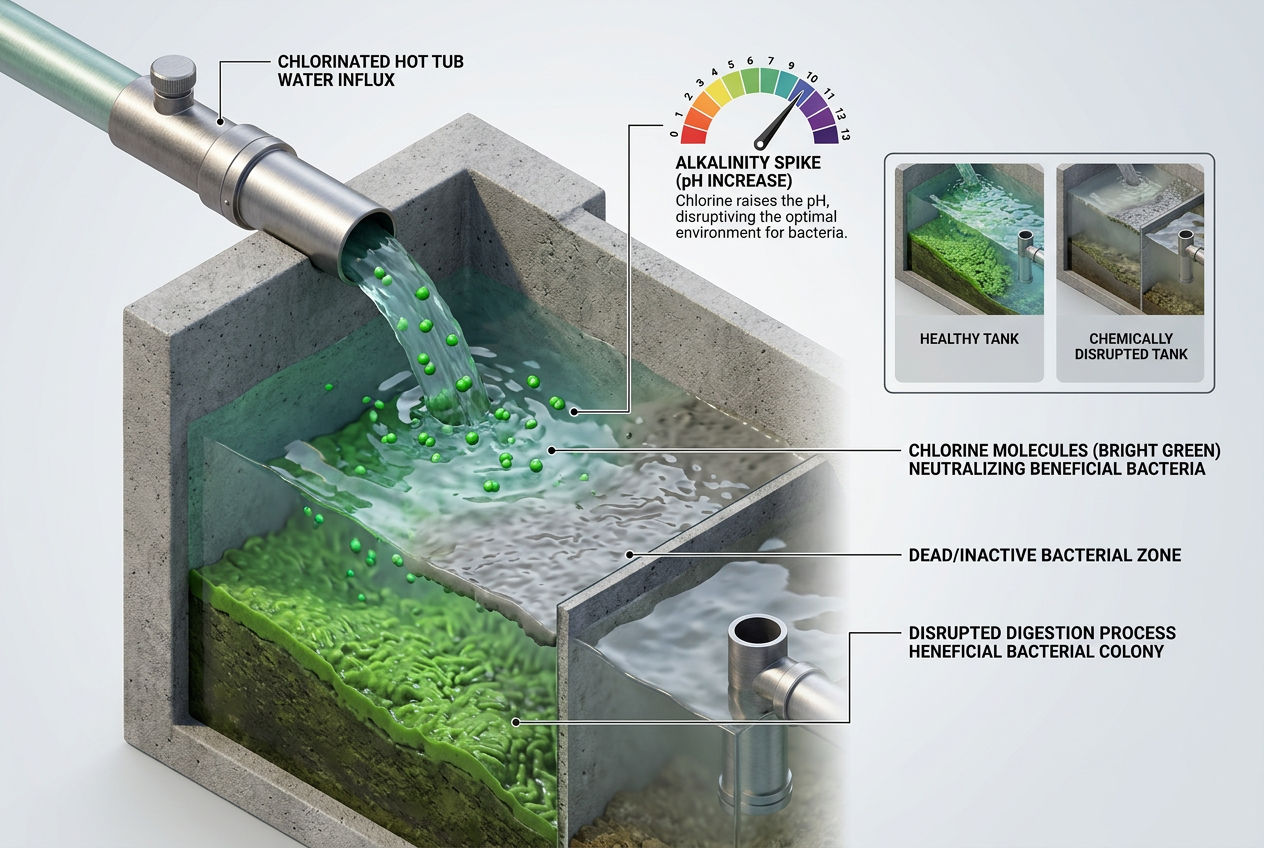
Your septic tank's beneficial bacteria — the anaerobic microbes that digest solids and break down organic waste in the first compartment before effluent flows to the drain field — begin dying off at chlorine concentrations above 0.5 ppm. Above 1 ppm, the biological process in a conventional septic tank is seriously disrupted.
The Dilution Math That Doesn't Add Up
Think about what that means practically. You drain 400 gallons of water at 4 ppm chlorine into a 1,000-gallon tank. Even after dilution with existing tank contents, you've introduced a concentration that can suppress or eliminate the bacterial colonies your system depends on.
⚠️ Warning: If those bacteria die off, raw sewage stops being processed. Undigested solids push out to the drain field, clog the leach laterals, and within months you have a failing system.
Bromine Isn't Safer
Bromine and chlorine are equally problematic at hot tub concentrations. Some homeowners assume bromine is "gentler" on septic biology. It isn't. At 3–5 ppm, bromine is similarly toxic to the anaerobic bacteria in your tank. Salt-water hot tub systems — which electrolyze salt to generate chlorine on demand — produce the same active chlorine compounds and carry the same risk.
Natural Chlorine Reduction
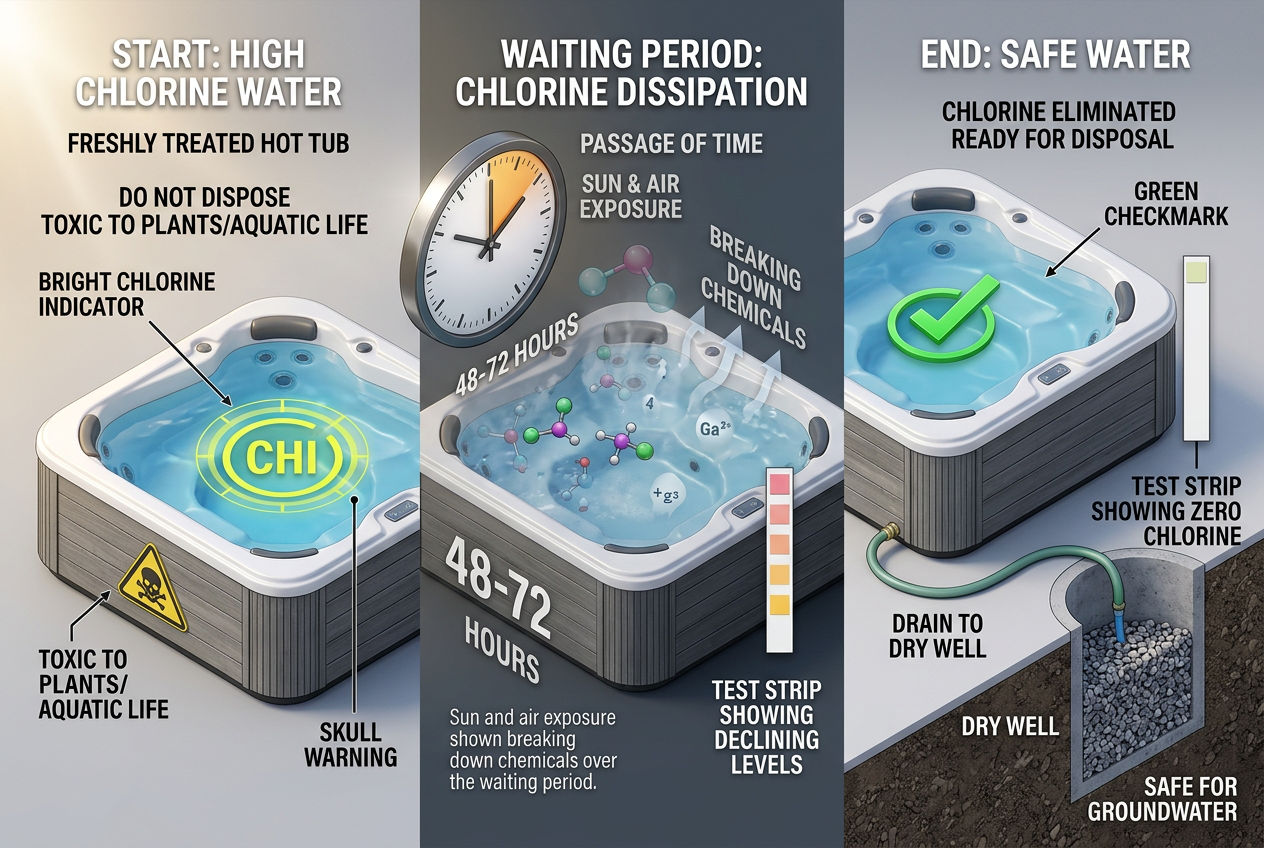
The good news: chlorine off-gasses naturally. With the hot tub cover off, in direct sunlight, free chlorine drops from 3–5 ppm to near zero in 24–48 hours. You can accelerate this with sodium thiosulfate, a neutralizing agent available at pool supply stores (typical dose: 1–2 oz per 100 gallons, depending on starting concentration).
✅ Pro Tip: Test with a basic chlorine test strip before draining. You want a reading below 0.5 ppm — ideally zero.
How Many Gallons Does a Hot Tub Hold — and Can My Septic Handle the Volume?
Here's the volume math that most articles skip entirely.

Hot Tub Capacity by Size
- Two-to-four-person residential hot tub: 300–400 gallons
- Six-to-eight-person model: 450–600 gallons
- Swim spa models: 800–1,000+ gallons
Your Septic System's Daily Capacity
Now compare that to your septic system:
- Average residential septic tank: 1,000–1,500 gallons
- Typical daily household wastewater flow: 100–150 gallons per day (roughly 50–70 gallons per person per day, per EPA estimates)
- Design capacity for most state-permitted systems: Approximately 120 gallons per bedroom per day
Why Sudden Volume Matters
A 400-gallon hot tub drain represents 25–40% of a 1,000-gallon tank's total capacity — introduced in 15–30 minutes instead of spread across a full day. That surge is called hydraulic overload, and it's one of the most common causes of premature drain field failure.
When hydraulic overload occurs, the sudden influx of water pushes partially treated effluent out of the tank and into the distribution box before it's ready. That under-treated wastewater floods the leach laterals faster than the surrounding soil can absorb it.
📊 Quick Fact: Clay-heavy soils common in the Midwest — Minnesota, Ohio, Wisconsin — are especially vulnerable because percolation rates are already slow. Sandy Florida soils absorb faster but offer less biological filtration before effluent reaches groundwater.
If you have a 1,500-gallon tank serving a two-person household, you have more buffer. But even then, dumping 500 gallons at once during a wet spring when your drain field is already saturated is asking for trouble.
| Hot Tub Size | Approx. Gallons | % of 1,000-gal Tank | % of 1,500-gal Tank |
|---|---|---|---|
| Small (2–3 person) | 250–300 gal | 25–30% | 17–20% |
| Standard (4–5 person) | 350–450 gal | 35–45% | 23–30% |
| Large (6–8 person) | 450–600 gal | 45–60% | 30–40% |
| Swim Spa | 800–1,000 gal | 80–100% | 53–67% |
Sources: EPA SepticSmart guidelines; manufacturer specifications from Jacuzzi, Hot Spring, and Caldera product lines; typical residential tank sizes per state health department guidance.
Free download
Free: the Septic Fridge Card — what to flush, what never to.
The Do / Don’t card the whole family can see, plus the Survival Kit: emergency flowchart, warning-sign decoder and pump-schedule card. One printable PDF.
Where Should You Drain a Hot Tub With a Septic System?
You have three practical options when your drain field sits in your backyard and there's no municipal sewer connection.
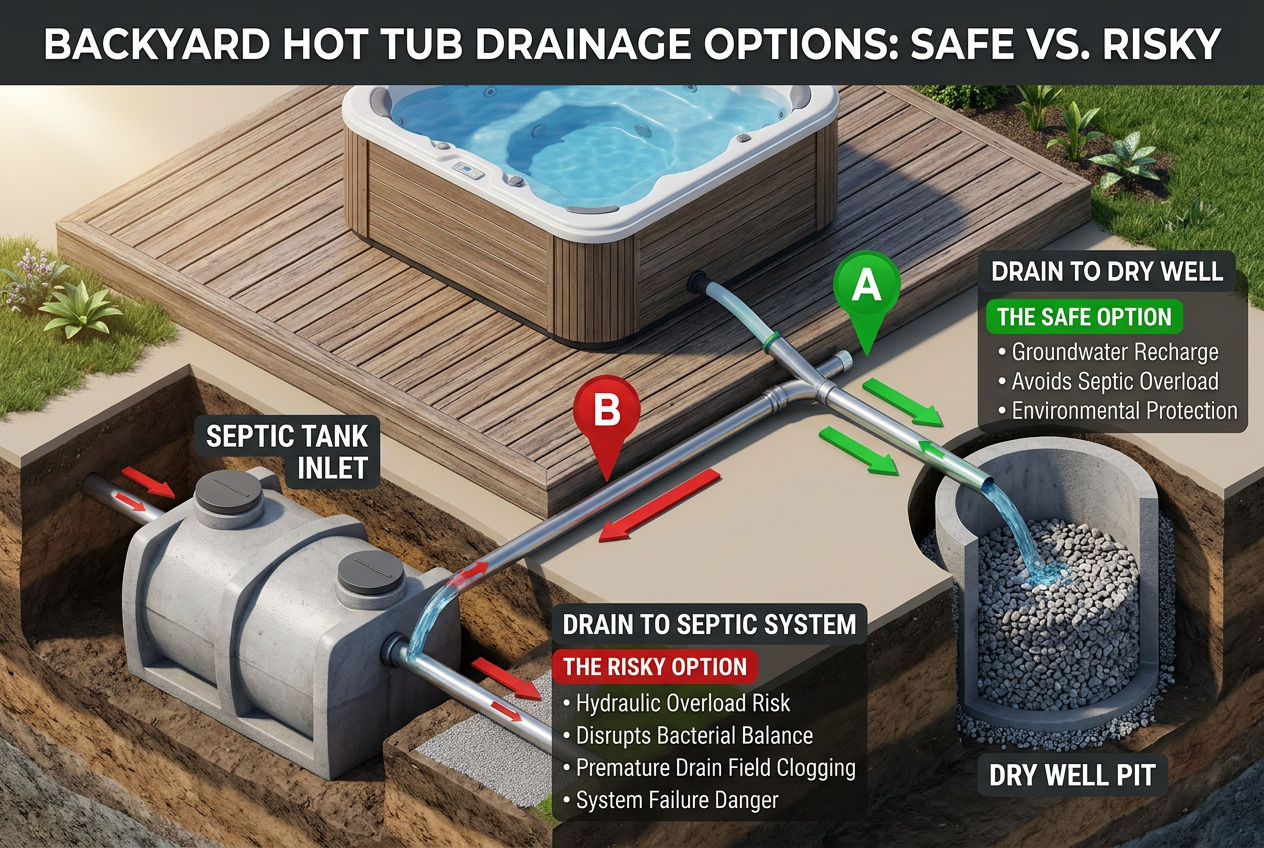
Option 1: Drain to a Vegetated Area (Most Recommended)
Hot tub water on lawn works well if the water is properly dechlorinated and pH-balanced. The EPA and most state extension programs confirm that spent hot tub water, once sanitizer levels drop to near zero and pH falls in the 6.5–7.5 range, poses minimal risk to turf grass and landscaping.
Best practices for lawn drainage:
- Discharge slowly — use a garden hose at the end of the drain line
- Rotate the discharge point across your yard so you don't oversaturate any one area
- Avoid draining onto slopes that direct water toward your well, a neighbor's property, or a waterway
Option 2: Drain to a Septic System — The Right Way
If you must use the septic system, follow this protocol:
- Stop adding chemicals 24–48 hours before draining
- Remove the cover and allow the water to off-gas in sunlight
- Use sodium thiosulfate if needed to accelerate chlorine reduction
- Test chlorine level — wait until it's below 0.5 ppm
- Drain slowly using a partially open valve or a hose, not a full-bore dump
- Drain during dry weather, not after heavy rain when your drain field is already saturated
- Avoid draining during spring snowmelt in northern climates
Option 3: Pump and Haul
A licensed septic pumping professional can pump your hot tub water and dispose of it at an approved treatment facility. This is the cleanest option and removes all risk to your system. It's also worth considering for swim spa models where volume alone makes lawn disposal impractical.
How Long Should You Wait After Adding Chemicals Before Draining?
Wait at least 24–48 hours after the last chemical addition, with the cover off and the jets running to promote off-gassing. In cloudy weather or if you added a large shock treatment, wait 72 hours and verify with a test strip.
Extended Wait Times for Shock Treatments
If you used a chlorine shock dose of 10+ ppm to treat algae or a foam problem, expect that it may take three to four days to drop to safe levels naturally. Sodium thiosulfate neutralizes chlorine chemically — it doesn't work on bromine as effectively, so bromine systems may require the full natural off-gassing period.
pH Considerations
One more note on pH: hot tub water is typically maintained at 7.2–7.8. Your septic system functions best at pH 6.5–7.5. Properly balanced hot tub water sits at the upper edge of that range — close enough that pH alone isn't usually the problem. But if you've been battling high alkalinity and your water is sitting at pH 8.0+, let it neutralize before draining anywhere near your system.
Is It Legal to Drain a Hot Tub Into a Septic System?
This is where the stakes get real. Many homeowners drain their hot tubs without a second thought, then discover afterward that their county explicitly prohibits it.
State-Specific Guidance
Several states and counties have specific guidance:
-
Minnesota — The Minnesota Pollution Control Agency (MPCA) advises against draining hot tub water to septic systems and recommends discharge to a vegetated area or municipal storm sewer where permitted. Clay soils throughout the state make hydraulic overload especially damaging.
-
Virginia — The Virginia Department of Health's onsite sewage regulations classify hot tub discharge as a significant volume addition. Many Virginia jurisdictions require that high-volume water sources be routed away from the septic system entirely.
-
Florida — Miami-Dade, Broward, and Palm Beach counties all have ordinances addressing pool and spa discharge. Connecting spa drainage directly to a septic system without a permit is prohibited in these counties. Contact your county health department for the specific rule that applies to your property.
-
Washington State — The Washington State Department of Health recommends against hot tub drainage to septic systems and references hydraulic loading concerns in its onsite sewage guidance documents.
-
Oregon — The Oregon DEQ classifies excessive water loading as a contributing factor in septic system failures and advises homeowners to keep non-household water sources separate from their onsite system.
Federal vs. Local Regulation
The honest answer about federal regulation: the EPA doesn't maintain a single national rule on hot tub drainage to septic systems. This is governed at the state and county level.
✅ Pro Tip: Call your local health department. Ask specifically whether your county has guidance on spa or hot tub discharge to onsite septic systems. Get the answer in writing if possible.
What Happens If You've Already Drained Into Your Septic?
If you've already dumped hot tub water into your septic system — before reading this — the damage depends on how much water, what chemical concentration, and how recently it happened.
Immediate Steps to Minimize Damage
-
Stop all non-essential water use in the house for 24–48 hours. Showers, laundry, dishwasher — minimize everything to give your system time to recover hydraulically.
-
Do not add more chemical shock or treatments to your hot tub and drain again. One event may be recoverable. Back-to-back dumps probably aren't.
-
Watch for signs of drain field stress:
- Slow drains inside the house
- Gurgling toilets
- Wet spots or unusually green grass over the drain field
- Sewage odors outdoors
These indicate the system is under stress. If you see signs your drain field is failing, act immediately.
-
Schedule a septic system inspection within 60–90 days. A professional can check sludge and scum levels in the tank, inspect the distribution box, and identify whether effluent is backing up in the laterals before you have a full failure on your hands.
-
Consider adding a septic-safe bacterial supplement to help recolonize the tank after a chemical insult. These products — available at hardware stores — won't fix a mechanical failure, but they can help restore biological activity after a one-time chlorine event.
💡 Key Takeaway: One accidental drain probably won't destroy a healthy, properly sized system. Two or three will, especially if they happen during wet weather or if your system was already marginal.
Does Seasonal Timing Matter When Draining a Hot Tub Near a Septic System?
It matters more than most homeowners realize, and it's rarely discussed in hot tub owner's manuals.
Spring (March–May) — Highest risk. Drain fields in northern states are often still partially frozen or saturated from snowmelt. The soil simply can't accept additional water volume. In Minnesota, Wisconsin, and other cold-climate states, adding hundreds of gallons during spring thaw is one of the most reliable ways to push a borderline system into failure.
Sources & Methodology
-
U.S. Environmental Protection Agency — A Homeowner's Guide to Septic Systems. Referenced for daily wastewater flow calculations and hydraulic loading guidance relevant to hot tub discharge volumes.
-
University of Arkansas Cooperative Extension — Research on high-volume water discharge effects on septic system performance and drain field saturation.
-
National Onsite Wastewater Recycling Association (NOWRA) — Industry standards for managing supplemental water sources (pools, hot tubs, water softeners) with residential septic systems.
-
Minnesota Pollution Control Agency — State guidance on hot tub and spa water discharge regulations related to onsite wastewater treatment systems.
-
NSF International — Standards for water treatment chemicals and their impact on biological wastewater treatment processes, including chlorine and bromine effects on septic bacteria.
Cost data reflects 2025–2026 national averages compiled from contractor pricing surveys across SepticTankHub.com's directory network.
Need help with your septic system? Find trusted septic professionals near you to get free quotes. See our complete guide to septic pumping costs for current pricing. Browse local septic companies in Indiana or Alabama.
Was this article helpful?
Frequently Asked Questions
Recommended Resources
Find Septic Professionals Near You
Compare licensed, verified septic companies by area — top county markets and cities below, or browse all 50 states.
County markets
Popular cities
