
Quick Answer
A drain field is failing when liquid waste - effluent - can no longer absorb into the surrounding soil and starts backing up toward your home or surfacing in your yard. Recognizing the warning signs early can be the difference between a $1,500 repair and a $15,000 replacement.
Key Takeaways
- Slow drains, sewage odors, and soggy ground over your leach field are the three most urgent warning signs
- Biomat buildup, hydraulic overload, and root intrusion are the most common causes of drain field failure
- The average drain field lasts 15–25 years; neglect cuts that to 5–10 years
- Repair is sometimes possible ($1,500–$5,000); full replacement typically runs $3,000–$15,000
- A professional drain field inspection ($100–$500) should be your first call - not a DIY fix
What Are the Warning Signs of a Failing Drain Field?
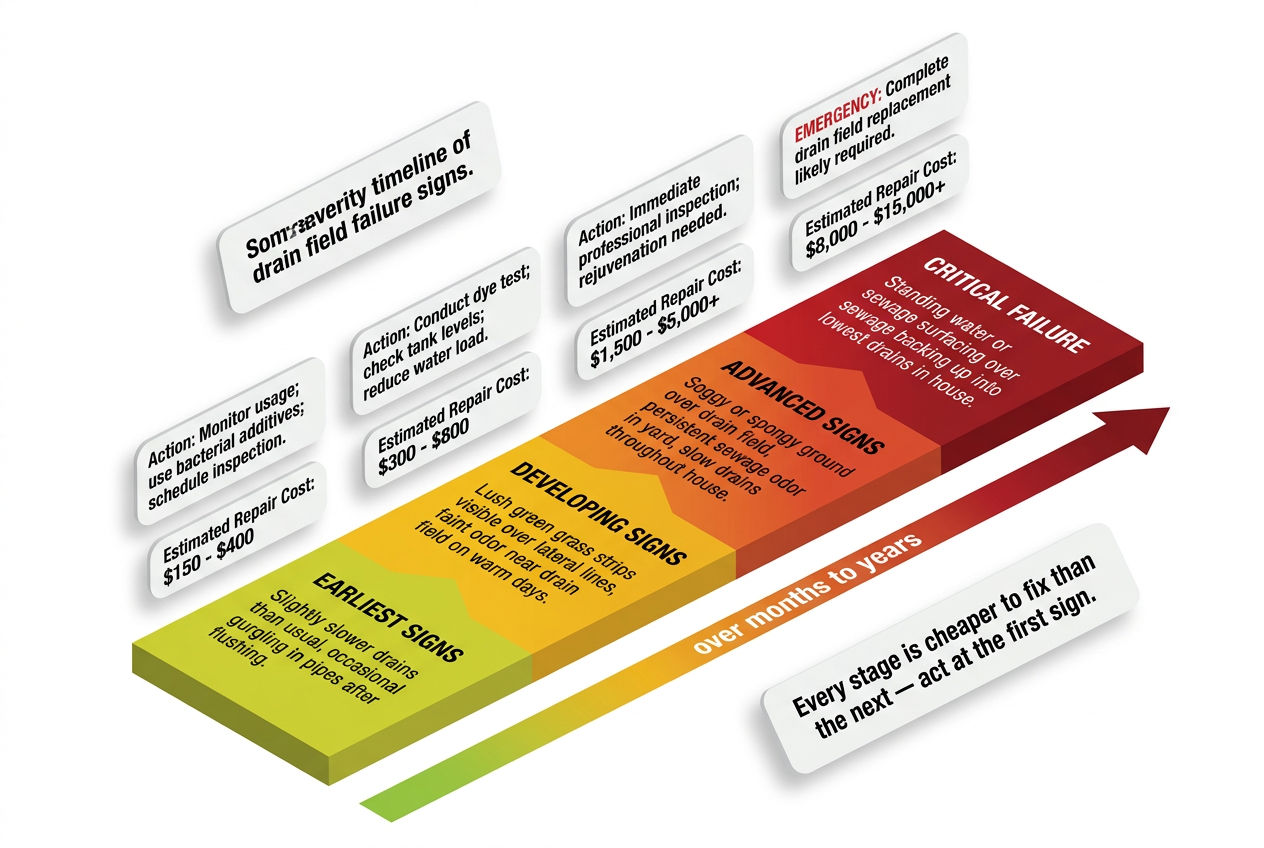
Drain field failure doesn't usually happen overnight. It builds over months or years. The problem is that many homeowners don't recognize the early symptoms - or they mistake them for an unrelated plumbing issue. By the time standing water appears in the yard, the system is often well past the early-intervention window.
Here are the signs you need to know, roughly in order from earliest to most severe.
1. Slow Drains Throughout the House
One slow drain usually means a clog in that specific fixture. But slow drains in multiple fixtures - sinks, tubs, toilets gurgling simultaneously - point to a problem downstream in the septic system itself.
If your toilets are sluggish and your washing machine backup makes the floor drain gurgle, that's a slow drains septic system problem, not a simple $12 bottle of Drano. Your drain field may not be accepting effluent fast enough, which creates a hydraulic backpressure throughout the house.
⚠️ Warning: Multiple slow drains appearing at the same time indicate systemic pressure buildup - not individual fixture clogs. This is an early-stage septic emergency.
2. Sewage Odors Inside or Outside
A properly functioning septic system is essentially odorless. If you're catching a sulfur-and-sewage smell near your tank lids, along your drain field, or inside the house near floor drains, something is wrong.
Odors outside, directly above the leach lines, are one of the clearest failing leach field symptoms. The effluent isn't being filtered by the soil - it's pooling near the surface where gases can escape. Inside odors often mean the system is under enough pressure that gases are pushing back through your P-traps.
3. Soggy Ground or Standing Water Over the Drain Field
This is the sign most homeowners notice first - and by then, it's serious. A soggy yard over your septic drain field or standing water over drain field lines means effluent is surfacing. It's not being absorbed. The soil is saturated, the lateral lines are overwhelmed, or both.
Walk the area above your drain field after a dry week. If the ground feels spongy or you see patches of standing water with no rain in the forecast, treat it as an emergency. Surfacing effluent is a health hazard. It contains E. coli, nitrates, and viruses that can contaminate your yard, your well, and neighboring groundwater.
🚨 Health Hazard: Surfacing effluent contains E. coli, nitrates, and waterborne viruses. Keep children and pets away from affected areas immediately.
4. Unusually Green or Lush Grass Above the Leach Lines
Ironic as it sounds, a suspiciously vibrant strip of grass over your drain field is a red flag. Our article on the green grass meaning explains exactly what this symptom tells you. That grass is getting extra nutrients - nitrogen and phosphorus - from effluent that's too close to the surface. Healthy drain fields don't fertilize the grass above them. Failing ones do.
This symptom often appears before standing water does, making it one of the most valuable early warnings if you know to look for it.
💡 Key Takeaway: A bright green stripe of grass directly above your leach lines is an early warning sign - not a landscaping success.
5. Gurgling Sounds From Drains and Toilets
Gurgling happens when air is being displaced by liquid in a pipe that shouldn't have liquid in it. A drain field not absorbing water creates backpressure that pushes air backward through your plumbing. You'll typically hear it first in the lowest fixture in the house - a basement floor drain or a first-floor toilet.
Don't ignore this sound. It's your system telling you something is wrong before it gets worse.
6. Sewage Backup Inside the Home
If raw sewage is backing up into your shower, toilet, or floor drains, your septic system has reached a critical point. A septic system backup is the last resort - the system has nowhere else for the effluent to go, so it comes back toward you.
This is a public health emergency. Don't use any water-consuming fixtures. Call a licensed septic professional immediately. You'll also want to keep children and pets away from any affected areas in the yard.
⚠️ Emergency Protocol: Sewage backup requires immediate professional intervention. Stop all water use and evacuate affected areas.
7. Failed Septic Inspection Report
Picture this: you're selling your home and the buyer's inspector flags your drain field as failing. Or you're buying a home and the inspection report comes back with concerns about hydraulic load capacity. Either scenario means professional evaluation isn't optional - it's urgent.
A septic inspection ($100–$500 depending on whether it's a visual inspection or a full hydraulic load test) is the only way to know with certainty whether the field is repairable or needs full replacement.
What Causes a Drain Field to Fail?
Understanding the cause matters because it determines your repair options. Here are the most common culprits behind drain field failure symptoms.
Primary Failure Mechanisms
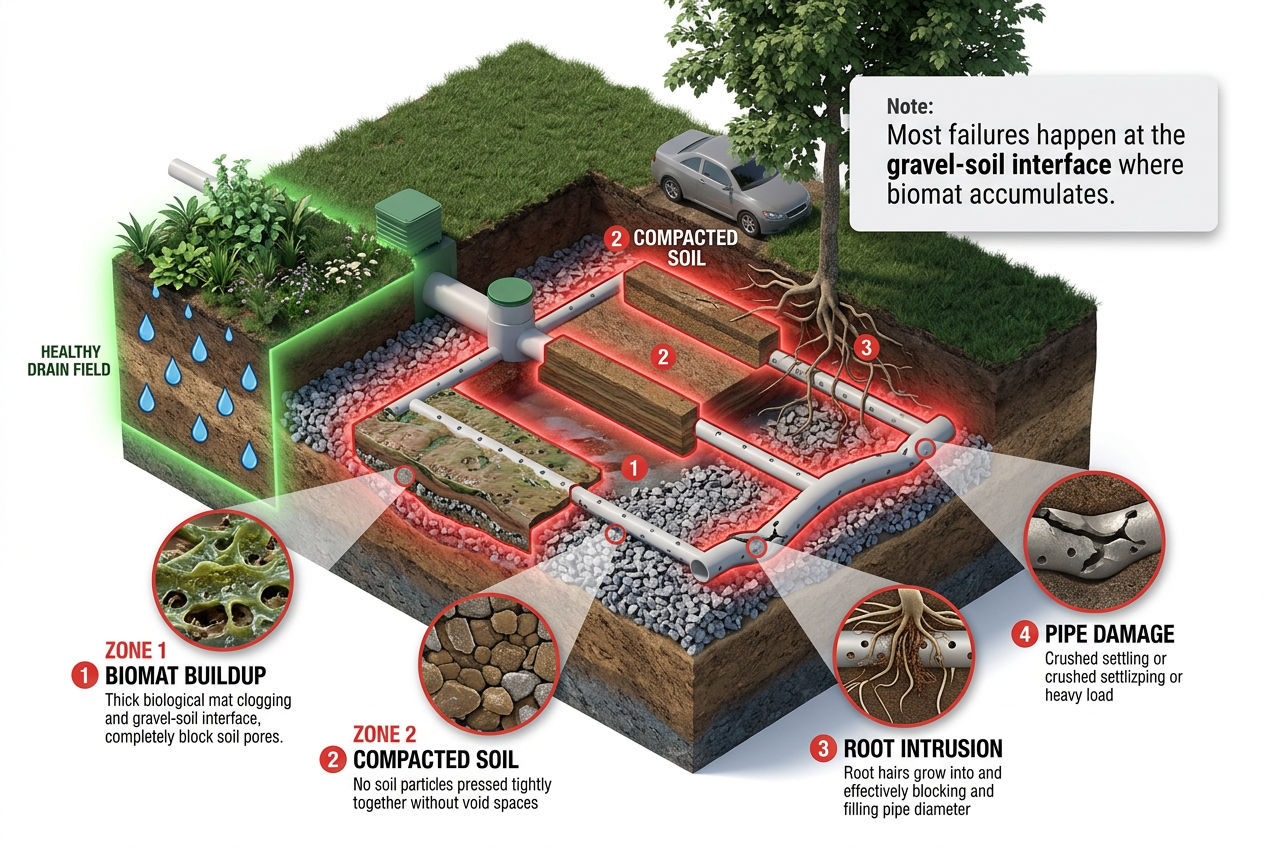
Biomat buildup is the number one cause. For a deeper dive into biomat problems, see our dedicated guide. A biomat is a dense layer of organic matter and anaerobic bacteria that forms at the soil interface in the leach trenches. A thin biomat - a few millimeters - is normal and actually helps with filtration. When it exceeds roughly 1 inch in thickness, it seals the soil surface and prevents absorption. Tanks that are pumped infrequently (less than every 3–5 years, per EPA guidelines) send excess solids into the field and accelerate biomat formation.
📊 Quick Fact: Neglecting septic tank pumping is responsible for 60–70% of premature drain field failures, according to EPA SepticSmart data.
Hydraulic overload happens when more water enters the system than the soil can absorb. Every drain field is sized based on a percolation test - a perc test - that measures how fast water moves through your specific soil. Acceptable rates typically fall between 1–60 minutes per inch, varying by jurisdiction. A field that handles a 2-person household fine can fail quickly when that home expands to 6 people or adds a garbage disposal and a second bathroom.
Root intrusion from trees and shrubs sends roots into the perforated leach lateral pipes, crushing them or blocking flow. Trees within 20–30 feet of a drain field are a known risk. Silver maple, willow, and poplar are particularly aggressive.
Soil compaction from driving vehicles or heavy equipment over the drain field collapses the soil structure and the infiltration zones. This is why driving over your drain field - even once with a heavy vehicle - can cause lasting damage.
System age is sometimes simply the answer. Even a well-maintained drain field has a finite life. The leach laterals - often 4-inch perforated PVC or corrugated pipe - degrade. The distribution box shifts. Aggregate settles and compacts.
High-Risk Trees & Root Aggression
| Tree Species | Root Aggression Level | Minimum Safe Distance |
|---|---|---|
| Willow, poplar, silver maple | Very High | 50–75 feet |
| Oak, elm, ash | High | 30–50 feet |
| Pine, spruce, fir | Moderate | 20–30 feet |
| Dogwood, cherry, apple | Low | 15–20 feet |
✅ Pro Tip: Plant shallow-rooted ornamentals (hostas, daylilies, grasses) above drain fields. Avoid woody plants entirely within the leach zone.
How Long Does a Drain Field Last?
The average drain field lifespan is 15–25 years with regular septic system maintenance. That assumes the tank is pumped every 3–5 years (the EPA's standard recommendation), no harmful chemicals are flushed into the system, and vehicle traffic never crosses the field.
Neglect the pumping schedule and that lifespan can drop to 5–10 years. A 1,000-gallon tank serving a family of four that hasn't been pumped in over a decade is almost certainly sending partially digested solids into the leach lines - a direct cause of biomat buildup that shortens field life dramatically.
Newer systems using Infiltrator Water Technologies chamber systems often outperform older gravel-and-pipe designs. But no system lasts forever. If your field is approaching 20 years old and you're seeing early symptoms, start budgeting for evaluation now rather than waiting for a backup.
Can a Failing Drain Field Be Repaired, or Does It Need to Be Replaced?
Sometimes repair works. Often, it doesn't. The honest answer depends on the cause and severity of the failure.
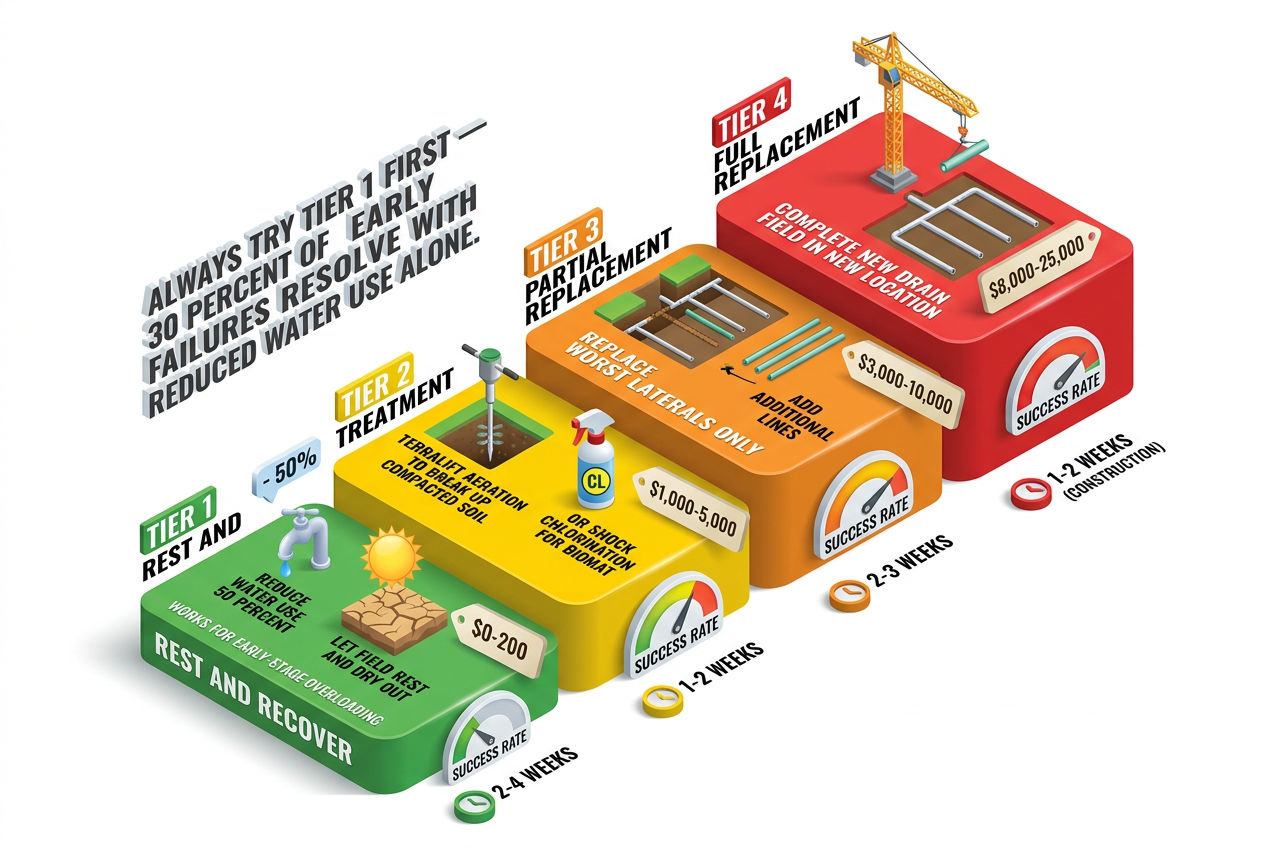
Repair Options (When Viable)
Repair options include:
- Aeration: Pumping air through the soil to break down the biomat
- Hydrojetting: High-pressure water cleaning of lateral lines
- Terralift treatment: A pneumatic process that fractures compacted soil around the leach lines and injects polystyrene beads to restore porosity
These methods cost roughly $1,500–$5,000 and can extend field life by several years if the underlying soil hasn't been permanently damaged.
⚠️ Reality Check: Bacterial additives like Rid-X are marketed as drain field restorers. They add beneficial microbes to the system, but peer-reviewed research - including studies from the University of Arkansas Cooperative Extension - shows they don't reverse established biomat clogging or eliminate the need for professional intervention.
When Full Replacement Is Necessary
Full drain field replacement is necessary when the soil is irreparably saturated, the lateral pipes have collapsed, or the original perc rate can no longer support the household's water use. Drain field replacement cost runs $3,000–$15,000 for conventional systems - and can exceed $20,000 for engineered alternatives like mound systems required by certain soil conditions or high water tables. For full system replacement including the tank, expect $10,000–$25,000 or more.
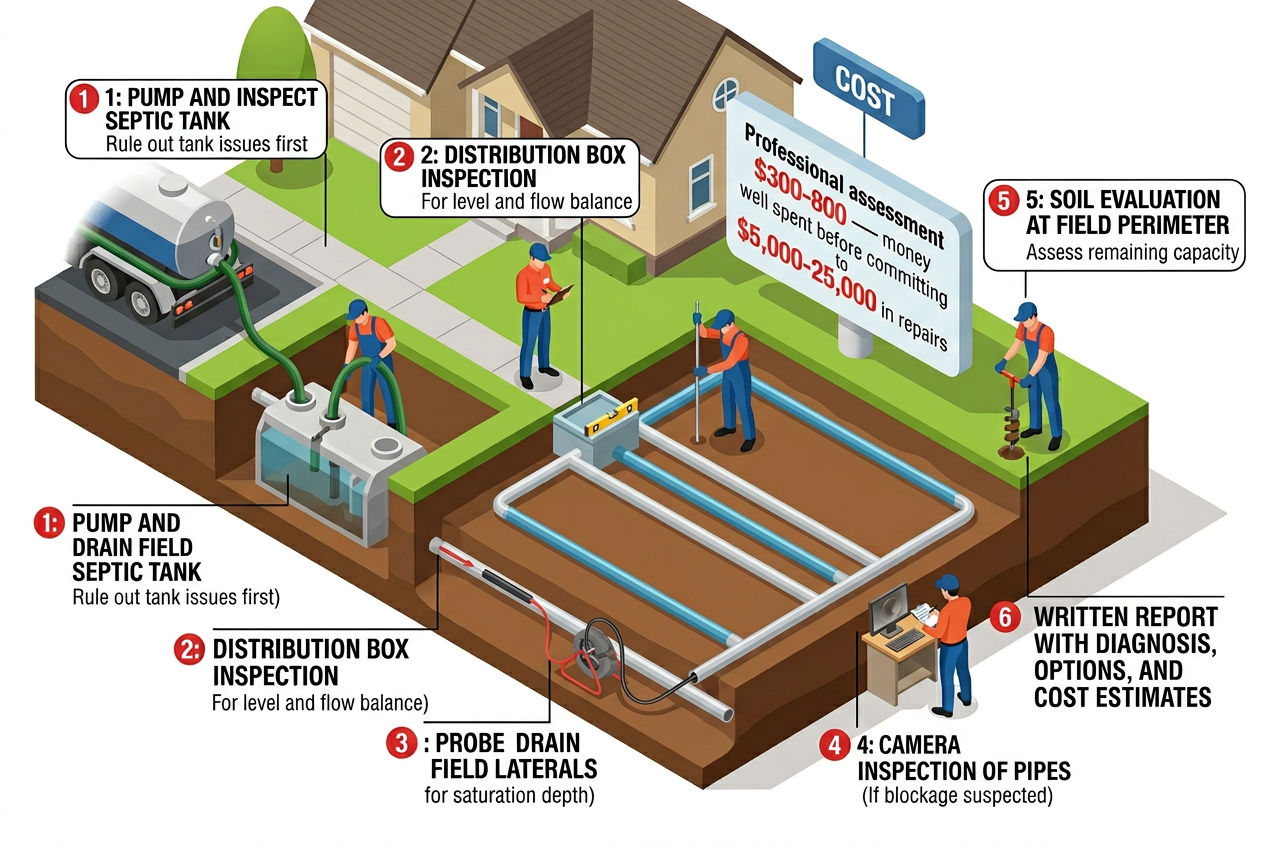
Drain field repair vs. replacement isn't a decision you can make from a symptom checklist. It requires a licensed inspector with a camera scope, a soil probe, and knowledge of your local regulations.
How Much Does It Cost to Replace a Drain Field?
| Scenario | Estimated Cost | Notes |
|---|---|---|
| Drain field repair (aeration/Terralift) | $1,500–$5,000 | Extends life; not a permanent fix |
| Conventional drain field replacement | $3,000–$15,000 | Depends on size, soil, and access |
| Mound system replacement | $10,000–$20,000+ | Required for high water tables, poor perc |
| Full septic system replacement | $10,000–$25,000+ | Tank + drain field + labor |
| Septic inspection (pre-diagnosis) | $100–$500 | Full hydraulic load test at higher end |
Cost data sourced from national contractor surveys and EPA SepticSmart program materials. Regional variation is significant - Florida and Texas systems often run 15–25% below Northeast pricing due to soil and regulatory differences.
💡 Key Takeaway: The septic repair cost guide on SepticTankHub breaks these numbers down further by region and system type if you want a more specific estimate before calling contractors.
Is a Failing Drain Field Dangerous to Your Health?
Yes - and this isn't an overstatement. A failing drain field that allows effluent to surface or reach groundwater is a genuine public health hazard.
Contamination Risks
The EPA identifies improperly treated sewage as a significant nonpoint source pollutant. Failing drain fields can contaminate groundwater with:
- Nitrates - Exceed safe drinking water limits, particularly dangerous for infants
- Phosphorus - Causes algal blooms in surface waters
- E. coli and fecal coliform bacteria - Direct disease vectors
- Waterborne viruses - Including hepatitis A and norovirus
If your home uses a private well, a failing field within 50–100 feet of that well (the typical setback requirement, which varies by jurisdiction) puts your drinking water at direct risk. Septic system failure is one of the leading causes of waterborne disease outbreaks in areas served by private wells, according to EPA research.
Surfacing effluent in your yard is also a direct contact hazard. Children and pets should be kept away from any wet or odorous areas above the drain field until a professional has assessed and resolved the situation.
🚨 Well Water Warning: If you have a private well and see drain field failure symptoms, test your water for nitrates and coliform bacteria immediately - even before repairs begin.
Can Heavy Rain Cause Drain Field Problems?
Heavy rainfall and snowmelt are among the most common triggers for revealing a failing drain field - especially in spring. Saturated soil can't accept additional effluent from your system. During extended rain events, even a borderline-functional field can temporarily show symptoms: standing water, odors, slow drains.
Temporary vs. Permanent Saturation
The distinction matters:
- Temporary saturation from a major storm that resolves within 24–48 hours after rain stops is concerning but may not indicate permanent failure
- Symptoms that persist well after dry conditions return strongly suggest the field was already compromised
This is why spring - particularly March through May - is peak season for drain field problems. Snowmelt in northern states (Minnesota, Wisconsin, Pennsylvania) saturates already-frozen ground. High-rainfall regions like the Pacific Northwest and Southeast U.S. see chronic high water tables that stress conventional drain fields year-round.
📊 Regional Reality: If you're in a region with heavy clay soils (Ohio, Indiana, Michigan) or a high water table (coastal Florida, South Carolina), your drain field size and system type matter more than anywhere else. These areas are most likely to require engineered alternatives when conventional fields fail.
What Should You Do If You Suspect Your Drain Field Is Failing?
Here's the action sequence, in order:
Immediate Actions (First 24 Hours)
1. Stop adding stress to the system immediately. Reduce water use - shorter showers, no laundry, no dishwasher - until you've had it inspected. Every gallon you push into a failing field makes the problem worse.
2. Keep people and pets away from the drain field area. Surfacing effluent is a biohazard. Don't let kids play in that part of the yard.
3. Don't flush anything into the system you wouldn't normally flush. No additives, no "septic treatments," no extra enzymes. If the field is failing, none of these help and some can harm.
Professional Assessment (Within 48 Hours)
4. Call a licensed septic professional for a drain field inspection. Not a plumber - a licensed septic contractor or certified inspector. They'll scope the lateral lines, check the distribution box, probe the soil, and review your tank's pumping history. If you haven't had your tank pumped recently, they'll likely do that first - a 1,000-gallon tank costs $300–$500 to pump nationally - because a full tank can mimic drain field failure symptoms.
5. Get at least two written estimates before committing to repair or replacement. Prices and recommendations vary. An honest contractor will tell you whether aeration has a realistic chance or whether replacement is the only real fix.
6. Check local permit requirements before any work begins. Most states require permits for drain field work. In Massachusetts, Title V septic regulations mandate licensed inspectors and specific reporting procedures. In Florida, all contractors must hold a Registered Septic Tank Contractor (RSTC) license through the Department of Health. Your local county health department can confirm what's required.
✅ Pro Tip: Find a septic professional near you through SepticTankHub's directory - contractors are vetted by state and service type.
How to Prevent Drain Field Failure
Prevention is always cheaper than repair. The core habits that protect a drain field are straightforward:
Essential Maintenance Habits
-
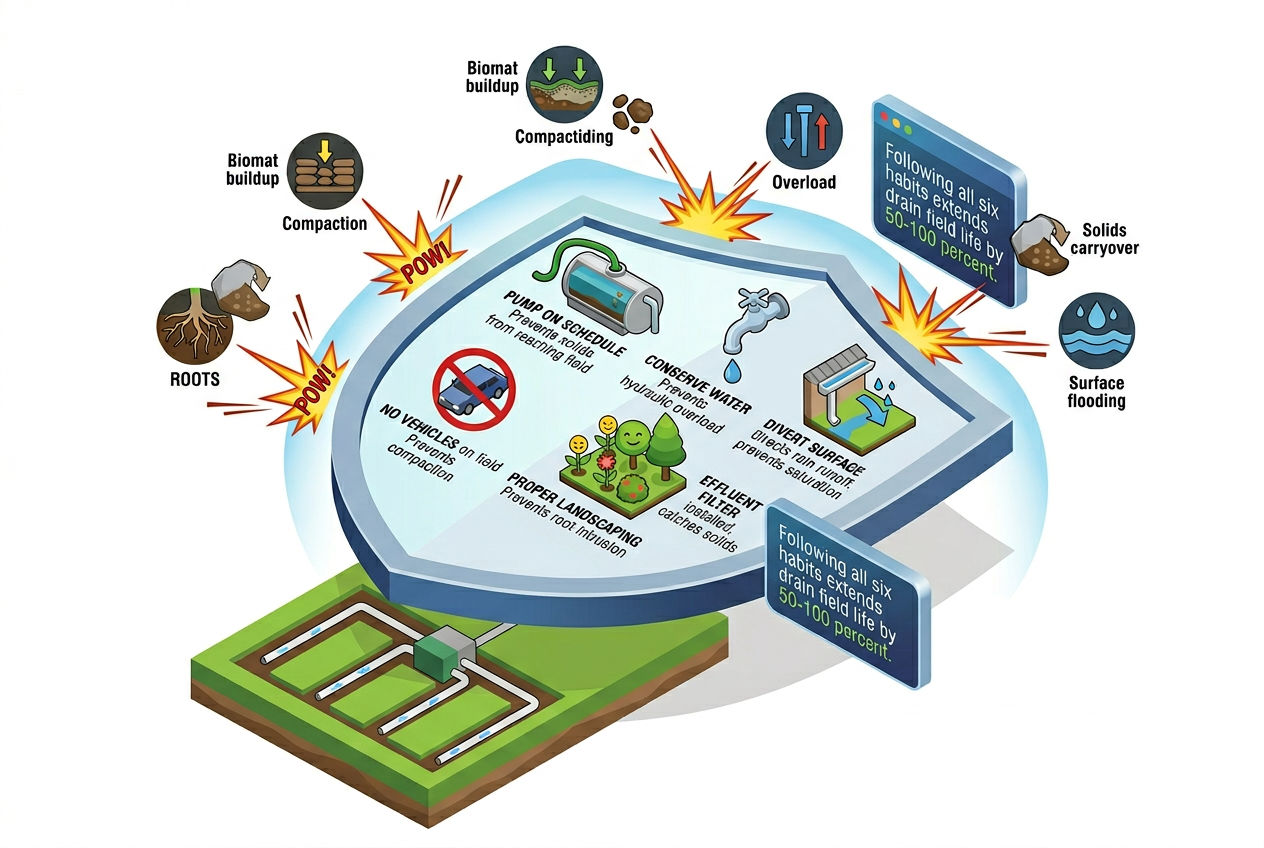
Pump your tank on schedule. Every 3–5 years for most households, per EPA guidelines. A 1,500-gallon tank serving 2 people can go longer; a 1,000-gallon tank with a garbage disposal and 4 people needs pumping closer to every 2–3 years. See the full pumping frequency guide for a breakdown by tank size and household size.
-
Never flush grease, wipes, medications, or harsh chemicals. These kill the beneficial bacteria that keep your tank processing solids and accelerate biomat formation in the field.
-
Protect the drain field area. No vehicles, no heavy equipment, no construction. No planting trees or shrubs within 20–30 feet of the leach lines.
-
Spread water use throughout the week. Running multiple large loads of laundry on the same day sends a hydraulic surge through the system. Space loads out.
-
Schedule a professional septic inspection every 1–3 years if your system is over 15 years old. Catching biomat buildup early - before it seals the soil - is the difference between a $2,000 aeration treatment and a $12,000 replacement.
💡 Key Takeaway: If you want to understand how the whole system connects, the guide to how septic systems work is a good starting point. And if you're already past the prevention stage and dealing with a saturated field, the article on how to fix a saturated drain field covers your repair options in detail.
Sources & Methodology
- U.S. Environmental Protection Agency - SepticSmart Program: Primary source for pumping frequency recommendations, contamination data, and statistical estimates on failing septic systems nationwide.
- National Onsite Wastewater Recycling Association (NOWRA): Industry standards and contractor licensing guidance referenced for repair and replacement protocols.
- University of Arkansas Cooperative Extension: Research cited on effectiveness (and limitations) of bacterial septic additives including Rid-X formulations.
- State Regulatory Agencies: Florida Department of Health (RSTC licensing requirements) and Massachusetts Title V regulations referenced for regional compliance context.
- National contractor pricing surveys: Cost ranges for inspection, repair, and replacement derived from aggregated contractor data and cross-referenced with regional market conditions.
Learn more about our drain field services services.
Related reading: septic system installation process.
About SepticTankHub.com
SepticTankHub.com is a national directory connecting homeowners with licensed septic service professionals. Our editorial team works with certified septic inspectors and contractors to produce accurate, unbiased guidance. We do not manufacture or sell septic products. All cost figures are reviewed annually against contractor pricing data.
Need help with your septic system? Browse local septic companies in Tennessee or Virginia.
Free download
Not ready for the Handbook? Start with the free Fridge Card.
The Do / Don’t card the whole family can see, plus the Survival Kit: emergency flowchart, warning-sign decoder and pump-schedule card. One printable PDF.
Was this article helpful?
Frequently Asked Questions
Recommended Resources
📖 Related Articles
- What Is a Drain Field? (And How Does It Work?)
- Can You Drive or Build Over a Drain Field?
- Leach Field Size by Bedrooms: Drain Field Sizing Chart (2026)
- How Often Should You Pump Your Septic Tank?
- What Is a Septic System? How It Works (Visual Guide)
- How to Fix a Saturated Drain Field
- Septic Tank Biomat: What It Is and When It's a Problem
- Green Grass Over Septic Tank: Normal or Warning Sign? (2026 Diagnostic Guide)
💰 Cost Guides
Find Septic Professionals Near You
Compare licensed, verified septic companies by area — top county markets and cities below, or browse all 50 states.
County markets
Popular cities
