
Quick Answer
Green grass over a septic tank or drain field (leach field) is usually a normal result of nutrient-rich effluent fertilizing the soil from below. Residential wastewater contains 20–85 mg/L of nitrogen and 10–15 mg/L of phosphorus — both primary fertilizer components. On its own, greener grass is not cause for alarm. Combined with other symptoms like soggy ground or sewage odor, it can signal a failing system that needs immediate attention.
💡 Key Takeaways
- Slightly greener grass over your drain field or septic tank is usually normal and expected.
- Effluent nutrients (nitrogen, phosphorus) act as underground fertilizer, stimulating grass growth above the system.
- Warning signs include soggy ground, sewage smell, bright patchy strips, or a sudden change from prior years.
- Dramatic green grass during a drought — especially if it's the only green area in your yard — warrants a closer look.
- A professional septic inspection costs $150–$450 and can confirm whether your system is functioning correctly.
Why Is Grass Greener Over a Septic Tank or Drain Field?
The short answer: underground fertilization. A conventional septic system separates wastewater into solids (which stay in the tank) and liquid effluent (which flows into the drain field, also called a soil absorption field or leach field). As that effluent percolates through the soil, it releases nitrogen and phosphorus — the same two macronutrients in most commercial lawn fertilizers.
📊 Quick Fact: The EPA notes that residential septic effluent typically contains 20–85 mg/L of nitrogen and 10–15 mg/L of phosphorus.
A typical household generates 60–70 gallons of wastewater per person per day. Do the math: a family of four pushes roughly 240–280 gallons of nutrient-rich liquid through the system daily. Grass roots above the drain field's 18–36 inch perforated pipes are sitting directly above a slow-release fertilizer drip that never turns off.
The Heat Factor
There's a second factor: heat. The decomposition process inside a septic tank is microbially driven and generates warmth. Tanks buried at shallow depths — as little as 4 inches in some installations, though 4 feet is more typical — can transfer enough heat to the surrounding soil to accelerate grass growth, particularly in early spring or late fall when ambient temperatures are cool.
✅ Pro Tip: Neither of these effects is inherently a problem. They're just physics and chemistry doing their thing.
Is It Bad If Your Grass Is Greener Over the Drain Field?
Uniformly slightly greener grass over the drain field, with no other symptoms, is not bad. It means your system is doing exactly what it's supposed to do: treating wastewater underground and slowly releasing nutrients into the soil.
The situation changes if the green patch is dramatically brighter than everything else, if it appeared suddenly when you've had the same system for years, or if it's concentrated directly over the tank rather than spread across the drain field area. Any of those deserve more scrutiny.
Diagnostic Framework
Here's the diagnostic framework most septic inspectors use:
-
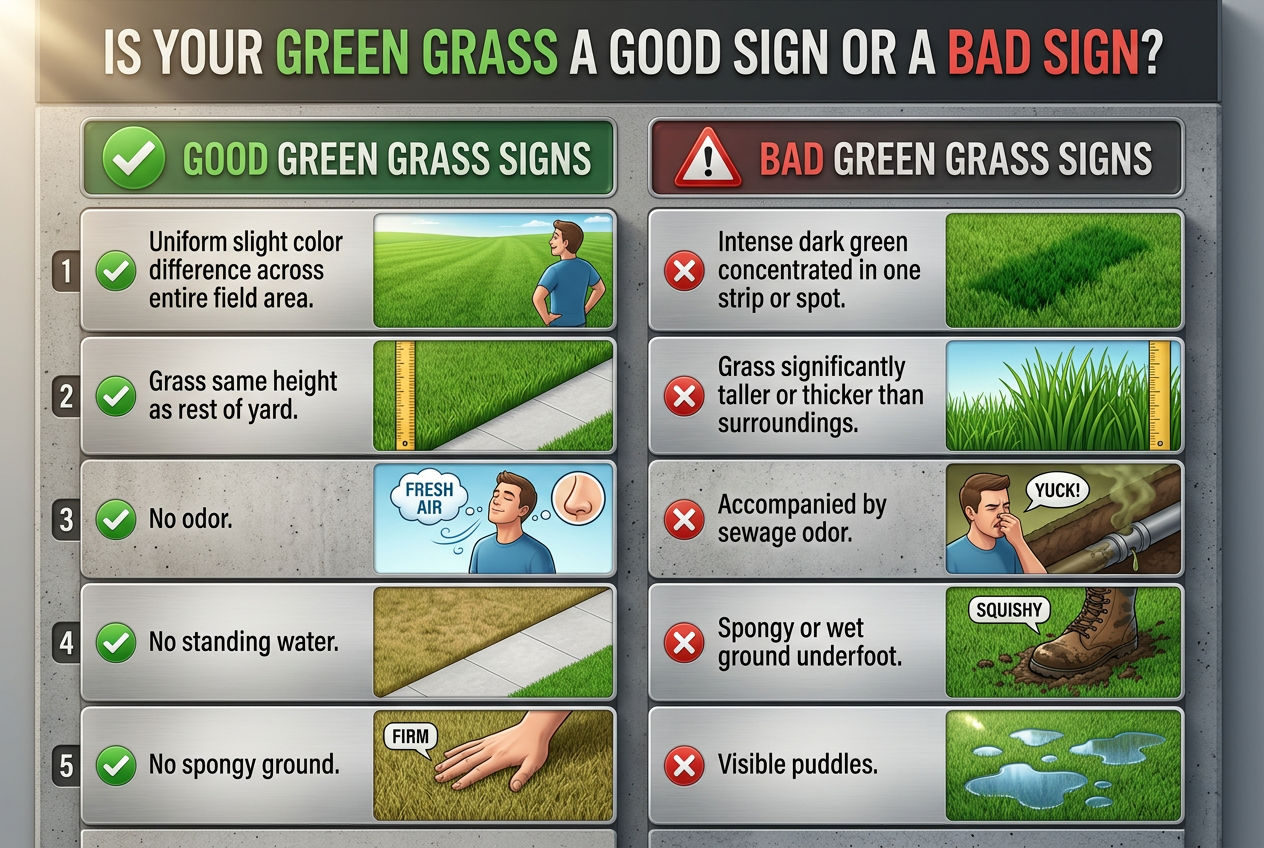
Normal scenario: Grass over the drain field (not the tank) is a consistent shade or two greener than the surrounding lawn. The ground feels firm underfoot. No odor. This pattern hasn't changed significantly year over year.
-
Watch-and-wait scenario: Grass is noticeably lusher but the ground is dry and there's no smell. This often means the system is functioning well — maybe a little too efficiently at releasing nutrients. Monitor it each season.
-
Warning scenario: The grass is dramatically greener, almost fluorescent in comparison to the rest of the yard. The ground is spongy or soggy when you walk on it. You notice a faint sewage or rotten egg odor near the area. This combination points toward effluent surfacing above grade — a drain field failure symptom that needs professional evaluation immediately.
Green Grass Over the Tank vs. Green Grass Over the Drain Field
Location matters enormously here. The drain field is supposed to release nutrients into the soil — that's by design. The tank is not. If your greenest grass is directly over the tank itself (not spread across the field area), that's a more specific concern.

A bright green strip or patch sitting exactly over the tank's footprint can indicate one of two things:
-
Shallow burial. If your tank is buried close to the surface, moisture and heat from inside transfer more readily to the soil above, creating a localized green hotspot. This isn't necessarily a failure, but shallow-buried tanks are more vulnerable to damage from vehicle traffic and freeze-thaw cycles. Learn more about whether driving over your drain field is safe.
-
Tank leaking or overflowing. If a concrete tank develops a crack, or if the inlet baffle is damaged and raw sewage is escaping, the area directly above can become saturated with undiluted wastewater. This is not the same as normal effluent percolation — this is sewage reaching the surface.
⚠️ Warning: If you can locate your septic tank lid and safely access it, inspect for visible cracks in the riser or lid. If the tank lid is warm to the touch in cool weather or you smell sewage, call a licensed inspector.
The Good vs. Bad Green Grass Comparison
| Signal | Normal | Warning Sign |
|---|---|---|
| Grass color | Slightly greener than yard | Vivid / fluorescent green |
| Ground feel | Firm, dry | Spongy, wet, or saturated |
| Odor | None | Sewage or sulfur smell |
| Pattern | Consistent year to year | Sudden new change |
| Location | Over drain field area | Directly over tank only |
| Season context | Spring/summer growth | During drought or winter |
Data sources: EPA Septic Systems Homeowner's Guide; NAWT inspection standards; National Environmental Services Center.
What Does a Dark Green Strip in Your Yard Mean?
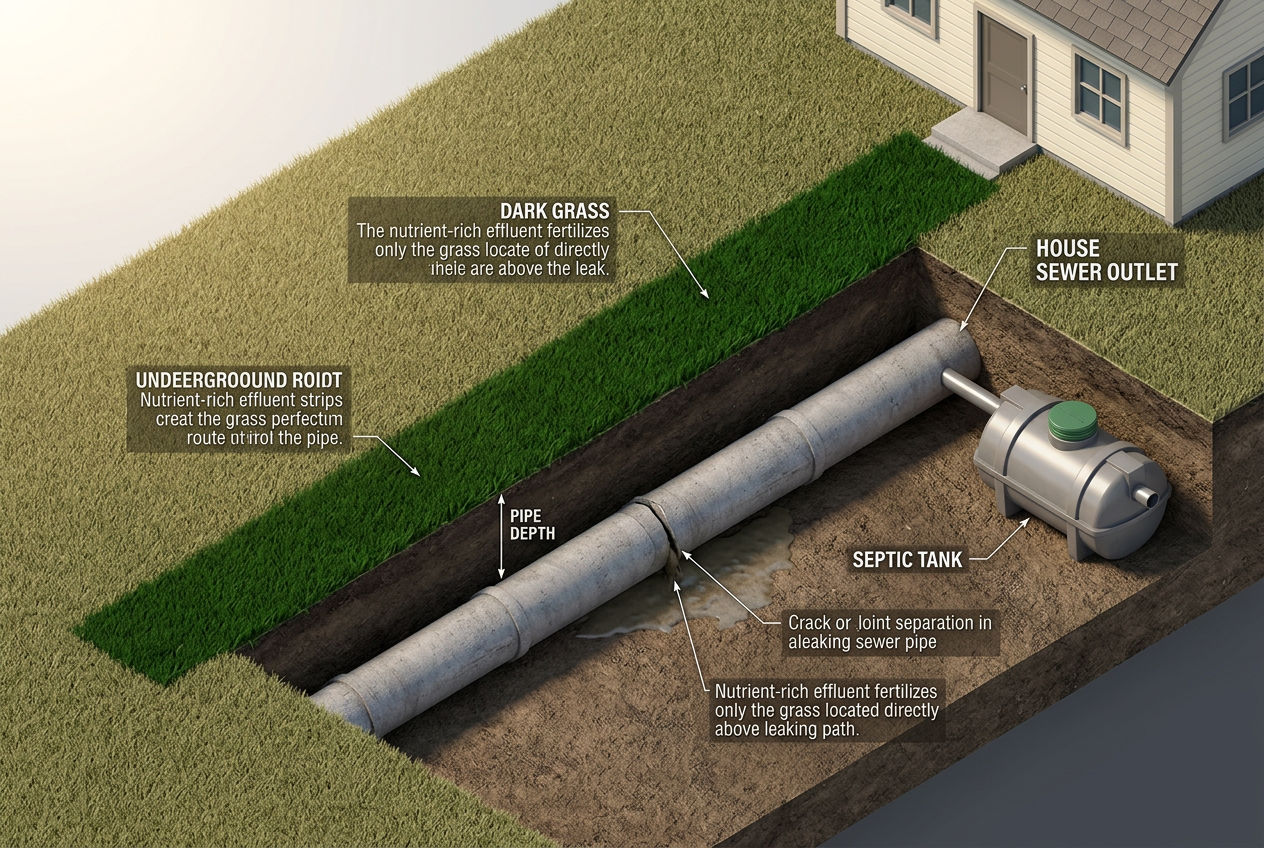
A dark green strip — a linear band of unusually lush grass cutting across your lawn — almost always traces the path of your drain field laterals (also called leach lines or distribution laterals). These perforated pipes are typically spaced 6–10 feet apart and buried 18–36 inches deep, running parallel across the soil absorption field.
Normal vs. Problem Stripes
When a system is functioning properly, you might see faint green stripes corresponding to each lateral's path. That's normal. When a lateral is partially clogged with biomat — the organic layer that naturally builds up at the pipe-soil interface in a healthy drain field — effluent can back up, saturate the area, and push nutrients (and eventually effluent) closer to the surface. The result is a very dark, very defined green stripe.
✅ Pro Tip: A single bright stripe isn't an emergency on its own. Two or three of them, combined with slow drains inside the house or gurgling sounds from your plumbing, suggests the system is struggling with hydraulic overload. That's when a professional septic inspection goes from "smart idea" to "do this now."
Seasonal Patterns: Why the Green Patch Looks Different All Year

Spring: When Differences Emerge
Spring is when most homeowners first notice the color difference. Dormant grass greens up unevenly, and the nutrient-rich soil over the drain field wakes up first. Snow melt in northern states can also reveal soggy patches over a struggling system — the winter equivalent of this same question.
Summer: The Drought Test
Summer tells a different story in dry climates. During a drought in Texas, Arizona, or New Mexico, the rest of your yard may go brown while the drain field stays vividly green. That contrast is alarming, but it's usually the system working correctly — the effluent is the only irrigation those grass roots are getting. That said, if the southwest summer version of this appears alongside soft ground or odor, take it seriously.
Fall and Winter: Hidden Signs
Fall and winter reduce the visibility of color differences, but heavy rain can overwhelm a saturated drain field and push signs of failure to the surface even in cooler months.
💡 Key Takeaway: Seeing snow melt faster over one area of your yard in winter? That's the cold-weather version of this same question — heat rising from decomposition in the tank or a saturated drain field warming the soil from below. It deserves the same diagnostic checklist.
When Green Grass Is a Red Flag: Other Warning Signs to Check
Greener grass alone rarely closes the case. Run through this quick checklist when you're assessing the area:
-
Walk the drain field. Does any section feel spongy or soft underfoot? A healthy field feels like normal lawn. A saturated one feels like a wet sponge.
-
Check for odor. Stand near the greenest area and breathe. Septic odor — sulfur, sewage, or a musty-wet smell — indicates effluent is near or at the surface.
-
Watch your drains. Slow drains inside your home are often the first internal symptom of a drain field that's losing its ability to absorb. Don't ignore them.
-
Check your pump-out history. The EPA recommends pumping every 3–5 years for most households. If you haven't pumped a 1,000-gallon tank serving a 4-person home in six or seven years, solids overflow into the drain field becomes a real risk. That overflow clogs the soil absorption layer permanently.
-
Ask about changes. Did you recently add people to the household? Run more laundry? Install a garbage disposal? Each of those can increase hydraulic load and accelerate failure.
⚠️ Warning: If you're checking boxes on more than one item, get a septic system inspection scheduled. A professional inspection typically costs $150–$450 — a fraction of the $5,000–$20,000+ it costs to replace a drain field.
What to Do If You're Worried About Green Grass Over Your Septic
Step 1: Document It
Take photos now. Note where the green area is, how large it is, and whether it corresponds to your tank location, drain field, or both. If you have a site map from your permit (county health departments typically have these on file), use it to confirm which area you're looking at.
Step 2: Walk the Perimeter
Do the sponge-foot test across the entire drain field. Note any wet spots, bare patches, or areas where the grass is dead rather than green. Dead grass over sections of the field can mean compaction, root intrusion, or biomat failure is preventing any water from moving.
Step 3: Check the Tank's Pump-Out Record
If you're overdue, schedule pumping first. A standard pump-out for a 1,000-gallon tank runs $275–$450 in most markets. It removes accumulated solids and gives the pumper a chance to visually inspect the tank's baffles and inlet/outlet condition.
Step 4: Call a Licensed Inspector If Warning Signs Are Present
If you've got soggy ground plus odor plus green grass, don't wait. Signs of a failing septic system escalate quickly, and some states have mandatory reporting requirements once effluent surfaces above grade.
For ongoing prevention, the septic tank maintenance guide covers the full schedule of pumping, inspection, and system care that keeps drain fields functioning for their full 15–25 year lifespan.
How Much Does It Cost If Something Is Wrong?
Here's the honest financial picture, because this is often what people are really worried about:
| Service | Typical Cost Range |
|---|---|
| Septic inspection | $150–$450 |
| Routine pump-out | $275–$500 (varies by tank size and region) |
| Drain field repair (partial) | $1,500–$5,000 |
| Full drain field replacement | $5,000–$20,000+ |
Costs depend on soil conditions, system type, and local permit requirements
📊 Quick Fact: The EPA estimates that over 21 million U.S. households — roughly 1 in 5 homes — rely on septic systems. And approximately 10–20% of those systems will experience significant malfunction at some point in their lifespan.
The ones that cost the most to fix are almost always the ones where early warning signs were ignored. A well-maintained system lasts 25–30 years. A neglected one can fail in under 15. The drain field replacement cost guide breaks down what you'd pay in different regions and system configurations if it comes to that.
Green Grass Over Septic: When to DIY vs Call a Pro
You Can Handle It Yourself If:
The grass is uniformly slightly greener and nothing else is wrong. Monitor it seasonally, take photos for comparison, and stick to your pumping schedule. No action required beyond awareness.
You're overdue for a pump-out. Schedule one. A routine pump-out ($275–$500) is something you can coordinate yourself by calling a local septic service. During the pump-out, ask the technician to inspect both baffles and check for any signs of solids carry-over to the outlet.
Call a Licensed Professional If:
You have two or more warning signs simultaneously — soggy ground plus odor, bright green grass plus slow drains, or standing water plus a sudden pattern change. Multiple symptoms together indicate system stress that needs professional diagnosis.
The green area is growing or changing rapidly. A patch that's expanding month over month, or grass that went from slightly green to fluorescent in one season, suggests escalating failure.
You're buying or selling the home. A pre-sale septic inspection ($150–$450) is standard in many states and protects both parties. Failed systems discovered after closing create expensive legal and remediation problems.
✅ Pro Tip: When calling for an inspection, ask specifically for a "full system evaluation" — not just a tank pump. A full evaluation includes dye testing, distribution box inspection, and drain field assessment, which is what you need to diagnose whether green grass is benign or a symptom of failure.
Sources
- U.S. Environmental Protection Agency — SepticSmart Program — Effluent nutrient concentrations (nitrogen 20–85 mg/L, phosphorus 10–15 mg/L), pumping frequency recommendations, and the estimate that 21 million U.S. households rely on septic systems. epa.gov/septic
- National Association of Wastewater Technicians (NAWT) — Inspection standards and diagnostic frameworks for assessing drain field condition based on surface indicators.
- National Environmental Services Center (NESC) — Technical guidance on drain field design, soil absorption rates, and seasonal performance variation in different climate zones.
- University of Minnesota Extension — Septic System Owner's Guide — Seasonal monitoring recommendations and the relationship between soil temperature, effluent distribution, and surface vegetation patterns.
Need help with your septic system? Find trusted septic professionals near you to get free quotes. Browse local septic companies in California or Ohio.
Free download
Not ready for the Handbook? Start with the free Fridge Card.
The Do / Don’t card the whole family can see, plus the Survival Kit: emergency flowchart, warning-sign decoder and pump-schedule card. One printable PDF.
Was this article helpful?
Frequently Asked Questions
Recommended Resources
📖 Related Articles
- What Is a Drain Field? (And How Does It Work?)
- Signs Your Drain Field Is Failing (And What to Do)
- Can You Drive or Build Over a Drain Field?
- How to Find Your Septic Tank Lid (And What to Do If It's Buried)
- Septic Tank Gurgling Sounds: Causes and Fixes
- Heavy Rain and Septic Systems: What Happens and What to Do
- Slow Drains With Septic: Is It the Plumbing or the Tank?
- What Happens During a Septic Inspection?
- The Complete Septic Tank Maintenance Guide
💰 Cost Guides
🔧 Services
Find Septic Professionals Near You
Compare licensed, verified septic companies by area — top county markets and cities below, or browse all 50 states.
County markets
Popular cities
