
Quick Answer
Heavy rain can turn a perfectly healthy septic system into a smelly, backed-up mess — fast. If your toilets are gurgling, your yard smells like raw sewage, or you've got standing water pooling over your tank, you're seeing your system under stress. The good news: most of the time, the damage is temporary. The bad news: if you make the wrong moves in the next 24–48 hours, you can turn a temporary problem into a $5,000–$20,000 drain field replacement.
Here's what's actually happening underground, what you should and shouldn't do right now, and how to tell when it's time to call a pro.
💡 Key Takeaways
- Heavy rain raises the water table, which saturates your drain field and stops it from absorbing effluent
- Warning signs include gurgling toilets, slow drains, sewage odors, and standing water over the leach field
- Most drain fields recover in 1–3 days in sandy soils; clay-heavy soils can take 1–2 weeks
- Do NOT pump your septic tank while the ground is still saturated — you risk floating the tank
- Symptoms lasting more than 72 hours after rain stops mean it's time to call a licensed septic professional
How Does Heavy Rain Affect a Septic System?
A heavy rain septic system problem almost always starts underground, not inside your house. To understand why, you need a quick picture of how the system normally works.
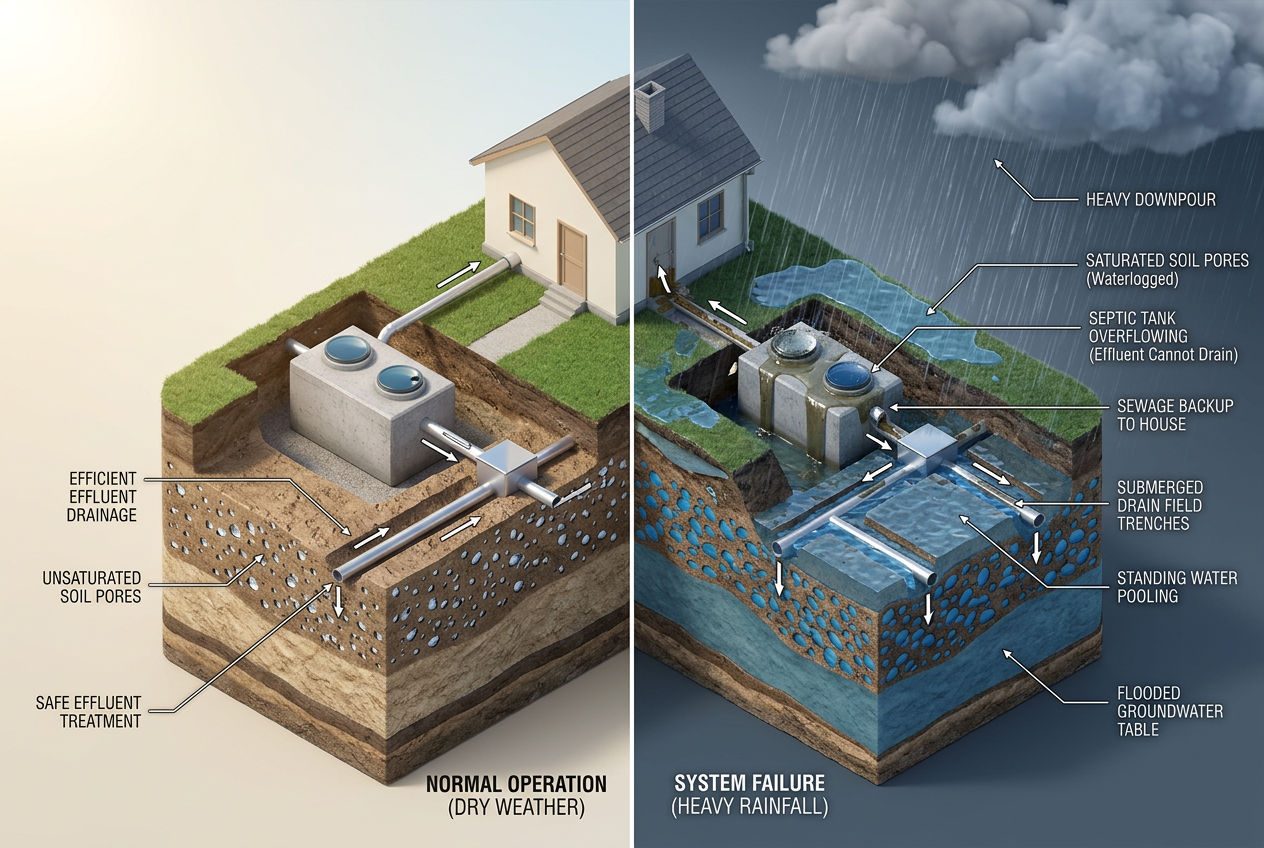
Wastewater flows from your house into your septic tank — typically a 1,000–1,500-gallon concrete or polyethylene tank for a 3-bedroom home. Solids settle to the bottom as sludge; fats and grease float to the top as scum. The clarified liquid in the middle (effluent) flows out through an outlet baffle into your drain field, also called a leach field. There, perforated pipes distribute the effluent through gravel-filled trenches, and the surrounding soil — ideally with a percolation rate of 1–60 minutes per inch (MPI) — absorbs and filters it. (If you need a refresher on the whole process, our guide to what a septic system is and how it works covers the basics.)
When several inches of rain fall in a short period, two things happen that break this cycle:
1. The Water Table Rises
In low-lying areas, the water table can jump several feet during a sustained storm. When groundwater rises up to meet your drain field trenches, there's nowhere for the effluent to go. The soil is already full of water. This is called groundwater saturation of the septic system, and it's the single most common cause of rain-related failures.
2. Stormwater Infiltrates the Tank Directly
If your tank risers or lids aren't properly sealed, rainwater and surface runoff pour directly into the tank. A 1,000-gallon tank serving a 4-person household already processes roughly 240–280 gallons of wastewater per day (based on the EPA's estimate of 60–70 gallons per person per day). Add several hundred extra gallons of stormwater infiltration, and the system hits hydraulic overload — more liquid coming in than the drain field can handle under even ideal conditions.
Free download
Free: the Septic Fridge Card — what to flush, what never to.
The Do / Don’t card the whole family can see, plus the Survival Kit: emergency flowchart, warning-sign decoder and pump-schedule card. One printable PDF.
What Are the Warning Signs of Rain-Related Septic Problems?
The symptoms usually show up in a predictable order. Slow drains and gurgling toilets after a rainstorm are typically the first signs. The gurgling happens because wastewater is backing up in the lines rather than flowing freely to an already-waterlogged tank and drain field.
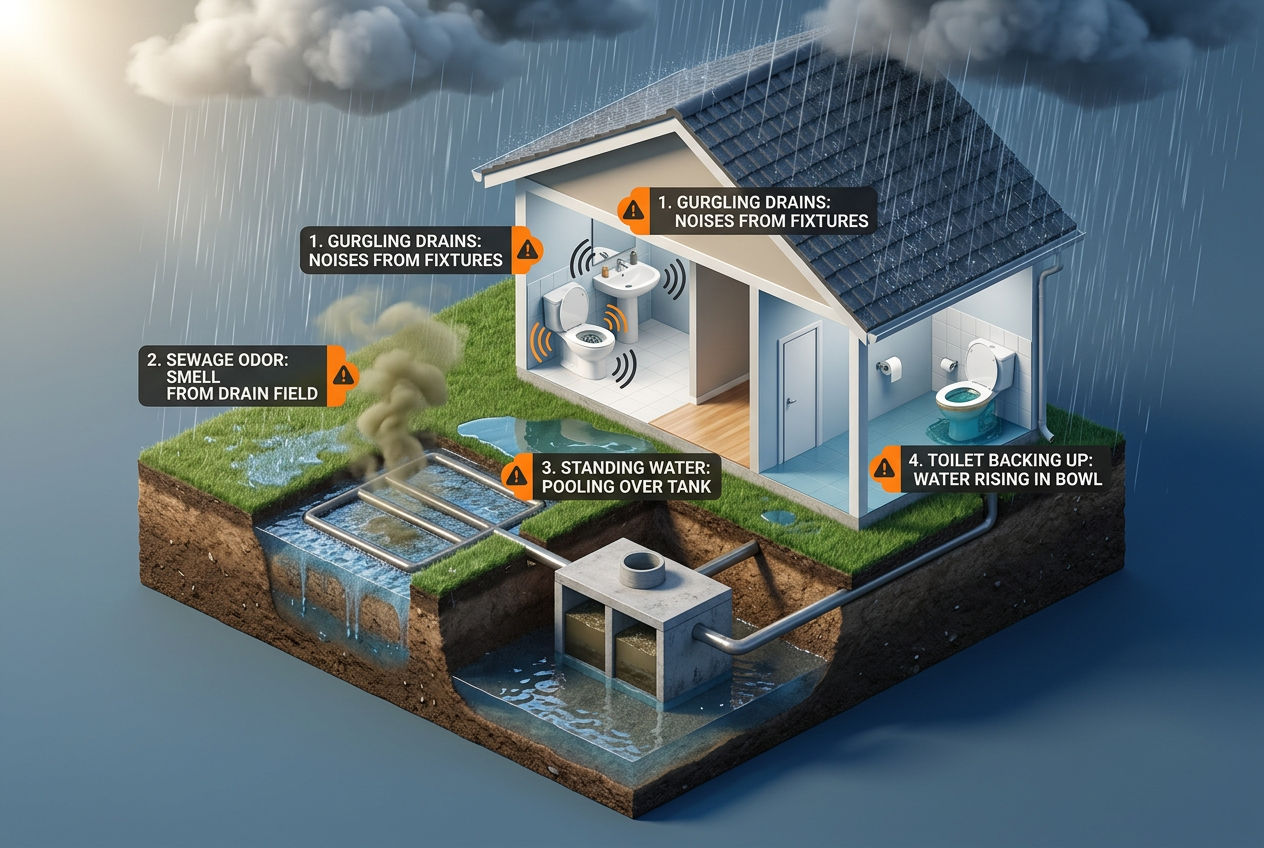
Here's what to watch for, roughly in order of severity:
- Gurgling sounds from toilets, sinks, or tub drains — often the first signal
- Slow drains throughout the house (not just one fixture — that's likely a clog)
- Septic smell after heavy rain, either inside the house or concentrated in the yard
- Standing water over your septic tank or drain field area when the rest of the yard is draining
- Soggy, spongy ground over the leach field, sometimes with unusually lush or green grass
- Sewage backup in the basement or lowest fixtures in the house — the most urgent symptom
- Effluent surfacing in the yard — visible, foul-smelling liquid pooling at ground level
⚠️ Warning: A single slow drain after a storm? Probably not your septic system — check for a localized clog first. But multiple symptoms hitting at once, especially if your whole house is draining slowly? That's a saturated drain field from rain, and the system needs time — or intervention.
For a deeper look at what these symptoms mean, our article on signs your drain field is failing walks through the full diagnostic picture.
Is Standing Water Over Your Septic Tank After Rain Normal?
Some standing water near the tank lid immediately after a downpour isn't automatically a crisis — surface water pools in low spots after any heavy storm. But standing water that persists for more than 24–48 hours after rain stops, especially if it has any odor, is not normal.
Use this table to self-assess what you're seeing:
| Symptom | Likely Normal | Needs Attention | Call a Pro Now |
|---|---|---|---|
| Standing water over tank, clears in <24 hrs | ✓ | ||
| Standing water with sewage odor | ✓ | ||
| Effluent visibly surfacing in yard | ✓ | ||
| Gurgling drains, stops when rain stops | ✓ | ||
| Slow drains 72+ hrs after rain stops | ✓ | ||
| Sewage backup inside home | ✓ | ||
| Soggy drain field, no odor, clears in 3 days | ✓ | ||
| Soggy drain field persisting 2+ weeks | ✓ |
Self-assessment guide. When in doubt, a licensed inspector can confirm. See septic inspection for professional evaluation.
How Long Does a Drain Field Take to Dry Out After Heavy Rain?
In well-draining sandy or loamy soils with a percolation rate under 30 MPI, most drain fields recover within 1–3 days after rain stops. If your system is healthy and the rain event was relatively brief, you may not even notice a lasting problem once the water table drops.
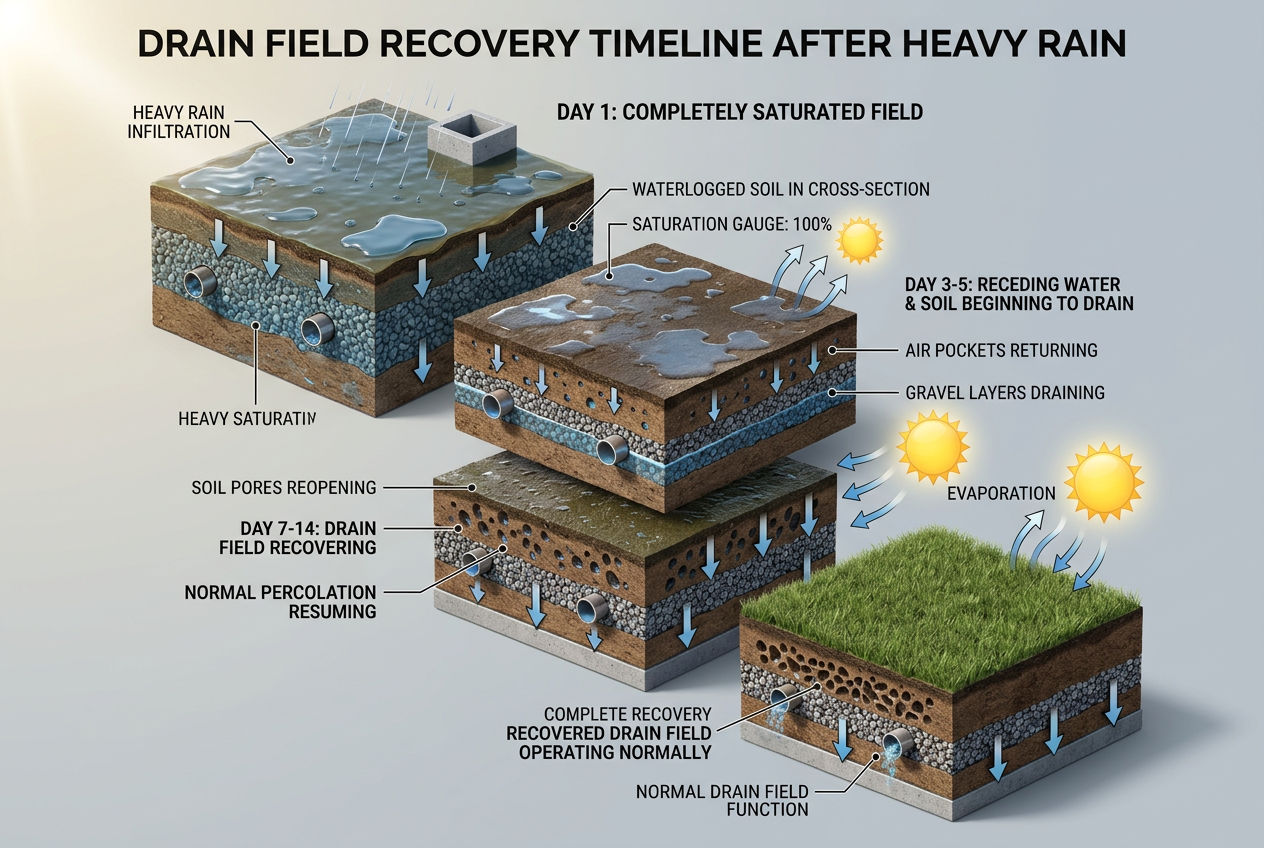
In clay-heavy or poorly draining soils — where perc rates can exceed 60 MPI — expect 1–2 weeks or longer for the drain field to return to normal function. Clay soils hold water stubbornly, and the drain field can remain saturated long after the surface yard looks dry.
📊 Quick Fact: If symptoms persist more than 72 hours after rain has completely stopped, that's your threshold for calling a licensed septic professional. At that point, you've crossed from "weather event" into "system problem."
Regional Variations Matter
Regional context matters significantly here:
-
Pacific Northwest: Rain can fall for weeks at a stretch from October through April, so drain fields may stay partially saturated for months. Systems in these areas often need engineered solutions — like curtain drains or upgraded leach field designs — rather than just waiting for dry weather.
-
Southeast Florida: Water tables are already near the surface year-round, so even a modest rainfall event can push the system into failure mode.
Our article on high water table septic system challenges covers those region-specific solutions in detail.
Should You Pump Your Septic Tank After Heavy Rain?
This is the most common question — and the most commonly mishandled one. The answer is almost always: wait.
Why Waiting Is Critical
When the soil around your buried septic tank is saturated, the tank loses the counterbalancing weight of dry soil pressing in on its walls. An empty or partially emptied tank can actually float upward — a phenomenon called tank buoyancy — causing it to shift, crack, or break the inlet and outlet connections. A 1,000-gallon concrete tank weighs roughly 8,500 pounds empty, but hydrostatic pressure from saturated soil is powerful enough to move it.
✅ Pro Tip: Septic professionals generally recommend waiting 24–48 hours after floodwaters fully recede before scheduling a pump-out. Even then, pumping is only appropriate if you have a specific reason — like the tank having taken on stormwater infiltration, or if the tank was already due for service.
Pumping will NOT fix a saturated drain field. If your leach field is waterlogged, pumping the tank just buys you a few hours before the tank refills and the same backup occurs. The real fix is letting the drain field dry out.
If you do need a pump-out after the storm passes, our guide on what to expect during a septic pumping appointment walks through the full process — and our septic pumping cost guide covers what you should expect to pay ($300–$600 for a standard 1,000-gallon tank nationally, with emergency or after-hours service running higher).
Can Heavy Rain Permanently Damage a Septic System?
One bad storm? Usually not, if your system was in good shape beforehand. Repeated flooding or chronic drain field saturation? That's where permanent damage happens.
How Chronic Flooding Destroys Drain Fields
When a drain field floods over and over, the soil structure breaks down. Fine particles wash into the perforated distribution pipes and the gravel bed surrounding the leach laterals, clogging the pores that allow absorption. Eventually, a biomat — a dense layer of biological material — forms at the soil-trench interface, and the field stops draining entirely. No amount of waiting or pumping reverses a failed biomat.
📊 Quick Fact: Late-1990s EPA literature estimated that 10–20% of septic systems were malfunctioning at any given time, with flooding being a leading contributing factor. Drain field replacement averages $5,000–$20,000 depending on system size, soil conditions, and regional labor costs.
Pre-Existing Weaknesses
The other risk: if your system is more than 20–25 years old, a major flooding event can expose pre-existing weaknesses — cracked concrete baffles, a deteriorated distribution box, or a compromised effluent filter (like an aging Polylok PL-122 or Zabel A1800 series) — that were holding on by a thread.
What Should You Do Right Now if Your Septic Is Backing Up After Rain?
If you're in the middle of a problem, here's the sequence:
Immediate Actions (First 24 Hours)
1. Reduce water use immediately. Every gallon you flush adds to an already-overwhelmed system. No laundry, short showers only, spread out dishwasher use. This is the single most effective short-term intervention.
2. Keep people away from standing water. Floodwater mixed with septic effluent can contain E. coli, Hepatitis A, and Giardia. FEMA classifies flooded septic systems as a public health hazard. Kids and pets need to stay out of the yard.
3. Don't use chemical drain openers. Products like Drano can disrupt the bacterial ecosystem inside your tank and won't touch a rain-related saturation problem. Read more about why chemical drain cleaners and septic systems don't mix.
4. Do NOT pump the tank yet. See above — wait until the ground dries.
Documentation and Professional Help
5. Document everything. If you have homeowner's insurance, photograph standing water, note the date and duration of rain, and check your policy. Some policies cover septic backup damage; many don't. Our article on homeowners insurance and septic systems explains what's typically covered.
6. Call a professional if sewage is backing up inside the house. This isn't a "wait and see" situation. Active sewage backup inside your home is a health emergency. Emergency septic service providers can install a temporary holding solution or assess whether the system can be relieved.
How to Protect Your Septic System Before the Next Storm
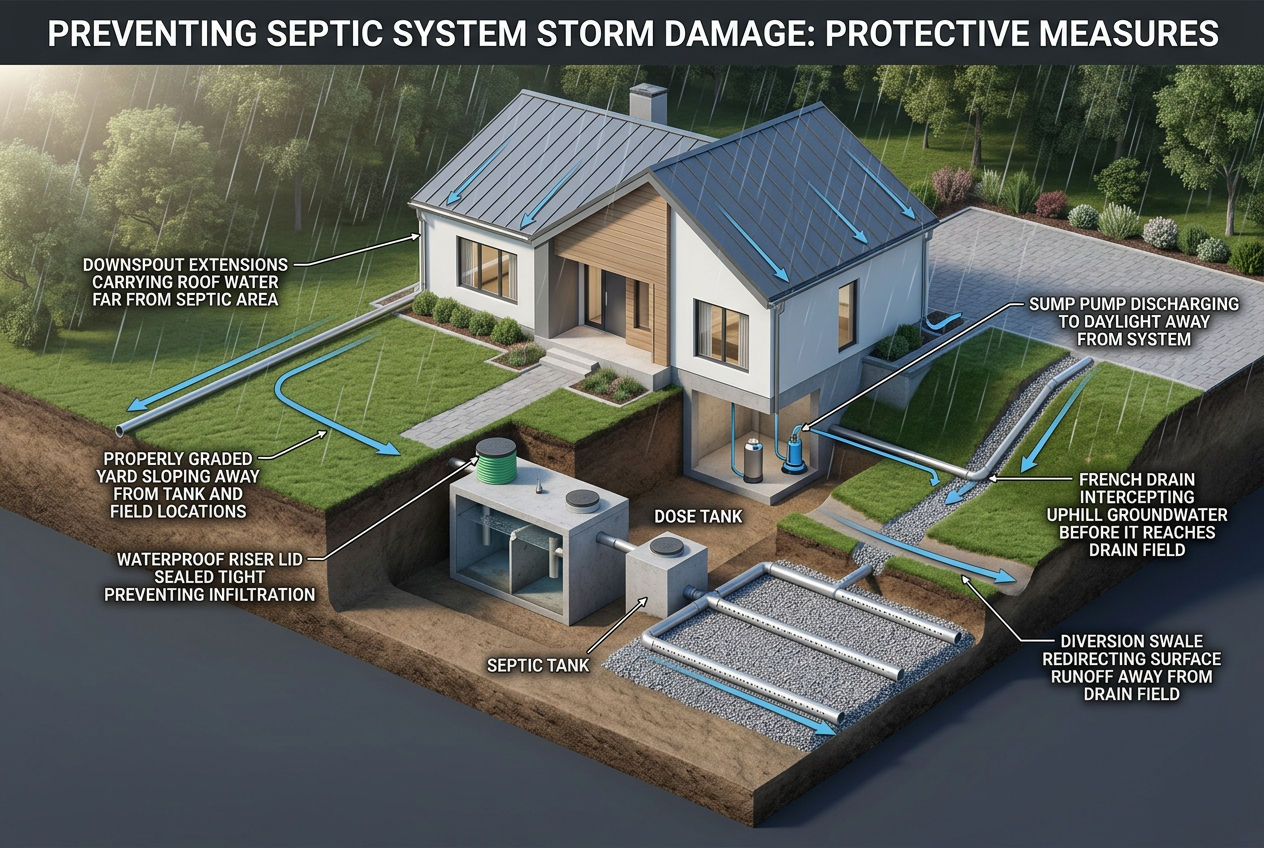
Prevention is significantly cheaper than repair. Here's what actually makes a difference:
Critical Prevention Measures
Redirect surface water away from the drain field. Downspouts, sump pump discharge, and driveway runoff should never drain toward your leach field area. Even small volumes of stormwater infiltration compound quickly. A licensed installer can design a curtain drain — a perforated pipe set in gravel — to intercept groundwater before it reaches your drain field.
Check and seal your tank risers and lids. Cracked or improperly seated riser lids let stormwater pour directly into your tank. A properly sealed lid costs $50–$150 to replace or re-seal. Stormwater infiltration that hydraulically overloads your system costs much more.
Pump your tank on schedule — before storm season, if possible. A 1,000-gallon tank serving a 4-person household should be pumped every 3–4 years per EPA guidance. If your tank is approaching that interval, scheduling a pump-out in early spring (before the heaviest rain season) gives you maximum working volume as a buffer against incoming water. Our guide on how often to pump a septic tank covers the full schedule by tank size and household size.
Long-Term Protection
Don't plant trees near the drain field. Root intrusion degrades the perforated laterals and gravel bed, making saturation damage worse. Our article on trees near septic systems covers safe distances by species.
Have your system inspected before storm season. A failing effluent filter, a cracked distribution box, or a compromised outlet baffle won't be obvious until a storm pushes the system to its limits. A septic inspection typically runs $250–$500 and is far cheaper than emergency repair. See our full septic inspection cost guide for regional breakdowns.
Related: power outage septic concerns — worth reading if this applies to your situation.
✅ Pro Tip: For a complete seasonal maintenance plan, our septic tank maintenance guide covers everything from routine pumping to pre-storm prep.
When Should You Call a Septic Professional?
Call a licensed septic contractor if any of the following apply:
- Sewage is backing up into your home — even once
- Standing water over your drain field has an odor and isn't draining after 48 hours
- Symptoms (slow drains, gurgling, odors) persist more than 72 hours after rain completely stops
- You can see effluent surfacing in your yard
- Your system is more than 20 years old and showing any rain-related symptoms
Sources & Methodology
-
U.S. Environmental Protection Agency — A Homeowner's Guide to Septic Systems (EPA 832-B-02-005). Referenced for guidance on septic system behavior during wet weather and hydraulic loading limits.
-
University of Georgia Cooperative Extension — Research on heavy rainfall effects and saturated soil conditions on conventional and alternative septic systems in the Southeast.
-
North Carolina Department of Health and Human Services — State guidance on septic system management during flood events and high water table conditions.
-
National Environmental Services Center (NESC) — Technical briefs on septic system performance under adverse weather conditions, including flooding and prolonged rainfall events.
-
USDA Natural Resources Conservation Service — Soil drainage classification data and percolation rate references used in drain field performance analysis during wet weather.
Cost data reflects 2025–2026 national averages compiled from contractor pricing surveys across SepticTankHub.com's directory network.
Need help with your septic system? Find trusted septic professionals near you to get free quotes. Browse local septic companies in Georgia or North Carolina.
Was this article helpful?
Frequently Asked Questions
Recommended Resources
📖 Related Articles
- What Is a Septic System? How It Works (Visual Guide)
- Signs Your Drain Field Is Failing (And What to Do)
- High Water Table and Septic Systems: What You Need to Know
- What to Expect When Getting Your Septic Tank Pumped
- Can You Use Drano with a Septic System?
- Does Homeowners Insurance Cover Septic Repairs? (2026 Guide)
- How Often Should You Pump Your Septic Tank?
- Trees Near Septic Systems: Safe Distances & Worst Species (2026)
- The Complete Septic Tank Maintenance Guide
💰 Cost Guides
🔧 Services
Find Septic Professionals Near You
Compare licensed, verified septic companies by area — top county markets and cities below, or browse all 50 states.
County markets
Popular cities
