
Quick Answer
A septic system during a power outage may work fine or fail completely — it depends entirely on your system type. Gravity-fed systems require no electricity and keep draining normally. Aerobic treatment units, effluent pumps, lift stations, and chlorinators all stop the moment power cuts out, creating a real risk of sewage backup within hours.
💡 Key Takeaways
- Gravity-fed septic systems need no electricity and work indefinitely during outages
- Aerobic treatment units (ATUs) begin losing beneficial bacteria within 24–48 hours without aeration
- Effluent pumps draw 800–1,500 watts running; a 3,000–5,000W generator handles most residential systems
- Water conservation is your most powerful tool during any outage — cut usage to under 50 gallons per person per day
- Pre-storm pump-outs and battery backups can prevent costly repairs that run $1,500–$6,000+
Does a Septic System Need Electricity to Work?
Not all septic systems need electricity — but some depend on it completely. The answer hinges on one thing: how wastewater moves through your system.
A conventional gravity-fed septic system uses slope and gravity to move waste from your house to the tank, and then from the tank out to the drain field. No pumps, no motors, no electricity required. If your home sits on a reasonably sloped lot with a traditional two-compartment concrete or fiberglass tank feeding a leach field downhill, a power outage is essentially a non-event for your septic system.
But a significant share of U.S. homes — roughly 21 million households use septic systems nationwide, according to the EPA — have systems that depend on electricity for one or more critical functions. Pump-assisted systems, aerobic treatment units, and mound systems all need power to move or treat wastewater. When the grid goes down, those systems either stop working or start degrading immediately.
System-by-System Power Requirements
| System Type | Needs Power? | Works During Outage? | Risk Level |
|---|---|---|---|
| Gravity-fed conventional | No | Yes, indefinitely | Low |
| Pump-to-drain-field (effluent pump) | Yes | No — pump stops | High |
| Aerobic treatment unit (ATU) | Yes | Partially — treatment degrades | High |
| Mound system | Yes | No — dose pump stops | High |
| Holding tank | Minimal (alarm only) | Yes, until full | Medium |
Source: EPA Septic Systems Overview; NOWRA system classification standards
Free download
Free: the Septic Fridge Card — what to flush, what never to.
The Do / Don’t card the whole family can see, plus the Survival Kit: emergency flowchart, warning-sign decoder and pump-schedule card. One printable PDF.
What Still Works During a Power Outage?
If you have a gravity-fed system, your septic keeps doing its job. Wastewater flows from your house through the inlet baffle into the first compartment of the tank. Solids settle to the bottom as sludge. The effluent — the liquid layer in the middle — flows through the outlet baffle into the drain field, where soil microbes handle the final treatment. Gravity does all the work.
What Makes Gravity Systems Work Without Power
- No float switches
- No pump chambers
- No aerator compressors
- Pure physics — slope and gravity handle everything
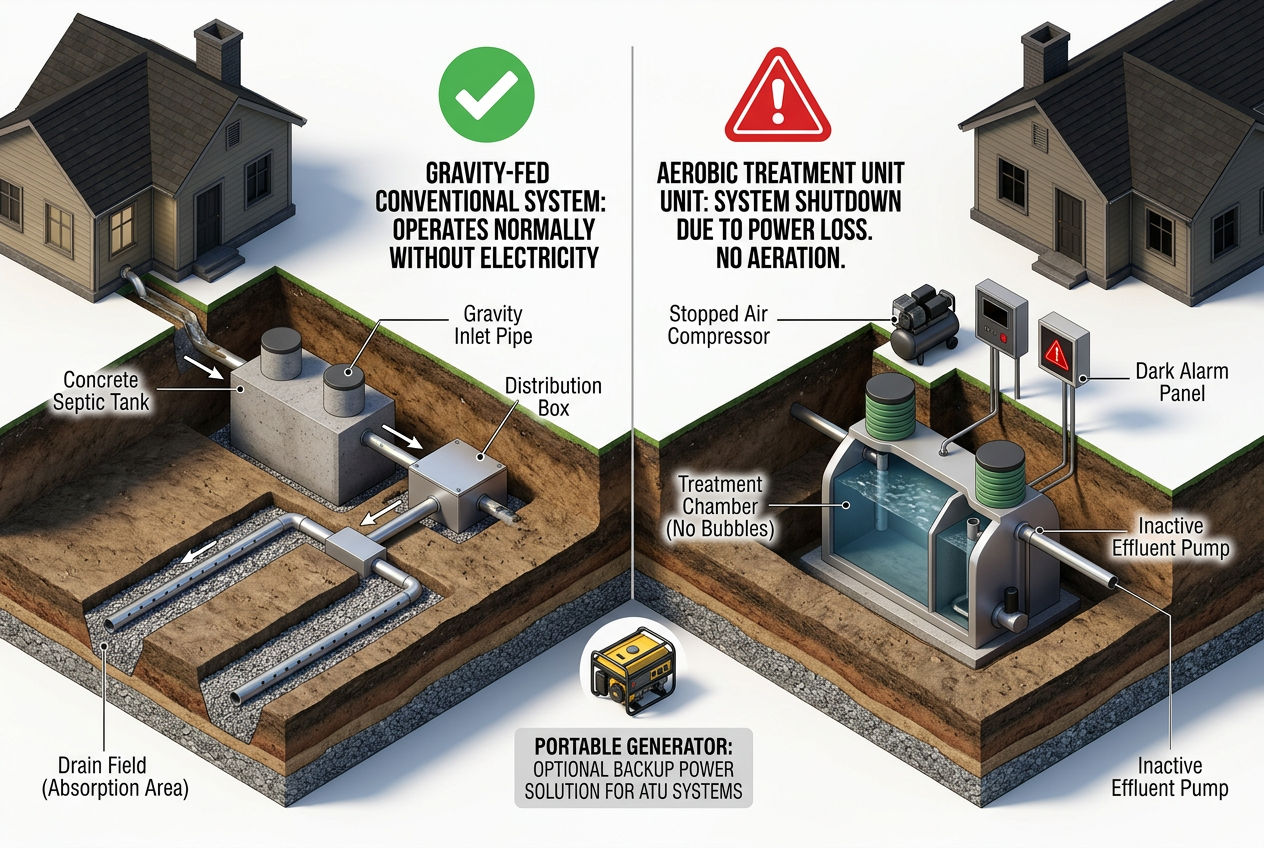
You can flush your toilet normally. Run the sink. Take a shower. As long as your 1,000–1,500 gallon tank isn't already near capacity, a multi-day outage won't cause a problem.
⚠️ Warning: Even gravity systems have limits. If your tank was already overdue for pumping before the storm hit, you have less buffer. A 1,000-gallon tank serving a four-person household that hasn't been pumped in five or six years may have very little active capacity left.
Understanding Daily Water Load
Modern low-flow toilets use 1.6 gallons per flush, and the average person uses 70–100 gallons per day. Four people generating 300+ gallons daily against a nearly full tank is a problem — power or no power.
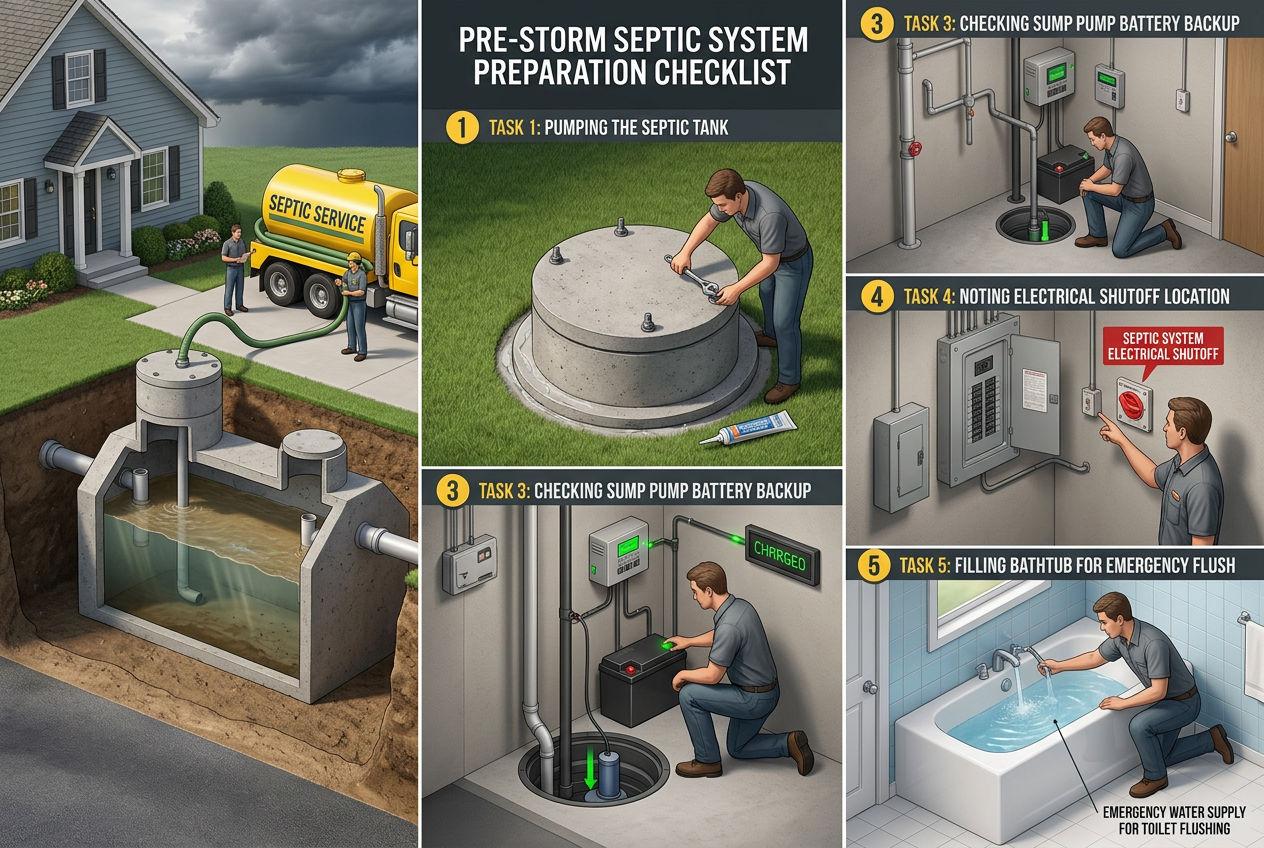
The fix? Get your tank pumped before storm season. A standard pump-out for a 1,000-gallon tank typically costs $275–$400. That's a cheap insurance policy compared to emergency service rates after a hurricane.
What Stops Working the Moment Power Cuts Out?
Effluent Pumps and Lift Stations
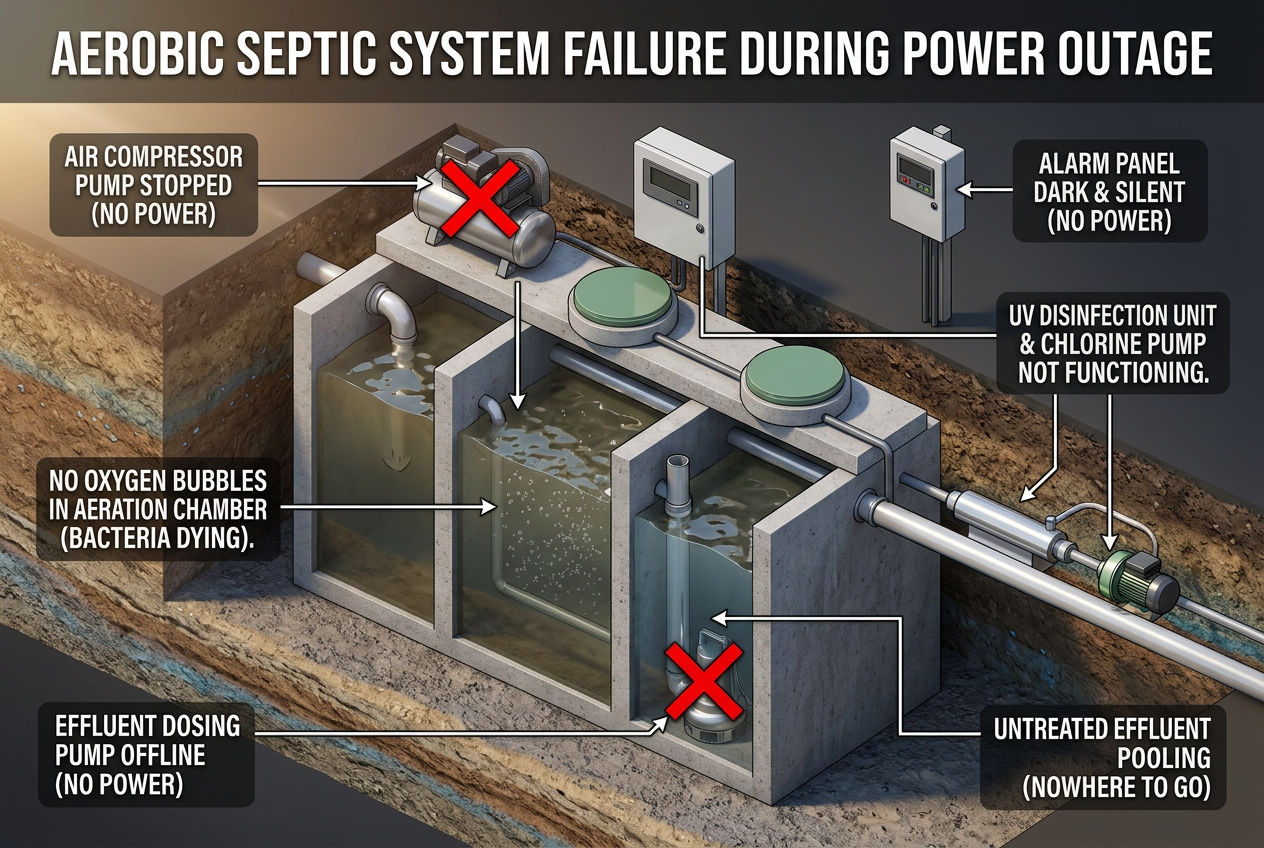
If your home is on flat land, or your drain field sits uphill from your tank, you almost certainly have an effluent pump (sometimes called a sewage pump or dosing pump) sitting in a pump chamber. When the power goes out, that pump stops. Wastewater has nowhere to go.
Your tank continues to receive waste from your house. But the effluent pump that pushes treated liquid out to the drain field? Silent. Depending on how much reserve capacity is in your pump chamber, you may have anywhere from a few hours to a day before wastewater starts backing up toward your home.
📊 Quick Fact: A lift station — common in subdivisions or properties where multiple homes share a collection system — faces the same problem, often at larger scale. If the lift station serving your neighborhood loses power and has no backup generator, sewage can overflow the wet well.
Aerobic Treatment Units
Aerobic systems are the ones most at risk during a power outage, full stop.
An aerobic treatment unit (ATU) works by continuously pumping air through the wastewater using an aerator compressor (think: a device similar to a Hiblow HP-80 or equivalent linear air pump) to cultivate colonies of oxygen-dependent bacteria that aggressively break down waste. This process is far more effective than conventional septic treatment — but it requires continuous power to the air compressor.
What Happens When Aeration Stops
The moment power cuts, aeration stops. The aerobic bacteria that make the system work begin dying off within 24–48 hours as the dissolved oxygen in the tank drops toward zero. Within a few days:
- System reverts to anaerobic conditions
- Produces foul odors
- Dramatically reduced treatment quality
- Chlorinator pump stops (no disinfection)
⚠️ Warning: In states like Texas and Florida, where ATUs are common due to soil conditions, discharging untreated effluent can trigger a regulatory violation. Texas requires licensed maintenance providers for all aerobic systems under 30 TAC Chapter 285, and some counties require reporting when systems are down beyond a certain threshold.
✅ Pro Tip: An air compressor for a typical residential ATU draws 80–150 watts continuously — it doesn't take much to keep it running, which is good news for backup power planning.
Septic Alarms
If your septic alarm starts going off during a power outage, don't panic — but don't ignore it either. Float-switch alarms in pump chambers are typically powered by the same electrical circuit as the pump.
Some systems are wired so:
- The alarm triggers when the float rises above a set level (indicating the pump isn't moving liquid out fast enough)
- Others trigger on a low-voltage signal from the control panel when power is lost entirely
Either way: an alarm during an outage means your pump chamber is filling. If you're on a generator, this is the first signal to fire it up.
How Long Can Your System Run Without Power?
The honest answer depends on your system type, tank capacity, and household usage:
| System Type | Runtime Without Power | Key Limiting Factor |
|---|---|---|
| Gravity-fed systems | Essentially indefinite | Tank capacity and drain field saturation |
| Pump-assisted systems | 6–12 hours normal use | Pump chamber reserve volume |
| Aerobic treatment units | 24–48 hours before degradation | Bacterial die-off from no aeration |
| Holding tanks | 5–7 days (4-person household) | Total storage capacity |
System-Specific Details
Gravity-fed systems: As long as the tank has capacity and the drain field isn't saturated, you're fine. A heavy rainstorm that floods the leach field is a bigger threat than a power outage — see our guide on heavy rain and septic systems for that scenario.
Pump-assisted systems (effluent pump to drain field): Most pump chambers hold enough reserve volume to handle 6–12 hours of normal household usage before the alarm triggers and backup becomes a real concern. Larger homes with higher daily flow will exhaust that buffer faster.
Aerobic treatment units: You have a 24–48 hour window before bacterial die-off becomes significant. After 72 hours, treatment quality drops sharply. After 5–7 days without power, you're essentially operating an untreated waste discharge system.
💡 Key Takeaway: The aerobic bacteria colonies do recover once power is restored and aeration resumes — typically within 24–72 hours of restart — but extended outages mean extended recovery periods.
Holding tanks: These have no treatment function; they just store waste until pumped. If power is out and you have a holding tank, your only limitation is tank capacity. A 1,500-gallon holding tank with a family of four will fill in roughly 5–7 days at normal usage. Emergency pump-out during a disaster event can cost $400–$600 or more, assuming a truck can reach you.
What Should You Do If the Power Is Out Right Now?
Immediate Action Steps
Step 1: Identify your system type. If you're not sure whether you have a gravity system or a pump-dependent system, look for a control panel box near your tank or in your garage.
- A green or red indicator light (or alarm box) = powered components
- No panel = likely gravity-fed
- Check property records or septic inspection report
Step 2: Reduce water usage immediately. This is the single most effective thing you can do.
📊 Quick Fact: Every flush is 1.6 gallons. Every shower is 15–25 gallons. Every load of laundry is 15–40 gallons.
Cut household usage to 50 gallons or less per person per day:
- Use the toilet only when necessary
- Skip showers or use minimal water
- Hold off on laundry entirely
Step 3: Don't pour grease, large food scraps, or non-flushables down any drain. With your system under stress, the last thing you want is to accelerate sludge buildup. Review what not to flush with a septic system if you need a refresher.
Step 4: If you have a generator, connect your septic pump. More on sizing below.
Step 5: Note the time. If you have an ATU, track how long the aerator has been off. Anything approaching 48 hours means you should call your maintenance provider when communications are restored.
Can I Flush My Toilet During a Power Outage With Septic?
Yes — with conditions. If you have a gravity-fed system, flush normally but be conservative. If you have a pump-dependent system, you can still flush for a limited time — but you're drawing down your pump chamber's reserve capacity with every flush.
💡 Key Takeaway: Think of it like a backup battery. You have some buffer. Use it wisely.
The Practical Rule
- Flush for bodily waste only
- Skip the long showers
- Skip the dishwasher
- Skip laundry
Every gallon you don't send down the drain is another hour of buffer before your pump chamber hits the alarm float.
Do You Need a Generator for Your Septic System?
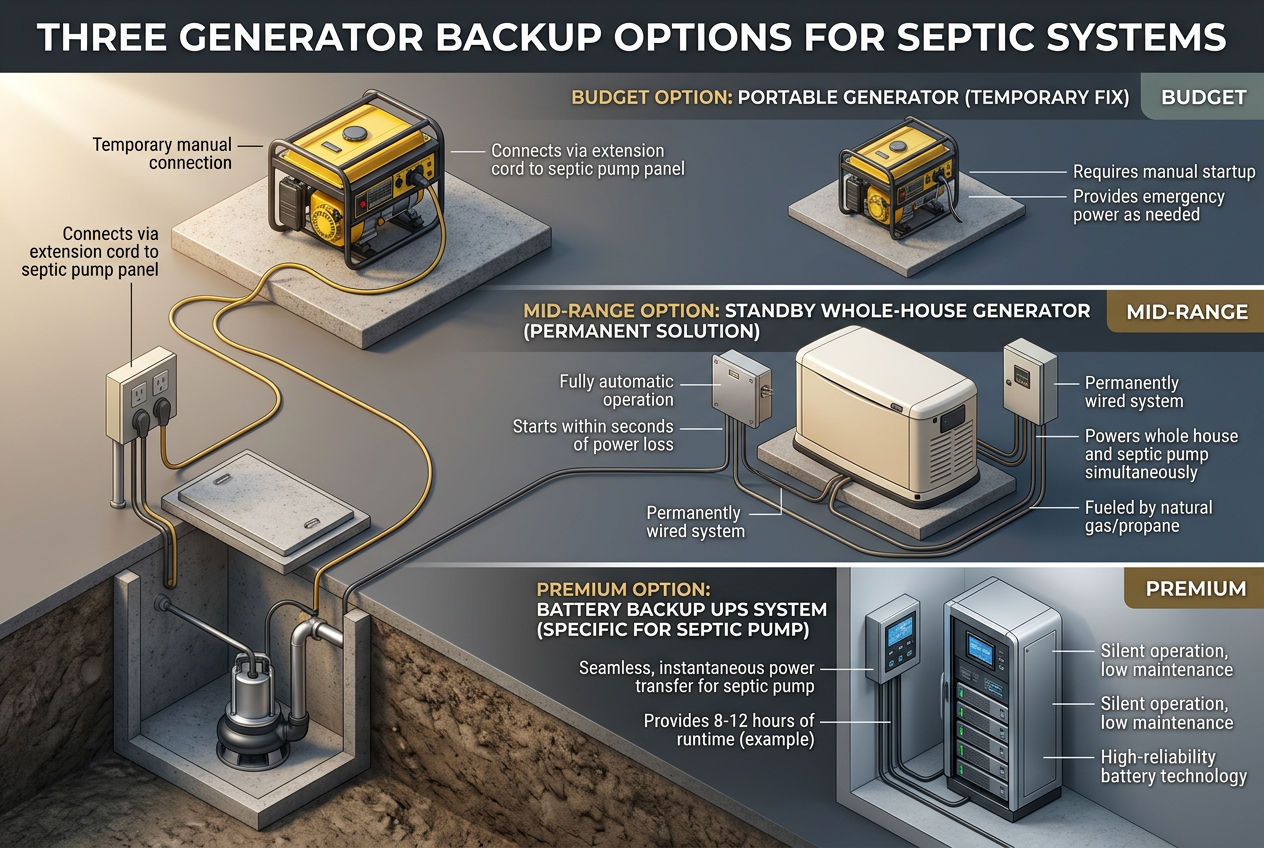
If you have an effluent pump, aerobic treatment unit, or lift station — yes, seriously consider it. A generator for a septic system doesn't need to be massive. Here's what you need to know:
Wattage Requirements by Component
| Component | Running Watts | Starting Surge | Notes |
|---|---|---|---|
| Effluent pump | 800–1,500W | Up to 2,500W | Most demanding component |
| ATU aerator (Hiblow HP-80) | 80–150W | Minimal | Continuous operation |
| Septic alarm panel | 5–20W | None | Negligible load |
Generator Sizing Options
Option 1: Portable Generator (3,000–5,000W)
- Handles standard residential effluent pump including startup surge
- Popular models: Honda EU3200i, Champion 3500W
- Cost: $400–$1,200
- Best for: Targeted septic backup during outages
Option 2: Whole-House Standby Generator
- Covers well pump, HVAC, and septic system
- Brands: Generac, Kohler
- Cost: $5,000–$15,000+ installed
- Runs automatically on natural gas or propane
- Best for: Comprehensive power security
Option 3: Battery Backup System
- Designed for sump or effluent pumps
- Models: Wayne WSS30VN, Zoeller Aquanot series
- Cost: $200–$600
- Runtime: 5–12 hours depending on cycling
- Best for: Budget-conscious homeowners, short outages
✅ Pro Tip: The aerator on an ATU is actually the easy part — 80–150 watts is well within the capacity of even a small generator or a quality UPS system. Keeping the air compressor running is the priority.
How to Prepare Your Septic System Before a Storm
The homeowners who come through extended power outages without a septic disaster
Sources & Methodology
-
U.S. Environmental Protection Agency — Federal guidance on septic system types and which components require electrical power for normal operation.
-
University of Minnesota Extension — Research on aerobic treatment unit operation, alarm systems, and the impact of power interruptions on treatment efficiency.
-
National Onsite Wastewater Recycling Association (NOWRA) — Industry guidance on backup power options and emergency protocols for electrically dependent septic systems.
-
Minnesota Pollution Control Agency — State guidance on aerobic system maintenance contracts and alarm response requirements during power outages.
-
American Red Cross — Emergency preparedness guidance for homeowners with private water and wastewater systems during extended power outages.
Cost data reflects 2025–2026 national averages compiled from contractor pricing surveys and generator manufacturer pricing across SepticTankHub.com's directory network.
Need help with your septic system? Find trusted septic professionals near you to get free quotes. Learn more about emergency septic services. Browse local septic companies in Indiana or Alabama.
Was this article helpful?
Frequently Asked Questions
Recommended Resources
📖 Related Articles
- What Is a Septic System? How It Works (Visual Guide)
- What Is a Drain Field? (And How Does It Work?)
- How Often Should You Pump Your Septic Tank?
- Aerobic vs Anaerobic Septic Systems: How They Compare
- Septic Tank Alarm Going Off? What It Means and What to Do
- Heavy Rain and Septic Systems: What Happens and What to Do
- What Can You Flush with a Septic System? (Tampons, Wipes & More)
Find Septic Professionals Near You
Compare licensed, verified septic companies by area — top county markets and cities below, or browse all 50 states.
County markets
Popular cities
