
Quick Answer
When your septic alarm starts blaring, it signals that water in your pump chamber has risen to the alarm float — roughly 6–8 inches above the normal pump-on level. This doesn't mean sewage is about to flood your yard in the next five minutes, but it does mean something is wrong and you need to address it within 24–48 hours.
Key Takeaways
- A septic alarm means your pump chamber water level is too high — not automatically a sewage emergency
- You typically have 24–48 hours of emergency capacity before a backup becomes likely
- 60–70% of alarm events trace back to pump failure, a stuck float switch, or a tripped circuit breaker
- Silence the alarm, cut water use, check the breaker, then call a pro if the problem persists
- Repair costs range from $0 (a tripped breaker you reset yourself) to $15,000+ for drain field replacement
What Does a Septic Tank Alarm Actually Mean?
Most residential septic systems that have a pump — whether a conventional pump-dose system or a more complex aerobic treatment unit — have a control panel with a red warning light and an audible buzzer. That panel is wired to a series of float switches hanging inside your pump chamber (also called the dose chamber or wet well).
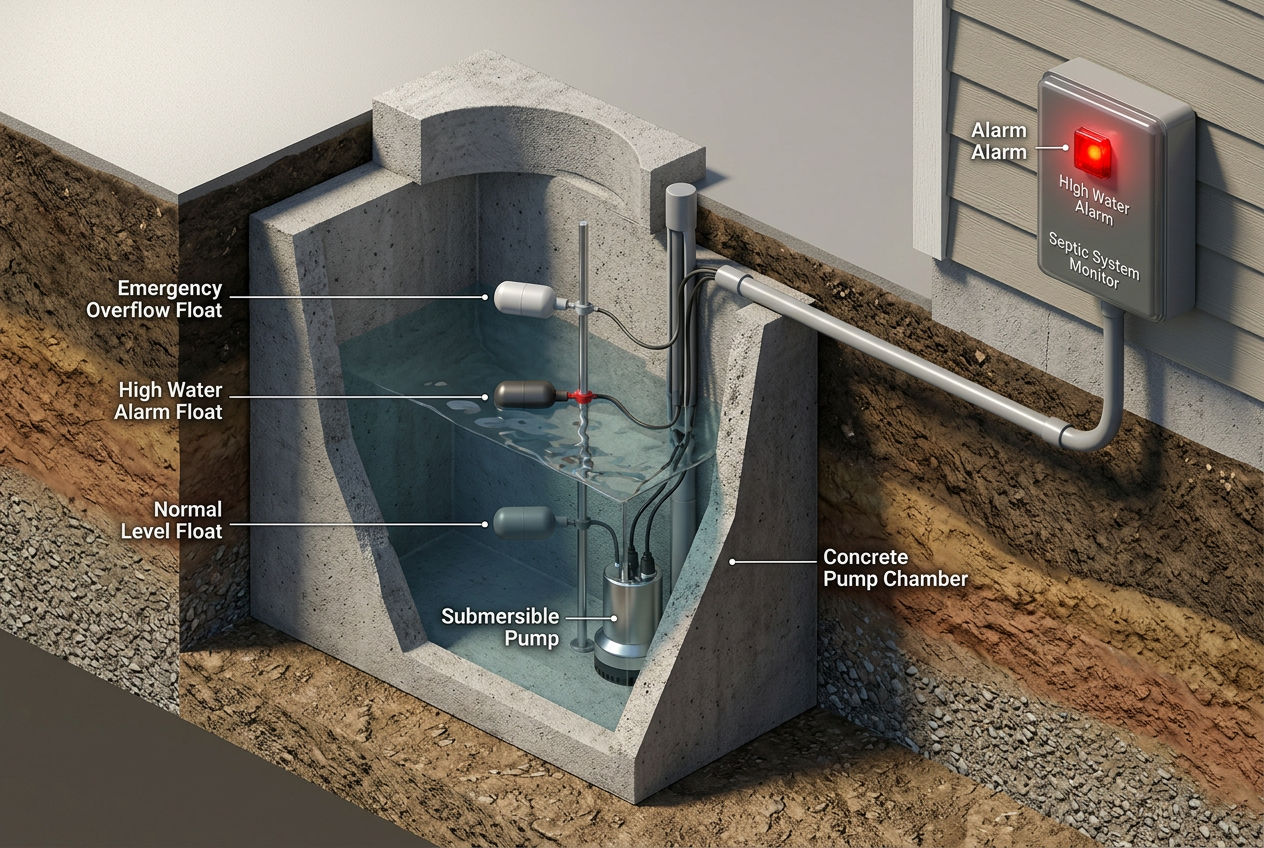
How Float Switches Work
Here's the basic setup: a 1,000-gallon pump chamber typically holds 2–4 float switches:
- Pump-on float — triggers the pump to start
- Pump-off float — shuts the pump down
- High-water alarm float — set 6–8 inches above the pump-on float
When effluent rises past that third float, it closes the circuit and triggers the alarm.
💡 Key Takeaway: The red light on your septic tank panel is telling you one thing: the water level is higher than it should be. The reason why is what you need to figure out.
Think of it this way — the alarm is the "check engine" light of your septic system. It doesn't tell you if you've got a loose gas cap or a blown head gasket. That part takes a little more digging.
Is a Septic Alarm an Emergency?
A septic alarm is not necessarily an emergency requiring you to call someone at 2 a.m., but it should be treated as urgent — address it within 24 hours.
A typical household of four generates roughly 400 gallons of wastewater per day. Most pump chambers have a few hundred gallons of emergency storage capacity above the alarm float. That buys you time, but not much. If the pump is completely dead and your household keeps using water normally, you could exhaust that buffer in 12–18 hours and face a septic system backup.
⚠️ Warning: The CDC classifies raw sewage backups as a serious health hazard, with over 100 types of pathogenic organisms. Interior sewage cleanup averages $7,000–$20,000.
So: not a "drop everything and call 911" situation. But don't go to bed without taking action.
What Causes a Septic Tank Alarm to Go Off?
The cause breakdown, based on service industry data, looks roughly like this:
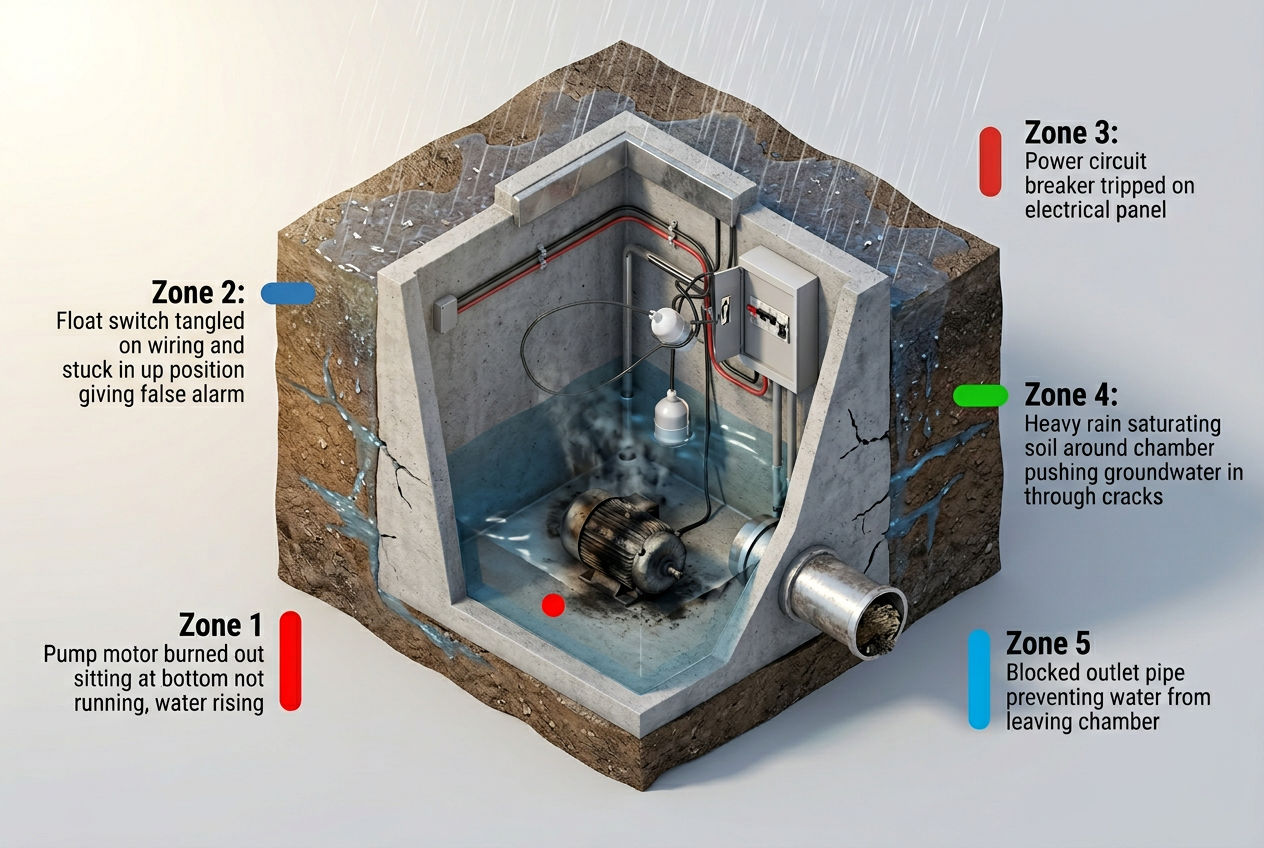
- 60–70% of alarm events: pump failure, stuck or failed float switch, or electrical issue
- 20–30%: hydraulic overload (heavy rain, excess water use, holiday guests)
- Remaining: drain field saturation, system-level failure
1. Failed or Stuck Float Switch
The float switch is a small, weighted bobber on a tethered cord. When it rises with the water level, it completes a circuit. They're cheap — $15–$40 at a plumbing supply house — but they fail constantly.
Common failure modes:
- Tangled on the tether cord
- Coated in biofilm that prevents movement
- Jammed against the chamber wall
- Internal mechanical failure
A stuck float can prevent the pump from turning on even when water levels are high.
2. Effluent Pump Failure
The effluent pump (sometimes called a sewage ejector pump) is the workhorse of the system. It pushes treated effluent from the pump chamber out to the drain field. Pumps typically last 7–15 years. When one fails, liquid builds up fast.
📊 Quick Fact: Replacing a residential effluent pump runs $250–$600 for the pump itself, plus $150–$400 in labor.
3. Tripped Circuit Breaker
Before you call anyone, check your electrical panel. The breaker for your septic pump is often labeled "septic pump" or "well/septic." A power surge, a momentary overload, or a worn breaker can trip it silently.
This is a $0 fix if that's all it is — flip it back, wait a few minutes, and watch whether the water level drops.
4. Hydraulic Overload
Scenario: You have 14 people over for Thanksgiving. Everyone showers. The dishwasher runs twice. The laundry pile disappears. A 1,500-gallon tank serving a 4-person household is sized for roughly 400 gallons a day — not 900. The pump can't move effluent out as fast as it's coming in, and the water level rises past the alarm float.
The pump is fine. The system is just overwhelmed.
5. Saturated Drain Field
If the leach field soil is saturated — either from system overuse or from external groundwater — effluent backs up into the pump chamber because it has nowhere to go. The pump runs, but the drain field can't accept the flow.
This is a more serious problem and may require a drain field repair or replacement, which can cost $2,000–$15,000+.
For more on recognizing this scenario, read our guide to signs your drain field is failing.
Free download
Free: the Septic Fridge Card — what to flush, what never to.
The Do / Don’t card the whole family can see, plus the Survival Kit: emergency flowchart, warning-sign decoder and pump-schedule card. One printable PDF.
Why Does My Septic Alarm Go Off After Heavy Rain?
Heavy rain is one of the most common triggers for a septic alarm — especially in the spring and in high-water-table regions like coastal Florida, Louisiana, and the Pacific Northwest.
What Happens During Rain Events
Prolonged rain saturates the soil around and above your drain field. When the soil is fully saturated, it can't absorb any more liquid — not from above (rain) and not from below (your septic effluent).
At the same time:
- Groundwater can infiltrate older septic tanks through cracked lids
- Faulty risers allow surface water entry
- Compromised inlet pipes leak rainwater into the system
- All that extra water raises the level in your pump chamber until it hits the alarm float
📊 Quick Fact: In Southeast Florida, where the average water table sits just 1–3 feet below grade in many areas, a single heavy storm can trigger alarms across an entire neighborhood simultaneously — even in systems that are otherwise functioning perfectly.
If your septic alarm keeps going off after every significant rain event, that's a pattern worth investigating. It may point to infiltration issues or chronic drain field saturation rather than a mechanical failure.
How Do I Silence My Septic Alarm?
Silencing the alarm is the first thing most homeowners want to do at 11 p.m. — and that's completely reasonable. Here's how.
Most septic control panels have a dedicated silence or acknowledge button, sometimes labeled "alarm silence" or just with a bell icon. Press it once. The audible beeping stops. The red light will stay on until the underlying problem is resolved.
⚠️ Warning: Silencing the alarm does not fix anything. It only mutes the buzzer. The high-water condition is still active. If you silence the alarm and go back to normal water use without investigating, you're borrowing time you may not have.
Some older panels don't have a silence button — in that case, you can temporarily switch the control panel to "manual" mode, but this disables the alarm function entirely and should only be a stopgap measure while you troubleshoot.
How to Reset a Septic Tank Alarm — Step by Step
Resetting the alarm (as opposed to just silencing it) means bringing the water level back to normal so the alarm float drops and the circuit opens. Here's the process:
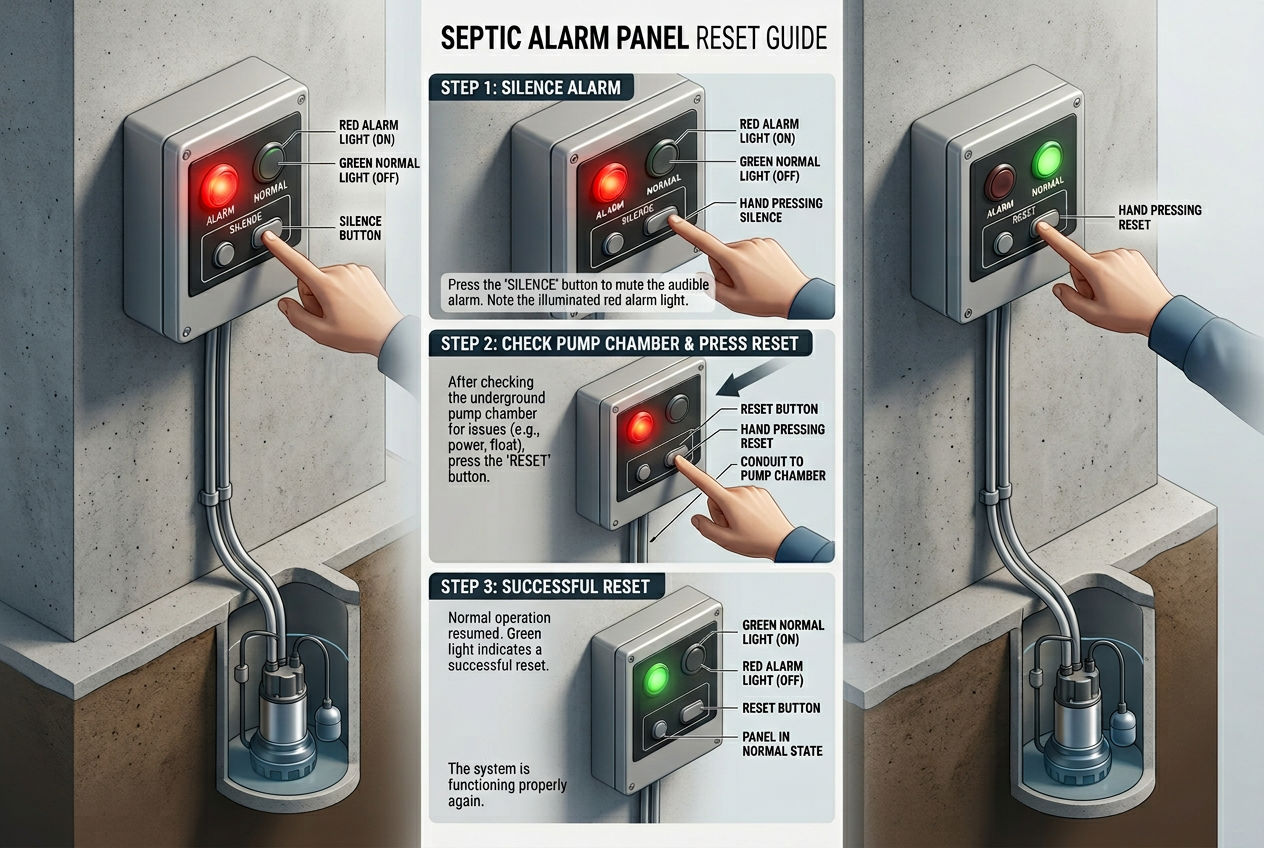
The Reset Procedure
Step 1: Silence the alarm. Press the silence/acknowledge button on the control panel.
Step 2: Reduce water use immediately. No laundry, no dishwasher, limit showers to one person at a time. Give the system room to catch up.
Step 3: Check the circuit breaker. Go to your electrical panel. Find the breaker for the septic pump. If it's tripped (sitting between on and off), switch it fully off, then back on. Return to the control panel and see if the pump indicator light shows the pump is now running.
Step 4: Listen for the pump. Stand near the pump chamber (the buried tank near your control panel). A running effluent pump makes a low hum or vibration. If you hear nothing after the breaker reset, the pump may be dead.
Step 5: Wait 30–60 minutes with reduced water use. If the pump is running normally, the alarm light should go out as the water level drops below the alarm float.
Step 6: If the light stays on, call a professional. A persistent alarm after these steps means the pump isn't moving water effectively — stuck float, dead pump, or drain field backup. This needs a licensed septic technician.
Cost to Fix a Septic Alarm Problem
| Problem | Estimated Cost | Notes |
|---|---|---|
| Tripped breaker | $0 | DIY reset |
| Float switch replacement | $75 – $250 | Parts + labor |
| Effluent pump replacement | $400 – $1,000 | Pump + labor |
| Septic tank pumping | $300 – $600 | National average; see full cost breakdown |
| Control panel replacement | $200 – $500 | Brand/complexity-dependent |
| Drain field repair/replacement | $2,000 – $15,000+ | Highly variable by region |
Cost data compiled from national service provider averages and EPA guidance. Regional variation is significant — rural areas typically run 20–40% higher due to travel time.
For a full breakdown by repair type, see our septic repair cost guide.
Can I Shower If My Septic Alarm Is Going Off?
Yes — briefly, with caution. A single short shower (5–7 minutes) adds roughly 20–40 gallons to your system. That's unlikely to push a borderline situation over the edge immediately.
What to Avoid
- Long showers (10+ minutes)
- Running the dishwasher or washing machine
- Multiple fixtures running simultaneously
- A family of four doing a full laundry day while the alarm is active could add 200+ gallons and accelerate a backup
✅ Pro Tip: Handle essential hygiene needs, but treat your water use like you're under a conservation alert. Every gallon you don't send into the system buys the pump time to catch up — or buys you time until a technician can arrive.
What About Aerobic Septic System Alarms?
Aerobic treatment units (ATUs) work differently from conventional systems, and their alarms mean different things. Instead of simply settling waste, an ATU injects oxygen into the treatment process using a compressor — typically a Hiblow HP-80 or similar linear air pump. This creates an aerobic environment that breaks down waste more thoroughly before it reaches the spray heads or drain field.
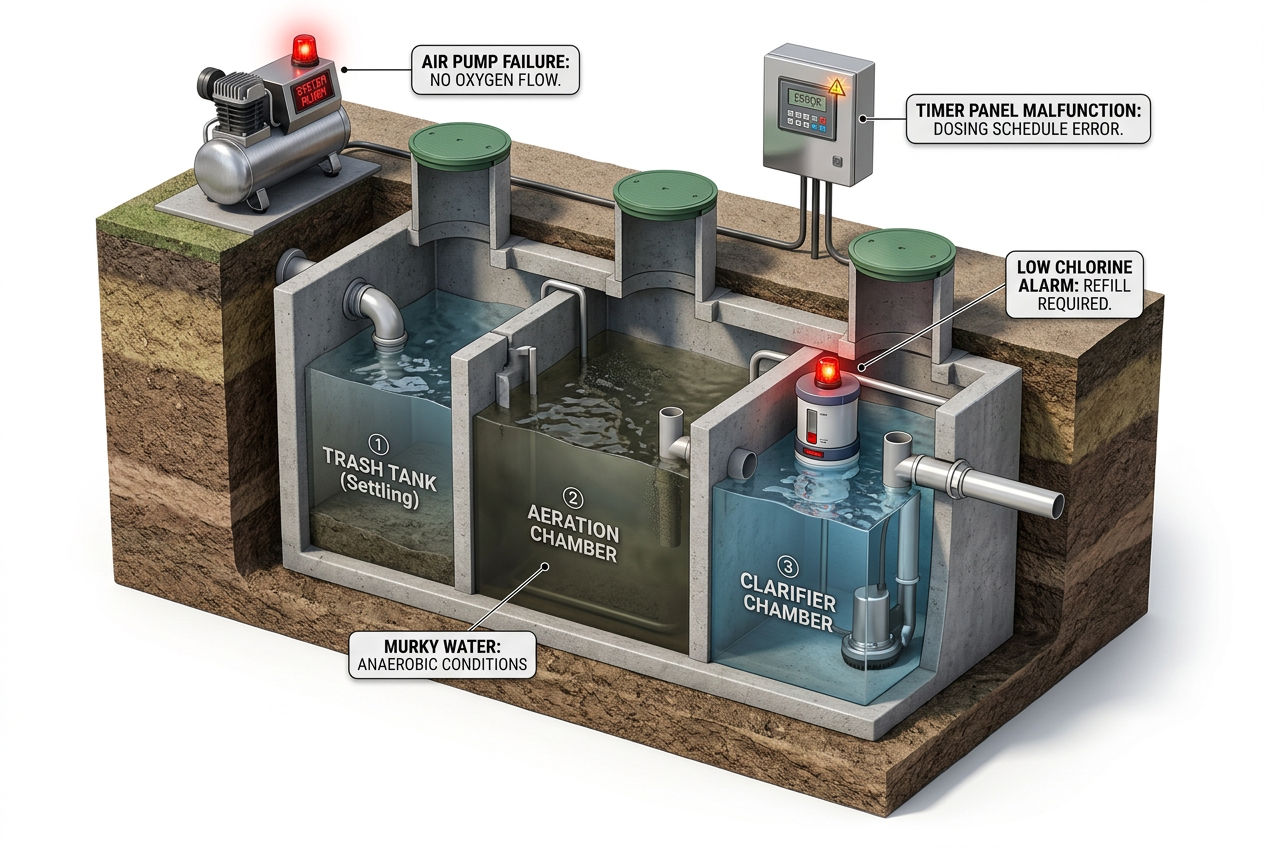
Common ATU Alarm Triggers
- Air compressor failure — the most common issue. Without aeration, the system shifts to anaerobic conditions and can't meet treatment standards
- High water level — same as conventional systems
- Chlorinator issue — ATUs use a chlorination chamber (chlorinator) to disinfect before dispersal; low chlorine tablets trigger an alarm in many systems
- Spray head clogging — especially common after extended dry periods
📊 Quick Fact: In Texas, which has over 1 million aerobic systems, the Texas Commission on Environmental Quality (TCEQ) requires ATU owners to maintain a service contract with a licensed maintenance provider. Those providers are required to respond to alarm conditions within a set timeframe.
If you're in Texas or another state with ATU mandates, your maintenance provider should be your first call — before you attempt any DIY troubleshooting.
For a deeper look at how aerobic systems differ from conventional ones, see our aerobic vs. anaerobic septic systems guide.
When Should You Call a Professional?
Call a licensed septic technician if:
- The alarm light stays on after you've reset the breaker and reduced water use for 2+ hours
- You hear the pump running but the water level isn't dropping
- The alarm triggers repeatedly — especially after rain events
- You notice sewage odors near the tank or drain field
- Drains inside the house are slow or gurgling
- The alarm is on an aerobic system (these require licensed service in most states)
Related: septic system power outage guide — worth reading if this applies to your situation.
⚠️ Warning: For emergency situations — active sewage backup, strong odors, or visible effluent surfacing in your yard — don't wait. Use our emergency septic service finder to connect with a provider in your area.
How to Prevent Septic Alarms Before They Happen
The single most effective preventive measure is regular pumping. The EPA recommends pumping every 3–5 years for most households. A 1,000-gallon tank serving four people hits that threshold around the 3-year mark. Add a garbage disposal, and drop that to every 2 years — disposals dramatically increase the solids load entering the tank.
💡 Key Takeaway: When a tank goes too long without pumping, solids overflow into the pump chamber, coat the float switches, clog the effluent filter, and eventually reach the drain field. That's how a $350 pump-out turns into a $12,000 drain field replacement.
Essential Preventive Maintenance
- Inspect and clean the effluent filter annually — a clogged Polylok PL-122 or Zabel A1800 filter restricts flow and backs up the pump chamber
- Reduce water use during heavy rain events — your drain field is under stress when soils are saturated
- Have the float switches inspected at every service visit — a technician can spot a deteriorating float before it fails
- Never flush wipes, even "flushable" ones — they wrap around pump impellers and kill pumps prematurely
For a full seasonal checklist, see our septic tank maintenance guide.
Sources & Methodology
EPA Septic Systems Overview (epa.gov/septic): Used for pumping frequency recommendations (3–5 years), household wastewater generation estimates, and septic system prevalence data (~21 million U.S. households on septic).
Texas Commission on Environmental Quality (TCEQ): Referenced for aerobic system maintenance contract requirements and ATU
Need help with your septic system? Find trusted septic professionals near you to get free quotes. Browse local septic companies in Georgia or North Carolina.
Was this article helpful?
Frequently Asked Questions
Recommended Resources
📖 Related Articles
💰 Cost Guides
🔧 Services
Find Septic Professionals Near You
Compare licensed, verified septic companies by area — top county markets and cities below, or browse all 50 states.
County markets
Popular cities
