
Quick Answer
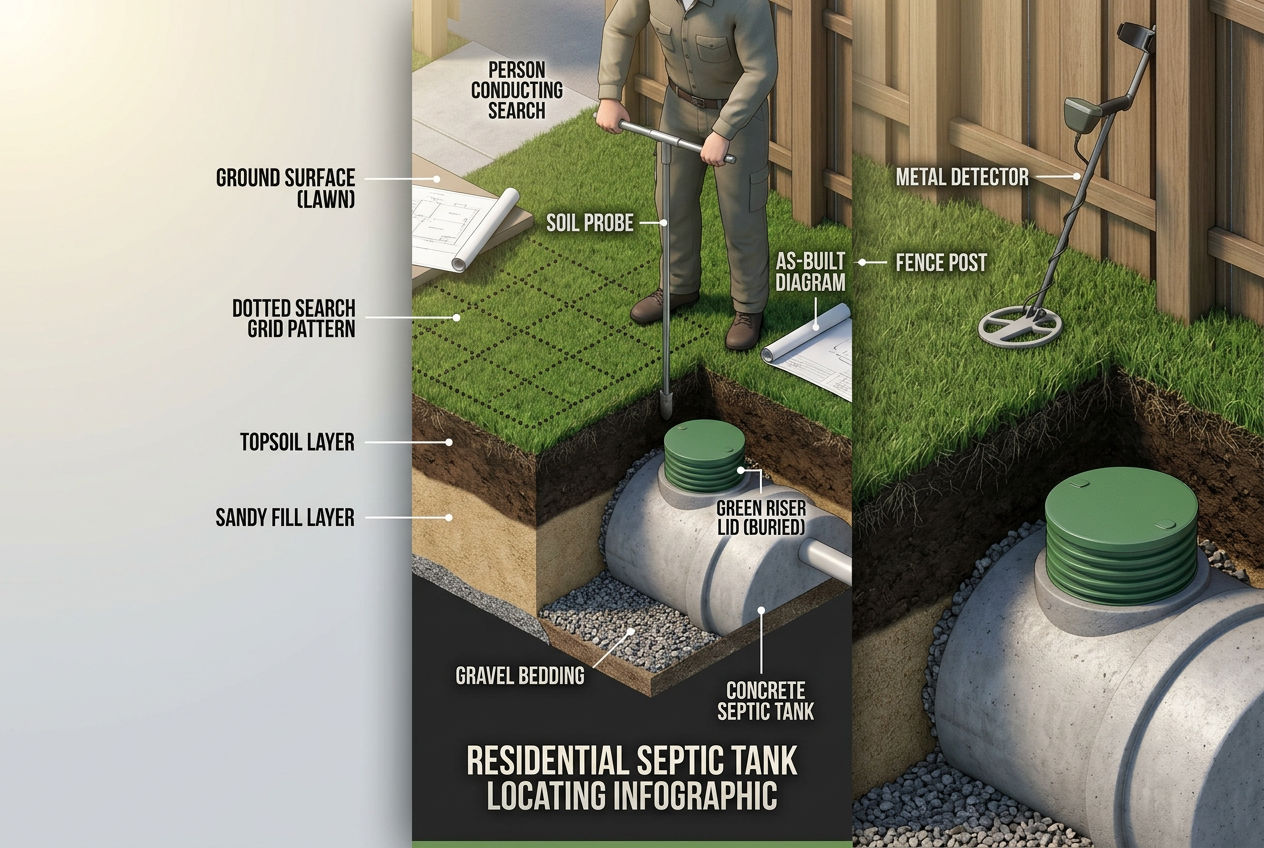
Finding your septic tank lid — also called the septic tank access cover or cleanout lid — starts by tracing the main sewer pipe from your house foundation outward 10–25 feet. Most lids sit 4 inches to 4 feet underground, most commonly 12–24 inches deep. Check county health department records for an as-built drawing before digging — it shows the exact tank location on your property.
💡 Key Takeaways
- Most septic tank lids are buried 12–24 inches below grade, but can be as deep as 4 feet in northern freeze zones
- Check your county health department for a septic permit or as-built drawing before picking up a shovel
- Most tanks have 1 or 2 lids — older single-compartment tanks have one; post-1990s tanks typically have two
- A concrete lid weighs 50–100+ lbs — never lift one alone, and never enter a tank
- Installing a septic tank riser ($200–$500) means you'll never have to dig up the lid again
Start Here: Check Your Records Before You Touch a Shovel
Your first move isn't grabbing a probe rod — it's a phone call. Your county health department keeps a septic system permit on file for most homes, and that permit often includes an as-built drawing that shows exactly where your tank sits relative to the house. This single document can save you two hours of digging.
Call your county health department and ask for the septic permit for your address. In some states — Washington, Oregon, Minnesota, and Wisconsin among them — permit records are searchable through an online portal. Most counties will email or mail you a copy for free or a nominal fee.
Secondary Sources If County Records Come Up Empty
- Your home inspection report — If you bought the house in the past 15 years, the inspector likely noted the tank location
- Previous pump-out receipts — Prior owners sometimes leave service records in a filing cabinet or with the home documents. A pumping company that serviced the tank will have the location on file
- Your real estate closing documents — Some states require a septic inspection or disclosure at sale
⚠️ Warning: Properties built before the 1970s present a trickier situation. Permit records are sparse, tanks may be steel or concrete block with non-standard configurations, and some older tanks were abandoned in place when a neighborhood connected to municipal sewer. If you're unsure whether you even have an active septic system, that's where the county can confirm.
7 Ways to Find Your Septic Tank Lid
No records? No problem. Work through these methods in order — most homeowners find the lid within the first three.
1. Follow the Sewer Pipe From Your House
This is the most reliable DIY method, and it works almost every time.
Your main sewer line exits the house through the foundation or crawlspace floor, typically 1–3 feet below grade. Find it in your basement or utility room — it's the 4-inch pipe heading toward an exterior wall. Note which direction it's pointing.
Outside, mark that spot on the foundation. The pipe slopes downhill at ¼ inch per foot toward the tank. Walk in that direction. At 10 feet of horizontal run, the pipe drops roughly 2–3 inches. At 20 feet, it's dropped 5–6 inches. The tank inlet is waiting at the end of that run, typically 10–25 feet from the foundation.
Grab a metal rod or a thin rebar stake and probe the ground as you walk. When you hit a hard, hollow-sounding surface, you've found the tank lid.
2. Look for Visual Clues in Your Yard
Your yard will often tell you where the tank is — if you know what to look for.
| Season | What to Look For | Why It Happens |
|---|---|---|
| Summer | Rectangular patch of greener, lusher grass | Nutrients in soil over tank feed the grass |
| Spring | Area that thaws faster after snow melt | Tank warmth melts snow earlier |
| Fall | Patch that stays green longer as ground cools | Retained warmth extends growing season |
✅ Pro Tip: What you're NOT looking for is the drain field — that's typically farther from the house and shows as a series of parallel lines or a larger zone of healthy grass. The drain field is where treated effluent disperses, not where the tank sits.
3. Check County Permit Records
Already covered in the intro, but worth emphasizing here: the as-built drawing is the gold standard. A good drawing will show distances from the tank to the house corners, often in a hand-sketched diagram. Even a rough one gets you within a few feet.
Some counties provide GPS coordinates if the system was permitted after 2000. Others have scanned documents that require a little interpretation — the dimensions may be in feet from specific corners of the foundation, so bring a tape measure.
4. Use a Soil Probe
A soil probe — essentially a 3–5 foot steel rod with a T-handle — lets you probe the ground without digging. Push it in at 6-inch intervals in the area where you expect the tank to be.
Undisturbed soil has consistent resistance. When you hit the concrete lid of a 1,500-gallon tank, you'll feel a distinct hard stop at consistent depth. Move a few inches and probe again — if it's consistently hard across a 20–24 inch span, that's a lid.
⚠️ Warning: Probe gently. You can crack an older, deteriorating concrete lid with aggressive force, and you absolutely do not want a lid collapse. If the lid feels soft or crumbles slightly, stop and call a professional.
5. Use a Metal Detector
A metal detector works specifically when the tank has cast iron lids, metal handles, or metal access covers — common on tanks installed before the mid-1980s. Many older concrete tanks had metal lifting handles set into the lid.
A basic metal detector (Garrett AT Pro, Bounty Hunter TK4) will pick up these handles at 12–18 inches depth. Scan in a grid pattern across the suspected area. This method won't find a purely concrete lid with no metal components, but it's a useful secondary tool.
6. Hire a Professional With an Electronic Locator
When the DIY methods fail, a professional septic locator uses electronic pipe locators to trace the line from your house to the tank with precision. They send a signal through the pipe and follow it with a receiver above ground — no guessing, no grid probing.
The cost runs $100–$350 depending on your region and how much access they need. That's money well spent compared to digging up your entire yard. Most septic pumping companies offer locating as an add-on service, or they can recommend a dedicated locating company.
If you're already scheduling a pump-out, book a septic pumping service through a company that includes locating — some do, some charge extra. Ask upfront.
7. Ask a Previous Owner or Neighbor
This one sounds obvious, but homeowners routinely skip it. The previous owner pumped that tank for years and knows exactly where it is. A quick text or call saves an afternoon.
Neighbors with similar-era homes on similar lots can also give you a reference point — if their tank is 18 feet northeast of their back door, yours might be in a comparable position.
Free download
Free: the Septic Fridge Card — what to flush, what never to.
The Do / Don’t card the whole family can see, plus the Survival Kit: emergency flowchart, warning-sign decoder and pump-schedule card. One printable PDF.
How Deep Is a Septic Tank Lid?
Most septic tank lids are buried 12–24 inches below the surface in conventional installations. That range covers the majority of homes built between 1970 and 2010 in temperate climates.
But depth varies considerably based on geography and installation era:
| Region / Condition | Typical Lid Depth | Notes |
|---|---|---|
| Southern states (FL, TX, SC) | 4–12 inches | High water table; shallower installs common |
| Mid-Atlantic / Midwest | 12–24 inches | Standard depth range |
| Northern states (MN, WI, ND) | 24–48 inches | Frost line drives deeper burial |
| Freeze zone (frost line 42–60") | Up to 48+ inches | Common in Minnesota, Michigan |
| Pre-1970 homes | Varies widely | Steel or block tanks; non-standard depth |
Source: EPA Septic System guidance; state health department installation standards
📊 Quick Fact: In Minnesota, the frost line reaches 42–60 inches, and many tanks are buried deep enough that the lid sits 3–4 feet underground. That's not unusual — it's by design, to prevent freezing. It does make finding and accessing the lid significantly harder, which is exactly why risers are especially popular in cold-climate states.
In Florida, the opposite problem exists. High water tables and sandy soil mean some tanks are buried with lids only 4–6 inches below grade. In those cases, you might be able to find the lid just by looking for a subtle ground-level outline.
What Should You Do If Your Septic Tank Lid Is Buried?
If you've found the lid location and need to uncover it, here's how to do it safely.
Step 1: Call 811 Before Digging
Before digging anywhere on your property, call 811 (the national "Call Before You Dig" number) or visit 811.com. Underground utilities — gas, electric, water, fiber — can be anywhere. This service marks them for free within 48–72 hours. Skipping this step is how people end up with a gas line hit.
Step 2: Dig Carefully With the Right Tools
Once utilities are marked, dig carefully. Use a flat spade or a round-point shovel — not a pickaxe or mattock that could crack a concrete lid. Dig a test hole about 18 inches deep in the center of your target area and work outward. Most concrete lids are 20–24 inches in diameter; riser lids are typically 24 inches.
If the lid is at 3–4 feet depth, you'll need to dig a wider access hole to work safely. That's a significant excavation — consider hiring a septic service company rather than doing it by hand. Pumping companies deal with buried lids routinely and have the right equipment.
Non-Negotiable Safety Rules
⚠️ Warning: Safety Rules — No Exceptions
- Never enter a septic tank. The hydrogen sulfide gas inside can kill within seconds
- Never remove a lid without a reason to open it (pumping, inspection, repair)
- If a lid is cracked or damaged, don't open it — call a pro
Can't find the lid at all after working through the methods above? It happens. Older tanks can be further from the house than expected, especially on rural properties where setback requirements were looser. At that point, hiring a professional with an electronic locator is the right call — find a septic service company near you through the SepticTankHub directory.
For more on what to do when the whole system is acting up, see signs your septic tank needs pumping — if you're hunting for the lid because drains are slow, that article will tell you what to look for.
What Does a Septic Tank Lid Look Like?
Knowing what you're looking for helps — especially if you're probing with a rod or digging a test hole.
Concrete Lids (Most Common)
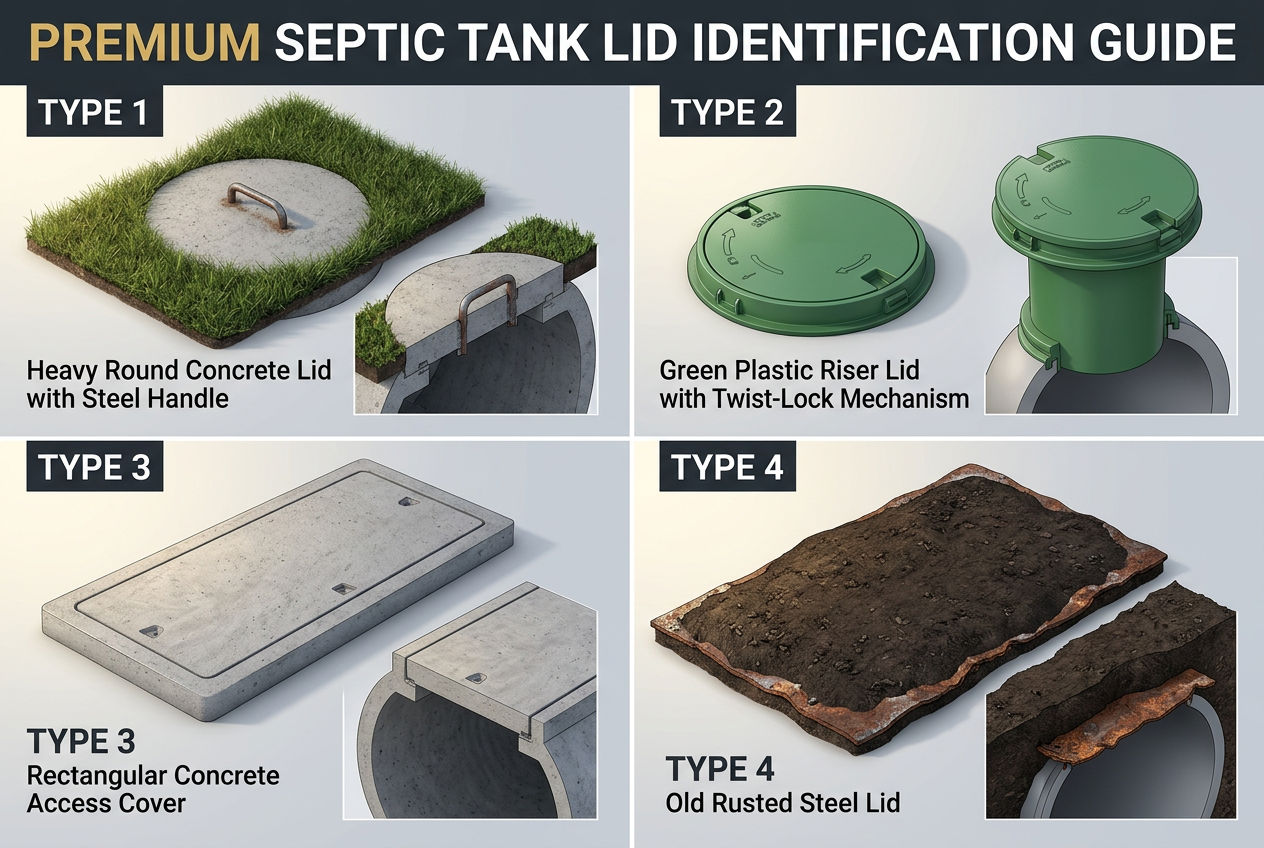
Concrete lids are the most common type, found on tanks installed from the 1950s through today. They're flat, circular (occasionally square on older tanks), roughly 20–24 inches across, and extremely heavy — 50 to 100+ lbs depending on thickness. The surface is rough gray concrete, often stained with soil or moss after years underground.
Plastic Risers and Lids (Modern Installations)
Plastic risers and lids are increasingly common on systems installed or retrofitted after 2000. These are usually green or black, 24 inches in diameter, and much lighter than concrete. If someone previously installed a riser on your tank, the lid may be flush with or slightly above grade — much easier to find.
How Many Lids Should You Expect?
| Tank Era | Number of Lids | Configuration |
|---|---|---|
| Pre-1990 tanks | Usually 1 | Central access lid over single compartment |
| Post-1990 two-compartment tanks | Typically 2 | One over inlet baffle, one over outlet baffle |
| Large tanks (1,500+ gallons) | May have 3 | Additional center access port |
✅ Pro Tip: If your pumping company needs to fully pump the tank, they'll need access to both lids. Some homeowners are surprised to learn there's a second one — it's often 4–6 feet away from the first, toward the drain field side.
Should You Install a Riser So You Never Have to Dig Again?
Yes. Full stop.
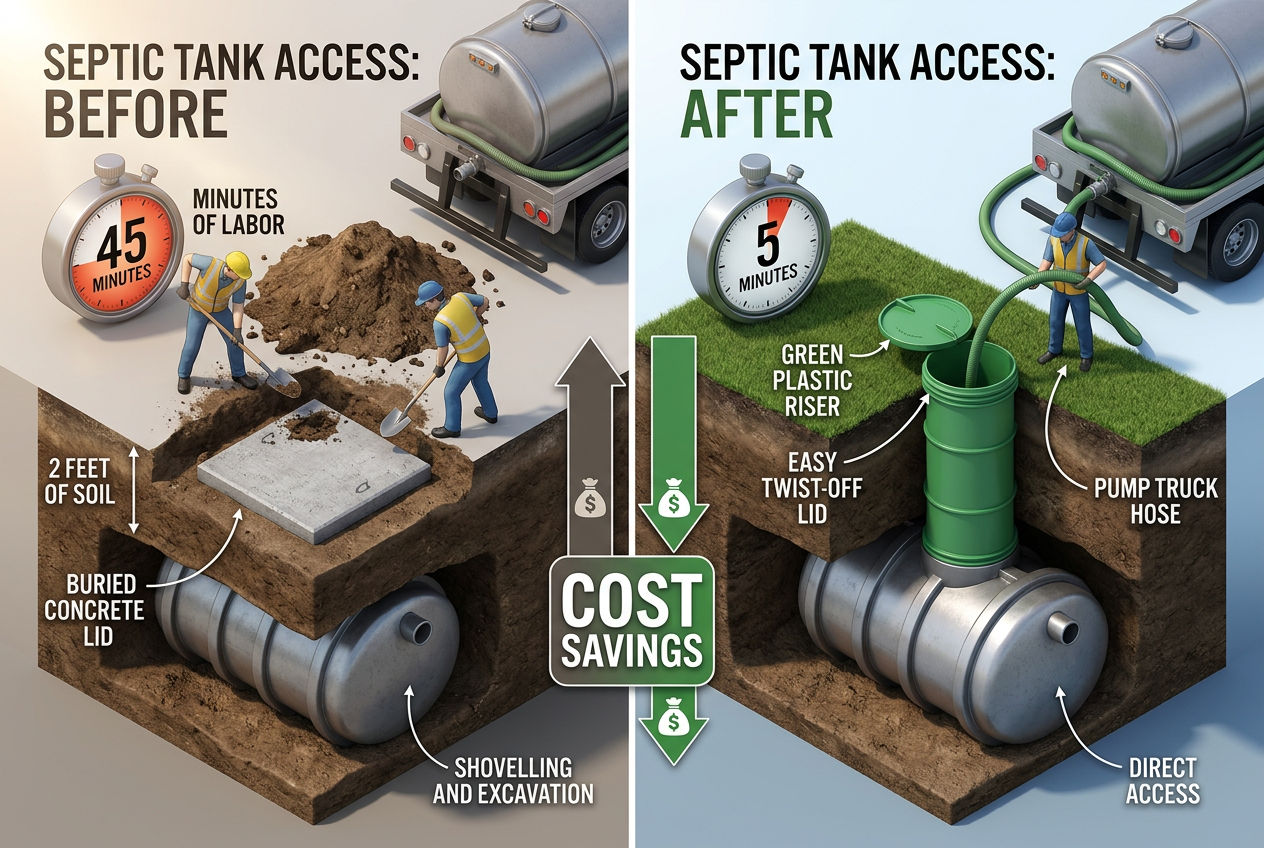
A septic tank riser is a vertical pipe — usually 12–24 inches tall, 24 inches in diameter — installed between the existing tank lid and the ground surface. The riser brings the access point up to grade, so future pump-outs and inspections require zero digging.
Cost vs. Return on Investment
| Item | Cost | Notes |
|---|---|---|
| Riser installation | $200–$500 per riser | Most tanks need 1–2 risers |
| Extra charge for buried lid | $50–$150 per pump-out | What you pay if lid isn't exposed |
| Break-even point | 3–4 pump cycles | Riser pays for itself in saved labor |
💡 Key Takeaway: If you're already paying for a pump-out and the ground is open, adding a riser the same day is the most cost-efficient time to do it. Some companies install them as a standard add-on; others offer it optionally.
Risers are especially worth it in northern states where lids are buried 3–4 feet deep. Digging down that far in frozen ground in November is a miserable job. Ask your pumping company about septic tank riser installation at your next service appointment.
For context on how often you'll need to access the tank, see how often to pump your septic tank — for most households, it's every 3–5 years.
Sources & Methodology
This article draws on the following primary sources:
- U.S. Environmental Protection Agency — Septic Systems Overview (epa.gov/septic): Household usage statistics (approximately 21 million U.S. homes on septic) and general pumping frequency guidance.
- National Onsite Wastewater Recycling Association (NOWRA) (nowra.org): Industry standards on tank design, lid specifications, and riser installation best practices.
- Minnesota Pollution Control Agency (MPCA) — State-specific frost line and burial depth data for northern climate installations.
- National Association of Wastewater Technicians (NAWT) — Professional locating equipment standards and contractor training certifications for septic system diagnostics.
- 811 — Call Before You Dig (call811.com): National one-call center requirements and state-specific utility marking timelines for safe excavation.
Need help with your septic system? Find trusted septic professionals near you to get free quotes. See our complete guide to septic repair costs for current pricing. Browse local septic companies in Colorado or Minnesota.
Was this article helpful?
Frequently Asked Questions
Recommended Resources
📖 Related Articles
🔧 Services
📍 Find Local Pros
Find Septic Professionals Near You
Compare licensed, verified septic companies by area — top county markets and cities below, or browse all 50 states.
County markets
Popular cities
