
Quick Answer
Finding your septic tank starts with checking your county health department for an as-built diagram — a property-specific map showing the exact tank location. If no records exist, follow your main sewer line from the house foundation 10-25 feet into the yard. Visual clues like unusually green grass, slight ground depressions, or patches where snow melts first also reveal buried tank locations.
Key Takeaways
- County as-built records are the fastest and most accurate way to find your tank
- Most septic tanks are 10-25 feet from the house, along the main sewer line
- Tanks are buried 4 inches to 4 feet deep — most commonly 12-24 inches
- Visual clues — greener grass, depressions, snow melt patterns — narrow your search
- A professional tank location service costs $100-$300 if DIY methods fail
Every septic homeowner eventually needs to find their tank — whether it's time for a routine pump out, you're preparing to sell your home, or you just moved in and have no idea where the system is buried. Roughly 21 million U.S. homes use septic systems, and a surprising number of owners can't point to their tank on a property map.
The good news: locating your septic tank is straightforward with the right approach. These five methods work in order from easiest to most involved. Most homeowners find their tank using the first two methods without touching a shovel.
Find a licensed septic company to locate your tank on SepticTankHub.com
Method 1: Check County Health Department Records
The single fastest way to find your septic tank is pulling the as-built diagram from your county health department. This is a scale drawing made when the system was installed, showing the exact tank location relative to your house, property lines, and other structures.
Every septic system installed with a permit has an as-built on file. The health department (sometimes called environmental health or sanitation department) maintains these records. Here's how to get yours:
Call your county health department and ask for the septic system file for your property address. Many counties now offer online record searches through their environmental health portal. Some charge a small copy fee ($5-$25).
Check your closing documents. If you purchased the home with a septic inspection, the inspection report usually includes or references the as-built diagram. Look through your home purchase folder first.
Ask previous owners. If you bought from someone who lived there long term, they may have copies of the original installation permit, inspection reports, or maintenance records that show the tank location.
The as-built diagram gives you exact measurements — typically something like "tank center is 15 feet from the southeast corner of the house, 8 feet from the property line." These measurements make the remaining methods unnecessary.
Pro Tip: Once you find your tank, take a photo of the location from a fixed reference point (like a corner of your house) and save the as-built diagram digitally. Share this with your septic pumping company so they can go straight to the tank on every service visit — saving you the $50-$150 "locate" fee some companies charge.

Method 2: Follow the Sewer Line From Your House
If county records aren't available, the most reliable physical method is following your main sewer line from the house to the tank. Every septic system connects to the house through a single main drain line, and that line runs in a straight path to the tank.
Step 1: Find where the sewer line exits your house. Go to your basement or crawl space and locate the main sewer pipe — it's typically a 4-inch PVC or cast iron pipe running through the foundation wall. Note which direction it exits. On slab foundations, look for the cleanout cap on the exterior wall — a round white or black cap at ground level, usually on the side of the house facing the backyard.
Step 2: Walk a straight line from the exit point. Once you know the direction, walk in a straight line away from the house. Sewer lines almost always run in a direct path — no curves, no turns. The tank is typically 10-25 feet from the foundation.
Step 3: Probe for the tank. Use a thin metal rod (a soil probe, available at hardware stores for $15-$30, or even a length of rebar) and push it into the ground every 2 feet along the line. When you hit something solid and flat within 4 feet of the surface, you've found the tank. The probe will make a distinct "thunk" against concrete versus the soft resistance of soil.
Step 4: Map the tank edges. Once you've hit the tank, probe around the initial contact point to determine the tank's outline. Most residential tanks are rectangular — roughly 5 feet wide by 8 feet long. The access lids are usually near the center or at each end of the tank.
For detailed instructions on exposing and opening the lid once you've found the tank, see our guide on how to find your septic tank lid.
Common Mistake: Probing too aggressively or using a sharp implement. You're looking for the tank, not trying to break through it. A soil probe encounters firm resistance against a concrete lid — stop pushing when you feel the solid surface. Driving a sharp rod through a plastic tank lid can crack it, creating an expensive repair.

Free download
Free: the Septic Fridge Card — what to flush, what never to.
The Do / Don’t card the whole family can see, plus the Survival Kit: emergency flowchart, warning-sign decoder and pump-schedule card. One printable PDF.
Method 3: Read the Visual Clues in Your Yard
Your yard tells a story about what's buried beneath it. Septic tanks and drain fields create distinct surface patterns that experienced homeowners and septic professionals recognize instantly.
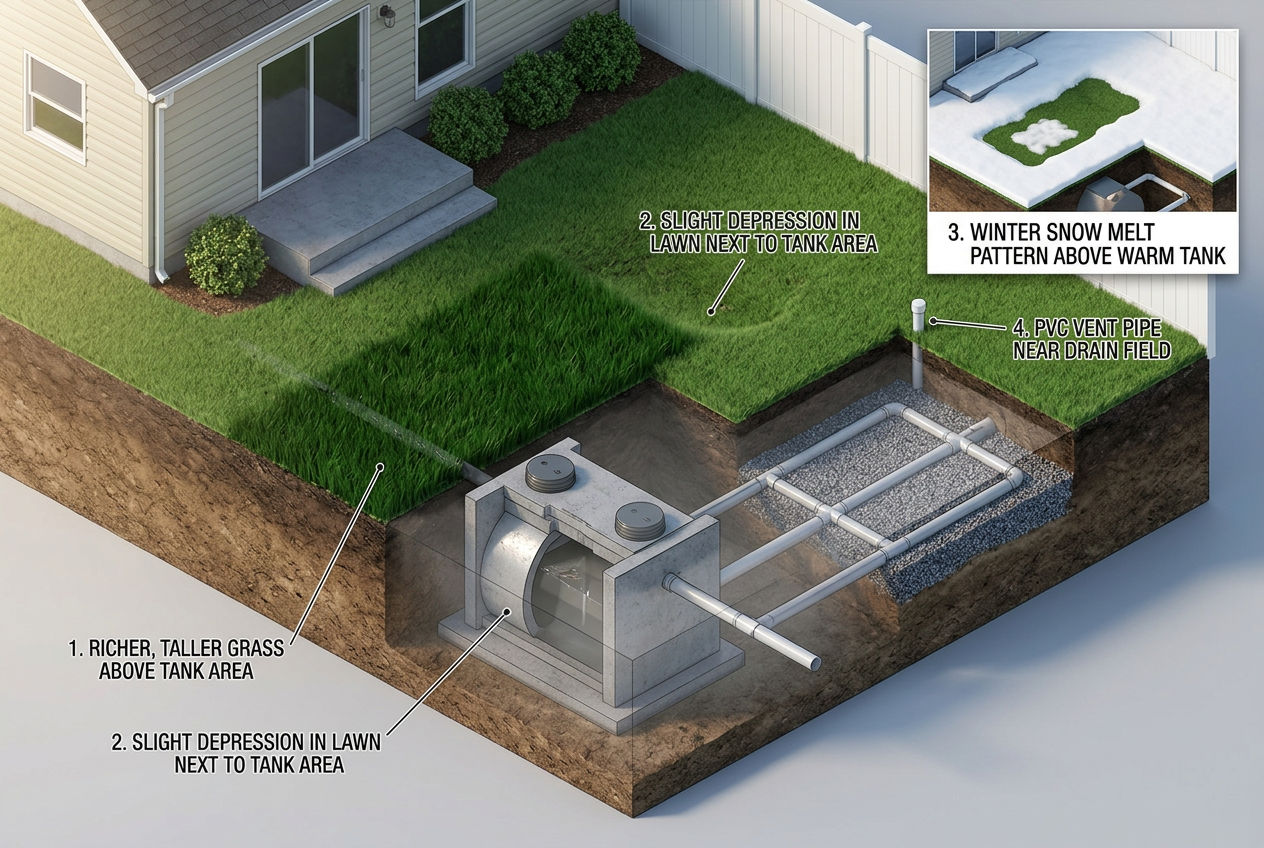
Greener or taller grass. A strip of grass that's noticeably greener or taller than the surrounding lawn often marks the septic tank or drain field. The buried tank retains warmth and moisture, and any minor leaks provide nutrients that fuel grass growth. Our article on green grass over septic tanks explains this phenomenon in detail.
Slight depression or mound. Over time, the soil above a buried tank settles differently than the surrounding ground. You may notice a rectangular depression where the excavated soil compacted, or a slight mound if the backfill was mounded during installation to account for settling.
Snow melt patterns. In cold climates, this is one of the most reliable clues. Septic tanks generate bacterial heat (typically 55-65°F inside). Snow melts faster directly above the tank. After a light snowfall, look for a rectangular bare patch 10-25 feet from the house. This also reveals the drain field, which appears as parallel melted lines.
Bare or struggling vegetation. If the tank is buried less than 12 inches deep, grass may struggle to grow because the root zone is too shallow over the concrete. A bare rectangular patch in an otherwise healthy lawn is a strong indicator.
Inspection or vent pipes. Look for short PVC pipes (1-2 inches in diameter) sticking up from the ground in the yard. These are inspection ports or vent pipes that mark the drain field. The septic tank is between these pipes and the house.
Key Insight: The drain field is always downhill or at the same level as the septic tank — never uphill. Gravity carries effluent from the tank to the drain field. If your yard has a clear slope, the tank is closer to the house and the drain field extends into the lower portion of the yard.
Method 4: Use a Pipe Locator or Metal Detector
When visual clues and probing don't work — for example, on properties with very deep tanks, landscaped yards, or hardscaped surfaces — electronic detection tools can help.
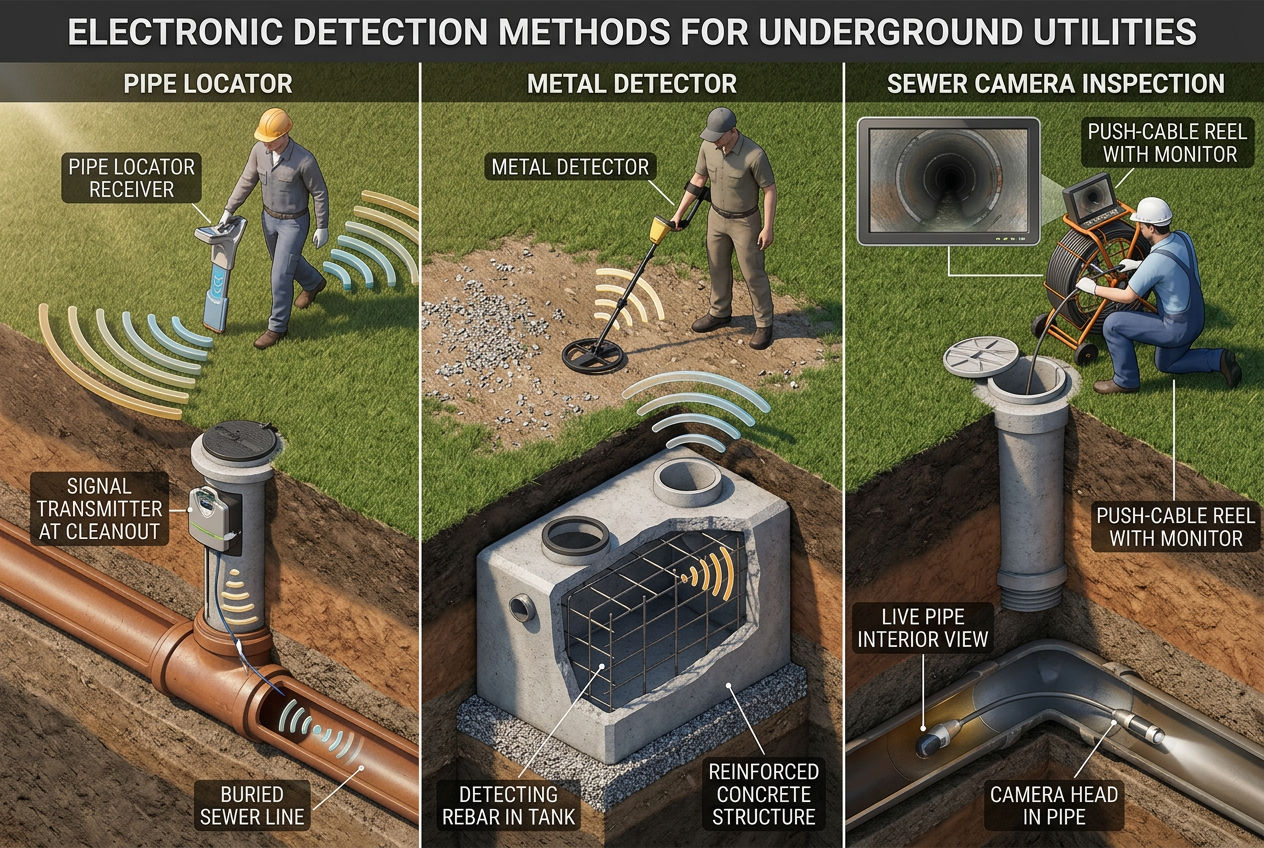
Pipe locators (also called line locators) send a radio signal through the sewer pipe from inside the house. A handheld receiver above ground tracks the signal as you walk the yard, showing you exactly where the pipe runs. The pipe leads straight to the tank. Professional-grade locators cost $200-$500 to buy, but many septic companies use them as part of their service. You can also rent one from equipment rental companies for $50-$100/day.
Metal detectors work on concrete tanks because most contain rebar reinforcement. They also detect cast iron inlet pipes, steel baffles, and steel access lids. A basic metal detector ($50-$150) can identify a concrete tank at 18-24 inches of depth. This method won't work for plastic or fiberglass tanks without metal components.
Sewer cameras are the nuclear option. A licensed plumber or septic inspector feeds a fiber-optic camera through the cleanout into the sewer line. The camera shows the pipe's interior condition and, on advanced models, transmits a locatable signal from the camera head. When the camera reaches the tank inlet, the technician marks the surface location with precision. Camera inspections cost $200-$500 but also reveal pipe condition, root intrusion, and bellied sections.
Quick Fact: Ground-penetrating radar (GPR) can locate plastic and fiberglass tanks that metal detectors miss. GPR units are expensive ($5,000+), but some septic companies and utility locating services offer GPR surveys for $300-$600 — worth it for properties with unknown system locations and no available records.
Method 5: Hire a Professional Locator
If DIY methods haven't worked or you'd rather not deal with probing and digging, a professional septic locator service is money well spent.
Septic pumping companies locate tanks routinely — most include basic location service in their pumping fee or charge $100-$200 as a standalone service. They use soil probes, pipe locators, and experience from servicing hundreds of tanks in your area. Many technicians can find a tank in under 10 minutes based on the house layout and common installation patterns for your neighborhood.
Septic inspectors provide the most thorough location service as part of a full septic inspection. For $300-$500, you get the tank located, pumped, visually inspected, and documented — plus a report on the overall system condition. This is the best value if you haven't had your system serviced recently.
Utility locating companies specialize in finding buried infrastructure. They use advanced equipment (GPR, electromagnetic locators, RFID scanners) and charge $200-$400 per visit. This is the best option when the tank location is truly unknown and basic methods have failed.
After a professional finds your tank, ask them to install risers ($150-$300) if the lid is buried more than a few inches deep. Risers bring the access port to ground level, making every future pump out faster, cheaper, and easier.
Pro Tip: When a professional locates your tank, ask them to mark the corners with landscape stakes or painted markers. Then measure the distance from two fixed reference points (corners of your house work best) and write it down. You'll never need to pay for location service again.

What to Do After You Find Your Septic Tank
Once you've located the tank, here's what to do depending on your situation:
Scheduling a pump out: Now that you know where the tank is, book a pumping appointment. Share the location with the company so they can pull the truck directly to the right spot. Knowing your tank location saves $50-$150 on the "locate and dig" fee many companies add when the lid position is unknown. Check how much pumping costs in your area.
New homeowner orientation: If you just moved in, knowing your tank location is step one. Map it on a sketch of your property, note the depth to the lid, and file the as-built diagram with your important home documents. Schedule a septic inspection if one wasn't done during the home purchase — it's the best way to baseline your system's health. See our home buyer's septic inspection guide for what to expect.
Preparing to sell: Buyers and their inspectors will need to find your tank for the septic inspection that's standard in most home sales. Having the location documented and the lid accessible makes the process smoother and avoids delays. Check our guide to selling a house with a septic system for everything you need to prepare.
Protecting your system: Now that you know where the tank and drain field are, follow the setback requirements — don't drive heavy vehicles over the tank, don't plant trees within 30 feet of the drain field, and don't build structures over any part of the system. Our septic tank maintenance guide covers all the do's and don'ts.
Sources & Methodology
EPA — Homeowner's Guide to Septic Systems — Federal guidance on locating, maintaining, and protecting residential septic systems
University of Minnesota Extension — Locating Your Septic System — Research-based methods for locating buried septic tanks using probing, records, and visual indicators
National Onsite Wastewater Recycling Association (NOWRA) — Industry standards for septic system inspection, location services, and professional certification
National Environmental Health Association — Professional guidelines for environmental health departments maintaining septic system records and permits
SepticTankHub.com Internal Data — Compiled from service pricing and location methods reported by 4,200+ listed septic companies
Was this article helpful?
Frequently Asked Questions
Recommended Resources
📖 Related Articles
- How to Find Your Septic Tank Lid (And What to Do If It's Buried)
- What Is a Septic System? How It Works (Visual Guide)
- Septic Inspection for Home Buyers: Complete Checklist
- The Complete Septic Tank Maintenance Guide
- How Often Should You Pump Your Septic Tank?
- 8 Signs Your Septic Tank Needs to Be Pumped
- Septic System Setback Requirements: How Far From the House?
- Selling a House With a Septic System: What Sellers Must Disclose
- How to Install Septic Tank Risers (and Why You Should)
- Green Grass Over Septic Tank: Normal or Warning Sign? (2026 Diagnostic Guide)
💰 Cost Guides
Find Septic Professionals Near You
Compare licensed, verified septic companies by area — top county markets and cities below, or browse all 50 states.
County markets
Popular cities
