
Quick Answer
Septic system setback requirements define the minimum distances between your tank, drain field, and key structures — your house, well, property line, and nearby water. Most states require at least 10 feet between the tank and your foundation and 100 feet between the drain field and a private drinking water well. Your county health department sets the binding rules.
💡 Key Takeaways
- No federal septic setback standard exists. Your state — and often your county — sets the rules.
- Most states require a septic tank at least 10 ft from the house foundation and 50–100 ft from a private well.
- Drain fields have stricter setbacks than tanks in nearly every jurisdiction.
- Violating setback requirements can trigger fines, forced relocation ($5,000–$30,000+), and problems selling your property.
- Always confirm distances with your local health department before breaking ground.
Roughly 21 million U.S. households — about one in five — rely on a septic system, according to the EPA. Most of those homeowners have no idea how close their tank or drain field is to their well or their neighbor's property line. That ignorance gets expensive fast.
Picture this: you're selling your home, the buyer's inspector pulls the as-built drawing, and your drain field is sitting 60 feet from a private well that code requires to be 100 feet away. The sale is now contingent on a $15,000 system relocation. This isn't a rare scenario.
Before you install a new system, replace an old one, or buy rural property, you need to understand exactly what septic system permit requirements demand — starting with setback distances.
How Far Does a Septic Tank Need to Be From a House?
Most states require a minimum of 5–10 feet between the septic tank and the house foundation, with 10 feet being the most common standard across the country. The drain field, or leach field, usually needs to be 10–20 feet away from the foundation — farther, because that's where treated effluent disperses into the soil.
Why Foundation Setbacks Matter
The reason isn't just odor. It's structural. Here's what inadequate clearance can cause:
- Saturated soil from a leaking tank undermining your foundation
- Aggressive roots from foundation landscaping infiltrating tank walls or clogging inlet baffles
- Equipment access problems during excavation for pumping or repairs
- Settlement damage if the tank cavity isn't properly backfilled
⚠️ Warning: New York's Appendix 75-A requires 20 feet from structure to the absorption field. Georgia's DHR rules require 10 feet from the tank to any building. These aren't suggestions — they're conditions of your permit.
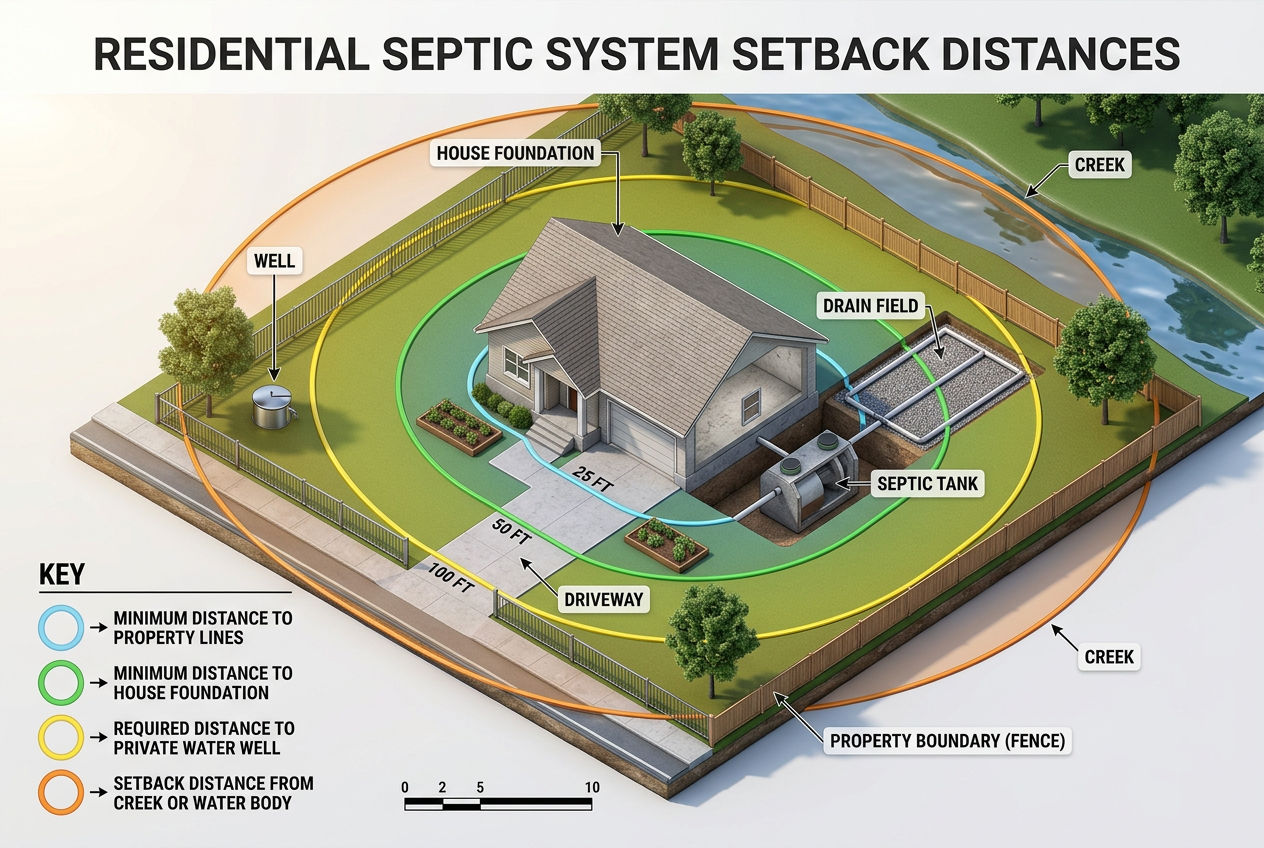
Standard Setback Distances: National Reference Table
The numbers below represent the most commonly enforced ranges across U.S. states. They are a starting point, not a substitute for your local code. Always verify with your county health department.
| Structure or Feature | Septic Tank | Drain Field / Leach Field |
|---|---|---|
| House / building foundation | 5–10 ft (most: 10 ft) | 10–20 ft |
| Private drinking water well | 50–100 ft (most: 50 ft) | 100 ft |
| Public water supply well | 100–200 ft | 100–200 ft |
| Property line | 5–10 ft | 5–10 ft |
| Stream, creek, or river | 25–50 ft | 50–100 ft |
| Lake, pond, or reservoir | 50–200 ft | 50–200 ft |
| Driveway or parking area | 5–10 ft | 10 ft |
| Swimming pool | 15–25 ft | 15–25 ft |
| Trees / large root systems | 10–25 ft | 10–30 ft |
| Water supply lines (pressurized) | 10–25 ft | 25 ft |
| Embankments / cuts | varies | 10–25 ft |
Sources: EPA Onsite Wastewater Treatment Systems Manual; state administrative codes cited below. Ranges reflect variation across jurisdictions — your state may fall outside these ranges.
📊 Quick Fact: Drain field setbacks are consistently 2–10x greater than tank setbacks because that's where treated effluent disperses into soil — and where contamination risk is highest.
Quick Answers: The Most-Asked Septic Distance Questions
How far does a septic tank have to be from a house? Typically 5–10 feet from the foundation, with 10 feet being the most common code requirement. The drain field needs 10–20 feet of separation.
How far does a septic tank need to be from a well? 50 feet minimum for the tank, 100 feet for the drain field, in most U.S. jurisdictions. Some states require up to 200 feet for public water supply wells.
How far does a septic system need to be from the property line? 5–10 feet for both the tank and the drain field, depending on state code.
How far does a septic tank have to be from a creek, stream, or river? 25–50 feet for the tank, 50–100 feet for the drain field. Coastal and watershed-sensitive states (Florida, North Carolina, Washington) push these to 75–100+ feet.
How far does a septic tank have to be from a lake or pond? 50–200 feet depending on jurisdiction. Lakeside communities and EPA-designated impaired watersheds often require the maximum.
How close can a driveway be to a septic tank? 5–10 feet from the tank, 10 feet from the drain field. Driving over either component compacts soil and crushes pipes.
How far does a septic tank need to be from the foundation? Same as house setbacks: 5–10 feet minimum, with most codes requiring 10 feet.
How far does a septic tank have to be from a swimming pool? 15–25 feet from both the tank and the drain field. Pools concentrate weight and create excavation conflicts.
How deep does a septic tank have to be? Typically 1–4 feet below ground surface to the top of the tank. Cold-climate states (Minnesota, Wisconsin, Maine) often require deeper burial to prevent freezing.

The Septic Owner's Handbook
Own a septic system? Get the manual nobody gave you.
How it works, the golden rules, the maintenance calendar, and a warning-signs decoder for every gurgle, smell, and wet spot — so small issues never become $15,000 ones.
Get the Handbook — $39 →Instant download · 250+ pages, 17 chapters + printable toolkit · Yours to keep foreverWhat Is the Minimum Distance Between a Septic Tank and a Well?
The septic tank to well distance requirement is typically 50 feet for the tank and 100 feet for the drain field — but this is one of the most variable numbers in all of septic regulation.
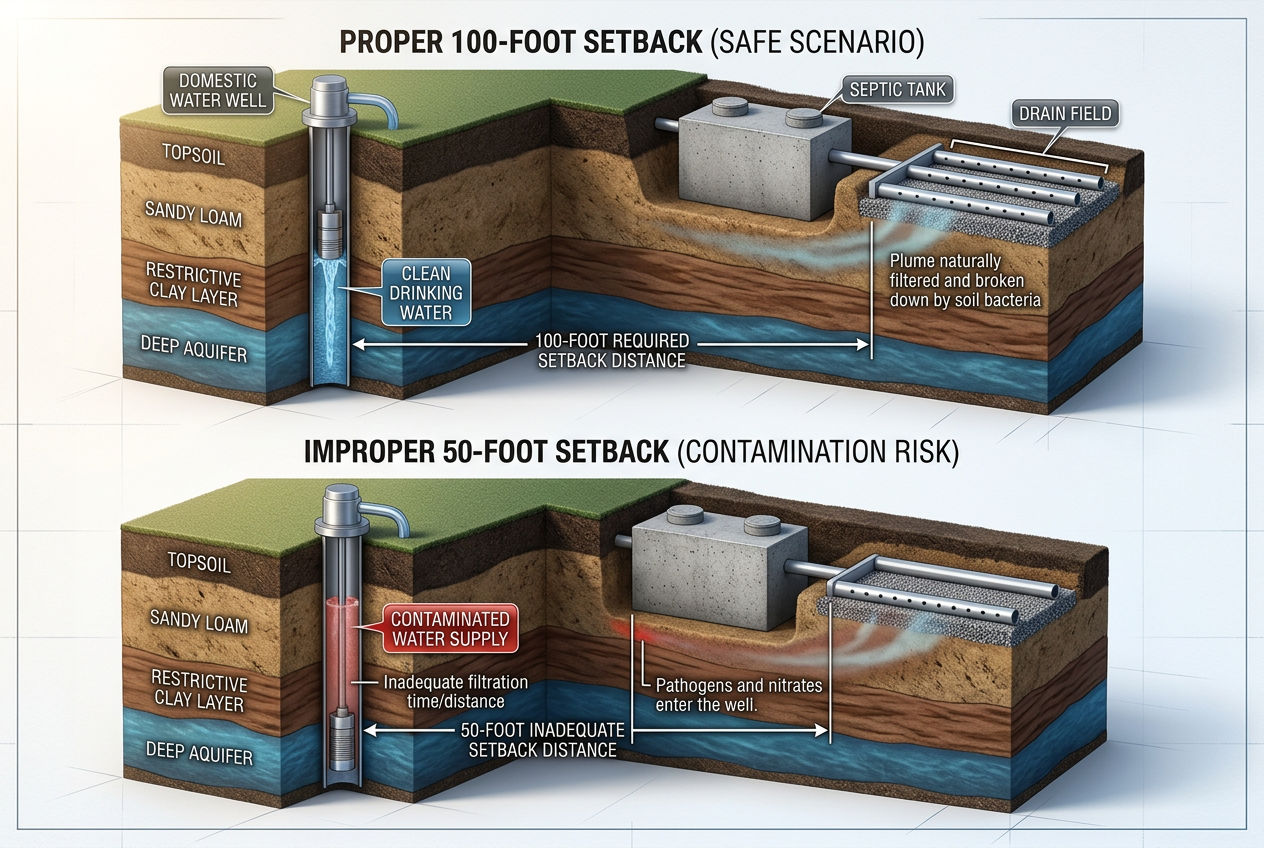
The EPA's Onsite Wastewater Treatment Systems Manual recommends a minimum of 50–100 feet between any septic component and a private well, specifically to reduce the risk of pathogen and nitrate migration through soil.
⚠️ Warning: The EPA estimates that improperly sited or maintained septic systems contribute to more than 168,000 viral illnesses and 34,000 bacterial illnesses annually in the United States.
The Critical Detail About Horizontal Distance
That 100-foot figure is a horizontal distance measured at grade. It does not account for:
- Slope or terrain grade
- Soil permeability characteristics
- Depth to seasonal groundwater
- Bedrock fracture patterns
A 100-foot setback in dense clay soil behaves very differently than 100 feet in coarse sandy loam. That's why states with sandy coastal soils — like Florida and North Carolina — often require the same or greater distances even though water moves faster through their geology.
For a deeper look at how well and septic placement interact during new construction, see our guide on well and septic cost.
How Close to a Property Line Can You Put a Septic System?
Most jurisdictions require 5–10 feet between the septic tank and the property line, with the same range applying to the drain field. Some counties add buffer requirements that push this to 15–25 feet.
Why Property Line Setbacks Matter on Small Lots
This matters most on small lots. A half-acre parcel with setback requirements on all four sides may leave very little usable footprint for a drain field — especially once you account for:
- House foundation setbacks (10–20 ft)
- Well setbacks (50–100 ft)
- Surface water setbacks (50–200 ft)
- Driveway and parking area clearances (5–10 ft)
For a practical look at how installers solve this problem, read our guide on septic systems on small lots.
✅ Pro Tip: If your neighbor ever installs a septic system close to your property line, those setback rules protect your groundwater too. Both systems need separation not just from structures, but from each other.
State-by-State Septic Setback Requirements
This is where most articles fail you. They give you national averages and call it a day. Here are specific standards from 10 heavily searched states, with regulatory references:
Texas
Texas Commission on Environmental Quality (TCEQ) rules require:
- 50 feet from tank to private well
- 100 feet from drain field to well
- Minimum 10 feet from house foundation to tank
Texas delegates enforcement heavily to county-level Authorized Agents, so Bexar County and Travis County can — and do — apply stricter standards.
Florida
Department of Health Rule 64E-6 requires:
- 75 feet from private well to tank and drain field
- 5 feet from property line
Florida also enforces strict setbacks from coastal wetlands and tidal waters that vary by zone.
California
Regulations vary significantly by county. The California State Water Board sets baseline guidance, but counties like Los Angeles, San Diego, and Sonoma each administer their own Environmental Health programs.
- Typical well setbacks: 100 feet
- Structure setbacks: 5–8 feet
Always contact the county Environmental Health Department directly.
North Carolina
15A NCAC 18A .1950 and related rules require:
- 100 feet from private well to nitrification (drain) field
- 50 feet from well to tank
NC's rules are enforced through county Environmental Health offices, and the state has particularly strict rules near coastal plain soils with seasonal high water tables.
Georgia
Under DHR's Manual for On-Site Sewage Management Systems:
- 10 feet from septic tank to house
- 100 feet from tank to private well
Georgia uses soil morphology evaluations that directly influence where setbacks can be met.
Ohio
Ohio Administrative Code 3701-29 sets:
- 50-foot minimum from private well to septic tank
- 100 feet to soil absorption system
- 10 feet clearance from buildings
Ohio county health departments have significant local authority to apply stricter rules.
Pennsylvania
Title 25, Chapter 73 (individual sewage disposal rules) requires:
- 100 feet from private well to absorption area
- 10 feet from property line (typical)
The state's mountainous terrain and variable soils make site-specific evaluations especially important.
New York
Appendix 75-A of the Public Health Law requires:
- 100 feet from private water supply well to any part of absorption system
- 50 feet from well to tank alone
- 20 feet from absorption field to structures
Individual counties like Suffolk and Westchester maintain additional overlay rules.
Virginia
12VAC5-613 (Sewage Handling and Disposal Regulations) sets:
- 50 feet from tank to private well
- 100 feet from drainfield to private well
Virginia's Onsite Sewage regulations are among the most detailed in the Southeast, with specific rules for alternative systems.
Michigan
Michigan's Part 117 (Onsite Wastewater Treatment) regulations set baseline standards, but county health departments have substantial local authority.
- Common setbacks: 50 feet (tank to well), 100 feet (drain field to well)
- Upper Peninsula counties in high-water-table areas may require more
How Far Does a Drain Field Need to Be From Different Features?
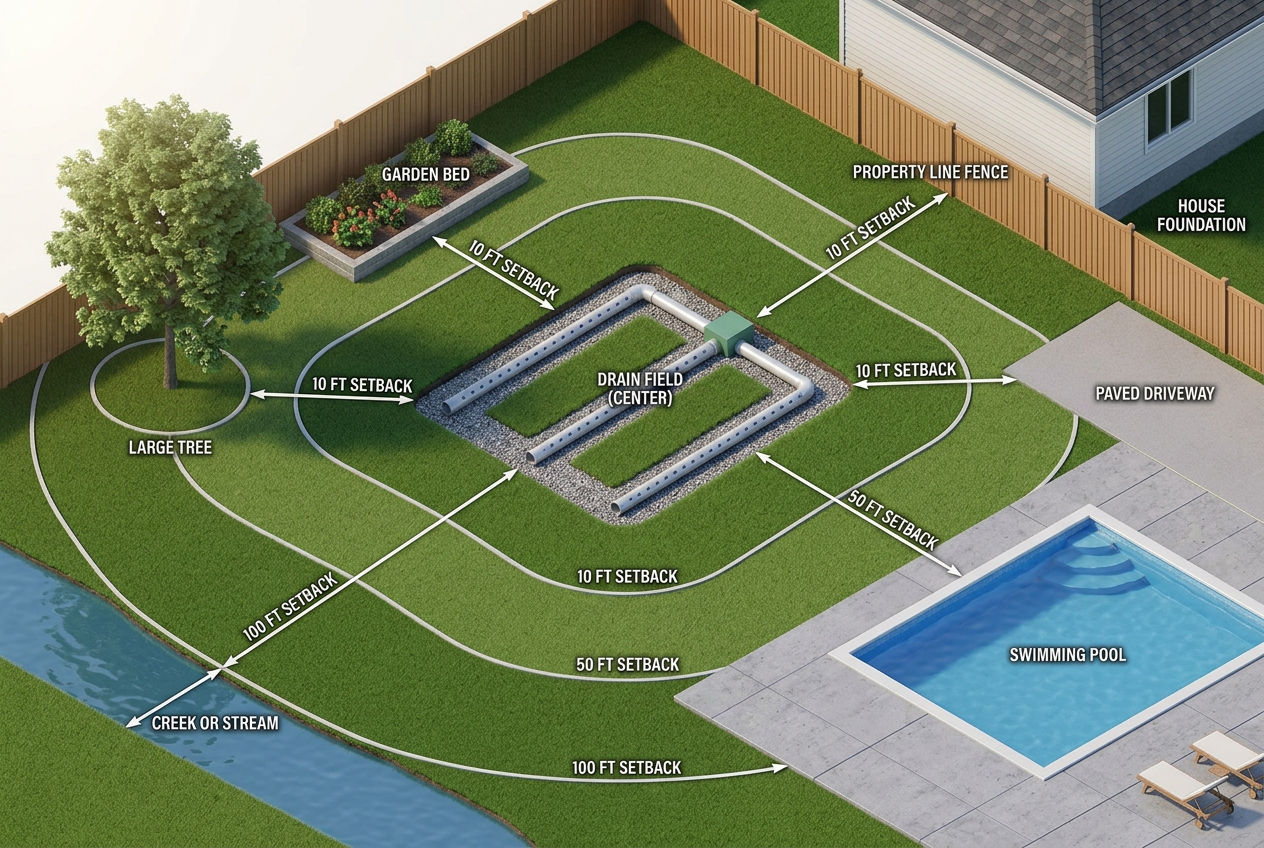
The drain field carries the heavier setback burden in almost every state. Here's why: the tank mostly holds and partially treats solids. The drain field — sometimes called an absorption field, soil absorption system, or leach field — is where treated liquid effluent disperses into the soil. Pathogens can travel through saturated or sandy soil. Groundwater contamination distance rules exist because of what happens when a leach field is too close to a water source.
Critical Drain Field Setback Rules
| Feature | Standard Setback | Why It Matters |
|---|---|---|
| Foundation | 10–20 ft | Maintenance access; prevents hydrostatic pressure against basement walls |
| Surface water | 50–100 ft (streams/creeks) 50–200 ft (lakes/reservoirs) |
Prevents direct contamination; coastal states add wetland buffers |
| Slopes/embankments | 10–25 ft horizontal | Prevents effluent "daylighting" on hillsides |
| Large trees | 10–30 ft | Tree roots actively seek moisture/nutrients and destroy laterals |
⚠️ Warning: Willow, oak, and maple trees are the most aggressive root invaders. A mature willow within 15 feet of your leach field can destroy it in 3–5 years.
Alternative System Setback Reductions
For a conventional septic system, these distances are measured from the outer edge of the lateral field. For alternative systems — mound systems, aerobic treatment units (ATUs), drip irrigation systems — some jurisdictions allow reduced setbacks because of the additional treatment these systems provide.
An ATU that discharges to a subsurface drip field, for example, may qualify for a 50-foot well setback instead of 100 feet under Virginia's 12VAC5-613 alternative standards.
For specifics on which trees pose the greatest risk, see our guide on trees near septic systems.
Can You Build Over a Septic Tank or Drain Field?
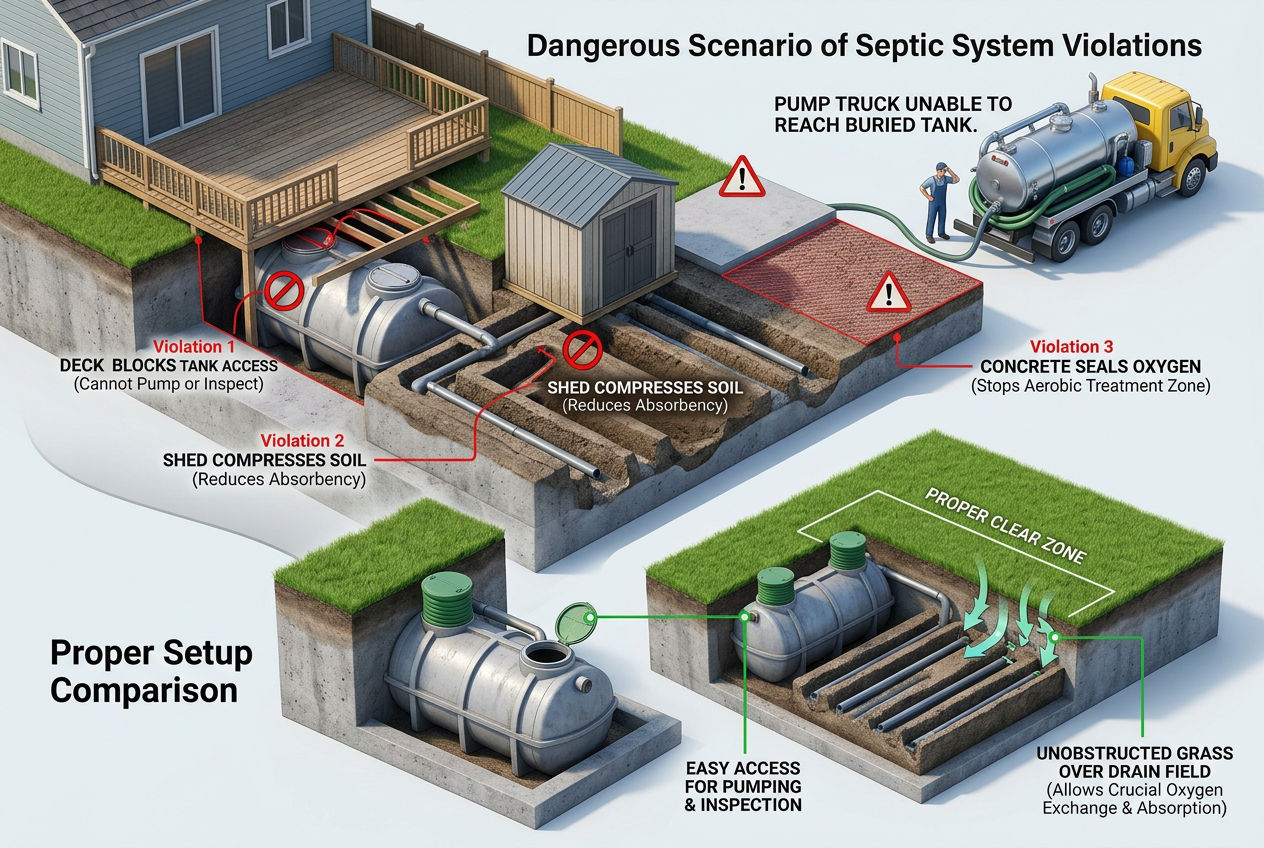
No. Building any permanent structure over a septic tank or drain field is prohibited in virtually every jurisdiction — and for good reason.
Why Tank Access Matters
Tanks need access for pumping every 3–5 years:
- A 1,000-gallon concrete tank serving a four-person household requires pumping every 3–5 years
- A 1,500-gallon tank extends this to 5–7 years
- Either way, the lid needs to be reachable
Building a deck, shed, or patio over it blocks access and can void your system's operating permit.
The Drain Field Compaction Problem
Drain fields are worse. Compacted soil from structures, driveways, or even regular foot traffic collapses the air pockets in the soil that make aerobic treatment possible.
📊 Quick Fact: A drain field buried under a parking area will fail — it's not a matter of if, but when. Soil compaction destroys the porosity that allows oxygen transfer and bacterial treatment.
For specifics on what compaction does to leach field performance, see our article on driving over drain fields.
What Happens If Setback Requirements Are Violated?
The consequences scale with how the violation is discovered.
Discovery During Permit Review
Your local health department reviews the site plan as part of the septic system permit process. If setbacks don't comply, the permit is denied. You redesign or you don't build.
Discovery During Inspection
A septic inspection during a home sale can flag setback violations even on systems installed decades ago. If the violation is material — a drain field 40 feet from a well that requires 100 feet — the lender may refuse to close until it's corrected.
Discovery After Installation
Discovered violations can trigger:
- Notice of Violation from county health department
- Mandatory system relocation
- Civil fines ranging from hundreds to thousands of dollars
Relocation costs: $5,000–$30,000 depending on what's being moved and site complexity. Full system replacement in difficult terrain can exceed $50,000.
Liability Exposure
If your improperly placed system contaminates a neighbor's well, you're looking at:
- Civil liability for remediation costs
- Health damages
- Potentially criminal charges under state environmental law
⚠️ Warning: Title insurance and homeowner's insurance typically exclude coverage for known code violations. You bear the full financial risk.
Do Setback Requirements Vary by State?
Yes — dramatically. There is no single federal septic setback standard. The EPA provides guidance and funds research, but the Clean Water Act delegates onsite wastewater regulation to the states. States, in turn, often delegate to county health departments.
The Three-Tier Regulatory Structure
- Federal (EPA): Provides research, guidance, and funding — but no enforceable setback rules
- State: Sets baseline standards through administrative code or public health law
- County/Local: Applies and often strengthens state minimums based on local conditions
This decentralization creates real-world situations where two neighboring counties in the same state have different minimum well-to-drain-field distances. In California, this is especially pronounced — a Marin County permit has different requirements than a Fresno County permit, even though both operate under the State Water Board's umbrella.
Seasonal Factors in Cold Climates
Seasonal factors add another layer. In Minnesota, Wisconsin, and Michigan's Upper Peninsula, seasonal high water tables during spring snowmelt are part of the setback calculation.
✅ Pro Tip: Always request the most current version of your county's septic siting requirements in writing before purchasing rural property or beginning site design. What was approved 10 years ago may not be grandfathered if you're doing new construction.
Sources & Methodology
-
U.S. Environmental Protection Agency — Federal guidelines on minimum separation distances between septic components and water sources, property boundaries, and structures.
-
International Association of Plumbing and Mechanical Officials (IAPMO) — Uniform Plumbing Code setback requirements referenced by many state and county jurisdictions for septic system siting.
-
National Environmental Services Center (NESC) — Comprehensive database of state-by-state setback requirements and regulatory frameworks for onsite wastewater systems.
-
USDA Natural Resources Conservation Service — Soil survey data and topographic considerations that influence setback requirements for septic system components.
-
National Onsite Wastewater Recycling Association (NOWRA) — Industry guidance on setback distance standards and variance procedures for challenging lot configurations.
Cost data reflects 2025–2026 national averages compiled from county permit records and engineering fee surveys across SepticTankHub.com's directory network.
Need help with your septic system? Find trusted septic professionals near you to get free quotes. See our complete guide to septic inspection costs for current pricing. Learn more about septic inspection services. Browse local septic companies in South Carolina or Missouri.
Free download
Not ready for the Blueprint? Start free.
Grab the free DIY Septic Planning Kit — the permit-first checklist, perc-test cheat sheet, and sizing tables that keep your build from getting red-tagged.
Was this article helpful?
Frequently Asked Questions
Recommended Resources
📖 Related Articles
- Septic System Permit Cost & State Requirements (2026 Guide)
- How Much Does a Well and Septic System Cost?
- Septic System for Small Lots: Options When Space Is Tight
- What Is a Drain Field? (And How Does It Work?)
- Trees Near Septic Systems: Safe Distances & Worst Species (2026)
- Types of Septic Systems: Complete Comparison Guide
- Concrete vs Plastic Septic Tanks: Which Is Better?
- Can You Drive or Build Over a Drain Field?
- What Happens During a Septic Inspection?
- High Water Table and Septic Systems: What You Need to Know
Find Septic Professionals Near You
Compare licensed, verified septic companies by area — top county markets and cities below, or browse all 50 states.
County markets
Popular cities
