
Quick Answer
A well and septic system costs $7,500–$30,000+ for the combined installation, with most new construction homeowners spending $15,000–$25,000. Well drilling typically runs $3,750–$15,300, while septic installation adds $3,500–$20,000 or more depending on your soil conditions, system type, and local regulations. Permit fees, perc testing, and site prep push the total higher.
Key Takeaways
- Most homeowners pay $15,000–$25,000 to drill a well and install a septic system together on new construction
- Well drilling costs $25–$65 per foot, with residential wells averaging 100–400 feet deep
- A conventional septic system runs $3,500–$10,000; aerobic and mound systems push $10,000–$20,000+
- Permits, perc testing, and water quality testing add $600–$2,500 to the total budget
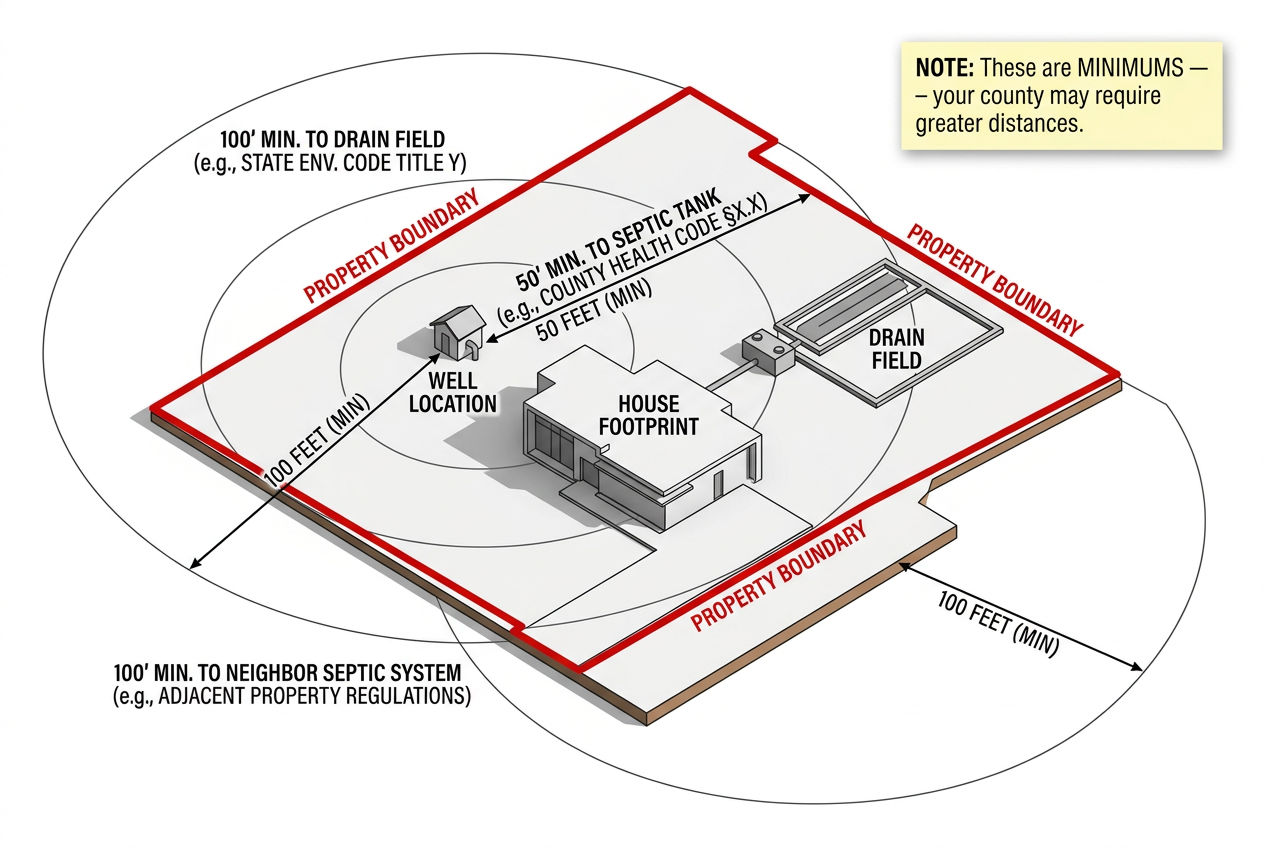
- Your well and septic drain field must be at least 50–100 feet apart - your lot size and layout affect both systems
What Does a Well and Septic System Cost Together?
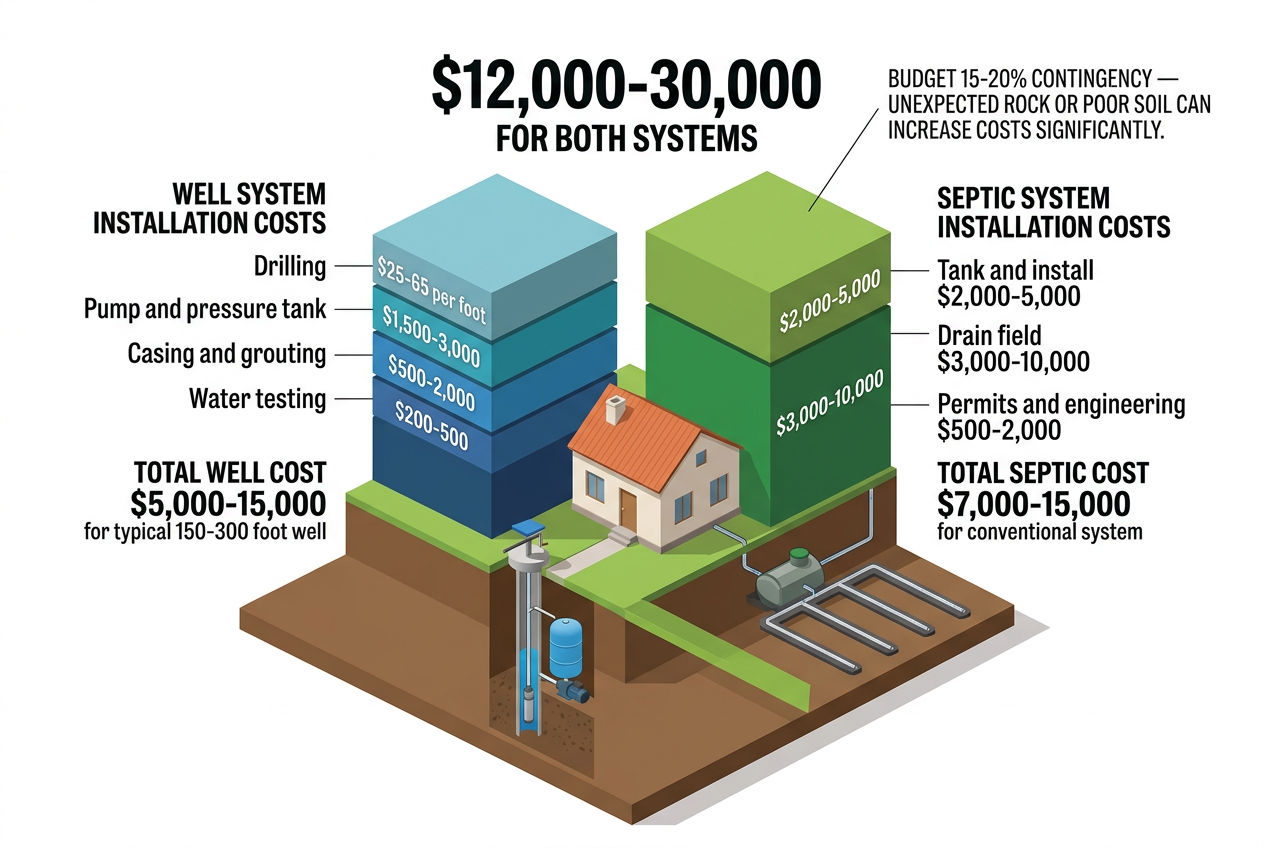
For a typical 3-bedroom rural home on raw land, the combined well and septic installation cost lands between $15,000 and $25,000. That range sounds wide, but the spread comes down to three things: how deep your well needs to go, what kind of septic system your soil will support, and where you live.
Here's a realistic scenario: You're building a 1,500-square-foot home on 5 acres in central Tennessee. Your well driller hits water at 180 feet, billing at $45/foot - that's $8,100 just for drilling, plus $1,800 for a submersible pump and pressure tank. Your soil perc test comes back favorable, so the county approves a conventional gravity-fed septic system with a 1,000-gallon concrete tank and a 900-square-foot drain field. That runs another $6,500. Add permits and the soil evaluation, and you're at roughly $18,000 total. Completely ordinary. Nothing went wrong. That's just the reality of off-grid utilities on raw land.
📊 Quick Fact: According to the EPA, approximately 21 million U.S. households rely on private wells, and roughly 1 in 5 homes uses a septic system. In rural counties, about 33% of new homes are built with both - meaning contractors who do this work are experienced, but demand is high and schedules fill fast.
How Much Does It Cost to Drill a Well?
Well drilling costs $3,750–$15,300 for most residential projects, with the national average running $7,500–$9,000. The biggest variable is depth. Drillers charge $25–$65 per foot, and you don't always know how deep you'll need to go until the bit is in the ground.
A 150-foot well at $40/foot costs $6,000 for drilling alone. A 350-foot well at the same rate costs $14,000. Add a submersible pump ($1,000–$2,800) and a pressure tank ($300–$800), and you can see how well costs balloon fast in areas with deep water tables.
Typical Well Installation Cost Breakdown
- Drilling: $25–$65/foot × 100–400 feet
- Steel or PVC casing: Often included; sometimes billed at $10–$30/foot extra
- Submersible pump: $1,000–$2,800 installed
- Pressure tank: $300–$800
- Well permit: $50–$500 depending on your state or county
- Water quality testing: $100–$500 (some states require it at completion)
⚠️ Warning: The Southwest is the most expensive region for well drilling. Parts of Arizona and New Mexico have water tables 500+ feet down. A $20,000+ well isn't unusual in those areas. Contrast that with parts of the Southeast, where sandy soils and shallow aquifers mean hitting water at 80–120 feet.
Before you call a driller, check your state's well construction records. Many states maintain public databases of nearby well logs - these show what depth neighboring properties hit water and what the geology looks like. Your state geological survey or department of natural resources is usually the place to find them.
How Much Does Septic System Installation Cost?
Septic installation cost depends almost entirely on which type of system your lot requires. The septic installation cost ranges from $3,500 for a basic conventional system to $25,000+ for engineered alternatives on difficult soils.
| System Type | Installed Cost | Best For |
|---|---|---|
| Conventional gravity-fed | $3,500–$10,000 | Deep, well-draining soil; flat lots |
| Chamber system | $5,000–$12,000 | Moderate soil, slightly smaller footprint |
| Mound system | $10,000–$20,000+ | High water table or shallow bedrock |
| Aerobic treatment unit (ATU) | $10,000–$20,000 | Poor soil, small lots, strict discharge rules |
| Engineered / alternative | $12,000–$25,000+ | Rocky terrain, steep slopes, challenging sites |
Source: National Onsite Wastewater Recycling Association (NOWRA); regional installer surveys.
A 1,000-gallon concrete septic tank - the standard for a 3-bedroom home - costs $800–$2,500 for the tank alone, before excavation and drain field work. The drain field installation is often the largest line item, running $2,000–$10,000 depending on soil conditions and linear footage of leach laterals required.
💡 Key Takeaway: To understand what a septic system is and how these components work together before you start taking bids, it helps to know the basics - you'll ask better questions and catch inflated quotes faster.

DIY Septic Blueprint
Thinking about building it yourself?
The complete, plain-English plan to size, permit and install your own septic system — designed for homeowners, not contractors. Skip the $15,000–$25,000 quotes and do it right the first time.
Get the DIY Blueprint — $67 →Instant download · 8 modules + 3 bonus guides · 60-day money-back guaranteeWhat Pre-Installation Costs Should You Budget For?
Before a shovel touches the ground, you'll spend money on permits and soil testing. These costs are non-negotiable and often underestimated.
Required Pre-Installation Expenses
Perc test (percolation test): $250–$1,000. This test measures how fast water drains through your soil. The results determine which type of septic system the county will approve. Some states now accept an alternative soil morphology evaluation by a licensed soil scientist instead of a traditional perc test - but both cost roughly the same. Skipping this step isn't an option. No perc test, no septic permit.
Septic permit: $200–$1,000. Fees vary dramatically by county. Some rural counties charge $250 flat. Others, particularly in New England, charge $800+ and require a licensed engineer to stamp the design drawings.
Well permit: $50–$500. Usually processed through your state's department of natural resources or environmental quality office.
Water quality testing: $100–$500. Most states require it before the well is approved for use. Tests typically screen for coliform bacteria, nitrates, and pH at minimum. If you're in an agricultural area, also test for pesticides and heavy metals.
📊 Quick Fact: Budget $1,000–$2,500 for this pre-installation phase. It's money spent before you see a single piece of equipment on your property, which frustrates a lot of first-time rural builders - but there's no shortcut around it.
Does It Cost Less to Install Both Systems at the Same Time?
Yes, and meaningfully so. Installing a well and septic system simultaneously saves money in two ways.
First, you're scheduling one mobilization instead of two. Excavation equipment, delivery trucks, and inspector visits cost money every time they show up. Combining projects reduces that overhead.
Second - and this matters more - coordinated installation ensures your setback requirements are met from the start. Every state requires a minimum separation distance between a well and a septic system. Most states set the minimum at 50 feet; many require 100 feet or more, particularly between the well and the drain field (not just the tank). Some counties add their own stricter requirements on top of state minimums.
⚠️ Warning: If you drill your well first, then bring in a septic contractor months later, you might discover your only viable drain field location is 40 feet from the wellhead. That's a problem requiring either a variance, system redesign, or in some cases an aerobic system with advanced treatment - all of which cost more than getting both layouts designed together from day one.
Working with a single contractor who handles both systems - or a project manager who coordinates the well driller and septic installer - typically saves $500–$2,000 compared to managing them separately. It also reduces permitting headaches, since some counties issue a combined site plan approval for both systems.
How Do Regional Costs Affect Your Well and Septic Budget?
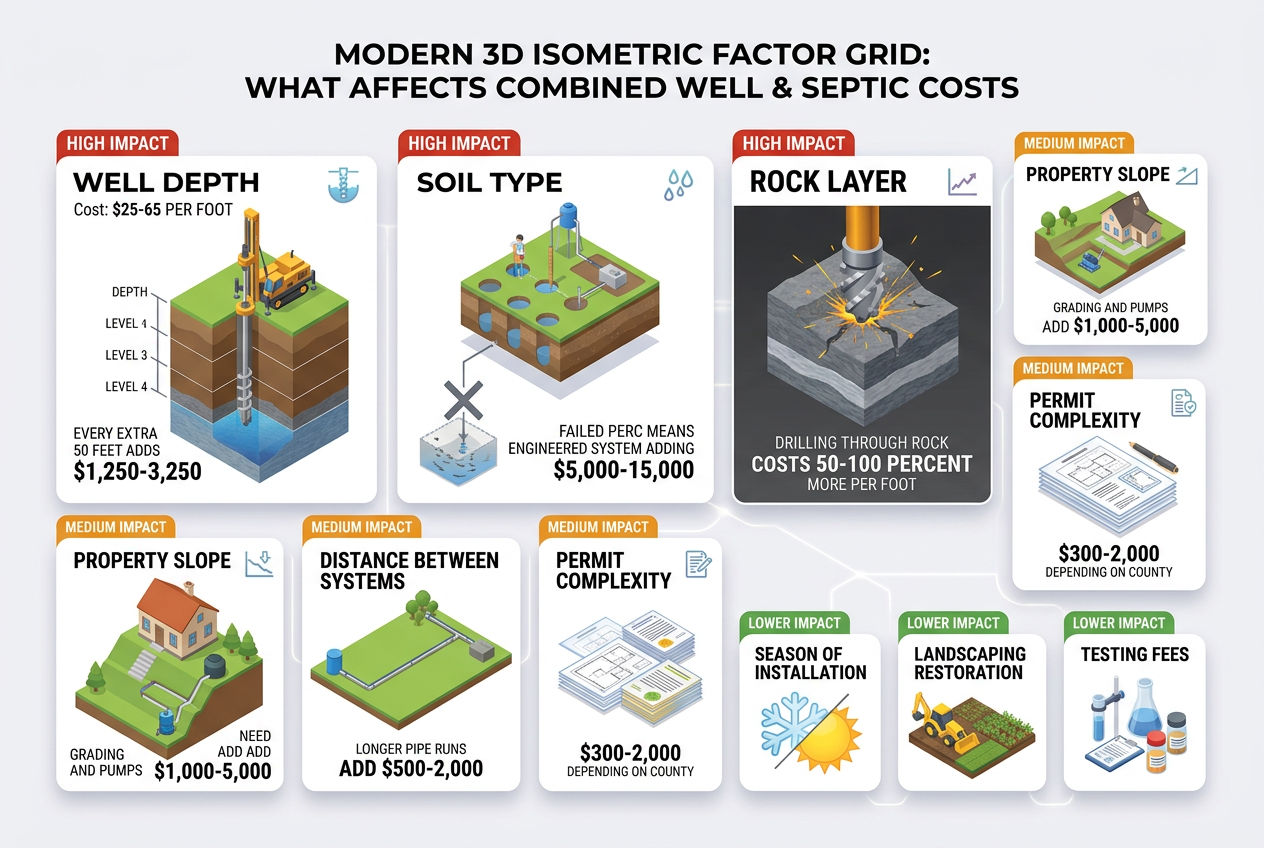
Where you build matters as much as what you build. Labor rates, geology, and state regulations create significant regional price differences.
| Region | Combined Cost Range | Key Cost Drivers |
|---|---|---|
| Northeast (NY, PA, New England) | $18,000–$35,000 | Granite bedrock ($50–$65/ft drilling), strict regulations, engineer requirements |
| Southeast (NC, GA, FL) | $12,000–$22,000 | High water table (mound/aerobic systems), RSTC licensing in Florida |
| South Central (TX, OK, AR) | $10,000–$20,000 | Limestone bedrock in Hill Country, county-level regulation variations |
| Mountain West (CO, MT, WY) | $15,000–$30,000+ | Hard rock drilling, remote locations, limited contractor availability |
| Southwest (AZ, NM) | $20,000–$35,000+ | Deep water tables (500+ ft), most expensive well drilling region |
Regional Notes Worth Knowing
Northeast: Connecticut and New Jersey require water quality testing at point of sale. Licensed engineer involvement is often mandatory for system design.
Southeast: Florida's high water table forces many properties into mound or aerobic systems, which pushes the septic cost up even when well drilling is cheap. The Florida Department of Health requires all septic contractors to hold a Registered Septic Tank Contractor (RSTC) license.
South Central: Texas delegates septic regulation to county-level Authorized Agents, so requirements vary significantly from county to county.
Mountain West: Get bids from multiple contractors - a 40% price swing between drillers isn't unusual in remote areas.
Southwest: Water tables at 500+ feet drive drilling costs to $15,000–$20,000 for the well alone. Budget accordingly.
✅ Pro Tip: Fall is the best season to schedule installation in most of the country. Contractors have shorter backlogs than summer, ground is still workable, and some drillers offer 10–15% off-season discounts. In northern states, installations must be completed before hard freeze - typically October in Minnesota or Wisconsin, where frost lines reach 42–60 inches.

What Are the Hidden or Overlooked Costs?
A few line items consistently catch first-time rural homeowners off-guard.
Commonly Overlooked Expenses
Land clearing and excavation prep: If your drain field site has trees, stumps, or heavy brush, add $500–$3,000 for clearing before the septic contractor can work. This is separate from the installation quote.
Electrical for the well pump: Your well pump needs a dedicated 240V circuit from your home's electrical panel. If the trench from the wellhead to your house runs 200+ feet, the electrical work alone can cost $800–$2,000.
Pressure tank and treatment equipment: Iron, manganese, or hardness issues in your water may require a whole-house filtration or softener system after the well is drilled. Budget $500–$3,000 depending on the issue.
Septic risers and access lids: A 1,000-gallon buried tank without septic tank risers means digging up the lid every time you need a pump-out. Installing polyethylene risers at the time of installation costs $200–$400 - a fraction of what repeated excavation costs over the life of the system.
Long-Term Operating Costs
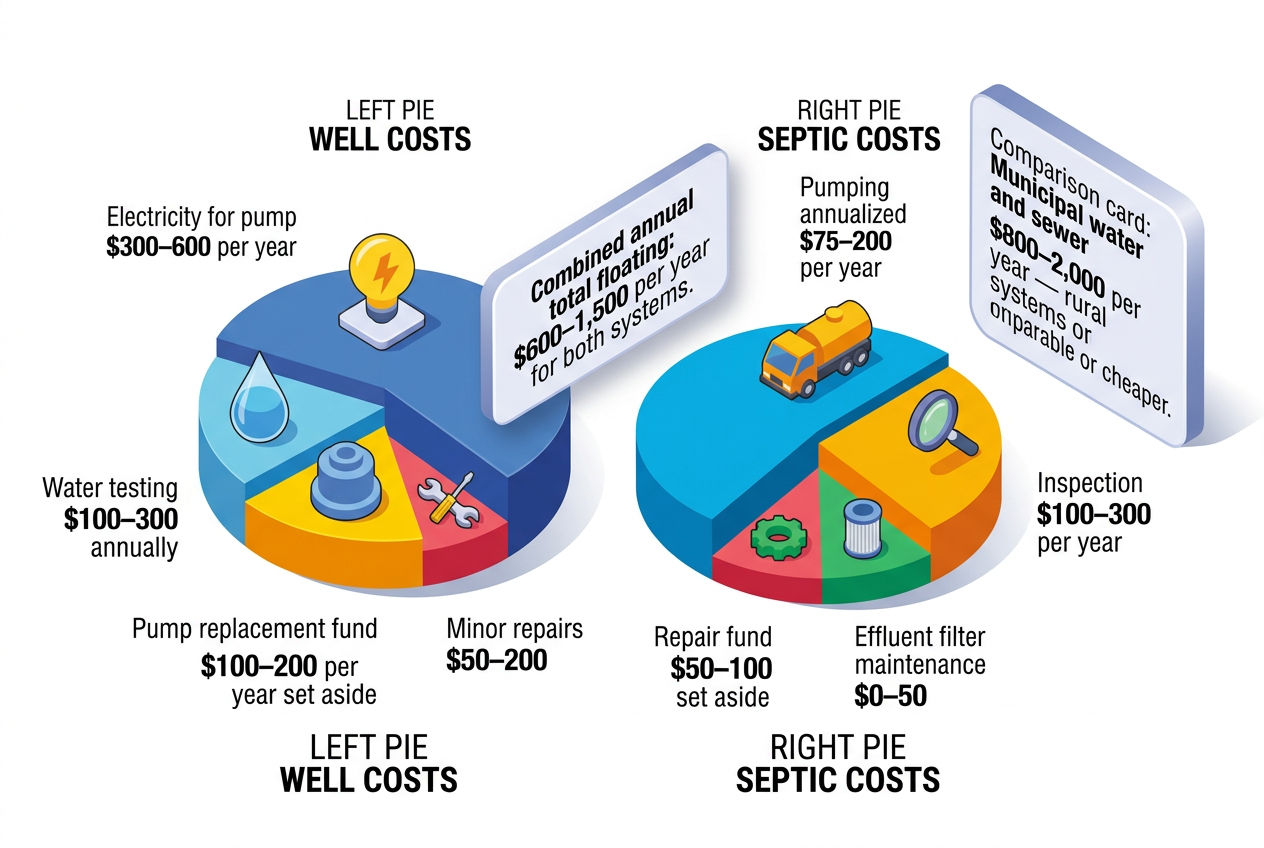
Ongoing maintenance: A conventional septic system serving a 4-person household needs pumping every 3–5 years, per EPA guidelines. That runs $300–$600 per pump-out depending on your region. Aerobic systems require quarterly inspections and annual maintenance contracts, often $150–$300/year.
💡 Key Takeaway: Budget for these before you build - they're not optional. See how often to pump a septic tank for a full breakdown by household size and usage.
How Long Does Well and Septic Installation Take?
The physical installation is faster than most people expect. The waiting is not.
| Project Phase | Timeline |
|---|---|
| Permit approval | 2–8 weeks (sometimes longer in busy counties or states with complex review) |
| Well drilling | 1–3 days for most residential wells; up to a week for deep or difficult formations |
| Septic installation | 2–5 days for conventional systems; allow a full week for mound or aerobic systems |
| Final inspections and approvals | 1–3 weeks after installation |
⚠️ Warning: From permit application to final approval, budget 1–3 months for the full process. In high-demand seasons (late spring through summer), contractor backlogs can push that to 4 months.
Apply for permits as early as possible - ideally before you break ground on the house itself. Understanding the full septic system installation process before you start helps you sequence the project correctly and avoid expensive delays caused by inspections happening out of order.
Learn more about our septic installation services.
Related reading: septic inspection process.
Sources & Methodology
EPA Septic Systems Overview: Used for household statistics (21 million private well users, 1 in 5 homes on septic).
NOWRA (National Onsite Wastewater Recycling Association): Referenced for system type cost ranges and installation standards.
USDA Rural Development: Contextual reference for rural housing development cost structures.
Regional contractor surveys and permit fee schedules - Cost ranges validated against publicly available county health department fee schedules and installer pricing data from multiple U.S. regions.
State regulatory references - Florida Department of Health (RSTC licensing), Texas Commission on Environmental Quality (county-level delegation), Connecticut and New Jersey point-of-sale testing requirements.
Browse our directory of septic professionals to find licensed installers in your area. Request quotes from local contractors who know your county's soil conditions and permit requirements.
Need help with your septic system? Browse local septic companies in Wisconsin or Oregon.
Free download
Not ready for the Blueprint? Start free.
Grab the free DIY Septic Planning Kit — the permit-first checklist, perc-test cheat sheet, and sizing tables that keep your build from getting red-tagged.
Was this article helpful?
Frequently Asked Questions
Recommended Resources
📖 Related Articles
💰 Cost Guides
🔧 Services
Find Septic Professionals Near You
Compare licensed, verified septic companies by area — top county markets and cities below, or browse all 50 states.
County markets
Popular cities
