
Quick Answer
Small lots don't automatically rule out septic systems — but they do require smarter design choices. A conventional gravity-fed drain field often won't fit within the required setbacks on compact properties. Advanced treatment systems — including aerobic treatment units (ATUs), drip dispersal, mound systems, and chamber systems — can cut the required soil absorption area by 40–60%, opening up options on lots as small as 0.25 acres in many jurisdictions.
💡 Key Takeaways
- Conventional drain fields for a 3-bedroom home typically need 450–900 sq ft of absorption area — plus setbacks that eat up much more total space.
- ATU and drip dispersal systems can reduce that footprint by 40–60%, often making small-lot installation feasible.
- Setback requirements — especially the drain field-to-well distance of 50–100 feet — are usually the tightest constraint on small properties.
- Most jurisdictions require a soil percolation test and county health department permit before any system is approved.
- Advanced systems cost more upfront ($8,000–$20,000+) but are often the only path forward on tight lots.
How Much Land Do You Need for a Septic System on a Small Lot?
There's no single national minimum. Lot size requirements for septic systems are set at the state or county level, and they vary widely. Many jurisdictions require a minimum of 0.5 to 1.0 acre for a conventional system. Some allow lots as small as 0.25 acres if you install an advanced treatment system.
What actually matters isn't just raw acreage — it's how much usable space remains after you subtract:
- The house footprint and setback from the foundation (10–20 feet for the drain field)
- The required distance from property lines (typically 5–15 feet)
- The distance from any well on the property (50–100+ feet in most states)
- Buffers from surface water, streams, or wetlands (50–100 feet)
- Driveways, easements, and other impervious surfaces
⚠️ Warning: A 0.5-acre lot sounds like plenty until you map all of that out. Suddenly, you've got a 30 x 40-foot corridor that has to carry your entire soil absorption system.
For context, a conventional drain field for a 3-bedroom home requires roughly 450–900 square feet of trench area, depending on your soil's perc rate. Fast-draining sandy soil needs less. Slow-draining clay can push that number well past 900 square feet — on a lot where you might only have 600 usable.
So what do you do when the numbers don't work? That's exactly what the rest of this guide covers.
Why Small Lots Create Specific Septic Challenges
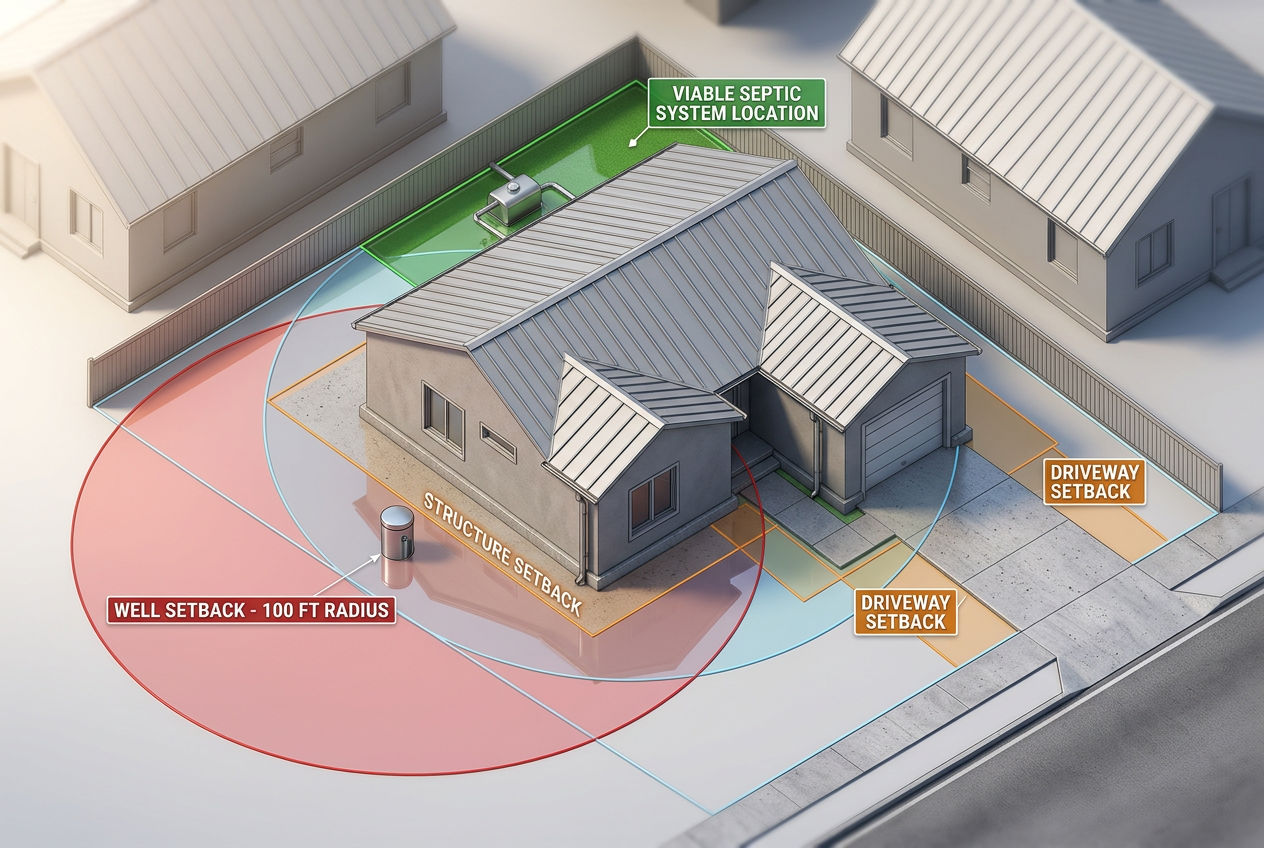
Setback Requirements Are the Real Constraint on Small Lot Septic Installs
Square footage is one thing. Setback requirements are another. On a small lot, the septic system setback requirements often dictate more than lot size alone.
Here's what you're typically working around (ranges reflect variation by state and county):
| Setback Type | Typical Distance |
|---|---|
| Drain field to house foundation | 10–20 feet |
| Drain field to property line | 5–15 feet |
| Drain field to potable well | 50–100+ feet |
| Septic tank to potable well | 50 feet (minimum) |
| Drain field to surface water | 50–100 feet |
| Septic tank to house foundation | 5–10 feet |
Source: EPA On-Site Wastewater Treatment Systems Manual; ranges reflect common state and county variations. Always verify with your county health department.
📊 Quick Fact: The well-to-drain-field separation distance is frequently the binding constraint on small properties. If you have a private well — which is common on rural lots — you may need to keep 100 feet of clear separation. On a 0.25-acre lot, that distance can cut your buildable area nearly in half.
Soil Conditions Change the Math
A perc test — formally called a soil percolation test — measures how fast water drains through your soil. The result, expressed in minutes per inch (MPI), directly determines how large your drain field needs to be.
Consider these common scenarios:
- Sandy loam soil (5–10 MPI) → relatively small field
- Heavy clay soil (45–60 MPI) → triple the required absorption area
- Failed soil (too slow or too fast) → requires completely engineered alternative
⚠️ Warning: High water tables add another layer. If the seasonal high water table sits within 24 inches of the proposed drain field depth, a conventional trench system isn't permitted in most states. This is especially common in Florida, coastal areas, and the Upper Midwest after snowmelt.
Compact Septic System Options for Small Properties
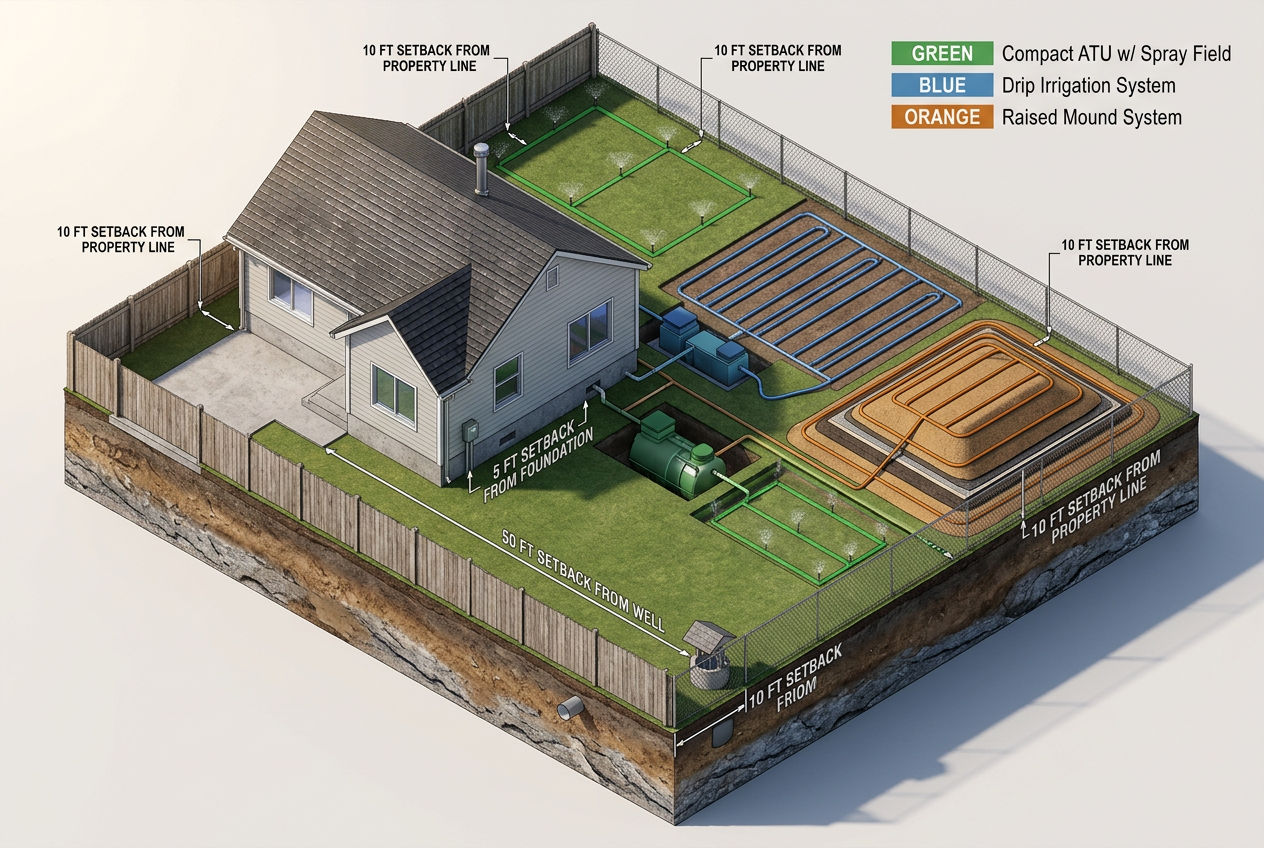
Aerobic Treatment Unit (ATU)
An aerobic treatment unit injects air into the treatment process, producing a much cleaner effluent than conventional anaerobic systems. Because the effluent quality is higher, the county typically allows a 40–60% reduction in the required drain field size.
✅ Pro Tip: A 3-bedroom home that would need 750 square feet of conventional drain field might qualify for only 300–400 square feet with an ATU. On a tight lot, that reduction is often what separates a permitted system from one that can't be approved.
ATUs use an aerator compressor — brands like the Hiblow HP-80 are common in residential installations — to maintain oxygen levels in the treatment chamber. They require an annual service contract, typically $200–$300/year, and some states mandate it by law. Texas, for example, regulates ATUs through the TCEQ (Texas Commission on Environmental Quality) and requires a maintenance provider agreement as a condition of the permit.
Cost breakdown:
- Upfront: $10,000–$20,000+
- Annual maintenance: $200–$300
- Higher than conventional, but often the only option that fits
Read the full breakdown at our aerobic septic system cost guide.
Drip Dispersal System
A drip irrigation septic system distributes treated effluent through a network of small-diameter tubing buried just 6–12 inches below the surface. Because it applies effluent slowly and evenly across a wider area, it can reduce the required land footprint by up to 50% compared to conventional trenches.
Key advantages:
- Works well on sloped lots
- Handles irregularly shaped parcels
- Effective where deep trenching isn't possible (shallow bedrock or high water tables)
- Popular in Pacific Northwest and coastal Southeast
The system requires a pump chamber, effluent filter, and a pressure-dosed delivery system. Emitters need periodic flushing to prevent clogging, and the pump requires annual inspection. Cost runs $8,000–$18,000 depending on system size and site complexity.
Mound Septic System
When the soil fails the perc test or the water table is too high for in-ground installation, a mound system builds the drain field above grade. Engineered sand fill creates the treatment bed, and effluent is pressure-dosed up into the mound.
Mound systems don't necessarily reduce footprint — the mound itself can be 30 feet wide and several feet tall — but they solve the soil limitation problem that often makes small lots undevelopable. In Wisconsin and Minnesota, mound systems are one of the most common alternatives because glacial clay soils and high seasonal water tables rule out conventional systems on a large percentage of rural lots.
💡 Key Takeaway: Cost runs $10,000–$20,000. They're expensive and visible. But on a lot with poor soil, a mound system is often the difference between a buildable property and one that can't be permitted at all.
See our mound septic systems guide for a deeper look.
Chamber Septic System
A chamber system replaces the gravel-and-pipe construction of a conventional leach field with interlocking plastic arch chambers (Infiltrator Water Technologies is the dominant brand for residential installs). The chambers create a larger void space for effluent storage and soil contact, often allowing 20–30% smaller trenches than gravel systems.
It's not a dramatic footprint reduction — this isn't going to save a 0.25-acre lot by itself — but it's a cost-effective upgrade when you need to squeeze a little more efficiency out of your available drain field area.
Cost runs $4,000–$8,000, making it one of the more affordable alternatives.
Sand Filter Septic System
A sand filter adds a pre-treatment step between the septic tank and the drain field. Effluent passes through a bed of clean sand, which removes additional biological and chemical load. Like an ATU, the improved effluent quality often allows a smaller drain field.
Sand filters are popular in the Pacific Northwest, where the Oregon Department of Environmental Quality and Washington State's DOH both recognize them as a path to reduced dispersal area. They require periodic inspection and sand replacement every 5–10 years.
Cost: $7,000–$15,000.
Holding Tank (Last Resort)
A holding tank doesn't treat or disperse anything. It simply stores all wastewater until a pump truck comes to empty it. Installation costs are low — $3,000–$5,000 — but ongoing pumping costs of $200–$500 per month make it the most expensive option over time.
⚠️ Warning: Most jurisdictions won't permit a holding tank as the primary wastewater system for a full-time residence. It's typically allowed for seasonal cabins, camps, or properties where no other option is feasible.
If someone tells you a holding tank is the solution for your small-lot home, get a second opinion before you agree.

DIY Septic Blueprint
Thinking about building it yourself?
The complete, plain-English plan to size, permit and install your own septic system — designed for homeowners, not contractors. Skip the $15,000–$25,000 quotes and do it right the first time.
Get the DIY Blueprint — $67 →Instant download · 8 modules + 3 bonus guides · 60-day money-back guaranteeCan You Put a Septic System on a Half-Acre Lot?
Yes, in most cases — but the answer depends more on your soil and setbacks than on the acreage itself.
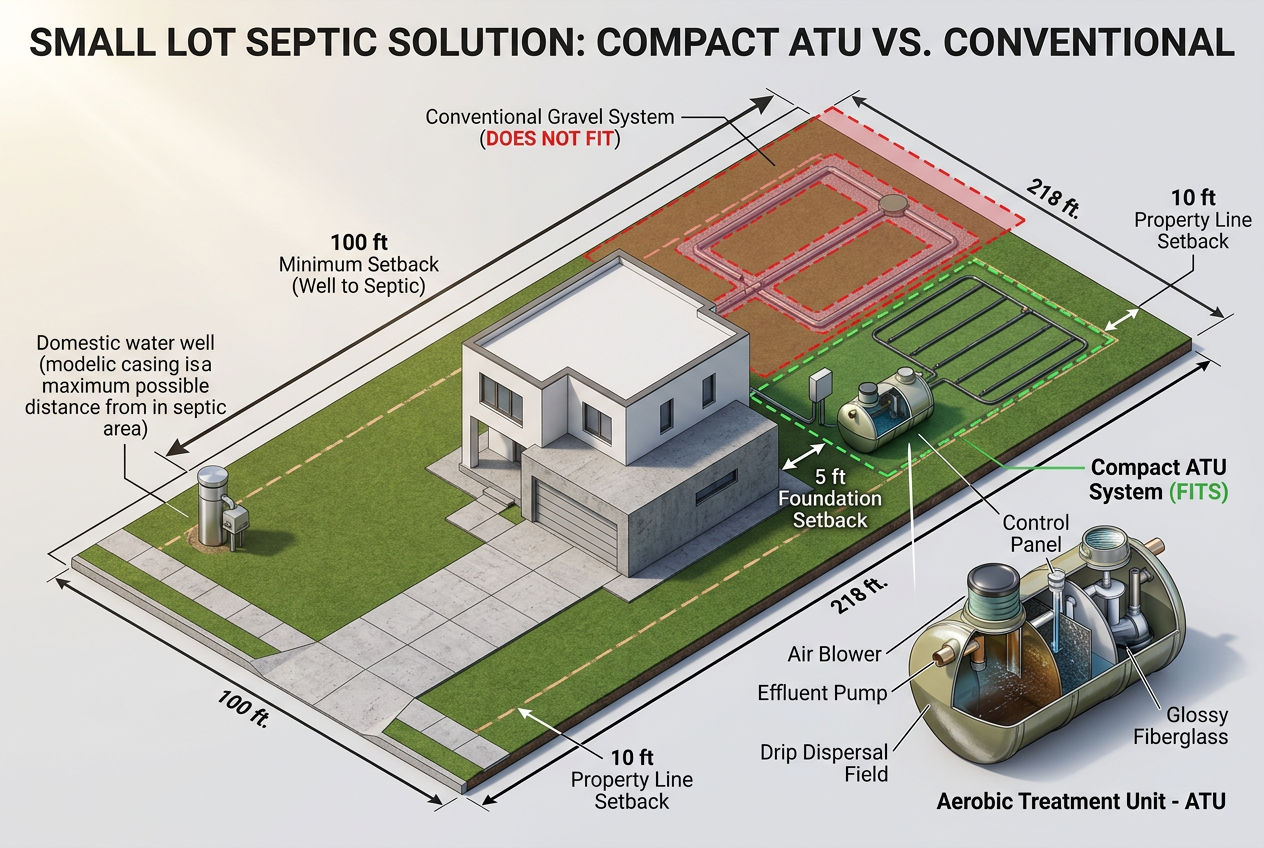
A half-acre lot gives you roughly 21,780 square feet of total space. After subtracting a typical house footprint (1,500–2,000 sq ft), a 100-foot well separation radius, setbacks from property lines, and any surface water buffers, you might realistically have 3,000–6,000 square feet of usable area for a drain field.
That's enough for a conventional system in good soil — but not in clay-heavy or high water table conditions. An ATU or drip dispersal system will give you the footprint reduction needed to make those tighter scenarios work.
✅ Pro Tip: The perc test cost is typically $300–$1,000 and is your first step before any system gets selected or permitted.
What If Your Lot Has Both Poor Soil and Limited Space?
This is where the engineering gets layered. Poor soil alone pushes you toward ATUs, sand filters, or mound systems. Limited space alone might be solvable with chamber systems or drip dispersal. When you have both problems simultaneously, you're usually looking at an ATU combined with drip dispersal — the ATU handles the treatment quality requirement, and the drip system handles the footprint constraint.
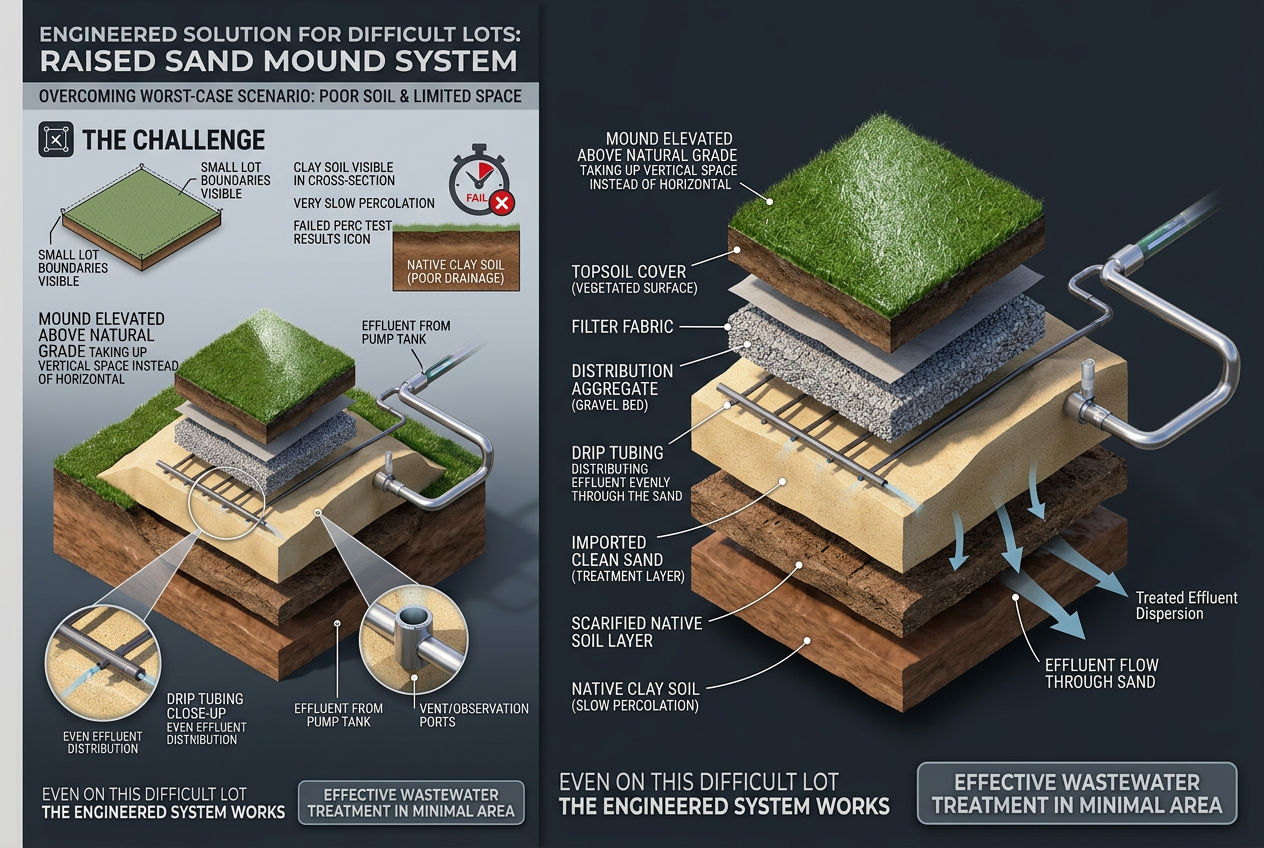
These combination systems are permitted in most states, though the specific design must be approved by a licensed professional engineer and the county health department. Costs for combination systems typically run $15,000–$25,000 or more.
💡 Key Takeaway: If you're buying a lot and suspect this scenario, budget for a full site evaluation — not just a perc test — before you close. A licensed soil scientist or PE can evaluate water table depth, soil profile, and available dispersal area in a single site visit. It's worth every penny of the $500–$1,500 fee when the alternative is buying an unbuildable parcel.
The Permitting Process for Small Lot Septic Systems
Getting a septic permit on a small lot follows the same general process as a standard permit, but with more scrutiny at each step. Here's what the process involves:
Step 1: Site Evaluation A licensed soil scientist or engineer evaluates your lot — soil profile, water table depth, topography, and available dispersal area. This is separate from the perc test and gives the designer the full picture.
Step 2: Percolation Test The perc test is conducted at the proposed drain field location. Some counties require the health department's own inspector to conduct or witness the test. Results drive the system sizing calculation.
Step 3: System Design A licensed professional engineer or OSSF designer produces a stamped design. On small lots, this almost always means an advanced system — the designer has to show that the system fits within all required setbacks and meets the state's effluent treatment standards.
Step 4: Permit Application The design is submitted to the county health department along with application fees, which typically run $200–$500. Review times range from a few days to several weeks depending on the county. See our full septic system permit requirements guide for state-by-state details.
Step 5: Installation and Inspection A licensed installer pulls the installation permit and completes the work. The county inspector performs one or more inspections — typically before backfill — to verify the system was built per the approved design.
✅ Pro Tip: Don't hire a generalist contractor for a small-lot installation. You need someone with specific experience in the advanced system type being installed. ATU installers need manufacturer certification; drip system installers need experience with the pressure distribution controls. Ask for references on similar installs before you sign a contract.
Regional Considerations That Affect Small Lot Septic Options
Rules and soil conditions vary enough by region that what works in Texas may not be permitted in New Jersey — and what's required in Wisconsin may not even be relevant in Arizona. Here's a regional breakdown of the key variables:
Texas
The TCEQ regulates all on-site sewage facilities (OSSFs) statewide, but enforcement and permitting run through Authorized Agents — typically county or city offices. ATUs are common on small lots, and the mandatory maintenance agreement requirement (TCEQ Chapter 285) is enforced at the local level. Many Texas counties allow lots as small as 0.5 acres for ATU systems.
Florida
High water tables are the dominant constraint. The Florida Department of Health regulates septic systems through county health departments, and Hillsborough, Pinellas, and Sarasota counties have some of the most restrictive rules in the state due to water quality concerns. Performance-based treatment systems — which include ATUs and drip dispersal — are often required within certain distances of surface water.
New Jersey
New Jersey has some of the strictest setback requirements in the country. The NJDEP requires a 100-foot separation between a drain field and a potable well in most circumstances. On a small lot, that single requirement can make conventional systems impossible. Engineered alternatives through the NJDEP's Alternative Treatment Technology (ATT) program are the standard path forward.
Related: tiny home septic systems — worth reading if this applies to your situation.
Wisconsin and Minnesota
Mound systems dominate in these states because glacial soils — predominantly silty and clay-heavy — fail conventional perc tests across much of the rural landscape. The Wisconsin DNR's Mound System Approval (SPS 383) and Minnesota's individual sewage treatment system rules both have detailed prescriptive standards for mound design that licensed designers follow directly.
Pacific Northwest (Oregon and Washington)
Both states have active programs for alternative systems. Oregon DEQ's Alternative Treatment
Sources & Methodology
-
U.S. Environmental Protection Agency — Federal guidance on alternative septic system technologies suitable for small lots and challenging site conditions.
-
University of Minnesota Extension — Research on compact septic system designs, including aerobic treatment units and drip dispersal systems for space-constrained properties.
-
National Onsite Wastewater Recycling Association (NOWRA) — Industry standards for septic system design on small lots, including setback reduction strategies and advanced treatment options.
-
National Environmental Services Center (NESC) — Technical guidance on system selection for small lots, including minimum lot size requirements by system type across jurisdictions.
-
Infiltrator Water Technologies — Technical specifications for chamber-based and compact drain field products designed for space-limited installations.
Cost data reflects 2025–2026 national averages compiled from contractor pricing surveys across SepticTankHub.com's directory network.
Need help with your septic system? Find trusted septic professionals near you to get free quotes. See our complete guide to septic installation costs for current pricing. Learn more about septic installation services. Browse local septic companies in Arizona or Washington.
Free download
Not ready for the Blueprint? Start free.
Grab the free DIY Septic Planning Kit — the permit-first checklist, perc-test cheat sheet, and sizing tables that keep your build from getting red-tagged.
Was this article helpful?
Frequently Asked Questions
Recommended Resources
📖 Related Articles
- Engineered Septic System Cost: $12K–$30K+ (2026)
- Septic System Setback Requirements: How Far From the House?
- Perc Test (Percolation Test): What It Is & How It Works
- Aerobic Septic System (ATU) Cost: $10K–$20K Install (2026)
- Mound Septic System: $10K–$25K Cost & How It Works (2026)
- How Much Does a Perc Test Cost? (2026 Pricing)
- Septic System Permit Cost & State Requirements (2026 Guide)
Find Septic Professionals Near You
Compare licensed, verified septic companies by area — top county markets and cities below, or browse all 50 states.
County markets
Popular cities
