
Quick Answer
A perc test costs between $750 and $1,850 on average in 2026, with most homeowners paying $1,000–$1,300. Costs vary based on the number of test holes required, soil conditions, local county regulations, and whether a full engineering report is included in the quote.
💡 Key Takeaways
- Most homeowners pay $1,000–$1,300 for a standard residential perc test in 2026
- Costs range from $250 in low-cost rural areas to $3,500+ in California and the Northeast
- The single biggest variable isn't your state — it's your county health department's requirements
- Roughly 15–25% of sites fail standard perc criteria; failed sites may require an engineered system costing $15,000–$35,000+
- Perc test results typically stay valid for 2–5 years, depending on your state
You're buying land. Or you're selling a rural lot. Maybe you've got a contractor telling you a septic system needs to go in before construction starts. Either way, someone has said the words "perc test" and now you need to figure out how much to budget.
Here's the straightforward version: a percolation test tells you whether your soil can absorb wastewater at a rate that makes a conventional drain field possible. If the soil passes, you're cleared for a standard septic system. If it fails, you're looking at alternative options and significantly more money. The test is non-negotiable in almost every jurisdiction — your county health department or state environmental agency will require it before issuing a septic system permit.
New to perc tests? Our complete guide to how percolation testing works walks through the procedure, passing MPI scores, and what happens if your land fails. This page focuses on the numbers.
Use the cost estimator below to get a ballpark for your situation before calling a pro.

DIY Septic Blueprint
Thinking about building it yourself?
The complete, plain-English plan to size, permit and install your own septic system — designed for homeowners, not contractors. Skip the $15,000–$25,000 quotes and do it right the first time.
Get the DIY Blueprint — $67 →Instant download · 8 modules + 3 bonus guides · 60-day money-back guaranteeWhat Does a Perc Test Cost in 2026?
A standard residential perc test runs $750–$1,850 nationally in 2026. That's the honest middle ground. But the real answer depends on where you live, how many test holes your county requires, what kind of soil sits under your feet, and whether your quote includes backhoe work and an engineering report or just the licensed professional showing up with a clipboard.
Price Ranges Explained
- Low end ($250–$500): Single test hole, simple residential lot, lenient jurisdiction, rural low-cost area — think parts of rural Tennessee or Eastern North Carolina
- Typical range ($800–$1,500): Two to three test holes, standard county requirements, moderate terrain, includes basic soil evaluation
- High end ($2,000–$3,500+): Multiple test holes, engineered report required, difficult terrain, high-cost metro, California or Massachusetts regulations
📊 Quick Fact: The spread is real. A neighbor in rural Missouri might pay $450. Someone buying a forested lot in Marin County, California can hit $3,000 before a single shovel touches the ground.
Perc Test Cost Breakdown: What Are You Actually Paying For?
The quote you get from a soil scientist or geotechnical engineer bundles several distinct tasks. Some contractors itemize them; others give you a single lump sum. Either way, here's what's built into the price:
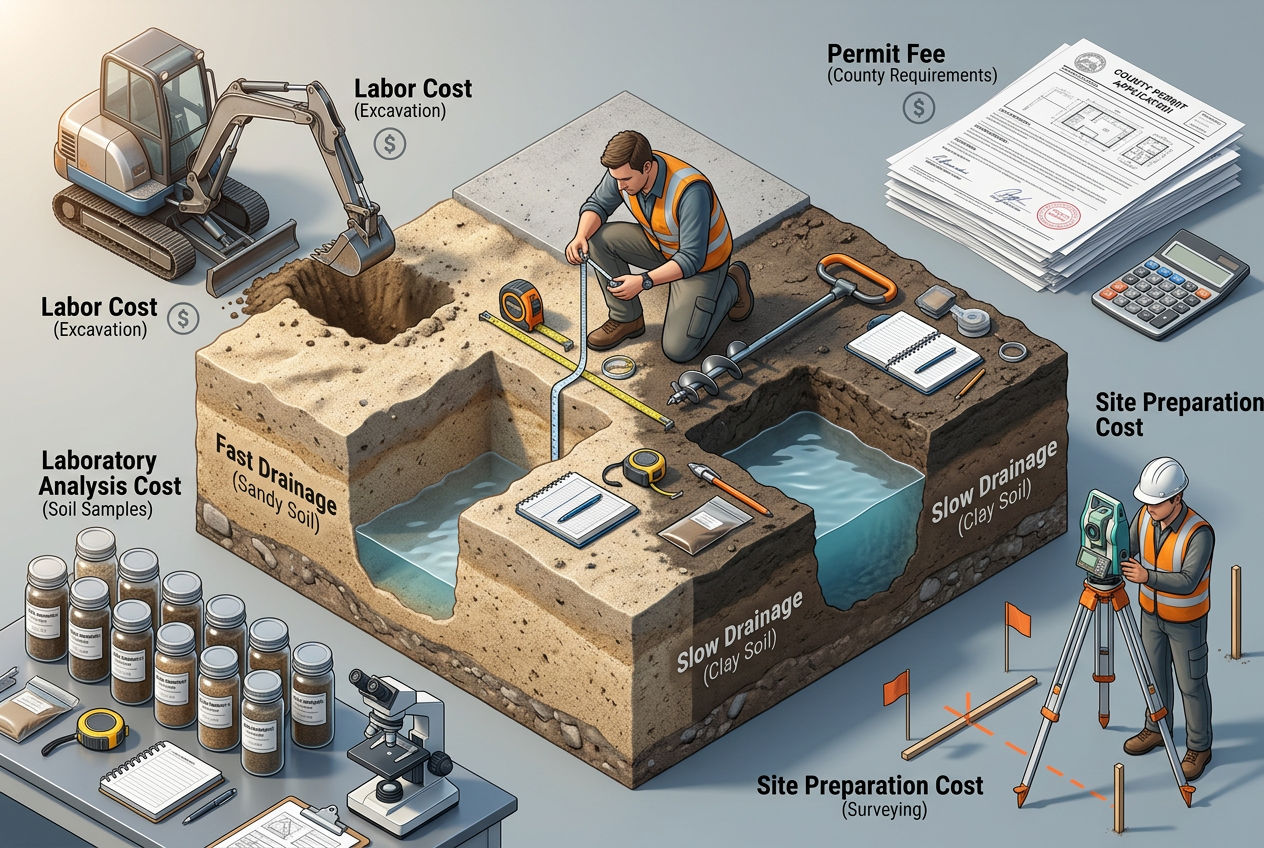
| Cost Component | Typical Range | Notes |
|---|---|---|
| Site evaluation / consultation | $100–$300 | Initial review of property maps, soil data, site conditions |
| Test hole excavation (backhoe) | $200–$600 per hole | 2–3 holes typical for residential; 6+ for commercial |
| Percolation test labor | $300–$800 | Licensed soil scientist or geotechnical engineer |
| Lab soil analysis | $100–$400 | Required in some states; not always necessary |
| Engineering report / design recommendation | $200–$800 | Often bundled; sometimes a separate contract |
| County/health department filing fee | $50–$250 | Paid to the jurisdiction, not the contractor |
| Re-test fee (if inconclusive) | $200–$500 | Applies if soil saturation was off or conditions failed |
Source: 2026 industry data compiled from licensed soil evaluators and county health department fee schedules across 30+ states.
⚠️ Warning: The backhoe work surprises a lot of people. Your county may require test holes dug to 48–60 inches deep. That's not a shovel job. Some contractors own excavation equipment and include it; others subcontract it and pass the cost to you. Ask specifically when you get a quote.
Average Perc Test Cost by State
Even within a single state, costs vary by county. The table below shows representative ranges — what a standard 2-to-3 hole residential perc test typically costs, including basic labor but not necessarily a full engineering report.
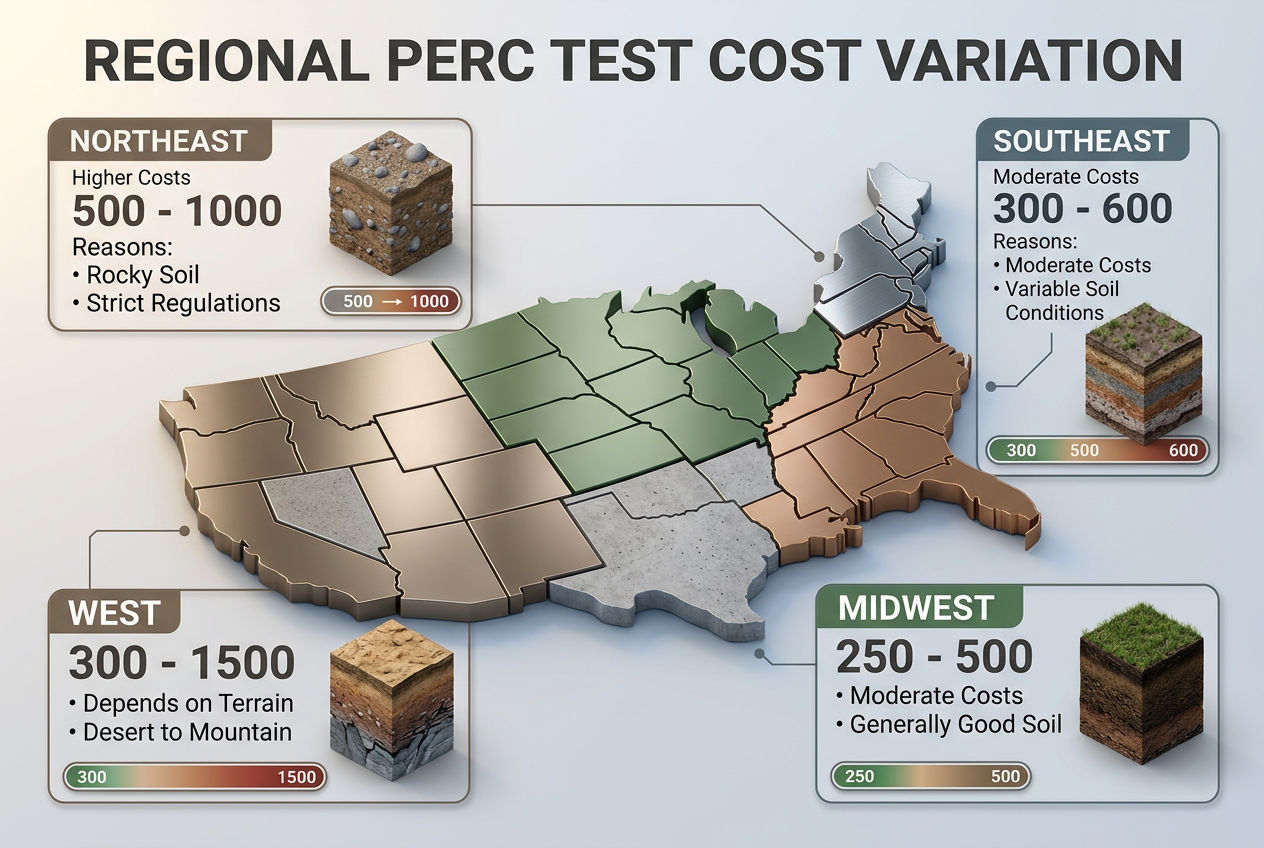
| State | Typical Range | Notes |
|---|---|---|
| California | $1,200–$3,500 | Licensed PE often required; strictest regs nationally |
| Massachusetts | $1,000–$2,500 | Witnessed tests; Title 5 regulations add complexity |
| Washington | $900–$2,000 | Wet soils; seasonal restrictions; strict DOH rules |
| Oregon | $800–$1,800 | Similar to WA; OHA oversight; rural travel costs add up |
| Colorado | $700–$2,000 | Rocky terrain; altitude and access affect pricing |
| Florida | $750–$1,500 | Year-round testing; sandy soil; DOH county oversight |
| Texas | $600–$1,200 | County-level regulation; large rural lots increase travel fees |
| North Carolina | $400–$900 | NCDHHS soil scientists; relatively streamlined process |
| Ohio | $600–$1,400 | Heavy clay common; county health dept. involvement |
| Michigan | $650–$1,500 | Seasonal frost limits; DEQ oversight in some areas |
| Georgia | $500–$1,100 | Piedmont clay can be challenging; EPD regulations |
| Tennessee | $400–$850 | Lower cost of living; county health depts. do many tests |
| Maine | $600–$1,200 | Rocky soil; DEP site evaluators; spring demand spikes |
| New York | $900–$2,200 | Varies hugely; NYC suburbs far more expensive than upstate |
| Arizona | $600–$1,400 | Caliche soil layers; ADEQ oversight; rural access costs |
| Montana | $700–$1,800 | Remote sites dominate; DEQ; short testing season |
| Wisconsin | $650–$1,400 | Frost limits; clay soils; county zoning requirements |
| Virginia | $550–$1,100 | VDH soil evaluators; Piedmont/Blue Ridge add complexity |
| Pennsylvania | $600–$1,400 | DEP oversight; limestone karst areas can be unpredictable |
| Idaho | $600–$1,500 | DEQ; rocky high-desert terrain; growing rural demand |
Ranges reflect residential testing with 2–3 test holes. Costs within each state vary significantly by county. Verify current fees with your local health department.
✅ Pro Tip: For a deeper look at how septic costs vary nationally, see our septic pumping cost by state guide.
What Factors Drive the Perc Test Price Up or Down?
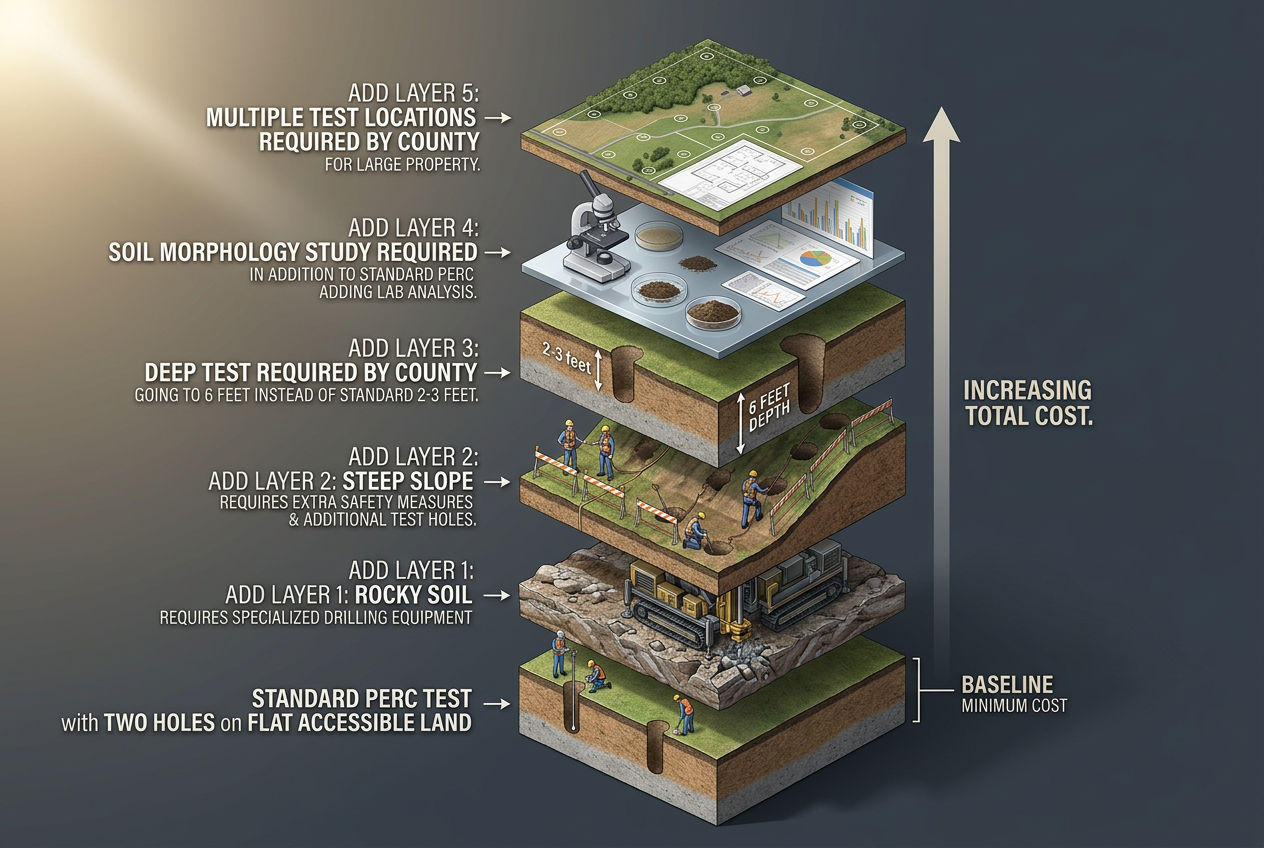
Soil Type
Clay soil is the slowest to drain and the most expensive to test properly. It often requires pre-soaking the test hole for 24 hours before the actual percolation test can begin. That means two site visits, which means more labor. Sandy soil drains fast — sometimes too fast — and the test itself is quicker.
📊 Quick Fact: The ideal percolation rate is 1 minute per inch (1 MPI) to 60 minutes per inch (60 MPI). Clay-heavy soil can push beyond 60 MPI and fail.
If your land sits in any of these challenging soil zones, expect costs to trend higher:
- Georgia's Piedmont region
- Ohio's Lake Erie clay belt
- Red River Valley in the Upper Midwest
Number of Test Holes
Most counties require 2–3 test holes for a standard residential lot. Go to commercial property and that can jump to 6 or more. Each hole needs excavation, preparation, and measurement — so every extra hole adds $200–$600 to your bill.
Terrain and Site Access
A flat, cleared lot in a suburb is easy. A wooded hillside with no road access? That backhoe operator is billing for every tricky turn.
Cost-increasing terrain factors:
- Steep slopes
- Wet ground conditions
- Thick root systems
- Limited equipment access
- Remote locations requiring extra drive time
💡 Key Takeaway: Some rural sites add $150–$300 just for the drive time if no local soil evaluators serve your area.
Whether an Engineering Report Is Required
Some jurisdictions want a simple pass/fail result. Others require a full engineered septic system design report, which documents soil layering, groundwater depth, and a recommended drain field configuration. That report can add $200–$800 to your bill — but it's also what you need to pull permits and break ground.
Seasonal Conditions
Spring is the busiest season for perc testing — land sales peak, building permits flow, and everyone wants tests done before summer construction. Wait times stretch to 2–4 weeks in March through May, and some contractors charge 10–15% more during peak demand.
⚠️ Warning: Winter is the opposite extreme. In Minnesota, Wisconsin, Michigan, and most of the Northeast, frozen ground stops testing completely. The MPCA (Minnesota Pollution Control Agency) and similar agencies in northern states prohibit perc testing when the ground is frozen or snow-covered. If you need a test done in February in Vermont, you're waiting until April.
Summer tests on dry soil sometimes require pre-soaking before the official test window. That's an extra step but rarely a major cost factor.
Who Pays for the Perc Test — Buyer or Seller?
In a real estate transaction, the buyer typically pays for the perc test — and that's the right arrangement. Here's why: you're the one making a purchase decision based on the results. If the land fails, you want to know before you close, not after.
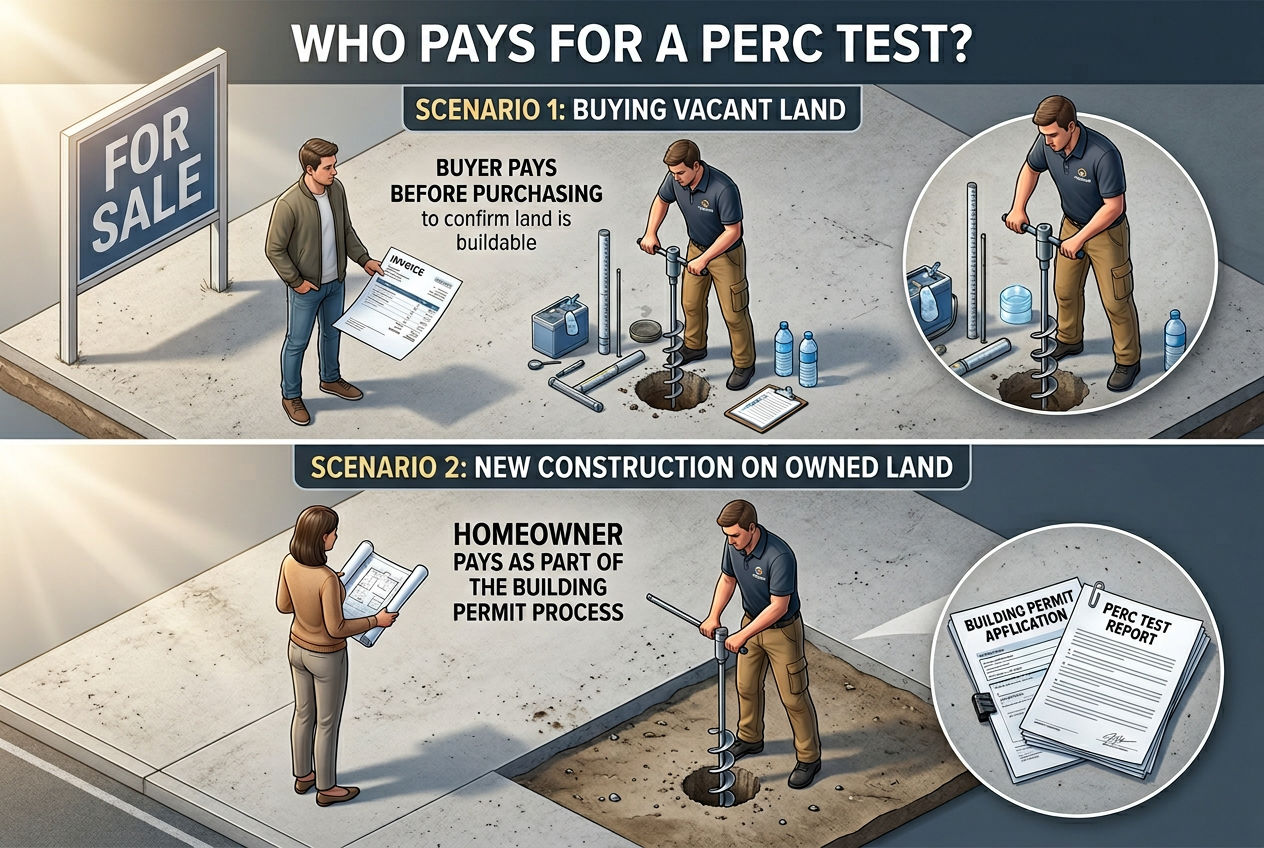
That said, this is negotiable. In a competitive market for rural land, sellers sometimes pay for a perc test proactively to make their listing more attractive. A lot that already has a passing perc test on file is worth more — it removes uncertainty from the deal.
Real-World Scenario
Picture this: You're under contract on 5 acres in rural Virginia. The seller hasn't tested. You add a perc test contingency to your offer, pay $650 for the test, and the results come back marginal at 55 MPI — technically passing, but just barely. That result tells you a conventional septic is possible, but the drain field size will need to be larger than usual, adding cost to your installation. Without that test, you'd have closed blind.
✅ Pro Tip: If you're selling land, get a perc test done before listing. It costs you $800–$1,300 upfront but eliminates the single biggest deal-killer in rural land transactions.
The perc test is one item on a longer due-diligence list. If you're evaluating raw land more broadly — access and easements, utility availability, zoning and soil alongside the septic question — Land Limited's raw-land buyer's guide covers the wider checklist well.
How Long Does a Perc Test Take?
The physical test itself runs 1–3 hours on site. But that's not the full timeline.
Complete Timeline Breakdown
- Scheduling: 1–4 weeks out, depending on season and local demand
- Pre-soaking (if required for clay soil): 24 hours before the test, requiring a separate site visit
- Test results: Available 24–72 hours after the test
- Full engineering report (if required): 1–2 weeks after testing
⚠️ Warning: Plan for 2–4 weeks from "I need a perc test" to having results in hand. During spring in the Northeast or Mountain West, it can stretch longer. Build that timeline into your land purchase contingency period.
Do Perc Tests Expire?
Yes. And the validity period matters more than most buyers realize.
Most states keep perc test results valid for 2–5 years. After that, the jurisdiction considers soil conditions potentially changed and requires a new test before issuing permits.
State-by-State Validity Periods
- North Carolina: 5 years (per NCDHHS soil improvement permit rules)
- Virginia: 18 months for some classifications; up to 5 years for others depending on permit type
- Florida: Generally 4 years through county health departments
- Massachusetts: Title 5 percolation test results have no standard statewide expiration, but local boards of health often set their own limits — commonly 2 years
- California: Varies by county; many require a new test if construction hasn't started within 3 years
Sources & Methodology
-
U.S. Environmental Protection Agency — Federal guidance on soil evaluation requirements for onsite wastewater treatment system permitting.
-
USDA Natural Resources Conservation Service — Soil survey data, percolation rate classifications, and soil morphology evaluation standards used in septic system site assessments.
-
North Carolina Department of Health and Human Services — State-specific perc test and soil morphology evaluation requirements, referenced as an example of alternative testing protocols.
-
Virginia Department of Health — State regulations for soil evaluation and percolation testing prior to septic system permitting, including licensed evaluator requirements.
-
National Environmental Services Center (NESC) — Technical resources on percolation test methodology, soil classification systems, and their relationship to septic system design.
Cost data reflects 2025–2026 national averages compiled from soil evaluation professional fee schedules and county health department records across SepticTankHub.com's directory network.
Need help with your septic system? Find trusted septic professionals near you to get free quotes. See our complete guide to septic pumping costs for current pricing. Learn more about septic inspection services. Browse local septic companies in Georgia or North Carolina.
Free download
Not ready for the Blueprint? Start free.
Grab the free DIY Septic Planning Kit — the permit-first checklist, perc-test cheat sheet, and sizing tables that keep your build from getting red-tagged.
Was this article helpful?
Frequently Asked Questions
Recommended Resources
📖 Related Articles
- What Is a Drain Field? (And How Does It Work?)
- Septic System Permit Cost & State Requirements (2026 Guide)
- Septic Tank Pumping Cost by State: Regional Price Comparison
- Engineered Septic System Cost: $12K–$30K+ (2026)
- How to Install a Septic Drain Field
- Leach Field Size by Bedrooms: Drain Field Sizing Chart (2026)
Find Septic Professionals Near You
Compare licensed, verified septic companies by area — top county markets and cities below, or browse all 50 states.
County markets
Popular cities
