
Quick Answer
Installing a septic drain field is one of the most technical - and regulated - projects on a residential property. The process involves soil science, civil engineering, and local health codes all converging in your backyard. Get it right and the system quietly handles tens of thousands of gallons of wastewater for 20–30 years. Get it wrong and you're looking at a failed system, a hefty fine, and a repair bill that can exceed the original installation cost.
This guide walks you through every phase of the drain field installation process - from soil testing through final inspection. You'll also find honest guidance on what you can realistically do yourself versus what requires a licensed contractor.
💡 Key Takeaways
- A percolation test and county permit are required before any leach field installation begins - in almost every U.S. jurisdiction.
- Standard drain field trenches run 18–36 inches deep, 1–3 feet wide, with 4-inch perforated PVC laid on a 6–12 inch gravel bed.
- Size your field at 150–300 square feet per bedroom, adjusted for your soil's absorption rate.
- Total installation costs range from $2,000–$10,000 for conventional systems; mound and alternative systems can reach $15,000–$20,000+.
- Most states legally require a licensed septic installer - DIY is permitted in some rural counties, but verify before you touch a shovel.
What Is a Drain Field and How Does It Work?
A septic drain field - also called a leach field - is the final treatment stage in a conventional septic system. Liquid effluent flows from your septic tank through a distribution box (D-box), then spreads through perforated pipes buried in gravel-filled trenches. As effluent seeps into the surrounding soil, naturally occurring bacteria break down any remaining organic material and pathogens before the water reaches the water table.
📊 Quick Fact: Understanding this process matters before you plan an installation. The field isn't just a disposal site - it's a living biological treatment system. That's why soil type, depth to groundwater, and proper pipe slope aren't optional details. They determine whether the system works at all.
For a deeper look at how the components fit together, see our guide on what a drain field is and how it works.
Step 1: Start With a Percolation Test (Perc Test)
Before any design work or permits, your soil needs to be tested. A percolation test - universally called a perc test - measures how fast water moves through your soil. The result, expressed in minutes per inch (MPI), determines whether a conventional drain field will work on your property at all.
Understanding Perc Test Results
The ideal perc rate for a conventional leach field installation is 1–60 minutes per inch. Here's what different rates mean:
- Under 1 MPI (very coarse sand/gravel): May allow untreated effluent to pass too quickly to the water table
- 1–60 MPI (ideal range): Supports conventional trench systems
- Above 60 MPI (heavy clay): Absorbs water so slowly that conventional trenches will flood and back up
What a perc test costs: Expect to pay $150–$500, depending on your county and how many test holes are required. Some jurisdictions bundle the perc test with a soil profile evaluation by a licensed soil scientist - that combination can run $400–$800.
Your county health department typically coordinates or approves perc testing. The EPA's SepticSmart resources outline the federal framework, but testing protocols vary by state. Contact your local health department before scheduling anything.
⚠️ Warning: If your soil fails a conventional perc test, you're not necessarily out of options - but you'll be looking at a mound system, a pressure-dosed system, or another alternative. Those systems cost significantly more.
See our breakdown of drain field replacement costs for comparison figures.
Step 2: Get Your Permits and Septic System Design Approved
No legitimate drain field installation starts without permits. Nearly all U.S. counties require a septic permit before excavation, and many require the design to be stamped by a licensed engineer or sanitarian.
What permits typically cost: $200–$1,000 depending on jurisdiction. Some rural counties charge flat fees around $200; others charge based on system size or daily flow rate.
Required Permit Documentation
Your permit application will typically require:
- Perc test results
- A site plan showing setback distances
- A proposed septic field layout with trench dimensions — see our residential drain field layout guide for how these plans are drawn
- Tank size and type
Mandatory Setback Requirements
Setback requirements are non-negotiable. Standard minimums in most jurisdictions:
| Feature | Minimum Distance | Notes |
|---|---|---|
| House foundation | 10 feet | Universal requirement |
| Drinking water well | 50–100 feet | Varies by state; MA requires 150 ft in some cases |
| Property lines | 5–10 feet | Check local code |
| Surface water features | 25 feet | Streams, wetlands, ponds |
✅ Pro Tip: These numbers represent minimums. Your local code may be stricter. Check with your county health department - not a neighbor, not a contractor, and not a forum post.

DIY Septic Blueprint
Thinking about building it yourself?
The complete, plain-English plan to size, permit and install your own septic system — designed for homeowners, not contractors. Skip the $15,000–$25,000 quotes and do it right the first time.
Get the DIY Blueprint — $67 →Instant download · 8 modules + 3 bonus guides · 60-day money-back guaranteeStep 3: Size Your Drain Field Correctly
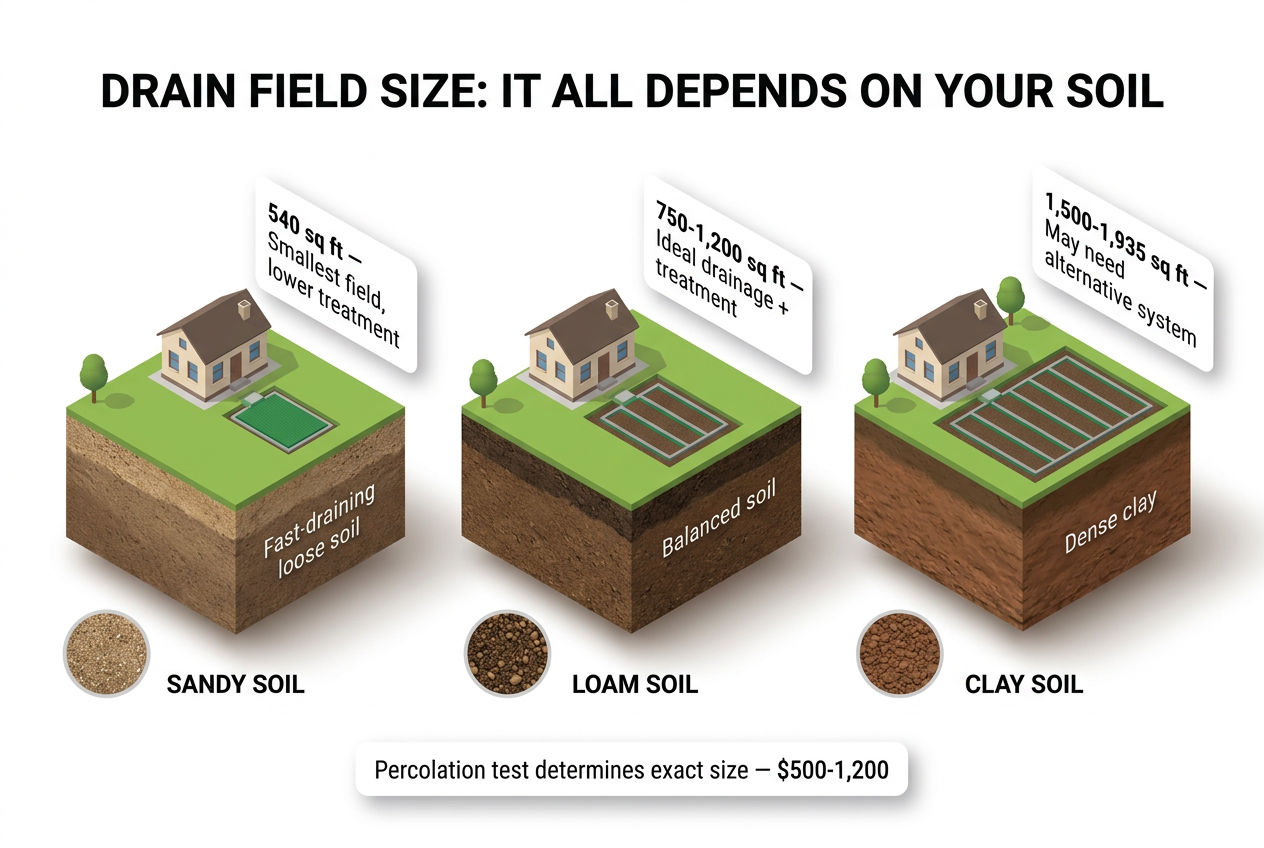
Sizing is where a lot of DIY attempts go sideways. Undersized fields fail early. Oversized fields waste money.
The standard rule of thumb: 150–300 square feet of drain field per bedroom, adjusted by soil absorption rate. A 3-bedroom home with average soil (perc rate around 30 MPI) typically needs 450–600 square feet of trench area.
Real-World Sizing Example
Here's a worked example for a 3-bedroom house:
- Daily wastewater flow: 330–450 gallons (using 110–150 gallons per bedroom per day)
- Perc rate: 45 MPI
- County absorption requirement: 2.5 gallons per square foot per day
- Calculation: 400 gallons ÷ 2.5 gallons/sq ft = 160 square feet minimum
- With 20% safety margin: ~200 square feet
- Field design: Two 50-foot trenches at 2 feet wide = 200 sq ft total
For a detailed sizing walkthrough, our drain field size guide covers absorption rate tables by soil type.
Step 4: Gather Materials
For a conventional trench-style leach field installation, you'll need:
Primary Components
- 4-inch perforated PVC pipe (ASTM D2729 spec)
- Washed drain rock or septic gravel (¾–1½ inch clean crushed stone)
- Geotextile fabric (non-woven polypropylene, 4 oz/sq yd minimum)
- Solid 4-inch PVC for the inlet line and any manifold piping
- Distribution box (D-box) - concrete or high-density polyethylene (HDPE)
- End caps for perforated pipe
- Backfill soil free of large rocks, roots, and debris
📊 Quick Fact: Gravel quantities add up fast. A single 100-foot trench at standard dimensions needs roughly 6–8 tons of gravel. Price that out before you finalize a budget.
Chamber System Alternative
If you're considering a chamber system (Infiltrator Water Technologies makes the most common chambers on the U.S. market), you eliminate the gravel bed entirely. Chamber systems use arch-shaped plastic units that sit directly on the soil. They cost slightly more per unit but reduce installation labor and work well in sandy soils. See our types of septic systems guide for a full conventional vs. chamber comparison, and our dedicated guide to Infiltrator septic chambers for sizing, spacing, and installation specifics.
Step 5: Excavate the Trenches
This is where the project requires either heavy equipment or a very large budget for manual labor. Most installations use a track excavator or a trenching machine. Renting a compact excavator runs $300–$600/day; a walk-behind trencher (suitable for smaller fields on accessible lots) runs $150–$300/day.
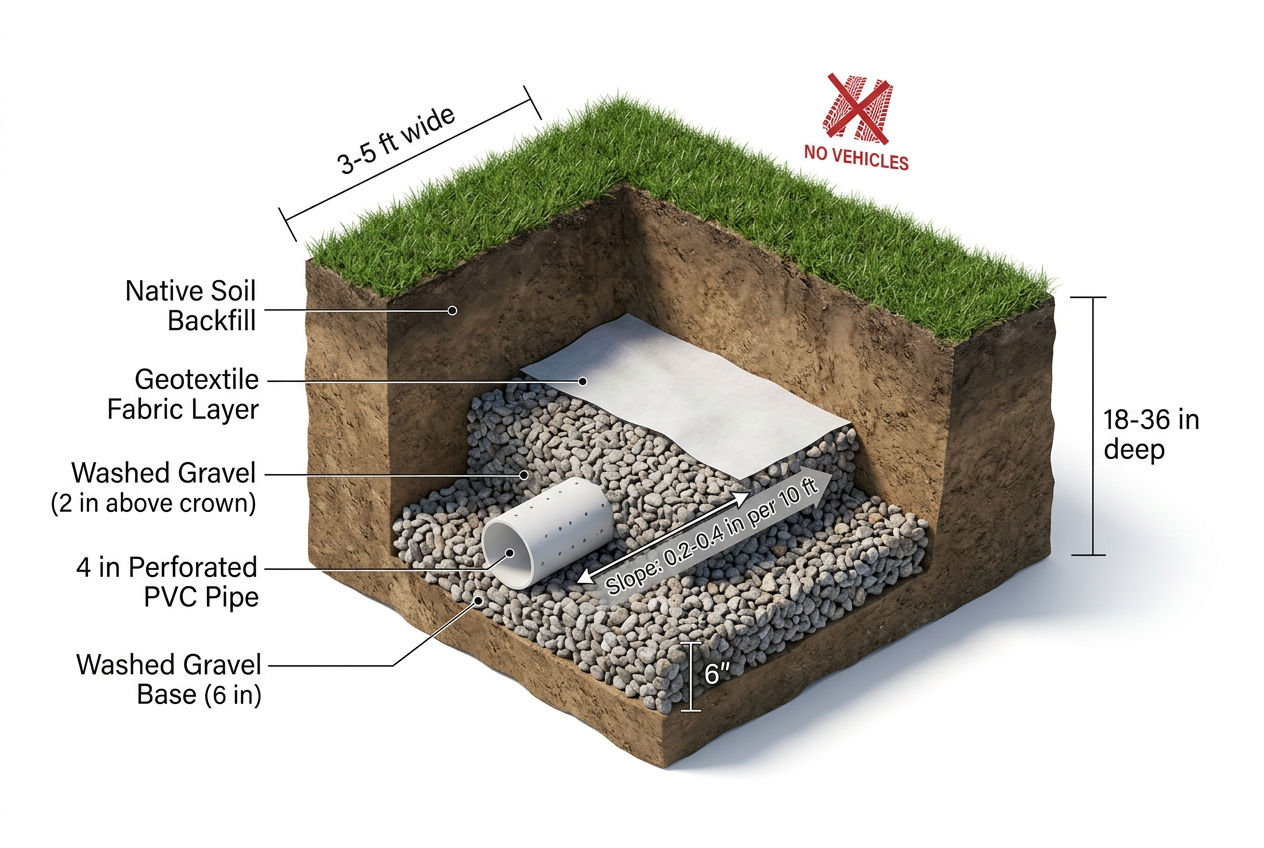
Critical Trench Specifications
| Dimension | Standard Range | Notes |
|---|---|---|
| Depth | 18–36 inches below finished grade | Check your permit - some counties specify minimums |
| Width | 1–3 feet | 24 inches is typical for residential systems |
| Slope | ⅛ to ¼ inch per foot | Ensures even effluent distribution |
| Spacing | 6 feet minimum center-to-center | Prevents absorption zone overlap |
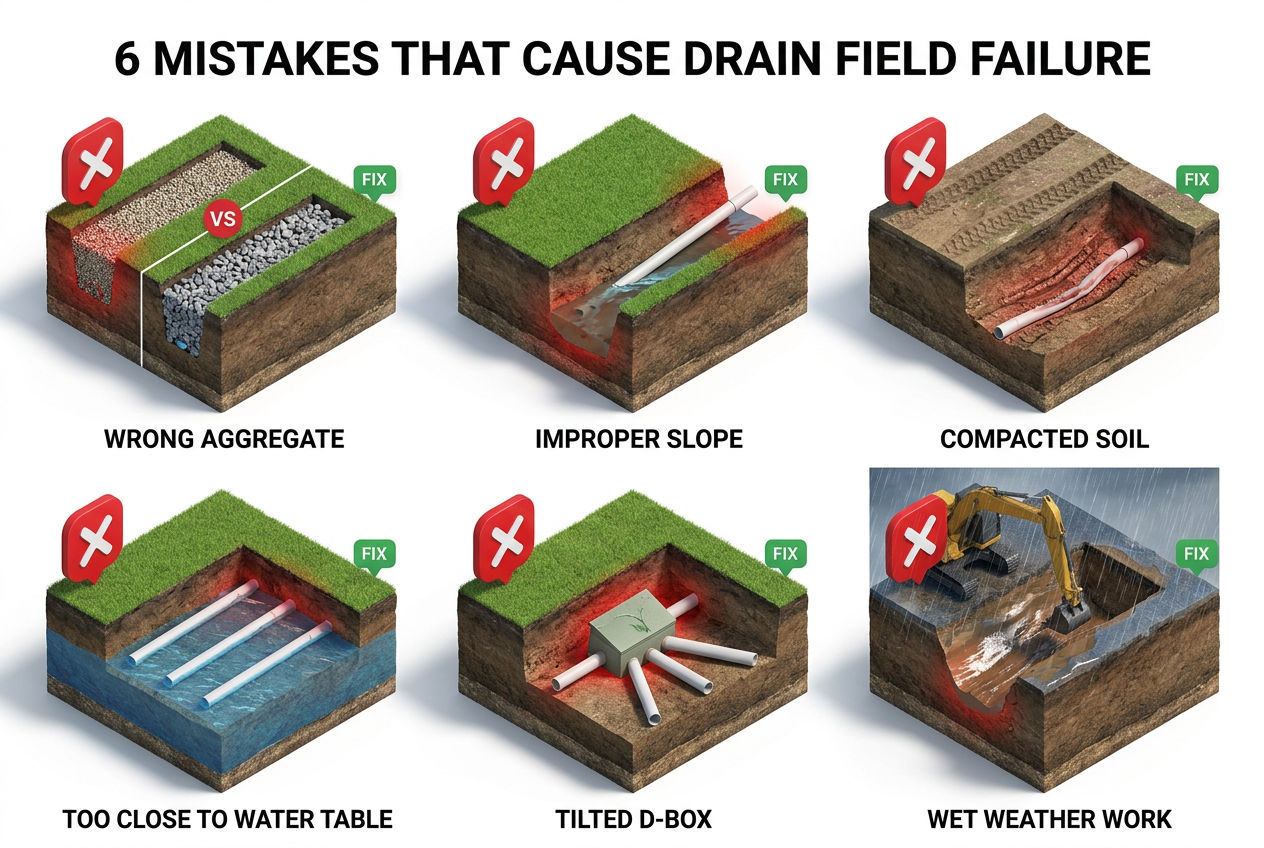
⚠️ Warning: Don't compact the trench bottom. Excavator buckets can smear and seal the soil surface. If your trench bottom looks glazed or compacted, lightly rake it before adding gravel.
For region-specific considerations on drain field depth, particularly in cold climates where frost lines run 36–48 inches deep, review your local frost depth maps before finalizing trench depth.
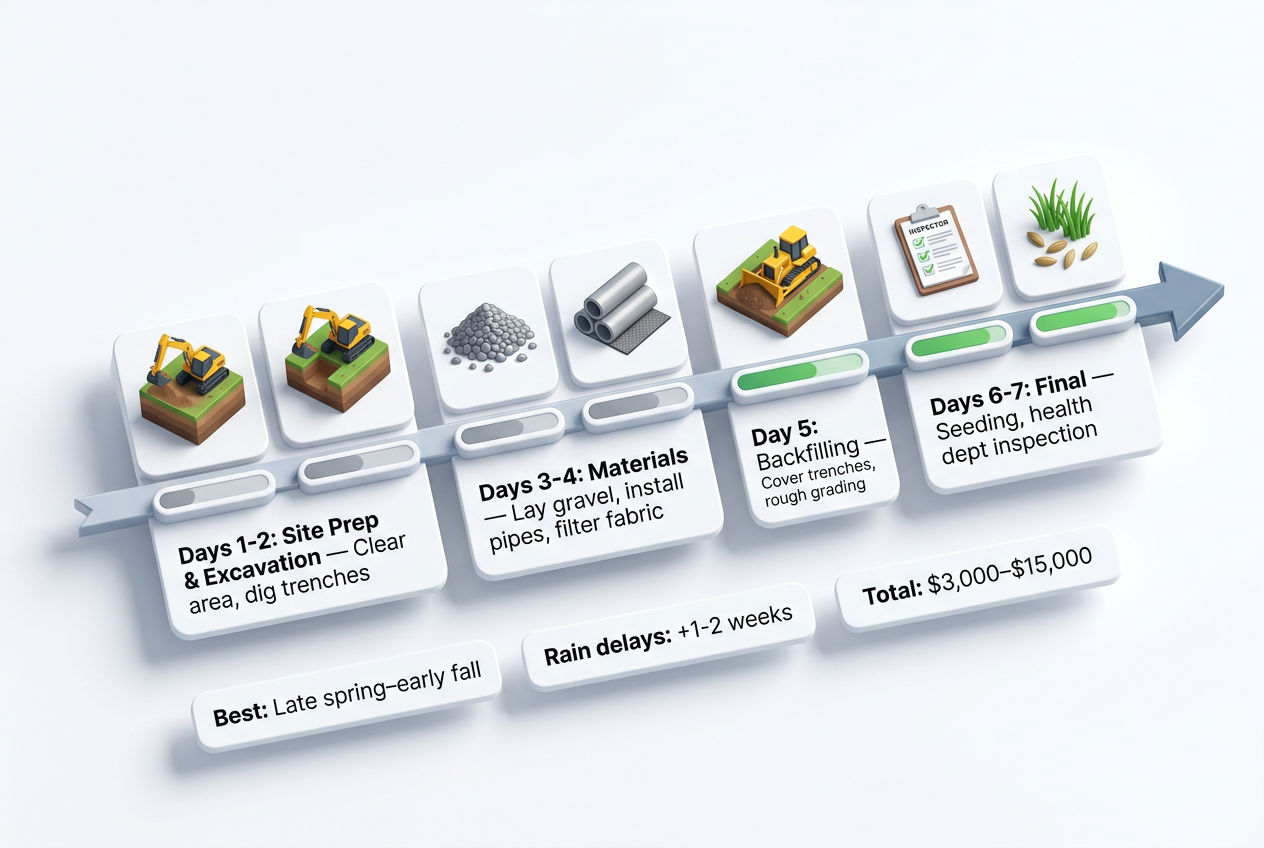
Step 6: Install the Gravel Bed and Perforated Pipe
With trenches open, the installation sequence is straightforward but precision matters.
Step-by-Step Installation Process
-
Add base gravel: Pour 6–12 inches of washed drain rock into the trench bottom. Level it and confirm your slope with a transit level or laser level.
-
Lay perforated pipe: Position 4-inch perforated PVC with the holes facing down. Yes, down - not up. The pipe distributes effluent into the gravel below, which then wicks it laterally into the soil. Secure pipe sections with couplings. Cap the downstream end.
-
Add cover gravel: Add 2 inches of gravel over the top of the pipe.
-
Lay geotextile fabric: Roll non-woven geotextile fabric over the entire gravel surface, overlapping seams by at least 6 inches. This prevents fine soil particles from migrating down and clogging the gravel bed - one of the most common causes of premature drain field failure.
-
Backfill: Cover with native soil to final grade. Mound the soil slightly (3–6 inches above grade) to account for settling.
⚠️ Warning: Never cover the field with impermeable material. No concrete, no asphalt, no compacted gravel driveways over the trench lines.
For more on what you can and can't do above a drain field, see our article on driving over a drain field.
Step 7: Connect the Distribution Box and Tank
The distribution box (D-box) sits between the septic tank outlet and the start of the leach laterals. Its job is to split effluent flow evenly between parallel trenches.
Critical D-Box Installation Requirements
- Level placement is essential - even a ¼-inch tilt will cause one trench to receive most of the flow while others sit dry, dramatically shortening field life
- Use a concrete or HDPE D-box rated for septic service
- Connect solid 4-inch PVC from the tank outlet to the D-box inlet
- Run solid pipe from D-box outlets to the start of each perforated lateral
- All connections should be watertight except where perforated pipe begins
Pre-Backfill Testing
Once connected, run water through the system before backfilling the D-box. Watch for even distribution at all lateral inlets. Adjust the D-box level until flow is balanced.
What Does Drain Field Installation Cost?
Drain field installation typically costs $2,000–$10,000 for a conventional trench system. Here's how that breaks down for a typical 3-bedroom home:
| Cost Item | Low Estimate | High Estimate | Notes |
|---|---|---|---|
| Perc test & soil evaluation | $150 | $800 | Varies by county & complexity |
| Permit fees | $200 | $1,000 | Jurisdiction-dependent |
| Excavation & equipment | $500 | $2,500 | Equipment rental or contractor |
| Materials (pipe, gravel, fabric) | $400 | $1,500 | Per trench footage and system size |
| Labor (licensed installer) | $800 | $4,500 | Most of the cost in contractor bids |
| Total (conventional system) | $2,000 | $10,000 | Regional variation is significant |
Source: NOWRA contractor survey data, EPA SepticSmart, regional contractor quotes. Costs reflect 2025–2026 pricing.
📊 Quick Fact: Alternative systems - mound, pressure-dosed, or aerobic treatment units - run $8,000–$20,000+.
For a full breakdown including replacement scenarios, see our drain field replacement cost guide and septic installation cost guide.
Can You Install a Drain Field Yourself?
Legally, the answer depends entirely on your state and county. Many states - including Florida, California, Massachusetts, and Washington - require a licensed septic contractor for all drain field work. Installing without one isn't just risky; it can result in fines, a mandatory removal order, and difficulty selling your home.
Where DIY May Be Permitted
Some rural counties in Texas, Tennessee, and parts of the Midwest do allow homeowner installation with a permit and inspection. But even where it's legal, DIY drain field installation is genuinely difficult. You need to:
- Rent and operate heavy equipment
- Accurately establish pipe slope across long distances
- Pass a county inspection
⚠️ Warning: One grading error and you're re-digging.
The Realistic Middle Ground
Homeowners can often legally handle site prep, material hauling, and backfilling in permissive jurisdictions. The licensed installer handles excavation, gravel placement, and pipe connection. That arrangement can save $500–$1,500 on labor without running afoul of licensing laws. If you're weighing a complete owner-build — tank, field, and all — our DIY septic system build guide walks through the full permit-to-inspection process.
If your current field is showing signs of failure - wet spots, odors, slow drains - call a professional before attempting repairs. A septic inspection can confirm whether you have a partial failure that's repairable or a full replacement situation.
How Long Will Your New Drain Field Last?
A properly designed and installed conventional drain field lasts 15–30 years. The biggest variable isn't soil type or system design - it's how the connected septic tank is maintained.
What Kills Drain Fields Early
Solid waste (sludge) that escapes the tank and reaches the drain field clogs the gravel bed. Once the biomat layer in the gravel becomes impermeable, the field effectively dies. No additive reverses that process.
📊 Quick Fact: The University of Minnesota Extension confirms that bacterial additives - including name-brand products like Rid-X - do not restore a clogged field or eliminate the need for regular tank pumping.
How to Protect Your Field Investment
- Pump your septic tank every 3–5 years (more frequently with a garbage disposal or large household)
- Divert roof drains and surface water away from the field
- Never flush non-biodegradables, grease, or harsh chemicals
- Follow a complete septic maintenance routine
✅ Regional Note: Drain field requirements vary significantly by state and county. In Florida, high water tables often require mound or drip-dosing systems instead of conventional trenches. In Minnesota, frost depths of 42–60 inches affect trench design and pipe placement. The Pacific Northwest's heavy annual rainfall influences system sizing and may require pressure-dosed distribution. Always confirm requirements with your local health department before purchasing materials or scheduling equipment.
Ready to Move Forward?
Understanding the process is the first step. The next one is finding a qualified installer who knows your county's codes and soil conditions. Find a licensed septic installer near you through the SepticTankHub directory - search by state, city, or service type to compare local contractors. If you need ongoing maintenance after installation, our drain field services page connects you with specialists who handle inspections, repairs, and routine upkeep.
Need drain field help? Find a qualified contractor near you on SepticTankHub.
Related reading: septic system installation process.
Related: DIY leach field layouts
Sources & Methodology
- U.S. Environmental Protection Agency - Septic Systems: Referenced for perc test requirements, setback guidance, and system maintenance recommendations.
- National Onsite Wastewater Recycling Association (NOWRA): Contractor cost data and licensing requirement summaries by state.
- University of Minnesota Extension - Septic System Owner's Guide: Referenced for frost-line depth data, maintenance intervals, and bacterial additive efficacy research.
- National Association of Wastewater Technicians (NAWT): Referenced for inspection standards and system sizing protocols.
- State Health Department regulations: Florida DOH, Massachusetts Title 5 (310 CMR 15), and Minnesota PCA rules referenced for regional variation examples.
About SepticTankHub.com: We connect homeowners with licensed septic professionals across the U.S. Our editorial team includes contractors, environmental engineers, and homeowners with firsthand system experience. Content is reviewed for technical accuracy before publication.
Need help with your septic system? Browse local septic companies in Georgia or North Carolina.
Free download
Not ready for the Blueprint? Start free.
Grab the free DIY Septic Planning Kit — the permit-first checklist, perc-test cheat sheet, and sizing tables that keep your build from getting red-tagged.
Was this article helpful?
Frequently Asked Questions
Recommended Resources
📖 Related Articles
- What Is a Septic System? How It Works (Visual Guide)
- What Is a Drain Field? (And How Does It Work?)
- Leach Field Size by Bedrooms: Drain Field Sizing Chart (2026)
- How Deep Should a Drain Field Be?
- Can You Drive or Build Over a Drain Field?
- Signs Your Drain Field Is Failing (And What to Do)
- How Often Should You Pump Your Septic Tank?
- The Complete Septic Tank Maintenance Guide
💰 Cost Guides
Find Septic Professionals Near You
Compare licensed, verified septic companies by area — top county markets and cities below, or browse all 50 states.
County markets
Popular cities
