
Quick Answer
An infiltrator septic system uses interlocking HDPE chambers buried in soil trenches to disperse treated wastewater — replacing the gravel-filled leach lines used in conventional drain fields. Infiltrator Water Technologies reports their chambers are installed in over 4 million systems nationwide and are accepted in all 50 states.
Key Takeaways
- Infiltrator septic chambers cost $40–$80 per unit retail; a complete installed system runs $5,000–$15,000+ for a 3–5 bedroom home
- The open-bottom HDPE design provides 42% more effluent storage than gravel-filled trenches of the same length
- Installation is typically 30–50% faster than conventional gravel systems — no gravel trucks, no heavy aggregate hauling
- Chambers are rated for 30–40+ years of service life; the overall system lasts 20–30 years with proper maintenance
- A septic permit is required in virtually every jurisdiction before any chamber installation begins
What Is an Infiltrator Septic System?
An infiltrator septic system is a gravelless septic system that uses arch-shaped plastic chambers — instead of crushed stone — to create void space in the drain field trenches. Wastewater flows from your septic tank into the chambers, pools briefly on the chamber floor, then percolates down through the open bottom into the native soil below.
The soil does the real work. Naturally occurring bacteria in the top 18–24 inches of soil treat the effluent through biological and mechanical filtration before it reaches groundwater. The chambers simply create the conditions — air, space, and soil contact — for that process to happen efficiently.
Infiltrator Water Technologies, based in Old Saybrook, Connecticut, is the dominant manufacturer in this space. You've almost certainly heard contractors mention the Infiltrator Quick4 Plus — it's the most widely installed chamber in residential applications across the country. If you want a broader look at how this fits into the overall septic picture, start with our guide on what a drain field is and how it works.
How Do Infiltrator Chambers Actually Work?
Picture a standard septic setup: wastewater leaves your house, settles in the septic tank where solids sink and scum floats, and then clarified liquid effluent flows out to the drain field. In a conventional system, that effluent enters perforated pipes surrounded by crushed gravel in buried trenches. The gravel supports the pipes and creates void space for effluent to spread before soaking into the soil.
Infiltrator chambers replace the gravel entirely. Here's the sequence:
- Effluent exits the septic tank through an outlet baffle or effluent filter, then flows through a septic distribution box that splits flow evenly across multiple trench runs.
- Effluent enters the first chamber at the inlet end cap and flows through the connected chamber run.
- The open-bottom design allows effluent to pool on the soil surface beneath the chamber, maximizing the contact area between liquid and native soil.
- Aerobic and anaerobic bacteria in the soil treat the effluent as it percolates downward.
- A biomat — a thin layer of organic material — naturally forms at the soil interface over time. This biomat actually improves treatment quality by slowing flow and encouraging bacterial activity, though excessive biomat buildup is what eventually limits a drain field's life.
The Quick4 Plus chamber measures 53 inches long × 34 inches wide × 12 inches tall and weighs just 10–11 pounds. Each unit provides 4 linear feet of drain field. Compare that to a gravel trench: you'd need 50 to 100+ tons of crushed stone to fill the equivalent trench length. An installer can unload a full system's worth of chambers by hand in an afternoon. That light weight is also why chambers are the go-to choice if you plan to build a septic system yourself in one of the few counties that allow owner installation.
Infiltrator Chambers vs. Traditional Gravel Drain Fields
This is the question most homeowners are really asking. Here's the honest comparison:
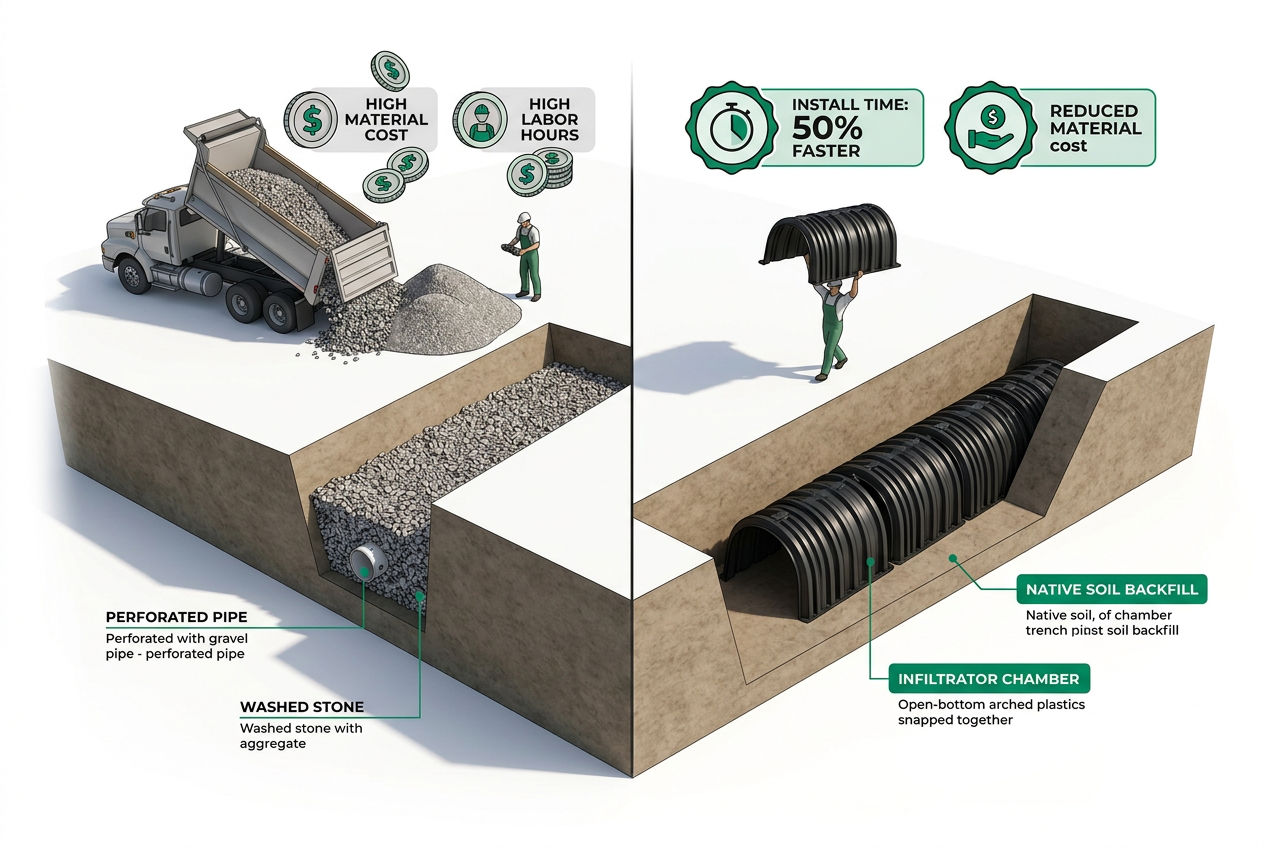
| Feature | Infiltrator Chambers | Conventional Gravel Trench |
|---|---|---|
| Material | HDPE plastic | Crushed stone + perforated pipe |
| Effluent storage volume | ~42% more per linear foot | Baseline |
| Installation speed | 30–50% faster | Slower; multiple material deliveries |
| Weight of materials | ~10–11 lbs/chamber | 50–100+ tons of gravel |
| Material cost | $40–$80/chamber | $1,500–$4,000+ in aggregate |
| Total installed cost | $5,000–$15,000+ | $3,000–$10,000 |
| Expected chamber lifespan | 30–40+ years | N/A (gravel degrades) |
| Overall system lifespan | 20–30 years (with maintenance) | 20–30 years (with maintenance) |
Sources: Infiltrator Water Technologies product specifications; national contractor cost surveys.
The gravel system has a lower sticker price on paper, but that gap narrows fast once you add gravel delivery, trucking fees (especially on rural or hilly properties), and the extra labor hours. In New England and the rural Mountain West, eliminating gravel trucks on narrow dirt roads can save $2,000–$4,000 by itself.
What chambers cannot do: they don't treat wastewater any better than a properly functioning gravel system does. The soil does the treatment — the chamber just gets effluent to the soil more efficiently. If your soil has failed a percolation test or you have a chronic high water table, a chamber system won't solve that underlying problem. You'd be looking at a mound system or another engineered septic system instead.

DIY Septic Blueprint
Thinking about building it yourself?
The complete, plain-English plan to size, permit and install your own septic system — designed for homeowners, not contractors. Skip the $15,000–$25,000 quotes and do it right the first time.
Get the DIY Blueprint — $67 →Instant download · 8 modules + 3 bonus guides · 60-day money-back guaranteeWhat Types of Infiltrator Chambers Are Available?
Infiltrator makes several chamber lines for different applications:
Quick4 Plus (Most Common) — The workhorse of residential installs. The standard unit is 53" L × 34" W × 12" H, H-10 traffic rated, and designed for standard 3-foot-wide trenches. The Quick4 Plus series includes standard chambers, high-capacity units (Quick4 Plus High Capacity at 16" tall), and perforated sidewall versions for certain soil conditions.
Infiltrator ARC Series — The ARC 24 and ARC 36 chambers are wider-footprint options suited for bed-style installations where multiple chamber rows run side by side. The ARC 36 is common in commercial applications or when site constraints demand a compact footprint.
EQ36 and EQ24 — Equalized chambers designed for high-flow or commercial applications requiring greater effluent dispersal per linear foot.
For most 3–4 bedroom homes, the Quick4 Plus is what your installer will spec. The ARC series comes up more often when your lot doesn't have room for long parallel trenches and you need a chamber bed instead.
How Much Does an Infiltrator Septic System Cost?
A complete installed infiltrator septic system for a 3–5 bedroom home typically runs $5,000–$15,000, depending on system size, local labor rates, soil conditions, and permitting fees. Here's how the numbers break down:
Individual chamber cost: $40–$80 per chamber at supply houses. A typical residential system needs 30–80 chambers depending on daily flow requirements and soil absorption rates.
A worked example: Say you have a 4-bedroom home in central Georgia with a design daily flow of 480 gallons per day. Your engineer calculates you need 60 Quick4 Plus chambers. At $60 each retail, that's $3,600 in chamber materials alone — before you add distribution piping, end caps, inspection ports, inlet fittings, and labor.
Total material costs for the chamber system (not including the septic tank itself) often run $2,000–$5,000. Labor adds another $3,000–$8,000+ depending on excavation difficulty, trench length, and local market rates.
For a full picture of what your total project might cost — tank, chambers, distribution box, piping, and labor — see our septic system installation cost guide.
Regional note: In rural Vermont or northern Maine, the math shifts significantly. Eliminating a gravel delivery that might require multiple dump truck trips over unpaved roads can save $3,000–$5,000 in trucking alone. In flat suburban Florida, that advantage shrinks because gravel delivery is cheap and easy. Know your market.
How Are Infiltrator Chambers Installed? (Step-by-Step)
Installing a chamber drain field isn't a weekend DIY project — it requires a licensed contractor and a septic permit in virtually every jurisdiction in the country. That said, understanding the process helps you have an intelligent conversation with your installer and catch any shortcuts.
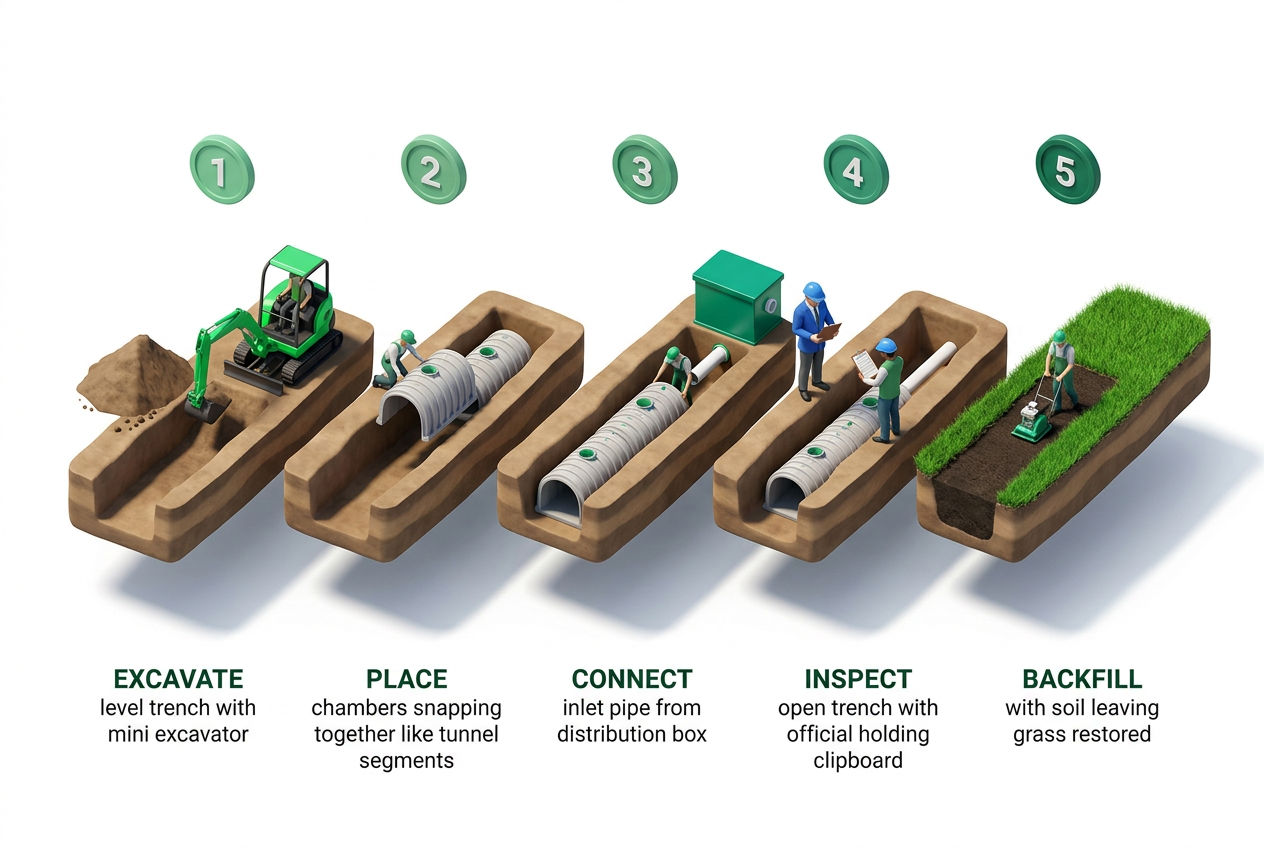
Step 1 — Perc Test and System Design
Before a single chamber is ordered, your soil must pass a percolation test administered by a licensed soil evaluator or engineer. The perc test measures how fast your soil absorbs water, expressed in minutes per inch. This number directly determines how many linear feet of chamber trench you need.
Your designer will also factor in daily flow rate (typically calculated at 75–100 gallons per bedroom per day), setback requirements (usually 10 feet from property lines, 25 feet from the house foundation, 50–100 feet from any well), and local health department rules. Regulations vary dramatically — even county to county within the same state.
Step 2 — Permitting
Your contractor submits a system design to the local health department for approval. Expect 1–4 weeks for permit processing depending on your jurisdiction. No permit, no legal installation — period. A system installed without permits creates serious problems when you sell the property. See our full rundown on septic system permit requirements.
Step 3 — Site Preparation and Excavation
A tracked excavator digs the drain field trenches to the specified depth. Standard trench width for Quick4 Plus is 3 feet. Minimum soil cover above the chambers is typically 6–12 inches depending on local code and whether the area sees any vehicle traffic.
If the trench bottom is soft or unstable, the installer may need to add 6 inches of clean washed stone as a base. Many installations go directly onto native undisturbed soil — one of the benefits of the open-bottom chamber design.
Step 4 — Chamber Placement and Connection
Workers (this is where those 10-pound chambers earn their reputation) snap the chambers together end-to-end to form each trench run. Chamber end caps seal both ends of each run, with an inlet fitting at the head end connecting to the distribution piping.
Inspection ports — recommended at both ends of each run — allow future access to check for effluent depth, which is a key diagnostic tool if the system shows signs of stress. For bed-style installations, chambers run side by side with a minimum 12-inch separation between sidewalls.
Step 5 — Backfill and Final Grade
The trench is backfilled with native soil in lifts, compacting carefully to avoid collapsing the chamber arches. The inspector from the health department typically needs to observe the system before backfill — confirm this timing with your contractor so the inspection isn't missed.
Final grade should direct surface water away from the drain field. Soggy drain fields fail faster. For more on the full installation process, see our drain field installation guide.
How Many Infiltrator Chambers Do You Need?
System sizing depends on three variables: your home's daily wastewater flow, your soil's absorption rate from the perc test, and your local health department's sizing tables.
As a rough rule of thumb:
- 2-bedroom home: ~30–40 chambers (for a typical perc rate of 30–60 min/inch)
- 3-bedroom home: ~45–55 chambers
- 4-bedroom home: ~55–70 chambers
- 5-bedroom home: ~70–90 chambers
These numbers shift significantly based on soil conditions. Sandy, fast-draining soil (perc rate under 10 min/inch) requires more chambers to slow effluent dispersal and prevent groundwater contamination — counterintuitive but true. Clay-heavy soil may not support a standard chamber system at all and may push you toward an alternative design.
Our drain field size guide walks through the sizing math in more detail.
How Long Do Infiltrator Chambers Last?
The chambers themselves — virgin or recycled HDPE — are rated for 30–40+ years of service life. HDPE is highly resistant to chemical degradation, biological attack, and soil movement. You're not likely to replace chambers due to material failure.
The limiting factor is the soil, not the plastic. Biomat formation at the soil-chamber interface is a natural part of how these systems work, but over 20–30 years, the biomat can become dense enough to restrict effluent absorption. When that happens, the system backs up — not because the chambers failed, but because the surrounding soil is saturated or biologically clogged.
Proper maintenance extends that timeline significantly. The single most important thing you can do is keep your septic tank pumped on schedule. When solids escape the tank and enter the drain field, they accelerate biomat formation and dramatically shorten system life. For a 1,000-gallon tank serving a 4-person household, that means pumping every 3–4 years. Add a garbage disposal and drop that to every 2 years.
Learn more about what affects drain field longevity in our guide on how long drain fields last.
Do Infiltrator Chambers Clog?
Chambers themselves don't clog in the traditional sense — there's no gravel pore space to fill with fine particles. But the soil beneath them absolutely can become saturated or biologically clogged over time.
The most common culprit is a septic tank that's overdue for pumping. Solids escape the tank, flow into the chambers, and deposit directly on the soil surface where they accelerate biomat buildup. A system that should last 25 years can fail in 10 if the tank is never pumped.
Household habits matter too. Flushing non-biodegradables, heavy use of antibacterial soaps, and excessive water use (think five loads of laundry in one day) all stress the drain field. What you flush matters more than most homeowners realize.
If you're already seeing slow drains, sewage smells, or wet spots over the drain field, check out our drain field troubleshooting guide before assuming the worst.
Where to Buy Infiltrator Chambers
Infiltrator chambers aren't typically sold at big-box home improvement stores. You'll find them at:
- Plumbing and septic supply houses — the primary distribution channel for contractors
- Agricultural supply stores in rural areas
- Online distributors — pricing runs $40–$80 per Quick4 Plus chamber plus shipping
Searching "septic chambers for sale" plus your state will turn up regional distributors. That said, buying chambers retail and hiring separate labor is rarely the most cost-effective approach. Most licensed installers buy materials wholesale and include them in a complete project bid.
The smarter move: get 2–3 quotes from licensed local installers who work with Infiltrator products regularly. They know local code requirements, have distributor relationships for better material pricing, and carry the liability insurance you need for permitted work.
Find vetted septic installers in your area through our directory to get local quotes on a chamber system.
Maintaining Your Infiltrator Chamber System
Chamber systems need the same maintenance as any septic drain field — because the maintenance is really about the tank and the soil, not the plastic.
Pump your septic tank on schedule. This is non-negotiable. The EPA recommends pumping every 3–5 years for most households; your actual interval depends on tank size and occupancy. Schedule professional septic pumping before the tank fills past 30% solids.
Protect the drain field surface. No vehicles over the chamber area — ever, unless your system was specifically designed with H-20 traffic-rated components. Standard Quick4 Plus chambers are H-10 rated, meaning light vehicles only with adequate soil cover. See our guide on driving over a drain field for the full picture.
Watch for early warning signs. Slow drains, gurgling pipes, sewage odors, and unusually green or soggy patches of grass over the drain field are all red flags. Catching problems early — before the soil is fully saturated — can mean the difference between a repair and a full replacement. Learn the signs of a failing drain field so you're not caught off guard.
If your drain field does develop issues, drain field repair costs vary significantly by problem type and region.
Sources & Methodology
- Infiltrator Water Technologies — Product specifications, dimensions, load ratings, and performance data for the Quick4 Plus and ARC chamber series sourced from manufacturer published documentation. Referenced for product-specific data only; not a paid endorsement.
- U.S. Environmental Protection Agency (EPA) Septic Systems — Maintenance intervals, groundwater protection standards, and system design principles. Available at epa.gov/septic.
- National Onsite Wastewater Recycling Association (NOWRA) — Industry cost benchmarks and installation best practices. Available at nowra.org.
- National Association of Wastewater Technicians (NAWT) — Pumping frequency guidelines and system maintenance standards. Available at nawt.org.
- Regional contractor surveys and supply house pricing — Cost ranges validated against contractor bids and supply house retail pricing across multiple U.S. regions (2024–2026 data).
Free download
Not ready for the Blueprint? Start free.
Grab the free DIY Septic Planning Kit — the permit-first checklist, perc-test cheat sheet, and sizing tables that keep your build from getting red-tagged.
Was this article helpful?
Frequently Asked Questions
Recommended Resources
📖 Related Articles
- What Is a Drain Field? (And How Does It Work?)
- What Is a Distribution Box in a Septic System?
- Perc Test (Percolation Test): What It Is & How It Works
- Mound Septic System: $10K–$25K Cost & How It Works (2026)
- Engineered Septic System Cost: $12K–$30K+ (2026)
- Septic System Permit Cost & State Requirements (2026 Guide)
- How to Install a Septic Drain Field
- Leach Field Size by Bedrooms: Drain Field Sizing Chart (2026)
- How Long Do Drain Fields Last? Lifespan Guide
- What Can You Flush with a Septic System? (Tampons, Wipes & More)
- Can You Drive or Build Over a Drain Field?
- Signs Your Drain Field Is Failing (And What to Do)
💰 Cost Guides
🔧 Services
Find Septic Professionals Near You
Compare licensed, verified septic companies by area — top county markets and cities below, or browse all 50 states.
County markets
Popular cities
