
Quick Answer
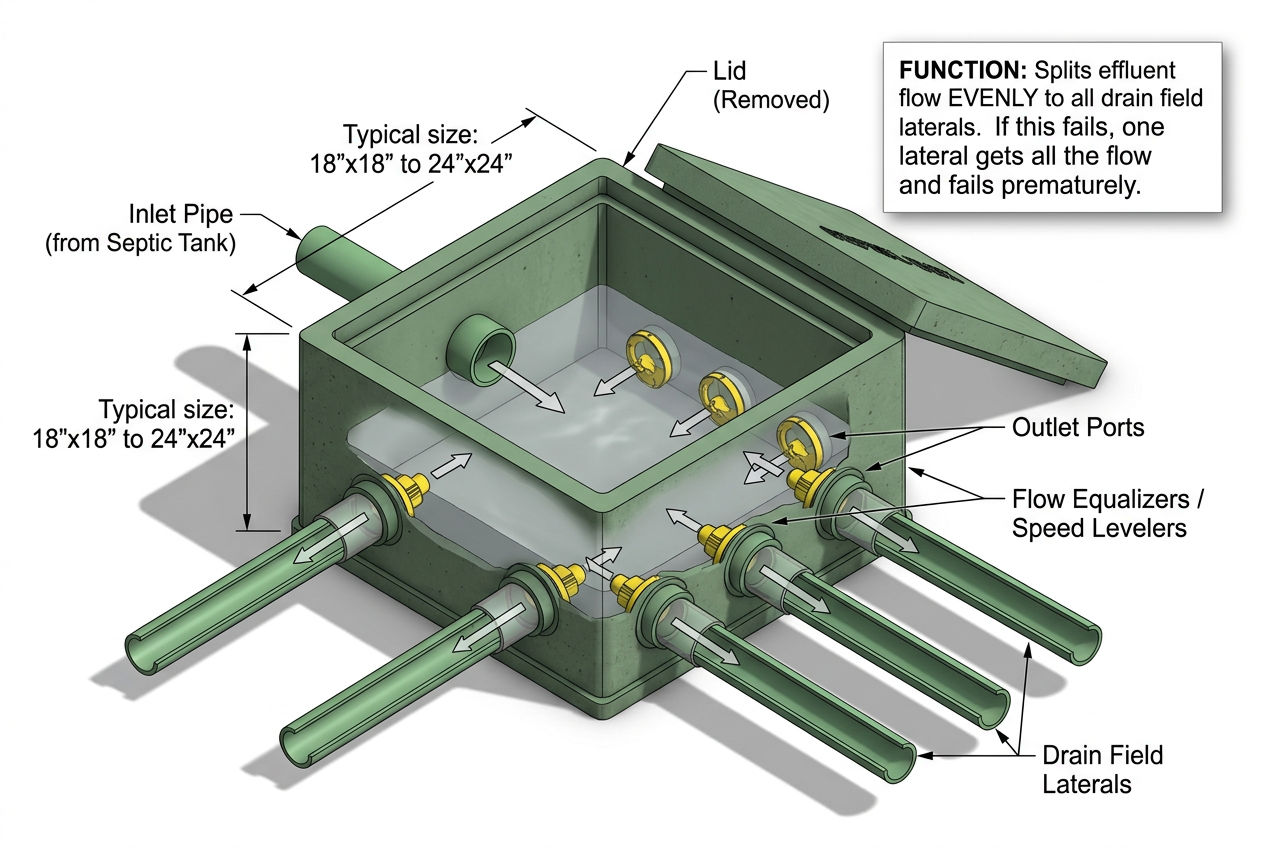
A distribution box is a small concrete or plastic junction box installed between your septic tank and drain field that splits outgoing wastewater evenly across multiple leach lines. It is a passive, gravity-fed component with no moving parts - but when it fails, your entire drain field can fail with it.
Key Takeaways
- A d-box (distribution box) evenly divides septic effluent among 2–9 drain field laterals
- Most conventional gravity-fed systems use one; pressure distribution and drip systems do not
- Concrete d-boxes last 20–30 years; plastic (polyethylene) models can last 30–50 years
- Signs of failure include soggy yard patches, sewage odors, and slow drains throughout the house
- Replacement typically costs $500–$2,000 installed, depending on material, depth, and labor rates
How Does a Distribution Box Work?
A d-box receives partially treated wastewater - called effluent - from the septic tank through a single inlet pipe. That effluent then flows out through multiple outlet holes, each connected to a separate drain field lateral (leach line). The goal is equal flow distribution: every lateral gets the same volume of wastewater so the drain field wears evenly.
Picture it like a traffic roundabout. One road feeds in, multiple roads feed out, and the design keeps everything moving without gridlock. If one exit gets all the traffic, it breaks down. Same principle applies underground.
💡 Key Takeaway: The box works entirely on gravity. Effluent pools inside the d-box until it reaches outlet level, then spills equally into each pipe. No pumps, no electronics, no filters - simple and effective, as long as the box stays level and the outlets stay clear.
The numbers tell the story: The EPA estimates roughly 21 million U.S. households rely on septic systems. The majority of those are conventional gravity-fed systems, which represent approximately 75–80% of all residential septic installations nationwide. Nearly every one of them has a d-box. If your home uses a conventional septic system, there's a strong chance one is buried in your yard right now.

DIY Septic Blueprint
Thinking about building it yourself?
The complete, plain-English plan to size, permit and install your own septic system — designed for homeowners, not contractors. Skip the $15,000–$25,000 quotes and do it right the first time.
Get the DIY Blueprint — $67 →Instant download · 8 modules + 3 bonus guides · 60-day money-back guarantee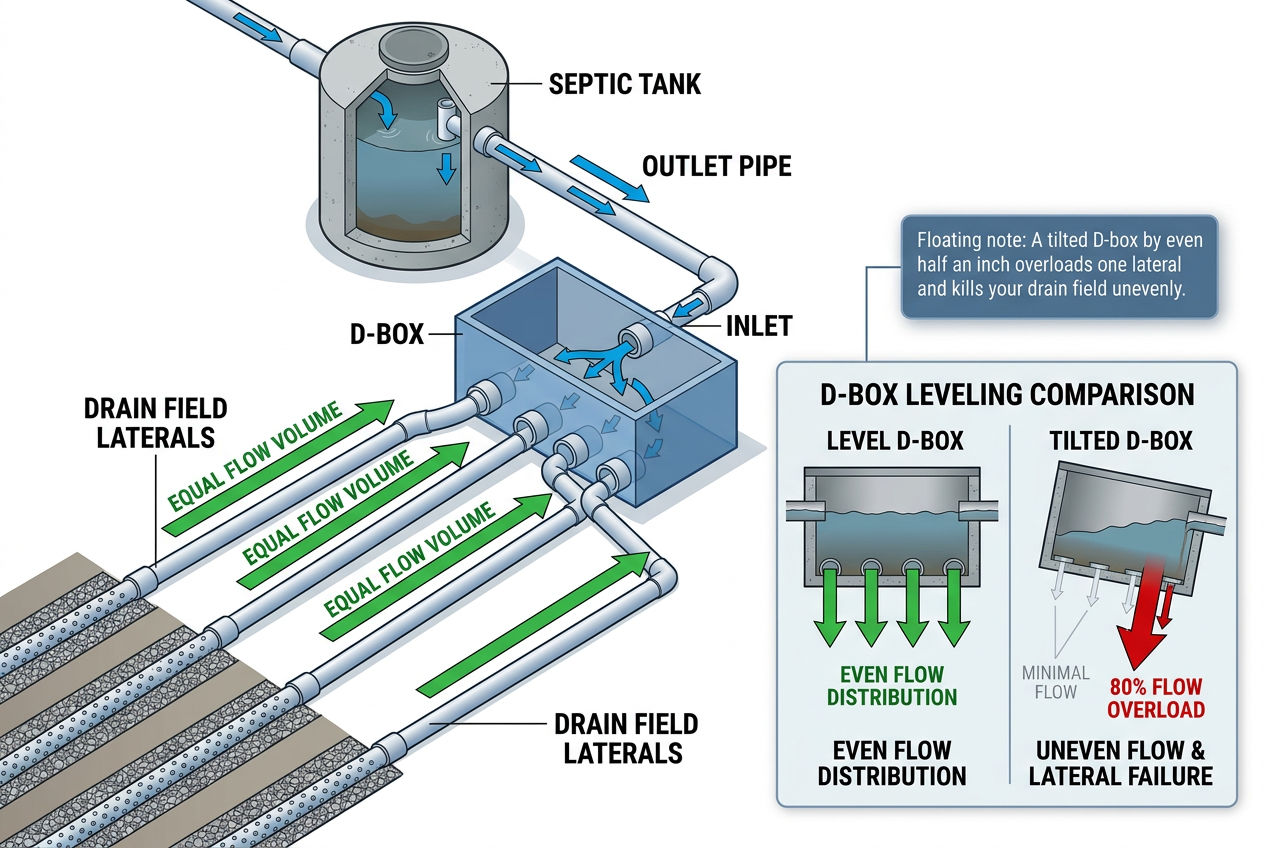
Where Is the Distribution Box Located?
The d-box is typically buried 6–24 inches below the soil surface, positioned 5–15 feet from the septic tank outlet, directly in the path between the tank and the drain field. It sits close enough to the tank to receive effluent by gravity flow, but far enough to allow the outlet pipes to fan out toward individual leach laterals.
How to Locate Your Distribution Box
Finding yours isn't always obvious from the surface. A few practical methods:
- Check your as-built drawing. Most counties require one on file. Call your local health department and ask for the permit records for your property.
- Follow the tank outlet pipe. If you know where your tank lid is, probe the soil 5–15 feet downhill (effluent flows by gravity) in the direction of your drain field.
- Look for a subtle depression or green patch. A leaking or settling d-box sometimes causes a slightly sunken area or an unusually green strip of grass above it.
✅ Pro Tip: A licensed inspector with a probe rod or electronic locator can find it in minutes. If you're scheduling a septic inspection before buying or selling a home, ask the inspector to locate and open the d-box specifically - not all inspectors do this by default.
Concrete vs. Plastic Distribution Boxes: Which Is Better?
Homeowners and contractors debate this one regularly. Here's the honest breakdown:
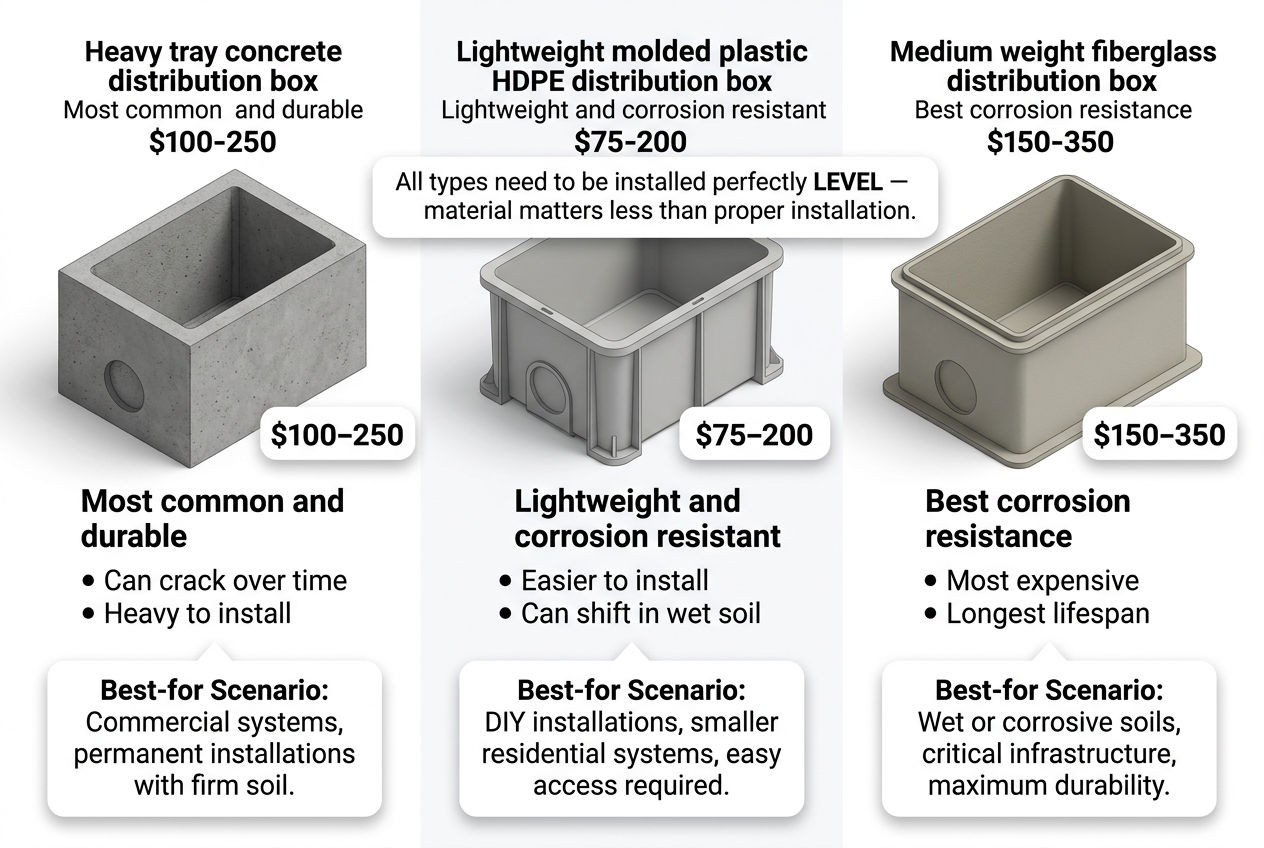
| Feature | Concrete D-Box | Plastic (Poly) D-Box |
|---|---|---|
| Typical lifespan | 20–30+ years | 30–50+ years |
| Cost (parts only) | $100–$250 | $80–$200 |
| Frost heave resistance | Low - can crack | High - flexes with soil |
| Corrosion resistance | Moderate - degrades with H₂S | High |
| Weight / ease of install | Heavy (50–100 lbs) | Light (5–15 lbs) |
| Regional prevalence | Northeast, Midwest | Southeast, Pacific Northwest |
Sources: Infiltrator Water Technologies product specifications; National Onsite Wastewater Recycling Association (NOWRA) component guidance; contractor cost surveys.
Concrete Distribution Boxes
Concrete boxes dominated for decades. They're heavy and stable, which helps in flat terrain. But concrete reacts with hydrogen sulfide gas - a natural byproduct of anaerobic decomposition in septic tanks - and slowly degrades from the inside out.
⚠️ Warning: In cold climates, frost heave can crack concrete boxes open entirely. If your home is more than 20 years old and in New England or the upper Midwest, there's a real chance your concrete d-box is showing its age.
Plastic (Polyethylene) Distribution Boxes
Plastic boxes - typically high-density polyethylene (HDPE) - are lighter, easier to install, and resist both chemical corrosion and frost movement. Infiltrator Water Technologies makes a widely used poly d-box that sits at around $80–$150 retail.
The downside? They're more buoyant. In areas with high water tables (think coastal Florida or the Gulf Coast), an improperly installed plastic d-box can actually float upward if the backfill soil becomes saturated.
Does Every Septic System Have a Distribution Box?
No - and this surprises a lot of homeowners. The d-box is specific to gravity-fed conventional systems. Other system types distribute effluent differently:
- Pressure distribution systems use a pump chamber and perforated laterals under pressure to dose effluent evenly without a central d-box
- Drip irrigation systems (common in arid regions like the Southwest) use a network of small-diameter tubing and electronic controls
- Mound systems typically use a pump and a manifold rather than a gravity d-box
- Chamber systems (like Infiltrator chambers) may use a simple end-cap manifold instead of a traditional box
📊 Quick Fact: If your property is in Arizona, Nevada, or parts of California where water-conserving alternative systems are more common, you may have a system that bypasses the traditional d-box entirely. Check with your installer's as-built drawing or your types of septic systems documentation to confirm.
What Are the Signs of a Failing Distribution Box?
A d-box problem rarely announces itself politely. Here's what to watch for:
Primary Warning Signs
1. Uneven wet patches in the drain field
If one section of your yard is soggy and another is bone dry, effluent isn't distributing evenly. One lateral is getting overloaded while others sit idle.
2. Sewage odors near the drain field or the d-box location
Hydrogen sulfide smells (rotten egg) rising from the ground above the d-box typically mean effluent is surfacing - either through a cracked box or flooded laterals.
3. Slow drains throughout the house
One slow drain usually means a clog in that drain line. Slow drains in every fixture simultaneously often point to a system-level backup - the d-box may be blocked or underwater.
4. Gurgling sounds from toilets and drains
This is backpressure from a system that can't move effluent forward.
5. Sewage backup inside the home
This is the end-stage warning. If effluent is coming up through floor drains or toilets, the system is backed up from the house to the d-box - or beyond.
⚠️ Warning: Spring is the highest-risk season. Snow melt and heavy rain saturate soil, raise groundwater levels, and can flood a d-box entirely. A flooded d-box can't distribute effluent - it just fills up, and wastewater backs up toward the house. If you notice symptoms in March or April, don't wait.
If you're seeing any of these signs, review our guide on signs your septic system is failing for a full diagnostic checklist, and get a professional out quickly.
What Happens When a Septic Distribution Box Fails?
A failing d-box typically plays out in one of three ways:
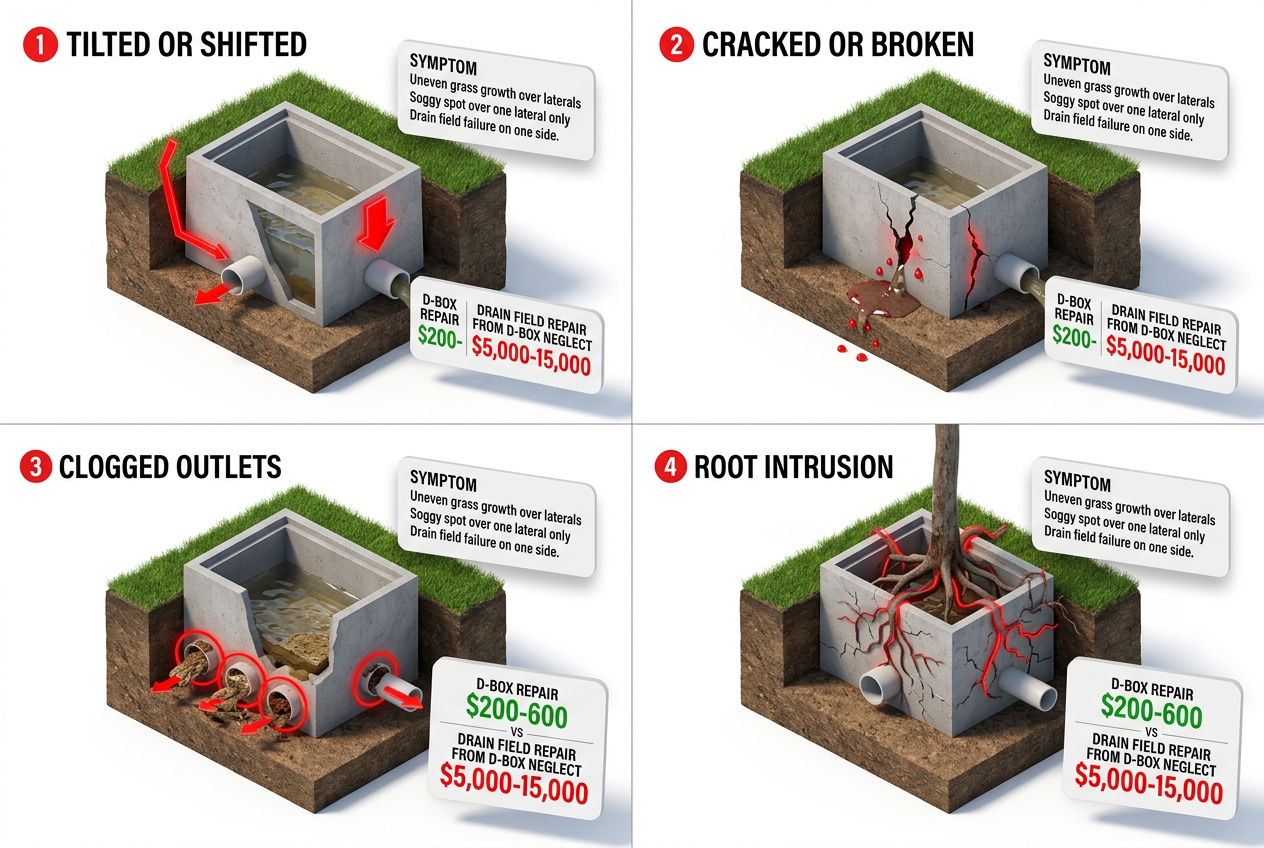
1. Clogging
Sludge or debris migrates from the septic tank (often after a tank that's overdue for pumping) and blocks one or more outlet holes. When that happens:
- Some laterals get no effluent at all
- One lateral gets everything
- The overloaded lateral floods and fails
- The rest of the drain field stays healthy - but you still get a failing system because one section is overwhelmed
2. Shifting or Settling
If the d-box settles unevenly in the soil - which happens frequently after frost heave, root intrusion, or soil erosion - the outlet pipes tilt. Even a quarter-inch difference in outlet elevation means one pipe gets far more flow than the others. The "low" outlet floods its lateral; the "high" outlets starve.
📊 Quick Fact: Soil condition matters enormously here. Clay-heavy soils in the Midwest are particularly prone to this kind of heaving.
3. Structural Failure
Cracked or broken boxes - especially older concrete models that have been slowly degraded by hydrogen sulfide - allow untreated effluent to escape into the surrounding soil before it ever reaches the leach laterals. This is a public health concern, and most state codes require immediate repair or replacement.
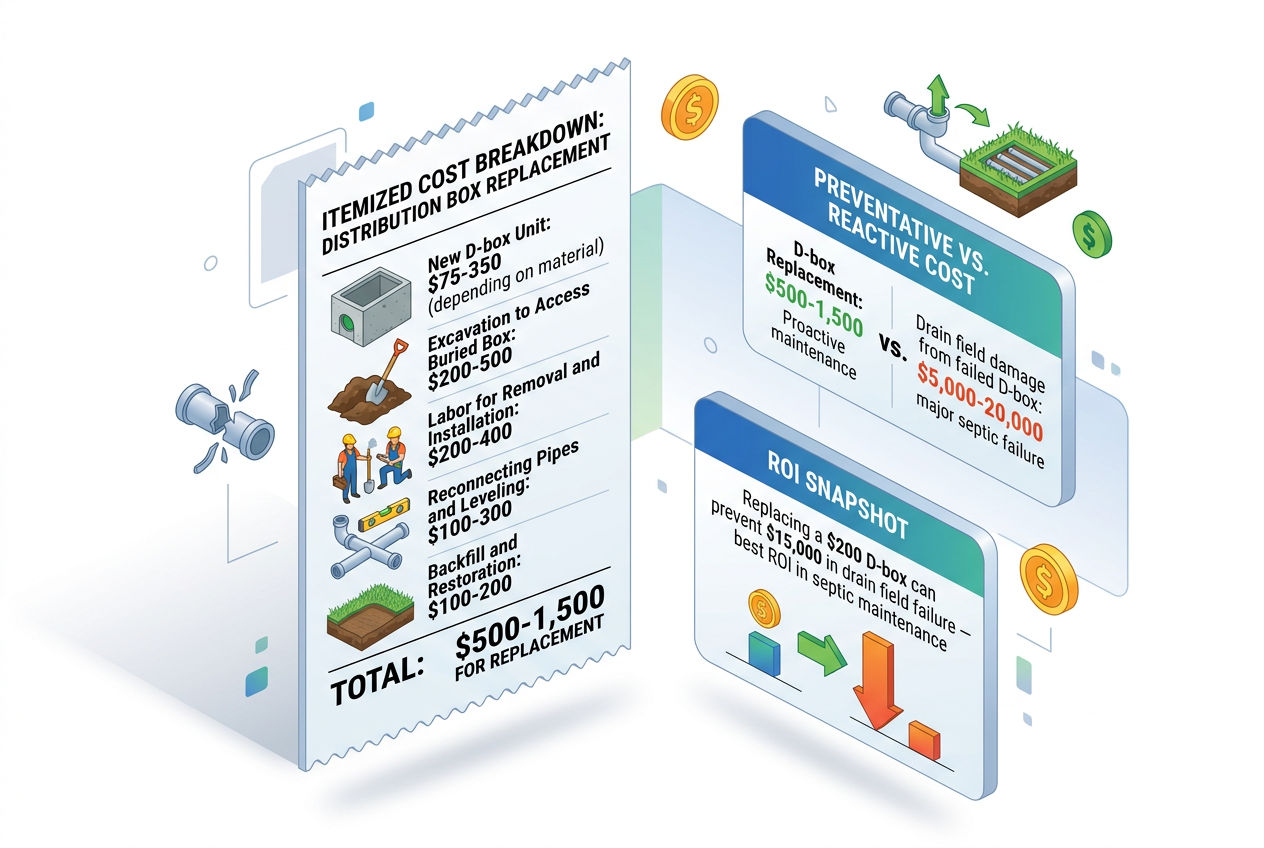
How Much Does It Cost to Replace a Septic Distribution Box?
Replacing a d-box is one of the less expensive septic repairs - but costs vary based on material, depth, and your region.
Parts-Only Costs
- Concrete d-box: $100–$250
- Poly box: $80–$200
- Custom-sized unit with additional outlets (6–9 laterals): $300–$400
Installed Cost (Parts + Labor)
Most homeowners pay $500–$1,200 for a straightforward d-box replacement. If the box is buried deeper than 18 inches, if excavation hits roots or existing infrastructure, or if the contractor needs to re-grade the outlet pipes for level distribution, costs can reach $1,500–$2,000.
Real-World Example
Central Massachusetts installation:
A 4-person household with a 1,500-gallon concrete tank and a 5-lateral drain field. The 22-year-old concrete d-box cracked from frost heave. Replacement with a poly box, including:
- Excavation to 14 inches
- Pipe reconnection
- Backfill
Total cost: $850–$1,100 with a licensed Title 5 contractor
Rural Tennessee (same job): $500–$750 (lower labor rates, no frost depth concerns)
See our septic repair cost guide for a full regional breakdown of repair and replacement costs.
Can You Inspect a Distribution Box Yourself?
You can locate it and remove the lid yourself - if you know where it is and can safely dig down to it.
What to Look For
- Visible cracks in concrete boxes, especially along the walls or corners
- Inlet and outlet pipes that are sitting at clearly uneven heights
- Standing effluent that's at or above outlet level (indicates a blockage or flooded laterals)
- Root intrusion - tree roots will find their way into any box with a joint or crack
- Settled silt or solid debris blocking outlet holes
What You Cannot Assess Yourself
Whether effluent is distributing evenly across all laterals. That requires flow testing - a professional uses a bucket, a stopwatch, and a measured sequence to confirm equal flow from each outlet. The NAWT (National Association of Wastewater Technicians) recommends this as part of any comprehensive septic inspection.
✅ Pro Tip: If you're buying a home and the inspector didn't open the d-box, ask for a full septic inspection before closing. It's a $200–$500 service that can save you a $5,000–$30,000 drain field replacement.
For more on what to expect from a professional assessment, see our guide to the septic system installation process - it includes a full breakdown of components inspectors should check.
Distribution Box Maintenance: What You Can Actually Do
The d-box itself requires almost no active maintenance. But a few habits protect it:
Essential Maintenance Practices
Pump your tank on schedule
The most common cause of d-box clogging is solids migrating from an overfull septic tank. A 1,000-gallon tank serving a 3-person household needs pumping every 3–4 years. Let it go 8 years and you're pushing sludge toward the d-box. Review our septic tank pumping schedule guide if you're not sure where you stand.
Keep vehicles and heavy equipment off the drain field
The d-box is buried in that zone too. Compaction from a truck or tractor can crack a concrete box or displace a poly box.
Manage trees near the drain field
Willow, poplar, and silver maple are notorious for aggressive root systems. A mature willow within 30 feet of a d-box will find it. Root intrusion is one of the top causes of blocked outlet holes.
Check after every major frost or flooding event
Frost heave and saturated soil are the two biggest physical threats to a d-box. A quick visual inspection after a hard winter or significant rain event can catch a shifted box before it turns into a failed drain field.
💡 Key Takeaway: For a full preventive maintenance checklist, our septic tank maintenance guide covers every component in the system. If you need professional help with your distribution box, find a septic professional near you through our directory.
For pricing details, see our septic installation cost guide.
Learn more about our septic installation services.
Related reading: septic inspection process.
Sources & Methodology
U.S. Environmental Protection Agency - Septic Systems Overview (): Used for national household count (21 million+) and conventional system prevalence statistics.
National Association of Wastewater Technicians (NAWT) (): Referenced for inspection standards and flow-testing methodology for distribution box assessment.
National Onsite Wastewater Recycling Association (NOWRA) (): Consulted for component classification, system type definitions, and contractor guidance.
Infiltrator Water Technologies: Product specifications for polyethylene distribution boxes, including dimensions and material performance data.
State health department codes (Massachusetts Title 5; Florida Department of Health): Referenced for regional regulatory context and contractor licensing requirements.
Cost ranges reflect contractor survey data and regional pricing compiled from licensed septic professionals across multiple U.S. markets. Individual costs vary by jurisdiction, system condition, and site conditions.
Need help with your septic system? Browse local septic companies in Texas or Florida.
Free download
Not ready for the Blueprint? Start free.
Grab the free DIY Septic Planning Kit — the permit-first checklist, perc-test cheat sheet, and sizing tables that keep your build from getting red-tagged.
Was this article helpful?
Frequently Asked Questions
Recommended Resources
Find Septic Professionals Near You
Compare licensed, verified septic companies by area — top county markets and cities below, or browse all 50 states.
County markets
Popular cities
