
Quick Answer
A septic drain field — also called a leach field or septic field — typically ranges from 200 to 2,250 square feet of absorption area, depending on how many bedrooms your home has and how fast your soil absorbs water. A standard 3-bedroom house needs roughly 600–1,350 square feet of drain field. Most states also require you to reserve an equally sized backup area - so the real land commitment is often twice that number.
💡 Key Takeaways
- Drain field size depends on two things: daily wastewater flow (driven by bedroom count) and your soil's absorption rate.
- A 3-bedroom home typically needs 600–1,350 sq ft of drain field, but soil type can swing that range dramatically.
- Most states require a 100% reserve drain field area - effectively doubling your land commitment.
- There is no single national standard. Your county health department sets the actual rules.
- A percolation test (perc test) is the only way to know your soil's true absorption rate - and you can't skip it.
What Is a Drain Field and What Does It Actually Do?
A drain field - also called a leach field or soil absorption system - is a network of perforated pipes buried in gravel-filled trenches beneath your yard. After your septic tank separates solids from liquid waste, the clarified liquid (effluent) flows out to those pipes and slowly seeps into the surrounding soil. The soil filters and treats the effluent before it reaches groundwater.
The size of that network determines how well - and how long - your system handles your household's waste. Too small, and effluent backs up. Too large, and you've wasted money and land you didn't need to disturb.
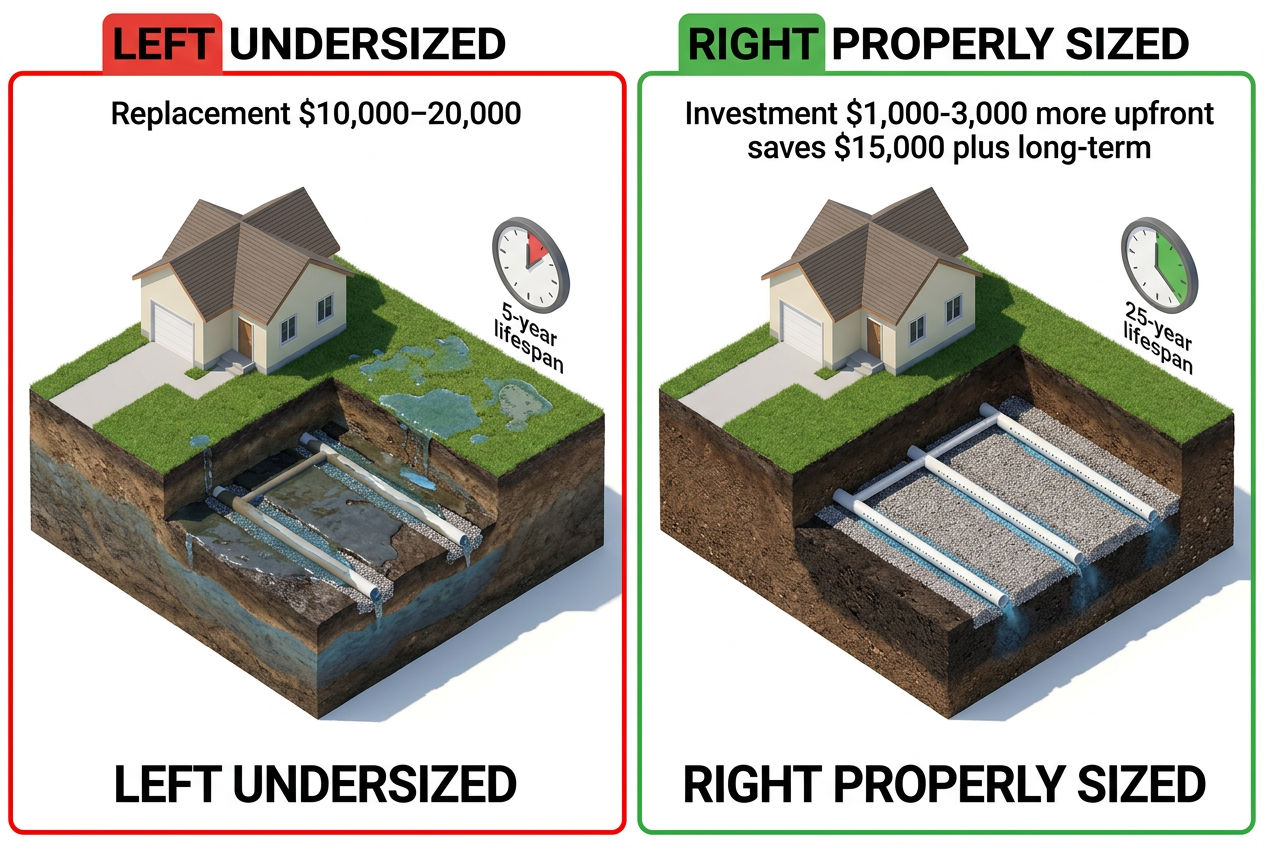
Understanding how long drain fields last starts with understanding whether the field was sized correctly in the first place. An undersized drain field often fails within 10 years. A properly sized one can last 25–30 years with reasonable maintenance.
How Do You Calculate the Size of a Drain Field?
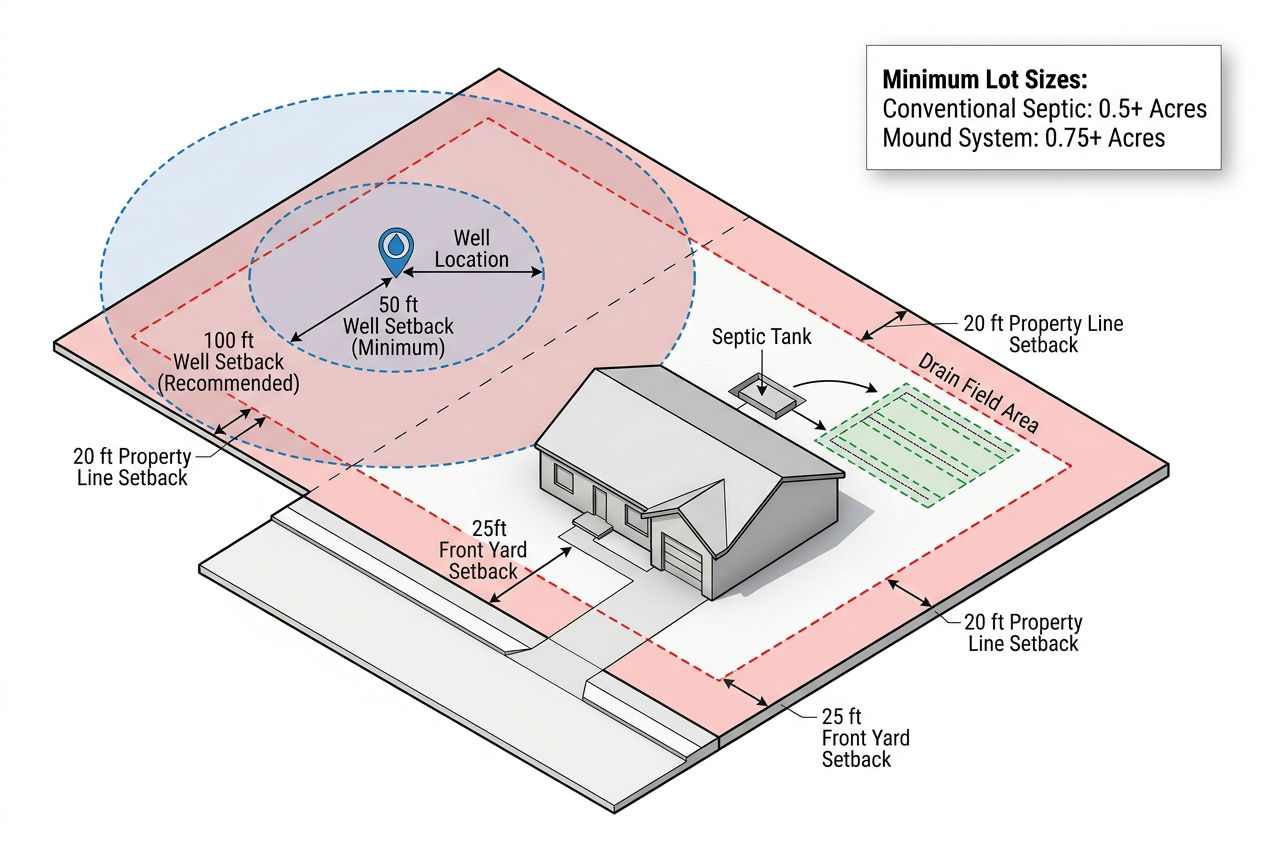
Drain field sizing comes down to a straightforward formula:
Drain Field Area (sq ft) = Daily Wastewater Flow (GPD) ÷ Soil Application Rate (GPD/sq ft)
Two numbers go in. One number comes out. But getting those two input numbers right is where it gets complicated.
Step 1: Estimate Your Daily Wastewater Flow
Most state health departments estimate daily flow by bedroom count, not bathroom count. The assumption is that each bedroom represents a potential occupant generating roughly 75–100 gallons of wastewater per day. A 3-bedroom home is assumed to produce approximately 450 gallons per day (GPD), whether you currently have three people living there or not. The same bedroom-count math drives tank sizing — our septic tank size chart shows the required gallons for each home size.
⚠️ Warning: Regulators size your system for maximum occupancy, not current occupancy. Designing for anything less creates a system that fails the moment the house fills up.
Step 2: Determine Your Soil Application Rate via Perc Test
Your soil's application rate - how many gallons per square foot it can absorb per day - comes directly from a percolation test. A licensed soil evaluator digs test holes, fills them with water, and measures how fast the water level drops. Results are expressed in minutes per inch (min/in).
A sandy loam that drops an inch in 10 minutes handles 0.8 GPD per square foot. A heavy clay soil that barely moves? It might be rated at 0.2 GPD per square foot - or declared unsuitable altogether.
📊 Quick Fact: That difference in soil type can triple or quadruple your required drain field size. You simply cannot skip this test and guess.
Perc tests typically cost $250–$1,000 depending on your state and the number of test holes required.
Worked Example
Picture this: you're buying a 3-bedroom home on a half-acre lot. The seller's disclosure says a new septic system will be needed. You want to know if the lot is big enough.
- Estimated daily flow: 450 GPD (3 bedrooms × 150 GPD)
- Soil type: sandy loam, application rate 0.8 GPD/sq ft
- Required absorption area: 450 ÷ 0.8 = 562.5 sq ft
- Plus 100% reserve area: 562.5 × 2 = 1,125 sq ft total
- Add standard setbacks from the well, property lines, and structures
That half-acre lot (21,780 sq ft) can almost certainly accommodate that system. A quarter-acre lot with clay soil? You'd need to run the numbers - and probably talk to a septic system installer before making an offer.

DIY Septic Blueprint
Thinking about building it yourself?
The complete, plain-English plan to size, permit and install your own septic system — designed for homeowners, not contractors. Skip the $15,000–$25,000 quotes and do it right the first time.
Get the DIY Blueprint — $67 →Instant download · 8 modules + 3 bonus guides · 60-day money-back guaranteeAverage Leach Field Size Chart (Drain Field Sizing by Bedroom + Soil)
The table below is the average leach field size chart for U.S. residential septic systems — also known as a drainfield size chart, drain field sizing chart, or septic field size chart. These are starting-point ranges across typical soil conditions. Your actual required size will come from a licensed designer using your specific perc test results.
| Bedrooms | Est. Daily Flow | Fast Soil (sq ft) | Moderate Soil (sq ft) | Slow Soil (sq ft) |
|---|---|---|---|---|
| 1 bedroom | 150 GPD | ~125 | 200–300 | 430–750 |
| 2 bedrooms | 300 GPD | ~250 | 375–600 | 860–1,500 |
| 3 bedrooms | 450 GPD | ~375 | 562–900 | 1,285–2,250 |
| 4 bedrooms | 600 GPD | ~500 | 750–1,200 | 1,715–3,000 |
| 5 bedrooms | 750 GPD | ~625 | 937–1,500 | 2,145–3,750 |
Fast soil = gravel/coarse sand (1.2 GPD/sq ft). Moderate soil = sandy loam (0.8 GPD/sq ft) to loam (0.5 GPD/sq ft). Slow soil = clay loam (0.2–0.35 GPD/sq ft). Ranges represent the span across moderate-to-slow soils. Source: EPA Onsite Wastewater Treatment Systems Manual; state health department sizing guidelines.
💡 Key Takeaway: The most-searched question in this topic is "how big of a drain field do I need for a 3-bedroom house?" The honest answer: 600–1,350 square feet of absorption area is the typical range, but your perc test results will determine where in that range you fall.
Leach Field Size for a 1-Bedroom Home
A 1-bedroom home produces approximately 150 gallons per day and needs 125–750 sq ft of drain field. On fast-draining sandy soil, you may only need around 125 square feet of absorption area. On slow clay soil, that jumps to 430–750 sq ft. One-bedroom homes are the most forgiving for lot size — even quarter-acre lots typically have no trouble accommodating the system plus reserve area.
Leach Field Size for a 2-Bedroom Home
A 2-bedroom home generates roughly 300 GPD and requires 250–1,500 sq ft of drain field depending on soil conditions. On moderate sandy loam, plan for 375–600 sq ft. The reserve area requirement doubles that to 750–1,200 sq ft of total committed land. This is a common size for vacation cabins and smaller rural homes.
Leach Field Size for a 3-Bedroom House
The 3-bedroom house is the most common configuration in the US, and drain field sizing for this home size gets searched more than any other. Expect 375–2,250 sq ft depending on soil: around 562 sq ft on sandy loam, up to 900 sq ft on standard loam, and 1,285–2,250 sq ft on slow clay. With the 100% reserve area, a 3-bedroom home on moderate soil needs roughly 1,125–1,800 sq ft of land set aside just for the drain field system. That's roughly 4% of a half-acre lot — manageable, but it gets tight on smaller properties.
Drain Field Size for a 4-Bedroom House
A 4-bedroom house pumps out an estimated 600 GPD, requiring 500–3,000 sq ft of drain field. On moderate soil, the typical range is 750–1,200 sq ft of absorption area. Factor in the reserve area and setbacks, and a 4-bedroom home on loam soil could need 2,400–3,600 sq ft of yard permanently committed to the septic system. If your lot is under a half acre, run the numbers carefully before committing to a conventional system — you may need a chamber system or alternative to reduce the footprint.
💡 Sizing affects ongoing cost too. A correctly sized 1,000–1,500 gallon tank for a 4-bedroom home pumps every 3–5 years at $500–$850 per service. An undersized tank for the same load needs pumping every 1–2 years and risks early drain field failure.
Drain Field Size for a 5-Bedroom House
Five-bedroom homes produce approximately 750 GPD and require the largest residential drain fields: 625–3,750 sq ft. On slow clay soil, the absorption area alone can exceed 3,750 sq ft — and with the reserve area, you're looking at over 7,500 sq ft of land. That's more than a sixth of an acre dedicated solely to wastewater treatment. Properties with 5+ bedrooms on challenging soil almost always need a professional site evaluation and may require alternative septic systems to fit within the available space.
How Does Soil Type Affect Drain Field Dimensions?
Soil type isn't just a footnote - it's often the single biggest variable in your drain field size. Here's what the percolation data looks like in practice:
| Soil Type | Perc Rate | Application Rate | Effect on Size |
|---|---|---|---|
| Gravel / Coarse Sand | 1–5 min/in | 1.2 GPD/sq ft | Smallest fields possible |
| Sandy Loam | 6–15 min/in | 0.8 GPD/sq ft | Moderate-size fields |
| Loam / Silt Loam | 16–30 min/in | 0.5 GPD/sq ft | Larger fields needed |
| Clay Loam | 31–60 min/in | 0.2–0.35 GPD/sq ft | Very large fields |
| Heavy Clay | 60+ min/in | Often unsuitable | May require alternative system |
Source: EPA Onsite Wastewater Treatment Systems Manual, Table 4-5.
📊 Quick Fact: A homeowner in coastal Georgia with heavy red clay soil may need a drain field three to four times larger than their neighbor in the Carolinas with sandy loam. That's not a typo.
That's why a perc test isn't optional - it's the foundation of every legitimate septic system design. When soil fails the perc test entirely, alternative systems like mound systems or drip distribution become necessary. Those systems come with their own sizing considerations and significantly higher drain field installation costs.
What Are Standard Drain Field Trench Dimensions?
Most conventional drain fields use a series of parallel trenches. Here are the typical dimensions you'll see in construction specs across most states:
- Trench width: 1–3 feet (most codes specify 2–3 ft)
- Trench depth: 18–36 inches below grade - this includes a 6–12 inch gravel bed, the 4-inch perforated distribution pipe, and at least 12 inches of soil cover
- Trench spacing: 6–10 feet center-to-center (varies by jurisdiction)
- Maximum trench length: Often capped at 100 feet per lateral run by state code - longer runs can cause uneven distribution
- Gravel/aggregate: 6–12 inches of washed stone (#57 or similar) surrounding the pipe
✅ Pro Tip: In a standard configuration for a 3-bedroom home on sandy loam, you might see four trenches, each 2.5 feet wide and 60 feet long. That gives you 600 square feet of absorption area in a footprint roughly 30 feet × 60 feet - before setbacks.
For a deeper look at trench construction specifications, see our guide to drain field depth.
What Are Minimum Drain Field Setback Requirements?
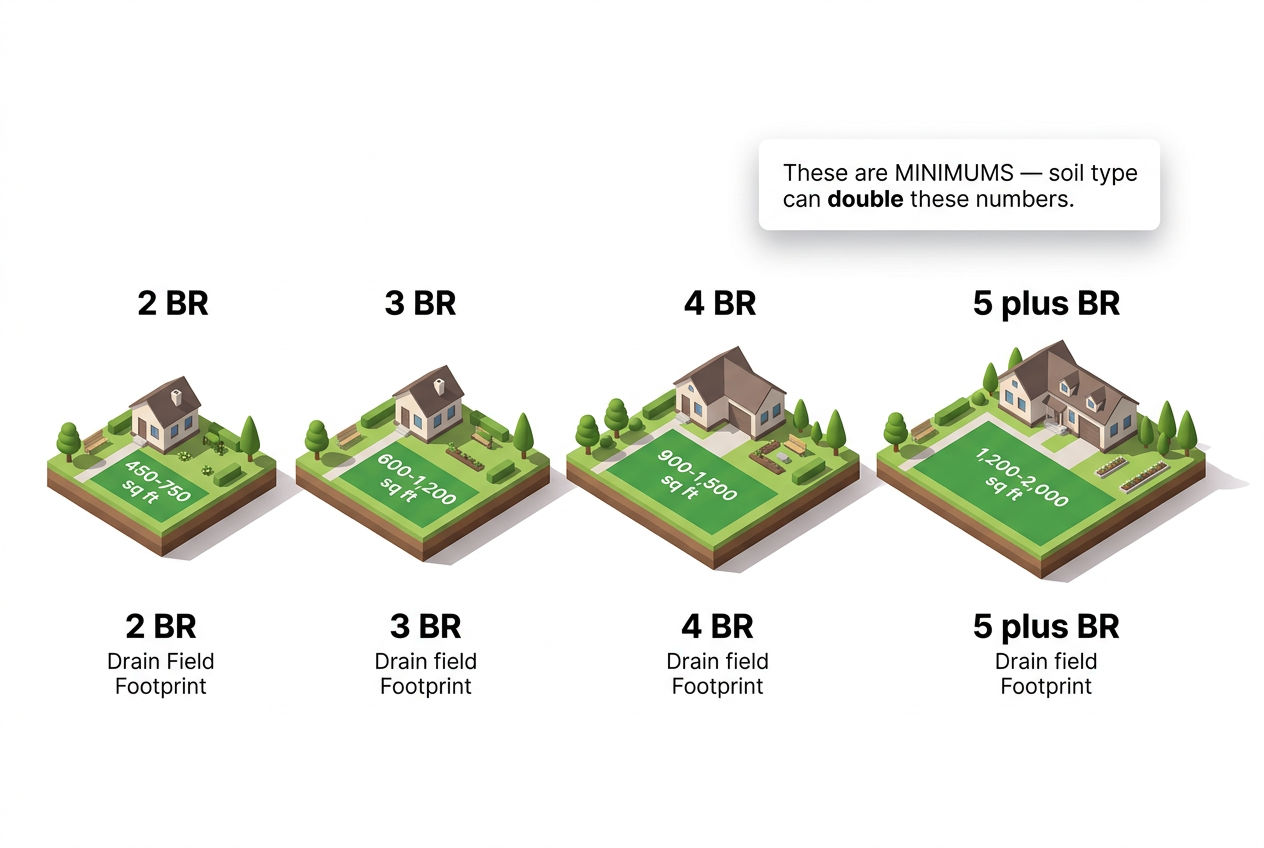
Your drain field can't go anywhere on your property. State and local codes establish minimum distances from potential contamination points and structures. These are general ranges - your county health department sets the exact numbers:
- From a private well or water supply: 50–100+ feet (Massachusetts Title 5 requires 100 feet minimum)
- From property lines: 5–10 feet
- From foundations and structures: 10–20 feet
- From trees with large root systems: 10+ feet
- From surface water (streams, ponds, wetlands): 50–100 feet
- From driveways and paved surfaces: 5–10 feet
⚠️ Warning: These setbacks are not suggestions - they're the reason a lot that looks big enough on paper sometimes isn't. A quarter-acre lot with a 50-foot setback from the well, 10-foot setbacks on all sides, and a house in the middle may leave very little room for the absorption area you actually need.
That brings us to the reserve area requirement, which many homeowners discover too late.
Does the Number of Bathrooms Affect Drain Field Size?
No - and this surprises most people. Bedrooms, not bathrooms, drive septic system sizing in virtually every state code. The logic is that bathrooms don't generate occupants; bedrooms do. A 3-bedroom home with two bathrooms gets sized identically to a 3-bedroom home with three bathrooms.
What Does Affect Sizing Beyond Bedroom Count:
- Garbage disposals: Many states add 25–50% to daily flow estimates for homes with garbage disposals
- Hot tubs and large soaking tubs: Some jurisdictions require additional flow credit
- Water softeners: Backwash water adds volume; some codes require separate drain systems for softener discharge
- Home offices or in-law suites: May trigger reclassification to a higher bedroom count
✅ Pro Tip: If your home has any of these features, mention them to your septic designer. An undersized system is far more expensive to correct after installation than before.
The Reserve Area: The Requirement Most Homeowners Miss
Here's the detail that catches people off guard: most states require you to set aside a 100% reserve drain field area at the time of initial installation. That means you need enough undisturbed, suitable soil for a second, full-size drain field - even if you never intend to use it.
The EPA's Onsite Wastewater Treatment Systems Manual recommends reserve areas as a standard design component. If your primary field fails - and drain fields do fail - you need somewhere to go.
⚠️ Warning: If you've built a deck, planted a garden, or graded a parking area over the reserve zone, you've just turned a $5,000 repair into a $20,000+ property problem.
Practically speaking, this means your total land commitment for a properly designed system is roughly 2× your calculated absorption area, plus all applicable setbacks. For a 4-bedroom home on loam soil, that could easily mean 2,400–3,600 square feet of yard that can never be built on, driven on, or planted with deep-rooted trees.
For more on what you can and can't do over a drain field, see can you drive over a drain field?
How Does Drain Field Size Vary by Region?
There is no federal drain field sizing standard. The EPA provides guidance; states write the rules; counties sometimes add requirements on top of those. Here's how geography plays out in practice:
Florida
High water tables across most of the state push drain field trenches upward or force mound systems entirely. Florida's Department of Health mandates minimum 24 inches of vertical separation between the bottom of the drain field and the seasonal high water table. In many coastal counties, conventional drain fields are simply not permitted - alternative systems are the baseline.
Massachusetts
Title 5 is one of the strictest septic codes in the country. It requires a 100-foot setback from private wells, mandates hydraulic loading calculations by a licensed site evaluator, and includes specific requirements for soil morphology testing beyond standard perc testing. Budget $500–$2,000 for a licensed Title 5 evaluator before you even start designing.
Texas
The TCEQ (Texas Commission on Environmental Quality) oversees on-site sewage facilities (OSSFs), but enforcement is delegated to Authorized Agents - county or city health authorities. Some rural Texas counties have minimal oversight; others are highly specific. Never assume what applied in your previous county applies in the next.
Pacific Northwest (Oregon, Washington)
High annual rainfall saturates soils seasonally, which effectively reduces your soil's available absorption capacity during wet months. Many jurisdictions require larger drain fields or pressure-dosed systems to compensate for seasonal saturation.
Midwest (Minnesota, Wisconsin, Ohio)
Glacially deposited soils can vary dramatically within a single property - sandy outwash in one corner, dense till in another. The Minnesota Pollution Control Agency (MPCA) requires mound systems when soil separation to groundwater is less than 3 feet.
✅ Pro Tip: Local knowledge matters here. A septic professional in your area will know the specific county health department rules, common soil conditions, and what inspectors actually look for on submittal.
What Happens If Your Drain Field Is Too Small?
An undersized drain field saturates faster than the soil can drain it. Effluent backs up into the distribution lines, then into the septic tank, and eventually into your home. Or it surfaces in your yard as wet, foul-smelling patches of grass.
Signs Your Drain Field May Be Undersized or Failing:
- Slow drains and gurgling sounds in your plumbing
- Wet spots or unusually green grass over the field area
- Sewage odors outside near the drain field
- Sewage backing up into toilets or tubs
⚠️ Warning: A saturated or failing field often can't be repaired - it needs replacement. That's a $5,000–$20,000+ project depending on system type and local conditions.
Learn to recognize the signs of drain field failure early, because early intervention is always cheaper.
Alternative System Types and How They Change the Size Equation
Conventional gravity-fed trench systems are the baseline. But not every property qualifies for one. When they don't, alternative systems come with their own footprint profiles:
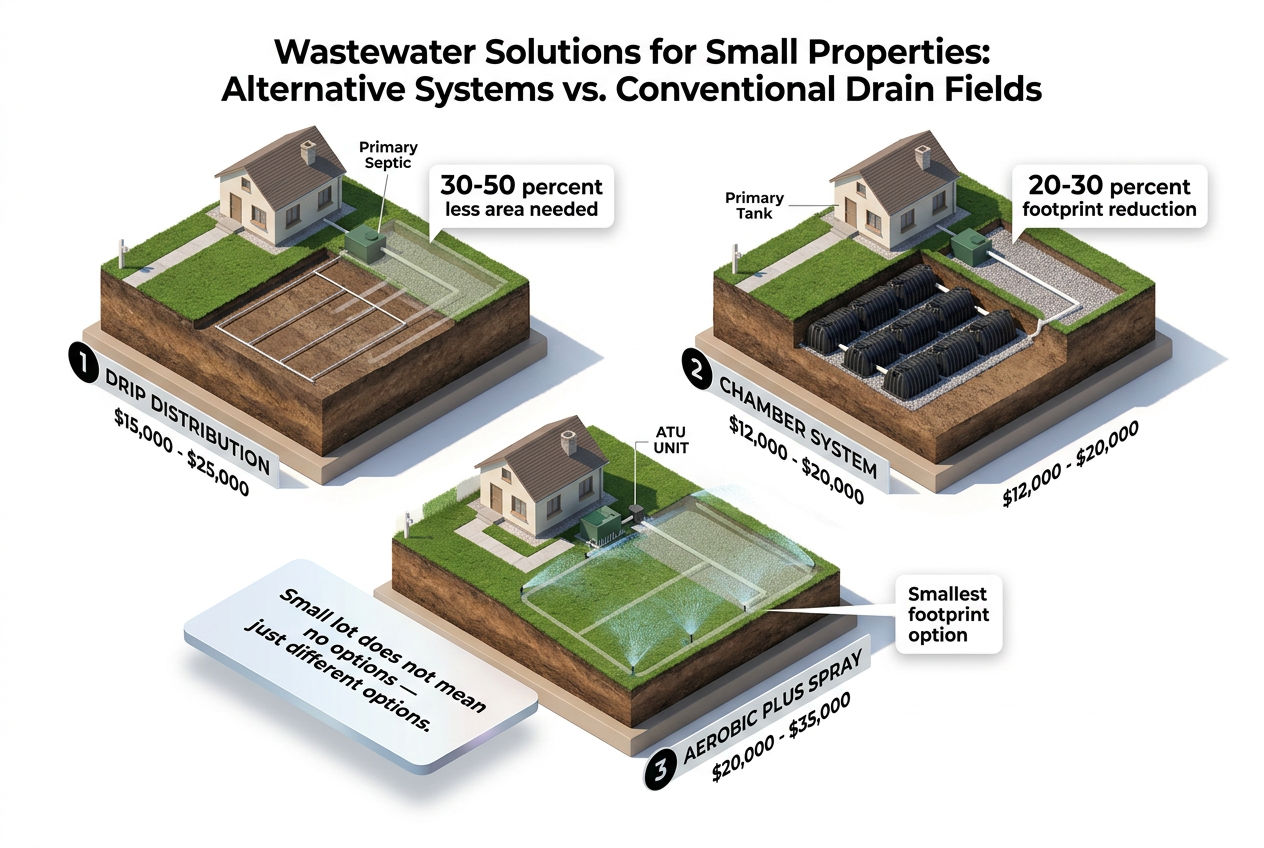
- Mound systems: Required when there's insufficient soil depth above groundwater or bedrock. The mound itself typically requires 2–3× the footprint of an equivalent conventional field, plus significant setbacks from the mound perimeter.
- Chamber systems (Infiltrator Water Technologies): Plastic arch chambers replace gravel and pipe. They can reduce the overall drain field footprint by 15–30% compared to conventional systems because chambers provide more infiltrative surface area per linear foot.
- Drip distribution systems (Orenco Systems): Small-diameter tubing delivers effluent in frequent, small doses across a wider area. Footprint can be 40–50% smaller than conventional, but equipment costs and maintenance requirements are higher.
- Pressure-dosed systems: Similar overall size to conventional, but timed doses improve effluent distribution across all laterals, extending field life.
For a full breakdown of system types and their land requirements, see our types of septic systems guide.
Conventional vs Chamber System: Size Comparison by Bedrooms
If lot space is tight, chamber systems can meaningfully reduce your drain field footprint. Here's how the two most common system types compare in required absorption area on moderate soil (sandy loam to loam):
| Bedrooms | Conventional Trench (sq ft) | Chamber System (sq ft) | Space Savings |
|---|---|---|---|
| 2 bedrooms | 375–600 | 265–420 | ~30% smaller |
| 3 bedrooms | 562–900 | 395–630 | ~30% smaller |
| 4 bedrooms | 750–1,200 | 525–840 | ~30% smaller |
| 5 bedrooms | 937–1,500 | 655–1,050 | ~30% smaller |
Chamber system estimates assume 30% reduction per Infiltrator Water Technologies specifications. Actual savings vary by product model and local code approval. Not all jurisdictions approve chamber systems — check with your county health department.
💡 Key Takeaway: For homeowners on smaller lots or properties with marginal space, chamber systems can be the difference between a conventional system and needing an expensive mound or drip system.
What Happens When Your Perc Test Fails?
If your soil fails the percolation test — typically meaning a perc rate slower than 60 minutes per inch — a conventional drain field is not an option. This doesn't mean you can't build on the property, but your alternatives are more expensive and complex.
Your options when soil fails a perc test include mound systems that build an artificial soil layer above grade ($10,000–$25,000+), drip distribution systems that use pressurized tubing for precise dosing ($12,000–$20,000+), aerobic treatment units (ATUs) that pre-treat wastewater before soil discharge ($8,000–$18,000), and in rare cases, connecting to a nearby municipal sewer line if available.
The key takeaway: a failed perc test doesn't kill the project, but it significantly increases your system cost and the professional design expertise required. Talk to a licensed septic installer who has experience with alternative systems in your county before making any commitments.
How Much Does Drain Field Size Affect Installation Cost?
Size and cost move together. More square footage means more trench excavation, more gravel, more pipe, and more labor. Here's the ballpark:
- Conventional drain field installation: $3,000–$15,000 for most residential systems
- Mound or alternative systems: $10,000–$25,000+
- Perc test: $250–$1,000
- Septic system design/engineering: $500–$2,000
📊 Quick Fact: A 4-bedroom home with slow clay soil needing a 1,800 sq ft field will cost significantly more than a 2-bedroom home on sandy loam needing 400 sq ft. That's not just a bigger trench - it's sometimes a fundamentally different system type.
See our full drain field replacement cost guide and septic installation cost guide for detailed regional pricing breakdowns.
Using a Drain Field Size Calculator: A Simple Step-by-Step
You don't need specialized software to get a rough estimate. Here's a manual drain field size calculator walkthrough:
Step 1: Count your bedrooms. Multiply by 150 GPD. (3 bedrooms × 150 = 450 GPD)
Step 2: Look up your perc test result (or estimate based on soil type). (Sandy loam = 0.8 GPD/sq ft)
Step 3: Divide daily flow by application rate. (450 ÷ 0.8 = 562.5 sq ft required absorption area)
Step 4: Multiply by 2 for reserve area. (562.5 × 2 = 1,125 sq ft total land commitment)
Step 5: Add setback buffers around the field perimeter.
✅ Pro Tip: That's your rough estimate. A licensed septic designer will run the same basic math with your actual perc test data, local code requirements, and site-specific conditions. Their calculation is the one that goes on the permit.
Find a Septic Professional for Accurate Sizing
The numbers in this guide give you a solid foundation for asking the right questions. But drain field sizing requires a licensed professional, a physical site visit, and a perc test conducted under your state's specific protocols. Estimates from an article - or anyone who hasn't been on your property - are starting points only.
Find a licensed septic installer in your area through the SepticTankHub directory. Search by state, read verified reviews, and connect with professionals who know your local soil conditions and county health department requirements.
For cost estimates, see our drain field replacement cost guide.
Planning a new system? Our septic installation cost guide covers full pricing.
Browse our drain field services to connect with local experts.
Depth matters too - read about drain field depth requirements.
Wondering about longevity? Learn how long drain fields last.
Watch for signs your drain field is failing to catch problems early.
For the bigger picture on sizing, see how big a septic system you need.
Find a qualified septic professional near you on SepticTankHub.
Related reading: septic system installation process.
Sources & Methodology
- EPA Onsite Wastewater Treatment Systems Manual (EPA/625/R-00/008): Primary technical reference for drain field sizing methodology, soil loading rates, and reserve area recommendations.
- University of Nebraska-Lincoln Extension — Drainfield Size & Design: Academic reference for percolation rate calculations and state-specific sizing formulas (NDEQ Title 124).
- Massachusetts Title 5 — 310 CMR 15.000: State environmental code governing septic system design, setbacks, and hydraulic loading requirements.
- Florida Department of Health — Onsite Sewage Programs: State-specific drain field standards including water table separation requirements.
- Infiltrator Water Technologies — Chamber System Specifications: Manufacturer data for chamber system sizing and footprint reduction calculations.
Need help with your septic system? Browse local septic companies in Tennessee or Virginia.
Free download
Not ready for the Blueprint? Start free.
Grab the free DIY Septic Planning Kit — the permit-first checklist, perc-test cheat sheet, and sizing tables that keep your build from getting red-tagged.
Was this article helpful?
Frequently Asked Questions
Recommended Resources
📖 Related Articles
- Septic Tank Replacement Cost 2026: $5,000–$15,000 (Full Breakdown)
- What Is a Drain Field? (And How Does It Work?)
- Drain Field vs Leach Field: Is There a Difference?
- How Long Do Drain Fields Last? Lifespan Guide
- Signs Your Drain Field Is Failing (And What to Do)
- How Deep Should a Drain Field Be?
- What Size Septic System Do I Need?
Find Septic Professionals Near You
Compare licensed, verified septic companies by area — top county markets and cities below, or browse all 50 states.
County markets
Popular cities
