
Quick Answer
Septic tank replacement costs $5,000 to $15,000 nationally in 2026, with most U.S. homeowners paying $8,000–$10,000 for a standard concrete tank swap-out. Tank-only replacement (when the drain field is still good) runs $3,000–$7,000. Replace the drain field at the same time and the total climbs to $10,000–$25,000+.
Tank size, material (concrete, plastic, or fiberglass), soil conditions, depth of excavation, and your county's permit fees are the four biggest cost drivers. The rest of this guide breaks down each one, with regional benchmarks, financing options, and ways to save 10–15% by timing the work right.
💡 Key Takeaways
- Most homeowners pay $8,000–$10,000 for a standard septic tank replacement in 2026
- Tank-only replacement (when the drain field is still good) runs $3,000–$7,000
- A 1,000-gallon concrete tank — the most common residential size — costs $4,000–$7,500 installed
- Costs have risen 15–25% since 2020 due to material and labor inflation
- Scheduling in fall (September–November) can save 10–15% versus peak spring season
🎯 Looking for something else? This guide covers full septic tank replacement (tank + labor + permits + drain field check). If you're researching something more specific:
- Just the tank price (no labor or permits)? → See Septic Tank Price by Size & Material — concrete, plastic, and fiberglass tanks from $400 to $4,800
- Brand-new septic system installation (full project from scratch)? → See Septic System Installation Cost Guide — $3,000–$25,000 depending on system type
- Repair instead of replacement (cracked baffle, broken lid, lateral fix)? → See Septic Repair Cost Guide — typical repairs run $200–$3,500
- Routine maintenance pumping (the every-3-to-5-year service)? → See Septic Pumping Cost Guide — $400–$750 nationally
How Much Does It Cost to Replace a Septic Tank in 2026?
Replacing a septic tank in 2026 costs $5,000–$15,000 for most residential properties, with a national average of $8,000–$10,000. Tank-only replacement — when your existing drain field is still functional — runs $3,000–$7,000. If the drain field also needs work, budget $10,000–$25,000 or more for a full system overhaul.
Those numbers have moved. Material and labor inflation has pushed replacement costs up 15–25% since 2020, according to contractor pricing data tracked by the National Association of Wastewater Technicians (NAWT). What cost $6,500 in 2021 routinely runs $8,000–$9,000 today.
📊 Quick Fact: The average septic replacement cost has increased faster than general construction inflation, rising 15–25% since 2020 compared to the overall construction CPI increase of 12–18% during the same period.
The table below gives you a fast-reference snapshot before we break down the specifics.
| Scope | Typical Cost Range | Notes |
|---|---|---|
| Tank only (no drain field work) | $3,000 – $7,000 | Existing field in good condition |
| Standard full replacement | $5,000 – $15,000 | National average ~$8,000–$10,000 |
| Tank + drain field replacement | $10,000 – $25,000+ | Worst-case / full system failure |
| Emergency replacement | $12,000 – $20,000+ | Off-hours, winter, or urgent access |
| Permit and inspection fees only | $400 – $2,500 | Varies widely by county |
Source: Synthesized from NAWT contractor data, EPA SepticSmart program, and regional contractor pricing surveys, 2026.
✅ Pro Tip: Use these as your planning benchmarks — not your final quote. Local permit costs alone can swing your total by $2,000+. Always collect three bids from licensed septic contractors in your area before committing. And if your tank is still structurally sound but overdue for service, a routine pump-out at $400–$750 often buys you years before replacement is actually necessary.
Septic Tank Replacement Cost by Size
Tank size is one of the biggest cost drivers. Bigger tanks need larger excavations, heavier equipment, and more concrete or material — all of which add labor time. Here's what each size tier costs to replace in 2026.
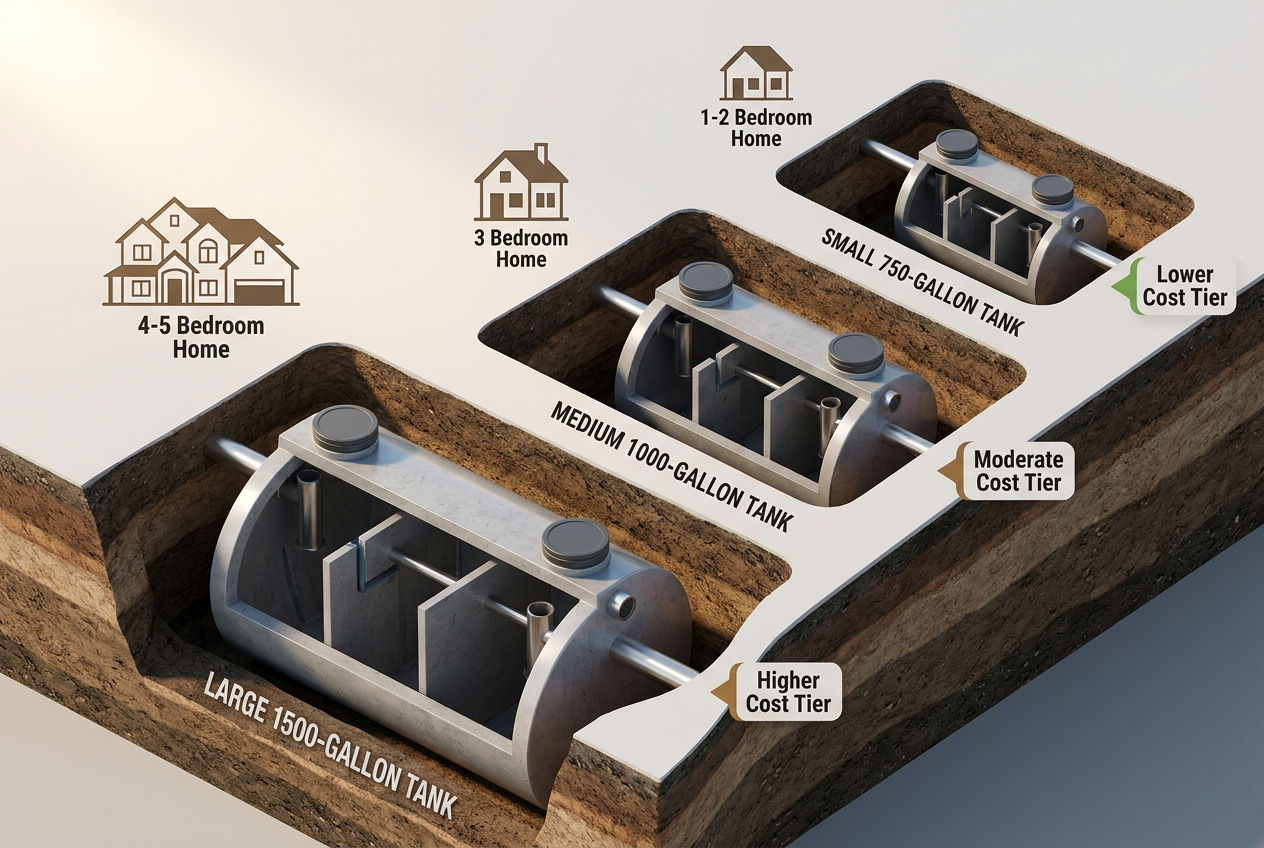
500–750 Gallon Tanks
A 500-gallon tank typically serves a one-bedroom home or a vacation cabin. Installed replacement cost runs $2,500–$5,500. A 750-gallon unit — common in older 1–2 bedroom homes — lands in the $3,000–$5,500 range. These smaller tanks are faster to excavate and easier to maneuver, which keeps labor costs down.
⚠️ Warning: If your 500-gallon tank is failing and you're upgrading the system, most county health departments will require you to right-size to current bedroom count standards. In many jurisdictions, a 2-bedroom home must have at least a 1,000-gallon tank regardless of what was installed originally.
1,000-Gallon Septic Tank Replacement Cost
The 1,000-gallon septic tank is the most common residential size in the U.S. — it's what most 3-bedroom homes use. Replacement cost runs $4,000–$7,500 installed, with most mid-Atlantic and Midwest homeowners landing around $5,500–$6,500 for a standard concrete unit. For tank-only pricing, dimensions, and what drives the concrete premium, see our full breakdown of 1,000-gallon concrete tank costs.
That range assumes the contractor is:
- Pulling out the old tank (or abandoning it in place, which some counties allow)
- Digging a properly sized excavation
- Setting the new tank
- Reconnecting your inlet and outlet pipes
It does not include drain field work.
Not sure what size your home actually needs? Our septic tank size guide walks through bedroom count, daily water usage, and local code minimums.
1,500-Gallon Septic Tank Replacement Cost
A 1,500-gallon concrete tank for a 4–5 bedroom home costs $6,500–$12,000 to replace — a wide range that reflects regional labor differences and soil conditions. In the Northeast, where rocky ledge and strict state regulations drive up costs, you could hit $12,000 for the tank alone. In rural Texas or the Midwest, the same job might come in closer to $7,000.
📊 Quick Fact: The heavier weight of a 1,500-gallon concrete tank (typically 12,000–14,000 lbs) sometimes requires a large-capacity crane or specialized lifting equipment, adding $500–$1,500 to the project.
2,000+ Gallon Tanks
Large residential properties with 5+ bedrooms, or small commercial sites, need 2,000-gallon tanks or larger. Replacement cost ranges from $8,000–$15,000+ and can run significantly higher on commercial projects with engineered system requirements. These jobs almost always require a licensed septic engineer to prepare a site plan before permits are issued.
Septic Tank Replacement Cost by Material Type
The material your new tank is made of affects both upfront cost and long-term lifespan. Here's how the four main options compare.
💡 Just buying a tank, not replacing the whole system? For the price of the tank unit by material and gallon size — including concrete septic tank cost and 1,000-gallon pricing — see our dedicated septic tank price guide.
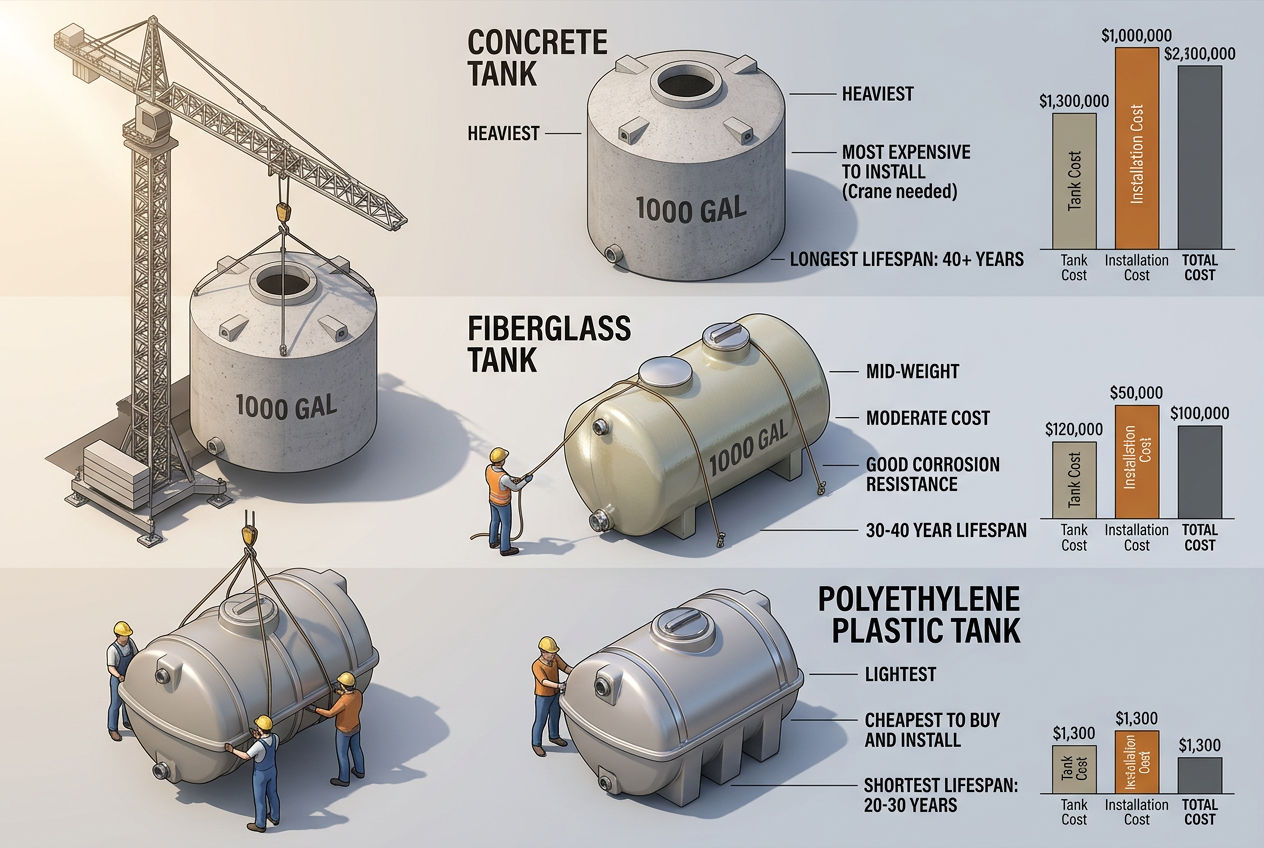
Concrete Septic Tank Replacement Cost
Concrete is the dominant material for replacement tanks — and for good reason. A concrete tank costs $1,200–$3,500 for the tank itself and lasts 40–50+ years with proper maintenance. It resists shifting, handles soil pressure well, and is widely available from local precast suppliers in most states.
The downside is weight. A standard 1,000-gallon precast concrete tank weighs around 8,500 lbs, which means your contractor needs a crane truck on-site. That's standard equipment for any experienced septic company, but it's part of why concrete installation labor runs slightly higher than plastic. For a detailed comparison, see our concrete vs. plastic septic tank breakdown.
Plastic (Polyethylene) Tank Cost
Plastic polyethylene tanks run $800–$2,500 for the tank and last 30–40 years. They're lightweight — a 1,000-gallon poly tank weighs under 500 lbs — which makes them easier to install in tight access situations. No crane required.
The trade-offs:
- Poly tanks can shift or float in high-water-table soils if not properly anchored
- In flood-prone areas or regions with shallow water tables (coastal Florida), a concrete tank is almost always the better call
- Some counties restrict poly tanks in certain soil classifications
✅ Pro Tip: Check with your local health department before specifying a poly tank — soil classification restrictions vary widely by jurisdiction.
Fiberglass Tank Cost
Fiberglass tanks land in the $1,500–$3,500 range for materials and offer a strong middle ground: lighter than concrete but more structurally rigid than plastic. Expected lifespan is 40–50 years. They resist corrosion well, making them a solid choice in acidic soil conditions.
Installation labor is similar to poly — no heavy crane needed — which keeps total installed costs competitive with concrete despite the higher material price. For a full side-by-side, check out fiberglass vs. concrete septic tanks.
Aerobic Treatment Unit (ATU) Cost
An aerobic treatment unit is a different category entirely. These systems use an aerator compressor (like the Hiblow HP-80) to inject oxygen into the tank, accelerating bacterial breakdown and producing a higher-quality effluent. ATU replacement costs $3,500–$8,000 for the unit, plus installation.
They're required in certain areas — much of rural Texas, for instance, mandates aerobic systems where soil conditions fail conventional percolation.
⚠️ Warning: Ongoing maintenance costs are higher: annual service contracts run $150–$400/year, and the aerator compressor typically needs replacement every 5–10 years ($300–$600).
For full ATU pricing, see our aerobic septic system cost guide.

DIY Septic Blueprint
Thinking about building it yourself?
The complete, plain-English plan to size, permit and install your own septic system — designed for homeowners, not contractors. Skip the $15,000–$25,000 quotes and do it right the first time.
Get the DIY Blueprint — $67 →Instant download · 8 modules + 3 bonus guides · 60-day money-back guaranteeFull Cost Breakdown: What Are You Actually Paying For?
When a contractor quotes you $8,500 to replace your septic tank, here's roughly where that money goes:
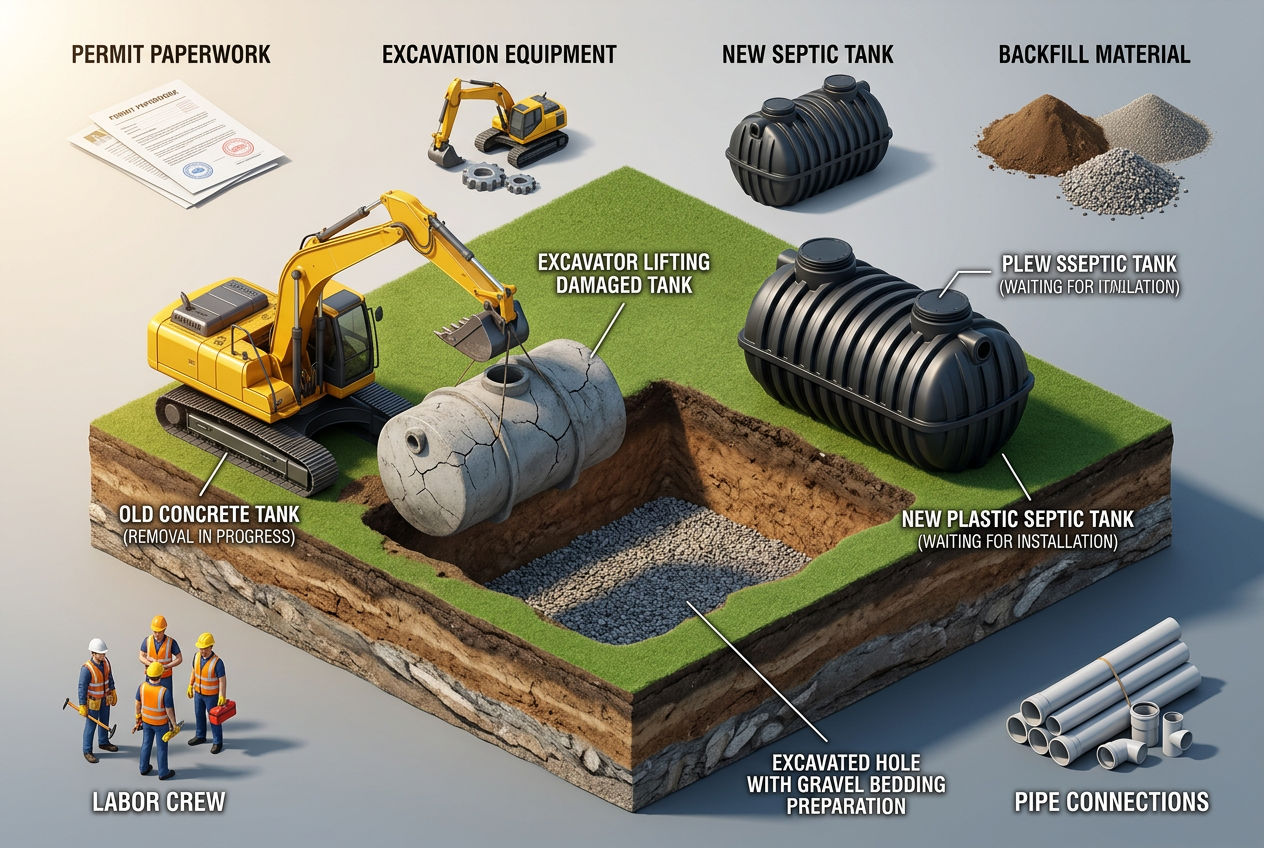
| Cost Component | Typical Range | What It Covers |
|---|---|---|
| Tank materials | $1,200–$3,500 | The precast concrete or poly tank itself |
| Excavation | $1,500–$4,000 | Digging out the old tank and preparing the new hole; clay or rocky soil pushes this higher |
| Old tank removal | $1,000–$3,500 | Pumping out residual waste, breaking up or hauling the old concrete, or properly abandoning the existing tank |
| Labor (setting, connecting, backfill) | $1,500–$3,000 | The actual installation crew time |
| Permits and inspections | $400–$2,500 | Highly variable by county and state |
| Pump, risers, and effluent filter | $300–$600 | Polylok PL-122 effluent filter and concrete or poly risers to bring access lids to grade |
| Landscaping restoration | $500–$2,000 | Regrading and seeding the excavation area after backfill |
📊 Quick Fact: Permit costs are highly variable — New Jersey and California are among the most expensive; rural Midwest counties are often under $600. See our guide to septic system permit requirements for state-by-state context.
A soil or perc test may also be required before permits are issued — budget $250–$1,000 if your county needs one. Our perc test guide explains when you'll need one and what to expect.
Can You Replace a Septic Tank Without Replacing the Drain Field?
Yes — and this is one of the most important questions to answer before you spend a dollar. If your drain field (also called a leach field) is functioning properly, you can replace just the tank and leave the field alone. That keeps your total cost in the $3,000–$7,000 range instead of $10,000–$25,000+.
The key is getting an honest assessment of your drain field's condition before the work starts. A licensed inspector can evaluate:
- The field's distribution box
- Leach laterals
- Soil absorption rate
Signs that the field is still viable:
- Normal drainage times
- No surfacing effluent
- Distribution box with equal flow to all laterals
💡 Key Takeaway: Picture this: you're selling your home and the buyer's inspector flags your 35-year-old concrete tank as structurally compromised — hairline cracks near the inlet baffle. Your drain field, however, was installed 12 years ago and is in excellent shape. In that scenario, a tank-only swap saves you $8,000–$15,000 compared to a full system replacement.
The situations where you can't skip the drain field:
- Biomat buildup has clogged the lateral trenches
- The soil's hydraulic capacity is exhausted
- The field is too old to guarantee another 20 years of service
If there's any doubt, get a septic inspection before committing to a scope of work. Learn more about drain field (leach field) replacement costs so you're not caught off guard if the field does need work.
Signs Your Septic Tank Needs Replacement (Not Just Repair)
Knowing whether you need a full replacement or a targeted repair can save you thousands of dollars — or prevent you from underinvesting in a genuinely failing system. Certain failure modes are irreversible; others are early warnings where a $300–$800 repair buys several more years of service life.
Hard Signals: Replacement Is Almost Certainly Required
These conditions typically mean the tank itself is structurally compromised or the surrounding system has failed beyond the point of economical repair:
- Cracked or collapsed concrete tank walls. Hairline cracks can sometimes be sealed, but lateral cracks, buckled walls, or a sunken lid indicate structural failure. A compromised concrete shell cannot be reliably patched long-term.
- Severely corroded steel tank. Steel tanks corrode from the inside out due to hydrogen sulfide gas. Once the corrosion has eaten through the sidewall or bottom, no lining product restores structural integrity.
- Collapsed or deteriorated baffles combined with drain field saturation. Baffles protect the drain field from solids. If baffles have failed for years, the leach field is likely biomat-clogged — meaning both the tank and field may need replacement at the same time.
- Repeated drain field failures after pumping. If your drain field has backed up two or more times within five years despite regular pumping, the tank is almost certainly passing solids and the system has reached end of life.
- Age 30 or older with multiple concurrent issues. Concrete tanks installed before the mid-1990s used thinner walls and lower-grade concrete mixes. A 30-plus-year-old tank showing any two of the above symptoms is a replacement candidate, not a repair candidate.
- Sinkholes or persistent wet spots directly over the tank. Ground movement above the tank suggests a collapsed lid or wall section — a safety hazard requiring immediate action.
Soft Signals: Repair May Still Be Viable
- Sluggish drains in one fixture only (often a plumbing issue, not the tank)
- A single backup after an unusually heavy-rain event
- Pumping interval slipping from every 3 years to every 2 years (monitor, but not yet an emergency)
- Minor effluent odor near the access lid after a pump-out (may be a simple gasket or riser seal)
If you are seeing hard signals above, budget for the full $5,000–$15,000 replacement project rather than repeated repair bills that delay the inevitable. For properties where the drain field must also be replaced, total system costs can reach $20,000–$30,000 depending on soil conditions and local permitting. See our drain field replacement cost guide for a full breakdown of leach field expenses.
Septic Tank Replacement vs. Repair: Which Makes More Sense?
Full replacement isn't always the answer. Sometimes a $400 repair buys you another decade. Other times, patching a failing tank is throwing money away.
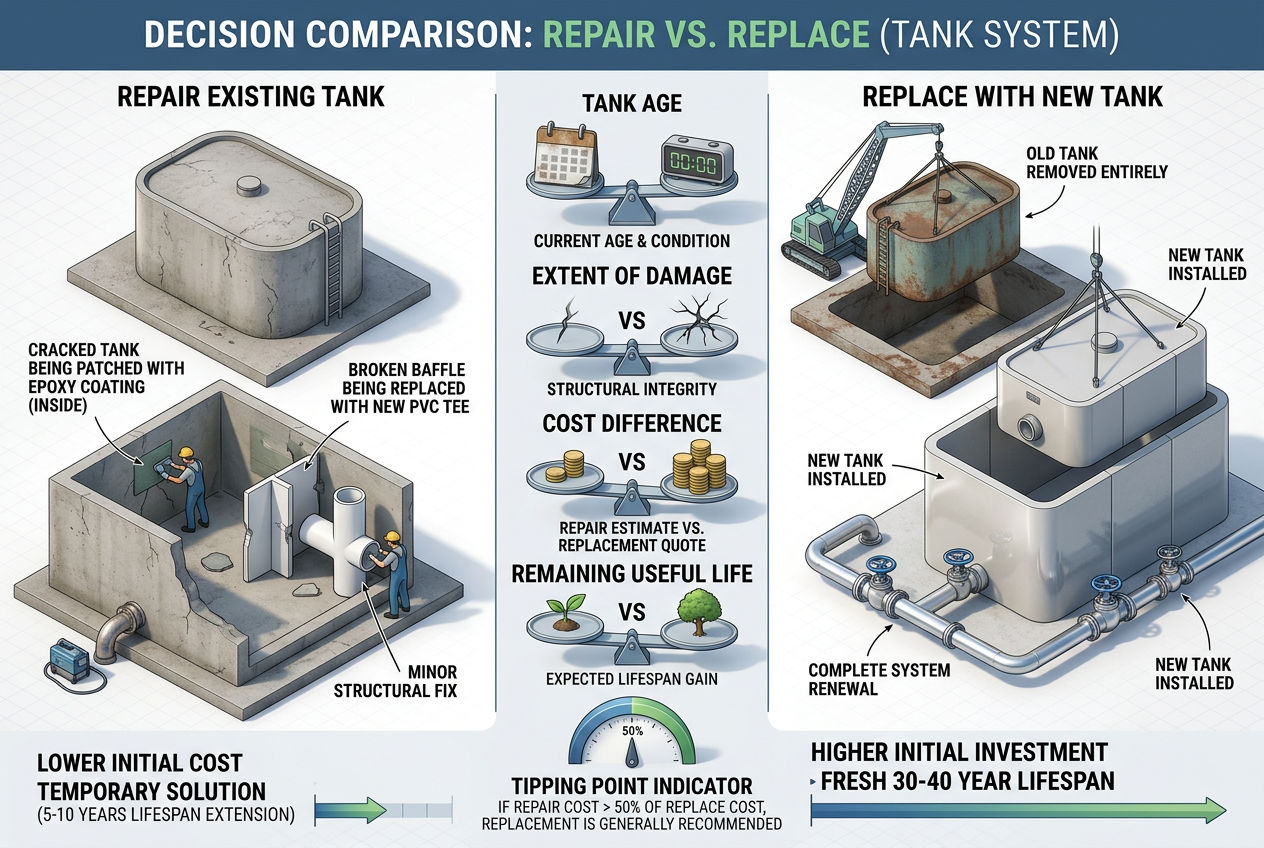
| Scenario | Typical Cost | When It Makes Sense |
|---|---|---|
| Minor repair (baffle, lid, riser replacement) | $200 – $1,500 | Isolated damage; tank is structurally sound |
| Major repair (crack patching, liner installation) | $1,500 – $4,000 | Tank is under 15 years old; single structural issue |
| Full tank replacement | $5,000 – $15,000 | Tank is 30+ years old; steel tank; multiple failures |
The Decision Framework
Minor damage? A cracked inlet baffle or a broken riser lid? Repair it — those are $300–$800 fixes.
Major structural issues? A 40-year-old concrete tank with active seepage through multiple crack lines? Replace it. Patching concrete that's been subjected to decades of hydrogen sulfide corrosion is a short-term band-aid on a long-term problem.
⚠️ Warning: Steel tanks are the clearest case for immediate replacement. Steel septic tanks have a 15–25 year lifespan, corrode from the inside out, and cannot be effectively repaired. If your inspector tells you the tank is steel, replacement isn't optional — it's overdue.
For a full breakdown of repair options and pricing, see our septic repair cost guide.
What Factors Can Increase (or Decrease) Your Total?
Beyond tank size and material, several variables can push your quote up or down by thousands of dollars.
Soil Conditions
Soil conditions are a major wildcard:
- Sandy or loamy soil — Excavates quickly and cheaply
- Clay-heavy soil — Takes longer and may require a larger machine
- Rocky ledge (common in New England and the Mountain West) — Can add $2,000–$5,000 in excavation costs alone
Site Accessibility
Site accessibility matters more than most homeowners realize. If your tank is buried under a deck, near a mature tree with root intrusion, or on a slope that limits equipment access, expect to pay a premium. Contractors price for complexity, not just time.
High Water Table
High water table situations may require switching to a mound system or aerobic treatment unit rather than a conventional buried tank. That upgrade adds $5,000–$10,000 to the project. High water table septic options explains the alternatives.
Local Regulations
Local regulations vary more than most people expect:
- Florida requires licensed Registered Septic Tank Contractors (RSTC) through the Department of Health
- California's permitting process can involve environmental review that adds months and thousands to a project
- Texas delegates oversight to county-level Designated Representatives, creating wide variation even within the state
Upgrading While You're At It
Common upgrades that add $500–$2,000 but avoid digging up the yard again in five years:
- Replacing old clay pipe with schedule 40 PVC
- Adding a pump chamber with float switches
- Installing concrete risers to bring lids to grade
Regional Cost Differences Across the U.S.
Where you live can shift your total by 30–50% compared to the national average.
| Region | Cost vs. National Average | Key Drivers |
|---|---|---|
| Northeast (NY, NJ, MA, CT) | +20–40% | Strict regulations, rocky soil, high labor rates, short building season |
| Southeast (FL, GA, SC) | Near avg to +10% | High water tables (especially FL) may require mound or ATU systems |
| Midwest (OH, IN, MI, MN) | -5% to +10% | Clay soil increases excavation; seasonal limitations in northern states |
| South Central (TX, OK, LA) | -10% to avg | Lower labor costs; many areas require aerobic systems |
| Mountain West (CO, MT, ID) | +10–25% | Rocky terrain; remote locations add mobilization costs |
| Pacific Northwest (WA, OR) | +15–30% | High labor costs; wet soil; strict environmental regulations |
| California | +30–50% | Highest regulatory burden; extensive permitting; high labor market |
📊 Quick Fact: A concrete 1,500-gallon tank replacement in rural Indiana might run $7,500. The same job in Marin County, California could exceed $18,000 once permitting, a licensed engineer's site plan, and California labor rates are factored in.
How to Save Money on Septic Tank Replacement
You can't negotiate away permit fees or soil conditions, but you can control a few things.
Time It Right
Fall (September–November) is the best window for non-emergency replacements. Contractors have more availability after the spring and summer rush, ground conditions are still workable, and you have more negotiating leverage than you would in April. Spring replacements in busy markets can run 10–15% higher simply because demand exceeds contractor capacity.
Get Three Quotes — Minimum
Pricing for the same job can vary $2,000–$4,000 between contractors in the same market. Use our contractor directory to find licensed companies near you. Check that each bidder holds a state septic contractor license — not just a general contractor license.
Sources & Methodology
-
U.S. Environmental Protection Agency — Federal guidance on septic system types, replacement standards, and homeowner responsibilities for onsite wastewater systems.
-
National Precast Concrete Association (NPCA) — Manufacturer pricing data and specifications for precast concrete septic tanks, the most commonly installed tank type.
-
National Onsite Wastewater Recycling Association (NOWRA) — Industry data on septic system replacement costs by type, region, and site complexity.
-
USDA Rural Development — Financing programs and grants available for septic system replacement in rural areas, including the Section 504 Home Repair Program.
-
National Environmental Services Center (NESC) — Technical guidance on replacement system selection based on site conditions, soil type, and regulatory requirements.
Cost data reflects 2025–2026 national averages compiled from contractor pricing surveys across SepticTankHub.com's directory network.
Need help with your septic system? Find trusted septic professionals near you to get free quotes. Browse local septic companies in Wisconsin or Oregon.
Free download
Not ready for the Blueprint? Start free.
Grab the free DIY Septic Planning Kit — the permit-first checklist, perc-test cheat sheet, and sizing tables that keep your build from getting red-tagged.
Was this article helpful?
Frequently Asked Questions
Recommended Resources
📖 Related Articles
- What Size Septic System Do I Need?
- Concrete vs Plastic Septic Tanks: Which Is Better?
- Fiberglass vs Concrete vs Poly Septic Tanks Compared
- Aerobic Septic System (ATU) Cost: $10K–$20K Install (2026)
- Septic System Permit Cost & State Requirements (2026 Guide)
- Perc Test (Percolation Test): What It Is & How It Works
- Types of Septic Systems: Complete Comparison Guide
- High Water Table and Septic Systems: What You Need to Know
💰 Cost Guides
🔧 Services
Find Septic Professionals Near You
Compare licensed, verified septic companies by area — top county markets and cities below, or browse all 50 states.
County markets
Popular cities
