
Quick Answer
An aerobic septic system costs $10,000–$20,000 installed nationally, with most homeowners landing near $15,000 for a standard residential setup. Monthly operating costs run $75–$175, covering electricity for the aerator pump, a required maintenance contract, and chlorine tablets — making the total 10-year cost of ownership $25,000–$40,000.
📖 Also known as: Aerobic septic systems are sometimes called aerated septic systems, aerated wastewater treatment systems (AWTS), or ATUs (aerobic treatment units). All four terms refer to the same technology — a septic system that injects oxygen into the treatment chamber to accelerate bacterial breakdown. Brand names you'll see quoted include Clearstream, Jet Inc., Norweco Singulair, and BioMicrobics FAST/RetroFAST.
💡 Key Takeaways:
- Installed cost: $10,000–$20,000 nationally (average ~$15,000); up to $25,000+ on difficult sites
- Monthly running cost: $75–$175/month (electricity + maintenance contract + chlorine)
- Equipment unit alone: $4,000–$8,000 depending on brand and capacity
- Conventional comparison: Aerobic systems cost 2–3x more than conventional septic ($3,000–$7,000 installed)
- Conversion from conventional: $5,000–$15,000 depending on what's already in the ground
How Much Does an Aerobic Septic System Cost to Install?
A fully installed aerobic treatment unit (ATU) costs $10,000–$20,000 for most residential properties. Complex sites — rocky terrain, high water tables, tight lot lines — push that number past $25,000. The equipment unit itself accounts for $4,000–$8,000 of that total; the rest is labor, permits, dispersal field installation, and site prep.
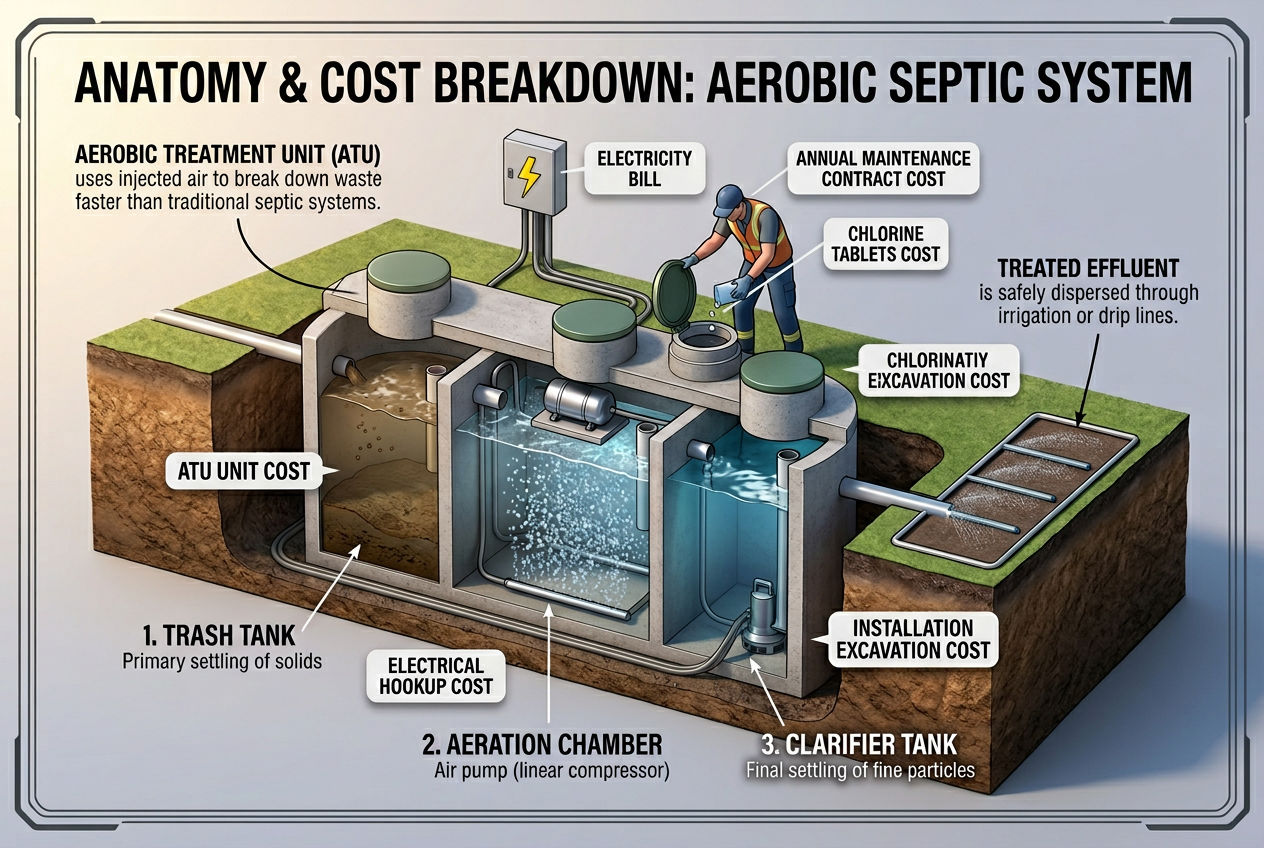
Installation Budget Breakdown
Here's how the installation budget typically breaks down:
| Cost Component | Low | High |
|---|---|---|
| ATU unit (equipment only) | $4,000 | $8,000 |
| Spray field / drip dispersal | $2,000 | $5,000 |
| Permit and engineering fees | $500 | $2,500 |
| Soil testing / site evaluation | $250 | $1,000 |
| Labor (excavation, install) | $2,500 | $5,000 |
| Total Installed | $10,000 | $20,000+ |
Source: National installer pricing data compiled from NAWT member contractors; EPA on-site wastewater program cost benchmarks.
Equipment Brand Pricing
The ATU brand you choose moves that equipment number significantly. Based on current manufacturer spec sheets:
- Clearstream: ~$4,500–$7,500 (unit only)
- Jet Inc. J-500/J-1500 series: ~$4,000–$7,000
- Norweco Singulair: ~$5,000–$8,000
- BioMicrobics FAST/RetroFAST: ~$4,500–$6,500
⚠️ Warning: All of these must meet NSF/ANSI Standard 40, the EPA-referenced certification for residential aerobic treatment units. If a contractor quotes you equipment that isn't NSF/ANSI 40 certified, walk away.
System Sizing and Capacity
Sizing matters too. Most residential systems are sized at 500–1,500 gallons per day (GPD). Most jurisdictions calculate capacity based on bedrooms — a three-bedroom home typically requires a system rated for ~450 GPD. Upsize to a four- or five-bedroom home and your ATU unit cost jumps, along with the spray field area.
For a general baseline on total septic system installation costs, including conventional options, see our full cost guide.
Aerobic Septic System Maintenance Cost: Monthly and Annual Running Costs
Aerobic septic system maintenance cost averages $75–$175 per month all-in ($900–$2,100 per year), covering three recurring expenses: electricity for the aerator, a required service contract, and chlorine tablets for the disinfection chamber. Over a 10-year ownership window, plan on $9,000–$21,000 in pure maintenance costs on top of the install.
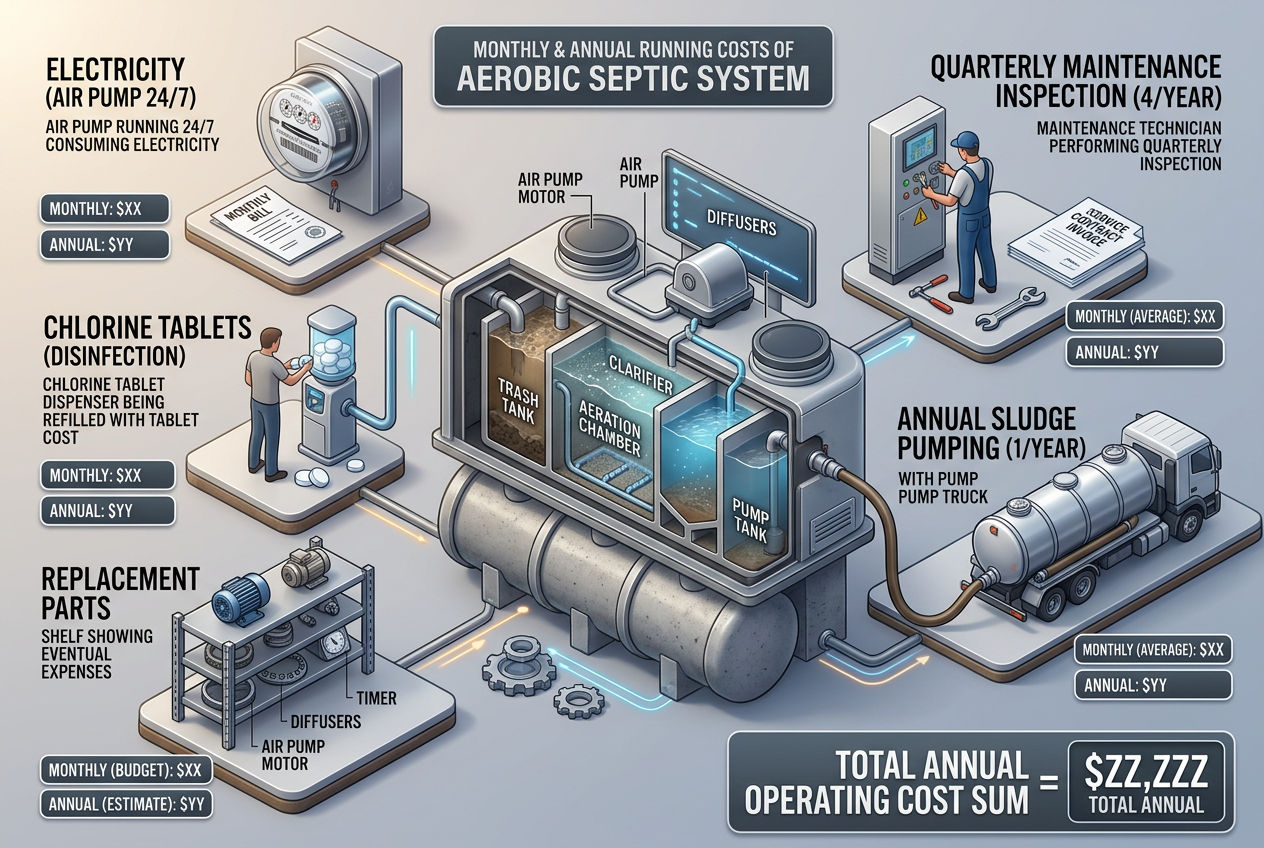
Breaking Down Electricity Costs
Electricity: The aerator pump (air compressor) runs 24 hours a day. A typical unit like the Hiblow HP-80 draws 80–100 watts continuously. A slightly larger system might use a 150-watt aerator. Run the math:
📊 Quick Fact: 100 watts × 24 hrs × 30 days = 72 kWh/month At $0.13/kWh (U.S. average): ~$9.36/month At $0.25/kWh (California, Hawaii): ~$18/month
Wait — those numbers seem low. The aerator isn't the only thing drawing power. Add the pump timer, control panel, spray head pump cycles, and alarm panel. Total system electricity typically runs $50–$130/month, or $600–$1,560/year. Texas homeowners with high summer usage tend to hit the upper end.
Maintenance Contracts and Chlorination
Maintenance contract: Most states legally require a licensed inspector to service your ATU 2–4 times per year. In Texas, the TCEQ (Texas Commission on Environmental Quality) mandates quarterly inspections. Annual contract cost: $200–$400/year, or roughly $17–$33/month.
Chlorine tablets: Your disinfection chamber consumes chlorination tablets to treat effluent before it disperses. Budget $50–$150/year — a minor cost, but one that surprises homeowners who didn't know it existed.
Total Operating Cost Summary
| Ongoing Cost | Annual | Monthly |
|---|---|---|
| Electricity | $600–$1,560 | $50–$130 |
| Maintenance contract | $200–$400 | $17–$33 |
| Chlorine tablets | $50–$150 | $4–$13 |
| Total | $850–$2,110 | $71–$176 |
✅ Pro Tip: You'll also need periodic sludge pumping — just like a conventional system. The pretreatment tank (sometimes called the trash tank) still accumulates solids. Plan on pumping every 1–3 years depending on household size.
Septic tank pumping cost typically runs $300–$600 for a standard residential tank. Check our septic pumping cost by state guide for regional pricing.
How Does Aerobic Septic System Cost Compare to Conventional?
The aerobic vs. conventional septic cost gap is real and significant. A conventional gravity-fed system with a drain field runs $3,000–$7,000 installed. An aerobic system costs 2–3 times more upfront, and carries ongoing monthly expenses a conventional system doesn't.
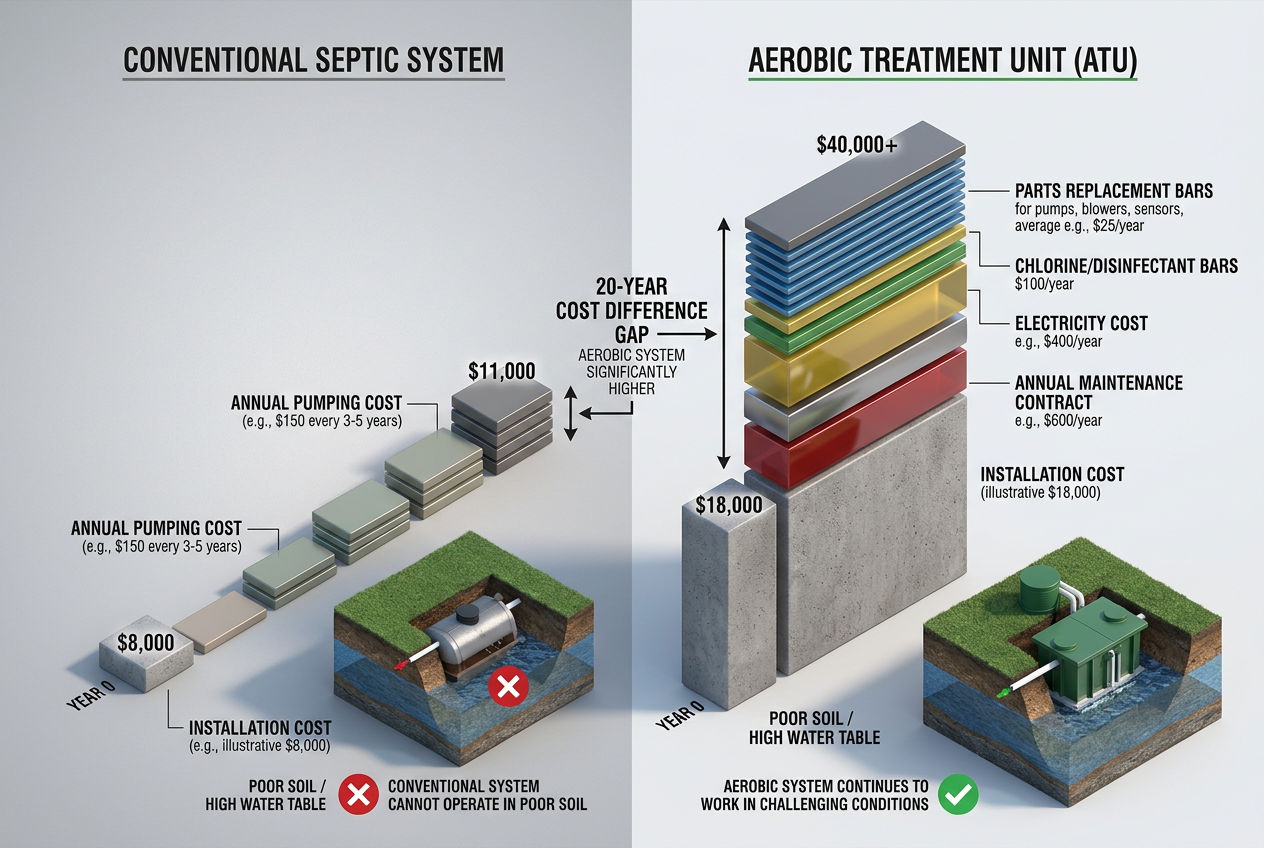
Why Choose Aerobic If It Costs More?
So why would anyone choose aerobic? Usually, they don't have a choice.
Common situations that mandate aerobic systems:
- Perc test failures on clay or rocky soil
- High water tables that prevent conventional drain field installation
- Small lots with insufficient space for conventional dispersal
- Proximity to waterways, wells, or environmentally sensitive areas
- County health department regulations requiring advanced treatment
📊 Quick Fact: In much of rural Texas, Florida, and the Ozarks, spanning Arkansas and Missouri, aerobic systems aren't optional; they're the only permitted option.
Learn more about how these systems compare at a technical level in our aerobic vs. anaerobic septic guide. Keep in mind that ATUs are just one of several alternative septic systems — mound, sand filter, and drip systems solve many of the same site problems.
10-Year Total Cost of Ownership
The ten-year total cost of ownership tells the full story:
| System Type | 10-Year Total Cost | Components |
|---|---|---|
| Aerobic system | $25,000–$40,000 | Installation + operating costs |
| Conventional system | $5,000–$12,000 | Installation + pumping only |
| Difference | $15,000–$28,000 | Added cost for aerobic |
On the flip side, aerobic systems produce significantly cleaner effluent — reducing biochemical oxygen demand (BOD) and total suspended solids (TSS) to levels that allow surface dispersal through spray heads, which often means a smaller footprint than a conventional drain field. On a tight lot, that's not nothing.
For a broader comparison of system types, see our guide to types of septic systems.

DIY Septic Blueprint
Thinking about building it yourself?
The complete, plain-English plan to size, permit and install your own septic system — designed for homeowners, not contractors. Skip the $15,000–$25,000 quotes and do it right the first time.
Get the DIY Blueprint — $67 →Instant download · 8 modules + 3 bonus guides · 60-day money-back guaranteeHow Much Does It Cost to Convert a Conventional Septic to Aerobic?
Converting an existing conventional system to aerobic costs $5,000–$15,000, depending on what's already in the ground and how much of it can be reused.
Retrofit vs. Full Conversion Options
A drop-in retrofit unit like the BioMicrobics RetroFAST can convert an existing septic tank by installing an aerobic treatment module inside the tank itself. These retrofit units run $4,000–$7,000 plus installation labor. They're a real option if your existing concrete tank is structurally sound and properly sized.
A full conversion — new ATU unit, new spray field, new control panel, new alarm — approaches the cost of a fresh installation. The savings come when you can reuse the existing tank as the pretreatment chamber, skip some excavation, and work with an existing dispersal area.
What Drives Conversion Costs Up
- Existing tank is undersized or structurally compromised
- New spray field required on a small or heavily landscaped lot
- Permit requirements mandate a full system redesign (common in Florida)
- Local regulations require a certified engineer to approve the retrofit
✅ Pro Tip: If you're on a failing conventional system and considering your options, review our septic system replacement cost guide alongside conversion quotes.
Is an Aerobic Septic System Worth the Extra Cost?
Whether an aerobic system is "worth it" depends almost entirely on whether you have a real choice.
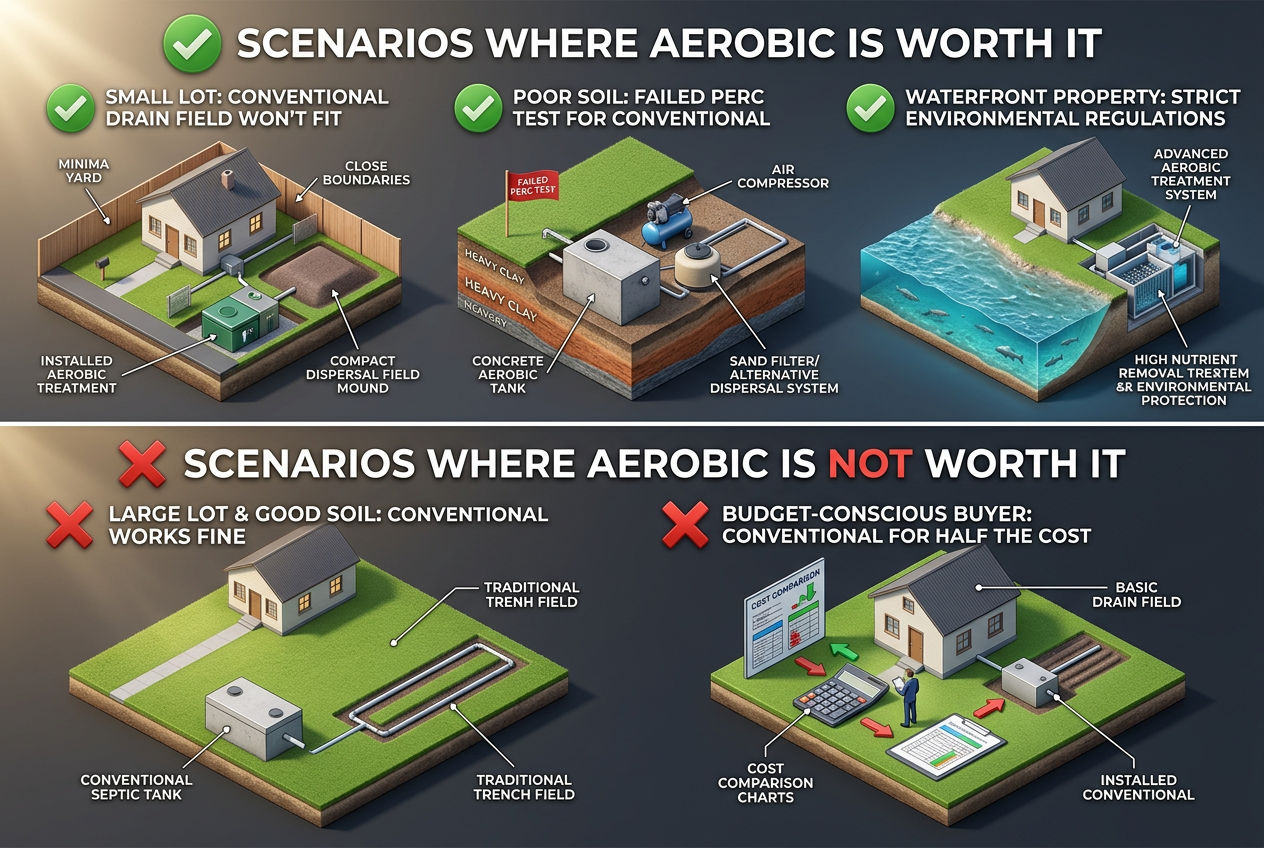
When You Have No Choice
If your lot failed a perc test, sits near a waterway, or falls in a county that mandates ATUs, you're not comparing aerobic to conventional — you're comparing aerobic to no system at all. In that case, the $15,000 installation cost is the cost of living on that property. Before you commit, though, it's worth reviewing the full range of options after a failed perc test — an aerobic unit is the most common answer, but not always the only one.
When the Math Gets Interesting
Where the math gets interesting is on marginal sites. Picture this: you're buying a five-acre rural property and the previous owner installed a conventional system that's 18 years old. A septic inspection reveals the drain field is showing early signs of stress. You could repair the existing system for $3,000–$8,000, or use the sale negotiation to fund a full aerobic conversion that meets current county code and carries a fresh permit.
💡 Key Takeaway: In some Texas counties, selling a property with a non-compliant conventional system is a deal-killer. An aerobic system — properly permitted and under a current maintenance contract — is a selling point.
The Honest Limitations
The honest limitations: aerobic systems have more moving parts. The aerator pump typically lasts 3–5 years before needing replacement ($200–$600). Spray heads clog or break ($20–$60 each). Control panels fail ($200–$700 to repair or replace). A conventional system, by contrast, has almost no mechanical components to fail. If you hate maintenance calls and monthly operating costs, aerobic is a harder sell. If you're on a site that genuinely needs it, the system is worth every dollar.
The EPA's on-site wastewater treatment guidance explicitly recognizes aerobic treatment units as appropriate technology for sites where conventional systems cannot perform adequately. See EPA.gov/septic for current federal guidance on advanced treatment systems.
Aerobic Septic Cost in Texas: Why ATUs Dominate the Lone Star State
Texas installs more aerobic septic systems per year than any other state. The reason: thin soils over limestone karst, drought-prone water tables, and TCEQ regulations that mandate aerobic treatment in dozens of counties make conventional gravity-fed septic systems impractical or illegal.
Texas-Specific Cost Breakdown
In Texas, expect installed costs of $11,000–$16,000 for a standard 3-bedroom residential ATU, with rural Hill Country and East Texas markets running closer to the $11,000–$13,000 range and metro Austin, San Antonio, and Houston suburbs hitting $14,000–$18,000+.
What's specific to Texas:
- Mandatory maintenance contracts. TCEQ Rules 30 TAC 285 require ATU owners to hold a service contract with a licensed maintenance provider for the life of the system. Quarterly inspections at $50–$125 each add $200–$500/year on top of the install cost.
- Spray field vs drip distribution. Texas counties typically allow surface spray dispersal, which keeps installation costs lower than drip irrigation systems required in Florida or California. Spray heads run $20–$60 each to replace.
- County Designated Representatives (DR). Permitting flows through county-level DRs rather than state-level review. Permit fees vary $100–$400 depending on county.
- Drought-driven equipment stress. Long Texas summers push aerator pumps harder than cooler climates. Plan on aerator replacement every 3–5 years at $200–$600 — slightly faster than the national average.
💡 Key Takeaway: In counties around Austin (Hays, Bastrop, Travis), San Antonio (Bexar, Comal, Kendall), and the Hill Country broadly, aerobic systems aren't a choice — they're the standard. Budget realistically and choose an installer with TCEQ-registered maintenance certification from day one.
Top Texas ATU Manufacturers
Most Texas installations use one of these NSF/ANSI Standard 40-certified units:
- Norweco Singulair — dominant in metro Austin and Houston ($5,000–$8,000 unit)
- Clearstream — Texas-based manufacturer, common in rural counties ($4,500–$7,500)
- Jet Inc. J-1500 — widely used in East Texas ($4,000–$7,000)
How Much Does an Aerobic Septic System Cost by Region?
Regional pricing varies by $3,000–$8,000 on the same basic system. Labor rates, permit costs, regulatory complexity, and local market competition all play a role.
Regional Cost Breakdown
Texas is the biggest aerobic market in the country by volume. The TCEQ mandates aerobic systems in many counties and requires legally binding maintenance contracts with quarterly inspections. Volume keeps equipment prices competitive — figure $11,000–$16,000 installed in most Texas markets. See our Texas septic directory for local installers.
Southeast (Florida, Georgia, Alabama): High water tables and strict DEH permitting in Florida add $1,000–$2,000 in permitting costs alone. Total installed cost runs $13,000–$18,000. Florida requires licensed Registered Septic Tank Contractors (RSTC) through the Department of Health.
Pacific Northwest (Oregon, Washington): Oregon DEQ regulations, higher labor rates, and nitrogen-reduction requirements in sensitive watersheds push costs to $15,000–$22,000. Some sites near coastal areas or streams require tertiary treatment, adding another $2,000–$5,000.
Northeast (New York, Vermont, Maine): Highest installed costs in the country — $16,000–$25,000+. Cold climates require:
- Insulated risers
- Deeper burial (42–60 inch frost lines)
- Sometimes heating elements on exposed components
- Add $500–$2,000 for cold-climate winterization
⚠️ Warning: Frost line depths of 42–60 inches in northern states require careful pipe burial to prevent $1,500–$2,500 freeze-thaw damage.
Read more about preventing cold-weather septic problems in our septic pipe freeze prevention guide.
Midwest (Ohio, Indiana, Michigan): Aerobic systems are less commonly required here; conventional systems remain the norm. But lower competition among ATU installers can mean higher per-unit pricing despite lower labor rates. Budget $12,000–$18,000 if an ATU is required.
Ozarks/Appalachian regions (Arkansas, Missouri, West Virginia): Rocky terrain and thin soils mandate ATUs on many properties, but lower labor costs partially offset equipment costs. Expect $10,000–$16,000 installed.
What Repairs and Replacements Should You Budget For?
An ATU lifespan runs 15–25 years with proper maintenance, but individual components fail well before the whole system does. Here's what breaks most often and what it costs:
Common Component Replacements
- Aerator pump replacement: $200–$600 (expect this every 3–5 years)
- Chlorinator replacement: $100–$300
- Spray head replacement: $20–$60 per head (clogging and mechanical wear)
- Control panel repair/replacement: $200–$700
- Full ATU unit replacement (end of life): $5,000–$8,000 for equipment only
💡 Key Takeaway: The aerator pump is by far the most frequent repair item. Budget for it like you would a furnace filter or water heater anode rod — it's not if, it's when.
Preventive Maintenance Saves Money
A good maintenance contract will catch early signs of aerator failure before it becomes an emergency. If you hear the alarm panel sounding, don't ignore it. That's your system telling you the aerator is failing and effluent quality is dropping.
⚠️ Warning: Keep up with inspections and you'll likely avoid the bigger repair bills. Neglect the maintenance contract for a few years and you're looking at a clogged spray field or a failing ATU unit — expenses that dwarf the $300/year contract cost.
Our septic tank maintenance guide covers best practices that apply to both conventional and aerobic systems.
Sources & Methodology
1. EPA On-Site Wastewater Treatment Systems: Federal guidance on aerobic treatment units, NSF/ANSI Standard 40 certification requirements, and appropriate-use criteria. epa.gov/septic
2. NAWT (National Association of Wastewater Technicians): Installer cost benchmarks and maintenance contract standards. nawt.org
3. TCEQ (Texas Commission on Environmental Quality): State-specific regulations for aerobic systems including mandatory maintenance contracts and quarterly inspection requirements. Referenced by agency name; see TCEQ.texas.gov for current rules.
4. Manufacturer spec sheets: Equipment pricing ranges for Clearstream, Jet Inc., Norweco Singulair, and BioMicrobics FAST/RetroFAST sourced directly from published manufacturer documentation and distributor pricing as of Q1 2026.
5. Florida Department of Health, Environmental Health Section: RSTC licensing requirements and DEH permitting cost benchmarks for on-site sewage treatment systems in Florida.
Cost ranges reflect national installer data compiled from NAWT member contractors and regional market surveys. Individual quotes may vary based on soil conditions, local permit fees, contractor availability, and site complexity. Prices current as of January 2026.
Ready to get real quotes for your property? Find aerobic septic installers near you through the SepticTankHub directory.
Need an aerobic septic system installed or serviced? Browse TCEQ-certified installers and licensed providers in Texas, Florida, Arkansas, Missouri, or Louisiana — or find a pro in any state on our homepage. Learn more about septic inspection services.
Free download
Not ready for the Blueprint? Start free.
Grab the free DIY Septic Planning Kit — the permit-first checklist, perc-test cheat sheet, and sizing tables that keep your build from getting red-tagged.
Was this article helpful?
Frequently Asked Questions
Recommended Resources
📖 Related Articles
- Septic Tank Pumping Cost by State: Regional Price Comparison
- How Much Does a Perc Test Cost? (2026 Pricing)
- Aerobic vs Anaerobic Septic Systems: How They Compare
- Types of Septic Systems: Complete Comparison Guide
- Septic Tank Replacement Cost 2026: $5,000–$15,000 (Full Breakdown)
- Freezing Pipes and Septic: How to Prevent Winter Damage
- The Complete Septic Tank Maintenance Guide
💰 Cost Guides
Find Septic Professionals Near You
Compare licensed, verified septic companies by area — top county markets and cities below, or browse all 50 states.
County markets
Popular cities
