
Quick Answer
Septic tank pumping cost by state ranges from roughly $200 in the rural South to $800 or more in Hawaii and coastal New England. The national average sits around $375–$400 for a standard 1,000-gallon residential tank. Where you live — not just the size of your tank — plays a major role in what you'll pay.
💡 Key Takeaways
- The national average septic pump-out costs $300–$500 for a 1,000-gallon tank (2024–2025 estimates).
- The cheapest states — Alabama, Mississippi, Arkansas — average $200–$350.
- The most expensive states — Massachusetts, Connecticut, Hawaii, Alaska — average $500–$800+.
- Tank size, disposal fees, travel distance, and seasonal demand all affect your final bill.
- Scheduling in early fall (September–October) typically gets you the best rates and fastest availability.
According to the EPA, more than 21 million households across the United States rely on septic systems — and every single one of those tanks needs pumping eventually. Ignore it long enough and you're looking at $15,000–$30,000 for a full system replacement. The pump-out? That's the cheapest maintenance you can do.
📊 Quick Fact: Septic pumping prices have risen 15–25% since 2020 due to higher diesel costs, tighter labor markets, and increased wastewater disposal fees at treatment facilities. A pump-out that cost $275 in 2021 now averages $325–$375 in most markets.
But "how much does septic pumping cost" isn't a simple one-number answer. A homeowner in rural Indiana and a homeowner in coastal Connecticut own the same 1,000-gallon concrete tank — and pay completely different prices to empty it. This guide breaks down exactly why, with real numbers by state.
If you're not sure your tank even needs pumping yet, check the signs your septic tank needs pumping before scheduling a service call.
For the national average, cost by tank size, and a full hidden-fee breakdown, see our main septic tank pumping cost guide. This page zooms in on how prices differ by state.
How Much Does Septic Tank Pumping Cost by State?
A standard septic pump-out for a 1,000-gallon tank costs $300–$500 nationally in 2026. Most residential homeowners pay somewhere between $275 and $450 depending on their region. The full range — from the cheapest rural Southern markets to Alaska — runs $200 to $850+.
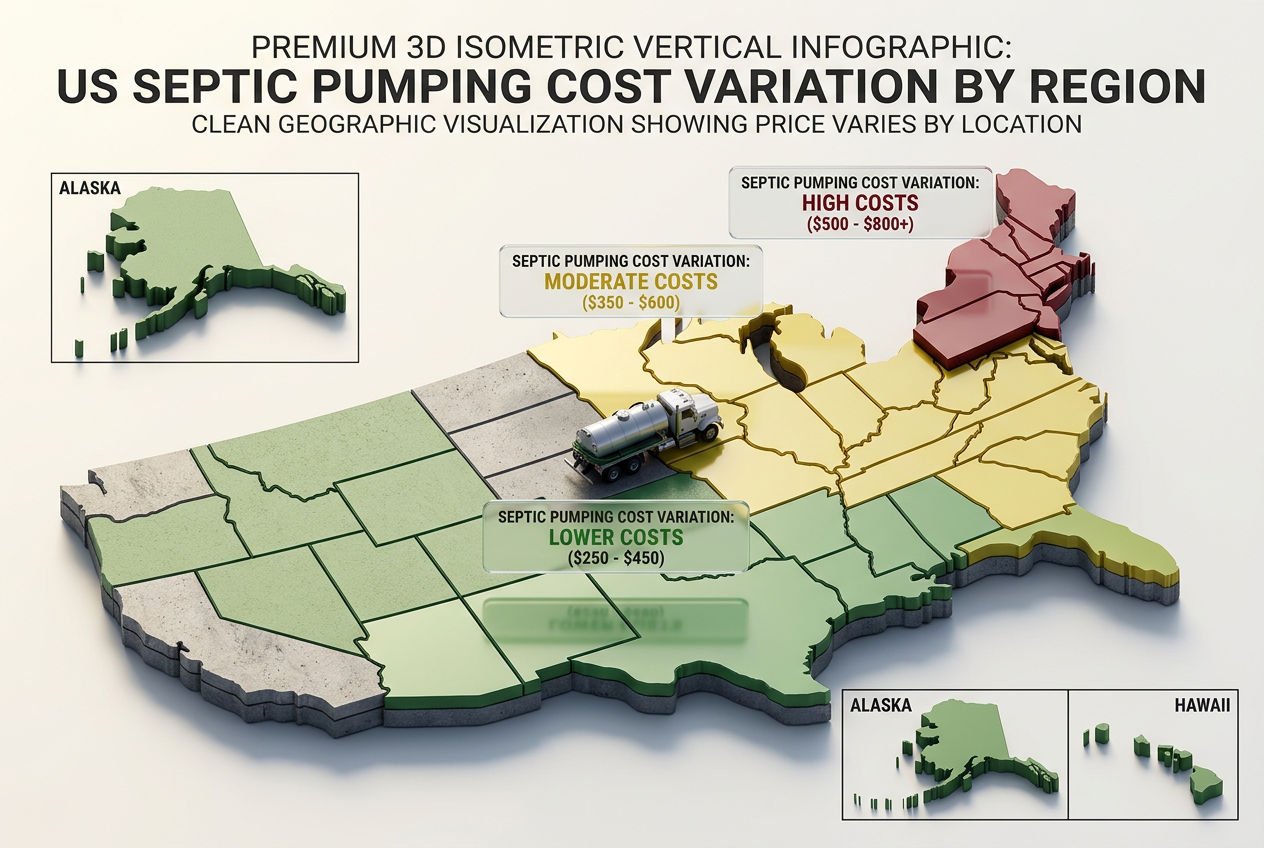
Prices have climbed 15–25% since 2020. Higher diesel costs, tighter labor markets, and rising wastewater disposal fees at treatment facilities have all pushed rates up across every region. The contractor who charged you $275 three years ago may quote $325–$350 today, and that's not gouging — that's the new normal.
The table below shows average septic pumping costs by state for 2024–2025. Each state links to its local service directory so you can check real contractor quotes in your area.
| State | Avg. Pumping Cost | Typical Range |
|---|---|---|
| Alabama | $270 | $200–$340 |
| Alaska | $700 | $550–$850 |
| Arizona | $385 | $300–$475 |
| Arkansas | $255 | $195–$330 |
| California | $490 | $380–$650 |
| Colorado | $400 | $310–$510 |
| Connecticut | $560 | $430–$720 |
| Delaware | $420 | $330–$540 |
| Florida | $340 | $260–$430 |
| Georgia | $325 | $250–$420 |
| Hawaii | $760 | $580–$900 |
| Idaho | $370 | $280–$470 |
| Illinois | $375 | $290–$480 |
| Indiana | $310 | $240–$400 |
| Iowa | $320 | $245–$410 |
| Kansas | $315 | $240–$405 |
| Kentucky | $300 | $230–$385 |
| Louisiana | $310 | $245–$400 |
| Maine | $500 | $390–$640 |
| Maryland | $430 | $335–$545 |
| Massachusetts | $570 | $440–$730 |
| Michigan | $355 | $270–$455 |
| Minnesota | $390 | $300–$500 |
| Mississippi | $250 | $190–$320 |
| Missouri | $310 | $240–$400 |
| Montana | $430 | $330–$545 |
| Nebraska | $305 | $235–$390 |
| Nevada | $415 | $320–$530 |
| New Hampshire | $530 | $410–$670 |
| New Jersey | $540 | $415–$695 |
| New Mexico | $365 | $275–$460 |
| New York | $510 | $390–$660 |
| North Carolina | $335 | $255–$425 |
| North Dakota | $345 | $265–$440 |
| Ohio | $340 | $260–$435 |
| Oklahoma | $280 | $215–$360 |
| Oregon | $430 | $330–$545 |
| Pennsylvania | $395 | $305–$505 |
| Rhode Island | $545 | $420–$700 |
| South Carolina | $305 | $235–$390 |
| South Dakota | $335 | $255–$430 |
| Tennessee | $320 | $245–$415 |
| Texas | $355 | $270–$455 |
| Utah | $380 | $290–$485 |
| Vermont | $510 | $390–$660 |
| Virginia | $380 | $290–$485 |
| Washington | $445 | $345–$570 |
| West Virginia | $315 | $240–$405 |
| Wisconsin | $365 | $280–$465 |
| Wyoming | $415 | $315–$530 |
Source: SepticTankHub.com contractor survey data, HomeAdvisor/Angi market data, and regional pumping company rate sheets, 2024–2025.
Why Do Septic Pumping Costs Vary So Much by State?
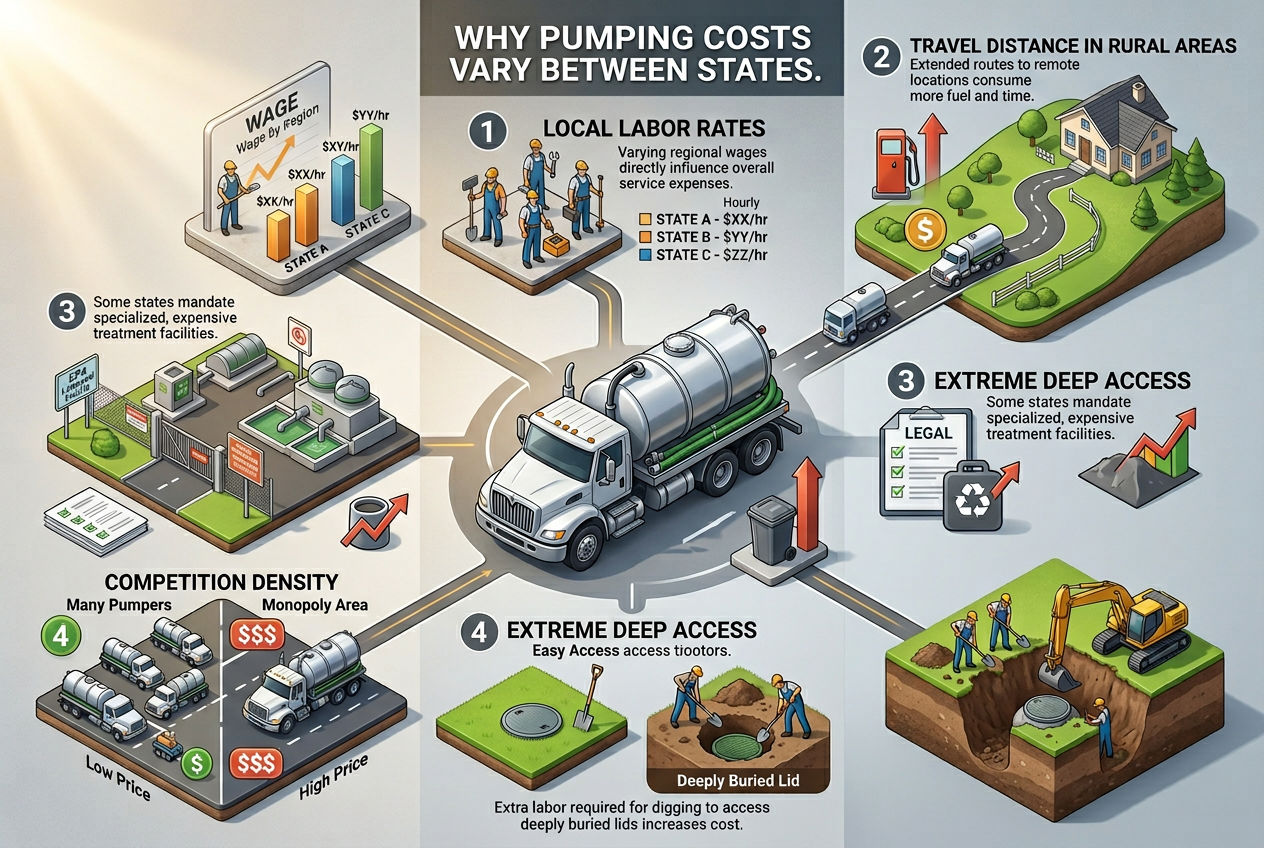
Regional septic pumping costs differ for seven concrete reasons — and most of them have nothing to do with the contractor's profit margin.
📊 Quick Fact: The gap between the cheapest and most expensive states is massive — a homeowner in Mississippi pays around $250 while one in Hawaii pays $760 for the same service. That's a 3x price difference for an identical 1,000-gallon pump-out.
Regulatory and Labor Costs
1. Cost of living and local labor rates. A licensed pumper in Hartford, CT, earns a different wage than one in rural Arkansas. Northeast and West Coast labor markets run 40–80% higher than the Southeast and Midwest. That gap flows directly into your invoice.
2. State licensing requirements. Minnesota's Pollution Control Agency (MPCA) requires licensed pumpers to file disposal manifests with the county after every service call. Florida requires all contractors to hold a Registered Septic Tank Contractor (RSTC) license through the Florida Department of Health. Texas delegates oversight to county-level Designated Representatives, which creates a patchwork of local rules. More regulatory overhead means higher compliance costs — which you pay.
3. Wastewater disposal fees. After the vacuum truck empties your tank, that waste has to go somewhere. Licensed treatment facilities charge tipping fees that range from $25 per load in rural Oklahoma to $150+ per load in parts of New England. In states with fewer approved disposal sites, those fees spike hard.
Geographic and Access Factors
4. Travel distance and rural surcharges. Picture a pumper in Bozeman, Montana, driving 45 minutes to reach a property on a dirt road. That fuel cost and drive time gets billed back to you — typically as a $50–$150 travel surcharge. Western states like Montana, Wyoming, and Nevada see this regularly. Rural properties in any state face this math.
5. Terrain and access. Rocky soil (common in New England) makes tank access harder. High water tables in Florida and Louisiana complicate pumping logistics. If the pumper has to hunt for your lid or hand-dig to reach it, expect a $50–$200 lid-locating fee on top of the base rate.
Market Dynamics
6. Competition density. In suburban Ohio, six septic companies might serve the same zip code. In rural North Dakota, there might be one. Less competition = less pricing pressure. It's not complicated. (Ever wonder what that competition looks like from the operator's side? See whether a septic pumping business is profitable and what owners actually earn.)
7. Fuel costs. Vacuum trucks run on diesel. States with higher diesel prices — California, Hawaii, New England — pass that cost through. A long-haul pump-out day burns 20–30 gallons, and the math adds up fast.
Which Are the Cheapest States for Septic Tank Pumping?
The five cheapest states for septic pumping in 2026 are Mississippi ($250 avg.), Arkansas ($255), Alabama ($270), Oklahoma ($280), and Kentucky ($300). All five share low cost-of-living indexes, affordable disposal options, and dense enough service competition to keep prices competitive.
Indiana, Iowa, Missouri, South Carolina, and Nebraska round out the bottom ten — all averaging under $325.
A real-world example: A 1,000-gallon tank serving a family of four in central Mississippi costs $220–$280 to pump. Pumping frequency for that household is every 3–4 years per EPA guidance. That's an annual ownership cost of roughly $60–$90 — less than a decent dinner out.
💡 Key Takeaway: In the ten cheapest states, regular septic pumping costs less than $90 per year when spread over a 3-year cycle. That's under $8 per month — far less than a municipal sewer bill, which averages $50–$70/month nationally.
If you live in one of these states, the financial case for sticking to a regular pumping schedule is even stronger. The cost of neglect — a failed drain field running $5,000–$15,000 to repair or replace — dwarfs decades of pump-outs.
Which Are the Most Expensive States for Septic Tank Pumping?
Hawaii tops the list at $760 average, followed by Alaska ($700), Massachusetts ($570), New Jersey ($540), Rhode Island ($545), Connecticut ($560), and New Hampshire ($530).
Hawaii and Alaska are geographic outliers — limited disposal infrastructure, remote logistics, and high base labor costs create a perfect storm for premium pricing. A 1,500-gallon tank in Honolulu can run $850–$1,000 for a standard pump-out. That's not an emergency call. That's Tuesday.
⚠️ Warning: If you own property in Hawaii or Alaska, budget 2–3x the national average for every septic service call — not just pumping. Parts, equipment, and licensed labor all carry island/remote-area premiums that apply to inspections, repairs, and replacements too.
The Northeast cluster (Massachusetts, Connecticut, Rhode Island, New Hampshire, New York, Vermont, Maine) sits 40–60% above the national average. Why? Dense regulatory environments, high tipping fees at regional treatment facilities, strong union labor markets, and some of the nation's oldest, most complicated septic infrastructure — much of it serving properties with limited access.
Vermont and Maine carry another factor: roughly 55% and 50% of households, respectively, rely on septic systems. High prevalence means high demand for a finite number of licensed contractors.
How Does Tank Size Affect Septic Pumping Prices?
Tank size is the single biggest variable your contractor controls on their quote. More gallons of sludge and scum means more vacuum truck time and higher tipping fees at the disposal facility.
Here's what you can expect nationally in 2026:
- 750-gallon tank: $200–$350
- 1,000-gallon tank: $300–$500
- 1,250-gallon tank: $350–$550
- 1,500-gallon tank: $400–$650
- 2,000-gallon tank or larger: $500–$800+
Not sure what size tank you have? A licensed contractor can tell you during the service call — or check your property records and original system permit, which should list the tank capacity.
✅ Pro Tip: Call your county health department or building permits office and ask for a copy of your septic system permit. It lists your tank size, installation date, and drain field location — all critical information that helps you get accurate pumping quotes and plan maintenance.
You can also read about how to find your septic tank lid if you're not even sure where the access point is.
What Hidden Fees Show Up on Septic Pumping Bills?
The base pump-out price rarely tells the whole story. Here's what can push your final invoice higher:

Lid locating and digging. If your concrete riser lids are buried under soil or sod — common on older systems — the pumper has to locate and uncover them manually. Expect $50–$200 depending on depth. Installing riser extensions after your next pump-out eliminates this charge permanently for around $100–$250.
Travel surcharges. Properties more than 15–20 miles from the contractor's base often incur fuel surcharges of $50–$150.
Emergency and after-hours calls. A midnight call because sewage is backing up into your house? Most companies charge 50–100% over standard rates for emergency septic pumping.
⚠️ Warning: Emergency septic calls on weekends and holidays can cost $600–$1,200+ — that's 2–3x the normal rate. Staying on a regular pumping schedule is the single best way to avoid these budget-busting surprise bills.
If you're worried about what an emergency might look like, learn the warning signs of a system backing up before it becomes a $700 midnight call.
Multiple compartment pumping. Two-compartment tanks (common in systems installed after the 1980s) require pumping both chambers. Some contractors include this in the base price; others don't. Ask upfront.
Effluent filter cleaning. Many modern tanks have a Polylok PL-122 or similar effluent filter installed on the outlet baffle. Cleaning it during pump-out typically adds $20–$50. Skipping it isn't a good idea — a clogged filter forces solids toward your drain field.
Wastewater disposal/tipping fees. Some contractors build this into the quote. Others itemize it separately — $25 to $150+ depending on their region.
Always ask for an itemized quote before the truck rolls up.
⚠️ Pro Tip: Request an itemized written estimate before any work begins. A reputable contractor will break out the base pump-out fee, travel charges, lid-locating costs, and disposal fees separately — so you know exactly what you're paying for and can compare quotes accurately.
How to Save Money on Septic Tank Pumping
Timing and Scheduling
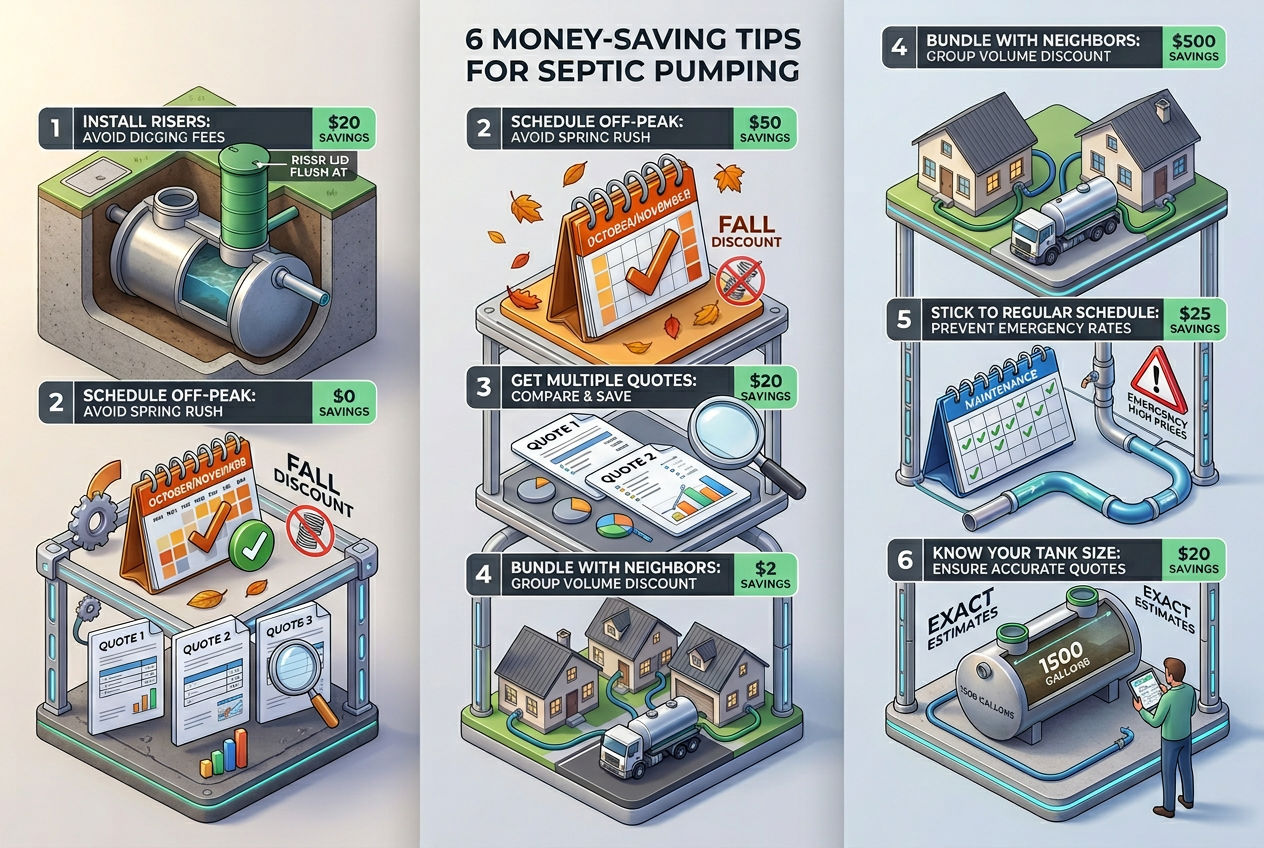
1. Schedule in early fall. September and October are the pricing sweet spot in most states. Spring and summer are peak demand — real estate transactions, pre-party prep, and post-winter backlog keep every truck busy and give contractors less reason to negotiate. Fall service often comes with shorter wait times and, sometimes, modest discounts.
✅ Pro Tip: Coordinate with 2–3 neighbors on your road and call the same contractor. Most pumping companies offer $25–$50 off per stop when they can service multiple properties in one trip — you all save money, and the contractor saves windshield time.
2. Bundle with neighbors. If you're on a rural road with three or four septic-owning neighbors, call them before you call the pumper. Many companies offer per-stop discounts when they can hit multiple properties in one trip. The truck is already in your driveway — the marginal cost to drive 200 feet to the next house is low, and a good contractor will reflect that.
3. Commit to a maintenance plan. Some contractors offer annual maintenance agreements that bundle inspection, effluent filter cleaning, and pumping at a discount. It's not always the right call, but for households with older systems or garbage disposals that increase pumping frequency, the math often works.
Long-Term Savings
4. Install riser lids now. Paying $150–$250 to install concrete or plastic riser extensions above your tank lids eliminates lid-locating fees on every future service call. Over 15 years, that's real money back in your pocket.
5. Don't oversave on pumping frequency. Stretching from a 3-year to a 5-year cycle to save one pump-out sounds smart. But if your 1,000-gallon tank is serving four people and you have a garbage disposal, you're risking sending solids into the drain field. Drain field replacement costs $5,000–$20,000. The $375 pump-out is the cheap option every time.
💡 Bottom Line: A single pump-out at $300–$500 every 3–5 years is the cheapest insurance you can buy for a septic system. Skipping it risks a drain field failure that costs 20–50x more to fix.
When Is the Best Time of Year to Have Your Septic Tank Pumped?
Early fall — specifically September and October — is the best time to schedule a pump-out in most U.S. regions. Demand drops after summer, but the ground hasn't frozen in northern states yet. Contractors are motivated to fill their schedules before winter, and you'll face shorter wait times.
Winter pumping gets complicated fast. In Minnesota, the frost line reaches 42–60 inches, and while properly buried tanks rarely freeze, access pipes and shallow risers can. For winter septic tank pumping in the northern tier — Minnesota, Wisconsin, Michigan, North Dakota, Maine, Vermont, New Hampshire — expect potential surcharges of $100–$300 if frozen ground requires extra labor. Some companies won't attempt pump-outs in January or February at all.
📊 Quick Fact: Winter surcharges in northern states add $100–$300 to a standard pump-out, and some contractors in Minnesota, Wisconsin, and North Dakota stop scheduling pump-outs entirely from December through February when frost depths exceed 4 feet.
In the South and Southwest, winter is actually a fine time to schedule. Ground stays workable, demand is low, and you'll likely get a quicker appointment than you would in June.
For a full breakdown of how often you should pump your septic tank based on household size and usage, that's the next article worth reading.
Sources & Methodology
SepticTankHub.com Contractor Survey (2024–2025): Aggregated pricing data from licensed septic contractors across all 50 states, including base pump-out rates, common surcharges, and seasonal pricing patterns.
U.S. Environmental Protection Agency — Septic Systems: EPA guidance on pumping frequency, household waste load, and system maintenance recommendations. epa.gov/septic
National Association of Wastewater Technicians (NAWT): Industry standards for pump-out procedures, sludge measurement (sludge judge readings), and technician certification. nawt.org
HomeAdvisor / Angi Market Data (2024): Consumer-reported cost data used to cross-validate regional pricing ranges.
State Health Department Licensing Databases: Florida Department of Health (RSTC licensing), Minnesota Pollution Control Agency (disposal manifest requirements), and Texas Commission on Environmental Quality (TCEQ) used to verify regulatory context.
All prices reflect 2024–2025 estimates. Regional averages represent standard residential pump-outs for 1,000-gallon tanks under normal access conditions. Individual quotes will vary based on tank size, access difficulty, travel distance, and local disposal fees.
Find Affordable Septic Pumping Services Near You
The best price data in the world doesn't help if you can't find a reliable contractor. Use the SepticTankHub.com directory to get quotes from licensed septic pumping companies in your area — or browse by state in the table above to find providers who serve your county.
If you're buying or selling a home with a septic system, you'll also want to read about septic inspection costs — most real estate transactions require one, and knowing what to expect keeps you from getting surprised at closing.
Need help with your septic system? Find trusted septic professionals near you to get free quotes. See our complete guide to septic pumping costs for current pricing. Browse local septic companies in Arizona or Washington.
Was this article helpful?
Frequently Asked Questions
Recommended Resources
📖 Related Articles
- 8 Signs Your Septic Tank Needs to Be Pumped
- How Often Should You Pump Your Septic Tank?
- How to Find Your Septic Tank Lid (And What to Do If It's Buried)
- Septic System Backing Up? Causes & Emergency Steps
- What Is a Drain Field? (And How Does It Work?)
- How Often Do Septic Systems Need to Be Replaced?
- Should You Pump Your Septic Tank Before Winter?
- Is a Septic Inspection Worth It? The $300 vs $20,000 Math
💰 Cost Guides
🔧 Services
Find Septic Professionals Near You
Compare licensed, verified septic companies by area — top county markets and cities below, or browse all 50 states.
County markets
Popular cities
