
Quick Answer
Septic systems need to be replaced every 20 to 40 years on average, depending on the material, system type, and how well they've been maintained. Concrete tanks can last 50+ years with proper care, while steel tanks often fail in 15–25 years. Drain fields - the most commonly replaced component - typically last 20–30 years.
💡 Key Takeaways
- Most conventional septic systems last 20–40 years; concrete tanks can exceed 50 years with maintenance
- The drain field fails first in most cases - replacement costs $3,000–$15,000 for the field alone
- Steel tanks rust out in 15–25 years and are a top replacement priority in older homes
- Routine pumping every 3–5 years can double or triple a system's working life
- Full system replacement runs $5,000–$20,000 for conventional systems, up to $30,000+ for advanced setups
Picture this: you're selling your home and the buyer's inspector flags your drain field as failing. The deal is in jeopardy, and you're suddenly looking at a $10,000 repair you didn't budget for. Or maybe you've been noticing a sulfur smell near the backyard after heavy rain, and you're wondering whether it's a minor issue - or the beginning of the end for your system.
Either way, you need real answers, not vague reassurances.
About 20% of U.S. homes rely on septic systems, according to the EPA. Most of those homeowners have no idea how old their system is, what it's made of, or what the warning signs of failure actually look like. This guide fixes that.
How Long Do Septic Systems Last?
Septic system lifespan varies significantly depending on three factors: the material the tank is made from, the type of system, and how consistently it's been maintained. A well-maintained 1,500-gallon concrete tank installed in good soil can outlast a neglected plastic tank by two decades.
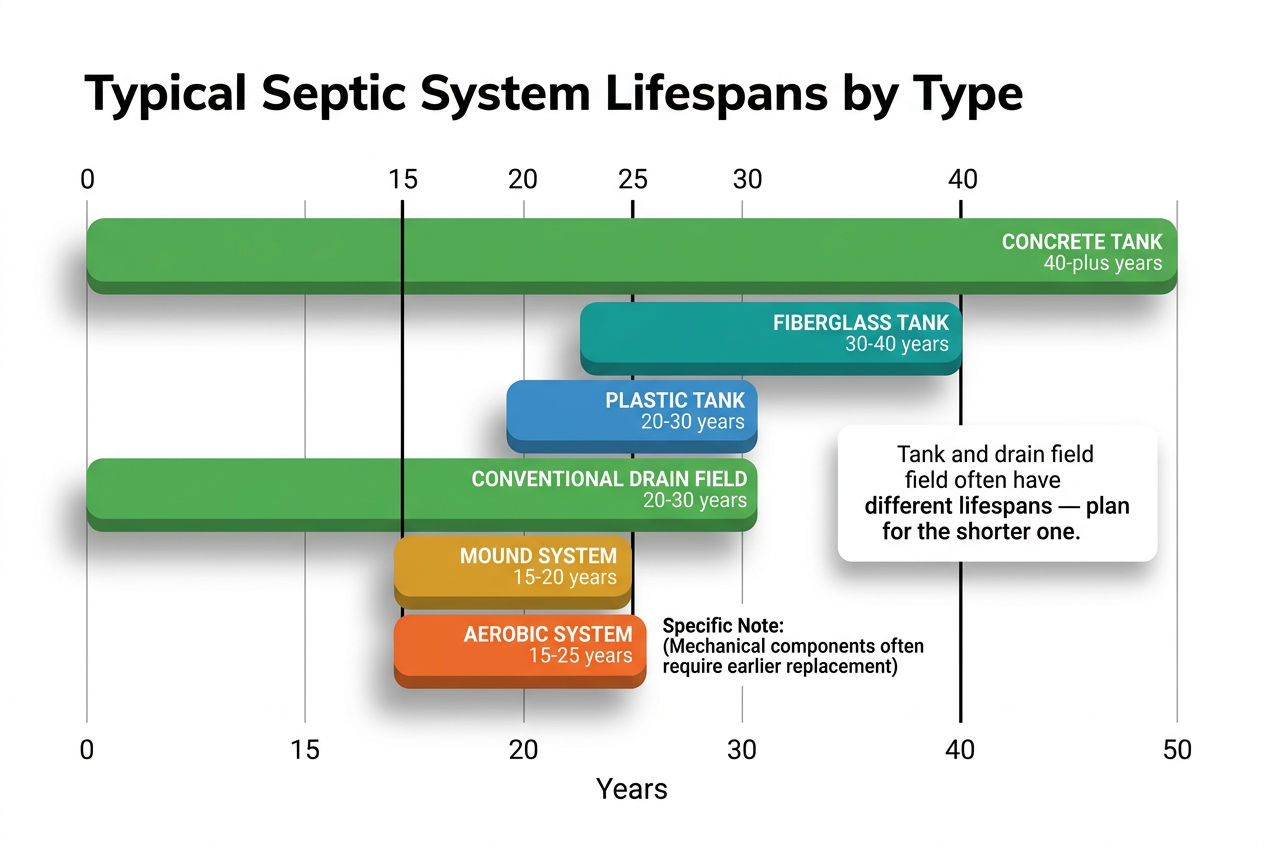
Here's how the numbers break down by component and material:
| Component / Material | Expected Lifespan | Notes |
|---|---|---|
| Concrete septic tank | 40–50+ years | Most durable; can crack if poorly made |
| Plastic / fiberglass tank | 30–40 years | Resistant to corrosion; can shift in high water tables |
| Steel septic tank | 15–25 years | Rusts from the top down; common in pre-1980 homes |
| Conventional drain field | 20–30 years | Most frequently replaced component |
| Mound system | 20–30 years | Varies with soil conditions and frost exposure |
| Aerobic treatment unit (ATU) | 20–30 years | Mechanical parts need more frequent service |
| Pumps and float switches | 7–15 years | Require periodic replacement regardless of system age |
Sources: EPA Septic Systems Overview; National Association of Wastewater Technicians (NAWT); industry installer surveys.
⚠️ Warning: Steel tanks have the shortest lifespan by far - and if your home was built between 1945 and 1980, there's a real chance you have one. The rust typically starts at the baffle walls and the tank lid, well before the bottom fails. By the time you see sewage backup, the tank has often been structurally compromised for years.
Aerobic treatment units (ATUs) - like those made by Orenco Systems - last 20–30 years when serviced properly, but the aerator compressor (often a Hiblow HP-80 or equivalent) needs replacement every 5–8 years. Factor that into your long-term maintenance budget.
Free download
Free: the Septic Fridge Card — what to flush, what never to.
The Do / Don’t card the whole family can see, plus the Survival Kit: emergency flowchart, warning-sign decoder and pump-schedule card. One printable PDF.
What Factors Affect How Long a Septic System Lasts?
The lifespan data above assumes average conditions. In the real world, several factors push systems toward the short end of those ranges - or cut them off early.
Household Size and Water Usage
The average person uses 70–100 gallons of water per day. A 1,000-gallon tank sized for a 2-person household is seriously undersized if you later have three teenagers and a home office. Overloading the tank shortens drain field life dramatically, because excess water pushes undigested solids out into the leach laterals before they've broken down.
Garbage Disposals
📊 Quick Fact: University of Minnesota Extension research found that garbage disposal use can increase the solids load entering a tank by up to 50%.
A household that normally needs pumping every 4 years may need it every 2 years once a disposal is installed - and if they don't adjust, they'll clog their drain field years ahead of schedule.
Soil Type and Water Table
Clay-heavy soils in the Southeast and Midwest drain poorly, which means effluent can't percolate away fast enough. If your soil perc rate is already marginal and your water table rises during spring rains, your drain field gets saturated - and a saturated drain field can fail in a single wet season. In Florida and the Carolinas, high water tables make drain field failure one of the most common septic complaints.
Neglected Pumping
The EPA recommends pumping every 3–5 years. Skip two pumping cycles and the sludge layer - measured with a sludge judge - can overflow into the distribution box and plug the drain field entirely. At that point, you're not looking at a pump-out. You're looking at a drain field replacement.
Tree Roots
Willow, poplar, and silver maple roots actively seek moisture and will infiltrate pipe joints and the tank itself. A root intrusion that looks minor during a camera inspection can collapse a lateral within two seasons.
What Are the Signs Your Septic System Needs to Be Replaced?
Most systems don't fail overnight. They give you warnings - sometimes for years - before they collapse completely.
Watch for these red flags:
- Slow drains throughout the house - not just one fixture. If every drain is sluggish, the problem is downstream of the house.
- Sewage backup into the lowest drains or toilets, especially after heavy rain or high water use. Learn more about what causes a septic system to back up and how to respond.
- Standing water or soggy ground over the drain field, even during dry weather. This means the field has failed and effluent is surfacing.
- Sewage odors inside the house or near the tank and drain field. A healthy system doesn't smell. If yours does, something is wrong. Our septic system smell guide covers the most common causes.
- Unusually green or lush grass over the drain field - effluent is fertilizing the surface, which means it's not being absorbed underground.
- Gurgling sounds from toilets or drains after flushing.
⚠️ Warning: If you're seeing two or more of these at once, don't wait. Schedule a professional septic inspection before the situation goes from expensive to catastrophic.
Repair vs. Replace: How Do You Decide?
This is the question most homeowners get wrong, usually because a contractor pushes them toward full replacement when a targeted repair would do the job - or because they choose a cheap repair that delays the inevitable by 18 months.
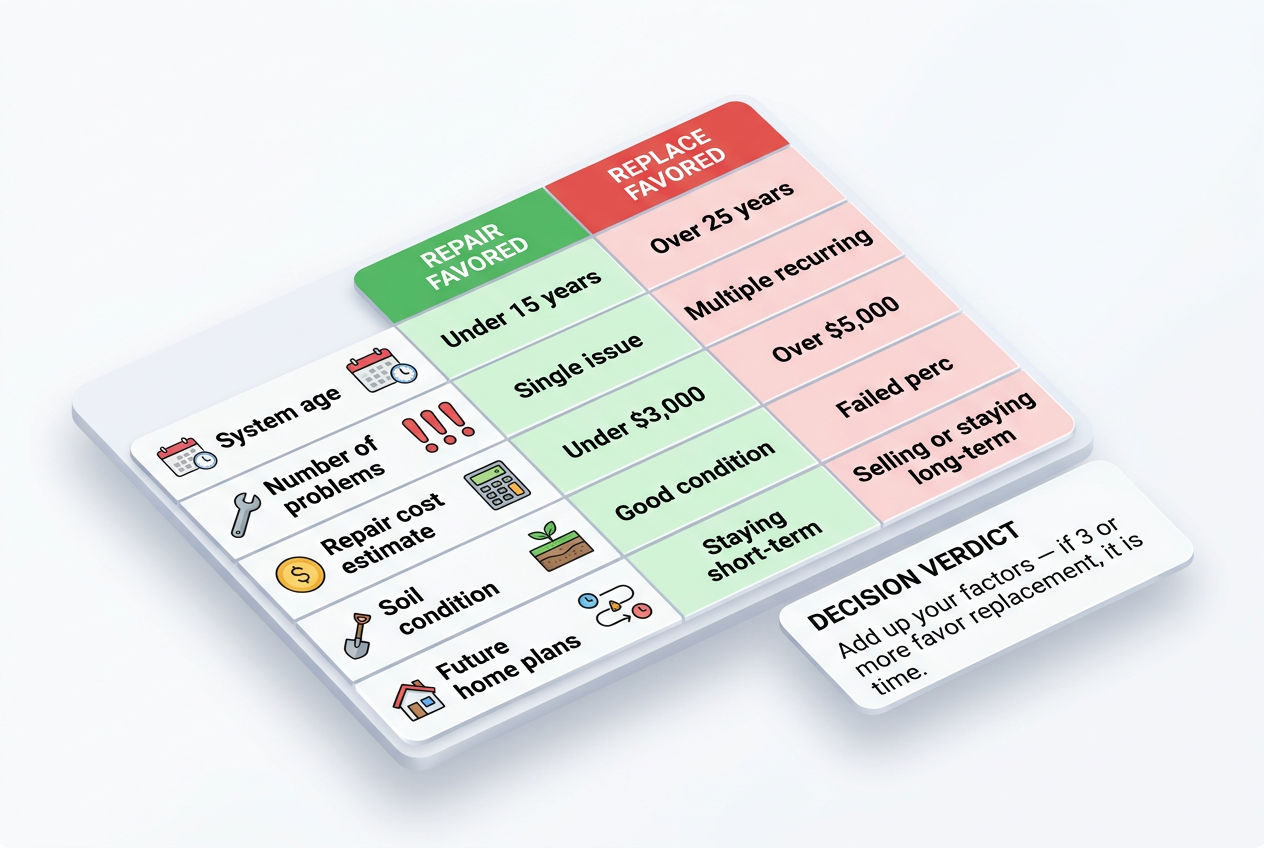
Here's a practical framework:
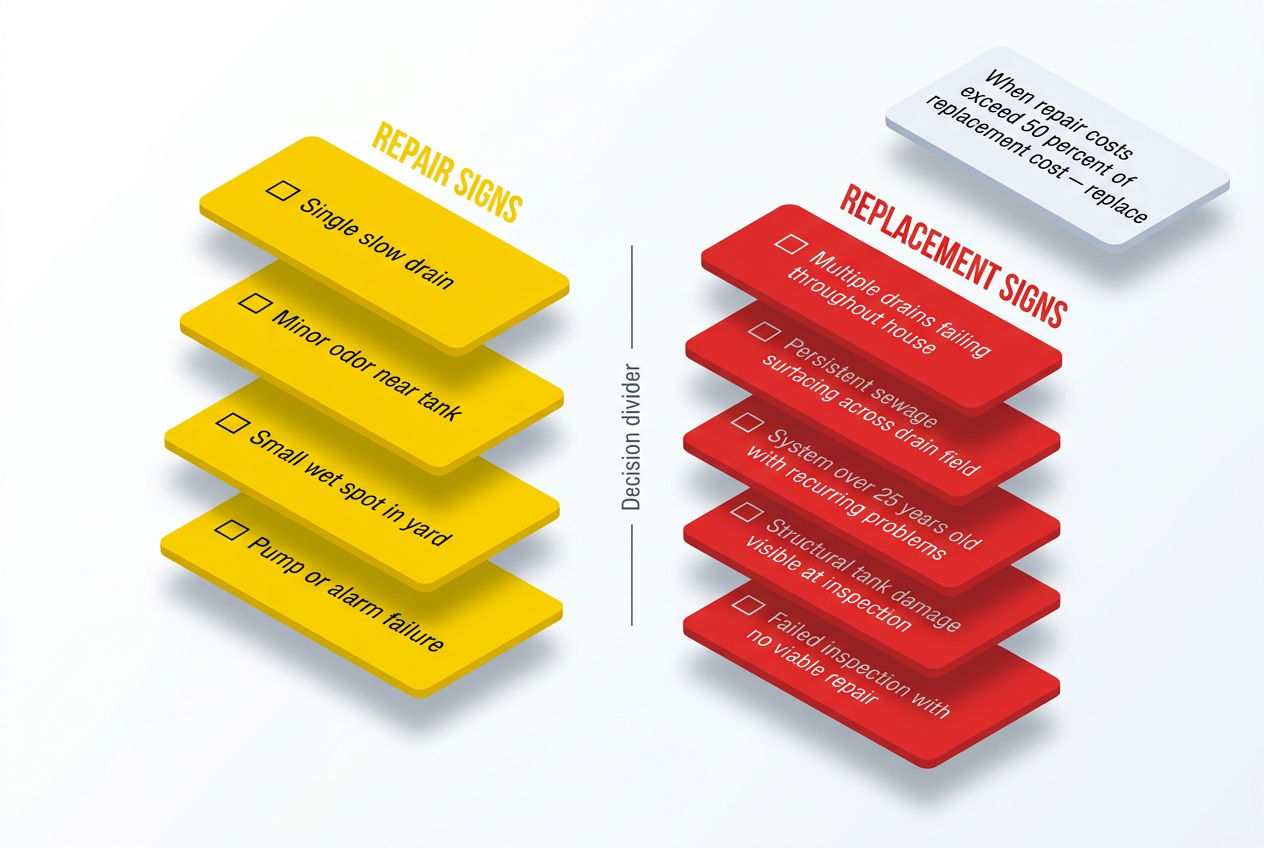
Repair Makes Sense When:
- The tank is structurally sound but the effluent filter (such as a Polylok PL-122) is clogged or the baffle has collapsed
- A single lateral in the drain field has failed but the rest of the field is healthy
- The pump or float switch has burned out but the system itself is functional
- The system is less than 15 years old
Replacement Makes More Sense When:
- Your steel tank is showing active rust or has collapsed baffles
- The entire drain field is saturated and there's no recovery after resting it
- The system is over 25–30 years old and has multiple failing components
- Repair costs exceed 50% of full replacement cost
- You're being required to upgrade to a more advanced system under new local regulations
✅ Pro Tip: If your septic system repair estimate is $4,000 and full replacement is $9,000, that might seem like an easy call. But if the repaired system fails again in three years, you've spent $4,000 to delay a $9,000 job. Get a second opinion.
A septic inspection from an independent licensed inspector - separate from whoever's quoting the repair - is worth every dollar.
How Much Does Septic System Replacement Cost?
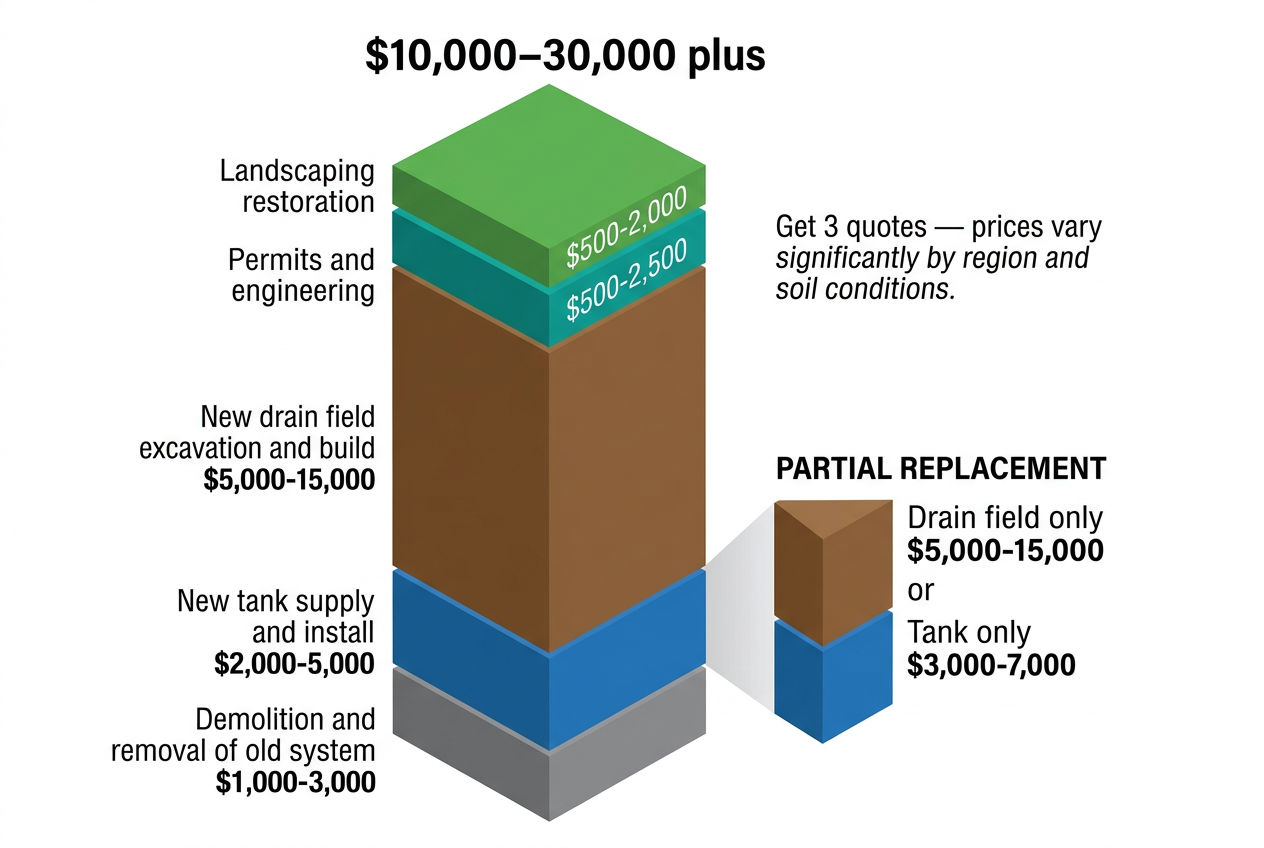
Full septic system replacement costs $5,000–$20,000 for a conventional system, with most homeowners landing between $7,000 and $13,000. Advanced or engineered systems - required in many coastal and environmentally sensitive areas - run $15,000–$30,000 or more.
Here's how costs break down by component:
| Component | Cost Range | Notes |
|---|---|---|
| Drain field replacement only | $3,000–$15,000 | Most common scenario |
| Tank replacement only (concrete) | $3,000–$7,000 | Tank alone, no field work |
| Full conventional system replacement | $5,000–$20,000 | Tank + field + permit |
| Mound or engineered system replacement | $15,000–$30,000+ | Required in challenging sites |
Regional labor and permitting costs move these numbers significantly. A straightforward drain field replacement in rural Tennessee might cost $4,500. The same job in coastal Connecticut - where nitrogen-reducing systems may be required and permit fees run higher - can exceed $18,000. For a detailed cost breakdown by system type and region, see our septic installation cost guide.
📊 Quick Fact: A failed septic system can reduce your home's value by $10,000–$30,000 or stall a sale entirely. Replacement is expensive. Letting a buyer's inspector discover a failing system for you is more expensive.
Homeowner's insurance typically does not cover septic system replacement from normal wear and deterioration. Some policies cover sudden, accidental damage - a tree falling on the tank, for example - but routine failure is almost universally excluded. Check your policy before assuming you're covered.
How Can You Extend the Life of Your Septic System?
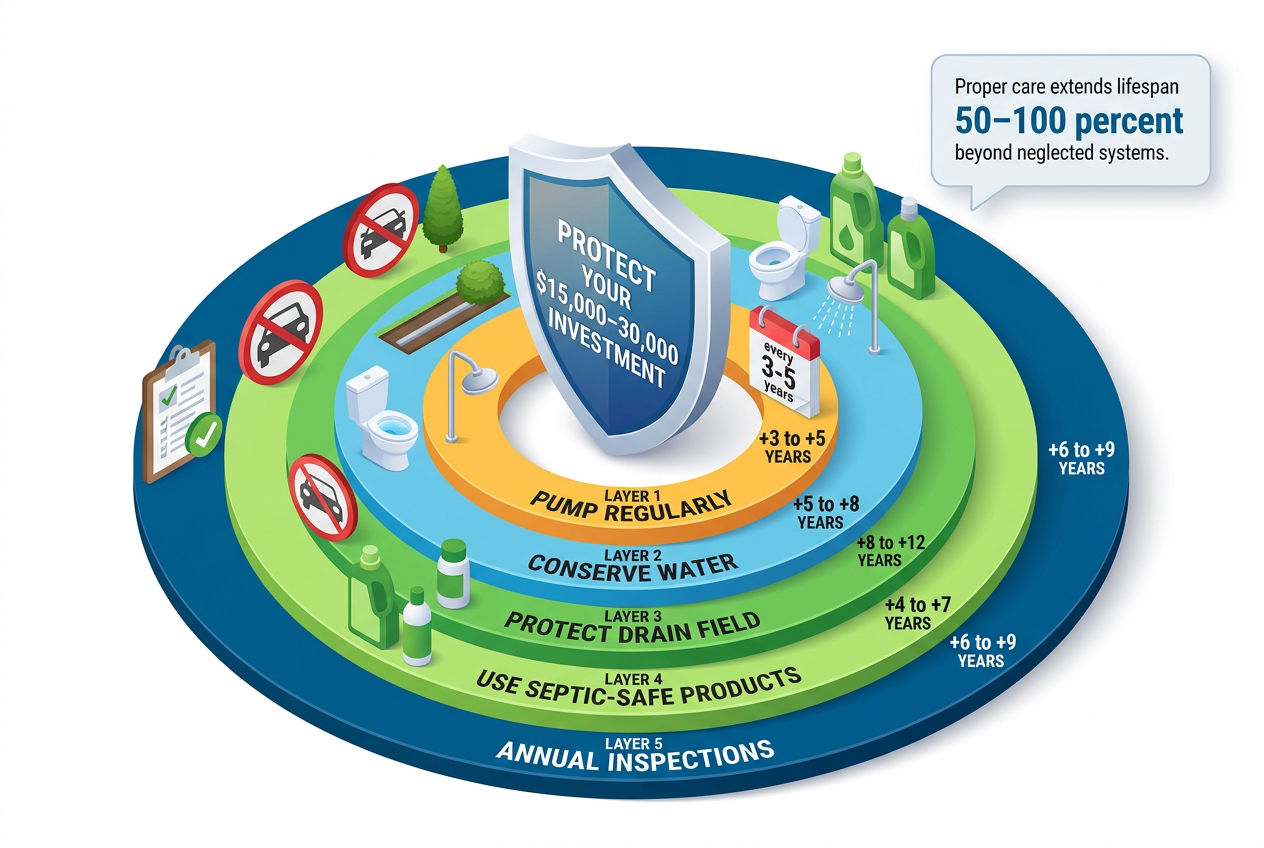
The difference between a system that lasts 20 years and one that lasts 40 years usually comes down to a few consistent habits.
Pump on Schedule
The EPA recommends pumping every 3–5 years for most households. A 1,000-gallon tank serving four people needs pumping every 3–4 years. Add a garbage disposal and drop that to every 2 years. Our septic pumping guide has a full breakdown by household size and tank capacity. For current pricing, see the septic pumping cost guide.
Protect the Drain Field
Never drive vehicles or park heavy equipment over it. Don't plant trees within 30 feet of leach laterals. Don't route roof drainage or sump pump discharge toward the field - it's already handling all the water it can manage.
Watch What Goes Down the Drain
⚠️ Warning: Flushable wipes aren't. Grease, medications, bleach, and paint all damage the bacterial ecosystem in your tank. The anaerobic bacteria breaking down your waste are the engine of the whole system. Kill them and effluent passes through largely untreated.
Get Regular Inspections
The EPA recommends a full septic inspection every 3 years. A licensed inspector will check baffle condition, scum and sludge levels, effluent filter status, and distribution box integrity. Catching a cracked baffle early costs a few hundred dollars. Missing it can cost you a drain field. For more on routine care, see the septic tank maintenance guide.
Spread Out Water Use
Running the dishwasher, doing three loads of laundry, and hosting overnight guests all in the same weekend can temporarily overwhelm your system. Space out high-water-use activities to give your tank time to process.
Does Your State or Region Change the Equation?
Yes - significantly. Replacement requirements, approved system types, and permit processes vary by state and often by county.
Florida
The Department of Health oversees septic regulation, and contractors must hold a Registered Septic Tank Contractor (RSTC) license. High water tables across much of the state make conventional drain fields problematic; many counties require mound or drip-irrigation systems for replacement. The average mound system replacement in Central Florida runs $12,000–$22,000.
The Northeast
Freeze-thaw cycles stress older concrete tanks - particularly pre-1970 poured-in-place tanks that may have hairline cracks widening every winter. Many homes in New England and upstate New York still have steel tanks from the 1960s that are operating on borrowed time. A proactive septic system test before a harsh winter can identify vulnerabilities before they become emergencies.
Coastal Areas
The Chesapeake Bay watershed, Cape Cod, Long Island, coastal North Carolina - nitrogen-reducing advanced treatment units are increasingly mandated for replacement systems. These ATUs cost significantly more than conventional systems but are required by environmental regulation. Verify local requirements through your county health department before budgeting a replacement.
The Pacific Northwest
Oregon and Washington see high annual rainfall that saturates drain fields faster than drier regions. Both states have robust permitting requirements, and many jurisdictions require soil evaluation by a licensed soil scientist before approving a replacement system.
✅ Pro Tip: No matter where you are, find licensed local contractors who know your county's specific requirements. Find septic professionals in your area through the SepticTankHub directory.
How to Find a Qualified Septic Replacement Contractor
Not every plumber or excavator is qualified to replace a septic system. In most states, septic work requires a specific license - separate from a general contractor's license. Before hiring anyone, verify their license through your state health department's contractor lookup tool.
Ask any contractor you're evaluating:
- Are you licensed for septic installation in this county?
- Will you handle the permit, or is that on me?
- Do you carry liability insurance and surety bonding?
- Can you provide references from similar replacement jobs in this area?
- Will you provide a written scope of work before any excavation starts?
✅ Pro Tip: Get at least three bids. Replacement scopes vary - one contractor may quote full field replacement while another is quoting only a partial lateral repair. Make sure bids compare apples to apples.
For more on what relocation and full replacement involve, see our septic relocation cost guide.
Related: septic tank abandonment requirements — worth reading if this applies to your situation.
You can search for licensed septic professionals near you on SepticTankHub and filter by service type, state, and availability.
Dealing with septic problems? Find emergency help near you on SepticTankHub.
For pricing details, see our septic repair cost guide.
Learn more about our septic repair services.
Related reading: septic system installation process.
Sources & Methodology
This article draws on the following primary sources:
- U.S. Environmental Protection Agency - Septic Systems Overview: Used for recommended inspection and pumping frequencies, household usage statistics, and general system guidance.
- National Association of Wastewater Technicians (NAWT): Referenced for component lifespan ranges and inspector certification standards.
- University of Minnesota Extension - Septic System Owner's Guide: Cited for garbage disposal impact on solids loading and tank pumping frequency adjustments.
- National Onsite Wastewater Recycling Association (NOWRA): Referenced for industry cost benchmarks and system type comparisons.
- State health department contractor licensing databases (Florida DOH, Oregon DEQ, North Carolina DHHS): Referenced for regional regulatory requirements and licensing standards.
Cost ranges reflect contractor pricing data aggregated from SepticTankHub directory submissions and publicly available regional cost studies. Individual costs vary by soil conditions, permit requirements, system type, and local labor markets.
Need help with your septic system? Browse local septic companies in Texas or Florida.
Was this article helpful?
Frequently Asked Questions
Recommended Resources
📖 Related Articles
- Septic System Backing Up? Causes & Emergency Steps
- Why Does My Septic System Smell? Causes & Fixes
- How to Repair a Septic System: DIY vs Professional
- How Often Should You Pump Your Septic Tank?
- The Complete Septic Tank Maintenance Guide
- How to Test Your Septic System
- How Much Does It Cost to Move a Septic System?
💰 Cost Guides
🔧 Services
Find Septic Professionals Near You
Compare licensed, verified septic companies by area — top county markets and cities below, or browse all 50 states.
County markets
Popular cities
