
Quick Answer
A septic system backup occurs when wastewater cannot flow forward through the system and reverses direction into your home's drains. The most common causes include an overfull tank, a clogged septic line, drain field failure, or septic pump failure. Left unaddressed, sewage backing up into your house creates serious health hazards and structural damage within 24–48 hours.
Key Takeaways
- Stop all water use the moment you suspect a backup - every flush makes it worse.
- The most common cause is a tank that hasn't been pumped on schedule (every 3–5 years for most households).
- Drain field failure is the costliest cause, with repairs ranging from $3,500 to $25,000+.
- Raw sewage exposure carries real pathogen risks: E. coli, Hepatitis A, and Giardia.
- A licensed professional should handle any true backup - this is not a DIY situation.
What Should You Do Right Now If Your Septic Is Backing Up?
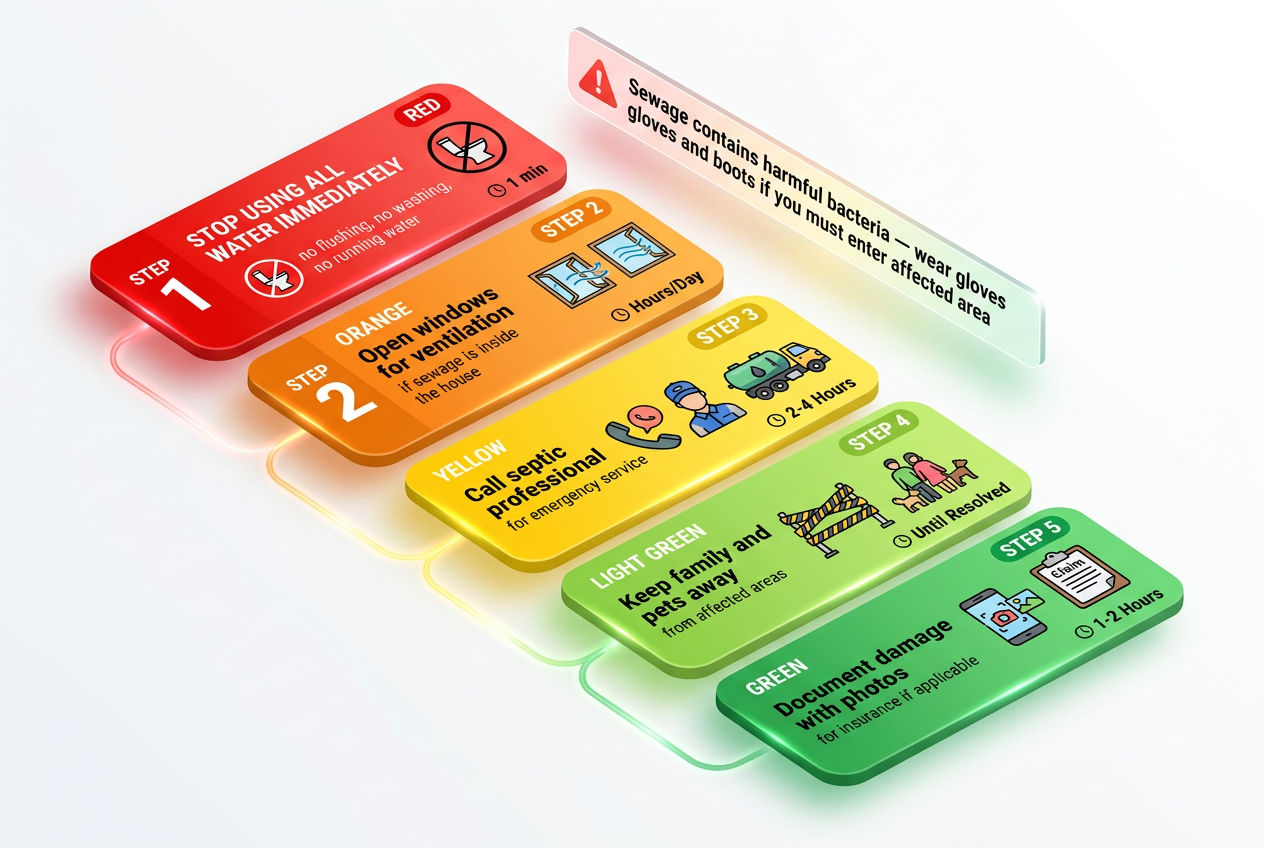
If sewage is actively backing up into your house, the next 30 minutes matter. Here's exactly what to do - in order.
Step 1: Stop all water use immediately
Every toilet flush, dish rinse, and shower adds volume to an already overwhelmed system. Turn off the washing machine. Tell everyone in the house. This single step buys you time.
Step 2: Don't use chemical drain cleaners
Pouring Drano into a backed-up line attached to a septic system can kill the beneficial bacteria inside your tank and make diagnosis harder. Skip it.
Step 3: Stay out of the affected area
Raw sewage contains E. coli, Hepatitis A, Giardia, and other pathogens, according to the CDC. If sewage has surfaced in a bathroom or basement, keep children and pets away. Don't touch it without nitrile gloves and rubber boots.
Step 4: Check the obvious outdoor signs
Walk your yard. Do you see soggy ground, green patches, or standing water over your drain field? Is the tank access riser lid cracked or sunken? These visual clues tell the technician a lot before they even pull a tool.
Step 5: Call a licensed septic professional
This is not the moment for YouTube tutorials. Find an emergency septic service provider in your area - many companies offer 24/7 response for active backups. Weekend and after-hours calls typically run $500–$1,000, but the alternative is raw sewage spreading through your subfloor.
Step 6: Document everything
Take photos of any surfacing sewage, wet spots, or damage before the technician arrives. Your homeowners insurance may cover certain types of sewage backup (more on that below).
⚠️ Warning: Don't attempt to open the septic tank yourself during an active backup. Confined-space hazards including toxic gas buildup (hydrogen sulfide and methane) make this a job for licensed professionals with proper safety equipment.
What Causes a Septic System to Back Up?
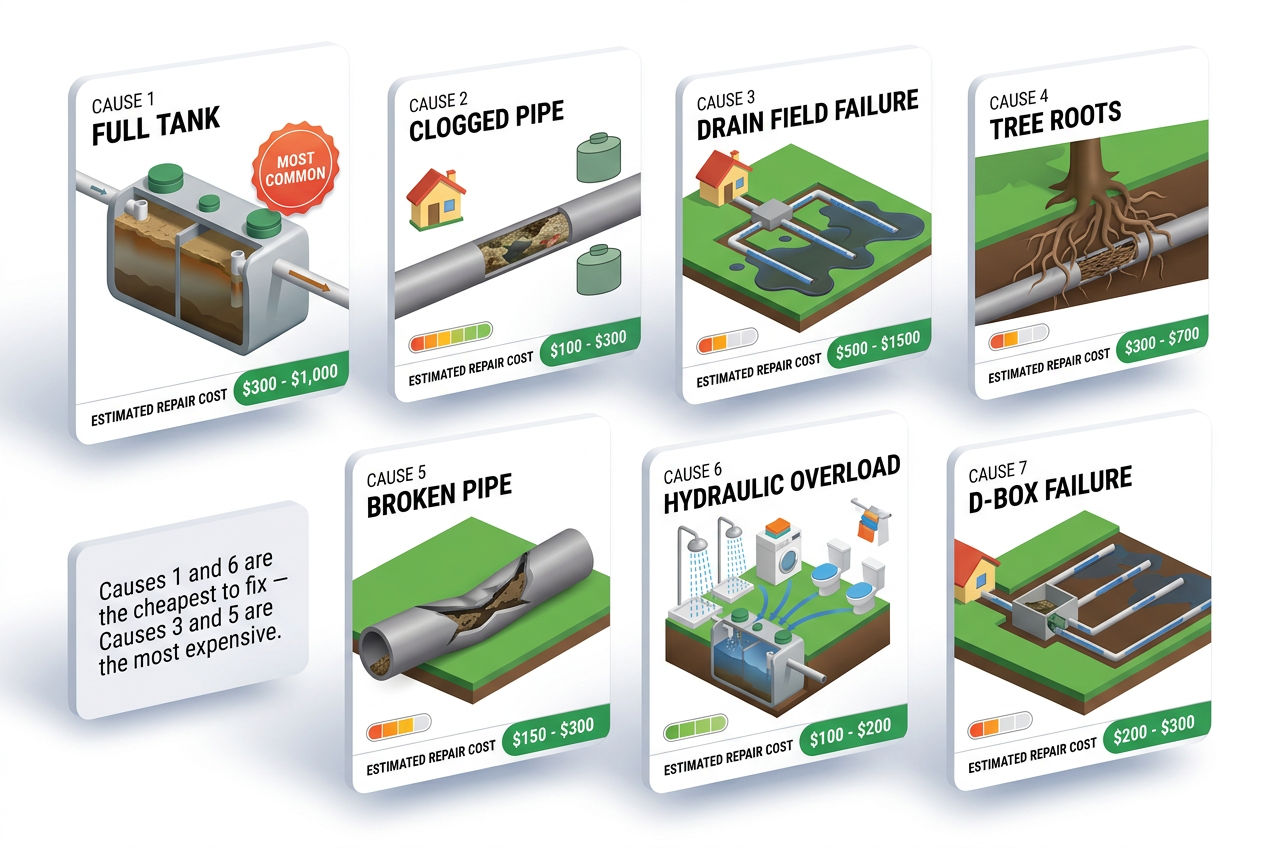
Septic system backup causes generally fall into four buckets: tank problems, pipe problems, drain field problems, and external factors. Most backups involve more than one.
1. The Tank Is Overdue for Pumping
This is the number-one cause - and the most preventable. The EPA recommends pumping every 3–5 years for a typical household. A 1,000-gallon tank serving four people needs service roughly every 3–4 years. Add a garbage disposal and that interval shrinks to every 2 years, because ground food solids fill the sludge layer much faster.
When sludge and scum layers together occupy more than one-third of total tank volume, solids start pushing into the outlet baffle and toward the drain field. From there, backup is a matter of time. A licensed pumper uses a "sludge judge" - a clear acrylic tube - to measure these layers at every service call.
📊 Quick Fact: A household of four generates approximately 400 gallons of wastewater daily. Over three years, that's 438,000 gallons flowing through a 1,000-gallon tank - which is why regular pumping isn't optional.
Learn more about pumping schedules in our full guide to how often to pump your septic tank.
2. A Clogged Septic Line
The 4-inch PVC or cast-iron pipe running from your house to the tank is the most overlooked part of the system. Non-flushable wipes (even "flushable" ones), feminine hygiene products, grease buildup, and paper towels are the usual suspects. A partial clog causes slow drains throughout the house. A full blockage causes sewage backing up into your house from the lowest drain - usually a basement floor drain or ground-floor toilet.
A technician can clear most line clogs with a hydro-jet or mechanical snake. Repair costs for a damaged septic line run $1,500–$4,000 depending on depth and access.
✅ Pro Tip: If you have slow drains in multiple fixtures but the toilet still flushes normally, the clog is likely in the main sewer line before it reaches the septic tank - not in the tank itself.
3. Drain Field Failure
If the tank pumps cleanly but problems persist, the drain field is usually the culprit. Drain field failure happens when the soil around the leach laterals becomes saturated or "biomat" - a layer of anaerobic bacteria - seals the soil pores and prevents liquid absorption.
A failing drain field announces itself with:
- Slow drains throughout the house
- Sewage smell in the yard
- Spongy, wet ground over the leach lines
- Unusually lush, dark green grass over the drain field
Repair costs range from $3,500 for localized lateral replacement to $25,000+ for a complete drain field replacement on a larger lot. Our drain field replacement cost guide breaks this down by system type and region.
4. Septic Pump Failure
Homes with mound systems, aerobic systems, or any system where the tank sits below the drain field rely on a submersible effluent pump - often a Goulds WE05H or similar - to push treated wastewater uphill. When that pump fails, effluent has nowhere to go. The tank fills, and backup follows.
Most pump failures come from:
- A burned-out motor
- A stuck float switch
- Electrical issues in the pump chamber
Float switches should be tested annually. Pump replacement typically costs $500–$1,200 in parts and labor, depending on pump horsepower and tank depth.
5. Tree Root Intrusion
Tree roots follow moisture. Septic lines are a perfect target. Roots can infiltrate pipe joints and tank walls from trees planted within 25–50 feet of the system. Silver maple, willow, poplar, and cottonwood are the worst offenders - their root systems extend aggressively.
Once inside a 4-inch pipe, roots grow into dense masses that catch solids and cause full blockages. Root intrusion into the tank itself can crack concrete walls. In the Pacific Northwest, conifer roots are a common cause of line blockages during the wet season (October through April).
6. Damaged or Missing Inlet/Outlet Baffles
Inside every septic tank, inlet and outlet baffles direct flow and keep solids from escaping into the drain field. Older systems - particularly pre-1980s concrete tanks in the Northeast - often have concrete baffles that corrode and collapse. When the outlet baffle fails, undigested solids flow directly into the drain field and clog it rapidly.
Baffle replacement costs $300–$900 and is far cheaper than the drain field damage that follows. Many states now require plastic or fiberglass baffle replacements (such as a Polylok effluent filter) that resist corrosion. Ask your pumper to inspect the baffles at every service visit.
7. Heavy Rain and High Water Table
Heavy rain doesn't just fall on your roof - it saturates the soil around your drain field. When the water table rises above the leach laterals, effluent has nowhere to go. The drain field backs up, and then the tank backs up. This is especially acute in spring when snowmelt and rain combine.
Coastal and low-lying properties in Florida, South Carolina, and Louisiana deal with this seasonally. A single weekend of sustained rain can temporarily overwhelm an otherwise healthy system. If your backups always follow major rain events, your drain field may be undersized for your soil's percolation rate - a perc test will confirm this. Understanding your drain field is the first step toward a permanent fix.
8. Frozen Pipes or a Frozen Tank Inlet
In Minnesota, Wisconsin, Michigan, and other northern states, the frost line can reach 42–60 inches. Septic tanks buried below 48 inches are rarely at risk, but the 4-inch pipe connecting your house to the tank is vulnerable - especially if it runs through an uninsulated crawl space or is buried too shallow. A frozen line creates an instant, complete backup. Thaw-out service runs $1,500–$2,500.
Warning Signs Before a Full Backup
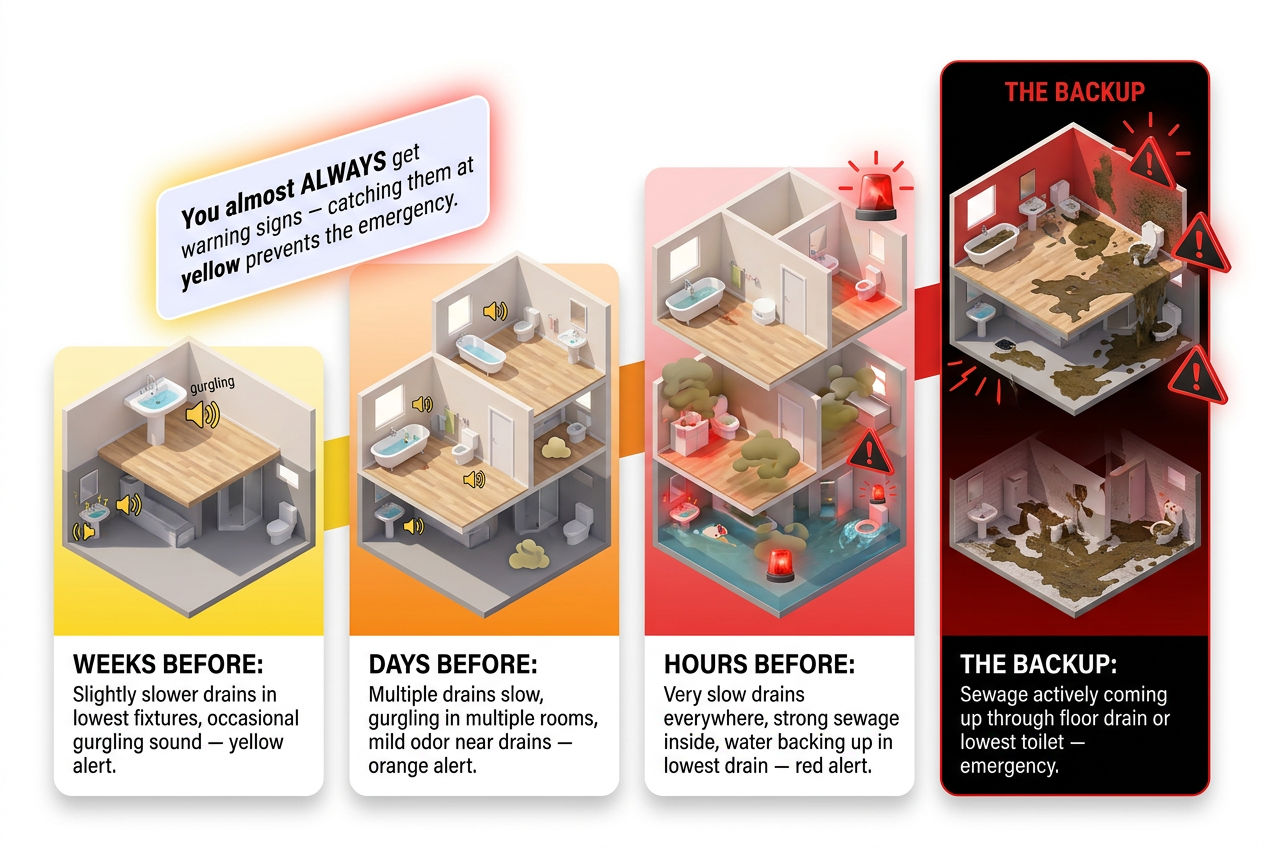
A septic backup rarely happens without warning. These signs appear days or weeks before sewage surfaces:
- Slow drains throughout the house - not just one fixture, which usually means a localized clog
- Gurgling sounds in pipes after flushing a toilet or running the dishwasher
- Sewage smell in the house, particularly near floor drains or basement drains
- Wet or unusually green patches over the drain field
- Toilets that won't flush fully or require multiple flushes
Any one of these symptoms warrants a call to a septic professional for an inspection. See our full list of septic system failure signs to understand when you're approaching a full replacement scenario.
Is a Septic Backup Dangerous?
Yes - and not just unpleasant. The CDC and EPA classify raw sewage as a biohazard. Septic backup exposes your household to:
| Pathogen | Health Risk | Incubation Period |
|---|---|---|
| E. coli | Severe gastrointestinal illness | 1–10 days |
| Hepatitis A | Liver infection spread through fecal-oral contact | 15–50 days |
| Giardia | Intestinal parasite causing diarrhea and cramping | 1–3 weeks |
| Salmonella | Bacterial infection causing fever and diarrhea | 6 hours–6 days |
| Campylobacter | Bacterial pathogen causing bloody diarrhea | 2–5 days |
⚠️ Warning: Standing sewage inside a home should be remediated within 24–48 hours. Beyond the pathogen risk, moisture penetrating subflooring and wall cavities triggers mold growth - often within 48–72 hours in warm conditions.
A professional sewage remediation company (separate from your septic contractor) handles interior cleanup. Expect $2,000–$6,000 for a contained basement backup; more for multi-room contamination.
Don't skip this step. Attempting to clean raw sewage with household disinfectants does not eliminate the pathogen load.
How Much Does It Cost to Fix a Septic Backup?
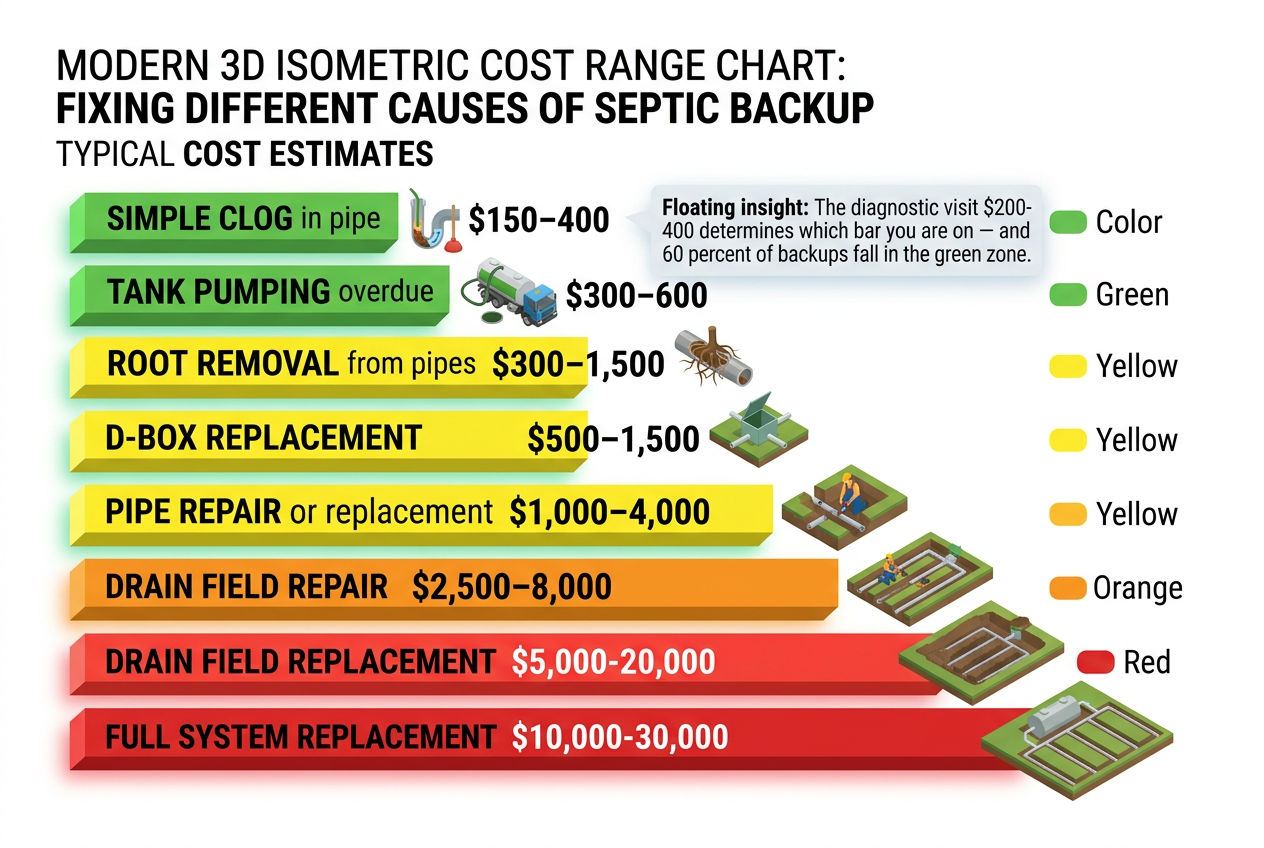
Repair costs depend entirely on the cause. Here's a realistic breakdown:
| Problem | Typical Repair Cost | Notes |
|---|---|---|
| Routine tank pump-out | $300–$600 | Higher if tank is severely overfull |
| Emergency/after-hours pump-out | $500–$1,000+ | Weekend and holiday premium |
| Septic line repair/replacement | $1,500–$4,000 | Depends on depth and length |
| Baffle replacement | $300–$900 | Polylok filter install included |
| Septic pump replacement | $500–$1,200 | Float switch + pump motor |
| Drain field repair (partial) | $3,500–$8,000 | Lateral replacement or aeration |
| Drain field replacement (full) | $8,000–$25,000+ | System type and region vary significantly |
Cost data sourced from national contractor surveys and EPA cost guidance. Regional variation applies - rural areas often carry 15–25% premiums due to travel time.
📊 Quick Fact: A 1,000-gallon tank in suburban Atlanta typically runs $275–$375 for a standard pump-out. The same service in rural northern Minnesota often runs $375–$525 because of longer drive times and seasonal access challenges.
See our full septic repair cost guide and septic pumping cost breakdown for regional data. If your tank seems still full after pumping, there may be an underlying issue beyond a simple pump-out.
Is Septic Backup Covered by Homeowners Insurance?
Standard homeowners insurance policies exclude septic system failure - it's treated as a maintenance issue, not a covered peril. However, water backup riders (sometimes called sewer backup endorsements) can cover interior sewage damage. These riders typically cost $50–$150/year and provide $10,000–$25,000 in coverage.
✅ Pro Tip: Check your policy declarations page right now. If you don't have a water backup endorsement, call your agent before you need it.
How Do You Prevent Septic System Backups?
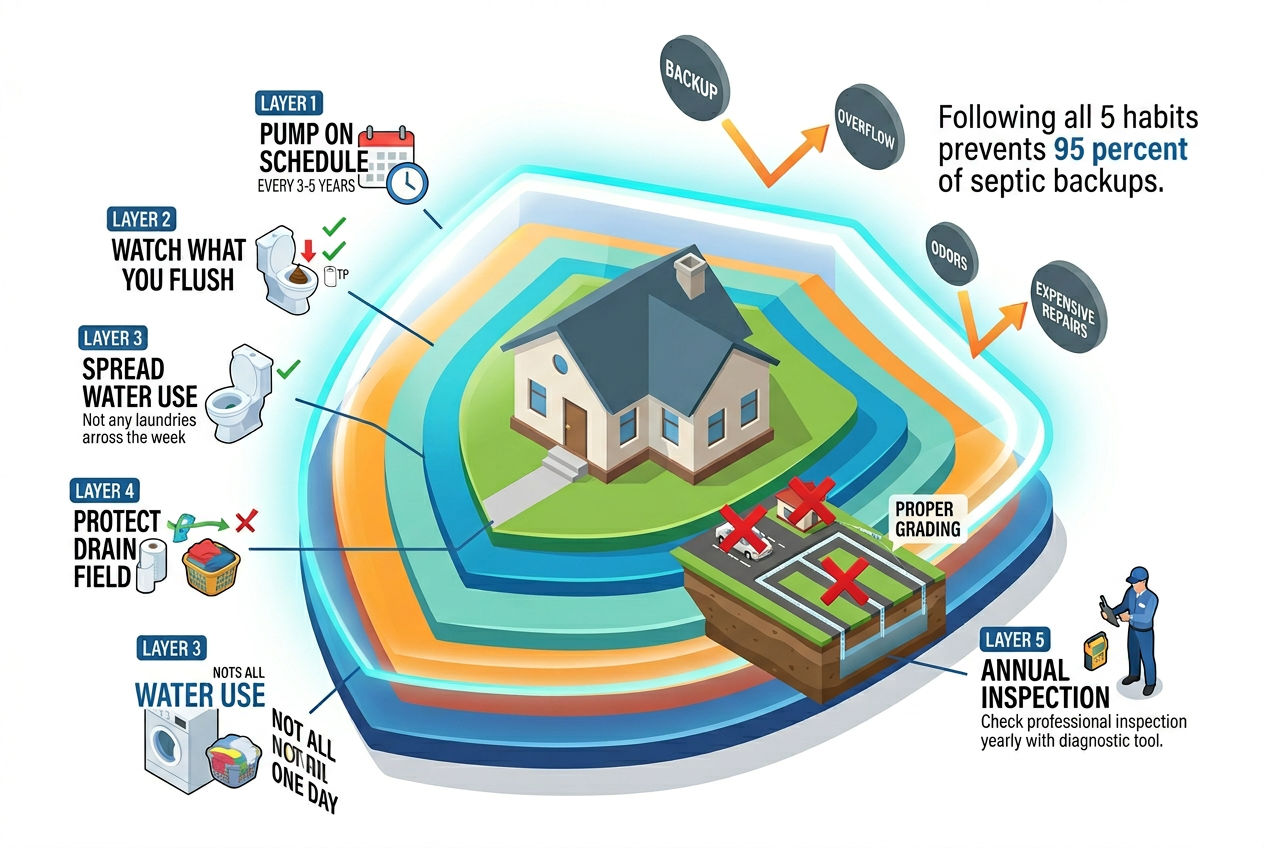
Most backups are preventable with consistent maintenance. Here's what actually works:
Pump on schedule
A 1,000-gallon tank serving two people needs pumping every 5–6 years. Four people, every 3–4 years. Six people, every 2–3 years. Don't guess - ask your pumper to measure sludge depth and give you a documented recommendation. Our septic maintenance guide covers the full schedule.
Install an effluent filter
A Polylok PL-122 or Zabel A1800 filter on the outlet baffle catches solids before they reach the drain field. They cost $50–$150 installed and require annual cleaning - your pumper can do it during a routine service.
Watch what goes down the drain
Nothing goes into a septic system except human waste and toilet paper. Items that destroy septic systems:
- Grease, fats, and oils
- "Flushable" wipes (they're not)
- Feminine hygiene products
- Medications
- Coffee grounds
- Paper towels
- Cat litter
Keep trees away from the system
Maintain at least a 25-foot buffer between any large tree and your septic lines or tank. If you have existing trees within that zone, have the lines inspected with a camera every 5 years.
Protect the drain field
Don't park vehicles, install pools, or plant gardens over the leach field area. Compacted soil destroys the absorption capacity that makes the system work.
Don't overload the system during peak use
Holiday gatherings and house guests can temporarily double water usage. Spread laundry loads across multiple days. Run the dishwasher at night. Understanding your system's capacity helps you manage peak demand without a crisis.
💡 Key Takeaway: The average cost of preventive maintenance (pumping every 3–5 years at $300–$600 per visit) is less than 5% of the cost of emergency drain field replacement. Maintenance isn't an expense - it's insurance.
Learn more about our septic repair services.
Related reading: septic system installation process.
Sources & Methodology
This article draws on the following primary sources:
- U.S. Environmental Protection Agency - Septic Systems Overview: Pumping frequency guidelines, system failure statistics, and groundwater contamination data.
- Centers for Disease Control and Prevention - Sewage and Health: Pathogen risk data including E. coli, Hepatitis A, and Giardia exposure from raw sewage contact.
- National Onsite Wastewater Recycling Association (NOWRA): Industry standards for system maintenance, inspection protocols, and contractor licensing.
- National Association of Wastewater Technicians (NAWT): Pumper training standards and sludge measurement methodology.
- University of Minnesota Extension - Septic System Owner's Guide: Regional frost-line data, soil percolation guidance, and cold-climate system management.
Cost ranges are aggregated from contractor surveys, permit data, and regional pricing variation. Individual quotes will vary.
Need help with your septic system? Browse local septic companies in Wisconsin or Oregon.
Free download
Not ready for the Handbook? Start with the free Fridge Card.
The Do / Don’t card the whole family can see, plus the Survival Kit: emergency flowchart, warning-sign decoder and pump-schedule card. One printable PDF.
Was this article helpful?
Frequently Asked Questions
Recommended Resources
📖 Related Articles
- How Often Should You Pump Your Septic Tank?
- What Is a Drain Field? (And How Does It Work?)
- How Often Do Septic Systems Need to Be Replaced?
- The Complete Septic Tank Maintenance Guide
- What Is a Septic System? How It Works (Visual Guide)
- Heavy Rain and Septic Systems: What Happens and What to Do
- Septic Tank Full After Just Pumped: Why and What to Do
💰 Cost Guides
🔧 Services
Find Septic Professionals Near You
Compare licensed, verified septic companies by area — top county markets and cities below, or browse all 50 states.
County markets
Popular cities
