
Quick Answer
Septic drain field problems typically show up as standing water over the field, persistent sewage odors, unusually green grass, or slow drains throughout the house. The six most common causes are tank solids reaching the field, biomat overgrowth, root intrusion, pipe damage, distribution box failure, and soil compaction. Repairs range from free DIY fixes to $15,000+ for full replacement — early diagnosis makes the difference.
Key Takeaways
- Most drain field problems start with a neglected septic tank — pump every 3-5 years to protect the field
- Standing water or odors over the field means the soil can't absorb effluent — act quickly
- Some problems have free DIY fixes (reduce water use, rest the field); others need professional repair
- Drain field repair costs $500-$5,000; full replacement runs $5,000-$20,000
- A professional inspection ($300-$500) pinpoints the exact problem before you spend money on the wrong fix
Your drain field is the largest and most expensive component of your septic system. It's also the one most likely to fail when maintenance falls behind. The good news is that most drain field problems follow predictable patterns — and catching them early is the difference between a $500 repair and a $15,000 replacement.
This troubleshooting guide walks through the six most common drain field problems, how to diagnose each one, and whether you can fix it yourself or need professional help.
Find a licensed drain field repair company in your area on SepticTankHub.com
How Do You Know Your Drain Field Has a Problem?
Before diving into specific problems, here's how to recognize that your drain field — not your tank or plumbing — is the issue. For a full labeled diagram showing where the drain field sits in your system, see our septic system diagram guide.
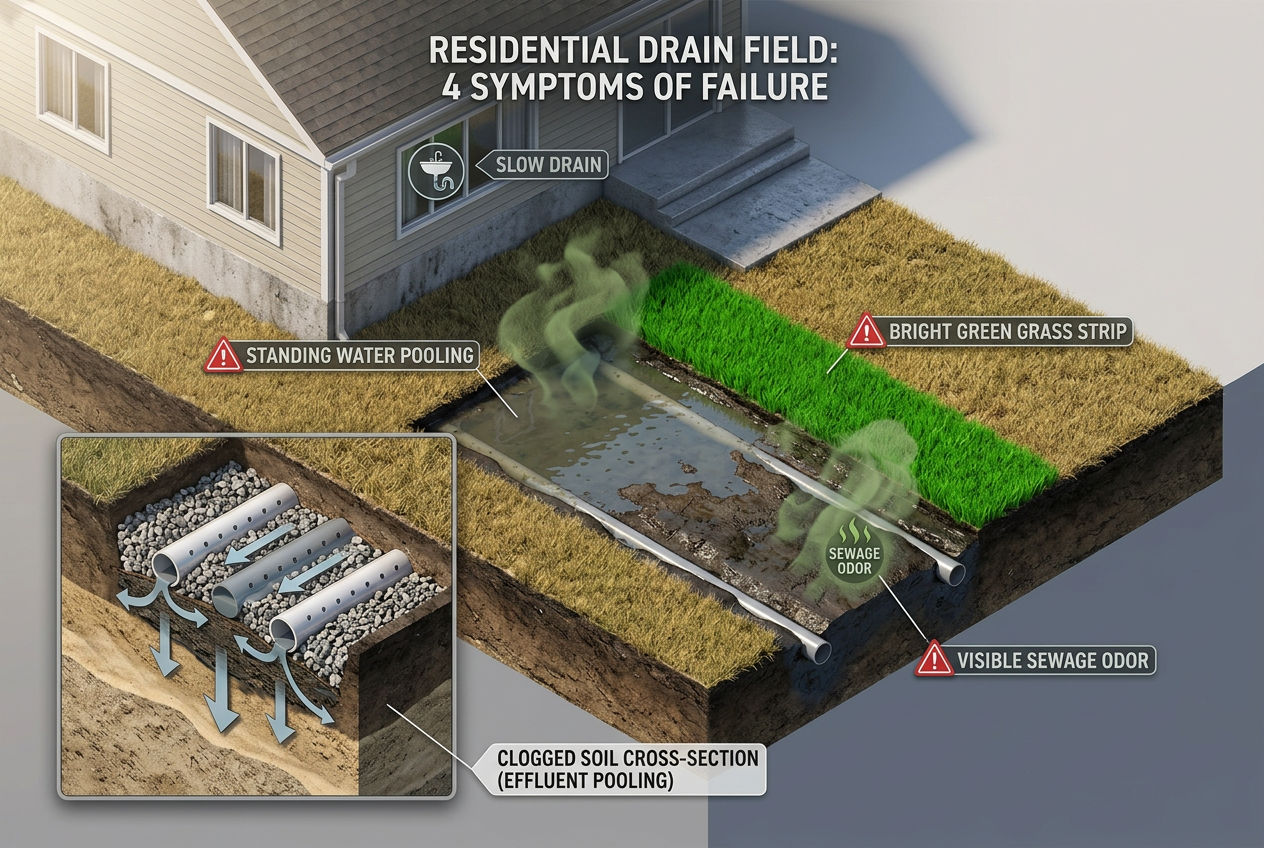
The drain field is the final treatment stage. Effluent exits the septic tank, flows through the distribution box, and enters perforated pipes buried in gravel trenches. The soil around those trenches filters and treats the effluent before it reaches groundwater.
When something goes wrong at this stage, you'll see these symptoms on the surface:
Standing water or soggy ground over the drain field area, especially when it hasn't rained. This is effluent that can't percolate into the soil fast enough.
Sewage odors in the yard near the drain field. Gases that should be contained underground are escaping through saturated soil.
Unusually green or lush grass in a strip pattern matching the trench layout. The grass is being fertilized by effluent reaching the root zone.
Slow drains inside the house that persist even after the septic tank has been pumped. If pumping the tank doesn't improve drainage, the drain field is rejecting effluent.
If you're seeing these signs of drain field failure, use the diagnostic sections below to identify the specific cause.
Problem 1: Biomat Overgrowth (Most Common Cause)
The biomat is a biological layer of bacteria that forms naturally at the gravel-soil interface in every drain field. In a healthy system, it regulates effluent absorption — a thin biomat is desirable. The problem occurs when the biomat grows too thick and essentially seals the soil, blocking absorption.
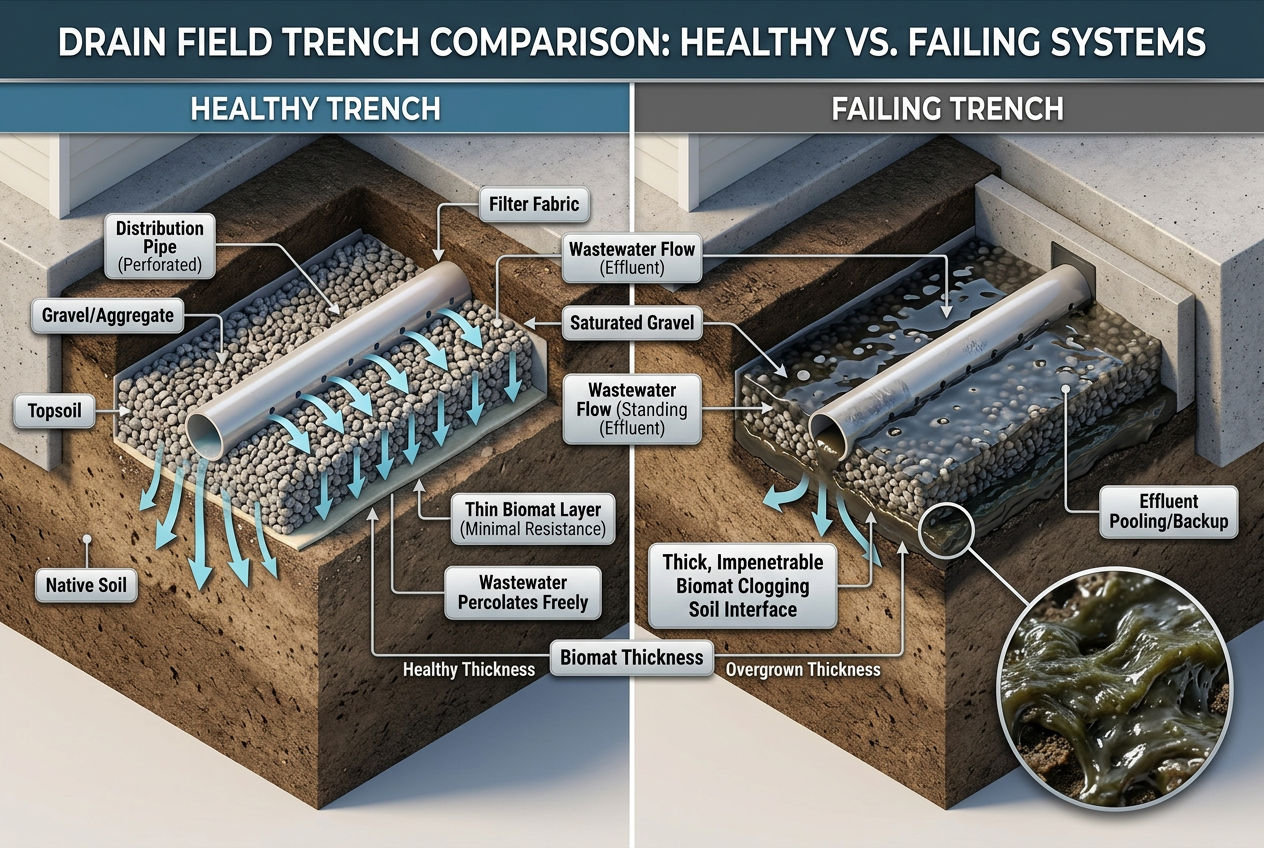
Why it happens: When a septic tank isn't pumped on schedule, solids overflow into the drain field. These organic solids feed the biomat bacteria excessively, causing the layer to thicken from a healthy 1/4 inch to 1-2 inches or more. At that thickness, effluent pools above the biomat instead of percolating through it.
How to diagnose: The drain field shows saturation symptoms but the distribution pipes are clear and the D-box is level. The tank has a history of infrequent pumping (5+ years between services). A test trench dug into the field reveals a thick, dark, slimy layer at the gravel-soil boundary.
How to fix it:
- Pump the tank immediately to stop sending effluent to the field
- Rest the drain field for 2-4 weeks (reduce household water use to bare minimum)
- The biomat layer partially decomposes when it dries out and loses its food source
- Resume normal use gradually, then maintain a strict pumping schedule
If resting doesn't work, the field may need aeration treatment ($1,500-$3,000) or partial replacement.
Key Insight: Biomat overgrowth is almost always caused by deferred tank pumping. A tank pumped on schedule sends clean effluent to the field, keeping the biomat thin and functional. Skipping even one pumping cycle can start the thickening process. This is why regular maintenance is the most cost-effective drain field protection.
Problem 2: Hydraulic Overload (Too Much Water)
The drain field has a maximum daily absorption capacity determined by the soil's percolation rate. When more water enters the field than the soil can absorb, effluent surfaces.
Why it happens: Excessive water use — running the washing machine, dishwasher, and showers simultaneously, hosting large gatherings, or having a leaking toilet that wastes 200+ gallons/day. Heavy rain events can also temporarily saturate the soil around the drain field.
How to diagnose: Symptoms appear during or shortly after heavy water use days. The septic tank is not overdue for pumping. The drain field depth and installation are correct. Symptoms may come and go — worse on heavy use days, better when water use is light.
How to fix it:
- Fix leaky fixtures — a running toilet alone can overwhelm a marginal drain field
- Spread water use across the week — don't do 5 loads of laundry on Saturday
- Install water-efficient fixtures — low-flow toilets and showerheads reduce daily volume by 30-40%
- Divert roof runoff — make sure gutters and downspouts direct water away from the drain field area
If the field is undersized for your household (common in older homes), adding supplemental trenches ($2,000-$5,000 per trench) may be necessary.
Pro Tip: Install a washing machine lint filter ($20-$40) on the discharge line. Synthetic fabric lint doesn't break down in the tank and contributes to both tank sludge and biomat buildup. This simple device measurably extends drain field life.
Problem 3: Root Intrusion
Tree and shrub roots seek water sources — and a drain field full of nutrient-rich effluent is irresistible. Roots enter through pipe joints, perforations, and cracks, growing inside the pipes until they block flow entirely.
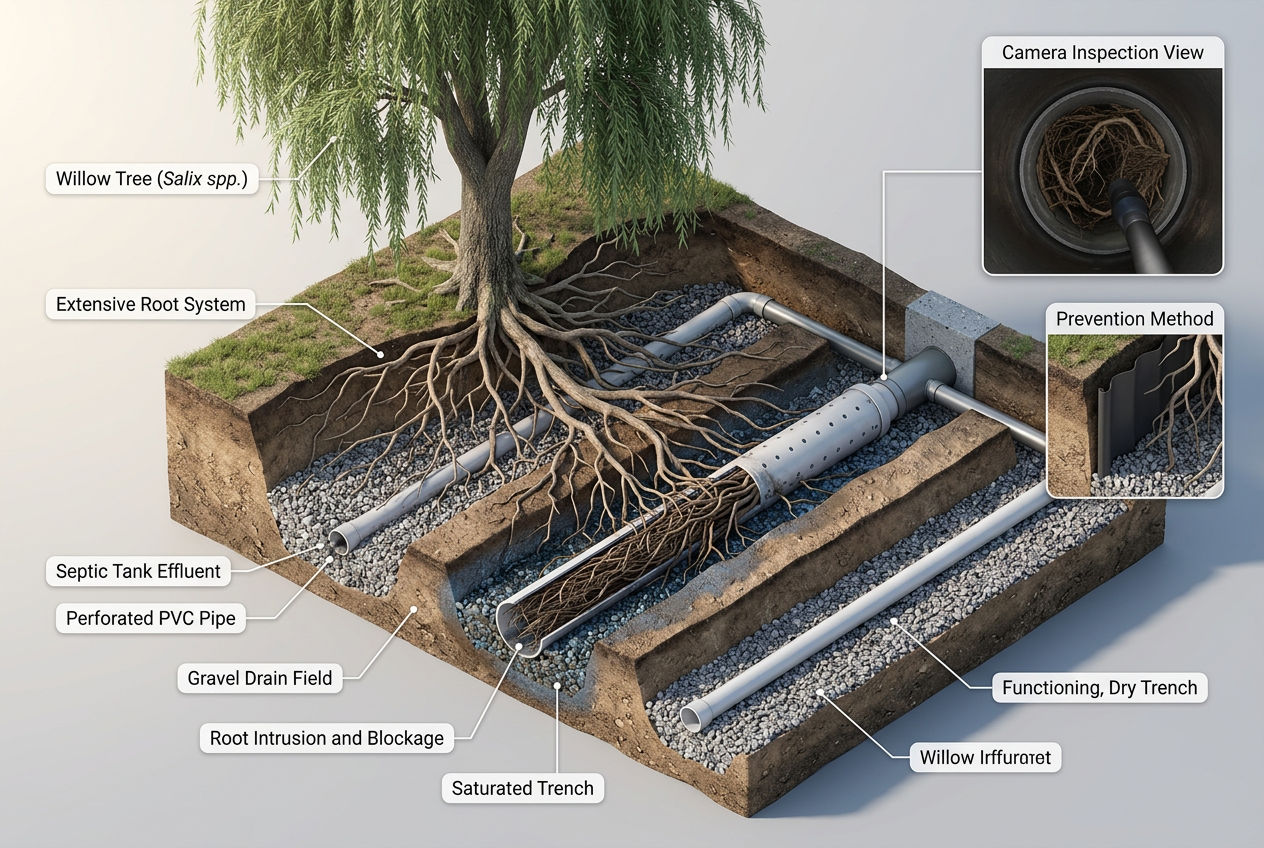
Why it happens: Trees planted within 30 feet of the drain field (willows, maples, and poplars are the worst offenders) send roots into the gravel trenches and pipe perforations. Even smaller shrubs can cause problems if planted directly over the trenches.
How to diagnose: One or more trenches show saturation while others are dry — roots typically invade individual pipe runs, not the entire field simultaneously. A camera inspection of the distribution pipes reveals root masses inside.
How to fix it:
- Mechanical root cutting ($300-$800) clears existing roots from pipes
- Remove the offending tree or shrub to prevent regrowth
- Install root barriers ($200-$500) — copper sulfate-impregnated barriers along the trench edges
- For severe cases, the affected trench may need replacement ($2,000-$5,000)
| Tree Species | Root Invasion Risk | Safe Distance from Drain Field |
|---|---|---|
| Willow, Poplar, Silver Maple | Very High | 50+ feet |
| Elm, Ash, Birch | High | 40+ feet |
| Oak, Maple (most species) | Moderate | 30+ feet |
| Pine, Spruce, Fir | Low-Moderate | 20+ feet |
| Ornamental shrubs | Low | 10+ feet |
| Grass, ground cover | Very Low | Safe to plant over field |
Source: University of Minnesota Extension and field data from drain field repair contractors
Common Mistake: Planting a "privacy screen" of fast-growing trees along the edge of the drain field. Arborvitae, Leyland cypress, and especially willows are common choices that send aggressive roots directly into the trenches. Use a fence or slow-growing ornamental plantings at least 30 feet from the field boundary.
Problem 4: Crushed or Damaged Distribution Pipes
The perforated pipes in the drain field can be crushed, cracked, or disconnected from physical damage — most commonly from vehicles driving over the field.
Why it happens: Heavy equipment, vehicles, or even riding mowers repeatedly crossing the drain field compress the gravel and soil, crushing the perforated PVC pipes below. Ground settling after installation can also disconnect pipe joints.
How to diagnose: One section of the field is completely saturated while others are dry. The affected section corresponds to an area that has been driven on or had heavy items stored on it. Camera inspection confirms pipe damage or collapse.
How to fix it: Crushed pipes must be excavated and replaced ($1,500-$4,000 per trench depending on length and depth). If the gravel bed is also compacted, the full trench — gravel, pipe, and filter fabric — needs rebuilding.
Prevention is the best approach: mark the drain field boundaries clearly and never allow vehicle traffic of any kind over the area.
Problem 5: Distribution Box Failure
A tilted, cracked, or clogged distribution box sends most or all of the effluent to one trench while starving the others. The overloaded trench fails while the rest of the field sits unused.
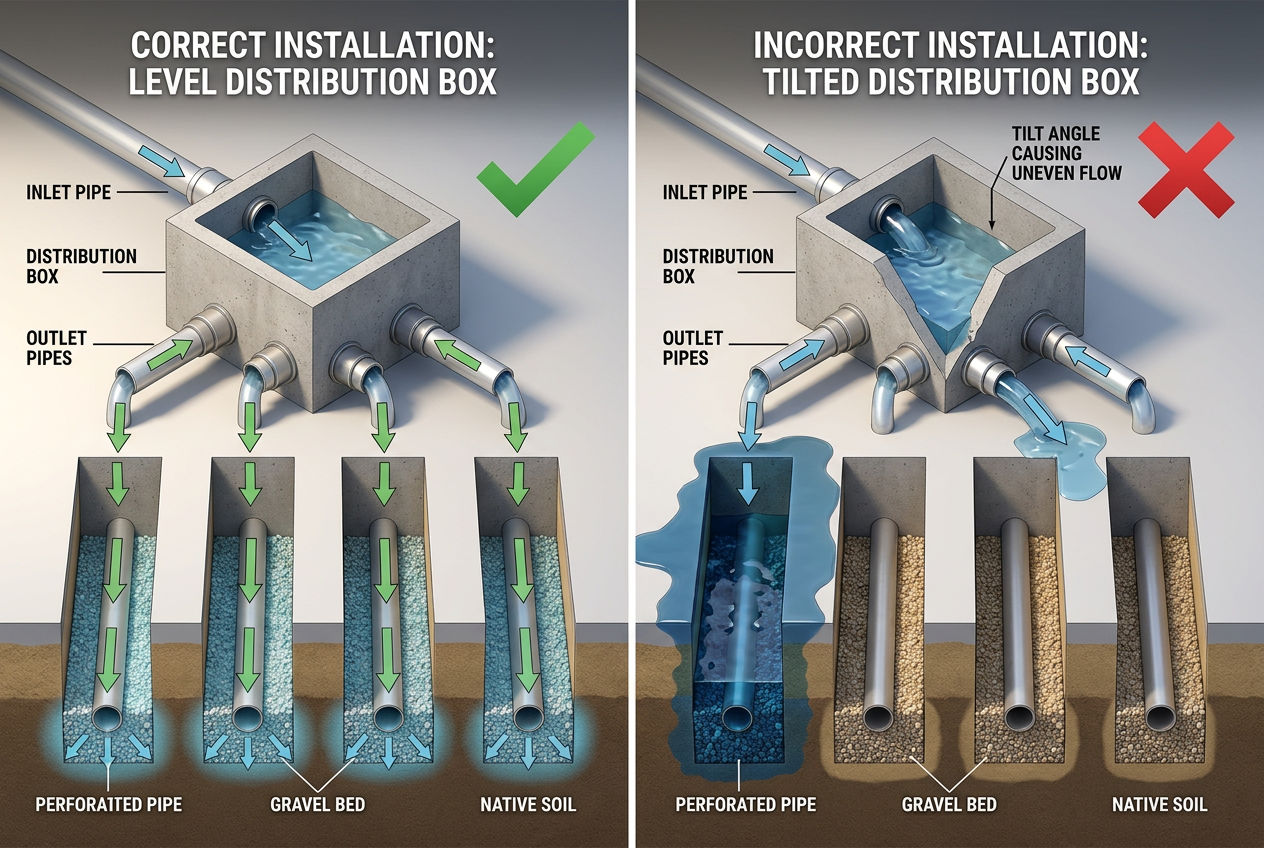
Why it happens: Frost heaving, soil settling, root pressure, or vehicle traffic shifts the D-box. The outlets that were once level now tilt, directing flow preferentially to the lowest outlet. Alternatively, solids accumulation inside the box blocks some outlets.
How to diagnose: Uneven saturation pattern — one area of the field is consistently wet while other sections are bone dry. Opening the D-box lid reveals uneven flow or visible tilt in the outlet positions.
How to fix it:
- Level the D-box ($500-$1,000) — excavate, re-level, and reset on a stable gravel pad
- Clean blocked outlets ($200-$400) — remove accumulated solids
- Replace the D-box ($800-$1,500) if cracked or structurally failed
- After repair, the previously overloaded trench may need 2-4 weeks of rest to recover
Problem 6: Soil Compaction or Saturation
Even with perfect upstream components, the native soil itself can become unable to absorb effluent due to compaction, seasonal high water tables, or changes in surface drainage.
Why it happens: Construction activity near the field, seasonal water table rise, landscape grading changes that redirect surface water toward the field, or long-term soil compaction from repeated foot traffic.
How to diagnose: The problem coincides with wet seasons (spring snowmelt, heavy rain periods). The tank, pipes, and D-box are all functioning correctly. The soil type is marginal (clay loam or heavier).
How to fix it:
For our detailed guide on this specific problem, see how to fix a saturated drain field. Key strategies include redirecting surface water with French drains and berms, curtain drains to intercept groundwater flow, and reducing household water use during wet seasons. Permanent solutions for chronically saturated fields include installing a supplemental raised bed or converting to a mound system ($10,000-$20,000).
When to Call a Professional vs. DIY
| Problem | DIY Fix Available? | Professional Cost | Urgency |
|---|---|---|---|
| Biomat overgrowth (mild) | Yes — pump tank + rest field | $300-$600 (pumping) | Medium |
| Biomat overgrowth (severe) | No — needs aeration or replacement | $1,500-$15,000 | High |
| Hydraulic overload | Yes — reduce water use, fix leaks | Free-$200 | Low |
| Root intrusion | Partial — can remove trees, but roots need cutting | $300-$5,000 | Medium |
| Crushed pipes | No — excavation required | $1,500-$4,000 | High |
| D-box failure | No — leveling requires excavation | $500-$1,500 | High |
| Soil saturation (seasonal) | Partial — redirect surface water | $500-$2,000 | Medium |
| Soil saturation (permanent) | No — needs system modification | $5,000-$20,000 | High |
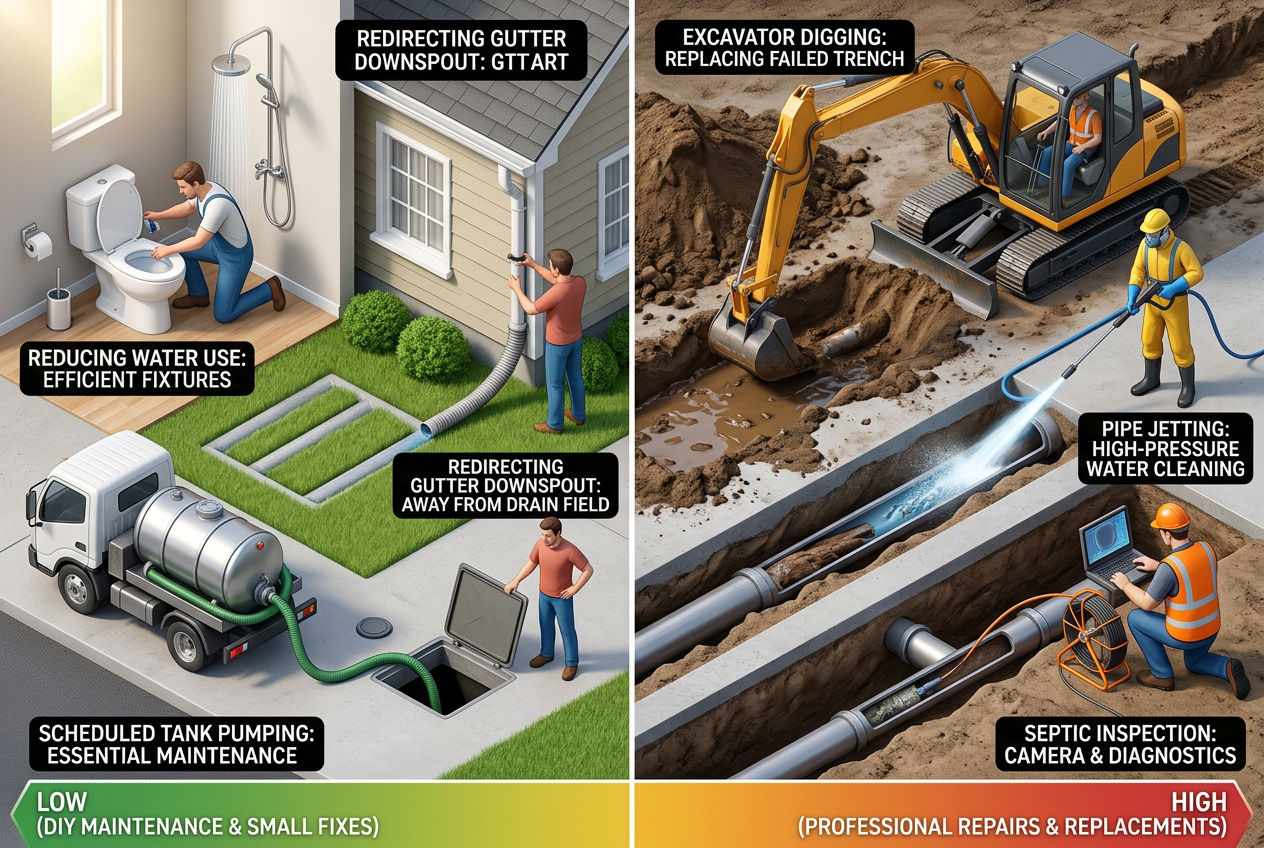
Before spending money on any repair, get a full septic inspection ($300-$500). The inspection identifies the root cause and prevents you from paying to fix the wrong thing. A drain field repair specialist can provide an accurate scope and cost estimate after diagnosis.
Pro Tip: If your drain field is showing early symptoms — slightly soggy ground, occasional odors — get your effluent filter cleaned and your tank pumped immediately. These two steps remove the most common cause (solids reaching the field) and give the field time to recover before damage becomes permanent. A $600 pump out now can prevent a $15,000 replacement later.
Sources & Methodology
EPA — A Homeowner's Guide to Septic Systems — Federal guidance on drain field maintenance, troubleshooting, and failure prevention
University of Minnesota Extension — Maintaining Your Septic System Drainfield — Research-based drain field diagnostics and root intrusion management
National Onsite Wastewater Recycling Association (NOWRA) — Professional standards for drain field inspection, repair, and replacement
Penn State Extension — Understanding Your Septic System — Soil percolation research and drain field troubleshooting for homeowners
SepticTankHub.com Internal Data — Drain field repair pricing and failure patterns from 4,200+ listed septic service companies
Free download
Not ready for the Handbook? Start with the free Fridge Card.
The Do / Don’t card the whole family can see, plus the Survival Kit: emergency flowchart, warning-sign decoder and pump-schedule card. One printable PDF.
Was this article helpful?
Frequently Asked Questions
Recommended Resources
📖 Related Articles
- What Is a Drain Field? (And How Does It Work?)
- Signs Your Drain Field Is Failing (And What to Do)
- How to Fix a Saturated Drain Field
- How Deep Should a Drain Field Be?
- Septic Tank Biomat: What It Is and When It's a Problem
- What Is a Distribution Box in a Septic System?
- How Often Should You Pump Your Septic Tank?
- Septic System Diagram: How Every Part Works (Labeled Guide)
- The Complete Septic Tank Maintenance Guide
- Septic Effluent Filters: Do You Need One?
💰 Cost Guides
🔧 Services
Find Septic Professionals Near You
Compare licensed, verified septic companies by area — top county markets and cities below, or browse all 50 states.
County markets
Popular cities
