
Quick Answer
A saturated drain field is one of the most stressful septic problems a homeowner can face. Sewage-scented standing water in your yard. Slow drains. A gurgling toilet at 7 a.m. These are the symptoms, and they're hard to ignore.
The good news: saturation doesn't always mean replacement. Many drain fields can be restored - if you catch the problem early and address the right cause. The bad news: some can't be saved, and wasting money on the wrong fix makes the situation worse.
This guide walks you through diagnosis, repair options in order of cost and complexity, and the decision every homeowner eventually faces: repair or replace.
💡 Key Takeaways
- Roughly 60–70% of all septic system failures originate in the drain field
- Pumping the septic tank ($300–$600) is always the first diagnostic step
- Biomat buildup, high water tables, and soil compaction are the three most common causes
- Targeted repairs cost $1,500–$5,000; full replacement runs $5,000–$20,000+
- A drain field that's never been properly maintained fails 3–5× faster than one that has
What Are the Signs of a Failing Drain Field?
A waterlogged drain field rarely fails silently. Most homeowners notice one or more of these warning signs weeks before the system completely stops functioning.
The most obvious is standing water or soggy ground directly above the drain field trenches - especially when it hasn't rained recently. That wet patch isn't a drainage fluke. It's effluent (partially treated wastewater) that has nowhere to go.
Common Warning Signs
- Slow drains throughout the house - not just one fixture, but all of them
- Sewage odors in the yard or near the drain field area
- Sewage backing up into the lowest fixtures in the house (floor drains, basement toilets)
- Unusually lush, green grass directly over the leach lines - nitrogen-rich effluent acts as fertilizer
- A gurgling sound in toilets after flushing, especially on the ground floor
⚠️ Warning: If you're seeing two or more of these symptoms, your drain field is likely saturated or failing. Don't wait for a complete system backup.
For a deeper breakdown of these warning signs, see our guide on signs your drain field is failing.
Why Is Your Drain Field Saturated? The 4 Main Causes
Before you spend a dime on repairs, you need to know why your drain field is waterlogged. The right fix depends entirely on the cause. Treating the wrong problem is how homeowners end up spending $3,000 on a bacterial treatment that does nothing.
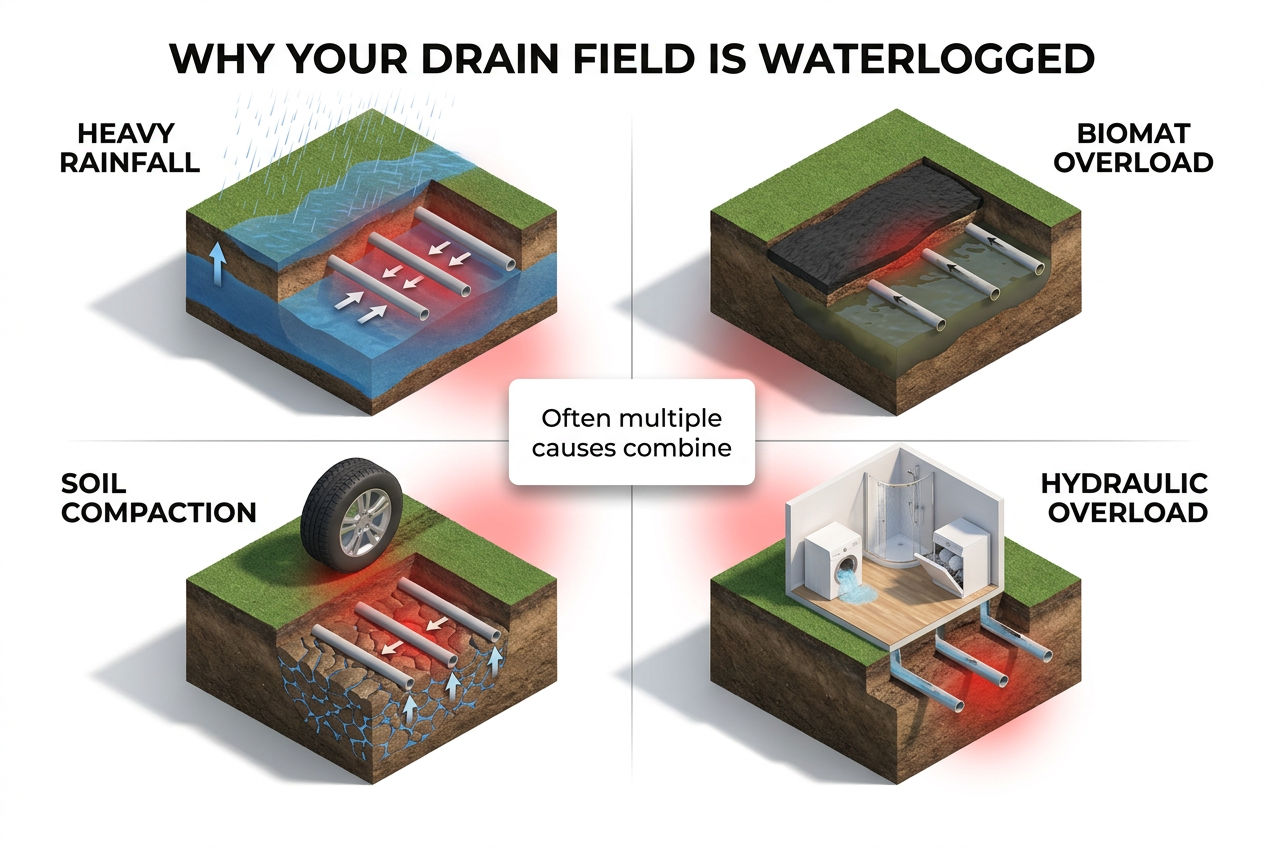
1. Biomat Buildup (Most Common)
A biomat is a layer of biological slime - composed of anaerobic bacteria, fats, and organic solids - that forms naturally along the walls and floor of your drain field trenches. A healthy biomat is actually normal. At roughly 1 inch thick, it slows effluent flow enough to allow treatment before it enters the soil.
The problem starts when the biomat exceeds 3–4 inches. At that point, it creates an impermeable barrier. Effluent can't absorb into the soil fast enough, so it backs up.
📊 Quick Fact: This almost always happens because the septic tank itself is overdue for pumping - solids overflow into the drain field and feed the biomat. Systems that are never pumped fail 3–5× faster, according to data from state cooperative extension programs.
2. High Water Table
Most local health codes require a minimum of 2–4 feet of separation between the bottom of the drain field trenches and the seasonal high water table. When that clearance disappears - from spring snowmelt, extended heavy rain, or a rising water table - groundwater essentially pushes back against the field. Effluent has nowhere to go.
This is especially common in Florida, the Gulf Coast, and the Pacific Northwest, where high water tables are a chronic condition rather than a seasonal one.
3. Soil Compaction or Failure
Soil needs adequate permeability to absorb effluent. The standard measure is the perc rate (percolation rate).
- Ideal soil: Absorbs about 1 inch of water per minute
- Failure-prone soil: Takes more than 60 minutes to absorb 1 inch
Heavy clay soils - extremely common in Ohio, Indiana, Michigan, and much of the Midwest - have naturally poor perc rates. If your drain field was installed in marginal soil, or if vehicles have been driven over it and compacted it over time (something to avoid - see can you drive over a drain field?), the soil absorption capacity may be permanently compromised.
4. Hydraulic Overload
Some drain fields aren't failing - they're just overwhelmed. A 3-bedroom home that adds a rental suite, a family member moves in long-term, or a guest visits for three weeks can push daily water usage well beyond what the system was designed to handle.
Most residential drain fields are sized for 60–75 gallons per person per day. Double the occupancy, and you can saturate a perfectly healthy field.
How to Fix a Saturated Drain Field: From Cheapest to Most Expensive
These repairs are organized by cost and invasiveness. Start with Step 1 regardless of what you suspect - it's diagnostic as much as it is a fix.

DIY Septic Blueprint
Thinking about building it yourself?
The complete, plain-English plan to size, permit and install your own septic system — designed for homeowners, not contractors. Skip the $15,000–$25,000 quotes and do it right the first time.
Get the DIY Blueprint — $67 →Instant download · 8 modules + 3 bonus guides · 60-day money-back guaranteeStep 1: Pump the Septic Tank ($300–$600)
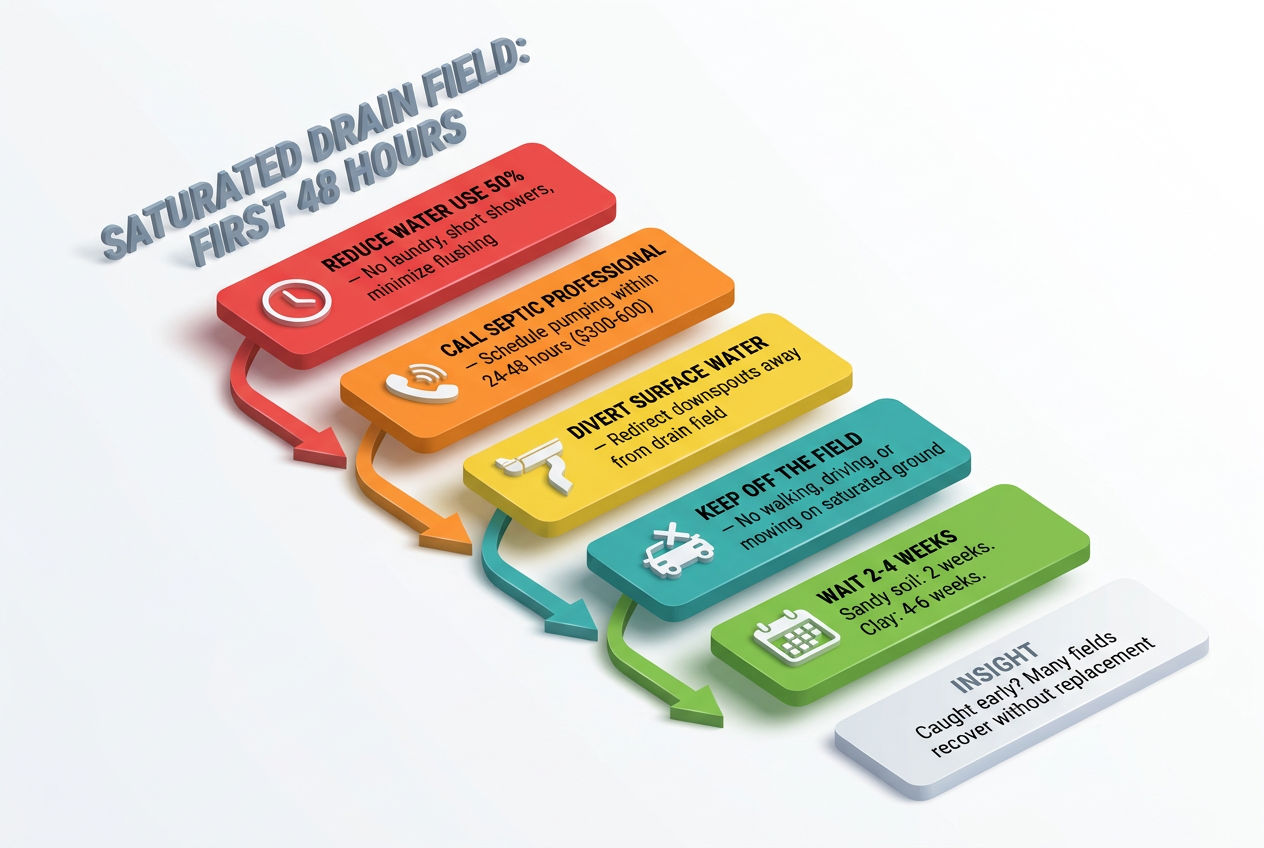
This is mandatory before anything else. A 1,000-gallon concrete tank serving a family of four should be pumped every 3–4 years. If it hasn't been pumped in 5+ years, solids have almost certainly overflowed into the drain field and are feeding biomat growth.
Pumping relieves hydraulic pressure on the drain field immediately, and a good pumper will inspect the baffles, effluent filter (components like the Polylok PL-122 or Sim/Tech STF-100 are common), and distribution box while they're on-site. That inspection can tell you a lot about what's happening downstream.
✅ Pro Tip: Get your septic tank pumped before you spend money on anything else. If you're not sure when it was last done, check out our guide on how often to pump your septic tank.
Step 2: Reduce Hydraulic Load (Free)
While the system recovers, cut your household water use aggressively.
Immediate water conservation steps:
- Fix any leaking toilets (a running toilet can dump 200+ gallons per day into the system)
- Spread laundry loads across the week instead of doing five loads on Saturday
- Install low-flow showerheads
- Take shorter showers
- Run dishwasher only when full
This isn't a permanent fix, but it gives the drain field a chance to dry out - which it needs before any restoration technique will work effectively.
Step 3: Bacterial/Enzyme Shock Treatment ($50–$200)
Products like Rid-X, BioOne, or Septic Drainer claim to break down biomat and restore soil permeability. They work by introducing high concentrations of aerobic bacteria and enzymes into the system.
Here's the honest assessment: these products can help in mild cases of biomat buildup, but they are not a cure for a seriously failing drain field. University of Arkansas Extension research has found that bacterial additives don't eliminate the need for pumping and won't reverse severe soil clogging. If your biomat has exceeded 3 inches and your soil is already impermeable, a $100 bottle of bacteria won't fix it.
💡 Key Takeaway: As a supplement to pumping and reduced water use in early-stage saturation? They're worth trying at that price point.
For a deeper look at which products actually work, see our best septic tank treatments guide.
Step 4: Septic Field Aeration / Terralift ($1,000–$3,000)
Terralift is a pneumatic soil fracturing process. A technician drives a probe 4–6 feet into the ground near the leach laterals and injects compressed air in short bursts, fracturing the compacted soil and biomat. Polystyrene beads are then injected to hold the fractures open. The goal is to restore soil permeability without excavation.
When Terralift works best:
- Soil compaction issues
- Moderate biomat buildup
- Structurally sound soil
When Terralift doesn't work:
- Heavy clay with no structure
- High water table as primary issue
- Severely failed soil
⚠️ Warning: Ask any contractor quoting you this service for local references - specifically, outcomes in your soil type.
Step 5: Install a Curtain Drain or French Drain ($1,000–$4,000)
If a high water table or surface water runoff is the problem rather than the drain field itself, water diversion may solve it. A curtain drain (also called an interceptor drain) is a perforated pipe installed uphill from the drain field in a gravel-filled trench. It intercepts groundwater before it saturates the field and redirects it away from the system.
This is a legitimate engineered fix - not a band-aid. In the Pacific Northwest and the Southeast, where seasonal high water tables are a chronic problem, curtain drains extend drain field life significantly. Installation requires a licensed contractor and, in most jurisdictions, a permit.
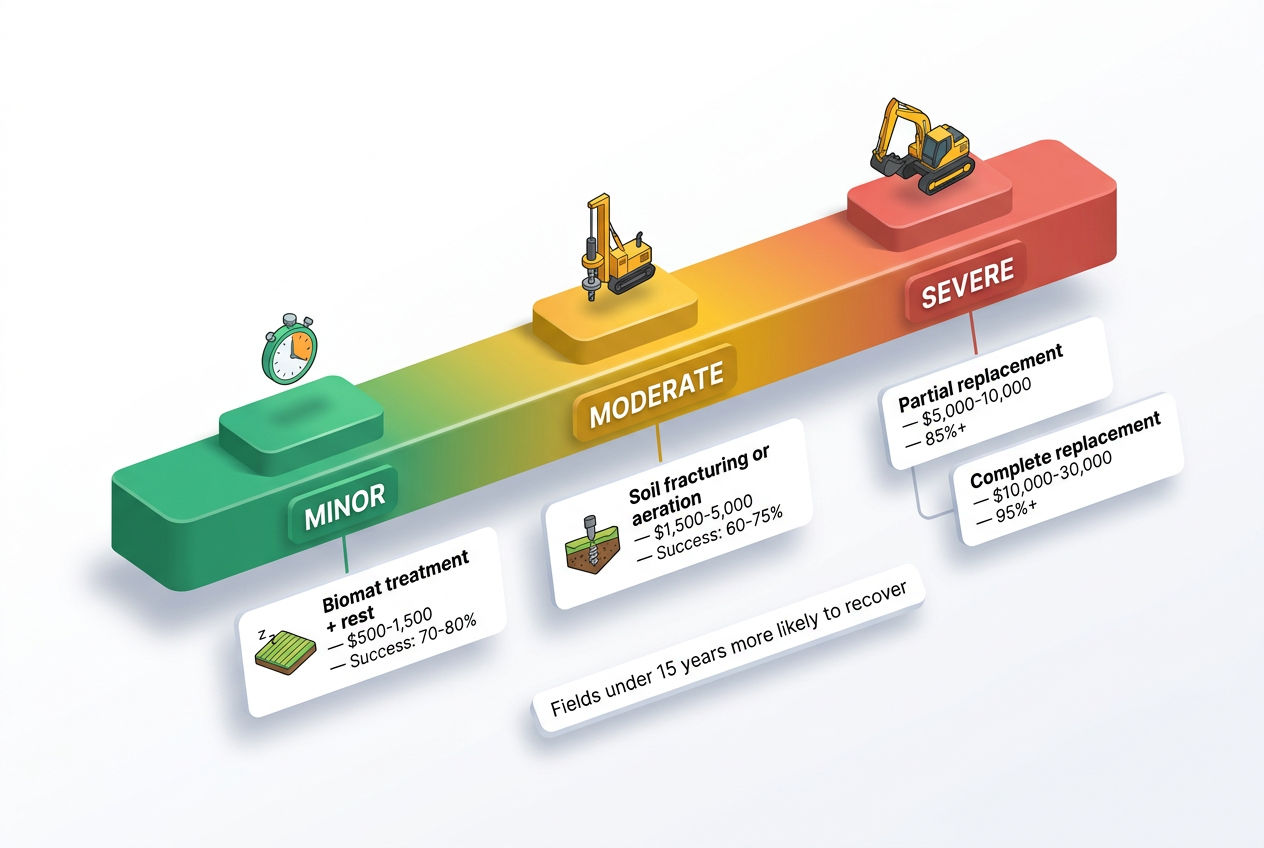
Step 6: Lateral Line Repair or Partial Replacement ($1,500–$5,000)
If the distribution box has failed, one lateral line is crushed or collapsed, or the inlet/outlet baffles have deteriorated (common in older concrete tanks), you may be able to repair only the damaged section rather than replacing the entire field. A camera inspection of the lateral lines - which many contractors now offer - can identify specific failures precisely.
- When it works: The field itself is intact and the problem is localized
- When it doesn't: The soil throughout the field has failed
Step 7: Full Drain Field Replacement ($5,000–$20,000+)
When the soil is permanently failed, the field is undersized, or repairs have been attempted without success, replacement is the answer.
Typical replacement costs:
- Conventional gravity drain field (3-bedroom home): $5,000–$10,000
- Mound system (required when soil depth or water table prohibits conventional): $10,000–$20,000+
Full replacement requires a permit, a licensed septic contractor, and in most states, a new perc test. You'll also need a permit from your local health department. In Florida, that's through the Department of Health under Chapter 64E-6, Florida Administrative Code. In Texas, county-level oversight applies - the rules vary by county, and some rural counties have minimal enforcement.
For current replacement pricing in your area, see our drain field replacement cost guide.
Repair Cost Comparison
| Repair Option | Typical Cost | Best For | Success Rate |
|---|---|---|---|
| Septic tank pump-out | $300–$600 | First step, all causes | High (diagnostic) |
| Bacterial shock treatment | $50–$200 | Mild biomat, early-stage | Low–Moderate |
| Terralift / aeration | $1,000–$3,000 | Compaction, moderate biomat | Moderate |
| Curtain / French drain | $1,000–$4,000 | High water table, surface runoff | High (right cause) |
| Lateral line repair | $1,500–$5,000 | Isolated damage, intact soil | High (if localized) |
| Full replacement | $5,000–$20,000+ | Soil failure, undersized field | Very High |
Cost data reflects 2025 national averages. Regional variation is significant - Southeast and rural markets typically run 15–25% below Northeast and Pacific Northwest rates. Source: NOWRA contractor survey data and SepticTankHub cost research.
Can a Saturated Drain Field Fix Itself?
Technically, yes - temporarily. A waterlogged drain field will sometimes recover on its own after a prolonged dry period, particularly in spring-saturated fields where high water tables drop as summer arrives. You'll see the standing water disappear, drains flow normally again, and it'll feel like the problem solved itself.
It didn't. The underlying cause is still there:
- Biomat doesn't shrink when the field dries out
- Perc rates don't improve in clay soil after one dry summer
- The water table will rise again next spring
⚠️ Warning: Treating "it dried out" as a fix is how homeowners end up with a total drain field failure two years later, usually when the timing is worst - right before selling the house, or in October when contractors are booked solid.
If your field recovered on its own, use the dry season to diagnose and address the root cause.
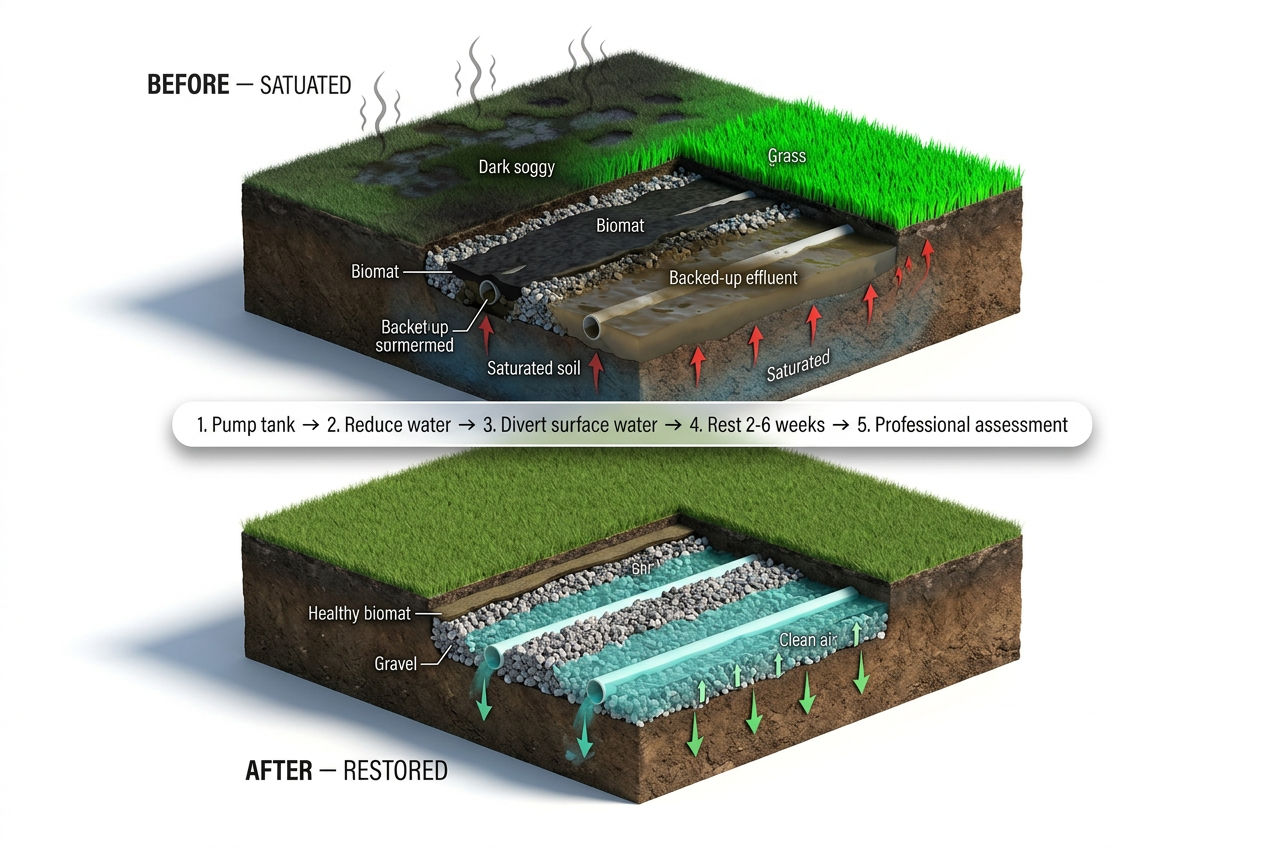
Will a Flooded Drain Field Dry Out on Its Own?
A field that's flooded due to seasonal high water table will typically dry out as summer progresses and the water table drops. This can take 4–8 weeks in typical Midwest or Northeast conditions. A field that's flooded because of biomat buildup will not dry out - the biomat is blocking absorption regardless of season.
The distinction matters for repair timing. Summer is the best time to repair or replace a drain field. Dry soil conditions make excavation easier, contractors have better access, and the field has the maximum drying period before the next wet season. In northern states, frozen ground makes repairs impossible from November through March - emergency situations excepted, at significant additional cost.
Should You Repair or Replace? A Practical Framework
Picture this: You're selling your home and the buyer's inspector flags your drain field as saturated. You have 30 days to close. Do you repair or replace?
Here's a practical decision framework:
Repair makes sense when:
- The drain field is less than 15 years old
- The problem is clearly isolated (one failed lateral, biomat from infrequent pumping)
- The soil perc rate was good at original installation
- The saturation is seasonal and linked to a high water table
Replacement is the better call when:
- The field is 20+ years old and has never been properly maintained
- Multiple repair attempts have failed
- Perc tests show fundamentally poor soil absorption
- The system was undersized for your actual household size
- Local codes have changed and the existing system is grandfathered but non-compliant
📊 Quick Fact: A drain field installed correctly in good soil, pumped every 3–5 years as the EPA recommends, typically lasts 15–25 years. One that's been neglected or is sited in marginal soil may fail in 8–10 years.
The average drain field lifespan is a useful benchmark - but local conditions matter more than the average.
Does Your Fix Depend on Where You Live?
Absolutely. Soil type and climate change everything about which repairs work and what they cost.
Florida and the Gulf Coast
High water tables are a chronic condition, not a spring event. Conventional gravity drain fields often can't maintain the required 2-foot separation from the water table. Aerobic treatment units (ATUs) and mound systems are more common here, and saturation is frequently a water-table problem, not a biomat problem.
Midwest (Ohio, Indiana, Michigan)
Heavy clay soils dominate. Perc rates in clay can exceed 60 minutes per inch, well below functional thresholds. Terralift has mixed results in dense clay. A full replacement with an engineered system (chamber systems like Infiltrator Water Technologies' Quick4 Plus are popular here) is often the right long-term answer.
Pacific Northwest
The October-through-May rainy season creates prolonged saturation. Curtain drains are frequently the most effective intervention because the field itself is often fine - it's just overwhelmed by surface water infiltration and a temporarily high water table.
✅ Pro Tip: This regional variation is exactly why online advice only goes so far. A licensed local contractor who has worked in your soil type is worth consulting before committing to any repair strategy.
Find a septic professional near you through SepticTankHub's directory.
Learn more about our drain field services services.
Related reading: septic system installation process.
Sources & Methodology
EPA Septic Systems Overview: Core guidance on drain field maintenance intervals, household sizing, and system types.
National Onsite Wastewater Recycling Association (NOWRA): Contractor cost data and regional repair benchmarks.
National Association of Wastewater Technicians (NAWT): Professional standards for septic inspection and diagnosis.
University of Arkansas Cooperative Extension Service - Research on bacterial additive efficacy in residential septic systems. Referenced by institution name.
Florida Department of Health, Chapter 64E-6 - State-level regulatory requirements for septic system permitting and contractor licensing. Referenced by regulation name.
Cost ranges reflect contractor data and homeowner-reported costs compiled by SepticTankHub researchers in 2024–2025. Regional averages are based on a minimum of 50 contractor quotes per region.
About the Author: This article was written by the SepticTankHub editorial team and reviewed for technical accuracy by a licensed septic system contractor with 15+ years of field experience in drain field diagnosis and repair.
Need help with your septic system? Browse local septic companies in Michigan or Pennsylvania.
Free download
Not ready for the Blueprint? Start free.
Grab the free DIY Septic Planning Kit — the permit-first checklist, perc-test cheat sheet, and sizing tables that keep your build from getting red-tagged.
Was this article helpful?
Frequently Asked Questions
Recommended Resources
📖 Related Articles
💰 Cost Guides
🔧 Services
Find Septic Professionals Near You
Compare licensed, verified septic companies by area — top county markets and cities below, or browse all 50 states.
County markets
Popular cities
